anaheim-gazette 1933-08-17
Scanned page
Searchable text
THE ANAHEIM GAZETTE
HENRY KUCHEL, Editor and Publisher
ESTABLISHED 1870
ISSUED EVERY THURSDAY
SUBSCRIPTION PER YEAR ... $2.00
SIX MONTHS ... $1.00
Entered at the Anaheim, California Postoffice as second-class matter.
THE WORLD WHEAT PROBLEM
One of the results of the world-wide depression has been the effort on the part of every civilized nation in the world to become as self-sufficient as possible. During the World War there was a tremendous increase in the production of raw materials. Following the war there was a decrease in demand but a continuation of high production. Each nation had learned to depend so far as possible on itself during the war and afterward decided to continue the process. The result was the erection of tariff barriers and an acceleration of the move toward self-sufficiency. The depression only increased this tendency.
The story of wheat production furnishes an outstanding example. There is a world surplus of wheat and no nation seems to need it or to want it. Nations of Europe have increased their wheat production until a great many who used to depend on the United States, Canada and Australia for their wheat now raise their own. Italy is one example. It was formerly a big importer of wheat, but through the efforts of Mussolini to make the nation self-sufficient, it now raises practically enough wheat to supply its own people.
Wheat authorities tell us that the consumption of wheat has held fairly constant over a number of years. The nations which formerly exported large surpluses of wheat have actually cut down their acreage. But the surplus remains because the nations which formerly imported the wheat are now, as far as possible, growing their own.
The lesson so far as the United States is concerned is very
United States, Canada and Australia for their own. Italy is one example. It was formerly a big importer of wheat, but through the efforts of Mussolini to make the nation self-sufficient, it now raises practically enough wheat to supply its own people.
Wheat authorities tell us that the consumption of wheat has held fairly constant over a number of years. The nations which formerly exported large surpluses of wheat have actually cut down their acreage. But the surplus remains because the nations which formerly imported the wheat are now, as far as possible, growing their own.
The lesson so far as the United States is concerned is very plain. Our country will never again be the big wheat exporter that it once was. With the wheat importing nations trying to far as possible to raise their own grain, stimulating production through prohibitive tariffs and in other ways, the world markets have decreased considerably. And even if there was a big world market for wheat, it is equally plain that Uncle Sam’s product could not compete with the cheaply grown wheat of Canada, Australia and the Argentine. Where, therefore, are we going to get an increased outlet for our wheat? It is plain to see that the market must be found here in the United States. As general employment increases and times get better, as unemployment decreases and our purchasing power becomes greater, the American people will be consuming more wheat on their own. Here is where we may increase the market for our wheat. This increase in demand, and the curtailment of production seem to offer the best solution to Uncle Sam’s wheat problem.
It is plain therefore that we cannot dispose of our wheat surplus abroad, by lowering our tariffs and so letting in a flood of cheap foreign goods in the vain hope that Europeans and Asiatics will in turn buy our wheat. This will only destroy the American market for the American farmer’s wheat, while the European will continue to buy wheat where he can get it the cheapest, and that certainly is not in the United States.
An Indiana University professor after a half hour’s talk with a bandit induces the robber to return over $5,500 stolen in a bank holdup. That professor is certainly entitled to membership in the brain trust.
COMPARATIVE WAGES
We are hearing a great deal nowadays about the increase in wages in the United States through application of the national recovery act. This is all well and good, and is something which every real American favors wherever it is possible. Our economic system has been builted on the theory of high wages. We have felt that our best market, as producers, is the great American home market which consumes over ninety per cent of what we raise and manufacture. And following the line of thought we have believed that the way to increase our home market was to pay high wages so that the American people could buy more of the things which they themselves produce. Certainly there is nothing difficult to comprehend in this logic. And in order that our men should be assured of steady employment at high wages we have generally protected our American industry by a tariff which has equalized the cost of living at home and abroad.
In this respect it is interesting to note the comparative wages today of the United States workers and those in other countries. The general average of approximate wages paid in the United States and other countries as compiled from Department of Labor and National Industrial Conference reports discloses some inter-
have believed that the way to increase our home market was to pay high wages so that the American people could buy more of the things which they themselves produce. Certainly there is nothing difficult to comprehend in this logic. And in order that our men should be assured of steady employment at high wages we have generally protected our American industry by a tariff which has equalized the cost of living at home and abroad.
In this respect it is interesting to note the comparative wages today of the United States workers and those in other countries. The general average of approximate wages paid in the United States and other countries as compiled from Department of Labor and National Industrial Conference reports discloses some interesting comparisons. Here is what the figures show about the average labor costs that enter into the production of foreign-made goods as compared with average labor costs in the United States:
United States ... $26.50 per week
England ... 11.37 per week
Sweden ... 19.20 per week
Germany ... 9.02 per week
France ... 7.25 per week
Belgium ... 6.21 per week
Japan ... 5.47 per week
Hungary ... 5.08 per week
China ... 1.31 per week
Certainly we want to increase wages further, and above all to increase the number of those employed. We cannot do this, and will be unable to raise the American standard of living or even to maintain it at the present level unless we maintain a tariff which will keep out a flood of foreign goods from countries which still go along on the theory of cheap production and the lowest possible living standards for the workers.
The administration, now in the process of raising domestic production costs, and thereby selling costs; to a higher level (in fact some of the prices have already been raised 100 per cent), must begin to think about increasing our tariff rates instead of lowering them, if the machinery of the general recovery program is to hit on all cogs.
The summer of 1933 has been so fickle so far this year that it is necessary to have both an electric fan and a fireplace filled with kindling in the living room.
The really successful wife is the one who greets her husband with a hearty meal instead of a lecture when he comes home.
Primo Carnero, the heavyweight boxing champion, wears a size 21 shoe. No wonder it is so hard to knock him off his feet.
Walter Runciman declared that his public work scheme them not to be such unremunerative of a ed that "the scheme shall not reopen them abandoned them on the vigorous support Prime Minister Ben
Mr. Runciman's view of the fact that ever since the close study the problem Americans are restoring employment to insist that the most handicap our people might throttle sourc We have heard balancing, and red that the money put retrenchment, is no pocket.
When it comes drought and an armenian economists.
It is said that But it is a good bekers for a Europea
They have a law the court to order says that the New
After all, it often Take the 1933 bath
One time when suits.
It used to be the bank cashier.
ANAHEIM GAZETTE
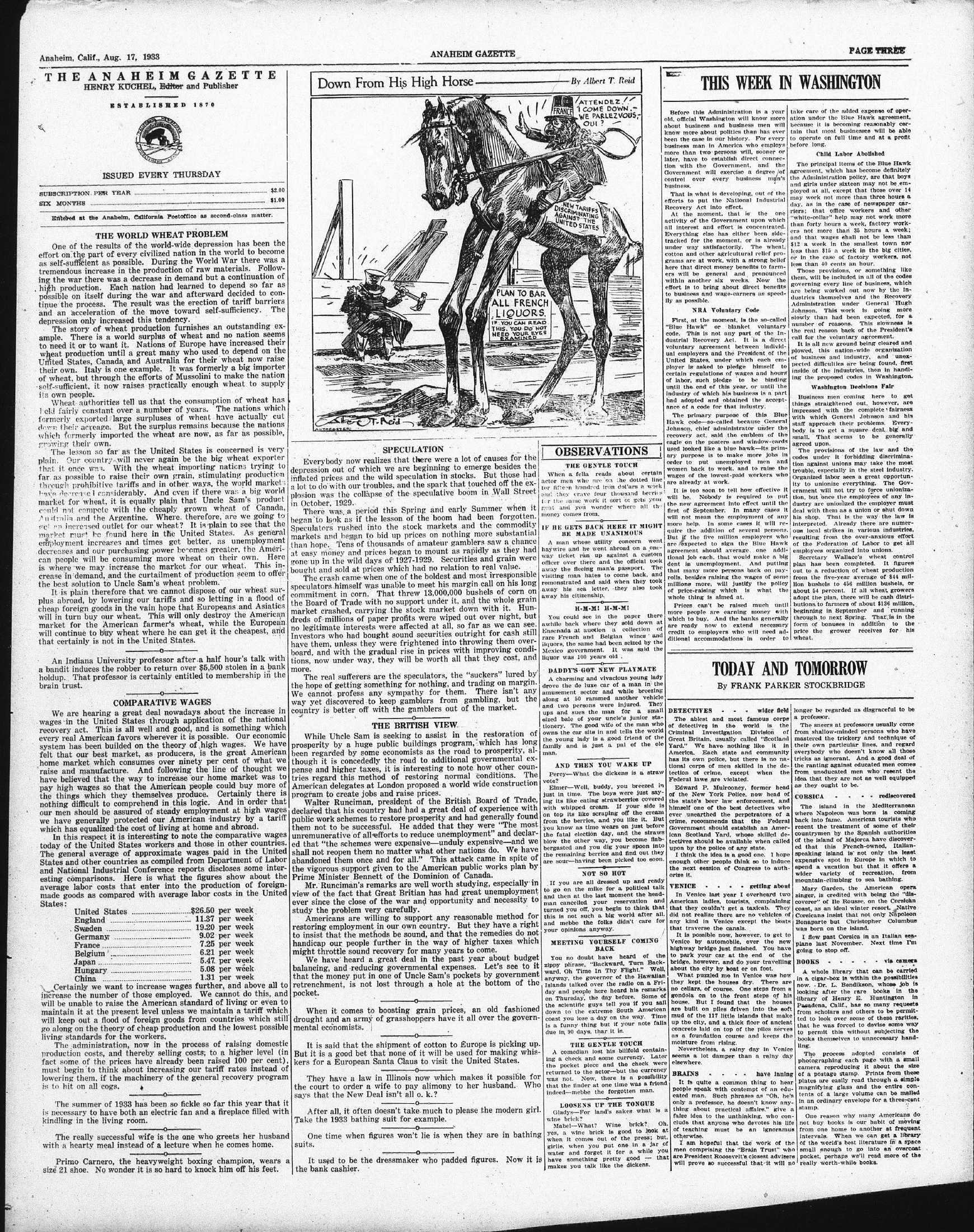
Down From His High Horse — By Albert T. Reid
ATTENDEZ! I COME DOWN, WE PARLEZVOUS, OUI?
NEW TARIFFS DISCRIMINATING THE UNITED STATES
PLAN TO BAR ALL FRENCH LIQUORS.
IF YOU CAN READ THIS, YOU DO NOT NEED YOUR EYES EXAMINED
SPECULATION
OBSERVATIONS
SPECULATION
Everybody now realizes that there were a lot of causes for the depression out of which we are beginning to emerge besides the inflated prices and the wild speculation in stocks. But those had a lot to do with our troubles, and the spark that touched off the explosion was the collapse of the speculative boom in Wall Street in October, 1929.
There was a period this Spring and early Summer when it began to look as if the lesson of the boom had been forgotten. Speculators rushed into the stock markets and the commodity markets and began to bid up prices on nothing more substantial than hope. Tens of thousands of amateur gamblers saw a chance at easy money and prices began to mount as rapidly as they had gone up in the wild days of 1927-1929. Securities and grain were bought and sold at prices which had no relation to real value.
The crash came when one of the boldest and most irresponsible speculators himself was unable to meet his margin call on his long commitment in corn. That threw 13,000,000 bushels of corn on the Board of Trade with no support under it, and the whole grain market crashed, carrying the stock market down with it. Hundreds of millions of paper profits were wiped out over night, but no legitimate interests were affected at all, so far as we can see. Investors who had bought sound securities outright for cash still have them, unless they were frightened into throwing them overboard, and with the gradual rise in prices with improving conditions, now under way, they will be worth all that they cost, and more.
The real sufferers are the speculators, the "suckers" lured by the hope of getting something for nothing, and trading on margin. We cannot profess any sympathy for them. There isn't any way yet discovered to keep gamblers from gambling, but the country is better off with the gamblers out of the market.
THE BRITISH VIEW
While Uncle Sam is seeking to assist in the restoration of prosperity by a huge public buildings program, which has long been regarded by some economists as the road to prosperity, although it is concededly the road to additional governmental expense and higher taxes, it is interesting to note how other countries regard this method of restoring normal conditions. The American delegates at London proposed a world wide construction program to create jobs and raise prices.
Walter Runciman, president of the British Board of Trade, declared that his country had had a great deal of experience with public work schemes to restore prosperity and had generally found them not to be successful. He added that they were "The most unremunerative of all efforts to reduce unemployment" and declared that "the schemes were expensive—unduly expensive—and we shall not reopen them no matter what other nations do. We have abandoned them once and for all." This attack came in spite of the vigorous support given to the American public works plan by
OBSERVATIONS
THE GENTLE TOUCH
When a fella reads about certain actor men who are on the dotted line for fifteen hundred iron dollars a week and they crave four thousand berrits for the same work it sort or gets your great and you wonder where all the money comes from.
IF HE GETS BACK HERE IT MIGHT BE MADE UNANIMOUS
A man whose utility concern went haywire and he went abroad on a one-way ticket ran up against a custom officer over there and the official took away the fleeing man's passport. The visiting man hates to come back, and remonstrated and said when they took away his sea letter, they also took away his citizenship.
H·M·M! H·M·M!
You could see in the paper there awhile back where they sold down at Ensenada at auction a collection of rare French and Belgian wines and liquors, the same had been seized by the Mexico government. It was said the liquor was 100 years old.
DADDY'S GOT NEW PLAYMATE
A charming and vivacious young lady drove the de luxe car of a man in the amusement sector and while breezing along at 50 rammed another vehicle and two persons were injured. They ups and sues the man for a small sized bale of your uncle's junior stationery. The good wife of the man who owns the car sits in and tells the world the young lady is a good friend of the family and is just a pal of the ole man.
AND THEN YOU WAKE UP
Percy—What the Dickens is a straw vote?
Elmer—Well, buddy, you breezed in just in time. The boys were just saying its like eating strawberries covered with whipped cream. If your side is on top its like scraping off the cream from the berries, and you like it. But you know as time wears on just before the fatal election day, and the straws blow the other way, you become flabbergasted and you dig your spoon into the remaining berries and find out they are sour—having been picked too soon.
tries regard this method of restoring normal conditions. The American delegates at London proposed a world wide construction program to create jobs and raise prices.
Walter Runciman, president of the British Board of Trade, declared that his country had had a great deal of experience with public work schemes to restore prosperity and had generally found them not to be successful. He added that they were "The most unremunerative of all efforts to reduce unemployment" and declared that "the schemes were expensive—unduly expensive—and we shall not reopen them no matter what other nations do. We have abandoned them once and for all." This attack came in spite of the vigorous support given to the American public works plan by Prime Minister Bennett of the Dominion of Canada.
Mr. Runciman's remarks are well worth studying, especially in view of the fact that Great Britian has had great unemployment ever since the close of the war and opportunity and necessity to study the problem very carefully.
Americans are willing to support any reasonable method for restoring employment in our own country. But they have a right to insist that the methods be sound, and that the remedies do not handicap our people further in the way of higher taxes which might throttle sound recovery for many years to come.
We have heard a great deal in the past year about budget balancing, and reducing governmental expenses. Let’s see to it that the money put in one of Uncle Sam’s pockets by government retrenchment, is not lost through a hole at the bottom of the pocket.
When it comes to boosting grain prices, an old fashioned drought and an army of grasshoppers have it all over the governmental economists.
It is said that the shipment of cotton to Europe is picking up. But it is a good bet that none of it will be used for making whiskers for a European Santa Claus to visit the United States.
They have a law in Illinois now which makes it possible for the court to order a wife to pay alimony to her husband. Who says that the New Deal isn’t all o. k.?
After all, it often doesn’t take much to please the modern girl. Take the 1933 bathing suit for example.
One time when figures won’t lie is when they are in bathing suits.
It used to be the dressmaker who padded figures. Now it is the bank cashier.
Percy—What the dickens is a straw vote?
Elmer—Well, buddy, you breezed in just in time. The boys were just saying its like eating strawberries covered with whipped cream. If your side is on top its like scraping off the cream from the berries, and you like it. But you know as time wears on just before the fatal election day, and the straws blow the other way, you become flabbergasted and you dig your spoon into the remaining berries and find out they are sour—having been picked too soon.
NOT SO HOT
If you are all dressed up and ready to go on the mike for a political talk and then at the last moment the headman cancelled your reservation and turned you off, you begin to think that this is not such a big world after all, and mebbe the folks didn't care for your opinions anyway.
MEETING YOURSELF COMING BACK
You no doubt have heard of the zippy phrase, "Backward, Turn Backward, Oh Time In Thy Flight." Well, anyway, the governor of the Hawaiian Islands talked over the radio on a Friday and people here heard his remarks on Thursday, the day before. Some of the scientific guys tell you if you sail down to the extreme South American coast you lose a day on the way. Time is a funny thing but if your note falls due in 90 days, thar it is.
THE GENTLE TOUCH
A comedian lost his billfold containing a check and some currency. Later the pocket piece and the check were returned to the actor—but the currency was not. Now, there is a possibility that the finder at one time was a friend indeed—mebbe the forgotten man.
LOOSENS UP THE TONGUE
Gladys—For land's sakes what is a wine brick?
Mabel—What? Wine brick? Oh, yes, a wine brick is good to look at when it comes out of the press; but, girlie, when you put one in a jar of water and forget it for a while you have something pretty good — that makes you talk like the dickens.
THIS WEEK IN WASHINGTON
Before this Administration is a year old, official Washington will know more about business and business men will know more about politics than has ever been the case in our history. For every business man in America who employs more than two persons will, sooner or later, have to establish direct connection with the Government, and the Government will exercise a degree of control over every business man's business.
That is what is developing, out of the efforts to put the National Industrial Recovery Act into effect.
At the moment, that is the one activity of the Government upon which all interest and effort is concentrated. Everything else has either been side-tracked for the moment, or is already under way satisfactorily. The wheat, cotton and other agricultural relief programs are at work, with a strong belief here that direct money benefits to farmers will be general and pronounced within another six weeks. Now the effort is to bring about direct benefits to business and wage-earners as speedily as possible.
NRA Voluntary Code
First, at the moment, is the so-called "Blue Hawk" or blanket voluntary code. This is not any part of the Industrial Recovery Act. It is a direct voluntary agreement between individual employers and the President of the United States, under which each employer is asked to pledge himself to certain regulations of wages and hours of labor, such pledge to be binding until the end of this year, or until the industry of which his business is a part had adopted and obtained the acceptance of a code for that industry.
The primary purpose of this Blue Hawk code—so-called because General Johnson, chief administrator under the recovery act, said the emblem of the eagle on the posters and window-cards used looked like a blue hawk—its primary purpose is to make more jobs in take care of the added expense of operation under the Blue Hawk agreement, because it is becoming reasonably certain that most businesses will be able to operate on full time and at a profit before long.
Child Labor Abolished
The principal items of the Blue Hawk agreement, which has become definitely the Administration policy, are that boys and girls under sixteen may not be employed at all, except that those over 14 may work not more than three hours a day, as in the case of newspaper carriers; that office workers and other "white-collar" help may not work more than forty hours a week, factory workers not more than 35 hours a week; and that wages shall not be less than $12 a week in the smallest town nor less than $15 a week in the big cities, or in the case of factory workers, not less than 40 cents an hour.
Those provisions, or something like them, will be included in all of the codes governing every line of business, which are being worked out now by the industries themselves and the Recovery Administration under General Hugh Johnson. This work is going more slowly than had been expected, for a number of reasons. This slowness is the real reason back of the President's call for the voluntary agreement.
It is all new ground being cleared and plowed, this nation-wide organization of business and industry, and unexpected difficulties are being found, first inside of the industries, then in handling the proposed codes in Washington.
Washington Decisions Fair
Business men coming here to get things straightened out, however, are impressed with the complete fairness with which General Johnson and his staff approach their problems. Everybody is to get a square deal, big and small. That seems to be generally agreed upon.
The provisions of the law and the codes under it forbidding discrimina-
TODAY AND TOMORROW
By FRANK PARKER STOCKBRIDGE
DETECTIVES . . wider field
The ablest and most famous corps of detectives in the world is the Criminal Investigation Division of Great Britain, usually called "Scotland Yard." We have nothing like it in America. Each state and community has its own police, but there is no national corps of men skilled in the detection of crime, except when the Federal laws are violated.
Edward P. Mulrooney, former head of the New York Police, now head of the state's beer law enforcement, and himself one of the best detectives who ever unearthed the perpetrators of a crime, recommends that the Federal Government should establish an American Scotland Yard, whose skilled detectives should be available when called upon by the police of any state.
I think the idea is a good one. I hope enough other people think so to induce the next session of Congress to authorize be regarded as disgraceful to be a professor.
The sneers at professors usually come from shallow-minded persons who have mastered the trickery and technique of their own particular lines, and regard everybody who doesn't know all those tricks as ignorant. And a good deal of the ranting against educated men comes from uneducated men who resent the idea that they are not as well equipped as they ought to be.
CORSICA . . rediscovered
The island in the Mediterranean where Napoleon was born is coming back into fame. American tourists who resent the treatment of some of their countrymen by the Spanish authorities of the island of Majorca have discovered that this French-owned, Italian-speaking island is not only the least expensive spot in Europe in which to spend a vacation but that it offers a
HOT
passed up and ready
for a political talk
moment the headreservation and
begin to think that
big world after all,
has didn't care for
any.
SELF COMING
BOK
he heard of the
ward, Turn Backly Flight." Well,
wor of the Hawaiian
one radio on a Frineard his remarks
by before. Some of
well you if you sail
the South American
on the way. Time
if your note falls
it is.
LE TOUCH
this billfold containthe currency. Later
and the check were
but the currency
there is a possibility
time was a friend
forgotten man.
THE TONGUE
is sakes what is a
Vine brick? Oh,
is good to look at
of the press; but,
but one in a jar of
for a while you
petty good — that
in the dickens.
Edward P. Mulrooney, former head of the New York Police, now head of the state's beer law enforcement, and himself one of the best detectives who ever unearthed the perpetrators of a crime, recommends that the Federal Government should establish an American Scotland Yard, whose skilled detectives should be available when called upon by the police of any state.
I think the idea is a good one. I hope enough other people think so to induce the next session of Congress to authorize it.
VENICE . . . getting about
In Venice last year I overheard two American ladies, tourists, complaining that they couldn't get a taxicab. They did not realize there are no vehicles of any kind in Venice except the boats that traverse the canals.
It is possible now, however, to get to Venice by automobile, over the new highway bridge just finished. You have to park your car at the end of the bridge, however, and do your travelling about the city by boat or on foot.
What puzzled me in Venice was how they kept the houses dry. There are no cellars, of course. One steps from a gondola on to the front steps of his house. But I found that the houses are built on piles driven into the soft mud of the 117 little islands that make up the city, and a thick floor of ancient concrete laid on top of the piles serves as a foundation course and keeps the moisture from rising.
Nevertheless, a rainy day in Venice seems a lot damper than a rainy day elsewhere.
BRAINS . . . have inning
It is quite a common thing to hear people speak with contempt of an educated man. Such phrases as "Oh, he's only a professor, he doesn't know anything about practical affairs," give a false idea to the unthinking, who conclude that anyone who devotes his life of teaching must be an ignoramus otherwise.
I am hopeful that the work of the men comprising the "Brain Trust" who are President Roosevelt's closest advisers will prove so successful that it will no
CORSICA . . . rediscovered
The island in the Mediterranean where Napoleon was born is coming back into fame. American tourists who resent the treatment of some of their countrymen by the Spanish authorities of the island of Majorca have discovered that this French-owned, Italian-speaking island is not only the least expensive spot in Europe in which to spend a vacation but that it offers a wider variety of recreation, from mountain-climbing to sea bathing.
Mary Garden, the American opera singer, is credited with being the "discoverer" of Ile Rousse, on the Corsican coast, as an ideal winter resort. Native Corsicans insist that not only Napoleon Bonaparte but Christopher Columbus was born on the island.
I flew past Corsica in an Italian seaplane last November. Next time I'm going to stop off.
BOOKS . . . via camera
A whole library that can be carried in a cigar-box is within the possibilities now. Dr. L. Bendikson, whose job is looking after the rare books in the library of Henry E. Huntington in Pagadena, Calif., has so many requests from scholars and others to be permitted to look over some of these rarities, that he was forced to devise some way to permit this without subjecting the books themselves to unnecessary handling.
The process adopted consists of photographing each page with a small camera reproducing it about the size of a postage stamp. Prints from these plates are easily read through a simple magnifying glass and the entire contents of a large volume can be mailed in an ordinary envelope for a three-cent stamp.
One reason why many Americans do not buy books is our habit of moving from one home to another at frequent intervals. When we can get a library of the world's best literature in a space small enough to go into an overcoat pocket, perhaps we'll read more of the really worth-while books.