anaheim-gazette 1933-08-10
Scanned page
Searchable text
THE ANAHEIM GAZETTE
HENKY KÜCHEL, Editor and Publisher
ESTABLISHED 1870
ISSUED EVERY THURSDAY
SUBSCRIPTION PER YEAR ... $2.00
SIX MONTHS ... $1.00
Entered at the Anaheim, California Postoffice as second-class matter.
THIS IS A FLYING YEAR
Perhaps the time is not so far distant, after all, when people going to Europe will go by airplane if they are in a hurry. It seems almost certain that it won't be long now before mail matter will be carried across the ocean in a day or so, so fast and far has aviation proved itself.
Look at what has been going on in the air in the past few weeks. Here we have Lindbergh and his brave young wife flying to Greenland to pick out a good landing place for planes on a proposed postal route to Europe. Most people think of the southern route across the Atlantic by way of Bermuda and the Azores, because of weather conditions. But the Greenland route is far shorter, and it is getting so that planes can fly in the northern latitudes much more safely than formerly.
General Balbo and his 24 Italian army planes came over by the northern route, via Iceland, which isn't as cold as its name implies because of the great volcanic hot springs which modify the climate and enable everybody to keep his house warm without fuel.
Here's Wiley Post, making his second flight around the world in the same 'plane. He crashed once, but didn't do any serious damage to himself or his plane. And here are the Mollisons, husband and wife, who flew safely from Wales to Bridgeport-Conn., and only crashed on landing in the dark because they got into a mud-flat near the landing field. And we've all read about brave Jimmy Mattern who, crashing in the Siberian wilderness, was resourceful enough to keep himself alive for eleven days, by shooting game and catching fish, until rescued.
implies because of the great volcanic hot springs which modify the climate and enable everybody to keep his house warm without fuel.
Here's Wiley Post, making his second flight around the world in the same 'plane. He crashed once, but didn't do any serious damage to himself or his plane. And here are the Mollisons, husband and wife, who flew safely from Wales to Bridgeport-Conn., and only crashed on landing in the dark because they got into a mud-flat near the landing field. And we've all read about brave Jimmy Mattern who, crashing in the Siberian wilderness, was resourceful enough to keep himself alive for eleven days, by shooting game and catching fish, until rescued.
Lincoln Ellsworth is getting ready for a flight to the South Pole. Crossing the American continent between daylight and dark is so commonplace that nobody paid much attention when Amelia Earhart did it again in record time not long ago.
The rising generation will learn how to fly just as their parents learned how to drive a car.
According to one economist, woman has at last taken her place in the business world. And there is some indication that she may take every one else's place too.
INTERNATIONAL AGREEMENTS
We do not quite understand why folks should be saying that the World Economic Conference in London has been a failure, when the United States comes out of it within six weeks with two important prizes.
Our delegation succeeded beyond expectations in getting all of the nations in the world which have an interest in silver to sign an agreement which is calculated to put the price of silver up to where it was before the war, or higher. That is important to the United States for several reasons. For one thing, it will be profitable to our producers of silver, but of greater importance is the fact that it will increase the value of the silver money of India, China, Mexico and other silver-using nations, making it easier for them to buy our cotton and other commodities, and at the same time making it harder for them to undersell us in the competitive markets of the world.
Another plum which we seem to have picked at London is the international agreement for controlling the production of wheat, and so keeping the price up in foreign trade. This will benefit directly a much larger number of American producers than will the silver agreement, although its effect on the total of world commodity prices may not be as great.
Of course, some of the nations, like France, who went to the conference determined to give nothing and take everything, are crying "failure." But when it comes to international agreements, those necessarily take time, and the time that has been spent in each nation getting the others' points of view has not been wasted. Such understanding of the other man's problems is essential to any sort of an agreement.
The Century of Progress fair in Chicago ought to prove that some things travel in circles. For example, during the past hundred years we have gone from beer to home brew and then back to beer again.
INTERNATIONALISM WANES
One of the remarkable developments of the past few weeks has been the way in which interest in international affairs has waned in the United States. From the moment it became apparent that
The Century of Progress fair in Chicago ought to prove that some things travel in circles. For example, during the past hundred years we have gone from beer to home brew and then back to beer again.
INTERNATIONALISM WANES
One of the remarkable developments of the past few weeks has been the way in which interest in international affairs has waned in the United States. From the moment it became apparent that the London conference could accomplish little, if anything, the people of the country wisely turned their attention once more to the domestic problems of the United States. The London conference vanished from the front pages of all the newspapers except those which are violently and chronically internationalist, and the announcement that the conference delegates might decide to reconvene after an extended recess has brought comparatively little comment or expressed satisfaction.
The development is of course a very salutary one. It is true that we must work out our own problems in the United States. Europe cannot bring prosperity to us. We must pull out of the ditch ourselves, by our own efforts. That this is generally realized from the White House down to the humble hamlet, is one of the most reassuring developments of the day.
It must be said to the credit of President Roosevelt that he has refused to subvert the interests of the United States to those of the world, that he has not sacrificed advantages which the United States possess in the vain hope that this could be more than made up by concessions from Europe. The international conference had only one chance of success, and that was at the expense of the United States. Had we been willing to peg the dollar at a high figure, compared with European currencies, had we been willing to make tariff agreements that would have permitted the flooding of American markets with foreign goods, had we agreed to pool our resources with Europe and abate our neutrality in case of trouble, an agreement could have been reached. This agreement could have been hailed by the European diplomats and by the internationalists in our own country as a big step forward in the interest of world brotherhood and international cooperation. But it would have just about finished the chances of the United States to restore prosperity and stability to the long suffering American people. That President Roosevelt refused to accept the bait offered him is all to his credit. No matter what the future has in store for him, so far as the development of his domestic national recovery program is concerned,
ANAHEIM GAZETTE
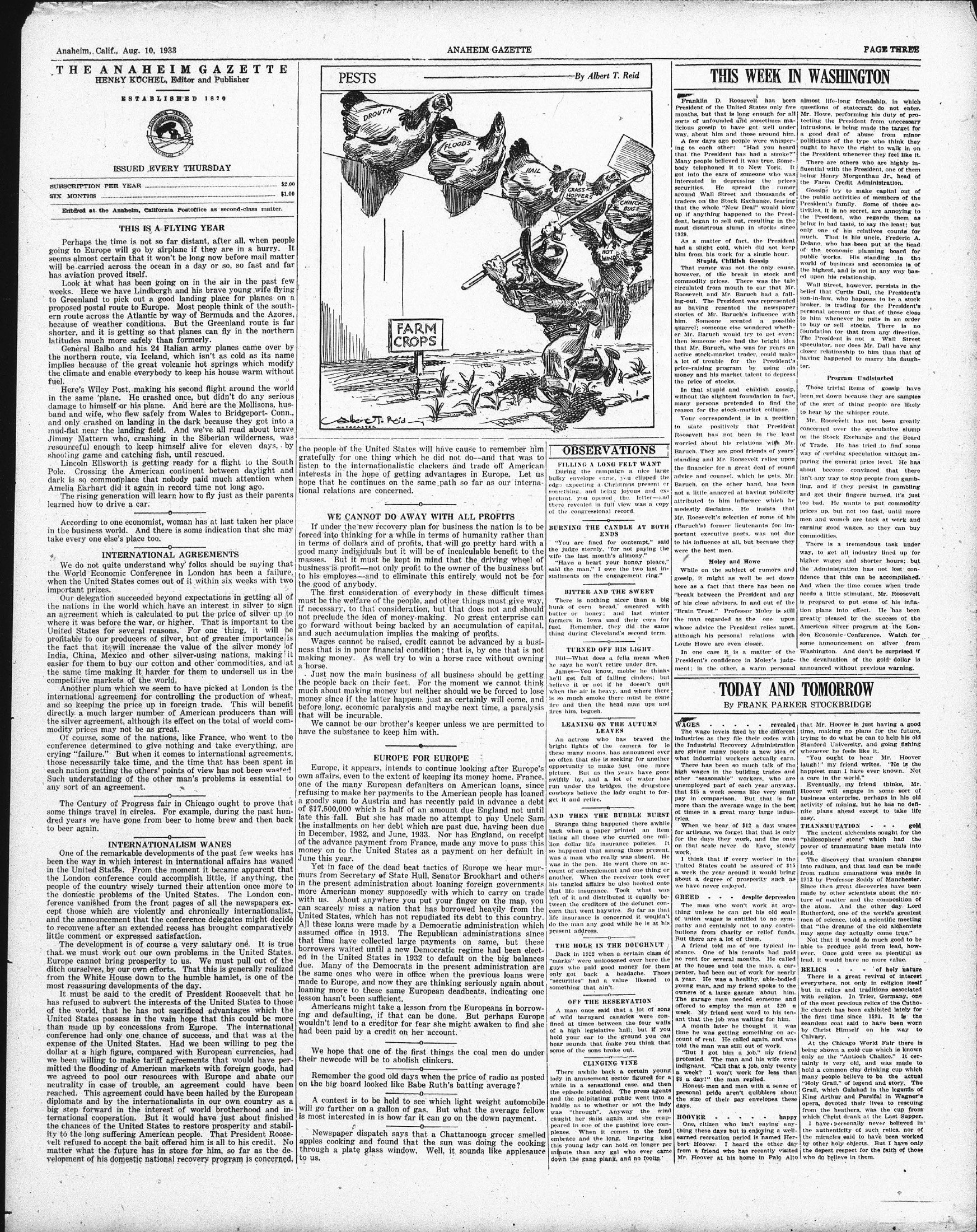
PESTS
By Albert T. Reid
DROUTH
FLOODS
HAIL
GRASS HOPPERS
CHINCH BUG
HOT WIND
FARM CROPS
Albert T. Reid
OBSERVATIONS
the people of the United States will have cause to remember him gratefully for one thing which he did not do—and that was to
the people of the United States will have cause to remember him gratefully for one thing which he did not do—and that was to listen to the internationalistic clackers and trade off American interests in the hope of getting advantages in Europe. Let us hope that he continues on the same path so far as our international relations are concerned.
WE CANNOT DO AWAY WITH ALL PROFITS
If under the new recovery plan for business the nation is to be forced into thinking for a while in terms of humanity rather than in terms of dollars and of profits, that will go pretty hard with a good many individuals but it will be of incalculable benefit to the masses. But it must be kept in mind that the driving wheel of business is profit—not only profit to the owner of the business but to his employees—and to eliminate this entirely would not be for the good of anybody.
The first consideration of everybody in these difficult times must be the welfare of the people, and other things must give way, if necessary, to that consideration, but that does not and should not preclude the idea of money-making. No great enterprise can go forward without being backed by an accumulation of capital, and such accumulation implies the making of profits.
Wages cannot be raised, credit cannot be advanced by a business that is in poor financial condition; that is, by one that is not making money. As well try to win a horse race without owning a horse.
Just now the main business of all business should be getting the people back on their feet. For the moment we cannot think much about making money but neither should we be forced to lose money since if the latter happens just as certainly will come, and before long, economic paralysis and maybe next time, a paralysis that will be incurable.
We cannot be our brother's keeper unless we are permitted to have the substance to keep him with.
EUROPE FOR EUROPE
Europe, it appears, intends to continue looking after Europe's own affairs, even to the extent of keeping its money home. France, one of the many European defaulters on American loans, since refusing to make her payments to the American people has loaned a goodly sum to Austria and has recently paid in advance a debt of $17,500,000 which is half of an amount due England not until late this fall. But she has made no attempt to pay Uncle Sam, the installments on her debt which are past due, having been due in December, 1932, and June, 1933. Nor has England, on receipt of the advance payment from France, made any move to pass this money on to the United States as a payment on her default in June this year.
Yet in face of the dead beat tactics of Europe we hear mur-
own affairs, even to the extent of keeping its money home. France, one of the many European defaulters on American loans, since refusing to make her payments to the American people has loaned a goodly sum to Austria and has recently paid in advance a debt of $17,500,000 which is half of an amount due England not until late this fall. But she has made no attempt to pay Uncle Sam. the installments on her debt which are past due, having been due in December, 1932, and June, 1933. Nor has England, on receipt of the advance payment from France, made any move to pass this money on to the United States as a payment on her default in June this year.
Yet in face of the dead beat tactics of Europe we hear murmurs from Secretary of State Hull, Senator Brookhart and others in the present administration about loaning foreign governments more American money supposedly with which to carry on trade with us. About anywhere you put your finger on the map, you can scarcely miss a nation that has borrowed heavily from the United States, which has not repudiated its debt to this country. All these loans were made by a Democratic administration which assumed office in 1913. The Republican administrations since that time have collected large payments on same, but these borrowers waited until a new Democratic regime had been elected in the United States in 1932 to default on the big balances due. Many of the Democrats in the present administration are the same ones who were in office when the previous loans were made to Europe, and now they are thinking seriously again about loaning more to these same European deadbeats, indicating one lesson hasn't been sufficient.
Americans might take a lesson from the Europeans in borrowing and defaulting, if that can be done. But perhaps Europe wouldn't lend to a creditor for fear she might awaken to find she had been paid by a credit on her account.
We hope that one of the first things the coal men do under their newcode will be to abolish clinkers.
Remember the good old days when the price of radio as posted on the big board looked like Babe Ruth's batting average?
A contest is to be held to see which light weight automobile will go farther on a gallon of gas. But what the average fellow is most interested in is how far it can go on the down payment.
Newspaper dispatch says that a Chattanooga grocer smelled apples cooking and found that the sun was doing the cooking through a plate glass window. Well, it sounds like applesauce to us.
AND THEN THE BUBBLE BURST
Strange thing happened there awhile back when a paper printed an item listing all those who carried one million dollar life insurance policies. It so happened that among those present, was a man who really was absent. He was in the pen. He went there on account of embezzlement and one thing or another. When the receiver took over his tangled affairs he also hooked onto that life insurance. Took what was left of it and distributed it equally between the creditors of the defunct concern that went haywire. So far as that life insurance is concerned it wouldn't do the man any good while he is at his present address.
THE HOLE IN THE DOUGHNUT
Back in 1922 when a certain class of "marks" were unloosened over here the guys who paid good money for them only got back a headache. Thoes "securities" had a value likened to something that ain't.
OFF THE RESERVATION
A man once said that a lot of sons of wild barnyard canaries were confined at times between the four walls of a high legislative hall; but if you hold your ear to the ground you can hear sounds that make you think that some of the sons broke out.
CLINGING VINE
There awhile back a certain young lady in amusement sector figured for a while in a sensational case, and then the episode subsided. The press agents and the palpitating public went into a huddle as to whether or not the lady was "through". Anyway the wind caught her skis again and she reappeared in one of the gushing love complexes. When it comes to the fond embrace and the long, lingering kiss this young lady can hold on longer per minute than any gal who ever came down the gang plank, and no foolin'."
THIS WEEK IN WASHINGTON
Franklin D. Roosevelt has been President of the United States only five months, but that is long enough for all sorts of unfounded and sometimes malicious gossip to have got well under way, about him and those around him.
A few days ago people were whispering to each other: "Had you heard that the President has had a stroke?" Many people believed it was true. Somebody telephoned it to New York. It got into the ears of someone who was interested in depressing the prices securities. He spread the rumor around Wall Street and thousands of traders on the Stock Exchange, fearing that the whole "New Deal" would blow up if anything happened to the President, began to sell out, resulting in the most disastrous slump in stocks since 1929.
As a matter of fact, the President had a slight cold, which did not keep him from his work for a single hour.
Stupid, Childish Gossip
That rumor was not the only cause, however, of the break in stock and commodity prices. There was the tale circulated from mouth to ear that Mr. Roosevelt and Mr. Baruch had a falling-out. The President was represented as having resented the newspaper stories of Mr. Baruch's influence with him. Someone scented a possible quarrel; someone else wondered whether Mr. Baruch would try to get even; then someone else had the bright idea that Mr. Baruch, who was for years an active stock-market trader, could make a lot of trouble for the President's price-raising program by using his money and his market talent to depress the price of stocks.
In that stupid and childish gossip, without the slightest foundation in fact, many persons pretended to find the reason for the stock-market collapse.
Your correspondent is in a position to state positively that President Roosevelt has not been in the least worried about his relations with Mr. Baruch. They are good friends of years' standing and Mr. Roosevelt relies upon almost life-long friendship, in which questions of statecraft do not enter. Mr. Howe, performing his duty of protecting the President from unnecessary intrusions, is being made the target for a good deal of abuse from minor politicians of the type who think they ought to have the right to walk in on the President whenever they feel like it.
There are others who are highly influential with the President, one of them being Henry Morgenthau Jr., head of the Farm Credit Administration.
Gossips try to make capital out of the public activities of members of the President's family. Some of those activities, it is no secret, are annoying to the President, who regards them as being in bad taste, to say the least; but only one of his relatives counts for much. That is his uncle, Frederic A. Delano, who has been put at the head of the economic planning board for public works. His standing in the world of business and economics is of the highest, and is not in any way based upon his relationship.
Wall Street, however, persists in the belief that Curtis Dall, the President's son-in-law, who happens to be a stock broker, is trading for the President's personal account or that of those close to him whenever he puts in an order to buy or sell stocks. There is no foundation for that from any direction. The President is not a Wall Street speculator, nor does Mr. Dall have any closer relationship to him than that of having happened to marry his daughter.
Program Undisturbed
Those trivial items of gossip have been set down because they are samples of the sort of thing people are likely to hear by the whisper route.
Mr. Roosevelt has not been greatly concerned over the speculative slump on the Stock Exchange and the Board of Trade. He has tried to find some way of curbing speculation without im-
TODAY AND TOMORROW
By FRANK PARKER STOCKBRIDGE
WAGES
The wage levels fixed by the different industries as they file their codes with the Industrial Recovery Administration are giving many people a new idea of what industrial workers actually earn.
There has been so much talk of the high wages in the building trades and other "seasonable" workers, who are unemployed part of each year anyway, that $15 a week seems like very small pay in comparison. But that is far more than the average wage in the best of times in a great many large industries.
When we hear of $12 a day wages for artisans, we forget that that is only for the days they work, and the ones on that scale never do have steady work.
I think that if every worker in the United States could be assured of $15 that Mr. Hoover is just having a good time, making no plans for the future, trying to do what he can to help his old Stanford University, and going fishing whenever he feels like it.
"You ought to hear Mr. Hoover laugh!" my friend writes. "He is the happiest man I have ever known. Not a care in the world."
Eventually, my friend thinks, Mr. Hoover will engage in some sort of business enterprise, perhaps in his old activity of mining, but he has no definite plans ahead except to take life easy.
TRANSMUTATION
The ancient alchemists sought for the "philosophers' stone" which had the power of transmuting base metals into gold.
The discovery that uranium changes into radium, and that lead can be made
BUBBLE BURST
opened there awhile
printed an item
to carried one millionurance policies. It
strong those present,
only was absent. He
went there on account and one thing or
receiver took over
he also hooked onto
Took what was
suggested it equally beof the defunct confirmire. So far as that
incerned it wouldn't
while he is at his
THE DOUGHNUT
in a certain class of
deemed over here the
money for them
headache. Thoes
value likened to
SERVATION
that a lot of sons
manaries were conseen the four walls
the hall; but if you
are ground you can
take you think that
take out.
GING VINE
ask a certain young
sector figured for a
final case, and then
The press agents
public went into a
er or not the lady
anyway the wind
gain and she reapr gushing love concomes to the fond
ling, lingering kise
hold on longer percal who ever came
kick, and no foolin'.
BUBBLE BURST
opened there awhile
printed an item
to carried one millionurance policies. It
strong those present,
only was absent. He
went there on account and one thing or
receiver took over
he also hooked onto
Took what was
suggested it equally beof the defunct confirmire. So far as that
incerned it wouldn’t
while he is at his
THE DOUGHNUT
in a certain class of
deemed over here the
money for them
headache. Thoes
value likened to
SERVATION
that a lot of sons
manaries were conseen the four walls
the hall; but if you
are ground you can
take you think that
take out.
GING VINE
ask a certain young
sector figured for a
final case, and then
The press agents
public went into a
er or not the lady
anyway the wind
gain and she reapr gushing love concomes to the fond
ling, lingering kise
hold on longer percal who ever came
kick, and no foolin'
BUBBLE BURST
opened there awhile
printed an item
to carried one millionurance policies. It
strong those present,
only was absent. He
went there on account and one thing or
receiver took over
he also hooked onto
Took what was
suggested it equally beof the defunct confirmire. So far as that
incerned it wouldn’t
while he is at his
TRANSMUTATION . . . gold
The ancient alchemists sought for the "philosophers' stone" which had the power of transmuting base metals into gold.
The discovery that uranium changes into radium, and that lead can be made from radium emanations was made in 1913 by Professor Soddy of Manchester. Since then great discoveries have been made by other scientists about the nature of matter and the composition of the atom. And the other day Lord Rutherford, one of the world's greatest men of science, told a scientific meeting that "the dreams of the old alchemists may some day actually come true."
Not that it would do much good to be able to produce gold from lead, however. Once gold were as plentiful as lead, it would have no more value.
RELICS . . . of holy nature
There is a great revival of interest everywhere, not only in religion itself but in relics and traditions associated with religion. In Trier, Germany, one of the most precious relics of the Catholic church has been exhibited lately for the first time since 1891. It is the seamless coat said to have been worn by Christ Himself on his way to Calvary.
At the Chicago World Fair there is being shown a gold cup which is known only as the "Antioch Challice." It certainly is very old, and was made to hold a common clay drinking cup which many people believe to be the actual "Holy Grail," of legend and story. The Grail, which Galahad in the legends of King Arthur and Parsifal in Wagner's opera, devoted their lives to rescuing from the heathers, was the cup from which Christ drank at the Last Supper.
I have personally never believed in the authenticity of such relics, nor of the miracles said to have been worked by other holy objects. But I have only the depest respect for the faith of those who do believe in them.