anaheim-gazette 1933-08-03
Scanned page
Searchable text
THE ANAHEIM GAZETTE
HENRY KUCHEL, Editor and Publisher
ESTABLISHED 1870
ISSUED EVERY THURSDAY.
SUBSCRIPTION PER YEAR $2.00
SIX MONTHS $1.00
Effited at the Anaheim, California Postoffice as second-class matter.
THE NAVY IS LOOKING UP
The latest announcement of the Navy Department that it is the intention of the department to strive for a U.S. navy second to department to strive for a United States navy second to none, is none, is one every American can rejoice, coming as it does after the recent statement as to the amount of construction which is to be undertaken from funds which will be available under the national rehabilitation program. It may be said in all fairness that Uncle Sam has been indeed fortunate in his last two secretaries of the navy, Senator Swanson, who is the present official, and Mr. Adams, who served under President Hoover. Both gentlemen have shown a concern for the welfare of the United States Navy which has earned for them the praise and thanks of all citizens who believe that our best national insurance is a good navy.
The program announced two policies which are regarded as of paramount importance: first that it is the purpose of the Navy Department "to develop the navy to a maximum in battle strength and ability to control the sea in defense of the nation and its interests."
The second purpose stated is one designed to help carry out the first. It is to the effect that it is the plan of the Navy Department "to further the development of two home naval bases on each coast. This was a bit of naval policy first outlined by Secretary Adams in the previous administration. It is reported unofficially in Washington that the bases on the Atlantic Coast would probably be at Norfolk and Narragansett Bay and that on the
The program announced two policies which are regarded as of paramount importance: first that it is the purpose of the Navy Department "to develop the navy to a maximum in battle strength and ability to control the sea in defense of the nation and its interests."
The second purpose stated is one designed to help carry out the first. It is to the effect that it is the plan of the Navy Department "to further the development of two home naval bases on each coast. This was a bit of naval policy first outlined by Secretary Adams in the previous administration. It is reported unofficially in Washington that the bases on the Atlantic Coast would probably be at Norfolk and Narragansett Bay and that on the Pacific Coast at San Francisco Bay and Bremerton Navy Yard, Puget Sound. Washington.
The four locations are said to be admirably adapted for the purpose. The two proposed bases on the Atlantic Coast, it is said by naval officials, would hold every ship in the world, and the Bremerton Yard would be considerably enlarged. The strategic position of San Francisco Bay is too well known to need comment.
The principles enunciated for the general naval policy include creation and operation of a navy second to none, under the treaty provisions; to organize the navy for possible operations on both oceans; to maintain the Marine Corps at necessary strength; to protect American lives and property; to support America especially the development of American foreign commerce and the merchant marine; to cooperate fully with other departments of the government.
Certainly there can be no complaint with any of the purposes outlined. Only a few of them can be given here. There can be no argument over the assertion that in the present disturbed state of world affairs, the cheapest and best insurance Uncle Sam can have is a navy second to none. It is to be hoped therefore that Secretary Swanson will use every dollar available under the public-works program to expand the navy in size and usefulness. That he intends to do so may be taken for granted in light of his patriotic pronouncements on the subject of our naval defense.
WHAT WILL WE DO WITH THE TIME?
It seems to be definitely on the cards that our reorganized industries will operate on a shorter working schedule than has prevailed in the past. Workers are to have a higher average wage and a shorter average working week.
In other words, everybody is to have more time for play.
It seems to us a rather important question: What will we do with this added leisure?
Beyond doubt, there will be a big boom in commercialized entertainment, all the way from the so-called "sports" of professional baseball, boxing matches and the like, to super-super-super-talkies and theatrical entertainments of all kinds. For there will always be a large percentage of people who have never learned how to get any real benefit out of their spare time, largely because they never had any spare time and partly because they are too lazy or too stupid to take part in any sort of sports or games themselves.
But we think there are signs that more and more people are interested in what may be called the old-fashioned ways of having a good time in their leisure hours, besides going out on petting parties in their automobiles. Roller skating has come back strong. So has bicycling; bicycle makers say they are doing a record business. And that is not because people haven't got cars; it is because a new generation of young people have discovered, what percent bonds.
All people who temptation. Treat New York admitted occurrence as to done by minor errors cumbs to the tem
To make any picked men of such used to be, a guard bank.
With all the e Washington to he ducts and to sta farmers will think for them.
Secretary of when, in his St. justment Act give wrongs, it is not machinery," said United States to o
We have never didn't have to ha success of any at farmers themselves more freedom from benefit most are t spirit of independ is much to be sa Wyoming Stock C
"This associ individualism of United States th unpractical theory business to create hours a day and t is real, would ree conditions of a th
We do not un farm relief program initiative and effo
always be a large percentage of people who have never learned how to get any real benefit out of their spare time, largely because they never had any spare time and partly because they are too lazy or too stupid to take part in any sort of sports or games themselves.
But we think there are signs that more and more people are interested in what may be called the old-fashioned ways of having a good time in their leisure hours, besides going out on petting parties in their automobiles. Roller skating has come back strong. So has bicycling; bicycle makers say they are doing a record business. And that is not because people haven't got cars; it is because a new generation of young people have discovered, what their grandparents knew, that there is more real enjoyment and health in a day of cycling in the country than there is a day's motoring.
In almost every community there are better facilities for community sports and entertainment than there were only a few years ago. With more people having leisure in which to take part in them, we ought to develop new forms of community activity in which everybody can have a good time.
And we hope, too, that some of the new leisure will be spent by at least a few in the cultivation of the intellect. Most of us could do with a good deal more of that.
MAKING BANKS SAFER
As we understand the provisions of the new Bank Act, the purpose is to make banks safer and to put the whole banking business of the nation on a saner basis than it has been.
We do not suppose that any government or Act of Congress can guarantee that no bank president or board of directors will ever make a mistake, but we understand that the new laws will not permit them such a wide range of individual judgment within which to go wrong, and that all banks which comply with the reasonable requirements of the law will at least be able to guarantee their depositors against the loss of their funds, with certain limits.
We hope the new law works as it is expected to. The banking situation in America has been nothing less than scandalous for years. As one wise man pointed out in an address to a state bankers' association the other day, banking has been looked on in America as a way to get rich, whereas in other countries the banker who gets rich is an object of suspicion.
Banking is a necessary social function, and must be conducted for the benefit. first, of society and the particular community and only secondarily for profits. In the competition for deposits and the greed for gain many banks, perhaps most, have offered higher interest than safety of their depositors' funds warranted, and in order to earn that interest have invested in speculative securities promising five percent or more instead of sticking to safe 3½ or 4
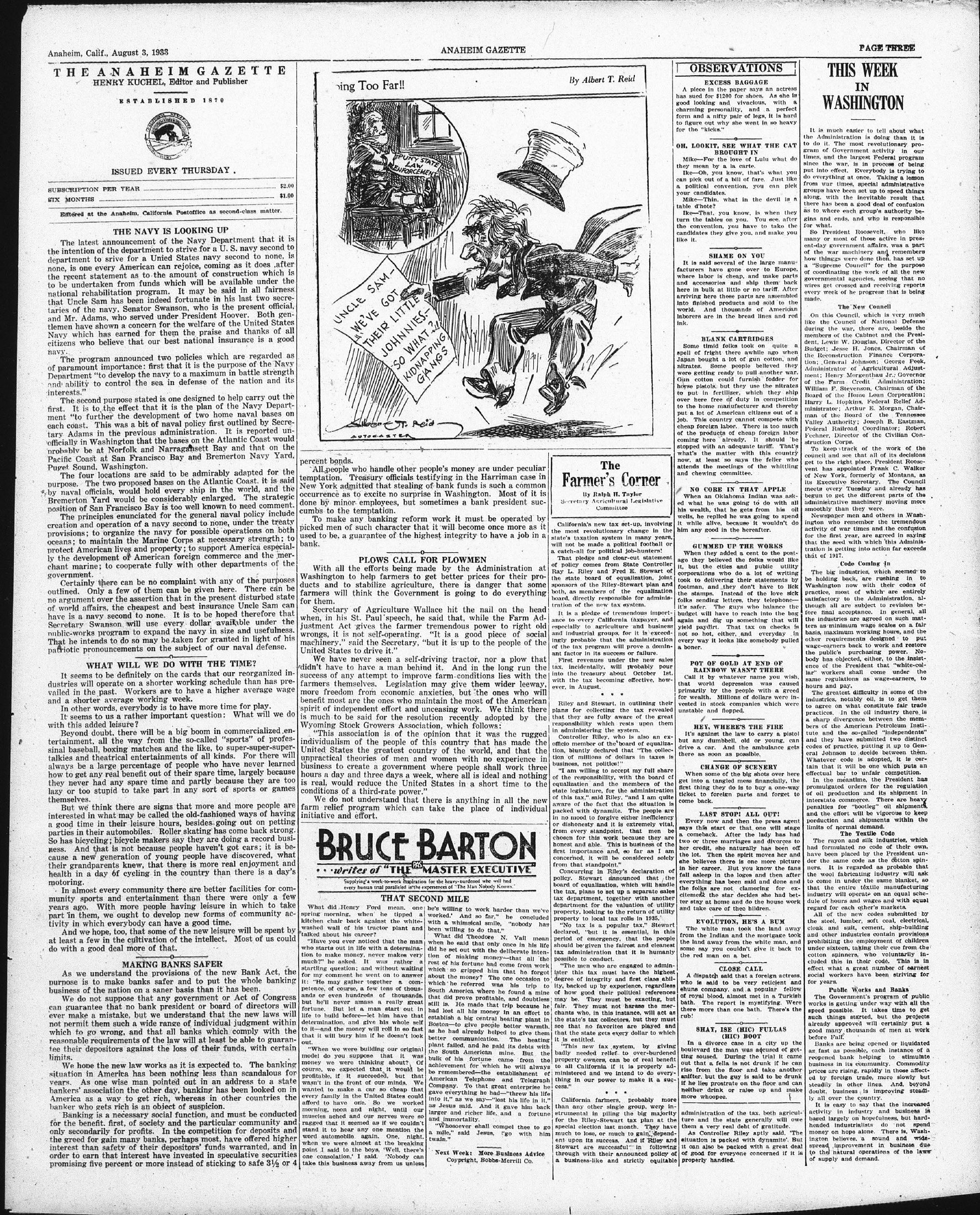
ING Too Far!!
By Albert T. Reid
UNCLE SAMWE'VE GOT
THEIR LITTLE
JOHNNIES.
SO WHAT?
KIDNAPPING
GANGS
Albert T. Reid
AUTOGASTER
percent bonds.
All people who handle other people's money are under peculiar temptation. Treasury officials testifying in the Harriman case in New York admitted that stealing of bank funds is such a common occurrence as to excite no surprise in Washington. Most of it is done by minor employees, but sometimes a bank president succeeds to the temptation.
To make any banking reform work it must be operated by picked men of such character that it will become once more as it used to be, a guarantee of the highest integrity to have a job in a bank.
PLOWS CALL FOR PLOWMEN
With all the efforts being made by the Administration at Washington to help farmers to get better prices for their products and to stabilize agriculture, there is danger that some farmers will think the Government is going to do everything for them.
Secretary of Agriculture Wallace hit the nail on the head when, in his St. Paul's speech, he said that, while the Farm Adjustment Act gives the farmer tremendous power to right old wrongs, it is not self-operating. "It is a good piece of social machinery," said the Secretary, "but it is up to the people of the United States to drive it."
We have never seen a self-driving tractor, nor a plow that didn't have to have a man behind it. And in the long run the success of any attempt to improve farm conditions lies with the farmers themselves. Legislation may give them wider leeway, more freedom from economic anxieties, but the ones who will benefit most are the ones who maintain the most of the American spirit of independent effort and unceasing work. We think there is much to be said for the resolution recently adopted by the Wyoming Stock Growers Association, which follows:
"This association is of the opinion that it was the rugged individualism of the people of this country that has made the United States the greatest country of the world, and that the unpractical theories of men and women with no experience in business to create a government where people shall work three hours a day and three days a week, where all is ideal and nothing is real, would reduce the United States in a short time to the conditions of a third-rate power."
We do not understand that there is anything in all the new farm relief program which can take the place of individual initiative and effort.
The Farmer's Corner
By Ralph H. Taylor
Secretary Agricultural Legislative Committee
California's new tax set-up, involving the most revolutionary change in the state's taxation system in many years, will not be made a political football or a catch-all for political job-hunters!
That pledge and clear-cut statement of policy comes from State Controller Ray L. Riley and Fred E. Stewart of the state board of equalization, joint sponsors of the Riley-Stewart plan and both, as members of the equalization board, directly responsible for administration of the new tax system.
It is a pledge of tremendous importance to every California taxpayer, and especially to agriculture and business and industrial groups, for it is exceedingly probable that the administration of the tax program will prove a dominant factor in its success or failure.
First revenues under the new sales tax, incidentally, will probably pour into the treasury about October 1st, with the tax becoming effective, however, in August.
Riley and Stewart, in outlining their plans for collecting the tax revealed that they are fully aware of the great responsibility which rests upon them in administering the system.
Controller Riley, who is also an ex-officio member of the board of equalization, bluntly declared that "The collection of millions of dollars in taxes is business, not politics!"
"I am willing to accept my full share of the responsibility, with the board of equalization and the members of the state legislature, for the administration of this tax," said Riley, "and I am quite aware of the fact that the situation is packed with dynamite. The people are in no mood to forgive either inefficiency or dishonesty and it is extremely vital, from every standpoint, that men be chosen for this work because they are honest and able. This is business of the first importance and, so far as I am concerned it will be considered solely."
business to create a government where people shall work three hours a day and three days a week, where all is ideal and nothing is real, would reduce the United States in a short time to the conditions of a third-rate power."
We do not understand that there is anything in all the new farm relief program which can take the place of individual initiative and effort.
BRUCE BARTON
writes of "THE MASTER EXECUTIVE"
Supplying a week-to-week inspiration for the heavy-purred who will fund every human trial paralleled in the experiences of "The Man Nobody Knows."
THAT SECOND MILE
What did Henry Ford mean, one spring morning, when he tipped a kitchen chair back against the white-washed wall of his tractor plant and talked about his career?
"Have you ever noticed that the man who starts out in life with a determination to make money, never makes very much?" he asked. It was rather a startling question; and without waiting for my comment he went on to answer it: "He may gather together a competence, of course, a few tens of thousands or even hundreds of thousands, but he'll never amass a really great fortune. But let a man start out in life to build before—let him have that determination, and give his whole self to it—and the money will roll in so fast that it will bury him if he doesn't look out.
"When we were building our original model do you suppose that it was money we were thinking about? Of course, we expected that it would be profitable, if it succeeded, but that wasn't in the front of our minds. We wanted to make a car so cheap that every family in the United States could afford to have one. So we worked morning, noon and night, until our muscles ached and our nerves were so ragged that it seemed as if we couldn't stand it to hear any one mention the word automobile again. One, night, when we were almost at the breaking point I said to the boys, 'Well, there's one consolation,' I said. 'Nobody can take this business away from us unless he's willing to work harder than we've worked.' And so far," he concluded with a whimsical smile, "nobody has been willing to do that."
What did Theodore N. Vail mean when he said that only once in his life did he set out with the deliberate intention of making money—that all the rest of his fortune had come from work which so gripped him that he forgot about the money? The one occasion to which he referred was his trip to South America where he found a mine that did prove profitable, and doubtless still is. He made that trip because he had lost all his money in an effort to establish a big central heating plant in Boston—to give people better warmth, as he had already helped to give them better communication. The heating plant failed, and he paid its debts with the South American mine. But the bulk of his fortune came from the achievement for which he will always be remembered—the establishment of American Telephone and Telegraph Company. To that great enterprise he gave everything he had—"threw his life into it," as we say—"lost his life in it," as Jesus said. And it gave him back larger and richer life, and a fortune and immortality.
"Whosoever shall compel thee to go a mile," said Jesus, "go with him twain."
Next Week: More Business Advice
Copyright, Bobbs-Merrill Co.
"I am willing to accept my full share of the responsibility, with the board of equalization and the members of the state legislature, for the administration of this tax," said Riley, "and I am quite aware of the fact that the situation is packed with dynamite. The people are in no mood to forgive either inefficiency or dishonesty and it is extremely vital, from every standpoint, that men be chosen for this work because they are honest and able. This is business of the first importance and, so far as I am concerned, it will be considered solely from that standpoint."
Concurring in Riley's declaration of policy. Stewart announced that the board of equalization, which will handle the tax, plans to set up a separate sales tax department, together with another department for the valuation of utility property, looking to the return of utility property to local tax rolls in 1935.
"No tax is a popular tax." Stewart declared, "but it is essential, in this period of emergency, that the people should be given the fairest and cleanest tax administration that it is humanly possible to conduct."
"The men who are engaged to administer this tax must have the highest degree of integrity and first class ability, backed up by experience, regardless of how good their political references may be. They must be exacting, but fair. They must not harass the merchants who, in this instance, will act as the state's tax collectors, but they must see that no favorites are played and that the state gets every dollar to which it is entitled."
"This new tax system, by giving badly needed relief to over-burdened property owners, can be of real benefit to all California if it is properly administered and we intend to do everything in our power to make it a success."
California farmers, probably more than any other single group, were instrumental in piling the big majority for the Riley-Stewart tax plan at the special election last month. They have much to lose, or much to gain dependent upon its success. And if Riley and Stewart are successful in following through with their announced policy of a business-like and strictly equitable business, not politics!"
"I am willing to accept my full share of the responsibility, with the board of equalization and the members of the state legislature, for the administration of this tax," said Riley, "and I am quite aware of the fact that the situation is packed with dynamite. The people are in no mood to forgive either inefficiency or dishonesty and it is extremely vital, from every standpoint, that men be chosen for this work because they are honest and able. This is business of the first importance and, so far as I am concerned, it will be considered solely from that standpoint."
Concurring in Riley's declaration of policy. Stewart announced that the board of equalization, which will handle the tax, plans to set up a separate sales tax department, together with another department for the valuation of utility property, looking to the return of utility property to local tax rolls in 1935.
"No tax is a popular tax." Stewart declared, "but it is essential, in this period of emergency, that the people should be given the fairest and cleanest tax administration that it is humanly possible to conduct."
"The men who are engaged to administer this tax must have the highest degree of integrity and first class ability, backed up by experience, regardless of how good their political references may be. They must be exacting, but fair. They must not harass the merchants who, in this instance, will act as the state's tax collectors, but they must see that no favorites are played and that the state gets every dollar to which it is entitled."
"This new tax system, by giving badly needed relief to over-burdened property owners, can be of real benefit to all California if it is properly administered and we intend to do everything in our power to make it a success."
OBSERVATIONS
EXCESS BAGGAGE
A piece in the paper says an actress has sued for $1200 for shoes. As she is good looking and vivacious, with a charming personality, and a perfect form and a nifty pair of legs, it is hard to figure out why she went in so heavy for the "kicks."
OH, LOOKIT, SEE WHAT THE CAT BROUGHT IN
Mike—For the love of Lulu what do they mean by a la carte.
Ike—Oh, you know, that's what you can pick out of a bill of fare. Just like a political convention, you can pick your candidates.
Mike—Thin, what in the devil is a table d'hote?
Ike—That, you know, is when they turn the tables on you. You see, after the convention, you have to take the candidates they give you, and make you like it.
SHAME ON YOU
It is said several of the large manufacturers have gone over to Europe, where labor is cheap, and make parts and accessories and ship them back here in bulk at little or no tariff. After arriving here these parts are assembled into finished products and sold to the world. And thousands of American laborers are in the bread lines and red ink.
BLANK CARTRIDges
Some timid folks took on quite a spell of fright there awhile ago when Japan bought a lot of gun cotton, and nitrates. Some people believed they were getting ready to pull another war. Gun cotton could furnish fodder for horse pistols, but they use the nitrates to put in fertilizer, which they ship over here free of duty in competition to the home manufacturer and thereby put a lot of American citizens out of a job. This country cannot compete with cheap foreign labor. There is too much of the products of cheap foreign labor coming here already. It should be stopped with an adequate tariff. That's what's the matter with this country.
THIS WEEK IN WASHINGTON
It is much easier to tell about what the Administration is doing than it is to do it. The most revolutionary program of Government activity in our times, and the largest Federal program since the war, is in process of being put into effect. Everybody is trying to do everything at once. Taking a lesson from war times, special administrative groups have been set up to speed things along, with the inevitable result that there has been a good deal of confusion as to where each group's authority begins and ends, and who is responsible for what.
So President Roosevelt, who like many or most of those active in present-day government affairs, was a part of the war machinery and remembers how thinggs were done then, has set up a "Supreme Council" for the purpose of coordinating the work of all the new governmental agencies, seeing that no wires get crossed and receiving reports every week of he progress that is being made.
The New Council
On this Council, which is very much like the Council of National Defense during the war, there are, beside the members of the Cabinet and the President, Lewis W. Douglas, Director of the Budget; Jesse H. Jones, Chairman of the Reconstruction Finance Corporation; General Johnson; George Peek, Administrator of Agricultural Adjustment; Henry Morgenthau Jr.; Governor of the Farm Credit Administration; William F. Stevenson, Chairman of the Board of the Home Loan Corporation; Harry L. Hopkins, Federal Relief Administrator; Arthur E. Morgan, Chairman of the Board of the Tennessee Valley Authority; Joseph B. Eastman, Federal Railroad Coordinator; Robert Fechner, Director of the Civilian Construction Corps.
To keep track of the work of the
Japan bought a lot of gun cotton, and nitrates. Some people believed they were getting ready to pull another war. Gun cotton could furnish fodder for horse pistols, but they use the nitrates to put in fertilizer, which they ship over here free of duty in competition to the home manufacturer and thereby put a lot of American citizens out of a job. This country cannot compete with cheap foreign labor. There is too much of the products of cheap foreign labor coming here already. It should be stopped with an adequate tariff. That's what’s the matter with this country now, at least so says the feller who attends the meetings of the whittling and chewing committee.
NO CORE IN THAT APPLE
When an Oklahoma Indian was asked what he was going to do with all his wealth, that he gets from his oil wells, he replied he was going to spend it while alive, because it wouldn’t do him any good in the hereafter.
GUMMED UP THE WORKS
When they added a cent to the postage they believed the folks would like it, but the cities and public utility corporations who do a lot of writing took to delivering their statements by footman, and they don’t have to lick the stamps. Instead of the love sick folks sending letters, they telephone—it’s safer. The guys who balance the budget will have to reach into the bag again and dig up something that will yield paydirt. That tax on checks is not so hot, either, and everyday in every way it looks like somebody pulled a boner.
POT OF GOLD AT END OF RAINBOW WASN’T THERE
Call it by whatever name you wish, that world depression was caused primarily by the people with a greed for wealth. Millions of dollars were invested in stock companies which were unstable and flopped.
HEY, WHERE'S THE FIRE
It’s against the law to carry a pistol but any dumbbell, old or young, can drive a car. And the ambulance gets there as soon as possible.
CHANGE OF SCENERY
When some of the big shots over here get into a tangled mess financially, the first thing they do is to buy a one-way ticket to foreign parts and forget to come back.
LAST STOP! ALL OUT!
Every now and then the press agent says this start or that one will stage a comeback. After the lady has had two or three marriages and divorces to her credit, she naturally has been off the lot. Then the spirit moves her and General Johnson; George Peek, Administrator of Agricultural Adjustment; Henry Morgenthau Jr.; Governor of the Farm Credit Administration; William F. Stevenson, Chairman of the Board of the Home Loan Corporation; Harry L. Hopkins, Federal Relief Administrator; Arthur E. Morgan, Chairman of the Board of the Tennessee Valley Authority; Joseph B. Eastman, Federal Railroad Coordinator; Robert Fechner, Director of the Civilian Construction Corps.
To keep track of the work of the council and see that all of its decisions get to the right place, President Roosevent has appointed Frank C. Walker of New York, formerly of Montana, as its Executive Secretary. The Council meets every Tuesday and already has begun to get the different parts of the administrative machinery moving more smoothly than they were.
Newspaper men and others in Washington who remember the tremendous activity of war times and the confusion for the first year, are agreed in saying that the seed with which this Administration is getting into action far exceeds that of 1917.
Code Coming In
The big industries, which seemed to be holding back, are rushing in to Washington now with their codes of practice, most of which are entirely satisfactory to the Administration, although all are subject to revision before final acceptance. In general, all the industries are agreed on such matters as minimum wage scales on a fair basis, maximum working hours, and the other requirements designed to put wage-earners back to work and restore the public’s purchasing power. Nobody has objected, either, to the insistence of the President that “white-collar” workers shall come under the same regulations as wage-earners, to hours and pay.
The greatest difficulty in some of the industries, notably oil, is to get them to agree on what constitute fair trade practices. In the oil industry there is a sharp divergence between the members of the American Petroleum Institute and the so-called “independents” and they have submitted two distinct codes of practice, putting it up to General Johnson to decide between them. Whatever code is adopted, it is certain that it will be one which puts an effectual bar to unfair competition.
In the meantime, the President has promulgated orders for the regulation of oil production and its shipment in interstate commerce. There are heavy penalties for “bootleg” oil shipments, and the effort will be vigorous to keep porduction and shipments within the limits of normal demand.
The Textile Code
The rayon and silk industries, which had formulated no code of their own, have been placed by the President un-
CHANGE OF SCENERY
When some of the big shots over here get into a tangled mess financially, the first thing they do is to buy a one-way ticket to foreign parts and forget to come back.
LAST STOP! ALL OUT!
Every now and then the press agent says this start or that one will stage a comeback. After the lady has had two or three marriages and divorces to her credit, she naturally has been off the lot. Then the spirit moves her and she believes there is one more picture in her career. But you know the fans fall asleep in the loges and then after everything has been said and done and the folks are not clamoring for excitement the star decides she had better stay at home and do the house work and take care of the children.
EVOLUTION, HE'S A BUM
The white man took the land away from the Indian and the mortgage took the land away from the white man, and some say you couldn't give it back to the red man on a bet.
CLOSE CALL
A dispatch said that a foreign actress who is said to be very reticient and shuns company, and a popular fellow of royal blood, almost met in a Turkish bath. The report is mystifying. Were there more than one bath. There's the rub!
SHAY, ISE (HIC) FULLAS (HIC) BOOT
In a divorce case in a city up the boulevard the man was accused of getting soused. During the trial it came out that a fella is not drunk if he can rise from the floor and take another snifter, but the guy is said to be drunk if he lies prostrate on the floor and can neither drink or raise up and make more whoopee.
administration of the tax, both agriculture and the state generally will owe them a very real debt of gratitude.
As Controller Riley aptly said, 'The situation is packed with dynamite'. But it can also be packed with a great deal of good for everyone concerned if it is properly handled.
tain that it will be one which puts an effectual bar to unfair competition.
In the meantime, the President has promulgated orders for the regulation of oil production and its shipment in interstate commerce. There are heavy penalties for "bootleg" oil shipments, and the effort will be vigorous to keep porduction and shipments within the limits of normal demand.
The Textile Code
The rayon and silk industries, which had formulated no code of their own, have been placed by the President under the same code as the cotton spinners. It is regarded as probable that the wool fabricating industry will ask to come in under the same blanket, so that the entire textile manufacturing industry will operate on an equal schedule of hours and wages and with equal regard for each other's markets.
All of the new codes submitted by the steel, lumber, soft coal, electrical, cloak and suit, cement, ship-building and other industries contain provisions prohibiting the employment of children under sixteen, taking their cue from the cotton spinners, who voluntarily included this in their code. This is in effect what a great number of earnest social workers have been striving for for years.
Public Works and Banks
The Government's program of public works is getting under way with all the speed possible. It takes time to get such things started, but the projects already approved will certainly put a good many thousands of men at work before Fall.
Banks are being opened or liquidated as fast as possible, each instance of a reopened bank helping to stimulate business in its community. Commodity prices are rising, rapidly in those affected by foreign trade, more slowly but steadily in other lines. And, beyond doubt, business is improving steadily all over the country.
It is easy to say that the increased activity in industry and business is based largely on hopefulness, but hard-headed industrialists do not spend money on hope alone. There is Washington believes, a sound and widespread improvement in business due to the natural operations of the laws of supply and demand.