anaheim-gazette 1933-07-20
Scanned page
Searchable text
THE ANAHEIM GAZETTE
HENRY KUCHEL, Editor and Publisher
ESTABLISHED 1870
ISSUED EVERY THURSDAY
SUBSCRIPTION PER YEAR ... $2.00
SIX MONTHS ... $1.00
Entered at the Anaheim, California Postoffice as second-class matter.
WE NEVER WILL BE THE SAME AGAIN
After a protracted case of Insull-itis we art turning to the old-fashioned economic health foods, consisting mainly of honesty, fair-dealing and neighborliness.
Our nerves and purse-strings are frayed. Our industrial vitality is about half what it was. But our fever is down to normal. Instead of burning with the fire of selfish heat, our eyes appear calmer and see the errors of past judgment. Instead of flushed cheeks we have drained pocket books. Back from the dreamland of quick fortune, we find ourselves glad to be up and about with prospects of a sounder national health than ever before.
As we look back on our post-war fever we behold many symptoms which betray temporary wandering from the paths of strict, old-fashioned virtues. First in mind is the Beesemyer case. There was a man whom thousands held in awe; his financial prowess was worshipped. No matter how he got money, he had plenty of it, didn't he? So thousands of trusting Southland investors were milked of millions of dollars. At random, we remember the American Mortgage company which bilked more thousands out of more millions, right here in our own Golden State. On the international horizon there was Kruger, a bad symptom for all nations. A little later we had our Mitchells and finally our Morgans. These symptoms may have been legal, but they strayed from the path of justice and are worthy of note in preparing the case data.
The diagnosis, like all major ills, involves a multitude of things. Our body politic would not not have suffered such violent internal pains had not the country indulged to excess in rugged
didn't he? So thousands of trusting Southland investors were milked of millions of dollars. At random, we remember the American Mortgage company which bilked more thousands out of more millions, right here in our own Golden State. On the international horizon there was Kruger, a bad symptom for all nations. A little later we had our Mitchells and finally our Morgans. These symptoms may have been legal, but they strayed from the path of justice and are worthy of note in preparing the case data.
The diagnosis, like all major ills, involves a multitude of things. Our body politic would not not have suffered such violent internal pains had not the country indulged to excess in rugged individualism, leading a temporary prosperity fever which turned our heads. Everybody burned up with desire to get-rick-quick, hence we forgot to check up on how people got rich. We did not have any more normal rational periods. We were in too much of a hurry. We abandoned the old axiom about not getting something for nothing, and thought that modern magic evolved around clipping coupons. That seemed to be about as strenuous as we cared to work.
Not till a series of disquieting symptoms, like the Insulls, Krugers, and Beesemeyers, did we develop a pain in the neck. Then we knew where to look for trouble, and we found plenty of it.
The doctors say we never will be the same. We can expect a long period of economic and political convalescence, but we are not likely to develop the old get-rich-quick fever again.
OH WHAT SPORT!
That New England woman who landed a sword fish with a hook and line after ten hours of battle ought to be elected to congress and made whip of the house.
LEGISLATIVE GUESSING
Our legislative tax guessers are back on their jobs at Sacramento. They have a big job. New school burdens of 77 millions were voted from the counties to the state, which already faced a deficit of 46 million dollars. This makes a total of 121 millions needed to balance the budget. Then, to meet the demands of expedient politics, the legislators must vote about 4 millions more for various state purposes. This would require 125 millions to be raised by new taxation.
The optimists among the legislative tax guessers reported to the legislature's committee that a two-and-one-half cent sales tax would raise 112 millions of dollars. The more practical experts who are better at anticipating dollars than anticipating votes (this faction is led by Budget Rolland Vandegrift), estimate that a three-cent sales tax will bring only 95 million; they say that a two-cent tax would approximately meet the new demands for school money.
Old Man Prosperity will determine which of the two groups is right. If we earn more money we will spend more, but if our income remains about the same we will spend no more, if as much. This holds true whether prices go up or not. The people of the state are not going to spend more than they make.
If the optimistic proposition is adopted a temporary saving of $7.50 per year per family may be enjoyed. If it succeeds the state will raise considerably more money than necessary, because returns from public utilities from insurance companies and every straight. After Fifteen thousand in the Manhattan chances he had the summer; and another missed Judge Woolsey s.
Although the manding its power two innocent parties United States, sur business and w pages of testimony.
One of the most to cut through low picture of the place counsel ex issue for juries, t up the court calendar.
We believe ju more power in di benefit of their e tting short unnec granted more pow would have cut i trial.
While Secretariat can farmer in such a procedure markets to the farmer who has Secretary of Agriculture Roosevelt's cabin Middle West that ed no hope for reg ion down to the value of foreign m is more practical tariffs in a theory us from the Vic period of long ski It is difficult th market for his g of our tariffs on lower living stan Australia and Ar markets of the w least. The result abroad but the lo
Old Man Prosperity will determine which of the two groups is right. If we earn more money we will spend more, but if our income remains about the same we will spend no more, if as much. This holds true whether prices go up or not. The people of the state are not going to spend more than they make.
If the optimistic proposition is adopted a temporary saving of $7.50 per year per family may be enjoyed. If it succeeds the state will raise considerably more money than necessary, because returns from public utilities, from insurance companies and every other phase of present state income will grow apace with returning prosperity.
However, we cannot afford to pass up the other side of the economic picture. Governmental income long ago reached the point of diminishing returns. Even our vaunted gasoline taxes are riding the toboggan. For several months they have returned several millions of dollars less than in 1932. Income tax reports to the federal government tell the same story. The total number of reports decreased alarmingly, while the incomes reported in themselves were considerably less. In other words taxes on incomes hit a new low for the past year, despite increases voted and lowering of the brackets to include single men making $1,000. Delinquencies on real property prove a boomerang in certain districts.
The situation at Sacramento is critical. To try to raise too much money is suicidal; to pile up a growing deficit is calamity; to rely on optimistic guesswork is foolhardy.
Only one rational course is open. Adopt taxes which, by their moderate demands will not force capital and business into hiding, thus raising the maximum amount of money. Then cut state expenses to within the ability of the people of pay.
LEGAL FAIRYLAND
"One of the interesting things in this case is that we have been in a corporate fairyland, and you never could tell when around the corner you might meet an appreciated asset or an ingeniously contrived surplus."
So stated Federal Judge John Munro Woolsey of the longest criminal case in U.S. history. Defendants were Otto E. Goebel, his two sisters-in-law and six salesmen, charged with bilking 400 Roman Catholic priests and 6,000 laymen out of $3,000,000. Jurymen heard 98 witnesses, needed two clerks to keep 941 exhibits
ANAHEIM GAZETTE
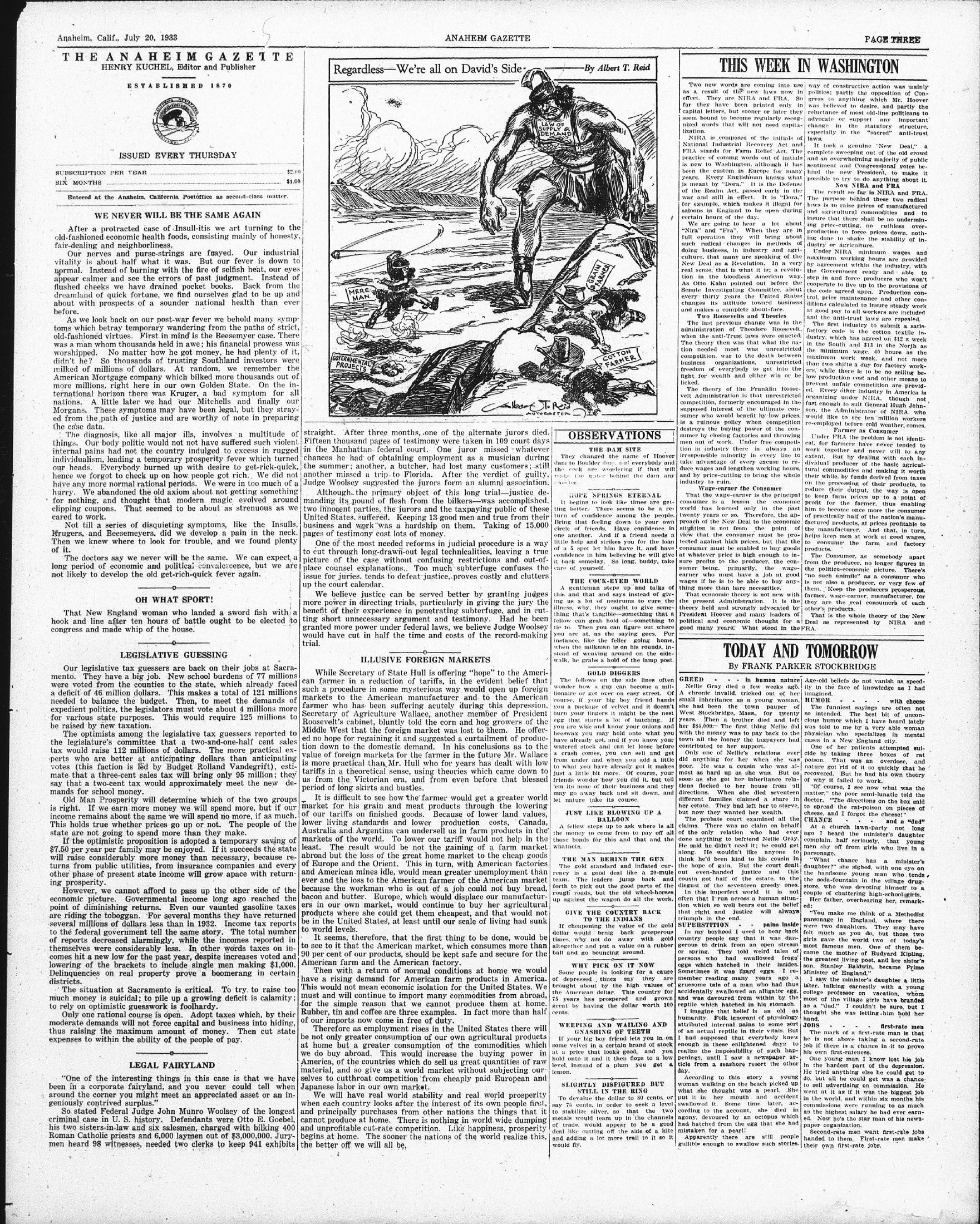
Regardless—We're all on David's Side—By Albert T. Reid
LAW OF SUPPLY & DEMAND
MERE MAN
GOVERNMENTAL PROJECTS
GRAIN FARMER
COTTON FARMER
Albert T. Reid
AUTOCASTER
straight. After three months, one of the alternate jurors died. Fifteen thousand pages of testimony were taken in 109 court days in the Manhattan federal court. One juror missed whatever chance he had of obtaining employment or a pension during
straight. After three months, one of the alternate jurors died. Fifteen thousand pages of testimony were taken in 109 court days in the Manhattan federal court. One juror missed whatever chances he had of obtaining employment as a musician during the summer; another, a butcher, had lost many customers; still another missed a trip to Florida. After the verdict of guilty, Judge Woolsey suggested the jurors form an alumni association.
Although the primary object of this long trial—justice demanding its pound of flesh from the bilkers—was accomplished, two innocent parties, the jurors and the taxpaying public of these United States, suffered. Keeping 13 good men and true from their business and work was a hardship on them. Taking of 15,000 pages of testimony cost lots of money.
One of the most needed reforms in judicial procedure is a way to cut through long-drawn-out legal technicalities, leaving a true picture of the case without confusing restrictions and out-of-place counsel explanations. Too much subterfuge confuses the issue for juries, tends to defeat justice, proves costly and clutters up the court calendar.
We believe justice can be served better by granting judges more power in directing trials, particularly in giving the jury the benefit of their experience in penetrating subterfuge, and in cutting short unnecessary argument and testimony. Had he been granted more power under federal laws, we believe Judge Woolsey would have cut in half the time and costs of the record-making trial.
ILLUSIVE FOREIGN MARKETS
While Secretary of State Hull is offering "hope" to the American farmer in a reduction of tariffs, in the evident belief that such a procedure in some mysterious way would open up foreign markets to the American manufacturer and to the American farmer who has been suffering acutely during this depression, Secretary of Agriculture Wallace, another member of President Roosevelt's cabinet, bluntly told the corn and hog growers of the Middle West that the foreign market was lost to them. He offered no hope for regaining it and suggested a curtailment of production down to the domestic demand. In his conclusions as to the value of foreign markets for the farmer in the future Mr. Wallace is more practical than Mr. Hull who for years has dealt with low tariffs in a theoretical sense, using theories which came down to us from the Victorian era, and from even before that blessed period of long skirts and bustles.
It is difficult to see how the farmer would get a greater world market for his grain and meat products through the lowering of our tariffs on finished goods. Because of lower land values, lower living standards and lower production costs, Canada, Australia and Argentina can undersell us in farm products in the markets of the world. To lower our tariff would not help in the least. The result would be not the gaining of a farm market abroad but the loss of the great home market to the cheap goods of Europe and the Orient. This in turn with American factories
OBSERVATIONS
THE DAM SITE
They changed the name of Hoover dam to Boulder dam, and everybody and the cook are wondering if that will make the water behind the dam any sweeter.
HOPE SPRINGS ETERNAL
It begins to look like times are getting better. There seems to be a return of confidence among the people. Bring that feeling down to your own circle of friends. Have confidence in one another. And if a friend needs a little help and strikes you for the loan of a 5 spot let him have it, and have confidence in him believing he will give it back someday. So long, buddy, take care of yourself.
THE COCK-EYED WORLD
A gentleman steps up and talks of this and that and says instead of giving us a lot of nostrums to cure the illness, why, they ought to give something that's tangible—something that a fellow can grab hold of—something to tie to. Then you can figure out where you are at, as the saying goes. For instance, like the feller going home, when the milkman is on his rounds, instead of weaving around on the sidewalk, he grabs a hold of the lamp post.
GOLD DIGGERS
The fellows on the side lines often wonder how a guy can become a millionaire or get over on easy street. Of course, if your big boy friend hands you a package of velvet and it doesn't burn your fingers it might be the nest egg that starts a lot of hatching. If you are wise and know your onions and beeswax you may hold onto what you have already got, and if you know your watered stock and can let loose before a crash comes, you can sell and get from under and when you add a little to what you have already got it makes just a little bit more. Of course, your friends wonder how you did it, but tell 'em its none of their business and they may go away back and sit down, and let nature take its course.
JUST LIKE BLOWING UP A BALLOON
A fellow steps up to ask where is all the money to come from to pay off all those bonds for this and that and the whatnots.
THE MAN BEHIND THE GUN
It is difficult to see how the farmer would get a greater world market for his grain and meat products through the lowering of our tariffs on finished goods. Because of lower land values, lower living standards and lower production costs, Canada, Australia and Argentina can undersell us in farm products in the markets of the world. To lower our tariff would not help in the least. The result would be not the gaining of a farm market abroad but the loss of the great home market to the cheap goods of Europe and the Orient. This in turn, with American factories and American mines idle, would mean greater unemployment than ever and the loss to the American farmer of the American market because the workman who is out of a job could not buy bread, bacon and butter. Europe, which would displace our manufacturers in our own market, would continue to buy her agricultural products where she could get them cheapest, and that would not be in the United States, at least until our scale of living had sunk to world levels.
It seems, therefore, that the first thing to be done, would be to see to it that the American market, which consumes more than 90 per cent of our products, should be kept safe and secure for the American farm and the American factory.
Then with a return of normal conditions at home we would have a rising demand for American farm products in America. This would not mean economic isolation for the United States. We must and will continue to import many commodities from abroad, for the simple reason that we cannot produce them at home. Rubber, tin and coffee are three examples. In fact more than half of our imports now come in free of duty.
Therefore as employment rises in the United States there will be not only greater consumption of our own agricultural products at home but a greater consumption of the commodities which we do buy abroad. This would increase the buying power in America, of the countries which do sell us great quantities of raw material, and so give us a world market without subjecting ourselves to cutthroat competition from cheaply paid European and Japanese labor in our own market.
We will have real world stability and real world prosperity when each country looks after the interest of its own people first, and principally purchases from other nations the things that it cannot produce at home. There is nothing in world wide dumping and unprofitable cut-rate competition. Like happiness, prosperity begins at home. The sooner the nations of the world realize this, the better off we will all be.
JUST LIKE BLOWING UP A BALLOON
A fellow steps up to ask where is all the money to come from to pay off all those bonds for this and that and the whatnots.
THE MAN BEHIND THE GUN
The gold standard and inflated currency is a good deal like a 20-mule team. The leaders jump back and forth to pick out the good parts of the rough roads, but the old wheel-horses up against the wagon do all the work.
GIVE THE COUNTRY BACK TO THE INDIANS
If cheapening the value of the gold dollar would brine back prosperous times, why not do away with gold altogether and put a value on a rubber ball and go bouncing around.
WHY PICK ON IT NOW
Some people in looking for a cause of depressed times say they are brought about by the high values of the American dollar. This country for 75 years has prospered and grown great by having the dollar worth 100 cents.
WEEPING AND WAILING AND GNASHING OF TEETH
If your big boy friend lets you in on some velvet in a certain brand of stock at a price that looks good, and you hold onto it and it then flops to a low level, instead of a plum you get a lemon.
SLIGHTLY DISFIGURED BUT STILL IN THE RING
To devalue the dollar to 80 cents, or say 75 cents, in order to seek a level to stabilize silver, so that the two metals would team up in the channels of trade, would appear to be a good deal like cutting off the side of a kite and adding a lot more trail to it so it would fly.
THIS WEEK IN WASHINGTON
Two new words are coming into use as a result of the new laws now in effect. They are NIRA and FRA. So far they have been printed only in capital letters, but sooner or later they seem bound to become regularly recognized words that will not need capitalization.
NIRA is composed of the initials of National Industrial Recovery Act and FRA stands for Farm Relief Act. The practice of coming words out of initials is new to Washington, although it has been the custom in Europe for many years. Every Englishman knows what is meant by "Dora." It is the Defense of the Realm Act, passed early in the war and still in effect. It is "Dora," for example, which makes it illegal for saloons in England to be open during certain hours of the day.
We are going to hear a lot about "Nira" and "Fra". When they are in full operation they will bring about such radical changes in methods of doing business, in industry and agriculture, that many are speaking of the New Deal as a Revolution. In a very real sense, that is what it is; a revolution in the bloodless American way. As Otto Kahn pointed out before the Senate Investigating Committee, about every thirty years the United States changes its attitude toward business and makes a complete about-face.
Two Roosevelts and Theories
The last previous change was in the administration of Theodore Roosevelt, when the anti-Trust laws were enacted. The theory then was that what the nation needed most was unrestricted competition, war to the death between business organizations, unrestricted freedom of everybody to get into the fight for wealth and either win or be licked.
The theory of the Franklin Roosevelt Administration is that unrestricted competition, formerly encouraged in the supposed interest of the ultimate consumer who would benefit by low prices, is a ruinous policy when competition destroys the buying power of the consumer by closing factories and throwing men out of work. Under free competition in industry there is always an irresponsible minority in every line to way of constructive action was mainly politics; partly the opposition of Congress to anything which Mr. Hoover was believed to desire, and partly the reluctance of most old-line politicians to advocate or support any important change in the statutory structure, especially in the "sacred" anti-trust laws.
It took a genuine "New Deal," a complete sweeping out of the old crowd and an overwhelming majority of public sentiment and Congressional votes behind the new President, to make it possible to try to do anything about it.
Now NIRA and FRA
The result so far is NIRA and FRA. The purpose behind these two radical laws is to raise prices of manufactured and agricultural commodities and to insure that there shall be no undermining price-cutting, no ruthless overproduction to force prices down, nothing done to shake the stability of industry or agriculture.
Under NIRA minimum wages and maximum working hours are provided by agreement within the industry, with the Government ready and able to step in and force producers who won't cooperate to live up to the provisions of the code agreed upon. Production control, price maintenance and other conditions calculated to insure steady work at good pay to all workers are included and the anti-trust laws are repealed.
The first industry to submit a satisfactory code is the cotton textile industry, which has agreed on $12 a week in the South and $13 in the North as the minimum wage. 40 hours as the maximum work week, and not more than two shifts a day for factory workers, while there is to be no selling below production cost and other means to prevent unfair competition are provided. Every other industry in America is organizing under NIRA, though not fast enough to suit General Hugh Johnson, the Administrator of NIRA, who would like to see ten million workers re-employed before cold weather comes.
Farmer as Consumer
Under FRA the problem is not identical, for farmers have never tended to work together and never will to any extent. But by dealing with
TODAY AND TOMORROW
By FRANK PARKER STOCKBRIDGE
GREED ... in human nature
Nellie Gray died a few weeks ago. A chronic invalid, tricked out of her small inheritance as a young woman, she had been the town pauper of West Stockbridge, Mass., for twenty years. Then a brother died and left her $85,000. The first thing Nellie did with the money was to pay back to the town all the money the taxpayers had contributed to her support.
Only one of Nellie's relations ever did anything for her when she was poor. He was a cousin who was almost as hard up as she was. But as soon as she got her inheritance relations flocked to her house from all directions. When she died seventeen different families claimed a share in her estate. They had left her to starve, but now they wanted her wealth.
The probate court examined all the claims. There was no claim on behalf of the only relation who had ever done anything to befriend Nellie Gray. He said he didn't need it; he could get along. He wouldn't like anyone to think he'd been kind to his cousin in business organizations, unrestricted freedom of everybody to get into the fight for wealth and either win or be licked.
The theory of the Franklin Roosevelt Administration is that unrestricted competition, formerly encouraged in the supposed interest of the ultimate consumer who would benefit by low prices, is a ruinous policy when competition destroys the buying power of the consumer by closing factories and throwing men out of work. Under free competition in industry there is always an irresponsible minority in every line to take advantage of every excuse to reduce wages and lengthen working hours, and by price-cutting to bring the whole industry to ruin.
Wage-earner the Consumer
That the wage-earner is the principal consumer is a lesson the economic world has learned only in the past twenty years or so. Therefore, the approach of the New Deal to the economic situation is not from the point of view that the consumer must be protected against high prices, but that the consumer must be enabled to buy goods at whatever price is high enough to insure profits to the producer, the consumer being, primarily, the wage-earner who must have a job at good wages if he is to be able to buy anything more than bare necessities.
That economic theory is not new with the present Administration. It is the theory held and strongly advocated by President Hoover and many leaders of political and economic thought for a good many years. What stood in the FRA.
Under FRA the problem is not identical, for farmers have never tended to work together and never will to any extent. But by dealing with each individual producer of the basic agricultural commodities and making it worth their while, by funds derived from taxes on the processing of their products, to reduce their output, the way is open to keep farm prices up to a point of profit for the farmer, thus enabling him to become once more the consumer of practically half of the nation's manufactured products, at prices profitable to the manufacturer. And that, in turn, helps keep men at work at good wages, to consume the farm and factory products.
The Consumer, as somebody apart from the producer, no longer figures in the politico-economic picture. There's "no such animile" as a consumer who is not also a producer, or very few of them. Keep the producers prosperous, farmer, wage-earner, manufacturer, for they are the real consumers of each other's products.
That is the whole theory of the New Deal as represented by NIRA and I forgot the cheese!"
CHANCE ... and a "dud"
At a church lawn-party not long ago I heard the minister's daughter complain, half seriously, that young men shy off from girls who live in a parsonage.
What chance has a minister's
BLOWING UP A LOON
to ask where is all from to pay off all and that and the
IND THE GUN
and inflated curreal like a 20-mule jump back and the good parts of the old wheel-horses do all the work.
UNTRY BACK
INDIANS
the value of the gold in back prosperous away with gold a value on a rubber ring around.
ON IT NOW
looking for a cause says they are the high values of this country for sheltered and grown the dollar worth 100
WAILING AND OF TEETH
lend lets you in on certain brand of stock was good, and you then flops to a low plum you get a
FIGURED BUT THE RING
dollar to 80 cents, or older to seek a level so that the two up in the channels appear to be a good side of a kite more trail to it so it
SUPERSTITION
In my boyhood I used to hear back country people say that it was dangerous to drink from an open stream or spring. They told weird tales of persons who had swallowed frogs' eggs which hatched in their insides. Sometimes it was lizard eggs. I remember reading many years ago a gruesome tale of a man who had thus accidentally swallowed an alligator egg, and was devoured from within by the reptile which hatched in his stomach.
I imagine that belief is as old as humanity. Folk ignorant of physiology attributed internal pains to some sort of an actual reptile in their vitals. But I had supposed that everybody knew enough in these enlightened days to realize the impossibility of such happenings, until I saw a newspaper article from a seashore resort the other day.
According to this story a young woman walking on the beach picked up what she thought was a pearl. She put it in her mouth and accident swallowed it. Some time later, according to the account, she died in agony, devoured by an octopus which had hatched from the egg that she had mistaken for a pearl!
Apparently there are still people gullible enough to swallow such stories.
CHANCE
and a "dud"
At a church lawn-party not long ago I heard the minister's daughter complain, half seriously, that young men shy off from girls who live in a parsonage.
"What chance has a minister's daughter?" she sighed, with one eye on the handsome young man who tends the soda-fountain in the village drugstore, who was devoting himself to a couple of chattering high-school girls.
Her father, overhearing her, remarked:
"You make me think of a Methodist parsonage in England, where there were two daughters. They may have felt much as you do, but those two girls gave the world two of today's most famous men. One of them became the mother of Rudyard Kipling, the greatest living poet, and her sister's son, Stanley Baldwin, became Prime Minister of England."
I saw the minister's daughter a little later, talking earnestly with a young college professor on vacation, whom most of the village girls have branded as a "dud." I couldn't be sure, but I thought she was letting him hold her hand.
JOBS
first-rate men
The mark of a first-rate man is that he is not above taking a second-rate job if there is a chance in it to prove his own first-rateness.
One young man I know lost his job in the hardest part of the depression. He tried anything else he could get to do, but all he could get was a chance to sell advertising on commission. He went at it as if it was the biggest job in the world, and within six months his commissions were running to as much as the highest salary he had ever earned. Now he's the star man of his newspaper organization.
Second-rate men want first-rate jobs handed to them. First-rate men make their own first-rate jobs.