anaheim-gazette 1933-07-06
Scanned page
Searchable text
THE ANAHEIM GAZETTE
HENRY KUCHEL, Editor and Publisher
ESTABLISHED 1870
ISSUED EVERY THURSDAY
SUBSCRIPTION PER YEAR ... $2.00
SIX MONTHS ... $1.00
Entered at the Anaheim, California Postoffice as second-class matter.
BUILDING COUNTY PROSPERITY
Howard Irwin of Fullerton puts vision and hard work in his job as chairman of the Associated chambers of commerce industrial committee. He recently completed an industrial survey of the county which reveals that manufacturing concerns are not getting the type of whole-hearted support they deserve. In the practical mind of this Fullerton civic leader grew a plan. He visions less unemployment, more comforts of life. Once Orange Countians realize the manifold benefits of supporting local institutions, they will buy more locally-produced merchandise, put more people to work. This would encourage new industries, enlarge payrolls, decrease unemployment, and provide a balance wheel for the gigantic citrus industry.
To make this dream come true, the board of supervisors will be asked to give $1,000, to be matched by industries of the county, for the purpose of driving home the telling message. Mr. Irwin’s advertisements of his own business, which dovetails with industry and gives him an insight into its problems, brought him success; he has planned a series of sensible advertisements to tell the county's story.
This program fits well with the “new deal’s” plan to decentralize industry and balance production.
MORE TRUTH, LESS HALF-TRUTH
If the editors of the United States ever go on strike, one of the first demands will be “bigger and better wastebaskets.”
MORE TRUTH, LESS HALF-TRUTH
If the editors of the United States ever go on strike, one of the first demands will be "bigger and better wastebaskets."
STRANGE INTERLUDE
Europe, accustomed to picking the pockets of United States taxpayers in diplomatic ways, really feels sore at us because our delegation to the economic conference at London has not consented to let France and her gold bloc allies rob America via stabilization of currency plans.
For years we operated under a tariff schedule so rigid that American industry and commerce were paralized by cheap foreign currencies before we had gumption enough to go off gold. No sooner do we begin to feel the pleasant effects of a revitilized trade than Europe tries to hamstring us with impossible restrictions. If America stabilized currencies with the pound at $4.25, England still would have a 25 per cent edge through cheaper money. France cut the gold content of the franc about 80 per cent in 1926, while Uncle Sam retained original value till recently.
The impatience of the gold bloc is heightened by the refusal of this country to let Europe trick us into dumping their commerce into America and at the same time raising their flexible tariffs to hold out our trade. This was the prize Europe hoped to win at the economic conference — and pay for with a lot of backslapping and platitudes.
While the American delegation furnished a lot of horse laughs for its uncouth diplomacy in London, it played its cards close to the chin in Old World style. The refusal to give until it hurt under the delusion of setting an admirable example of high-minded diplomacy upset the plans of Europeans. The demand of Uncle Sam to get something in return for what he offered surprised our neighbors across the sea. No wonder the air was rent with explosive outpourings of Frenchmen, and surcharged with sullenness on the part of others thwarted in their plans to dip their hands into the great America pocket book.
President Roosevelt deserves a lot of credit for not selling us down the river under a mistaken international generosity. The sensation for Uncle Sam is like a strange interlude in diplomatic experiences.
WOODPECKERS TALK
The favorite expression of the forest workers is said to be "gosh all hemlock."
THE LEGISLATIVE HOMESTRETCH
After jockeying for position in a legislative marathon starting with the New Year, the California legislature reconvenes in Sacramento this month to start down the homestretch in its race to balance the budget before a mandatory ad valorem slapped on the property holders of the state.
WOODPECKERS TALK
The favorite expression of the forest workers is said to be "gosh all hemlock."
THE LEGISLATIVE HOMESTRETCH
After jockeying for position in a legislative marathon starting with the New Year, the California legislature reconvenes in Sacramento this month to start down the homestretch in its race to balance the budget before a mandatory ad valorem is slapped on the property holders of the state.
The legislators are equipped with the same old machinery in a new guise — proposition No. 1, or constitutional amendment No. 30, passed by a large majority at the special election on June 27. In addition to the $43,000,000 deficit faced for the biennium starting July 1, the legislature must devise ways and means of raising $76,000,000 school costs transferred from the counties. Defeat of propositions Nos. 9 and 10 effectively prevents transferring any highway funds to the general fund to help relieve pressure for new taxation. The only new tax specifically authorized by the people of the state was the right to raise up to 25 percent of the state budget by a tax on real estate.
In addition to the actual problem of balancing the state budget, the legislature will be beset by two more problems, each more exasperating and less susceptible to rational solution than the financial difficulties. The first is Governor James Rolph himself, who has vetoed much of the good work the legislature did in its first two sessions this year. The kind-hearted governor just cannot hurt any if his official family's feelings, so he vetoed a bill which would have cut salaries of state employees. He forgets that public expenditures determine the size of the tax levy; he forgets nobody but the overburdened taxpayer. The second evil our legislators must face is the hard-fighting minorities seeking immunity and loopholes in new tax laws. Selfish interests wrote some of the measures passed this year; they will try to write the new tax laws with an eye to saddling the inarticulate public with the whole burden of taxation.
We want to remind our legislators, who are outnumbered by lobbyists at Sacramento, not to lose sight of the welfare of the people of California. The great body of taxpayers will sacrifice tax relief they expected to get under proposition No. 1 in exactly the proportion money is raised by new and higher levies to meet the state deficit.
As the legislature starts down the home stretch, one simple fact should be its goal: Reduced governmental costs — the only certain way of bringing tax relief.
ANAHEIM GAZETTE
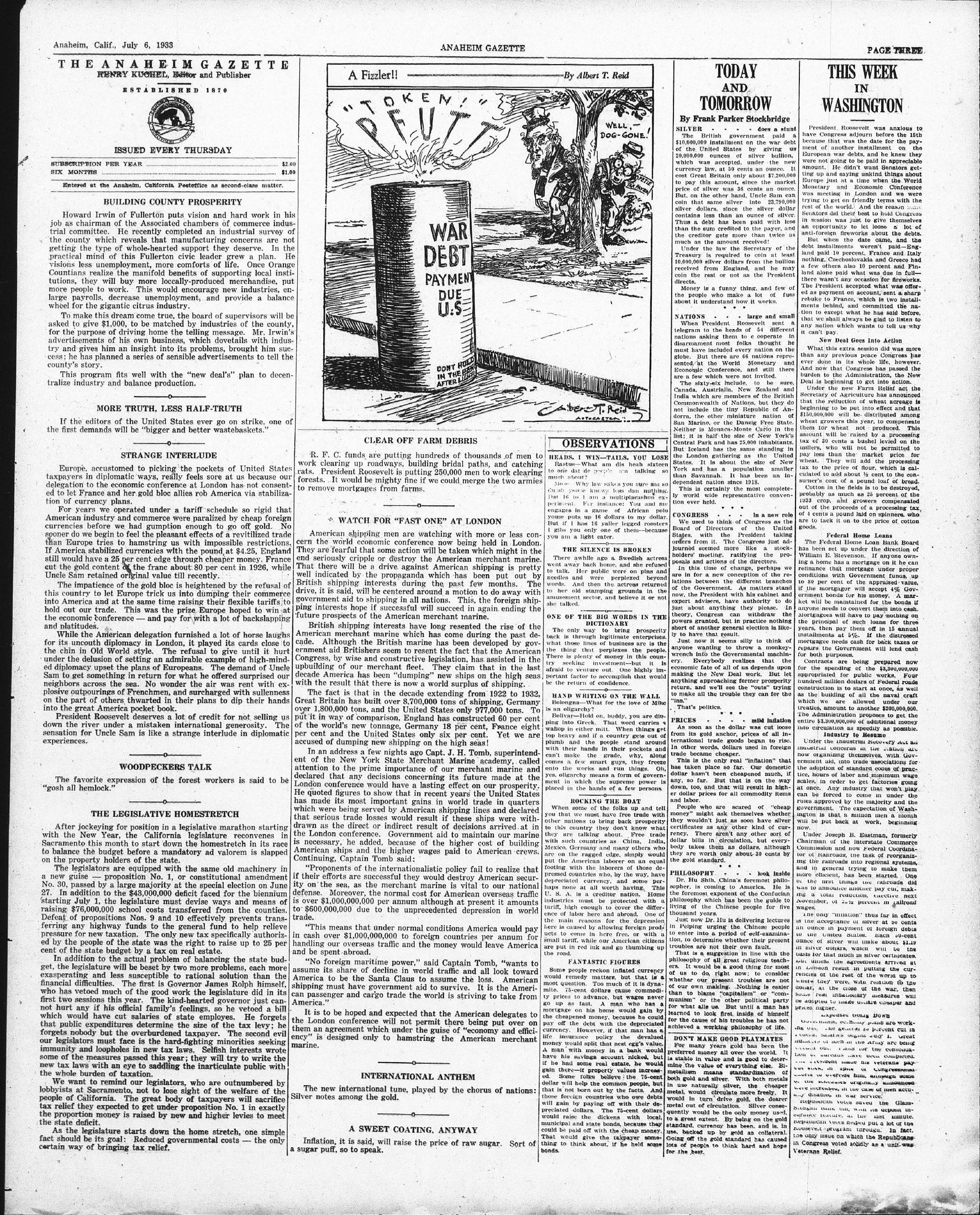
A Fizzler!! By Albert T. Reid
"TOKEN!"
WELL,
DOG-GONE!
WAR
DEBT
PAYMENT
DUE
U.S.
DON'T HOLD
IN THE KENNEL
AFTER LIGHT
CLEAR OFF FARM DEBRIS
OBSERVATIONS
CLEAR OFF FARM DEBRIS
R. F. C. funds are putting hundreds of thousands of men to work clearing up roadways, building bridal paths, and catching rats. President Roosevelt is putting 250,000 men to work clearing forests. It would be mighty fine if we could merge the two armies to remove mortgages from farms.
WATCH FOR "FAST ONE" AT LONDON
American shipping men are watching with more or less concern the world economic conference now being held in London. They are fearful that some action will be taken which might in the end seriously cripple or destroy the American merchant marine. That there will be a drive against American shipping is pretty well indicated by the propaganda which has been put out by British shipping interests during the past few months. The drive, it is said, will be centered around a motion to do away with government aid to shipping in all nations. This, the foreign shipping interests hope if successful will succeed in again ending the future prospects of the American merchant marine.
British shipping interests have long resented the rise of the American merchant marine which has come during the past decade. Although the British marine has been developed by government aid Britishers seem to resent the fact that the American Congress, by wise and constructive legislation, has assisted in the upbuilding of our merchant fleet. They claim that in the last decade America has been "dumping" new ships on the high seas with the result that there is now a world surplus of shipping.
The fact is that in the decade extending from 1922 to 1932, Great Britain has built over 8,700,000 tons of shipping, Germany over 1,800,000 tons, and the United States only 977,000 tons. To put it in way of comparison, England has constructed 60 per cent of the world's new tonnage, Germany 18 per cent, France eight per cent and the United States only six per cent. Yet we are accused of dumping new shipping on the high seas!
In an address a few nights ago Capt. J. H. Tomb, superintendent of the New York State Merchant Marine academy, called attention to the prime importance of our merchant marine and declared that any decisions concerning its future made at the London conference would have a lasting effect on our prosperity. He quoted figures to show that in recent years the United States has made its most important gains in world trade in quarters which were being served by American shipping lines and declared that serious trade losses would result if these ships were withdrawn as the direct or indirect result of decisions arrived at in the London conference. Government aid to maintain our marine is necessary, he added, because of the higher cost of building American ships and the higher wages paid to American crews. Continuing Captain Tomb said:
OBSERVATIONS
HEADS, I WIN—TAILS, YOU LOSE
Rastus—What am dis heah sixteen to one dat de people am talking so much about?
Mose Why law sakes you sure aim so Crabb you see knews less dan nuthing. Dat 16 to 1 am a multiplacushon experiment. For instance: You and me engages in a game of African polo youse puts up 16 dollars to my dollar. But if I has 16 yaller legged roosters I gibs you only one of them—because you am a light eater.
THE SILENCE IS BROKEN
There awhile ago a Swedish actress went away back home, and she refused to talk. Her public were on pins and needles and were perplexed beyond words. And then the actress returned to her old stamping grounds in the amusement sector, and believe it or not she talked.
ONE OF THE BIG WORDS IN THE DICTIONARY
The only way to bring prosperity back is through legitimate enterprises. what those lines of business are is the thing that perplexes the people. There is plenty of money in this country seeking investment—but it is afraid to venture out. One highly important factor to accomplish that would be the return of confidence.
HAND WRITING ON THE WALL
Bolongna—What for the love of Mike is an oligarchy?
Bolvar—Hold on, buddy, you are dipping into Greek. That word carries a wallop in either mitt. When things get top heavy and if a country gets out of plumb and the people stand around with their hands in their pockets and can't make the grade, why, along comes a few smart guys, they freeze onto the works and run things. Oh, yes, oligarchy means a form of government in which the supreme power is placed in the hands of a few persons.
ROCKING THE BOAT
When some of the folks up and tell you that we must have free trade with other nations to bring back prosperity to this country they don't know what they are talking about. Free trade with such countries as China, India, Mexico, Germany and many others who are on the ragged edge, simply would
attention to the prime importance of our merchant marine and declared that any decisions concerning its future made at the London conference would have a lasting effect on our prosperity. He quoted figures to show that in recent years the United States has made its most important gains in world trade in quarters which were being served by American shipping lines and declared that serious trade losses would result if these ships were withdrawn as the direct or indirect result of decisions arrived at in the London conference. Government aid to maintain our marine is necessary, he added, because of the higher cost of building American ships and the higher wages paid to American crews. Continuing, Captain Tomb said:
"Proponents of the internationalistic policy fail to realize that if their efforts are successful they would destroy American security on the sea, as the merchant marine is vital to our national defense. Moreover, the normal cost for American overseas traffic is over $1,000,000,000 per annum although at present it amounts to $600,000,000 due to the unprecedented depression in world trade.
"This means that under normal conditions America would pay in cash over $1,000,000,000 to foreign countries per annum for handling our overseas traffic and the money would leave America and be spent abroad.
"No foreign maritime power," said Captain Tomb, "wants to assume its share of decline in world traffic and all look toward America to be the Santa Claus to assume the loss. American shipping must have government aid to survive. It is the American passenger and cargo trade the world is striving to take from America."
It is to be hoped and expected that the American delegates to the London conference will not permit there being put over on them an agreement which under the guise of "economy and efficiency" is designed only to hamstring the American merchant marine.
INTERNATIONAL ANTHEM
The new international tune, played by the chorus of nations: Silver notes among the gold.
A SWEET COATING, ANYWAY
Inflation, it is said, will raise the price of raw sugar. Sort of a sugar puff, so to speak.
ROCKING THE BOAT
When some of the folks up and tell you that we must have free trade with other nations to bring back prosperity to this country they don't know what they are talking about. Free trade with such countries as China, India, Mexico, Germany and many others who are on the ragged edge, simply would put the American laborer on an equal footing with the laborers of those depressed countries who, by the way, have depreciated currency, and some perhaps none at all worth having. This U. S. A. is a creditor nation. Home industries must be protected with a tariff, high enough to cover the difference of labor here and abroad. One of the main reasons for the depression here is caused by allowing foreign products to come in here free, or with a small tariff, while our American citizens are put in red ink and go thumbing up the road.
FANTASTIC FIGURES
Some people reckon inflated currency would remedy matters, but that is a moot question. Too much of it is dynamic. 75-cent dollars cause commodity prices to advance, but wagees never go up as fast. A man who has a mortgage on his home would gain by the cheapened money, because he could pay off the debt with the depreciated currency. However, if that man has a life insurance policy the devalued money would split that nest egg's value. A man with money in a bank would have his savings account nicked, but if he had some real estate, he would gain there—if property values increased. Some folks believe the 75-cent dollar will help the common people, but that is not born out by the facts. And those foreign countries who owe debts will gain by paying off with their depreciated dollars. The 75-cent dollars would raise the dickens with local, municipal and state bonds, because they could be paid off with the cheap money. That would give the taxpayer something to think about, if he held some bonds.
TODAY AND TOMORROW
By Frank Parker Stockbridge
SILVER does a stunt
The British government paid a $10,000,000 installment on the war debt of the United States by giving us 20,000,000 ounces of silver bullion, which was accepted, under the new currency law, at 50 cents an ounce. It cost Great Britain only about $7,200,000 to pay this amount, since the market price of silver was 36 cents an ounce. But, on the other hand, Uncle Sam can coin that same silver into 23,790,000 silver dollars, since the silver dollar contains less than an ounce of silver. Thus a debt has been paid with less than the sum credited to the payer, and the creditor gets more than twice as much as the amount received!
Under the law the Secretary of the Treasury is required to coin at least 10,000,000 silver dollars from the bullion received from England, and he may coin the rest or not as the President directs.
Money is a funny thing, and few of the people who make a lot of fuss about it understand how it works.
NATIONS large and small
When President Roosevelt sent a telegram to the heads of 54 different nations asking them to cooperate in disarmament most folks thought he must have included every nation on the globe. But there are 66 nations represented at the World Monetary and Economic Conference, and still there are a few which were not invited.
The sixty-six include, to be sure, Canada, Austrialia, New Zealand and India which are members of the British Commonwealth of Nations, but they do not include the tiny Republic of Andorra, the other miniature nation of San Marino, or the Danzig Free State. Neither is Monaca-Monte Carlo in the list; it is half the size of New York's Central Park and has 25,000 inhabitants. But Iceland has the same standing in
THIS WEEK IN WASHINGTON
President Roosevelt was anxious to have Congress adjourn before the 15th because that was the date for the payment of another installment on the European war debts, and he knew they were not going to be paid in appreciable amount. He didn't want Senators getting up and saying unkind things about Europe just at a time when the World Monetary and Economic Conference was meeting in London and we were trying to get on friendly terms with the rest of the world. And the reason some Senators did their best to hold Congress in session was just to give themselves an opportunity to let loose a lot of anti-foreign fireworks about the debts.
But when the date came, and the debt installments weren't paid—England paid 10 percent, France and Italy nothing, Czechoslovakia and Greece had a few others also 10 percent and Finland alone paid what was due in full—there wasn't any occasion for fireworks. The President accepted what was offered as payment on account, sent a sharp rebuke to France, which is two installments behind, and committed the nation to except what he has said before, that we shall always be glad to listen to any nation which wants to tell us why it can't pay.
New Deal Goes Into Action
What this extra session did was more than any previous peace Congress has ever done in its whole life, however. And now that Congress has passed the burden to the Administration, the New Deal is beginning to get into action.
Under the new Farm Relief act the Secretary of Agriculture has announced that the reduction of wheat acreage is beginning to be put into effect and that $150,000,000 will be distributed among wheat growers this year, to compensate them for wheat not produced. This amount will be raised by a processing tax of 30 cents a bushel levied on the millers, who will not be permitted to
NATIONS
AILS, YOU LOSE
dills heah sixteen
can talking so
s you sure am so
less dan nuthing,
multiplacashon exence: You and me
of African polo
dars to my dollar,
or legged roosters
of them—because
IS BROKEN
Swedish actress
and she refused
were on pins and
interplexed beyond
actress returned
grounds in the
believe it or not
WORDS IN THE
MARY
bring prosperity
climate enterprises.
business are is the
exes the people.
money in this coument—but it is
One highly imemplish that would
valence.
IN THE WALL
the love of Mike
dddy, you are dint word carries a
When things get out of
the stand around
their pockets and
de, why, along
guys, they freeze
run things. Oh,
a form of governsupreme power is
a few persons.
LE BOAT
volks up and tell
free trade with
back prosperity
don't know what
out. Free trade
is China, India,
many others who
age, simply would
THE SIXTY-SIX include, to be sure,
Canada, Austrialia, New Zealand and India which are members of the British Commonwealth of Nations, but they do not include the tiny Republic of Andorra, the other miniature nation of San Marino, or the Danzig Free State.
Neither is Monaca-Monte Carlo in the list; it is half the size of New York's Central Park and has 25,000 inhabitants.
But Iceland has the same standing in the London gathering as the United States. It is about the size of New York and has a population smaller than Savannah. It has been an independent nation since 1918.
This is certainly the most completely world wide representative convention ever held.
CONGRESS
In a new role
We used to think of Congress as the Board of Directors of the United States, with the President taking orders from it. The Congress just adjourned seemed more like a stockholders' meeting, ratifying the proposals and actions of the directors.
In this time of change, perhaps we are in for a new conception of the relations between the different branches of the Government. As matters stand now, the President with his cabinet and expert advisers, have authority to do just about anything they please. In theory, Congress can withdraw the powers granted, but in practice nothing short of another general election is likely to have that result.
Just now it seems silly to think of anyone wanting to throw a monkey-wrench into the Governmental machinery. Everybody realizes that the economic fate of all of us depends upon making the New Deal work. But let anything approaching former prosperity return, and we'll see the "outs" trying to make all the trouble they can for the "ins."
That's politics.
PRICES
mild inflation
As soon as the dollar was cut loose from its gold anchor, prices of all international trade goods began to rise. In other words, dollars used in foreign trade became cheaper.
This is the only real "inflation" that has taken place so far. Our domestic dollar hasn't been cheapened much, if any, so far. But that is on the way down, too, and that will result in higher dollar prices for all commodity items and labor.
People who are scared of "cheap money" might ask themselves whether they wouldn't just as soon have silver certificates as any other kind of currency. There aren't any other sort of dollar bills in circulation, but everybody takes them as dollars, although they are worth only about 30 cents by ever done in its whole life, however.
And now that Congress has passed the burden to the Administration, the New Deal is beginning to get into action.
Under the new Farm Relief act the Secretary of Agriculture has announced that the reduction of wheat acreage is beginning to be put into effect and that $150,000,000 will be distributed among wheat growers this year, to compensate them for wheat not produced. This amount will be raised by a processing tax of 30 cents a bushel levied on the millers, who will not be permitted to pay less than the market price for wheat. They will add the processing tax to the price of flour, which is calculated to add about ½ cent to the consumer's cost of a pound loaf of bread.
Cotton in the fields is to be destroyed, probably as much as 25 percent of the 1933 crop, and growers compensated out of the proceeds of a processing tax of 4 cents a pound laid on spinners, who are to tack it on to the price of cotton goods.
Federal Home Loans
The Federal Home Loan Bank Board has been set up under the direction of William E. Stevenson. If anyone owning a home has a mortgage on it he can refinance that mortgage under proper conditions with Government funds, up to 80 per cent of the appraised value, if the mortgagor will accept 4% Government bonds for his money. A market will be maintained for the bonds if anyone needs to convert them into cash. Mortgagees will have to pay nothing on the principal of such loans for three years, then pay them off in 15 annual installments at 5%. If the distressed mortgagee needs cash for back taxes or repairs the Government will lend cash for both purposes.
Contracts are being prepared now for the spending of the $3,300,000,000 appropriated for public works. Four hundred million dollars of Federal roads construction is to start at once, as well as the building of all the naval craft which we are allowed under our treaties, amount to another $200,000,000. The Administration proposes to get the entire $3,300,000,000 of additional money into circulation as speedily as possible.
Industry to Resume
Under the industrial Recovery Act all industrial concerns in the Nation are now organizing themselves, with Government aid, into trade associations for the adoption of standard codes of practice, hours of labor and minimum wage scales, in order to get factories going at once. Any industry that won't play can be forced to come in under the rules approved by the majority and the government. The expectation of Washington is that a million men a month will be put back at work, beginning now.
Under Joseph B. Eastman, formerly Chairman of the interstate Commerce Commission and now Federal Coordinator of Railroads, the task of reorganiz-
BE BOAT
volks up and tell
the free trade with
the back prosperity
don't know what
out. Free trade
is China, India,
many others who
have, simply would
order on an equal
terms of those deby the way, have
and some perhaving. This
nation. Home
protected with a
cover the differeble abroad. One of
the depression
ing foreign prodfree, or with a
American citizens
go thumbing up
FIGURES
inflated currency
but that is a
much of it is dynabecause commodibut wages never
man who has a
would gain by
because he could
the depreciated
that man has a
the devalued
nest egg's value.
In a bank would
not nicked, but
state, he would
values increase
the 75-cent
mon people, but
the facts. And
who owe debts
with their de75-cent dollars
ins with local,
ads, because they
cheap money.
taxpayer someof he held some
PHILOSOPHY
look inside
Dr. Hu Shih, China's foremost philosopher, is coming to America. He is the foremost exponent of the Confucian philosophy which has been the guide to living of the Chinese people for five thousand years.
Just now Dr. Hu is delivering lectures in Peiping urging the Chinese people to enter into a period of self-examination, to determine whether their present troubles are not their own fault.
That is a suggestion in line with the philosophy of all great religious teachers. It would be a good thing for most of us to do, right now; to consider whether our present troubles are not of our own making. Nothing is easier than to blame "capitalism" or "communism" or the other political party for what alle use. But until a man has learned to look first, inside of himself for the cause of his troubles he has not achieved a working philosophy of life.
DON'T MAKE GOOD PLAYMATES
For many years gold has been the preferred money all over the world. It is stable in value and is good to determine the value of everything else. Bi-metallism means standardization of both gold and silver. With both metals in use naturally silver, the cheaper metal, would circulate more freely. It would in turn drive gold, the dearer metal out of circulation. Silver consequently would be the only money used to a great extent. By being on the gold standard, currency has been, and is, in use, backed up by gold as collateral. Going off the gold standard has caused lots of people to think hard and hope for the best.
The only "innation" thus far in effect is the acceptance of silver at 90 cents an ounce in payment of foreign debts to the United States. Each 90-cent ounce of silver will make about $1.19 in silver dollars, which will be the basis for that much in silver certificates. But unless the agreements arrived at in London result in putting the currencies of the rest of the world up where they were, with relation to the dollar, at the close of the war, then some real inflationary measures will be adopted to make dollars cheaper and prices higher.
Expenses Going Down
Government economy plans are work- ing out. The general 10 percent cut in current salaries begins July 1. Great numbers of men in the army are being worked out. Plans for the consummation of curfews have been completed. President made his veterans pay cut stock, in spite of congressional efforts to override him, although some of the sanctions originally announced were increased, in the case of men actually disabled in war service.
Republican votes saved the Glass-Stegan bank bill, with its deposit insurance feature, at the last minute. Republican votes helped put a lot of the Roosevelt program through. In fact, the only issue on which the Republicans in Congress voted solidly as a unit was Veterans Relief.