anaheim-gazette 1933-06-29
Scanned page
Searchable text
THE ANAHEIM GAZETTE
HENRY KUCHEL, Editor and Publisher
ESTABLISHED 1870
ISSUED EVERY THURSDAY
SUBSCRIPTION PER YEAR $2.00
SIX MONTHS $1.00
Entered at the Anaheim, California Postoffice as second-class matter.
DRY ZEAL DEFEATS ITS OWN ENDS
We admire persons possessing the courage to fight for their convictions. The effectiveness of their campaigns, however, depends upon two general conditions: First, the fundamental truths presented, and secondly, the reasonableness with which they advance their cause.
To the second of these precepts we wish to call the attention of the dry forces of the county. We have no quarrel with the ideals of prohibition, much as we might differ in method through which temperance may be achieved. As a matter of fact, we are anxious to promote temperance. In this friendly spirit we suggest that the leaders of the dry forces of Orange county set an example of reasonableness to their fellow workers throughout the nation.
To do the just and reasonable act is not always easy. Often it is hard to be fair, especially when the tide of public opinion seems to be turning in the opposite direction. Under duress, the less competent prohibition leaders are apt to forget their desire for temperance, and intemperately recommend anti-liberal boycotts. Boycotts have been threatened and even attempted in Orange county. In one case, some ministers of Fullerton went to the extreme of pitting a Santa Ana newspaper against the home product, because the home paper did not honestly believe that sale of beer would ruin Fullerton. While there was some element of altruism in the Santa Ana paper's stand, the basic reason it entered the fight was selfish. The ministers' position in this instance is much like that of an angry parent spanking his child simply because the parent did not have resourcefulness enough to cope with the problem in rational ways. In short, that attitude in itself is an admission of defeat. Fear may produce temporary, but never permanent results.
Orange county. In one case, some ministers of Fullerton went to the extreme of pitting a Santa Ana newspaper against the home product, because the home paper did not honestly believe that sale of beer would ruin Fullerton. While there was some element of altruism in the Santa Ana paper's stand, the basic reason it entered the fight was selfish. The ministers' position in this instance is much like that of an angry parent spanking his child simply because the parent did not have resourcefulness enough to cope with the problem in rational ways. In short, that attitude in itself is an admission of defeat. Fear may produce temporary, but never permanent results.
We do not believe prohibition ever should have stalked the national political stage. But since it has, the drys must abide by the rules of politics, the fundamentals of which have been developed in such liberal documents as the Magna Carta, the Bill of Rights, and the underlying principle of open forum which preceded the adoption of our own constitution. The outcome of these documents is a sportsmanship in politics which insists on fair play for both sides. Each side may play the game as hard as possible, but the moment the public suspects that economic pressure or force is being brought to bear to force a favorable reaction, the people rise up in peaceful rebellion. They discountenance unfair practices. That is why boycotts, in the long run, invariably fail.
The weakness of the dry campaigns of late has been their resort to force. Failure to procure a majority by logic and reason prompts zealous leaders to advocate boycott. The weakness of the entire prohibition history is that it entered politics with an essentially moral problem; leaders erroneously figured upon a Dry Utopia when the eighteenth amendment was passed. Prohibitionists fought for legislative action forgetting that the unwritten law more accurately mirrors and controls the morals of our times.
We want to suggest to the dry leaders of the county that they will get farther and receive a greater welcome if they will forget threats and boycotts, and enter upon private and public discussion with tolerance and consideration.
HE STICKS TO HIS SONG, ANYWAY
Senator Pittman, enroute for the economic conference, says that he is not for free and unlimited coinage of silver but is in favor of a monetary reserve which partly would be made up of the white metal. Sort of silver threads among the gold, as it were.
F. D. R.'S BUSY SEASON
President Roosevelt promises to be a busy man this summer. In fact, it appears he will be the busiest peace-time president in our history. Before adjourning, congress heaped upon the chief executive powers unheard of in peace times in America; powers to control every phase of our national life, financial, agricultural, industrial and social.
Fortunately, President Roosevelt is given wide latitude. He may use his own judgment in "making over" our national fabric along the 14 following lines:
1—Make heavy reductions in acreage devoted to farming.
2—Levy a tax on processors of agricultural products.
President Roosevelt promises to be a busy man this summer. In fact, it appears he will be the busiest peace-time president in our history. Before adjourning, congress heaped upon the chief executive powers unheard of in peace times in America; powers to control every phase of our national life, financial, agricultural, industrial and social.
Fortunately, President Roosevelt is given wide latitude. He may use his own judgment in "making over" our national fabric along the 14 following lines:
1—Make heavy reductions in acreage devoted to farming.
2—Levy a tax on processors of agricultural products.
3—Fix minimum hours and minimum wages for industrial employees, with licensing of business enterprises.
4—Spend up to $3,300,000,000 on construction of public and semi-public improvements.
5—Spend up to $250,000,000 on maintenance of civilian conservation corps.
6—Modify or suspend anti-trust laws when industries come to agreements among themselves satisfactory to him.
7—Fix pensions for war veterans, and their dependents, and to change existing pension regulations.
8—Raise or lower the wages of federal employes on the basis of the rise and fall in the purchasing power of the dollar.
9—Legalize or outlaw the possession of monetary gold stocks by American citizens, place an embargo on the exportation of gold, and require licenses to engage in foreign exchange transactions.
10—Direct the federal reserve banks to purchase up to $2,000,-000,000 in government obligations.
11—Fix the gold content of the dollar at any level between 50 and 100 per cent of the present content.
12—Embargo commodity imports, raise tariffs, or fix import quotas as he may consider necessary to protect American industry from foreign competition.
13—Cancel or annul existing air and ocean mail contracts containing subventions to carriers.
14—Raise or lower charges for mail service within certain narrow limits.
Every American, regardless of politics, wishes the president success in his gigantic undertaking.
SUCH IS FAME!
One of our friends, who was six years old when the World's fair was held in Chicago 40 years ago, says that all he can remember of a three-day visit to the Columbian exposition is that he got his first drink of orangeade there.
ANAHEIM GAZETTE
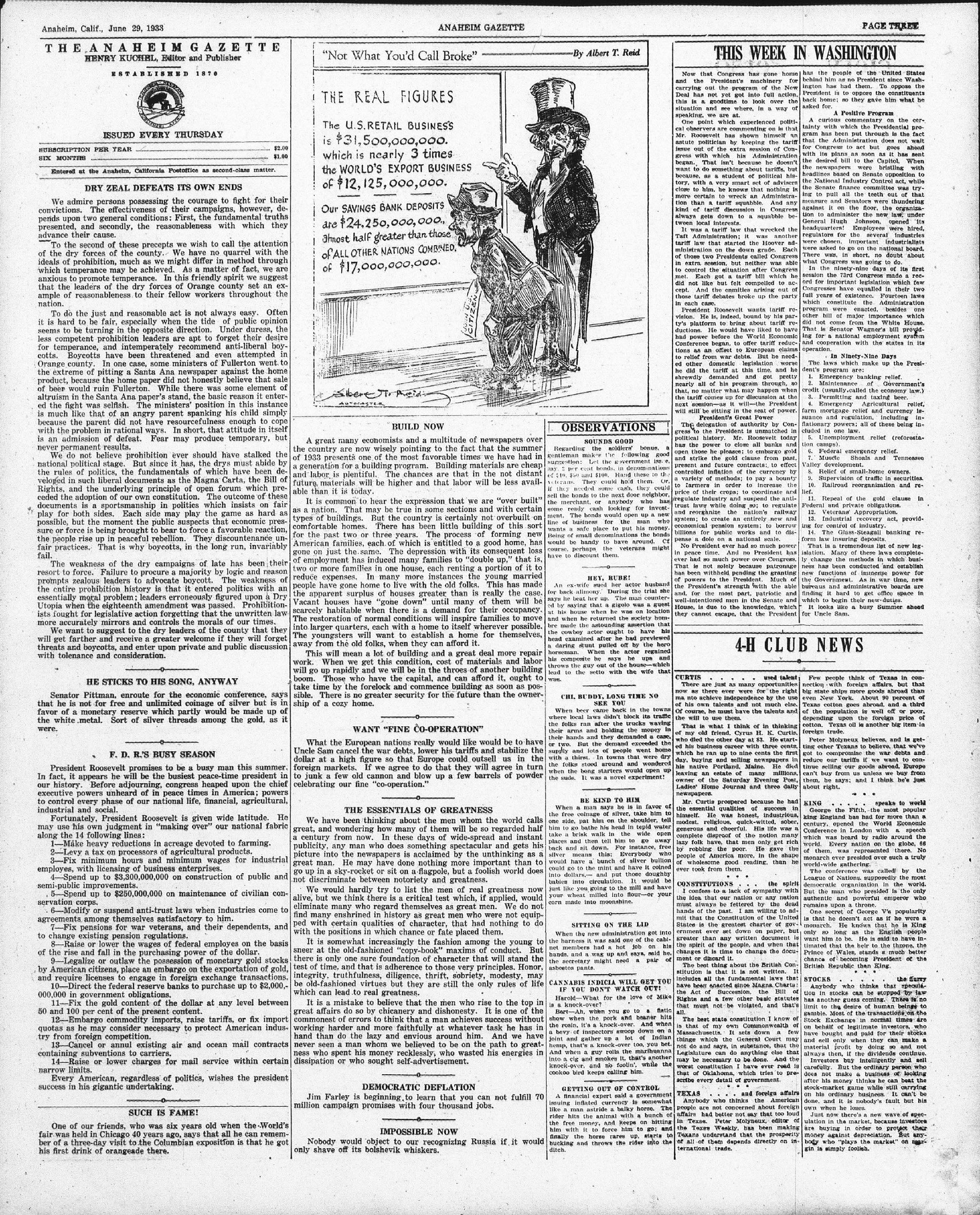
"Not What You'd Call Broke" By Albert T. Reid
THE REAL FIGURES
The U.S. RETAIL BUSINESS is $31,500,000,000. which is nearly 3 times the WORLD'S EXPORT BUSINESS of $12,125,000,000.
Our SAVINGS BANK DEPOSITS are $24,250,000,000., almost half greater than those of ALL OTHER NATIONS COMBINED, of $17,000,000,000.
BUILD NOW
A great many economists and a multitude of newspapers over the country are now wisely pointing to the fact that the summer
OBSERVATIONS
SOUNDS GOOD
Regarding the soldiers' bonus.
BUILD NOW
A great many economists and a multitude of newspapers over the country are now wisely pointing to the fact that the summer of 1933 presents one of the most favorable times we have had in a generation for a building program. Building materials are cheap and labor is plentiful. The chances are that in the not distant future materials will be higher and that labor will be less available than it is today.
It is common to hear the expression that we are "over built" as a nation. That may be true in some sections and with certain types of buildings. But the country is certainly not overbuilt on comfortable homes. There has been little building of this sort for the past two or three years. The process of forming new American families, each of which is entitled to a good home, has gone on just the same. The depression with its consequent loss of employment has induced many families to "double up," that is, two or more families in one house, each renting a portion of it to reduce expenses. In many more instances the young married people have gone home to live with the old folks. This has made the apparent surplus of houses greater than is really the case. Vacant houses have "gone down" until many of them will be scarcely habitable when there is a demand for their occupancy. The restoration of normal conditions will inspire families to move into larger quarters, each with a home to itself wherever possible. The youngsters will want to establish a home for themselves, away from the old folks, when they can afford it.
This will mean a lot of building and a great deal more repair work. When we get this condition, cost of materials and labor will go up rapidly and we will be in the throes of another building boom. Those who have the capital, and can afford it, ought to take time by the forelock and commence building as soon as possible. There is no greater security for the future than the ownership of a cozy home.
WANT "FINE CO-OPERATION"
What the European nations really would like would be to have Uncle Sam cancel the war debts, lower his tariffs and stabilize the dollar at a high figure so that Europe could outsell us in the foreign markets. If we agree to do that they will agree in turn to junk a few old cannon and blow up a few barrels of powder celebrating our fine "co-operation."
THE ESSENTIALS OF GREATNESS
We have been thinking about the men whom the world calls great, and wondering how many of them will be so regarded half a century from now. In these days of wide-spread and instant publicity, any man who does something spectacular and gets his picture into the newspapers is acclaimed by the unthinking as a
OBSERVATIONS
SOUNDS GOOD
Regarding the soldiers' bonus, a gentleman makes the following good suggestion: Let the government issue say, 2 per cent bonds, in denominations of $10, $50 and $100. Hand these to the veterans. They could hold them. Or, if they needed some cash, they could sell the bonds to the next door neighbor, the merchant, or anybody who has some ready cash looking for investment. The bonds would open up a new line of business for the man who wants a safe place to put his money. Being of small denominations the bonds would be handy to have around. Of course, perhaps the veterans might have to discount them.
HEY, RUBE!
An ex-wife sued her actor husband for back alimony. During the trial she says he beat her up. The man countered by saying that a gigolo was a guest at his house when he was on location and when he returned the society hombre made the astounding assertion that the cowboy actor ought to have his head examined after he had previewed a daring stunt pulled off by the hero horseman. When the actor regained his composite he says he ups and throws the guy out of the house—which lead to the setto with the wife that was.
CHI, BUDDY, LONG TIME NO SEE YOU
When beer came back in the towns where local laws didn't block its traffic the folks ran after the trucks waving their arms and holding the money in their hands and they demanded a case, or two. But the demand exceeded the supply and lots of people went home with a thirst. In towns that were dry the folks stood around and wondered when the bong starters would open up the suds. It was a novel experiment!
BE KIND TO HIM
When a man says he is in favor of the free coinage of silver, take him to one side, pat him on the shoulder, tell him to go bathe his head in tepid water take a brisk walk in the wide open places and then tell him to go away back and sit down. For instance, free silver means this: Everybody who
THE ESSENTIALS OF GREATNESS
We have been thinking about the men whom the world calls great, and wondering how many of them will be so regarded half a century from now. In these days of wide-spread and instant publicity, any man who does something spectacular and gets his picture into the newspapers is acclaimed by the unthinking as a great man. He may have done nothing more important than to go up in a sky-rocket or sit on a flagpole, but a foolish world does not discriminate between notoriety and greatness.
We would hardly try to list the men of real greatness now alive, but we think there is a critical test which, if applied, would eliminate many who regard themselves as great men. We do not find many enshrined in history as great men who were not equipped with certain qualities of character, that had nothing to do with the positions in which chance or fate placed them.
It is somewhat increasingly the fashion among the young to sneer at the old-fashioned "copy-book" maxims of conduct. But there is only one sure foundation of character that will stand the test of time, and that is adherence to those very principles. Honor, integrity, truthfulness, diligence, thrift, sobriety, modesty, may be old-fashioned virtues but they are still the only rules of life which can lead to real greatness.
It is a mistake to believe that the men who rise to the top in great affairs do so by chicanery and dishonesty. It is one of the commonest of errors to think that a man achieves success without working harder and more faithfully at whatever task he has in hand than do the lazy and envious around him. And we have never seen a man whom we believed to be on the path to greatness who spent his money recklessly, who wasted his energies in dissipation or who sought self-advertisement.
DEMOCRATIC DEFLATION
Jim Farley is beginning to learn that you can not fulfill 70 million campaign promises with four thousand jobs.
IMPOSSIBLE NOW
Nobody would object to our recognizing Russia if it would only shave off its bolshevik whiskers.
THIS WEEK IN WASHINGTON
Now that Congress has gone home and the President's machinery for carrying out the program of the New Deal has not yet got into full action, this is a goodtime to look over the situation and see where, in a way of speaking, we are at.
One point which experienced political observers are commenting on is that Mr. Roosevelt has shown himself an astute politician by keeping the tariff issue out of the extra session of Congress with which his Administration began. That isn't because he doesn't want to do something about tariffs, but because, as a student of political history, with a very smart set of advisers close to him, he knows that nothing is more certain to wreck an Administration than a tariff squabble. And any kind of tariff discussion in Congress always gets down to a squabble between local interests.
It was a tariff law that wrecked the Taft Administration; it was another tariff law that started the Hoover administration on the down grade. Each of those two Presidents called Congress in extra session, but neither was able to control the situation after Congress met. Each got a tariff bill which he did not like but felt compelled to accept. And the enemies arising out of those tariff debates broke up the party in each case.
President Roosevelt wants tariff revision. He is, indeed, bound by his party's platform to bring about tariff reductions. He would have liked to have had power before the World Economic Conference began, to offer tariff reductions as an offset to European claims to relief from war debts. But he needed other domestic legislation worse he did the tariff at this time, and he shrewdly demanded and got pretty nearly all of his program through, so that, no matter what may happen when the tariff comes up for discussion at the next session—as it will—the President will still be sitting in the seat of power.
President's Great Power
The delegation of authority by Congress to the President is unmatched in political history. Mr. Roosevelt today has the power to close all banks and open those he pleases; to embargo gold has the people of the United States behind him as no President since Washington has had them. To oppose the President is to oppose the constituents back home; so they gave him what he asked for.
A Positive Program
A curious commentary on the certainty with which the Presidential program has been put through is the fact that the Administration does not wait for Congress to act but goes ahead with its plans as soon as it has sent the desired bill to the Capitol. When the newspapers were bristling with headlines based on Senate opposition to the National Industry Control act, while the Senate finance committee was trying to pull all the teeth out of that measure and Senators were thundering against it on the floor, the organization to administer the new law, under General Hugh Johnson, opened its headquarters! Employees were hired, regulators for the several industries were chosen, important industrialists were asked to go on the national board. There was, in short, no doubt about what Congress was going to do.
In the ninety-nine days of its first session the 73rd Congress made a record for important legislation which few Congresses have equalled in their two full years of existence. Fourteen laws which constitute the Administration program were enacted, besides one other bill of major importance which did not come from the White House. That is Senator Wagner's bill providing for a national employment system and cooperation with the states in its operation.
In Ninety-Nine Days
The laws which make up the President's program are:
1. Emergency banking relief.
2. Maintenance of Government's credit (usually called the economy law.)
3. Permitting and taxing beer.
4. Emergency Agricultural relief, farm mortgage relief and currency issuance and regulation, including inflationary powers; all of these being included in one law.
5. Unemployment relief (reforestation camps).
6. Federal emergency relief.
MATIONS
GOOD
militers' bonus, a
following good
government issue,
in denominations
Hand these to the
hold them. Or,
cash, they could
next door neighbor,
anybody who has
looking for investhold open up a new
man who
put his money.
inations the bonds
have around. Cf
veterans might
UBE!
other actor husband
during the trial she
The man counterrigolo was a guest
was on location
and the society homling assertion that
right to have his
he had previewed
off by the hero
the actor regained
days he ups and
of the house—which
with the wife that
ONG TIME NO YOU
back in the towns
n't block its traffic
the trucks waving
the money in
demanded a case,
mand exceeded the
people went home
owns that were dry
and wondered
would open up
novel experiment!
TO HIM
he is in favor of
silver, take him to
the shoulder, tell
head in tepid water
the wide open
him to go away
For instance, free Everybody who
4-H CLUB NEWS
CURTIS ... used talent
There are just as many opportunities now as there ever were for the right ma nto achieve independence by the use of his own talents and not much else. Of course, he must have the talents and the will to use them.
That is what I think of in thinking of my old friend, Cyrus H. K. Curtis, who died the other day at 83. He started his business career with three cents, which he ran up to nine cents the first day, buying and selling newspapers in his native Portland, Maine. He died leaving an estate of many millions, owner of the Saturday Evening Post, Ladies' Home Journal and three daily newspapers.
Mr. Curtis prospered because he had the essential qualities of success in himself. He was honest, industrious, modest, religious, quick-witted, sober, generous and cheerful. His life was a complete disproof of the notion many lazy folk have, that men only get rich by robbing the poor. He gave the people of America more, in the shape
Few people think of Texas in connection with foreign affairs, but that big state ships more goods abroad than even New York. About 90 percent of Texas cotton goes abroad, and a third of the population is well off or poor, depending upon the foreign price of cotton. Texas oil is another big item in foreign trade.
Peter Molyneux believes, and is getting other Texans to believe, that we've got to compromise the war debts and reduce our tariffs if we want to continue selling our goods abroad. Europe can't buy from us unless we buy from them, he says; and I think he's just about right.
KING ... speaks to world
George the Fifth, the most popular king England has had for more than a century, opened the World Economic Conference in London with a speech which was heard by radio around the world. Every nation on the globe, 66 of them, was represented there. No monarch ever presided over such a truly
TO HIM
he is in favor of silver, take him to the shoulder, tell me the wide open him to go away. For instance, free Everybody who has of silver bullion and have it coined out those doughby coin. It would be the mill and have unto flour—or your sunshine.
THE LID
ministration got into hold one of the cabi- hot job on his hand and says, said he, we need a pair ofCONSTITUTIONS . . . the spirit
I confess to a lack of sympathy with the idea that our nation or any nation must always be fettered by the dead hands of the past. I am willing to admit that the Constitution of the United States is the greatest charter of government ever set down on paper, but greater than any written document is the spirit of the people, and when that changes it is time to change the document or discard it.
The best thing about the British Constitution is that it is not written. It includes all the fundamental laws that have been enacted since Magna Charta: the Act of Succession, the Bill of Rights and a few other basic statutes that must not be violated, and that's all.
The best state constitution I know of is that of my own Commonwealth of Massachusetts. It sets down a few things which the General Court may not do and says, in substance, that the Legislature can do anything else that may be necessary to be done. And the worst constitution I have ever read is that of Oklahoma, which tries to prescribe every detail of government.
TEXAS . . . and foreign affairs
Anybody who thinks the American people are not concerned about foreign affairs had better not say that too loud in Texas. Peter Molyneux, editor of the Texas Weekly, has been making Texans understand that the prosperity of all of them depends directly on international trade.
KING . . . speaks to world
George the Fifth, the most popular king England has had for more than a century, opened the World Economic Conference in London with a speech which was heard by radio around the world. Every nation on the globe, 66 of them, was represented there. No monarch ever presided over such a truly world-wide gathering.
The conference was called by the League of Nations, supposedly the most democratic organization in the world. But the man who presided is the only authentic and powerful emperor who remains upon a throne.
One secret of George V's popularity is that he doesn't act as if he were a monarch. He knows that he is King only so long as the English people want him to be. He is said to have intimated that the heir to the throne, the Prince of Wales, stands a much better chance of becoming President of the British Republic than King.
STOCKS . . . the furry
Anybody who thinks that speculation in stocks can be stopped by law has another guess coming. There is no limit to the desire of human beings to gamble. Most of the transactions on the Stock Exchange in normal times are on behalf of legitimate investors, who have bought and paid for their stocks and sell only when they can make a material profit by doing so and not always then, if the dividends continue.
Investors buy intelligently and sell carefully. But the ordinary person who does not make a business of looking after his money thinks he can beat the stock-market game while still carrying on his ordinary business. It can't be done, and it is nobody's fault but his own when he loses.
Just now there's a new wave of speculation in the market, because investors are buying in order to protect their money against depreciation. But anybody who "plays the market" on margin is simply foolish.