anaheim-gazette 1933-06-22
Scanned page
Searchable text
THE ANAHEIM GAZEITE
HENRY KUCHEL, Editor and Publisher
ESTABLISHED 1870
ISSUED EVERY THURSDAY
SUBSCRIPTION PER YEAR ... $2.00
SIX MONTHS ... $1.00
Entered at the Anaheim, California Postoffice as second-class matter.
KNOW YOUR PROPOSITIONS
No. 1—Encourages governmental extravagance.
After a lot of hocus-pocus, vote-catching phrases, proposition No. 1 simmers down to an attempt to get the people of California to place their stamp of approval on a plan to increase taxes.
Although the proposition is labeled as the Riley-Stewart "tax relief" measure, it affords relief in only two ways—and then provides for a "morning after" awakening that certainly would rile the taxpayers clear down to their boots. The chief claim to "relief" is that it proposes to shift mandatory county schools costs to the state, thus "relieving" real and personal property of the county school taxes. As a matter of fact, there would be some saving on real property taxes, but the only persons who would benefit would be large corporations, large property-owners, and absentee land-owners. In the first two instances, they would pay much less under a sales tax than the reduction in real property taxes would amount to. Then, loopholes (and the new law is full of them) would allow additional savings. The absentee land-owner would have a clear saving. The individual who owns property assessed at less than $20,000 would make up the difference. Under a two-cent sales tax as proposed, and spending $1500 a year, the average person would pay into the coffers of the state $30. On property assessed at $6,000 the tax saving would be $9.66. Thus the net loss by the new tax to that person would be $20.34!
In considering the tax relief measure, first understand that it provides for the state to levy an ad valorem tax to raise not more than 25 per cent of its total budget! Since the additional manatory school costs assumed by the state would be $77,000,000, and a
of them) would allow additional savings. The absentee land-owner would have a clear saving. The individual who owns property assessed at less than $20,000 would make up the difference. Under a two-cent sales tax as proposed, and spending $1500 a year, the average person would pay into the coffers of the state $30. On property assessed at $6,000 the tax saving would be $9.66. Thus the net loss by the new tax to that person would be $20.34!
In considering the tax relief measure, first understand that it provides for the state to levy an ad valorem tax to raise not more than 25 per cent of its total budget! Since the additional manatory school costs assumed by the state would be $77,000,000, and a two-cent sales tax would raise $2,000,000 less than that amount; since the budget this year is in the "red" $10,000,000; since utility taxes increased at the lest session of the legislature have failed to produce the expected revenue the legislature will be forced to take advantage of the ad valorem tax feature under the new law. Hence, savings on real property taxes would be much less than expected. The argument that we should approve proposition No. 1 in order to prevent an ad valorem tax is just so much hot air.
Other features of the bill are just as misleading. In the first place, it sets up permissable five per cent increases in city, county, and state government. The legislature has shown its weakness by failing to meet the demands of the people for economy. Now comes a permissive increase proposal which is tantamount to an invitation to increase. Even that restriction on increase is not real because it allows the legislature to alter the provision at will, and requires action in this regard by 1935. Provisions demanding certain annual reductions in government expenses would be much more to the point.
Another misleading idea the bill fosters is that it would give the legislators the right to levy an income or sales tax. They already have that right. We do not need to pass the bill to give them this power. Truth of the matter is, the legislature has been too weak-kneed to balance the state budget, either by reducing expenditures to present income, or raising taxes to meet expenditures.
Like a disobedient child, the legislature should be sent back to Sacramento to accomplish what it was told to do by the people last November—cut expenses. If the taxpayers are not to be further abused, they must spank their lobby-ridden legislature by a thumping "No" vote on proposition No. 1. Let the legislators know who is boss.
We want economy, not extravagance.
No. 2—Unemployment relief bond issue.
This proposition provides for a $20,000,000 unemployment bond issue to be loaned by the state to the cities and counties.
Basically, this measure simply allows Californians to get their finger in the R. F. C. unemployment pie. Since the nation is committed to unemployment relief in this manner, and since we will be taxed in the next decade to pay this bill whether or not we partake of the present fruits, we believe that for self protection we should approve the proposition. It sets up the machinery through which counties can get the R. F. C. loans, which will be paid back by withholding state highway subventions to the counties and borrowing cities.
Here too, there is the further consideration of lending a helping hand to thousands of families throughout the state who need the necessities of life. This bond issue will allow us to extend allow our sympathies of the measure claims rates now being born what cost! The state bonds, which mean through taxes the price we recommend
No. 7—Speeds up b
Proposition No.
ures, passed by the effect 90 days after
Out of generosity own mind, we recom
No. 8—County-cont
Proposition No.
regulate employment supervisors, district courts.
The only fault enough. It takes an error the power to county officials share with the county and It partially returns affairs.
Nos. 9 and 10—Ma
Both of these pro way bond issues dur department is spent state government p
No. 9 asks that (now surplus in theral fund for the p money already paid issues voted in 1870 biennium, 1933-35, o a quarter of a million
These are fair p as we are undergoing pouring more money cation, especially wi ing number of auto
We recommend
CO
Writers on econo pointing to the fac
They show that ma
Basically, this measure simply allows Californians to get their finger in the R. F. C. unemployment pie. Since the nation is committed to unemployment relief in this manner, and since we will be taxed in the next decade to pay this bill whether or not we partake of the present fruits, we believe that for self protection we should approve the proposition. It sets up the machinery through which counties can get the R. F. C. loans, which will be paid back by withholding state highway subventions to the counties and borrowing cities.
Here too, there is the further consideration of lending a helping hand to thousands of families throughout the state who need the necessities of life. This bond issue will allow us to extend that help painlessly.
No. 4—Do not tax non-profit schools
This measure exempts from taxation private non-profit schools under college status.
Let us consider this measure in the light of how it will effect our pocket books. Thousands of students are attending these non-profit schools, receiving their elementary and high school education at no cost to the taxpayers. Because these non-profit schools are being taxed, they are threatened with extinction. Should those students be enrolled in the public schools of the state, many more teachers and much equipment would be needed. That would mean added taxes for the taxpayer.
We urge a "yes" vote.
No. 5—Assessment adjustments to quake-damaged property
The Hand of Fate reached out on the evening of March 10, four days after the law specifies real and personal property be assessed for next year's taxes, and destroyed many millions of dollars of property.
Proposition No. 5 allows assessors of Los Angeles and Orange counties to re-value earthquake damaged property as of the first Monday in July instead of the first Monday in March. The fairness of this measure cannot be questioned. We heartlly approve it.
No. 6—$55,000,000 irrigation-district relief bond issue
This proposition would grant the state permission to issue bonds in the sum of $55,000,000 for the purpose of acquiring or refunding bonds of irrigation districts.
While we recognize the plight of irrigation districts throughout the state, and sympathize with those who are caught in the maelstrom of economic vagaries, we do not believe we should
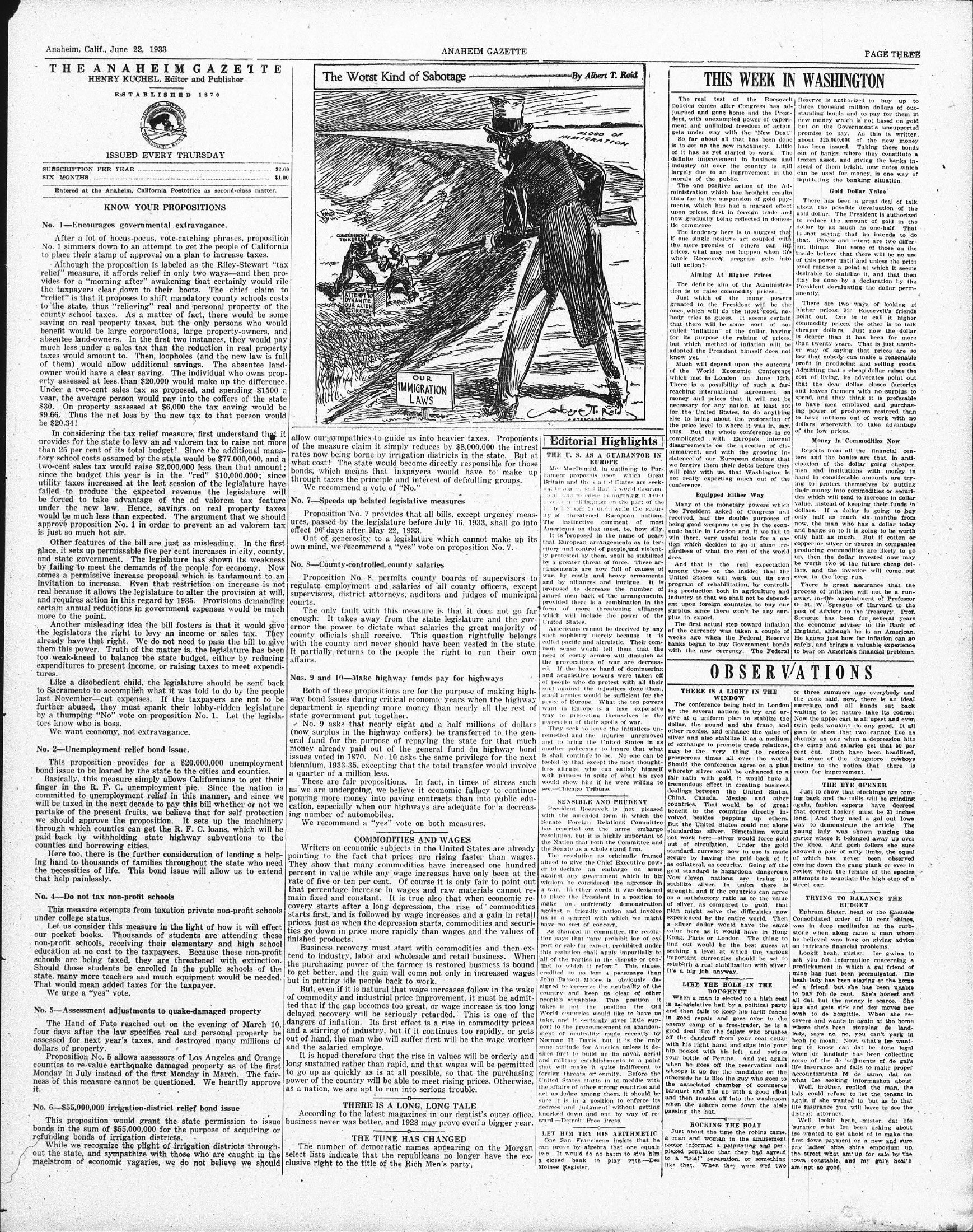
The Worst Kind of Sabotage — By Albert T. Reid
FLOOD OF IMMIGRATION
CONGRESSIONAL TINKERERS
ATTEMPT TO DYNAMITE OUR ALIEN RESTRICTIONS
OUR IMMIGRATION LAWS
Albert T. Reid
allow our sympathies to guide us into heavier taxes. Proponents of the measure claim it simply reduces by $8,000,000 the interest rates now being borne by irrigation districts in the state. But at
allow our sympathies to guide us into heavier taxes. Proponents of the measure claim it simply reduces by $8,000,000 the interest rates now being borne by irrigation districts in the state. But at what cost! The state would become directly responsible for those bonds, which means that taxpayers would have to make up through taxes the principle and interest of defaulting groups.
We recommend a vote of "No."
No. 7—Speeds up belated legislative measures
Proposition No. 7 provides that all bills, except urgency measures, passed by the legislature before July 16, 1933, shall go into effect 90 days after May 22, 1933.
Out of generosity to a legislature which cannot make up its own mind, we recommend a "yes" vote on proposition No. 7.
No. 8—County-controlled county salaries
Proposition No. 8, permits county boards of supervisors to regulate employment and salaries of all county officers, except supervisors, district attorneys, auditors and judges of municipal courts.
The only fault with this measure is that it does not go far enough. It takes away from the state legislature and the governor the power to dictate what salaries the great majority of county officials shall receive. This question rightfully belongs with the county and never should have been vested in the state. It partially returns to the people the right to run their own affairs.
Nos. 9 and 10—Make highway funds pay for highways
Both of these propositions are for the purpose of making highway bond issues during critical economic years when the highway department is spending more money than nearly all the rest of state government put together.
No. 9 asks that nearly eight and a half millions of dollars (now surplus in the highway coffers) be transferred to the general fund for the purpose of repaying the state for that much money already paid out of the general fund on highway bond issues voted in 1870. No. 10 asks the same privilege for the next biennium, 1933-35, excepting that the total transfer would involve a quarter of a million less.
These are fair propositions. In fact, in times of stress such as we are undergoing, we believe it economic fallacy to continue pouring more money into paving contracts than into public education, especially when our highways are adequate for a decreasing number of automobiles.
We recommend a "yes" vote on both measures.
COMMODITIES AND WAGES
Writers on economic subjects in the United States are already pointing to the fact that prices are rising faster than wages. They show that many commodities have increased one hundred
These are fair propositions. In fact, in times of stress such as we are undergoing, we believe it economic fallacy to continue pouring more money into paving contracts than into public education, especially when our highways are adequate for a decreasing number of automobiles.
We recommend a "yes" vote on both measures.
COMMODITIES AND WAGES
Writers on economic subjects in the United States are already pointing to the fact that prices are rising faster than wages. They show that many commodities have increased one hundred percent in value while any wage increases have only been at the rate of five or ten per cent. Of course it is only fair to point out that percentage increase in wages and raw materials cannot remain fixed and constant. It is true also that when economic recovery starts after a long depression, the rise of commodities starts first, and is followed by wage increases and a gain in retail prices, just as when the depression starts, commodities and securities go down in price more rapidly than wages and the values of finished products.
Business recovery must start with commodities and then extend to industry, labor and wholesale and retail business. When the purchasing power of the farmer is restored business is bound to get better, and the gain will come not only in increased wages but in putting idle people back to work.
But, even if it is natural that wage increases follow in the wake of commodity and industrial price improvement, it must be admitted that if the gap becomes too great, or wage increase is too long delayed recovery will be seriously retarded. This is one of the dangers of inflation. Its first effect is a rise in commodity prices and a stirring of industry, but if it continues too rapidly, or gets out of hand, the man who will suffer first will be the wage worker and the salaried employee.
It is hoped therefore that the rise in values will be orderly and long sustained rather than rapid, and that wages will be permitted to go up as quickly as is at all possible, so that the purchasing power of the country will be able to meet rising prices. Otherwise, as a nation, we are apt to run into serious trouble.
THERE IS A LONG, LONG TALE
According to the latest magazines in our dentist's outer office, business never was better, and 1928 may prove even a bigger year.
THE TUNE HAS CHANGED
The number of democratic names appearing on the Morgan select lists indicate that the republicans no longer have the exclusive right to the title of the Rich Men's party,
with phrases in spite of what his eyes would show him if he were willing to see.—Chicago Tribune.
SENSIBLE AND PRUDENT
President Roosevelt is not pleased with the amended form in which the Senate Foreign Relations Committee has reported out the arms embargo resolution, but it is highly important to the Nation that both the Committee and the Senate as a whole stand firm.
The resolution as originally framed aimed to give the Chief Executive power to declare an embargo on arms against any government which in his wisdom he considered the agressor in a war. In other words, it was designed to place the President in a position to make an unfriendly demonstration against a friendly nation and involve us in a quarrel with which we might have no sort of concern.
As changed in committee, the resolution says that "any prohibit ion of export or sale for export, prohibited under this resolution shall apply impartially to all of the parties in the dispute or conflict to which it refers." This clause, credited to no less a personage than John Bassett Moore, is obviously designed to preserve the neutrality of the country and keep us clear of other people's squabbles. This position it takes is not the position the Old World countries would like to have us take, and it certainly gives little support to the pronouncement on abandonment of neutrality made recently by Norman H. Davis, but it is the only sane attitude for America unless it desires first to build up its naval, aerial and military establishments to a point that will make it quite indifferent to foreign threats or enmity. Before the United States starts in to meddle with the affairs of other strong countries and act as judge among them, it should be sure it is in a position to enforce its decrees and judgment without getting knocked down and out, by way of reward.—Detroit Free Press.
LET HIM TRY HIS ARITHMETIC
One San Francisco insists that he can prove by algebra that one equals two. It would do no harm to give him a closed bank to play with.—Des Moines Register.
THIS WEEK IN WASHINGTON
The real test of the Roosevelt policies comes after Congress has adjourned and gone home and the President, with unexampled power of experiment and unlimited freedom of action, gets under way with the "New Deal."
So far about all that has been done is to set up the new machinery. Little of it has as yet started to work. The definite improvement in business and industry all over the country is still largely due to an improvement in the morale of the public.
The one positive action of the Administration which has brought results thus far is the suspension of gold payments, which has had a marked effect upon prices, first in foreign trade and now gradually being reflected in domestic commerce.
The tendency here is to suggest that if one single positive act coupled with the mere promise of others can lift prices, what may not happen when the whole Roosevelt program gets into full action?
Alming At Higher Prices
The definite aim of the Administration is to raise commodity prices.
Just which of the many powers granted to the President will be the ones which will do the most good, nobody tries to guess. It seems certain that there will be some sort of so-called "inflation" of the dollar, having for its purpose the raising of prices, but which method of inflation will be adopted the President himself does not know yet.
Much will depend upon the outcome of the World Economic Conference which met in London on June 12th. There is a possibility of such a far-reaching international agreement on money and prices that it will not be necessary for any nation, at least not for the United States, to do anything else to bring about the restoration of the price level to where it was in, say, 1926. But the whole conference is so complicated with Europe's internal disagreements on the question of disarmament, and with the growing insistence of our European debtors that Reserve is authorized to buy up to three thousand million dollars of outstanding bonds and to pay for them in new money which is not based on gold but on the Government's unsupported promise to pay. As this is written, about $25,000,000 of the new money has been issued. Taking these bonds out of banks, where they constitute a frozen asset, and giving the banks instead of them bright, new notes which can be used for money, is one way of liquidating the banking situation.
Gold Dollar Value
There has been a great deal of talk about the possible devaluation of the gold dollar. The President is authorized to reduce the amount of gold in the dollar by as much as one-half. That is not saying that he intends to do that. Power and intent are two different things. But some of those on the inside believe that there will be no use of this power until and unless the price level reaches a point at which it seems desirable to stabilize it, and that then may be done by a declaration by the President devaluating the dollar permanently.
There are two ways of looking at higher prices. Mr. Roosevelt's friends point out. One is to call it higher commodity prices, the other is to talk cheaper dollars. Just now the dollar is dearer than it has been for more than twenty years. That is just another way of saying that prices are so low that nobody can make a reasonable profit in producing and selling goods. Admitting that a cheap dollar raises the cost of living, its advocates point out that the dear dollar closes factories and leaves farmers with no surplus to spend, and they think it is preferable to have men employed and purchasing power of producers restored than to have millions out of work with no dollars wherewith to take advantage of the low prices.
Money In Commodities Now
Reports from all the financial centers and the banks are that, in anti-
Much will depend upon the outcome of the World Economic Conference which met in London on June 12th. There is a possibility of such a far-reaching international agreement on money and prices that it will not be necessary for any nation, at least not for the United States, to do anything else to bring about the restoration of the price level to where it was in, say, 1926. But the whole conference is so complicated with Europe's internal disagreements on the question of disarmament, and with the growing insistence of our European debtors that we forgive them their debts before they will play with us, that Washington is not really expecting much out of the conference.
Equipped Either Way
Many of the monetary powers which the President asked of Congress and received, had the double purposes of being good weapons to use in the economic battle in London and, if we fail to win there, very useful tools for a nation which decides to go it alone regardless of what the rest of the world does.
And that is the real expectation among those on the inside; that the United States will work out its own program of rehabilitation, by controlling production both in agriculture and industry so that we shall not be dependent upon foreign countries to buy our surplus, since there won't be any surplus to export.
The first actual step toward inflation of the currency was taken a couple of weeks ago when the Federal Reserve banks began to buy Government bonds with the new currency. The Federal profit in producing and selling goods. Admitting that a cheap dollar raises the cost of living, its advocates point out that the dear dollar closes factories and leaves farmers with no surplus to spend, and they think it is preferable to have men employed and purchasing power of producers restored than to have millions out of work with no dollars wherewith to take advantage of the low prices.
Money In Commodities Now
Reports from all the financial centers and the banks are that, in anticipation of the dollar going cheaper, men and institutions with money in hand in considerable amounts are trying to protect themselves by putting their money into commodities or securities which will tend to increase in dollar value, instead of keeping their funds in dollars. If a dollar is going to buy only half as much six months from now, the man who has a dollar today and hangs on to it is going to be worth only half as much. But if cotton or copper or silver or shares in companies producing commodities are likely to go up, then the dollar invested now may be worth two of the future cheap dollars, and the investor will come out even in the long run.
There is great assurance that the process of inflation will not be a runaway, in the appointment of Professor O. M. W. Sprague of Harvard to the post of Adviser to the Treasury. Prof. Sprague has been for several years the economic adviser to the Bank of England, although he is an American. He knows just how far inflation can go safely, and brings a valuable experience to bear on America's financial problems.
OBSERVATIONS
THERE IS A LIGHT IN THE WINDOW
The conference being held in London by several nations to try and arrive at a uniform plan to stabilize the dollar, the pound and the franc, and other monies, and enhance the value of silver and also stabilize it as a medium of exchange to promote trade relations, may be the very thing to restore prosperous times all over the world. Should the conference agree on a plan whereby silver could be enhanced to a fair ratio with gold, it would have a tremendous effect in creating business dealings between the United States, China, Canada, Mexico and other countries. That would be of great benefit to the countries directly involved, besides pepping up others. But the United States could not alone standardize silver. Bimetallism would not work here—silver would force gold out of circulation. Under the gold standard, currency now in use is made secure by having the gold back of it as collateral, as security. Going off the gold standard is horrendous.
THE EYE OPENER
Just to show that stockings are coming back and the mills will be grinding again, fashion experts have decreed that correct hosiery must be 31 inches long. And they used a gal out Iowa way to demonstrate the article. The young lady was shown placing the garter where it belonged away up over the knee. And gosh fellers she sure showed a pair of nifty limbs, the equal of which has never been observed coming down the gang plank or ever in previous years.
THE EYE OPENER
Just to show that stockings are coming back and the mills will be grinding again, fashion experts have decreed that correct hosiery must be 31 inches long. And they used a gal out Iowa way to demonstrate the article. The young lady was shown placing the garter where it belonged away up over the knee. And gosh fellers she sure showed a pair of nifty limbs, the equal of which has never been observed coming down the gang plank or ever in review when the female of the species attempts to negotiate the high step of a street car.
TRYING TO BALANCE THE BUDGET
Ephram Slater, head of the Eastside Consolidated order of 10 cent shines, was in deep meditation at the curbstone when along came a man whom he believed was long on giving advice on intricate financial problems.
Lookit heah, mister, Ise gwine to ask you foh information concerning a predickament in which a gal friend of mine has just been promulgated. Die heah lady has been staying at the home of a friend, but she has been unable to pay foh de rent. She's honest and all dat, but the money is scarce. She ups and gets sick and dey moves her ovah to de hospittle. When she recovers and wants in again at the home where she's been stopping de landlady, says no, no, you can't park in heah no moah. Now, what's Ise wanting to know can dat be done legal when de landlady has been collecting some of the de 'sailments of de gal's life insurance and fails to make proper accountaments of de same, dat an what Ise seeking informashon about.
Well, brother, replied the man, the lady could refuse to let the tenant in again if she wanted to, but as to that life insurance you will have to see the district attorney.
Well, lookit heah, mister, dat life 'surance what Ise been asking about Ise wanted to get ahold of to make the first down payment on a new and sure pay ladies' shoe shine emporium up the street what am up for sale by the town constable, and my gal'e health am not so good.