anaheim-gazette 1933-06-15
Scanned page
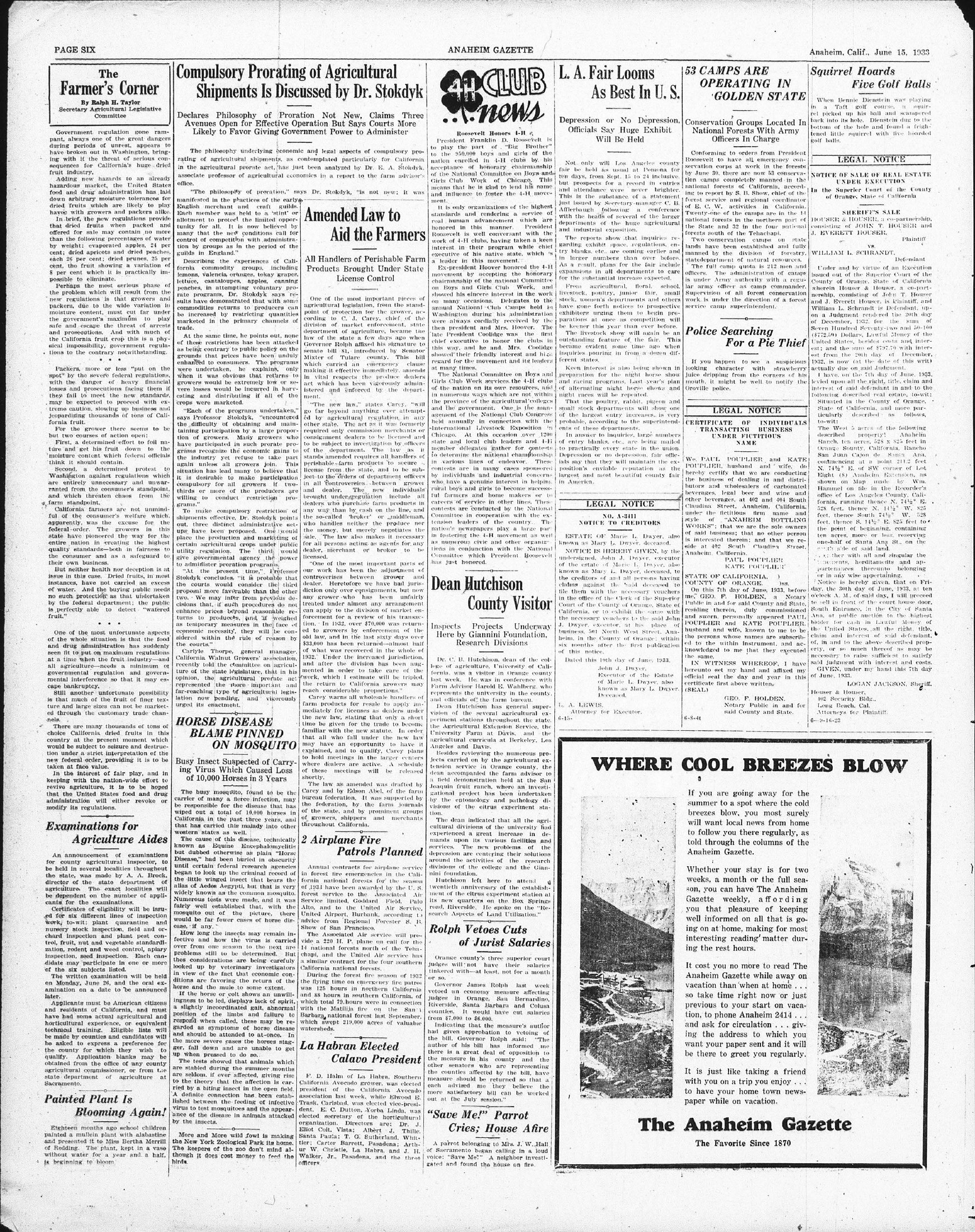
Searchable text
The Farmer’s Corner
By Ralph H. Taylor
Secretary Agricultural Legislative Committee
Government regulation gone rampant, always one of the great dangers during periods of unrest, appears to have broken out in Washington, bringing with it the threat of serious consequences for California’s huge dried fruit industry.
Adding new hazards to an already hazardous market, the United States food and drug administration has laid down arbitrary moisture tolerances for dried fruits which are likely to play havoc with growers and packers alike.
In brief, the new regulations provide that dried fruits when packed and offered for sale may contain no more than the following percentages of water by weight: evaporated apples, 24 per cent; dried apricots and dried peaches, each 25 per cent; dried prunes, 25 per cent, the fruit showing a variation of 8 per cent which it is practically impossible to eliminate.
Perhaps the most serious phase of the problem which will result from the new regulations is that growers and packers, due to the wide variation in moisture content, must cut far under the government's maximum to play safe and escape the threat of arrests and prosecutions. And with much of the California fruit crop this is a physical impossibility, government regulations to the contrary notwithstanding.
Packers, more or less "put on the spot" by the severe federal regulations, with the danger of heavy financial losses and prosecutions facing them if they fail to meet the new standards, may be expected to proceed with extreme caution, slowing up business and jeopardizing thousands of tons of California fruit.
For the grower there seems to be but two courses of action open:
First, a determined effort to foil nature and get his fruit down to the moisture content which federal officials
Compulsory Prorating of Agricultural Shipments Is Discussed by Dr. Declares Philosophy of Proration Not New, Avenues Open for Effective Operation But Says Likely to Favor Giving Government Power to The philosophy underlying economic and legal aspects rating of agricultural shipments, as contemplated particularly in the agricultural prorate act, has just been analyzed by associate professor of agricultural economics in a report to office.
"The philosophy of proration," says Dr. Stokdyk, "is manifested in the practices of the early English merchant and craft guilds. Each member was held to a 'stint' or allotment to protect the limited opportunity for all. It is now believed by many that the new conditions call for control of competition with administration by groups as in the period of the guilds in England."
Describing the experiences of California commodity groups, including lemons, valencia oranges, tokay grapes, lettuce, cantaloupes, apples, canning peaches, in attempting voluntary prorate programs, Dr. Stokdyk says results have demonstrated that with some commodities returns to producers can be increased by restricting quantities marketed in the primary channels of trade.
At the same time, he points out, none of these restrictions has been attacked as being contrary to public policy on the grounds that prices have been unduly enhanced to consumers. The programs were undertaken, he explains, only when it was obvious that returns to growers would be extremely low or severe losses would be incurred in harvesting and distributing if all of the crops were marketed.
"Each of the programs undertaken," says Professor Stokdyk, "encountered the difficulty of obtaining and maintaining participation by a large proportion of growers. Many growers who have participated in such prorate programs recognize the economic gains to the industry yet refuse to take part
Amended Aid tha All Handlers of Products Brought License
One of the most important points of protection according to C. J. C division of market department of agriculture law of the state a Governor Rolph affirms senate bill 81, intros Mixter of Tulare which carried an making it effective in vital respects in vital respects in vital respects in vital respects in vital respects in vital respects in vital respects in vital respects in vital respects in vital respects in vital respects in vital respects in vital respects in vital respects in vital respects in vital respects in vital respects in vital respects in vital respects in vital respects in vital respects in vital respects in vital respects in vital respects in vital respects in vital respects in vital respects in vital respects in vital respects in vital respects in vital respects in vital respects in vital respects in vital respects in vital respects in vital respects in vital respects in vital respects in vital respects in vital respects in vital respects in vital respects in vital respects in vital respects in vital respects in vital respects in vital respects in vital respects in vital respects in vital respects in vital respects in vital respects in vital respects in vital
Packers, more or less "put on the spot" by the severe federal regulations, with the danger of heavy financial losses and prosecutions facing them if they fail to meet the new standards, may be expected to proceed with extreme caution, slowing up business and jeopardizing thousands of tons of California fruit.
For the grower there seems to be but two courses of action open:
First, a determined effort to foil nature and get his fruit down to the moisture content which federal officials think it should contain.
Second, a determined protest to Washington against regulations which are entirely unnecessary and unwarranted from the consumer's standpoint, and which threaten chaos from the farm standpoint.
California farmers are not unmindful of the consumer's welfare which, apparently, was the excuse for the federal order. The growers in this state have pioneered the way for the entire nation in creating the highest quality standards—both in fairness to the consumer and as a safeguard to their own business.
But neither health nor deception is at issue in this case. Dried fruits, in most instances, have not carried an excess of water. And the buying public needs no such protection as that undertaken by the federal department; the public is perfectly able to detect "watered fruit."
One of the most unfortunate aspects of the whole situation is that the food and drug administration has suddenly seen fit to put on maximum regulations at a time when the fruit industry—and all agriculture—needs a minimum of governmental regulation and governmental interference so that it may escape bankruptcy.
Still another unfortunate possibility is that much of the fruit of finer texture and large sizes can not be marketed through the customary trade channels.
There are many thousands of tons of choice California dried fruits in this country at the present moment which would be subject to seizure and destruction under a strict interpretation of the new federal order, providing it is to be taken at face value.
In the interest of fair play, and in keeping with the nation-wide effort to revive agriculture, it is to be hoped that the United States food and drug administration will either revoke or modify its regulations.
Examinations for Agriculture Aides
An announcement of examinations for county agricultural inspector, to be held in several localities throughout enhanced to consumers. The programs were undertaken, he explains, only when it was obvious that returns to growers would be extremely low or severe losses would be incurred in harvesting and distributing if all of the crops were marketed.
"Each of the programs undertaken," says Professor Stokdyk, "encountered the difficulty of obtaining and maintaining participation by a large proportion of growers. Many growers who have participated in such prorate programs recognize the economic gains to the industry yet refuse to take part again unless all growers join. This situation has lead many to believe that it is desirable to make participation compulsory for all growers if two-thirds or more of the producers are willing to conduct restriction programs."
To make compulsory restriction of shipments effective, Dr. Stokdyk points out, three distinct administrative setups have been proposed. One would place the production and marketing of certain agricultural crops under public utility regulation. The third would give governmental agency the power to administer proration programs.
"At the present time," Professor Stokdyk concludes, "it is probable that the courts would consider the third proposal more favorable than the other two. We may infer from previous decisions that, if such procedures do not enhance prices beyond reasonable returns to producers, and if weighed as temporary measures in the face of economic necessity, they will be considered within the rule of reason by the courts."
Carlyle Thorpe, general manager, California Walnut Growers' association, recently told the committee on agriculture of the state legislature, that in his opinion, the agricultural prorate act represented the more important and far-reaching type of agricultural legislation now pending, and vigorously urged its enactment.
HORSE DISEASE BLAME PINNED ON MOSQUITO
Busy Insect Suspected of Carrying Virus Which Caused Loss of 10,000 Horses in 3 Years
The busy mosquito, found to be the carrier of many a fierce infection, may be responsible for the disease that has wiped out a total of 10,000 horses in California in the past three years, and that has carried this malady into other western states as well.
The cause of this disease, technically known as Equine Encephalomyelitis but dubbed otherwise as plain "Horse Disease," had been buried in obscurity until certain federal research agencies...
Examinations for Agriculture Aides
An announcement of examinations for county agricultural inspector, to be held in several localities throughout the state, was made by A. A. Brock, director of the state department of agriculture. The exact localities will be dependent on the number of applicants for the examinations.
Certificates of eligibility will be issued for six different lines of inspection work, to-wit: plant quarantine and nursery stock inspection, field and orchard inspection and plant pest control, fruit, nut and vegetable standardization, rodent and weed control, apiary inspection, seed inspection. Each candidate may participate in one or more of the six subjects listed.
The written examination will be held on Monday, June 26, and the oral examination on a date to be announced later.
Applicants must be American citizens and residents of California, and must have had some actual agricultural and horticultural experience, or equivalent technical training. Eligible lists will be made by counties and candidates will be asked to express a preference for the county for which they wish to qualify. Application blanks may be obtained from the office of any county agricultural commissioner, or from the state department of agriculture at Sacramento.
Painted Plant Is Blooming Again!
Eighteen months ago school children painted a mullein plant with alabastine and presented it to Miss Bertha Merrill of Redding. The plant, kept in a vase without water for a year and a half, is beginning to bloom.
The busy mosquito, found to be the carrier of many a fierce infection, may be responsible for the disease that has wiped out a total of 10,000 horses in California in the past three years, and that has carried this malady into other western states as well.
The cause of this disease, technically known as Equine Encephalomyelitis but dubbed otherwise as plain "Horse Disease," had been buried in obscurity until certain federal research agencies began to look up the criminal record of the little winged insect that bears the alias of Aedes Aegypti, but that is very widely known as the common mosquito. Numerous tests were made, and it was fairly well established that, with the mosquito out of the picture, there would be far fewer cases of horse disease, if any.
How long the insects may remain infective and how the virus is carried over from one season to the next are problems still to be determined. But these considerations are being carefully looked up by veterinary investigators in view of the fact that economic conditions are favoring the return of the horse and the mule to some extent.
If the horse or colt shows an unwillingness to be led, displays lack of spirit, a slightly incoordinated gait, abnormal position of the limbs and failure to respond when called, these may be regarded as symptoms of horse disease and should be attended to at once. In the more severe cases the horses stagger, fall down and are unable to get up when pressed to do so.
The tests showed that animals which are stabled during the summer months are seldom, if ever affected, giving rise to the theory that the affection is carried by a biting insect in the open field. A definite connection has been established between the feeding of infective virus to test mosquitoes and the appearance of the disease in animals attacked by the insects.
More and More wild fowl is making the New York Zoological Park its home. The keepers of the zoo don't mind although it does cost money to feed the birds.
Ring of Agricultural Discussed by Dr. Stokdyk
Corporation Not New, Claims Three
The Operation But Says Courts More
Government Power to Administer
Economic and legal aspects of compulsory procams contemplated particularly for California
has just been analyzed by Dr. E. A. Stokdyk,
economics in a report to the farm advisor's
says Dr. Stokdyk, "is not new; it was
Amended Law to Aid the Farmers
All Handlers of Perishable Farm Products Brought Under State License Control
One of the most important pieces of agricultural legislation, from the standpoint of protection for the grower, according to C. J. Carey, chief of the division of market enforcement, state department of agriculture, became the law of the state a few days ago when Governor Rolph affixed his signature to senate bill 81, introduced by Senator Mixter of Tulare county. This bill which carried an emergency clause making it effective immediately, amends in vital respects the produce dealers act which has been vigorously administered and enforced by the department.
"The new law," states Carey, "will go far beyond anything ever attempted by agricultural regulation, in any other state. The act as it was formerly required only commission merchants or consignment dealers to be licensed and to be subject to investigation by officers of the department. The law as it stands amended requires all handlers of
4H CLUB news
Roosevelt Honors 4-H
President Franklin D. Roosevelt is to play the part of "Big Brother" to the 350,000 boys and girls of the nation enrolled in 4-H clubs by his acceptance of honorary chairmanship of the National Committee on Boys and Girls Club Work of Chicago. This means that he is glad to lend his name and influence to foster the 4-H movement.
It is only organizations of the highest standards and rendering a service of real human advancement which are honored in this manner. President Roosevelt is well conversant with the work of 4-H clubs, having taken a keen interest in their program while chief executive of his native state, which is a leader in this movement.
Ex-president Hoover honored the 4-H movement by accepting the honorary chairmanship of the national Committee on Boys and Girls Club Work, and showed his sincere interest in the work on many occasions. Delegates to the annual National Club Camps held in Washington during his administration were always cordially received by the then president and Mrs. Hoover. The late President Coolidge was the first chief executive to honor the clubs in this way, and he and Mrs. Coolidge showed their friendly interest and high regard for the movement and its leaders at many times.
The National Committee on Boys and Girls Club Work services the 4-H clubs of the nation on its own resources, and in numerous ways which are not within the province of the agricultural colleges and the government. One is the management of the National Club Congress held annually in connection with the International Livestock Exposition in Chicago. At this occasion over 1200 state and local club leaders and 4-H member delegates gather for contests to determine the national championship
L. A. Fair Looms As Best In U.S.
Depression or No Depression, Officials Say Huge Exhibit Will Be Held
Not only will Los Angeles county fair be held as usual at Ponona for ten days, from Sept. 15 to 24 inclusive, but prospects for a record in entries and attendance were never brighter. This is the substance of a statement just issued by Secretary-manager C. B. Afflerbaugh following a conference with the heads of several of the larger departments of the huge agricultural and industrial exposition.
The reports show that inquiries regarding exhibit space, regulations, entry blanks, etc., are coming earlier and in larger numbers than over before. As a result, plans for the fair include expansions in all departments to care for the substantial increase expected.
From agricultural, floral, school, livestock, poultry, junior fair, small stock, women's departments and others have gone forth notices to prospective exhibitors urging them to begin preparations at once as competition will be keener this year than ever before.
The livestock show will again be outstanding feature of the fair. This became evident some time ago when inquiries pouring in from a dozen different states.
Keen interest is also being shown in preparation for the night horse show and racing programs. Last year's plan of alternating night horse shows and night races will be repeated.
That the poultry, rabbit, pigeon and small stock departments will show one of the largest entry increases, is very probable, according to the superintendents of these departments.
In answer to inquiries, large numbers of entry blanks, etc., are being mailed to practically every state in the union. Depression or no depression, fair officie-
which carried an emergency clause making it effective immediately, amends in vital respects the produce dealers act which has been vigorously administered and enforced by the department.
"The new law," states Carey, "will go far beyond anything ever attempted by agricultural regulation, in any other state. The act as it was formerly required only commission merchants or consignment dealers to be licensed and to be subject to investigation by officers of the department. The law as it stands amended requires all handlers of perishable farm products to secure license from the state, and to be subject to the orders of department officers in all controversies between grower and dealer. The new individuals brought under regulation include all dealers who purchase farm products in any way than by cash on the line, and the so-called 'broker' or middleman, who handles neither the produce nor the money, but merely negotiates the sale. The law also makes it necessary for all persons acting as agents for any dealer, merchant or broker to be licensed."
"One of the most important parts of our work has been the adjustment of controverises between grower and dealer. Heretofore we have had jurisdiction only over consignments, but now any grower who has been unfairly treated under almost any arrangement can apply to the division of market enforcement for a review of his transaction. In 1932, over $70,000 was returned to growers by enforcement of the old law, and in the last sixty days over $33,000 has been returned—almost half of what was recovered in the whole of 1932. Under the increased jurisdiction, and after the division has been augmented in order to take care of the work, which I estimate will be tripled, the return to California growers may reach considerable proportions."
Carey warns all wholesale handlers of farm products for resale to apply immediately for licenses as dealers under the new law, stating that only a short time be given for the trade to become familiar with the new statute. In order that all who fall under the new law may have an opportunity to have it explained, and to qualify, Carey plans to hold meetings in the larger centers where dealers are active. A schedule of these meetings will be released shortly.
The law as amended was drafted by Carey and by Edson Abel, of the farm bureau federation. It was supported by the federation, by the farm journals of the state, and by prominent groups of growers, shippers and merchants throughout California.
2 Airplane Fire Patrols Planned
Annual contracts for airplane service
The National Committee on Boys and Girls Club Work services the 4-H clubs of the nation on its own resources, and in numerous ways which are not within the province of the agricultural colleges and the government. One is the management of the National Club Congress held annually in connection with the International Livestock Exposition in Chicago. At this occasion over 1200 state and local club leaders and 4-H member delegates gather for contests to determine the national championship in various lines of endeavor. These contests are in many cases sponsored by individuals and industrial concerns who have a genuine interest in helping rural boys and girls to become successful farmers and home makers or to careers of service in other lines. These contests are conducted by the National Committee in cooperation with the extension leaders of the country. The nation's newspapers play a large part in fostering the 4-H movement as well as numerous civic and other organizations in conjunction with the National Committee which President Roosevelt has just honored.
Dean Hutchison County Visitor
Inspects Projects Underway Here by Giannini Foundation, Research Divisions
Dr. C. B. Hutchison, dean of the college of agriculture, University of California, was a visitor in Orange county last week. He was in conference with Farm Advisor Harold E. Wahlberg, who represents the university in the county, and officials of the farm bureau.
Dean Hutchison has general supervision of the several agricultural experiment stations throughout the state. The Agricultural Extension Service, the University Farm at Davis, and the agricultural curricula at Berkeley, Los Angeles and Davis.
Besides reviewing the numerous projects carried on by the agricultural extension service in Orange county, dean accompanied the farm advisor to a field demonstration held at the San Joaquin fruit ranch, where an investigational project has been undertaken by the entomology and pathology divisions of the citrus experiment station.
The dean indicated that all the agricultural divisions of the university had experienced a great increase in demands upon its various facilities and services. The new problems of the depression are centering their solutions around the activities of the research divisions of the college and the Gian-
The law as amended was drafted by Carey and by Edson Abel, of the farm bureau federation. It was supported by the federation, by the farm journals of the state, and by prominent groups of growers, shippers and merchants throughout California.
2 Airplane Fire Patrols Planned
Annual contracts for airplane service in forest fire emergencies in the California national forests for the season of 1933 have been awarded by the U.S. forest service to the Associated Air Service limited, Goddard Field, Palo Alto, and to the United Air Service, United Airport, Burbank, according to advice from Regional Forester S. B. Show of San Francisco.
The Associated Air service will provide a 220 H.P. plane on call for the 14 national forests north of the Tehachapi, and the United Air service has a similar contract for the four southern California national forests.
During the forest fire season of 1932 the flying time on emergency fire patrol was 125 hours in northern California and 88 hours in southern California, of which total 79 hours were in connection with the Matilija fire on the Santa Barbara national forest last September, which swept 219,000 acres of valuable watersheds.
La Habran Elected Calavo President
F. D. Halm of La Habra, Southern California Avocado grower, was elected president of the California Avocado association last week, while Elwood E. Trask, Carlsbad, was elected vice-president. E. C. Dutton, Yorba Linda, was elected secretary of the horticultural organization. Directors are; Dr. J. Eliot Coit, Vista; Albert J. Thille, Santa Paula; T. G. Sutherland, Whitier; Carter Barrett, Pasadena; Arthur W. Christie, La Habra, and J. H. Walker, Jr., Pasadena, and the three officers.
Rolph Vetoes Cuts of Jurist Salaries
Orange county's three superior court judges will not have their salaries tinkered with—at least, not for a month or so.
Governor James Rolph last week vetoed an economy measure affecting judges in Orange, San Bernardino, Riverside, Santa Barbara and Colusa counties. It would have cut salaries from $7,000 to $6,000.
Indicating that the measure's author had given approbation to vetoing of the bill, Governor Rolph said: "The author of his bill has informed me there is a great deal of opposition to the measure in his county and the other senators who are representing the counties affected by the bill, have measure should be returned so that each advised me they believe the more satisfactory bill can be worked out at the July session."
"Save Me!" Parrot Cries; House Afire
A parrot belonging to Mrs. J. W. Hall of Sacramento began calling in a loud voice: "Save Me!" A neighbor investigated and found the house on fire.
53 CAMPS ARE OPERATING IN GOLDEN STATE
Conservation Groups Located In National Forests With Army Officers In Charge
Conforming to orders from President Roosevelt to have all emergency conservation corps at work in the forests by June 30, there are now 53 conservation camps completely manned in the national forests of California, according to report by S. B. Show, chief of the forest service and regional coordinator of E. C. W. activities in California. Twenty-one of the camps are in the 14 national forests in the northern part of the State and 32 in the four national forests south of the Tehachapi.
Two conservation camps on state lands have been established and fully manned by the division of forestry, stated department of natural resources.
The full camp quota is 212 men and officers. The administration of camps is under Army authority with a regular army officer as camp commander. Supervision of all forest conservation work is under the direction of a forest service camp superintendent.
Police Searching For a Pie Thief
If you happen to see a suspicious looking character with strawberry juice dripping from the corners of his mouth, it might be well to notify the Oroville police.
LEGAL NOTICE
CERTIFICATE OF INDIVIDUALS TRANSACTING BUSINESS UNDER FICTITIOUS NAME
We PALL POUPLIER and KATE
LEGAL NOTICE
CERTIFICATE OF INDIVIDUALS TRANSACTING BUSINESS UNDER FICTITIOUS NAME
We, PAUL POUPLIER and KATE POUPLIER, husband and wife, do hereby certify that we are conducting the business of dealing in and distributors and wholesalers of carbonated beverages, legal beer and wine and other beverages, at 402 and 404 South Claudina Street, Anaheim, California, under the fictitious firm name and style of "ANAHEIM BOTTLING WORKS"; that we are the sole owners of said business; that no other person is interested therein; and that we reside at 402 South Claudina Street, Anaheim, California.
PAUL POUPLIER
KATE POUPLIER
STATE OF CALIFORNIA.
COUNTY OF ORANGE.
ss.
On this 7th day of June, 1933, before me, GEO. F. HOLDEN, a Notary Public in and for said County and State, residing therein, duly commissioned and sworn personally appeared PAUL POUPLIER and KATE POUPLIER, husband and wife, known to me to be the persons whose names are subscribed to the within instrument, and acknowledged to me that they executed the same.
IN WITNESS WHEREOF, I have hereunto set my hand and affixed my official seal the day and year in this certificate first above written.
GEO. F. HOLDEN.
Notary Public in and for said County and State.
6-8-4t
Notice is hereby given, that on Friday, the 30th day of June, 1933, at ten o'clock A.M., of said day, I will proceed to sell in front of the court house door, South Entrance, in the City of Santa Ana, at public auction to the highest bidder for cash in Lawful Money of the United States, all the right, title, claim and interest of said defendant, of, in and to the above described property, or so much thereof as may be necessary to raise sufficient to satisfy said judgment with interest and costs.
GIVEN, under my hand this 7th day of June, 1933.
LOGAN JACKSON, Sheriff.
Houser & Houser,
402 Security Bldg..
Long Beach, Cal.
Attorneys for Plaintiff.
WHERE COOL BREEZES BLOW
If you are going away for the summer to a spot where the cold breezes blow, you most surely will want local news from home to follow you there regularly, as told through the columns of the Anaheim Gazette.
Whether your stay is for two
If you are going away for the summer to a spot where the cold breezes blow, you most surely will want local news from home to follow you there regularly, as told through the columns of the Anaheim Gazette.
Whether your stay is for two weeks, a month or the full season, you can have The Anaheim Gazette weekly, offering you that pleasure of keeping well informed on all that is going on at home, making for most interesting reading matter during the rest hours.
It cost you no more to read The Anaheim Gazette while away on vacation than when at home... so take time right now or just previous to your start on vacation, to phone Anaheim 2414... and ask for circulation... giving the address to which you want your paper sent and it will be there to greet you regularly.
It is just like taking a friend with you on a trip you enjoy... to have your home town newspaper while on vacation.
The Anaheim Gazette
The Favorite Since 1870