anaheim-gazette 1933-06-08
Scanned page
Searchable text
THE ANAHEIM GAZETTE
HENRY KUCHEL, Editor and Publisher
ESTABLISHED 1870
ISSUED EVERY THURSDAY
SUBSCRIPT PER YEAR ... $2.00
SIX MONTHS ... $1.00
Entered at the Anaheim, California Postoffice as second-class matter.
LIFE'S LADDER—A CHALLENGE
Hundreds of young Anaheimers, their diplomas from public and private schools assured, face the future with characteristic confidence and courage of youth.
Younger children vaguely understand that next year they go into another grade; youngsters leaving elementary view with delight the broader opportunities of high school. Going from high school to college or university, however, usually involves the first great decision the student makes for himself. Here the major considerations must include what type of study he wishes to pursue in order to enable him to choose the college best suited to his needs, and finances.
The problem fits into life's great scheme. As he advances, he faces greater problems. Choosing a college or university primarily affects the individual. Later, in marriage and profession or business, he must consider others, solve more intricate questions. Thus pyramid the problems of life.
Upon the foundation of character and understanding, carefully nurtured in home and school, and the individual's own application and ability depend his success. It is not the amount of schooling or training to which he has been subjected, but the amount he has absorbed that counts. It is not what has been handed him on a silver platter, but what he understands through tedious hours of hard work that qualifies him for life's battles. Naturally then, the several hundred diplomas to be awarded in the next few days constitute one more important step in the students' forward journey.
Youth can save itself many laborious and painful side trips by tearing a page from the experience of its elders. And even more fittingly, those of us who are discouraged by what seems like an
Upon the foundation of character and understanding, carefully nurtured in home and school, and the individual's own application and ability depend his success. It is not the amount of schooling or training to which he has been subjected, but the amount he has absorbed that counts. It is not what has been handed him on a silver platter, but what he understands through tedious hours of hard work that qualifies him for life's battles. Naturally then, the several hundred diplomas to be awarded in the next few days constitute one more important step in the students' forward journey.
Youth can save itself many laborious and painful side trips by tearing a page from the experience of its elders. And even more fittingly, those of us who are discouraged by what seems like an interminable depression can take a lesson from the courage of youth; all of us should get an inspiration from the confidence and energy and faith of the graduates.
HEADS WE WIN, TAILS YOU LOSE
The British idea of tariff agreement seems to be that if Uncle Sam will cancel the sum John Bull owes him, John Bull will then be glad to ship us a lot more goods if we also will cancel our tariff schedules.
CONSCRIPT PROPERTY, TOO
The legislature of Wisconsin recently memorialized congress to pass house joint resolution No. 155, submitted by Congressman Thomas O'Malley, authorizing congress to conscript property as well as persons in time of war.
Since the World war the people of America more and more realize the importance of conscripting wealth as well as "cannon fodder." The average citizen is convinced that when property is conscripted, there will be a lot less danger of war. He believes this discrimination between persons and property is grossly unjust.
In past wars property has not been subject to conscription. Only by declaring certain property necessary for the public good or protection, and only by payment of an adequate compensation, could such property be taken against the will of the owner. In times of peace we sympathize with this interpretation, although in times of war it led on occasion to abnormally large payments for property, and a certain amount of political maneuvering for private profit. Prices invariably advance during wars, increasing the value of property. Thus the person with property benefits. If, on the other hand, property is subject to conscription, financing of wars could be done without obligating the country to the long series of amatorized payments which followed the World war, the paying of which constitute one of the major problems of today.
Why should property be placed above life in time of war? America conscripts men, taking them away from their families and their labor or business, sending them onto the battle field to sacrifice their lives if necessary for their country. We have no quarrel with this prerogative of government. We believe it is necessary and just, that every citizen owes his country this measure of devotion. But, in our opinion, life is more valuable than property. If persons can be conscripted, then property should be.
Before wealth can be conscripted, however, the constitution of the United States must be amended. Passing of house joint
Why should property be placed above life in time of war? America conscripts men, taking them away from their families and their labor or business, sending them onto the battle field to sacrifice their lives if necessary for their country. We have no quarrel with this prerogative of government. We believe it is necessary and just, that every citizen owes his country this measure of devotion. But, in our opinion, life is more valuable than property. If persons can be conscripted, then property should be.
Before wealth can be conscripted, however, the constitution of the United States must be amended. Passing of house joint resolution No. 155 would start the amendment on the rounds of the states for ratification. It should meet immediate favor.
We believe that when property, as well as persons, is conscripted, we will have less war.
IT'S A CASE, ANYHOW
A lot of people are complaining that 1933 beer does not measure up to the required 3.2 per cent. Maybe what the brewers need is Professor Mordecai Ezekiel's table of logarithms.
CONSIDER THE TAXPAYER
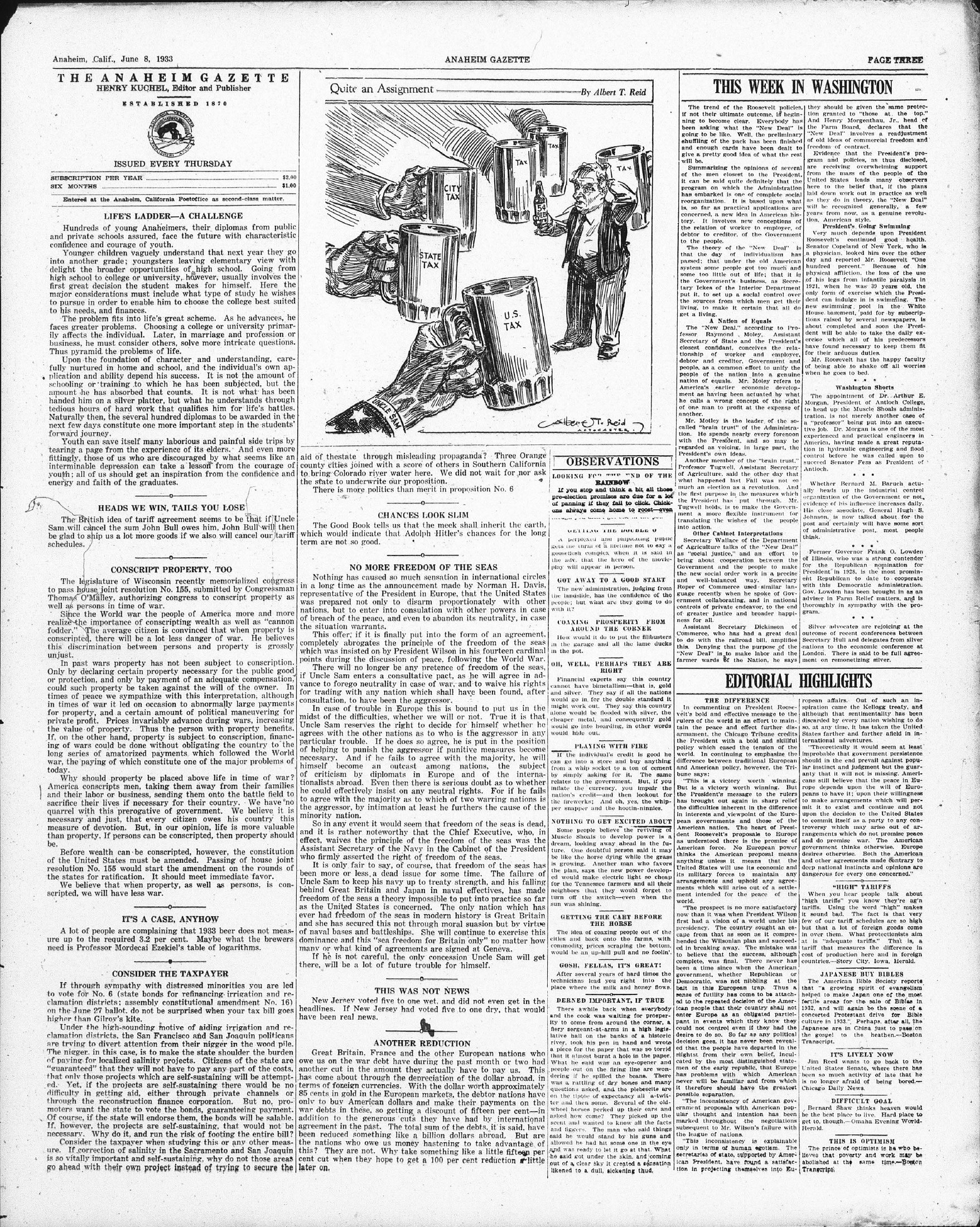
If through sympathy with distressed minorities you are led to vote for No. 6 (state bonds for refinancing irrigation and reclamation districts; assembly constitutional amendment No. 16) on the June 27 ballot, do not be surprised when your tax bill goes higher than Gilroy's kite.
Under the high-sounding motive of aiding irrigation and reclamation districts, the San Francisco and San Joaquin politicians are trying to divert attention from their nigger in the wood pile. The nigger, in this case, is to make the state shoulder the burden of paying for localized salinity projects. Citizens of the state are "guaranteed" that they will not have to pay any part of the costs, that only those projects which are self-sustaining will be attempted. Yet, if the projects are self-sustaining there would be no difficulty in getting aid, either through private channels or through the reconstruction finance corporation. But no, promoters want the state to vote the bonds, guaranteeing payment. Of course, if the state will endorse them, the bonds will be salable. If, however, the projects are self-sustaining, that would not be necessary. Why do it, and run the risk of footing the entire bill?
Consider the taxpayer when studying this or any other measure. If correction of salinity in the Sacramento and San Joaquin is so vitally important and self-sustaining, why do not those areas go ahead with their own project instead of trying to secure the
of criticism by nationalists abroad. He could effectively agree with the aggressor, by minority nation.
So in any event and it is rather effect, waives the Assistant Secretary who firmly asserts it is only fair been more or less Uncle Sam to keep behind Great Britain freedom of the sea as the United State ever had freedom and she has secured of naval bases and dominance and this many or what kind.
If he is not care there, will be a lo
ANAHEIM GAZETTE
Quite an Assignment
By Albert T. Reid
CITY TAX
STATE TAX
U.S. TAX
ALBERT T. REID
ARTOGASTER
aid of the state through misleading propaganda? Three Orange county cities joined with a score of others in Southern California to bring Colorado river water here. We did not wait for nor ask the state to underwrite our proposition.
There is more politics than merit in proposition No. 6
CHANCES LOOK SLIM
The Good Book tells us that the meek shall inherit the earth, which would indicate that Adolph Hitler's chances for the long term are not so good.
NO MORE FREEDOM OF THE SEAS
Nothing has caused so much sensation in international circles in a long time as the announcement made by Norman H. Davis, representative of the President in Europe, that the United States was prepared not only to disarm proportionately with other nations, but to enter into consultation with other powers in case of breach of the peace, and even to abandon its neutrality, in case the situation warrants.
This offer; if it is finally put into the form of an agreement, completely abrogates the principle of the freedom of the seas which was insisted on by President Wilson in his fourteen cardinal points during the discussion of peace, following the World War.
There will no longer be any pretence of freedom of the seas, if Uncle Sam enters a consultative pact, as he will agree in advance to forego neutrality in case of war, and to waive his rights for trading with any nation which shall have been found, after consultation, to have been the aggressor.
In case of trouble in Europe this is bound to put us in the midst of the difficulties, whether we will or not. True it is that Uncle Sam reserves the right to decide for himself whether he agrees with the other nations as to who is the aggressor in any particular trouble. If he does so agree, he is put in the position of helping to punish the aggressor if punitive measures become necessary. And if he fails to agree with the majority, he will himself become an outcast among nations, the subject of criticism by diplomats in Europe and of the internationalists abroad. Even then there is serious doubt as to whether he could effectively insist on any neutral rights. For if he fails to agree with the majority as to which of two warring nations is the aggressor, by intimation at least he furthers the cause of the minority nation.
So in any event it would seem that freedom of the seas is dead, and it is rather noteworthy that the Chief Executive, who, in effect, waives the principle of the freedom of the seas was the Assistant Secretary of the Navy in the Cabinet of the President who firmly asserted the right of freedom of the seas.
It is only fair to say, of course, that freedom of the seas has
of criticism by diplomats in Europe and of the internationalists abroad. Even then there is serious doubt as to whether he could effectively insist on any neutral rights. For if he fails to agree with the majority as to which of two warring nations is the aggressor, by intimation at least he furthers the cause of the minority nation.
So in any event it would seem that freedom of the seas is dead, and it is rather noteworthy that the Chief Executive, who, in effect, waives the principle of the freedom of the seas was the Assistant Secretary of the Navy in the Cabinet of the President who firmly asserted the right of freedom of the seas.
It is only fair to say, of course, that freedom of the seas has been more or less a dead issue for some time. The failure of Uncle Sam to keep his navy up to treaty strength, and his falling behind Great Britain and Japan in naval effectiveness, has made freedom of the seas a theory impossible to put into practice so far as the United States is concerned. The only nation which has ever had freedom of the seas in modern history is Great Britain and she has secured this not through moral suasion but by virtue of naval bases and battleships. She will continue to exercise this dominance and this "sea freedom for Britain only" no matter how many or what kind of agreements are signed at Geneva.
If he is not careful, the only concession Uncle Sam will get there, will be a lot of future trouble for himself.
THIS WAS NOT NEWS
New Jersey voted five to one wet, and did not even get in the headlines. If New Jersey had voted five to one dry, that would have been real news.
ANOTHER REDUCTION
Great Britain, France and the other European nations who owe us on the war debt have during the past month or two had another cut in the amount they actually have to pay us. This has come about through the depreciation of the dollar abroad, in terms of foreign currencies. With the dollar worth approximately 85 cents in gold in the European markets, the debtor nations have only to buy American dollars and make their payments on the war debts in these, so getting a discount of fifteen per cent—in addition to the generous cuts they have had by international agreement in the past. The total sum of the debts, it is said, have been reduced something like a billion dollars abroad. But are the nations who owe us money hastening to take advantage of this? They are not. Why take something like a little fifteen per cent cut when they hope to get a 100 per cent reduction little later on.
NOTHING TO GET EXCITED ABOUT
Some people believe the reviving of Muscle Shoals to develop power is a dream, looking away ahead in the future. One doubtful person said it may be like the horse dying while the grass is growing. Another man who favors the plan, says the new power developed would make electric light so cheap for the Tennessee farmers and all their neighbors that they would forget to turn off the switch—even when the sun was shining.
GETTING THE CART BEFORE THE HORSE
The idea of coaxing people out of the cities and back onto the farms, with commodity, prices scraping the bottom, would be an up-hill pull and no foolin'.
GOSH, FELLAS, IT'S GREAT!
After several years of hard times the technicians lead you right into the place where the milk and honey flows.
DERNED IMPORTANT, IF TRUE
There awhile back when everybody and the cook was waiting for prosperity to come from around the corner, a fiery sergeant-at-arms in a high legislative hall on the banks of a historic river, took his pen in hand and wrote a piece for the paper that was so torrid that it almost burnt a hole in the paper. What he said was an eye-opener and people out on the firing line are wondering if he spilled the beans. There was a rattling of dry bones and many questions asked, and the plebescite are on the tiptoe of expectancy all a-twitter and then some. Several of the old-wheel horses perked up their ears and asked how come? They picked up the scent and wanted to know all the facts and figgers. The man who said things said he would stand by his guns and allowed he had hit some one in the eye and was ready to let it go at that. What he said got under the skin, and coming out of a clear sky it created a sensation likened to a dull, sickening thud.
THIS WEEK IN WASHINGTON
The trend of the Roosevelt policies, if not their ultimate outcome, is beginning to become clear. Everybody has been asking what the "New Deal" is going to be like. Well, the preliminary shuffling of the pack has been finished and enough cards have been dealt to give a pretty good idea of what the rest will be.
Summarizing the opinions of several of the men closest to the President, it can be said quite definitely that the program on which the Administration has embarked is one of complete social reorganization. It is based upon what is, so far as practical applications are concerned, a new idea in American history. It involves new conceptions of the relation of worker to employer, of debtor to creditor, of the Government to the people.
The theory of the "New Deal" is that the day of individualism has passed; that under the old American system some people got too much and some too little out of life; that it is the Government's business, as Secretary Ickes of the Interior Department put it, to set up a social control over the sources from which men get their living, to make it certain that all do get a living.
A Nation of Equals
The "New Deal," according to Professor Raymond Moley, Assistant Secretary of State and the President's closest confidant, conceives the relationship of worker and employer, debtor and creditor, Government and people, as a common effort to unify the people of the nation into a genuine nation of equals. Mr. Moley refers to America's earlier economic development as having been actuated by what he calls a wrong concept of the right of one man to profit at the expense of another.
Mr. Motley is the leader of the so-called "brain trust" of the Administration. He spends nearly every forenoon with the President, and so may be regarded as voicing, in large part, the President's own ideas.
they should be given the same protection granted to "those at the top." And Henry Morgenthau, Jr., head of the Farm Board, declares that the "New Deal" involves a readjustment of old ideas of commercial freedom and freedom of contract.
Evidence that the President's program and policies, as thus disclosed, are receiving overwhelming support from the mass of the people of the United States leads many observers here to the belief that, if the plans laid down work out in practice as well as they do in theory, the "New Deal" will be recognized generally, a few years from now, as a genuine revolution, American style.
President's Going Swimming
Very much depends upon President Roosevelt's continued good health. Senator Copeland of New York, who is a physician, looked him over the other day and reported Mr. Roosevelt "One hundred percent." Because of his physical affliction, the loss of the use of his legs from infantile paralysis in 1921, when he was 39 years old, the only form of exercise which the President can indulge in is swimming. The new swimming pool in the White House basement, paid for by subscriptions raised by several newspapers, is about completed and soon the President will be able to take the daily exercise which all of his predecessors have found necessary to keep them fit for their arduous duties.
Mr. Roosevelt has the happy faculty of being able to shake off all worries when he goes to bed.
Washington Shorts
The appointment of Dr. Arthur E. Morgan, President of Antioch College, to head up the Muscle Shoals administration, is not merely another case of a "professor" being put into an executive job. Dr. Morgan is one of the most experienced and practical engineers in America, having made a great reputation in hydraulic engineering and flood control before he was called upon to
EDITORIAL HIGHLIGHTS
THE DIFFERENCE
In commenting on President Roosevelt's bold and effective message to the rulers of the world in an effort to maintain the peace and effect further disarmament, the Chicago Tribune credits the President with a bold and skillful policy which eased the tension of the world. In continuing to emphasize the difference between traditional European and American policy, however, the Tribune says:
"This is a victory worth winning. But is a victory worth winning. But the President's message to the rulers has brought out again in sharp relief the difficulties inherent in the difference in interests and viewpoint of the European governments and those of the American nation. The heart of President Roosevelt's proposals to Europe as understood there is the promise of American force. No European power thinks the American proposal means anything unless it means that the United States will use its economic and debtor and creditor, Government and people, as a common effort to unify the people of the nation into a genuine nation of equals. Mr. Moley refers to America's earlier economic development as having been actuated by what he calls a wrong concept of the right of one man to profit at the expense of another.
Mr. Motley is the leader of the so-called "brain trust" of the Administration. He spends nearly every forenoon with the President, and so may be regarded as voicing, in large part, the President's own ideas.
Another member of the "brain trust," Professor Tugwell, Assistant Secretary of Agriculture, said the other day that what happened last Fall was not so much an election as a revolution. And the first purpose in the measures which the President has put through, Mr. Tugwell holds, is to make the Government a more flexible instrument for translating the wishes of the people into action.
Other Cabinet Interpretations
Secretary Wallace of the Department of Agriculture talks of the "New Deal" as "social justice," and an effort to bring about cooperation between the Government and the people to make the new social order work in a precise and well-balanced way. Secretary Roper of Commerce used similar language recently when he spoke of Government collaborating, and in national controls of private endeavor, to the end of greater justice and broader happiness for all.
Assistant Secretary Dickinson of Commerce, who has had a great deal to do with the railroad bill, amplifies this. Denying that the purpose of the "New Deal" is to make labor and the farmer wards of the Nation, he says
Washington Shorts
The appointment of Dr. Arthur E. Morgan, President of Antioch College, to head up the Muscle Shoals administration, is not merely another case of a "professor" being put into an executive job. Dr. Morgan is one of the most experienced and practical engineers in America, having made a great reputation in hydraulic engineering and flood control before he was called upon to succeed Senator Fess as President of Antioch.
Whether Bernard M. Baruch actually heads up the industrial control organization of the Government or not, evidence of his influence increases daily. His close associate, General Hugh S. Johnson, is now talked about for the post and certainly will have some sort of administrative post, most people think.
Former Governor Frank O. Lowden of Illinois, who was a strong contender for the Republican nomination for President in 1928, is the most prominent Republican to date to cooperate with this Democratic administration. Gov. Lowden has been brought in as an adviser in Farm Relief matters, and is thoroughly in sympathy with the program.
Silver advocates are rejoicing at the outcome of recent conferences between Secretary Hull and delegates from silver nations to the economic conference at London. There is said to be full agreement on remonetizing silver.
EDITORIAL HIGHLIGHTS
"Theoretically it would seem at least improbable that government persistence should in the end prevail against popular instinct and judgment but the guaranty that it will not is missing. Americans still believe that the peace in Europe depends upon the will of Europeans to have it; upon their willingness to make arrangements which will permit it to exist and continue and not upon the decision to the United States to commit itself as a party to any controversy which may arise out of arrangements which do not promise peace and do promise war. The American government thinks otherwise. Europe desires otherwise. Both the American and other agreements made contrary to deep national instincts and opinions are..."
EXCITED ABOUT
have the reviving of the develop power is a way ahead in the future person said it may bring while the grass man who favors new power develop electric light so cheap farmers and all their would forget to even when the
CAST BEFORE CORSE
big people out of the farm with trapping the bottom pull and no foolin'.
IT'S GREAT!
of hard times the right into the bank and honey flows.
TANT, IF TRUE
when everybody waiting for prosper around the corner, a mass in a high legislature of a historic hand and wrote that was so torrid a hole in the paper. An eye-opener and stirring line are won by the beans. There many bones and many the plebescite are rectancy all a-twit- Several of the old up their ears and they picked up the know all the facts man who said things by his guns and some one in the eye go at that. What the skin, and coming created a sensation kening thud,
"This is a victory worth winning. But is a victory worth winning. But the President's message to the rulers has brought out again in sharp relief the difficulties inherent in the difference in interests and viewpoint of the European governments and those of the American nation. The heart of President Roosevelt's proposals to Europe as understood there is the promise of American force. No European power thinks the American proposal means anything unless it means that the United States will use its economic and its military forces to maintain any arrangements and uphold any agreements which will arise out of a settlement intended for the peace of the world.
"The prospect is no more satisfactory now than it was when President Wilson first had a vision of a world under his presidency. The country sought an escape from that as soon as it comprehended the Wilsonian plan and succeeded in breaking away. The mistake was to believe that the success, although complete, was final. There never has been a time since when the American government, whether Republican or Democratic, was not nibbling at the bait in this European trap. Thus a sense of futility has come to be attached to the repeated decision of the American people that their country shall not enter Europe as an obligated participant in events which they know they could not control even if they had the desire to do so. So far as any political decision goes, it has never been revealed that the people have departed in the slightest from their own belief, Inculcated by the most distinguished statesmen of the early republic, that Europe has problems with which American never will be familiar and from which it therefore should have the greatest possible separation.
"The inconsistency of American government proposals with American popular thought and intention has been marked throughout the negotiations subsequent to Mr. Wilson's failure with the league of nations.
"This inconsistency is explainable only in terms of human egotism. The secretaries of state, supported by American President, have found a satisfaction in projecting themselves into EU-anty that it will not is missing. Americans still believe that the peace in Europe depends upon the will of Europeans to have it; upon their willingness to make arrangements which will permit it to exist and continue and not upon the decision to the United States to commit itself as a party to any controversy which may arise out of arrangements which do not promise peace and do promise war. The American government thinks otherwise. Europe desires otherwise. Both the American and other agreements made contrary to deep national instincts and opinions are dangerous for every one concerned."
HIGH TARIFFS
When you hear people talk about "high tariffs" you know they're ag'n tariffs. Using the word "high" makes it sound bad. The fact is that very few of our tariff schedules are so high but that a lot of foreign goods come in over them. What protectionists aim at is "adequate tariffs." That is, a tariff that measures the difference in cost of production here and in foreign countries.—Story City, Iowa, Herald.
JAPANESE BUY BIBLES
The American Bible Society reports that "a growing spirit of evangelism helped to make Japan one of the most fertile areas for the sale of Bibles in 1932, and will again be the scene of a concerted Protestant drive for Bible culture in 1933." Perhaps, after all, the Japanese are in China just to pass on the gospel to the heathen.—Boston Transcript.
IT'S LIVELY NOW
Jim Reed wants to go back to the United States Senate, where there has been so much activity of late that he is no longer afraid of being bored.—Chicago Daily News.
DIFFICULT GOAL
Bernard Shaw thinks heaven would be the best place to live. Hard place to get to, though.—Omaha Evening World-Herald.
THIS IS OPTIMISM
The prince of optimists is he who believes that poverty and work may be abolished at the same time.—Boston Transcript.