anaheim-gazette 1933-05-25
Scanned page
Searchable text
THE ANAHEIM GAZETTE
HENRY KUCHEL, Editor and Publisher
ESTABLISHED 1870
ISSUED EVERY THURSDAY
SUBSCRIPTION PER YEAR ... $2.00
SIX MONTHS ... $1.00
Entered at the Anaheim, California Postoffice as second-class matter.
WORTHWHILE ECONOMY
California’s highway commission has an opportunity to spend about $20,000 and, in the course of approximately five years, save the taxpayers about 400 per cent on the investment.
Re-surfacing of Los Angeles street from Sycamore to La Palma, and widening the street from La Palma to Palm with modern grading and elimination of dangerous curves, at this time will prevent the necessity for a much greater expenditure within a few years. This is the expert opinion of highway engineers. The total cost for the project would be in the neighborhood of $40,000, with the county and city standing half, and the state the balance of the cost.
This portion of U. S. highway No. 101 is one of the last sections between Los Angeles and San Diego remaining to be improved. The center part of the road from Sycamore to La Palma is the original 1913 18-foot pavement. It was widened to its present 56-foot measurement when Mills Park was developed in 1923. Considerable effort has been made by the city engineer to iron out courduroy effects, realizing that by preventing a heavy pounding on the pavement its life would be prolonged. But the pavement, with the best of care, will last a few years longer, at best. Then replacement in its entirety will be necessary. If it is adequately resurfaced at this time the additional strength will make the pavement last approximately a quarter of a century longer. There can be no argument about the true economy to taxpayers and motorists in this proposal.
From La Palma to Romneya avenue the highway is narrow, poorly graded and generally unsatisfactory. This portion was about the first pavement in Orange county, laid when engineers could not anticipate modern traffic demands. It has served its purpose well, but needs replacement. The city engineer’s office has no record of when that pavement was put down. Present plans call for widening of the project to a full 56-foot pavement or behind the execution is to build proper sphere of change and appreciation for No, education is for technical skill.
The reason we keep good thing for Uncle greeted the move with HAPPY
Students of social mental factor in civil California marriages pared with 1931. In this state, while 47%
replacement in its entirety will be necessary. If it is adequately resurfaced at this time the additional strength will make the pavement last approximately a quarter of a century longer. There can be no argument about the true economy to taxpayers and motorists in this proposal.
From La Palma to Romneya avenue the highway is narrow, poorly graded and generally unsatisfactory. This portion was about the first pavement in Orange county, laid when engineers could not anticipate modern traffic demands. It has served its purpose well, but needs replacement. The city engineer’s office has no record of when that pavement was put down. Present plans call for widening of the project to a full 56-foot pavement with the standard 80-foot right-of-way; regrading would eliminate dips, while curves at the junction with South Spadra street and Romneya, and again at La Palma would be modified until motorists scarcely would notice them. The need for this improvement cannot be questioned.
Property owners are signing up in rapid order to deed the state a five-foot strip of land in order to give the highway department the required 80-foot right-of-way. Generous response to first appeals hearten officials seeking the improvement, and bespeaks a general recognition of its need.
This project meets a three-fold benefit: True economy, in that money spent now will save several times that amount a few years hence; a real need for the improvement; and the desirability of putting men to work at this particular time.
Anaheim and the county are champing at the bit, so to speak, awaiting the highway commission to join them at the starting post.
TWO EXCEPTIONS
The country’s industries are all excited about proposed shorter hours for labor and a commensurate wage. Somehow or other we cannot picture an old-fashioned farmer who works from sun-up till sun-down, or the hand that rocks the craddle and rules the world, getting very excited about the 30-hour week.
IS EDUCATION OVERDONE?
The publisher of Orange county’s largest newspaper believes that people are too highly educated. He refers editorially to the oversupply of talent in all professions; he argues that education costing $5,000 may not be worth the risk of getting a job afterward; in all seriousness, he discusses the danger of a top-heavy aristocracy of learning.
Insofar as his consideration of education goes, he is right in believing a little less education and a little more muscle would balance the needs of the country less disproportionately. In our opinion, however, there is a wide difference between the skilled laborer he talks about, and education. He makes the common mistake of confusing true learning with technical accomplishments. The skilled laborer might be educated, and the educated person might excel in a trade or profession, though not necessarily.
The distinction lies not in book learning or laboratory experiment. It is the ability to sympathetically comprehend and correlate divergent political, social, economic, industrial and spiritual forces of life, in contrast to pursuit of specialized progress, regardless of its place in well-rounded development.
Both types are needed, one as much as the other. To classify technical skill as education, however, is a mistake. A better understanding of our problems on the part of the entire populace is urgently needed. To us this interpretation of education could
HAPPY
Students of social mental factor in civil California marriages pared with 1931. In this state, while 47,424 obviously. This drop is 100,000 population in economic disturbance.
There is a ray of nounced by the bureau. Although this percent marriages and there breaking up of families the face of innumerable ties of life, and the society—the family annulments decreased.
Orange county, the of 180 marriages, with 1931. Divorces decreed marriages, the r 245.
Orange county’s rise is comparatively enlarge marriages than in marriages, and 2,000 Angeles had 2,000 less a drop of 269.
In addition to its mentions and its other more stable and happy California.
HOLD ON
J. Pierpont Morgan a senate committee. Leave with a first move.
THE S
We have been spee people of China in ternal enemies. A lot tions of some of the opean countries. We w with any human trous cans are overlooking a is more serious and sh
We refer to the s United States went to because of the tales island. The Cuban p imprisoned and even “Butcher” Weyler. T was aroused and we
take of confusing true learning with technical accomplishments. The skilled laborer might be educated, and the educated person might excel in a trade or profession, though not necessarily.
The distinction lies not in book learning or laboratory experiment. It is the ability to sympathetically comprehend and correlate divergent political, social, economic, industrial and spiritual forces of life, in contrast to pursuit of specialized progress, regardless of its place in well-rounded development.
Both types are needed, one as much as the other. To classify technical skill as education, however, is a mistake. A better understanding of our problems on the part of the entire populace is urgently needed. To us, this interpretation of education could not be overdone. It is not secured alone in universities and colleges, because we know of technical institution graduates whose groundwork in general knowledge, aside from their speciality, is negligible; on the other hand, we know men working with pick and shovel who propound an understanding and philosophy of life that would do credit to a college professor. We know men with sixth-garde schooling who are vitally interested in our complex life, who neglect no opportunity to read worthwhile books, magazines or hear intelligent speakers. Yearning for broader understanding, and restlessness in the face of tradition-bound customs are not confined to the amount of money, nor the number of years one spends in schooling.
The lack of balance between true education and skilled progress, we believe, is one of the contributory causes of present economic disturbances. Specialized progress created machinery that does the work formerly done by manual labor; this led to overproduction, and overproduction led to credit inflation, with the sad result of which we are keenly aware.
While the market for skilled workers, because of its excess, is in the doldrums, true education, in the form of social change, is taking place on a faster scale than ever before in the history of the world. Everybody feels, even though he may not identify it as such, this change we are undergoing, socially, politically, industrially and even spiritually. The educated recognize and prepare for life on a scale never tried before.
Herein lies the opportunities of our institutions of higher learning. They met the demands of the past with colleges to produce skilled graduates. Just because a surplus of these graduates gluts the present market does not out-mode university training. Rather, it should beget a truer balance between supply and demand, and concentrate attention upon the deeper significance of education, preparing young people to take their proper place in this world, regardless of whether it is behind the janitor's broom.
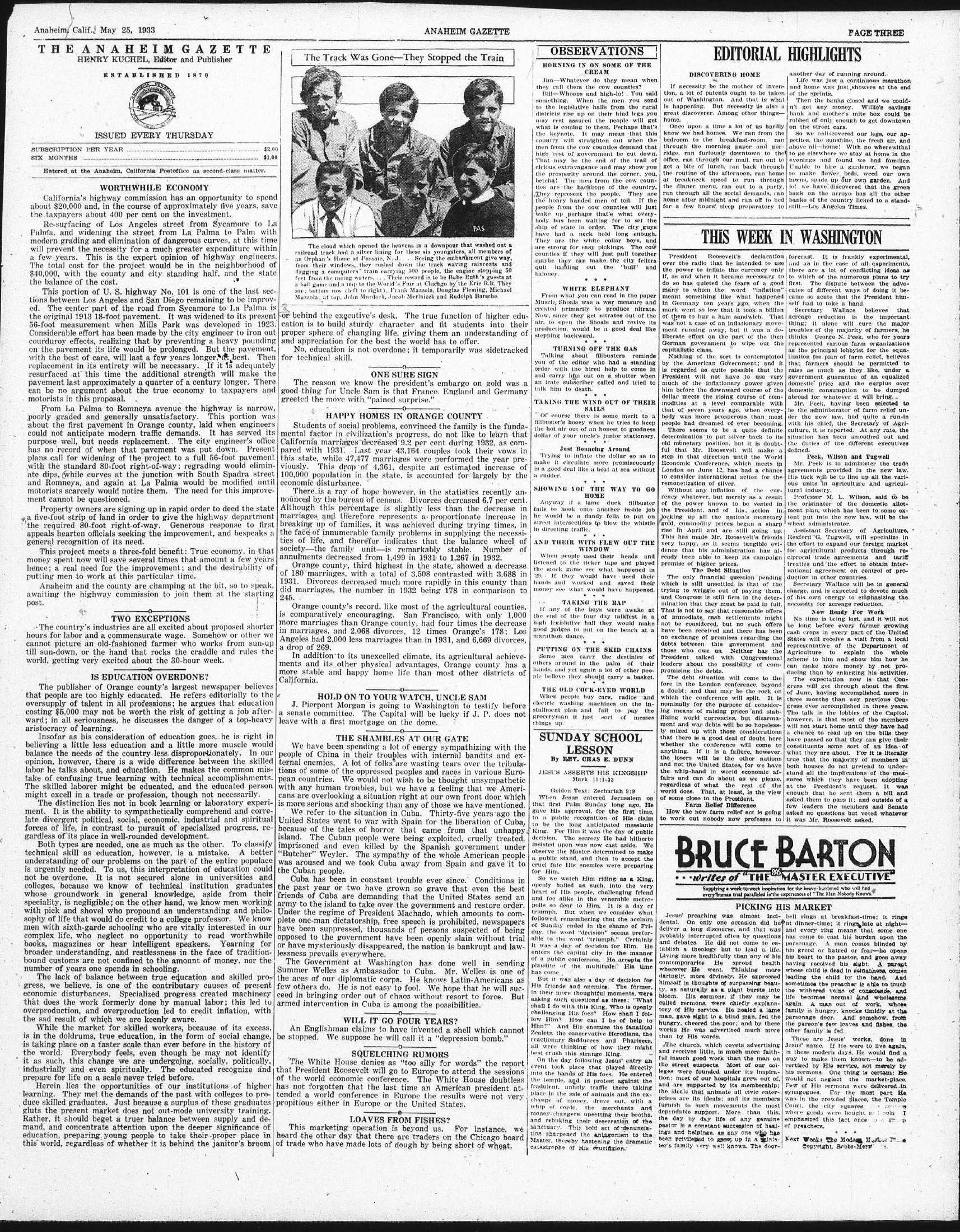
The Track Was Gone—They Stopped the Train
The cloud which opened the heavens in a downpour that washed out a railroad track had a silver lining for these six youngsters, all members of an Orphan’s Home at Passaic, N.J. Seeing the embankment give way, from their windows, they rushed down the track waving raincoats and flagging a computer’s train carrying 500 people, the engine stopping 50 feet from the racing waters. Their reward is to be Babe Ruth’s guests at a ball game and a trip to the World’s Fair at Chicago by the Eric R.R. They are; bottom row (left to right), Frank Mazzola, Douglas Fleming, Michael Muzzola, at top, John Murdock, Jacob Merlnizek and Rudolph Barche.
or behind the executive’s desk. The true function of higher education is to build sturdy character and fit students into their proper sphere of changing life, giving them an understanding of and appreciation for the best the world has to offer.
No, education is not overdone; it temporarily was sidetracked for technical skill.
ONE SURE SIGN
The reason we know the president’s embargo on gold was a good thing for Uncle Sam is that France, England and Germany greeted the move with “pained surprise.”
HAPPY HOMES IN ORANGE COUNTY
Students of social problems, convinced the family is the fundamental factor in civilization’s progress, do not like to learn that California marriages decreased 9.2 per cent during 1932, as compared with 1931. Last year 43,164 couples took their vows in this state, while 47,477 marriages were performed the year pre-
OBSERVATIONS
HORNING IN ON SOME OF THE CREAM
Jim—Whatever do they mean when they call them the cow counties?
Bill—Whoops and high-lo! You said something. When the men you send to the legislative halls from the rural districts rise up on their hind legs you may rest assured the people will get what is coming to them. Perhaps that’s the keynote. It may mean that this country will straighten out when the men from the cow counties demand that high cost of government be cut down. That may be the end of the trail of cicious extravagance and may show you the prosperity around the corner, you, betcha! The men from the cow counties are the backbone of the country. They represent the people. They are the honry handed men of toll. If the people from the cow counties will just wake up perhaps that’s what everybody has been waiting for to set the ship of state in order. The city guys have had a neck hold long enough. They are the white collar boys, and are strong for easy pickings. The cow counties if they will just pull together maybe they can make the city fellers quit handing out the “bull” and baloney.
WHITE ELEPHANT
From what you can read in the paper Muscle, Shoals was a war measure and created primarily to produce nitrate. Now, since they get nitrates out of the air, to open the Shoals and revive its production, would be a good deal like stepping backward.
TURNING OFF THE GAS
Talking about filibusters reminds you of the editor who had a standing order with the hired help to come in and carry him out on a shutter when an irate subscriber called and tried to talk him to death.
TAKING THE WIND OUT OF THEIR SAILS
Of course there is some merit to a filibuster’s hooey when he tries to keep the hot air out of an honest to goodness dollar of your uncle’s junior stationery.
Just Bouncing Around
Trying to inflate the dollar so as to
ONE SURE SIGN
The reason we know the president's embargo on gold was a good thing for Uncle Sam is that France, England and Germany agreed the move with "pained surprise."
HAPPY HOMES IN ORANGE COUNTY
Students of social problems, convinced the family is the fundamental factor in civilization's progress, do not like to learn that California marriages decreased 9.2 per cent during 1932, as compared with 1931. Last year 43,164 couples took their vows in this state, while 47,477 marriages were performed the year previously. This drop of 4,361, despite an estimated increase of 100,000 population in the state, is accounted for largely by the economic disturbance.
There is a ray of hope however, in the statistics recently announced by the bureau of census. Divorces decreased 6.7 per cent. Although this percentage is slightly less than the decrease in marriages and therefore represents a proportionate increase in breaking up of families, it was achieved during trying times, in the face of innumerable family problems in supplying the necessities of life, and therefor indicates that the balance wheel of society—the family unit—is remarkably stable. Number of annulments decreased from 1,499 in 1931 to 1,267 in 1932.
Orange county, third highest in the state, showed a decrease of 180 marriages, with a total of 3,508 contrasted with 3,688 in 1931. Divorces decreased much more rapidly in this county than did marriages, the number in 1932 being 178 in comparison to 245.
Orange county's record, like most of the agricultural counties, is comparatively encouraging. San Francisco, with only 1,000 more marriages than Orange county, had four times the decrease in marriages, and 2,068 divorces, 12 times Orange's 178; Los Angeles had 2,000 less marriages than in 1931, and 6,669 divorces, a drop of 269.
In addition to its unexcelled climate, its agricultural achievements and its other physical advantages, Orange county has a more stable and happy home life than most other districts of California.
HOLD ON TO YOUR WATCH, UNCLE SAM
J. Pierpont Morgan is going to Washington to testify before a senate committee. The Capital will be lucky if J. P. does not leave with a first mortgage on the dome.
THE SHAMBLES AT OUR GATE
We have been spending a lot of energy sympathizing with the people of China in their troubles with internal bandits and external enemies. A lot of folks are wasting tears over the tribulations of some of the oppressed peoples and races in various European countries. We would not wish to be thought unsympathetic with any human troubles, but we have a feeling that we Americans are overlooking a situation right at our own front door which is more serious and shocking than any of those we have mentioned.
We refer to the situation in Cuba. Thirty-five years ago the United States went to war with Spain for the liberation of Cuba, because of the tales of horror that came from that unhappy island. The Cuban people were being exploited, cruelly treated, imprisoned and even killed by the Spanish government under Butcher" Weyler. The sympathy of the whole American people was aroused and we took Cuba away from Spain and gave it to the Cuban people.
TAKING THE WIND OUT OF THEIR SAILS
Of course there is some merit to a filibuster's hooey when he tries to keep the hot air out of an honest to goodness dollar of your uncle's junior stationery.
Just Bouncing Around
Trying to inflate the dollar so as to make it circulate more promiscuously is a good deal like a boat at sea without a rudder.
SHOWING YOU THE WAY TO GO HOME
Anyway if a lame duck filibuster fails to hook onto another inside job he would be a dandy fella to put on street intersections to blow the whistle in directing traffic.
AND THEIR WITS FLEW OUT THE WINDOW
When people used their heads and listened to the ticker tape and played the stock game see what happened in '29. If they would have used their hands and worked and saved their money see what would have happened.
TAKING THE RAP
If any of the boys were awake at the end of the four day talkfest in a high legislative hall they would make good judges to put on the bench at a marathon dance.
PUTTING ON THE SKID CHAINS
Some men carry the destinies of others around in the palm of their hands, and yet again a lot of other people believe they should carry a basket.
THE OLD COCK-EYED WORLD
When people buy cars, radios and electric washing machines on the installment plan and fail to pay the groceryman it just sort of messes things up.
SUNDAY SCHOOL LESSON
By REV. CHAS E. DUNN
JESUS ASSERTS HIS KINGSHIP
Mark 11:1-33
Golden Text: Zechariah 9:9
When Jesus entered Jerusalem on that first Palm Sunday long ago, He gave His approval, for the first time, to a public recognition of His claim to be the long anticipated messianic King. For Him it was the day of public decision. The secrecy He had hitherto insisted upon was now cast aside. We observe the Master determined to make a public stand, and then to accept the cruel fate His enemies were preparing
We would not wish to be thought unsympathetic with any human troubles, but we have a feeling that we Americans are overlooking a situation right at our own front door which is more serious and shocking than any of those we have mentioned.
We refer to the situation in Cuba. Thirty-five years ago the United States went to war with Spain for the liberation of Cuba, because of the tales of horror that came from that unhappy island. The Cuban people were being exploited, cruelly treated, imprisoned and even killed by the Spanish government under "Butcher" Weyler. The sympathy of the whole American people was aroused and we took Cuba away from Spain and gave it to the Cuban people.
Cuba has been in constant trouble ever since. Conditions in the past year or two have grown so grave that even the best friends of Cuba are demanding that the United States send an army to the island to take over the government and restore order. Under the regime of President Machado, which amounts to complete one-man dictatorship, free speech is prohibited, newspapers have been suppressed, thousands of persons suspected of being supposed to the government have been openly slain without trial or have mysteriously disappeared, the nation is bankrupt and lawlessness prevails everywhere.
The Government at Washington has done well in sending Summer Welles as Ambassador to Cuba. Mr. Welles is one of the aces of our diplomatic corps. He knows Latin-Americans as new others do. He is not easy to fool. We hope that he will succeed in bringing order out of chaos without resort to force. But armed intervention in Cuba is among the possibilities.
WILL IT GO FOUR YEARS?
An Englishman claims to have invented a shell which cannot be stopped. We suppose he will call it a "depression bomb."
SQUELCHING RUMORS
The White House denies as "too silly for words" the report that President Roosevelt will go to Europe to attend the sessions of the world economic conference. The White House doubtless was not forgotten that the last time an American president attended a world conference in Europe the results were not very propitious either in Europe or the United States.
LOAVES FROM FISHES?
This marketing operation is beyond us. For instance, we heard the other day that there are traders on the Chicago board of trade who have made lots of dough by being short of wheat.
EDITORIAL HIGHLIGHTS
DISCOVERING HOME
If necessity be the mother of invention, a lot of patents ought to be taken out of Washington. And that is what is happening. But necessity is also a great discoverer. Among other things—home.
Once upon a time a lot of us hardly knew we had homes. We ran from the bedroom to the breakfast-room, ran through the morning paper and porridge, ran furiously downtown to the office, ran through our mall, ran out to get a bite of lunch, ran back through the routine of the afternoon, ran home at breakneck speed to run through the dinner menu, ran out to a party, ran through all the social demands, ran home after midnight and ran off to bed for a few hours' sleep preparatory to another day of running around.
Life was just a continuous marathon and home was just showers at the end of the sprints.
Then the banks closed and we couldn't get any money. Willie's savings bank and mother's mite box could be robbed of only enough to get downtown on the street cars.
So we rediscovered our legs, our appetites, the sunshine, the fresh air, and above all—home! With no wherewithal to go elsewhere we stay at home in the evenings and found we had families. Unable to hire a gardener, we began to make flower beds, weed our own lawns, spade up our own garden. And lo! we have discovered that the green bank on the arroyo has all the other banks of the country licked to a standstill.—Los Angeles Times.
THIS WEEK IN WASHINGTON
President Roosevelt's declaration over the radio that he intended to use the power to inflate the currency only if, as and when it became necessary to do so has quieted the fears of a good many to whom the word "inflation" meant something like what happened in Germany ten years ago, when the mark went so low that it took a billion of them to buy a ham sandwich. That was not a case of an inflationary movement running away, but it was a deliberate effort on the part of the then German government to wipe out the capitalistic class.
Nothing of the sort is contemplated by the American Government; and it is regarded as quite possible that the President will not have to use very much of the inflationary power given him before the downward course of the dollar meets the rising course of commodities at a level comparable with that of seven years ago, when everybody was more prosperous than most people had dreamed of ever becoming.
There seems to be a quite definite determination to put silver back to its old monetary position, but it is doubtful that Mr. Roosevelt will make a step in that direction until the World forecast. It is frankly experimental, and as in the case of all experiments, there are a lot of conflicting ideas as to which of the numerous plans to try first. The dispute between the advocates of different ways of doing it became so acute that the President himself had to take a hand.
Secretary Wallace believes that acreage reduction is the important thing; it alone will cure the major troubles of the majority of farmers, he thinks. George N. Peek, who for years represented various farm organizations as the principal lobbyist for the equalization fee plan of farm relief, believes that farmers should be permitted to raise as much as they like, under a government guarantee of an equalized domestic price and the surplus over domestic consumption to be dumped abroad for whatever it will bring.
Mr. Peek, having been selected to be the administrator of farm relief under the new law, had quite a run-in with his chief, the Secretary of Agriculture, it is reported. At any rate, the situation has been smoothed out and the duties of the different executives defined.
Peck, Wilson and Tugwell
BY OUT OF THEIR
SOME MERIT TO A
HE THEN TRIES TO KEEP
HONEST TO GOODNESS
IN JUNIOR STATIONERY.
G AROUND
THE DOLLAR SO AS TO
MORE PROMISCUOUSLY
BOAT AT SEA WITHOUT
E WAY TO GO
THE DUCK FILIBUSTER
ANOTHER INSIDE JOB
Y FELLA TO PUT ON
BLOW THE WHISTLE
FLEW OUT THE DOW
THEIR HEADS AND
TApe AND PLAYED
WHAT HAPPENED IN
HAVE USED THEIR
AND SAVED THEIR
AND HAVE HAPPENED.
RAP
WE WERE AWAKE AT
DAY TALKFEST IN A
THEY WOULD MAKE
IN THE BENCH AT A
SKID CHAINS
THE DESTINIES OF
THE PAIM OF THEIR
A LOT OF OTHER PEOPLE CARRY A BASKET.
YED WORLD
YARS, RADIOS AND
OHNES ON THE INTAIL TO PAY THE
RESPORT OF MESSSES
CHOOL
ON
E. DUNN
HIS KINGSHIP
19-33
chariah 9:9
and Jerusalem on
day long ago. He
for the first time,
on of His claim
capitated messianic
the day of public
He had hitherto
cast aside. We
determined to make
en to accept the
were preparing
BY THE American Government; and it is regarded as quite possible that the President will not have to use very much of the inflationary power given him before the downward course of the dollar meets the rising course of commodities at a level comparable with that of seven years ago, when everybody was more prosperous than most people had dreamed of ever becoming.
There seems to be a quite definite determination to put silver back to its old monetary position, but it is doubtful that Mr. Roosevelt will make a step in that direction until the World Economic Conference, which meets in London on June 12, has had a chance to consider international action for the remonetization of silver.
Without any inflation of the currency whatever, but merely as a result of the power known to be vested in the President, and of his action in locking up all the nation's monetary gold, commodity prices began a sharp rise in April and are still going up. This has made Mr. Roosevelt's friends very happy, as it seems tangible evidence that his administration has already been able to keep its campaign promise of higher prices.
The Debt Situation
The only financial question pending which is still unsettled is that of the trying to wriggle out of paying them, and Congress is still firm in the determination that they must be paid in full. That is not to say that reasonable offers of immediate cash settlements might not be considered, but no such offers have been received and there has been no exchange of promises regarding the debts between this government and those who owe us. Neither has the President talked with Congressional leaders about the possibility of compromising the debts.
The debt situation will come to the fore in the London conference, beyond a doubt; and that may be the rock on which the conference will split. It is nominally for the purpose of considering means of raising prices and stabilizing world currencies, but disarmament and war debts will be so hopelessly mixed up with those considerations that there is a good deal of doubt here whether the conference will come to anything. If it is a failure, however, the losers will be the other nations and not the United States, for we have the whip-hand in world economic affairs and can do about as we please, regardless of what the rest of the world does. That, at least, is the view of some close to the President.
Farm Relief Difference
How the new farm relief act is going to work out nobody now professes to that farmers should be permitted to raise as much as they like, under a government guarantee of an equalized domestic price and the surplus over domestic consumption to be dumped abroad for whatever it will bring.
Mr. Peek, having been selected to be the administrator of farm relief under the new law, had quite a run-in with his chief, the Secretary of Agriculture, it is reported. At any rate, the situation has been smoothed out and the duties of the different executives defined.
Peck, Wilson and Tugwell
Mr. Peek is to administer the trade agreements provided in the new law. His tack will be to line up all the various units in agriculture and agricultural industry.
Professor M. L. Wilson, said to be the originator of the domestic allotment plan, which has been to some extent put into the new law, will be the wheat administrator.
Assistant Secretary of Agriculture, Rexford G. Tugwell, will specialize in the effort to expand our foreign market for agricultural products through reciprocal trade agreements and tariff treaties and the effort to obtain international agreement on control of production in other countries.
Secretary Wallace will be in general charge, and expected to devote much of his own energy to emphasizing the necessity for acreage reduction.
Now Ready For Work
No time is being lost, and it will not be long before every farmer growing cash crops in every part of the United States will receive a visit from a local representative of the Department of Agriculture to explain the whole scheme to him and show him how he can make more money by not producing than by enlarging his activities.
The expectation now is that Congress will get through about the first of June, having accomplished more in three months than any previous Congress ever accomplished in three years. The talk in the lobbies of the Capitol, however, is that most of the members will not start home until they have had a chance to read up on the bills they have passed so that they can give their constituents some sort of an idea of what they are about. For it is literally true that the majority of members in both houses do not pretend to understand all the implications of the measures which they have been adopting at the President's request. It was enough that he sent them a bill and asked them to pass it; and outside of a few leaders the members and Senate asked no questions but voted whatever it was Mr. Roosevelt asked.
BRUCE BARTON
writes of "THE MASTER EXECUTIVE"
Supplying a week-to-week inspiration for the heavy-burdened who will find every human trial paralleled in the experiences of "The Man Nobody Knows."
PICKING HIS MARKET
Jesus' preaching was almost incidental. On only one occasion did he deliver a long discourse, and that was probably interrupted often by questions and debates. He did not come to establish a theology but to lead a life. Living more healthfully than any of his contemporaries He spread health wherever He went. Thinking more daringly, more divinely, He expressed himself in thoughts of surpassing beauty, as naturally as a plant bursts into bloom. His sermons, if they may be called sermons, were chiefly explanatory of His service. He healed a lame man, gave sight to a blind man, fed the hungry, cheered the poor; and by these works He was advertised much more than by His words.
The church, which covets advertising and receives little, is much more faithful insuch good work than the man on the street suspects. Most of our colleges were founded under its inspiration; most of our hospitals grew out of, and are supported by its membership; the ideals that animate all civic enterprises are its ideals; and its members furnish to such movements the most dependable support. More than this, the day by day life of any genuine pastor is a constant succession of healings and helpings, as any one who has been privileged to grow up in a minister's family very well knows. The door-
bell rings at breakfast-time; it rings at dinner-time; it rings late at night—and every ring means that some one has come to cast his burden upon the parsonage. A man comes blinded by his greed or hatred or fear—he opens his heart to the pastor, and goes away having received his sight. A parent whose child is dead in selfishness, comes leading the child by the hand. And sometimes the preacher is able to touch the withered veins of conscience, and life becomes normal and wholesome again. A man out of work, whose family is hungry, knocks timidly at the parsonage door. And somehow, from the parson's few loaves and fishes, the other family is fed.
These are Jesus' works, done in Jesus' name. If He were to live again, in these modern days, He would find a way to make them known—to be advertised by His service, not merely by his sermons. One thing is certain: He would not neglect the market-place. Few of His sermons were delivered in synagogues. For the most part He was in the crowded places, the Temple Court, the city squares where goods were bought and sold. I emphasized this fact once a group of preachers.
Next Week: The Modern Marker Time
Copyright, Bobbs-Merrill