anaheim-gazette 1933-05-18
Scanned page
Searchable text
THE ANAHEIM GAZETTE
HENRY KUOHEL, Editor and Publisher
ESTABLISHED 1870
ISSUED EVERY THURSDAY
SUBSCRIPTION PER YEAR ... $2.00
SEK MONTHS ... $1.00
Entered at the Anaheim, California Postoffice as second-class matter.
CALIFORNIA'S FOOTBALL
California's political football — the state constitution — has been bruised and torn and punctured in elective battles for so many years that it is in sad need of replacement.
Originally, the state constitution was designed to lay down broad principles of government and define the rights of citizens of California. But this instrument, which should guide the course of government, has been dragged down in the mire of political mud. It is plastered with amendments which by no stretch of the imagination should be written into a state constitution; it is punctured by lobbies seeking to inflate minority interests; it is buffeted about in the storms and counter storms of reformation; to puncture it again is the goal of political creeds and selfish interests who want to plaster their label upon it, realizing that by so doing they erect the strongest fences possible against changing public opinion.
Writing proposed amendments to the state constitution fascinates our politicians. At the special election on June 27 we vote upon not less than eight constitutional amendments, as well as other propositions. Every time the legislature wants to do something, or opportunists gain an upper hand, and wish to take advantage of a temporary shift of current opinion, the first thing thought of is to change the state constitution. A system has grown up in California which makes such constitutional alterations comparatively easy, but once these special privileges are entered, makes their elimination almost impossible. That explains why active minorities always aim at the constitution.
The Gazette believes this practice inherently wrong. It holds the constitution should be a guide, and not a set of by-laws for the state. It should define the rights of citizens, the functions of government and public institutions, but it should not be so specific
The Gazette believes this practice inherently wrong. It holds the constitution should be a guide, and not a set of by-laws for the state. It should define the rights of citizens, the functions of government and public institutions, but it should not be so specific in detail as to cripple the very government which it is designed to govern and protect. The Gazette realizes occasional changes may become necessary as our ideals of republican government change. Many of the propositions submitted are meritorious. But the principle of writing every political measure into the constitution is wrong.
For instance, we have no quarrel with attempts to change our method of taxation. Real estate certainly bears more than its proportionate share of taxes, and deserves relief. The constitution as it stands does not specifically prohibit any kind of a tax. The legislature should be free to levy a sales tax, an income tax, or any other method of raising money it feels is equitable and just.
Instead of passing an income or sales tax, what happens? Influential lobbies tack on the measure a plan to write into the constitution provisions increasing and fixing the amounts the state must pay for educational purposes. This is the weakness of proposition No. 30, which we will vote upon June 27. A lot of noise will be made about the necessity of changing our tax system in order to relieve real property. But the vital thing we will be voting upon is the provision taking away from the counties, where the people might get some semblance of control, the present requirements for educational expense. The tax plan simply is a screen behind which the school lobby is hiding. If the lobby can succeed in its ambition to re-write the constitution it will accomplish a major selfish interest—and it will violate the principle for which a constitution should stand. Regardless of the ability of the people of California to pay, they would have to raise, with present school enrollment, approximately 150 million dollars every two years—nearly twice the total estimated general fund income of the state of California for the next biennium. If the sales tax fails to raise the money, then the state must levy an ad valorem tax, or an income tax, or both. Decreasing the real estate burden is doubtful.
The seriousness of this proposal is seen by our present budgetary difficulties. Even with drastic curtailments in all functions of government under legislative control, general fund budget for the next biennium is 140 million dollars. Total estimated income under present laws is 92 million. Fixed expenditures which the state must pay before it spends one cent for maintenance of police protection, legislative expenses or judiciary, is over 87 million. Actually, our present fixed expenditures set by the constitution come within four and one-half million of equalling the total estimated income under present laws. Remember, the legislature could not prune fixed expenditures, even though the item for schools alone amounts to 57 per cent of the total general budget. All the cuts had to be made in other functions. The state's appropriations for schools are larger than ever. Now our teacher lobby proposes to more than double fixed state expenditures for schools, transferring from small political units, or counties, to one larger unit certain mandatory school costs.
When the individual sedatives, and face from quack politics
Everybody has cannot deny it. The unload his personal Hoover has been told of that statement for President Roosevelt.
This goat-hunt sane attitude is my willingness to accept tion to emerge from values.
With this in mind choosing our politic order of thought they represent against an appropriate past, too many pol term simply because would make enemy opposition. This is feared to decrease ex-service men; lo display of courage cut expenses to me whittle here and to measure which fair money with which nate from our board the slip-shod meth quences.
The root of this plant him with me with their best jud kind of courage w all the people, evenity circles, is the k must be rewarded endures.
Several local f roofs leak during a
WE HAVE
Three years of adversity have taught things we thought
Things were an every week-end de
state must pay before it spends one cent for maintenance of police protection, legislative expenses or judiciary, is over 87 million. Actually, our present fixed expenditures set by the constitution come within four and one-half million of equalling the total estimated income under present laws. Remember, the legislature could not prune fixed expenditures, even though the item for schools alone amounts to 57 per cent of the total general budget. All the cuts had to be made in other functions. The state's appropriations for schools are larger than ever. Now our teacher lobby proposes to more than double fixed state expenditures for schools, transferring from small political units, or counties, to one larger unit certain mandatory school costs.
The Gazette opposes such legislation for two basic and sound reasons. The first, making the state guarantee a fixed and continuously-growing amount of money for any purpose, is wrong in principle. It is inflexible and does not allow for varying economic conditions. Because eliminating any provision of the state constitution is practically impossible, it carries the threat of bankrupting our government in times of financial distress. The second reason is political. Defending a portion of the constitution against legislative attacks is a mighty simple matter in comparison to controlling the legislature. It would put an end to the present hue and cry about decreasing fixed expenditures for schools, relieving the strain from lobbyists, but not relieving the strain on harassed taxpayers.
California's political football already contains many similar levils. Why should we continue to clutter up our constitution with inflexible provisions which hamstring ourselves and future generations? Why continue to commit the same mistakes which experience proves have prevented the legislature from making readjustments to meet present economic needs?
The wise course is not to amend our constitution, but to write a new one, making it conform to a declaration of principles of government—and keeping it off the political football field.
IT'S SETTLED; THE EGG WAS FIRST
A white leghorn hen at Olean, New York, laid an egg which measured nine inches around the ends and six inches along the middle. Good thing Secretary Wallace's new farm bill was not in effect or that hen might be liable to arrest for violating the agricultural proration orders.
ANYWAY, NOBODY BOSSES HIM
When it comes to crop control it seems to us that Old Man Weather still has it all over congress and the U.S. department of agriculture.
ANAHEIM GAZETTE
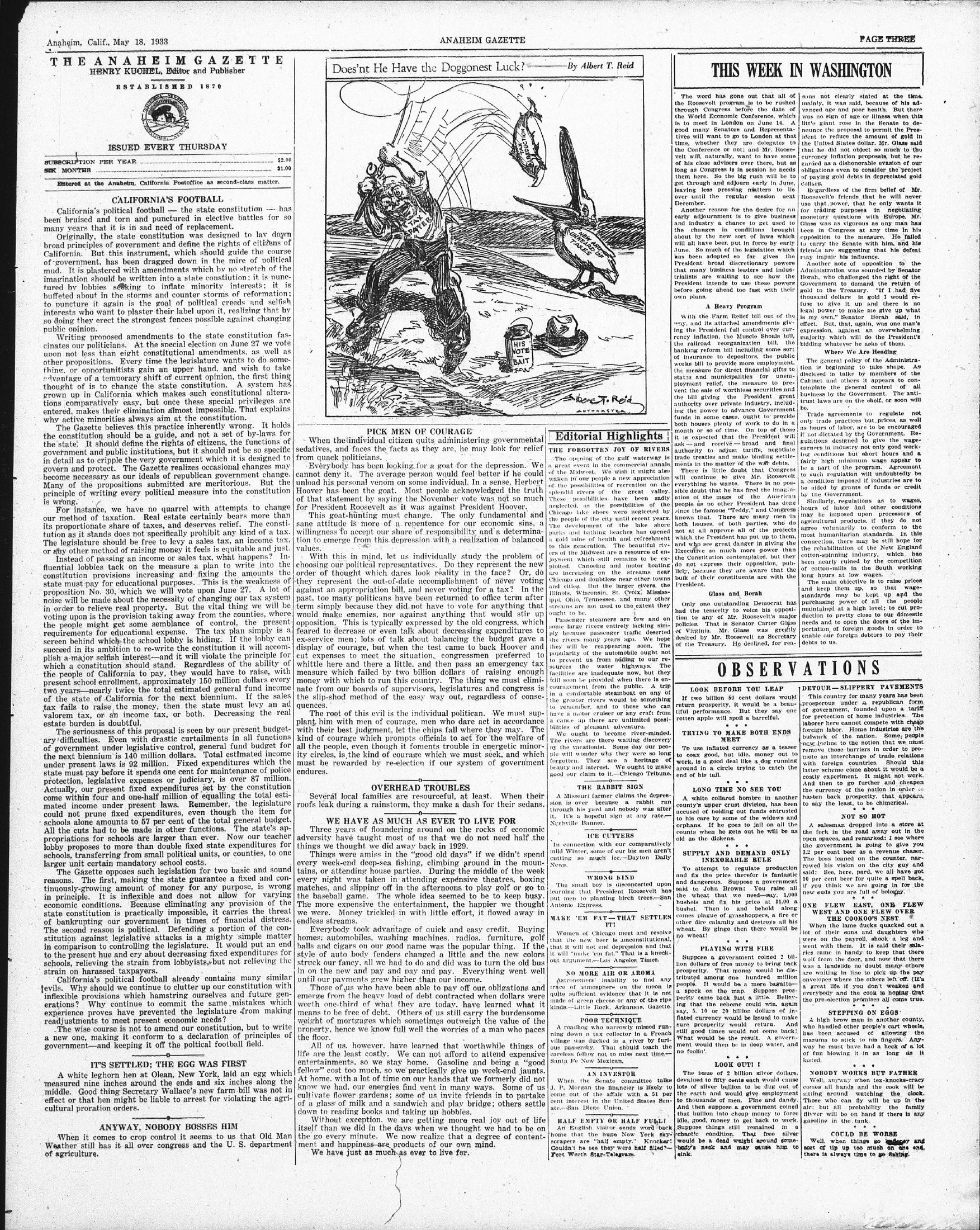
Does’nt He Have the Doggonest Luck? By Albert T. Reid
PICK MEN OF COURAGE
When the individual citizen quits administering governmental sedatives, and faces the facts as they are, he may look for relief from quack politicians.
Editorial Highlights
THE FORGOTTEN JOY OF RIVERS
PICK MEN OF COURAGE
When the individual citizen quits administering governmental sedatives, and faces the facts as they are, he may look for relief from quack politicians.
Everybody has been looking for a goat for the depression. We cannot deny it. The average person would feel better if he could unload his personal venom on some individual. In a sense, Herbert Hoover has been the goat. Most people acknowledged the truth of that statement by saying the November vote was not so much for President Roosevelt as it was against President Hoover.
This goat-hunting must change. The only fundamental and sane attitude is more of a repentence for our economic sins, a willingness to accept our share of responsibility and a determination to emerge from this depression with a realization of balanced values.
With this in mind, let us individually study the problem of choosing our political representatives. Do they represent the new order of thought which dares look reality in the face? Or, do they represent the out-of-date accomplishment of never voting against an appropriation bill, and never voting for a tax? In the past, too many politicans have been returned to office term after term simply because they did not have to vote for anything that would make enemies, nor against anything that would stir up opposition. This is typically expressed by the old congress, which feared to decrease or even talk about decreasing expenditures to ex-service men; lots of talk about balancing the budget gave a display of courage, but when the test came to back Hoover and cut expenses to meet the situation, congressmen preferred to whittle here and there a little, and then pass an emergency tax measure which failed by two billion dollars of raising enough money with which to run this country. The thing we must eliminate from our boards of supervisors, legislatures and congress is the slip-shod method of the easy way out, regardless of consequences.
The root of this evil is the individual politican. We must supplant him with men of courage, men who dare act in accordance with their best judgment, let the chips fall where they may. The kind of courage which prompts officials to act for the welfare of all the people, even though it foments trouble in energetic minority circles, is the kind of courage which we must seek, and which must be rewarded by re-election if our system of government endures.
OVERHEAD TROUBLES
Several local families are resourceful, at least. When their roofs leak during a rainstorm, they make a dash for their sedans.
WE HAVE AS MUCH AS EVER TO LIVE FOR
Three years of floundering around on the rocks of economic adversity have taught most of us that we do not need half the things we thought we did away back in 1929.
Things were amiss in the "good old days" if we didn't spend every week-end deep-sea fishing, climbing around in the moun-
Editorial Highlights
THE FORGOTTEN JOY OF RIVERS
The opening of the gulf waterway is a great event in the commercial annals of the Midwest. We wish it might also waken in our people a new appreciation of the possibilities of recreation on the splendid rivers of the great valley. These possibilities have been sadly neglected, as the possibilities of the Chicago lake shore were neglected by the people of the city until recent years. The development of the lake shore parks and bathing beaches has opened a gold mine of health and refreshment to this generation. The beautiful rivers of the Midwest are a resource of enjoyment which still remains to be exploited. Canoeing and motor boating are increasing on the streams near Chicago and doubtless near other towns and cities. But the larger rivers, the Illinois, Wisconsin, St. Croix, Mississippi, Ohio, Tennessee, and many other streams are not used to the extent they ought to be.
Passenger steamers are few and on some large rivers entirely lacking simply because passenger traffic deserted the rivers many years ago. We hope they will be reappearing soon. The popularity of the automobile ought not to prevent us from adding to our resources the water highways. The facilities are inadequate now, but they will soon be provided when there is encouragement from the public. A trip in a comfortable steamboat on any of the greater rivers would be something to remember, and to those who can have a motor cruiser or any craft from a canoe up there are unlimited possibilities of pleasant adventure.
We ought to become river-minded. The rivers are there waiting discovery by the vacationist. Some day our people will wonder why they were so long forgotten. They are a heritage of beauty and interest. We ought to make good our claim to it—Chicago Tribune.
THE RABBIT SIGN
A Missouri farmer claims the depression is over because a rabbit ran through his yard and nobody was after it. It's a hopeful sign at any rate—Nebraska Banner.
ICE CUTTERS
In connection with our comparatively mild Winter, some of our big men aren't cutting so much ice—Dayton Dally News.
OVERHEAD TROUBLES
Several local families are resourceful, at least. When their roofs leak during a rainstorm, they make a dash for their sedans.
WE HAVE AS MUCH AS EVER TO LIVE FOR
Three years of floundering around on the rocks of economic adversity have taught most of us that we do not need half the things we thought we did away back in 1929.
Things were amiss in the "good old days" if we didn't spend every week-end deep-sea fishing, climbing around in the mountains, or attending house parties. During the middle of the week every night was taken in attending expensive theatres, boxing matches, and slipping off in the afternoons to play golf or go to the baseball game. The whole idea seemed to be to keep busy. The more expensive the entertainment, the happier we thought we were. Money trickled in with little effort, it flowed away in endless streams.
Everybody took advantage of quick and easy credit. Buying homes; automobiles; washing machines; radios; furniture; golf balls and cigars on our good name was the popular thing. If the style of auto body fenders changed a little and the new colors struck our fancy, all we had to do and did was to turn the old bus in on the new and pay and pay and pay. Everything went well until our payments grew higher than our income.
Those of us who have been able to pay off our obligations and emerge from the heavy load of debt contracted when dollars were worth one-third of what they are today, have learned what it means to be free of debt. Others of us still carry the burdensome weight of mortgages which sometimes outweigh the value of the property, hence we know full well the worries of a man who paces the floor.
All of us, however, have learned that worthwhile things of life are the least costly. We can not afford to attend expensive entertainments, so we stay home. Gasoline and being a "good fellow" cost too much, so we practically give up week-end jaunts. At home, with a lot of time on our hands that we formerly did not know we had, our energies find vent in many ways. Some of us cultivate flower gardens; some of us invite friends in to partake of a glass of milk and a sandwich and play bridge; others settle down to reading books and taking up hobbies.
Without exception, we are getting more real joy out of life itself than we did in the days when we thought we had to be on the go every minute. We now realize that a degree of contentment and happiness are products of our own mind.
We have just as much as ever to live for.
THIS WEEK IN WASHINGTON
The word has gone out that all of the Roosevelt program is to be rushed through Congress before the date of the World Economic Conference, which is to meet in London on June 14. A good many Senators and Representatives will want to go to London at that time, whether they are delegates to the Conference or not; and Mr. Roosevelt will, naturally, want to have some of his close advisers over there, but as long as Congress is in session he needs them here. So the big rush will be to get through and adjourn early in June, leaving less pressing matters to lie over until the regular session next December.
Another reason for the desire for an early adjournment is to give business and industry a chance to get used to the changes in conditions brought about by the new sort of laws which will all have been put in force by early June. So much of the legislation which has been adopted so far gives the President broad discretionary powers that many business leaders and industrialists are waiting to see how the President intends to use these powers before going ahead too fast with their own plans.
A Heavy Program
With the Farm Relief bill out of the way, and its attached amendments giving the President full control over currency inflation, the Muscle Shoals bill, the railroad reorganization bill, the banking reform bill including some sort of insurance to depositors, the public works bill to provide more employment, the measure for direct financial gifts to states and municipalities for unemployment relief, the measure to prevent the sale of worthless securities and the bill giving the President great authority over private industry, including the power to advance Government funds in some cases, ought to provide both houses plenty of work to do in a month or so of time. On top of those it is expected that the President will ask—and receive—broad and final authority to adjust tariffs, negotiate trade treaties and make binding settlements not clearly stated at the time, mainly, it was said, because of his advanced age and poor health. But there was no sign of age or illness when this little's giant rose in the Senate to denounce the proposal to permit the President to reduce the amount of gold in the United States dollar. Mr. Glass said that he did not object so much to the currency inflation proposals, but he regarded as a dishonorable evasion of our obligations even to consider the project of paying gold debts in depreciated gold dollars.
Begardless of the firm belief of Mr. Roosevelt's friends that he will never use that power, that he only wants it for trading purposes in negotiating monetary questions with Europe, Mr. Glass was as vigorous as any man has been in Congress at any time in his opposition to the measure. He failed to carry the Senate with him, and his friends are suggesting that his defeat may impair his influence.
Another note of opposition to the Administration was sounded by Senator Borah, who challenged the right of the Government to demand the return of gold to the Treasury. "If I had five thousand dollars in gold I would refuse to give it up and there is no legal power to make me give up what is my own," Senator Borah said, in effect. But, that, again, was one man's expression, against an overwhelming majority which will do the President's bidding whatever he asks of them.
Where We Are Heading
The general policy of the Administration is beginning to take shape. As disclosed in talks by members of the Cabinet and others it appears to contemplate the general control of all business by the Government. The anti-trust laws are on the shelf, or soon will be.
Trade agreements to regulate not only trade practices but prices, as well as hours of labor, are to be encouraged if not dictated by the Government. Regulations designed to give the wage earners in industry not only good working conditions but short hours and a
JOY OF RIVERS
A gulf waterway is commercial annals wish it might also a new appreciation recreation on the great valley. Have been sadly possibilities of the were neglected by until recent years. In the lake shore reaches has opened and refreshment The beautiful rivage a resource of enremains to be extended motor boating the streams near is near other towns larger rivers, the St. Croix, Mississippi, and many other to the extent they are few and on entirely lacking similar traffic deserted years ago. We hope hearing soon. The mobile ought not adding to our re- highways. The date now, but they when there is en- public. A tripamboat on any of would be something so those who can or any craft from the unlimited possi- adventure. Some river-minded. Waiting discovery Some day our peo- they were so long like a heritage of We ought to make —Chicago Tribune.
OBSERVATIONS
LOOK BEFORE YOU LEAP
If two billion 50 cent dollars would return prosperity, it would be a beautiful performance. But they say one rotten apple will spoil a barrelful.
TRYING TO MAKE BOTH ENDS MEET
To use inflated currency as a teaser to coax good, but idle, money out to work, is a good deal like a dog running around in a circle trying to catch the end of his tail.
LONG TIME NO SEE YOU
A white collared hombre in another county's upper crust division, has been accused of holding out funds entrusted to his care by some of the widows and orphans. If he goes to jail on all the counts when he gets out he will be as old as the dickens.
SUPPLY AND DEMAND ONLY INEXORABLE RULE
To attempt to regulate production
DETOUR—SLIPPERY PAVEMENTS
This country for many years has been prosperous under a republican form of government, founded upon a tariff for protection of home industries. The laborer here cannot compete with cheap foreign labor. Home industries are the bulwark of the nation. Some people now incline to the notion that we must remove those barriers in order to promote an interchange of trade relations with foreign countries. Should this latter scheme come about it would be a costly experiment. It might not work. And then to go further and cheapen the currency of the nation in order to hasten back prosperity, that appears, to say the least, to be chimerical.
NOT SO HOT
A salesman dropped into a store at the fork in the road away out in the open spaces, and remarked: I see where the government is going to give you 3.2 per cent beer as a revenue chaser. The boss leaned on the counter, narrowed his vision on the city guy and
LONG TIME NO SEE YOU
A white collared hombre in another county's upper crust division, has been accused of holding out funds entrusted to his care by some of the widows and orphans. If he goes to jail on all the counts when he gets out he will be as old as the dickens.
SUPPLY AND DEMAND ONLY INEXORABLE RULE
To attempt to regulate production and fix the price therefor is fantastic and dangerous. Suppose a government said to John Brown: You raise all the wheat that we need—say, 1,000 bushels and fix his price at $1.00 a bushel. Then lo and behold along comes plague of grasshoppers, a fire or other dire calamity and destroys all his wheat. By gingo then there would be no wheat!
PLAYING WITH FIRE
Suppose a government coined 2 billion dollars of free money to bring back prosperity. That money would be distributed among one hundred million people. It would be a mere bagatto—a speck on the map. Suppose prosperity came back just a little. Believing that the scheme could win again say, 5, 10 or 20 billion dollars of inflated currency would be issued to make sure prosperity would return. And still good times would not come back! What would be the result. A government would then be in deep water, and no foolin'.
LOOK OUT!!
The issue of 2 billion silver dollars, devalued to fifty cents each would cause lots of silver bullion to be dug out of the earth and would give employment to thousands of men. Fine and dandy, And then suppose a government coined that bullion into cheap money to force idle, good, money to get back to work. Suppose things still remained in a chaotic condition. That free silver would be a dead weight around somebody's neck and may cause him to sink.
NOT SO HOT
A salesman dropped into a store at the fork in the road away out in the open spaces, and remarked: I see where the government is going to give you 3.2 per cent beer as a revenue chaser. The boss leaned on the counter, narrowed his vision on the city guy and said: See, here, pard, we all have got 10 per cent beer for quite a spell back, if you think we are going in for the new suds you are full of boloney.
ONE FLEW EAST, ONE FLEW WEST AND ONE FLEW OVER THE COOKOO'S NEST
When the lame ducks quacked out a lot of their sons and daughters who were on the payroll, shook a leg and went with them. It is said their salaries came in handy to keep that there wolf from the door, and now that there was a landslide no doubt many others are waiting in line to pick up the pay envelopes where the others left off. (It's a great life if you don't weaken and everybody and the cook is hoping that the pre-election promises all come true.
STEPPING ON EGGS
A high brow man in another county, who handled other people's cart wheels, has been accused of allowing the mazuma to stick to his fingers. Anyway he must have had a heck of a lot of fun blowing it in as long as it lasted.
NOBODY WORKS BUT FATHER
Well, anyway when tex-knocks-cracy comes all hands and the cook will be sitting around watching the clock. Those who can fly will be up in the air; but all probability the family flivver will be on hand if there is any gasoline in the tank.
COULD BE WORSE
Well, when things go bad oopsy and sort of tip up too much on one end, there is always time to go fishing.