anaheim-gazette 1933-05-11
Scanned page
Searchable text
THE ANAHEIM GAZETTE
HENRY KUCHEL, Editor and Publisher
ESTABLISHED 1870
ISSUED EVERY THURSDAY
SUBSCRIPTION PER YEAR ... $2.00
SIX MONTHS ... $1.00
Entered at the Anaheim, California Postoffice as second-class matter.
CALIFORNIA BETRAYED
California's legislature ordered in November to cut state expenses to within the ability of the people to pay, admits its betrayal of the electorate.
After spending many thousands of the taxpayers' dollars in legislative tomfoolery, our senators and assemblymen concede that the teachers' lobby, which the citizens repudiated when they turned thumbs down on proposition No. 9, still rides the legislative saddle. The admission is contained in the passage of constitutional amendment No. 30, to be voted upon June 27.
Instead of obeying the electorate, the legislature kotows to the lobby and re-submits proposition No. 9, all dolled up in a new dress!
Californians last fall decided in no uncertain terms that they did not want nearly all of their educational expense written into the state constitution where it would be beyond the power of the legislature or the people themselves to control. Yet, with fixed requirements for educational costs already exceeding 57 per cent of the total general fund, the legislature rewrites proposition No. 9, to double the elementary and triple the high school constitutional requirements to be paid by the state.
The legislature was ordered to reduce costs. Now it proposes to increase expenditures and to raise the money by an attention-compelling two-cent sales tax!
Proposed amendment No. 30, however, contains one more evil which may overshadow the balance of the measure. Ominously hidden away in an inconspicuous clause is the authority for the legislature to levy any kind of a tax which the constitution does not specifically prohibit. Since there is no tax which the constitution does not prohibit (it merely defines our dual tax system and provides for an ad valorem tax in case of a deficit), our legislation
The legislature was ordered to reduce costs. Now it proposes to increase expenditures and to raise the money by an attention-compelling two-cent sales tax!
Proposed amendment No. 30, however, contains one more evil which may overshadow the balance of the measure. Ominously hidden away in an inconspicuous clause is the authority for the legislature to levy any kind of a tax which the constitution does not specifically prohibit. Since there is no tax which the constitution does not prohibit (it merely defines our dual tax system and provides for an ad valorem tax in case of a deficit), our legislators seek absolute power to levy any or all kinds of taxes, and in any amounts they see fit.
This is a double admission that the legislature, which was ordered to cut expenses to within state income, intends to do no such thing.
Instead, it proposes to meet a threatened deficit by increasing taxes.
THE SWORD HANGS BY A THREAD
The federal government will punish brewers who put out beer containing more than 3.2 per cent alcohol. New York state authorities say that they will punish brewers who put out beer containing less than 3.2 per cent alcohol. The New York brewer in trying to adhere to the 3.2 per cent line will feel like the fellow who crosses over Niagara Falls on a tight rope.
PROTECTING THE BUYER
Never before have merchants, manufacturers and distribution agencies faced so great a temptation to offer products at a cheap price. While many retailers want to take advantage of the public demand for articles selling at lower prices, they do not, on the average, intend to victimize their customers. That would be poor policy. But the reiterated demand for price merchandise has resulted in instances of injustice.
Fortunately, the state has several bureaus which have succeeded in protecting to some extent the innocent buyers. For instance, the state recently confiscated six carloads of strawberries, shipped from Louisiana, on the grounds that the berries were packed in below-standard size containers, thus misleading the purchaser as to what he was buying. The shipment was made to a large chain store, which was allowed to send the berries out of the state to dispose of them. Another instance of vigilence on the part of the state government was in finding that 3615 gallons of lubricating oil were shipped to California from a Pennsylvania concern in drums one and one-half gallons short, and gallon cans one pint shy of legal requirements.
Possibly the zeal of the retailer in demanding lower price prompted out-of-state sellers to meet the price demand with below-legal measurements. What ever the cause, the bald fact remains that the innocent purchaser might have been victimized had not the state stepped in to prevent fraud.
SHORT CIRCUITS
A noted scientist says that the human brain is an electric dynamo. A lot of people seem to be suffering with short circuits just now.
NEW CONCEPTION OF RIGHTS
Americans today devote more thought to causes of social distress than ever before. Our economic condition, which forces truths from day to back into barbarism.
We go forward in the life of the rafties. Nothing can courage still are potent than war.
The other day a miles an hour, more seconds! Twice flown over the peak a spot heretofore wrecked, but the gaze with her crew unleashed lights in the distance signalling to unknown universe.
"Imagination can a few days ago. In this world of ours,
Those who adhere of our present deprived long after the deprivation made recently where the tariff question give adequate protec our tariff Mr. Farrell.
"That it no longer failure to accomplish France, Canada and taxes on imports for these increases world economic coerce strongly bargaining merely be reduction.
"In the United States duty, but have perished much of the protection."
"Our decline inifiable reprisals probably not alone to unjustify a combination of use the buying power come the secondary.
Here is the true giving us rates high the free traders changing world course proper amount of pican industry going."
SHORT CIRCUITS
A noted scientist says that the human brain is an electric dynamo. A lot of people seem to be suffering with short circuits just now.
NEW CONCEPTION OF RIGHTS
Americans today devote more thought to causes of social distress than ever before. Our economic condition, which forces millions of people to face the uncertainties of unemployment, is the direct cause of this concentrated attention.
Several years ago common thought cried out for government to keep out of business—captains of industry voiced the demands of the people. Since the depression virtually paralized business, we now find the business leader asking for government assistance, and with it, government supervision. Vagaries of fortune forced millions of people out of their jobs, thus starting the vicious cycle of cutting down buying power and causing more unemployment. Distress of the individual, multiplied hundreds of thousands of times, becomes the distress of a great nation.
Importance to society of the individual's employment is receiving the earnest attention of political and business leaders, as well as the worker himself. There is a deep-seated and growing conviction that one of society's first duties is to give the individual the continuous opportunity of earning a living.
TARIFF WALL NO DAM
Some European nations have increased the tariff on American apples. Unfortunately, it seems to be impossible for Uncle Sam to retailiate by putting an effective embargo on European apple sauce.
THE GREATEST FORCE IN THE WORLD
The other day Dr. George Crile, one of the most distinguished men in medical research, announced his discovery that the functioning of the human brain is in the nature of electrical discharges. The brain contains millions upon millions of tiny electrical generators, deriving their energy from the body through the supra-renal glands, just above the kidneys. Mental activity depends upon the proper functioning of those glands.
That is another illustration of the depths to which modern science has penetrated into nature's secrets. It is more than that, however; it is an illustration of the fact that nothing, not even the most serious economic distress, can keep men from thinking. And as long as thought persists, and the human mind reveals new
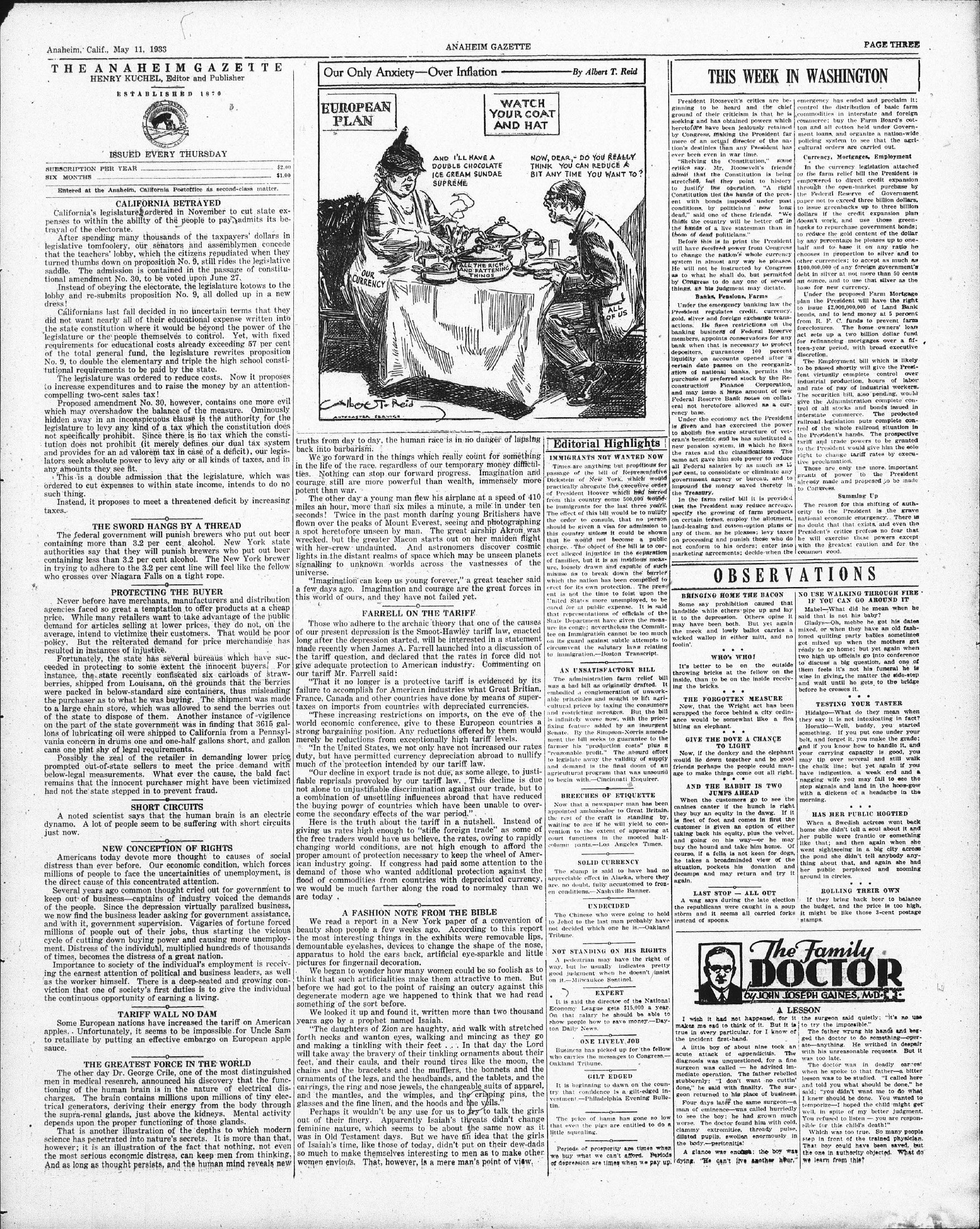
Our Only Anxiety—Over Inflation — By Albert T. Reid
EUROPEAN PLAN
WATCH YOUR COAT AND HAT
AND ILL HAVE A DOUBLE CHOCOLATE ICE CREAM SUNDAE SUPREME
NOW, DEAR, - DO YOU REALLY THINK YOU CAN REDUCE A BIT ANY TIME YOU WANT TO?
OUR CURRENCY
ALL THE RICH AND FATTENING THINGS
ALL OF US
Caleb T. Reid
AUTOGASTER SERVICE
truths from day to day, the human race is in no danger of lapsing back into barbarism.
We go forward in the things which really count for something
Editorial Highlights
IMMIGRANTS NOT WANTED NOW
truths from day to day, the human race is in no danger of lapsing back into barbarism.
We go forward in the things which really count for something in the life of the race, regardless of our temporary money difficulties. Nothing can stop our forward progress. Imagination and courage still are more powerful than wealth, immensely more potent than war.
The other day a young man flew his airplane at a speed of 410 miles an hour, more than six miles a minute, a mile in under ten seconds! Twice in the past month daring young Britishers have flown over the peaks of Mount Everest, seeing and photographing a spot heretofore unseen by man. The great airship Akron was wrecked, but the greater Macon starts out on her maiden flight with her crew undaunted. And astronomers discover cosmic lights in the distant realms of space which may be unseen planets signalling to unknown worlds across the vastnesses of the universe.
"Imagination can keep us young forever," a great teacher said a few days ago. Imagination and courage are the great forces in this world of ours, and they have not failed yet.
FARRELL ON THE TARIFF
Those who adhere to the archaic theory that one of the causes of our present depression is the Smoot-Hawley tariff law, enacted long after the depression started, will be interested in a statement made recently when James A. Farrell launched into a discussion of the tariff question, and declared that the rates in force did not give adequate protection to American industry: Commenting on our tariff Mr. Farrell said:
"That it no longer is a protective tariff is evidenced by its failure to accomplish for American industries what Great Britian, France, Canada and other countries have done by means of supertaxes on imports from countries with depreciated currencies.
"These increasing restrictions on imports, on the eve of the world economic conference, give to these European countries a strong bargaining position. Any reductions offered by them would merely be reductions from exceptionally high tariff levels.
"In the United States, we not only have not increased our rates duty, but have permitted currency depreciation abroad to nullify much of the protection intended by our tariff law.
"Our decline in export trade is not due, as some allege, to justifiable reprisals provoked by our tariff law. This decline is due not alone to unjustifiable discrimination against our trade, but to a combination of unsettling influences abroad that have reduced the buying power of countries which have been unable to overcome the secondary effects of the war period."
Here is the truth about the tariff in a nutshell. Instead of giving us rates high enough to "stifle foreign trade" as some of the free traders would have us believe, the rates, owing to rapidly changing world conditions, are not high enough to afford the proper amount of protection necessary to keep the wheel of American industry going. If congress had paid some attention to the Editorial Highlights
IMMIGRANTS NOT WANTED NOW
Times are anything but propitious for passage of the bill of Representative Dickstein of New York, which would practically abrogate the executive order of President Hoover which had barred from this country some 500,000 would-be immigrants for the last three years.
The effect of this bill would be to nullify the order to consuls, that no person should be given a visa for admission to this country unless it could be shown that he would not become a public charge. The object of the bill is to correct alleged injustice in the separation of families, but it is an insidious measure, loosely drawn and capable of such misuse as to break down the barrier which the nation has been compelled to erect for its own protection. The present is not the time to foist upon the United States more unemployed, to be cared for at public expense. It is said that representations of officials of the State Department have given the measure its conge; nevertheless the Committee on Immigration cannot be too much on its guard against subtle attempts to circumvent the salutary laws relating to immigration.—Boston Transcript.
AN UNSATISFACTORY BILL
The administration farm relief bill was a bad bill as originally drafted. It embodied a conglomeration of unworkable principles and sought to lift agricultural prices by taxing the consumers and restricting acresages. But the bill is infinitely worse now, with the price-fixing feature added by an insurgent Senate. By the Simpson-Norris amendment the bill seeks to guarantee to the farmer his "production costs" plus a "reasonable profit." The absurd effort to legislate away the validity of supply and demand is the final doom of an agricultural program that was unsound to begin with.—Cincinnati Enquirer.
BREECHES OF ETIQUETTE
Now that a newspaper man has been appointed ambassador to Great Britain, the rest of the craft is standing by, waiting to see if he will yield to convention to the extent of appearing at court functions in the mooted half-column pants.—Los Angeles Times.
SOLID CURRENCY
"Our decline in export trade is not due, as some allege, to justifiable reprisals provoked by our tariff law. This decline is due not alone to unjustifiable discrimination against our trade, but to a combination of unsettling influences abroad that have reduced the buying power of countries which have been unable to overcome the secondary effects of the war period."
Here is the truth about the tariff in a nutshell. Instead of giving us rates high enough to "stifle foreign trade" as some of the free traders would have us believe, the rates, owing to rapidly changing world conditions, are not high enough to afford the proper amount of protection necessary to keep the wheel of American industry going. If congress had paid some attention to the demand of those who wanted additional protection against the flood of commodities from countries with depreciated currency, we would be much farther along the road to normalcy than we are today.
A FASHION NOTE FROM THE BIBLE
We read a report in a New York paper of a convention of beauty shop people a few weeks ago. According to this report the most interesting things in the exhibits were removable lips, demountable eyelashes, devices to change the shape of the nose, apparatus to hold the ears back, artificial eye-sparkle and little pictures for fingernail decoration.
We began to wonder how many women could be so foolish as to think that such artificialities make them attractive to men. But before we had got to the point of raising an outcry against this degenerate modern age we happened to think that we had read something of the sort before.
We looked it up and found it, written more than two thousand years ago by a prophet named Isaiah.
"The daughters of Zion are haughty, and walk with stretched forth necks and wanton eyes, walking and mincing as they go and making a tinkling with their feet ... In that day the Lord will take away the bravery of their tinkling ornaments about their feet, and their cauls, and their round tires like the moon, the chains and the bracelets and the mufflers, the bonnets and the ornaments of the legs, and the headbands, and the tablets, and the earrings, the ring and nose jewels, the changeable suits of apparel, and the mantles, and the wimples, and the crisping pins, the glasses and the fine linen, and the hoods and the veils."
Perhaps it wouldn't be any use for us to try to talk the girls out of their finery. Apparently Isaiah's threats didn't change feminine nature, which seems to be about the same now as it was in Old Testament days. But we have an idea that the girls of Isaiah's time, like those of today, didn't put on their dew-dads so much to make themselves interesting to men as to make other women envious. That, however, is a mere man's point of view.
THIS WEEK IN WASHINGTON
President Roosevelt's critics are beginning to be heard and the chief ground of their criticism is that he is seeking and has obtained powers which heretofore have been jealously retained by Congress, making the President far more of an actual director of the nation's destinies than any President has ever been even in war time.
"Shelving the Constitution," some critics say. Mr. Roosevelt's friends admit that the Constitution is being stretched, but they point to history to justify the operation. "A rigid Constitution ties the hands of the present with bonds imposed under past conditions, by politicians now long dead," said one of these friends. "We think the country will be better off in the hands of a live statesman than in those of dead politicians."
Before this is in print the President will have received power from Congress to change the nation's whole currency system in almost any way he pleases. He will not be instructed by Congress as to what he shall do, but permitted by Congress to do any one of several things as his judgment may dictate.
Banks, Pensions, Farms
Under the emergency banking law the President regulates credit, currency, gold, silver and foreign exchange transactions. He fixes restrictions on the banking business of Federal Reserve members, appoints conservators for any bank when that is necessary to protect depositors, guarantees 100 percent liquidity on accounts opened after a certain date passes on the reorganization of national banks, permits the purchase of preferred stock by the Reconstruction Finance Corporation, and may issue a large amount of new Federal Reserve Bank notes on collateral not heretofore allowed as a currency base.
Under the economy act the President is given and has exercised the power to abolish the entire structure of veteran's benefits, and he has substituted a new pension system, in which he fixes the rates and the classifications. The emergency has ended and proclaim it; control the distribution of basic farm commodities in interstate and foreign commerce; buy the Farm Board's cotton and all cotton held under Government loans, and organize a nation-wide policing system to see that the agricultural orders are carried out.
Currency, Mortgages, Employment
In the currency legislation attached to the farm relief bill the President is empowered to direct credit expansion through the open-market purchase by the Federal Reserve of Government paper not to exceed three billion dollars, to issue greenbacks up to three billion dollars if the credit expansion plan doesn't work, and use those green-backs to repurchase government bonds; to reduce the gold content of the dollar by any percentage he pleases up to one-half and to base it on any ratio he chooses in proportion to silver and to other currencies; to accept as much as $100,000,000 of any foreign government's debt in silver at not more than 50 cents an ounce, and to use that silver as the base for new currency.
Under the proposed Farm Mortgage plan the President will have the right to issue $2,000,000,000 of Land Bank bonds, and to lend money at 5 percent from R. F. C. funds to prevent farm foreclosures. The home owners' loan act sets up a two billion dollar fund for refinancing mortgages over a fifteen-year period, with broad executive discretion.
The Employment bill which is likely to be passed shortly will give the President virtually complete control over industrial production, hours of labor and rate of pay of industrial workers. The securities bill, also pending, would give the Administration complete control of all stocks and bonds issued in interstate commerce. The projected railroad legislation puts complete control of the whole railroad situation in the President's hands. The prospective tariff and trade powers to be granted to the President would give him the sole right to change tariff rates by execu-
OBSEVATIONS
BRINGING HOME THE BACON
Some say prohibition caused that landslide while others pipe up and lay it to the depression. Others opine it may have been both. But yet again the meek and lowly ballot carries a wicked wallop in either mitt, and no foolin'.
WHO'S WHO?
It's better to be on the outside throwing bricks at the fellow on the inside, than to be on the inside receiving the bricks.
THE FORGOTTEN MEASURE
Now, that the Wright act has been scrapped the force behind a city ordinance would be somewhat like a flea biting an elephant.
GIVE THE DOVE A CHANCE TO LIGHT
Now, if the donkey and the elephant would lie down together and be good friends perhaps the people could manage to make things come out all right.
AND THE RABBIT IS TWO JUMPS AHEAD
When the customers go to see the canines canter if the hunch is right they buy an equity in the dawg. If it is fleet of foot and comes in first the customer is given an option of either taking back his equity, plus the velvet, and going on his way—or he may buy the hound and take him home. Of course, if a fella is not keen for dogs, he takes a broadminded view of the situation, pockets his donation and certain date passes on the reorganization of national banks, permits the purchase of preferred stock by the Reconstruction Finance Corporation, and may issue a large amount of new Federal Reserve Bank notes on collateral not heretofore allowed as a currency base.
Under the economy act the President is given and has exercised the power to abolish the entire structure of veteran's benefits, and he has substituted a new pension system, in which he fixes the rates and the classifications. The same act gave him sole power to reduce all Federal salaries by as much as 15 per cent, to consolidate or eliminate any government agency or bureau, and to impound the money saved thereby in the Treasury.
In the farm relief bill it is provided that the President may reduce acreage, specify the growing of farm products on certain terms, employ the allotment, land-leasing and cotton-option plans or any of them, as he pleases; levy taxes on processing and punish those who do not conform to his orders; enter into marketing agreements; decide when the
NO USE WALKING THROUGH FIRE IF YOU CAN GO ABOUND IT
Mabel—What did he mean when he said that is not his baby?
Gladys—Oh, mebbe he got his dates mixed, or when they have an old fashioned quilting party babies sometimes get mixed up when the mothers get ready to go home; but yet again when two high up officials go into conference to discuss a big question, and one of them feels it's not his funeral he is wise in giving, the matter the side-step and wait until he gets to the bridge before he crosses it.
TESTING YOUR TASTER
Hidalgo—What do they mean when they say it is not intoxicating in fact?
Horatio—Well, buddy, you started something. If you put one under your belt, and forget it, you make the grade; and if you know how to handle it, and your carrying capacity is good, you may tip over several and still walk the chalk line; but yet again if you have indigestion, a weak end and a nagging wife you may fail to see the stop signals and land in the hoos-gow with a dickens of a headache in the morning.
HAS HER PUBLIC HOGTIED
When a Swedish actress went back home she didn't tell a soul about it and her public were frantic or something like that; and then again when she went sightseeing in a big city across the pond she didn't tell anybody anything about that, and again she had
AND THE RABBIT IS TWO JUMPS AHEAD
When the customers go to see the canines canter if the hunch is right they buy an equity in the dawg. If it is fleet of foot and comes in first the customer is given an option of either taking back his equity, plus the velvet, and going on his way—or he may buy the hound and take him home. Of course, if a fella is not keen for dogs, he takes a broadminded view of the situation, pockets his donation and decamps and may return and try it again.
LAST STOP — ALL OUT
A wag says during the late election the republicans were caught in a soup storm and it seems all carried forks instead of spoons.
HAS HER PUBLIC HOGIED
When a Swedish actress went back home she didn't tell a soul about it and her public were frantic or something like that; and then again when she went sightseeing in a big city across the pond she didn't tell anybody anything about that, and again she had her public perplexed and zooming around in circles.
ROLLING THEIR OWN
If they bring back beer to balance the budget, and the price is too high, it might be like those 3-cent postage stamps.
The Family Doctor
BY JOHN JOSEPH GAINES, M.D.
A LESSON
I wish it had not happened, for it makes me sad to think of it. But it is true in every particular, for I know of the incident first-hand.
A little boy of about nine took an acute attack of appendicitis. The diagnosis was unquestioned, for a fine surgeon was called — he advised immediate operation. The father rebelled stubbornly: "I don't want no cuttin' done," he said with finality. The surgeon returned to his place of business.
Four days later the same surgeon—a man of eminence—was called hurriedly to see the boy; he had grown much worse. The doctor found him with cold, clammy extremities, thready pulse, dilated pupils, swollen enormously in the body.—peritonitis!
A glance was enough; the boy was dying. "He can't live another hour."
the surgeon said quietly; "It's no use to try the impossible."
The father wrung his hands and berged the doctor to do something—operate—anything. He writhed in despair with his unreasonable requests. But it was too late.
The doctor was in deadly earnest when he spoke to that father—a bitter lesson was to be studied. "I called here and told you what should be done," he said; "you didn't want me to do what I knew should be done. You wanted to temporize—I hoped the child might get well, in spite of my better judgment. You refused to listen — you are responsible for this child's death!"
Which was too true. So many people step in front of the trained physician. That boy could have been saved, but the one in authority objected. What do we learn from this?