anaheim-gazette 1933-05-04
Scanned page
Searchable text
THE ANAHEIM GAZETTE
HENRY KUCHEL, Editor and Publisher
ESTABLISHED 1870
ISSUED EVERY THURSDAY
SUBSCRIPTION PER YEAR ... $2.00
SIX MONTHS ... $1.00
Entered at the Anaheim, California Postoffice as second-class matter.
IF THIS IS TREASON, MAKE THE MOST OF IT
People who revolt at the idea of changing long-established convictions will not like the disturbing suggestion that the state cut in half the amount of money now expended on highways every year, and transfer it to the general fund where it would go a long way toward eliminating a dreaded ad valorem tax.
We know the arguments advanced for spending all the money derived from gasoline taxes on state highways. Now mildewed with age, these arguments once were sound. Certainly, the people in a different time and in a different state of mind, did vote to spend gas tax money on roads exclusively. That was in a period after the war when the use of the automobile grew by leaps and bounds, when keeping highway development in pace with the increased use of horseless carriages was an acute problem.
Times have changed. Highway construction under the plan authorized by the people a number of years ago now has dwindled to the point of "6600" mile schemes promoted by the Auto Club of Southern California for the specific purpose of keeping cities from getting a larger and more equitable share of gas tax money with which they could make substantial reduction on common property taxes. Motor organizations of the state, however, are not the only ones howling to prevent any diversion of gas tax funds. They are ably seconded by cement trust and contractors' representatives, and other groups lobbying for selfish purposes. The argument that men will be put to work is used to cover up the enormous expenditures of the state highway department. Spending of the money for the purpose of putting men to work benefits comparatively few individuals directly, but if we insist that gas tax funds continue to be spent for that reason, every property-
of Southern California for the specific purpose of keeping cities from getting a larger and more equitable share of gas tax money with which they could make substantial reduction on common property taxes. Motor organizations of the state, however, are not the only ones howling to prevent any diversion of gas tax funds. They are ably seconded by cement trust and contractors' representatives, and other groups lobbying for selfish purposes. The argument that men will be put to work is used to cover up the enormous expenditures of the state highway department. Spending of the money for the purpose of putting men to work benefits comparatively few individuals directly, but if we insist that gas tax funds continue to be spent for that reason, every property-owner in the state of California will feel the heavy hand of an ad valorem tax of about 50 cents on every $100 of actual valuation of his property. This means that in Orange county, where assessments are made on the basis of one-third the actual value of the property, the assessed value would be multiplied by three before figuring the 50 cents per $100 valuation.
To illustrate what widening of a few roads, building thoroughfares through many sections that are not ready for them, cutting off a few miles here and there on an otherwise adequate highway system, is costing the taxpayers of California, let us look at the proposed expenditures in the state for the next biennium:
General government ... $67,328,328.34
Education ... 84,324,659.13
Highways ... 107,002,176.66
Total ... $258,654,164.13
Every official of state government, from the governor to the newest recruit among the assemblymen, admits that California faces bankruptcy. The proposed expenditures, with the exception of highways, have been pruned a great deal. Governor Rolph and his financial aide, Rolland Vandegrift, cut approximately 20 per cent off the estimated expenditures from the general fund before submitting the figure to the legislature. The assembly and senate committees have reduced costs still more. Certain retrenchments in education have been made, more are in order. But in the highway department there has been no curtailment because there has been no need to. In fact, there is a surplus of $9,500,000 in that department now that is badly needed to approximately make up a certain deficit at the end of June. Here is a department spending almost as much as the total costs of general government and education in the state, getting its money from a special fund that has been considered sacred. If we had money to throw away, letting any single department of government out-spend the rest of it would be folly. Voters of California never intended such a result.
The truth is, we have enough highways to meet our present needs. Less than half the money now being spent by the highway department would maintain the present highway system in good repair. The balance of this money, about $16,000,000 a year, could be diverted temporarily to the general fund, with the likelihood that it would prevent our legislators from looking for new sources of revenue. Money must be raised to balance the budget. If it is not taken from present taxes by reduction of costs and transferring of money from one fund to another, then it must be obtained by new taxation. More taxes, new or heavier, would fall most heavily upon motorists because they represent the majority of the taxpayers of the state of California.
Look at the facts calmly. This plan takes money out of one pocket and puts it into another. Note that it does not increase our taxes; it does not drain both pockets any more than is down Washington. Smartly promote selfish interest attention on promotion put their powerful arm would help them supers steamship companies laws subsidizing, our coastal and international public relations bureau favorable reaction ther organizations, and our unduly influence aut schools and universities.
Even our cherished for 100 years and many pagandists. Partly educational leaders educators organized the welfare of true to pay is followed or industrialists, can above public interests have the teachers' lobby in California, to restrict education saw the prohibitioni lobby, succeed in writing amendment; now w through a reversal o wet propaganda, suc European nations annually appropriated large share of that boundaries, much or opinion in devious w government has gone exists daring to exp nation's leaders. Thus has grown Everywhere, by direct by public speakers still is fed sugar-coat their bones in public create a favorable pi propagandists immediate to divert attention, co They realize that what people are led The people of th verses and collapse
The balance of this money, about $16,000,000 a year, could be diverted temporarily to the general fund, with the likelihood that it would prevent our legislators from looking for new sources of revenue. Money must be raised to balance the budget. If it is not taken from present taxes by reduction of costs and transferring of money from one fund to another, then it must be obtained by new taxation. More taxes, new or heavier, would fall most heavily upon motorists because they represent the majority of the taxpayers of the state of California.
Look at the facts calmly. This plan takes money out of one pocket and puts it into another. Note that it does not increase our taxes; it does not drain both pockets any more than is down now. Blind refusal to face the facts, to realize that these are unusual times demanding unusual action and changes of common thought to meet new conditions, must result in increased taxes.
Let us throw off the yoke of out-worn convictions and do the sensible thing of getting along on the present income of the state rather than impose new taxes upon an already over-taxed and financially harassed citizenship.
EVEN SO, THERE IS TROUBLE AHEAD
Our friends who have the price of a bottle of the new three point two beer claim it is not intoxicating. But other friends who never profess a thirst argue that we pay enough tax to pacify the public conscience.
THE MEDICINE OF BITTER EXPERIENCE
Propagators of half truths, after a decade of unrestricted and successful use of selfish methods, face the bitter experience of being found out.
As long as John Citizen earned enough money to live comfortably and enjoy a few luxuries, he went along his own private way, believing what he wanted to believe, disbelieving what did not appeal to him, and not bothering a great deal about protesting against a yearly rise in his tax bill because he feared his howl would bounce off the great stonewall of public opinion without so much as an echo. During the last decade of prosperity, the nation and its intricate labyrinth of business fabrications grew as never before. The World war gave business leaders and selfish interests a new weapon — propaganda. Persons who stopped for as much as a moment to think about the extent of propaganda during the war, realized they were victims of hokum. The breezes of propaganda, not all of it bad and not much of it good, blew human emotions to the four winds.
Big business saw the effectiveness of propaganda — and profited thereby. Lobbies were set up in state capitols, with the nerve center of gigantic corporations' lobbies centralized at
ANAHEIM GAZETTE
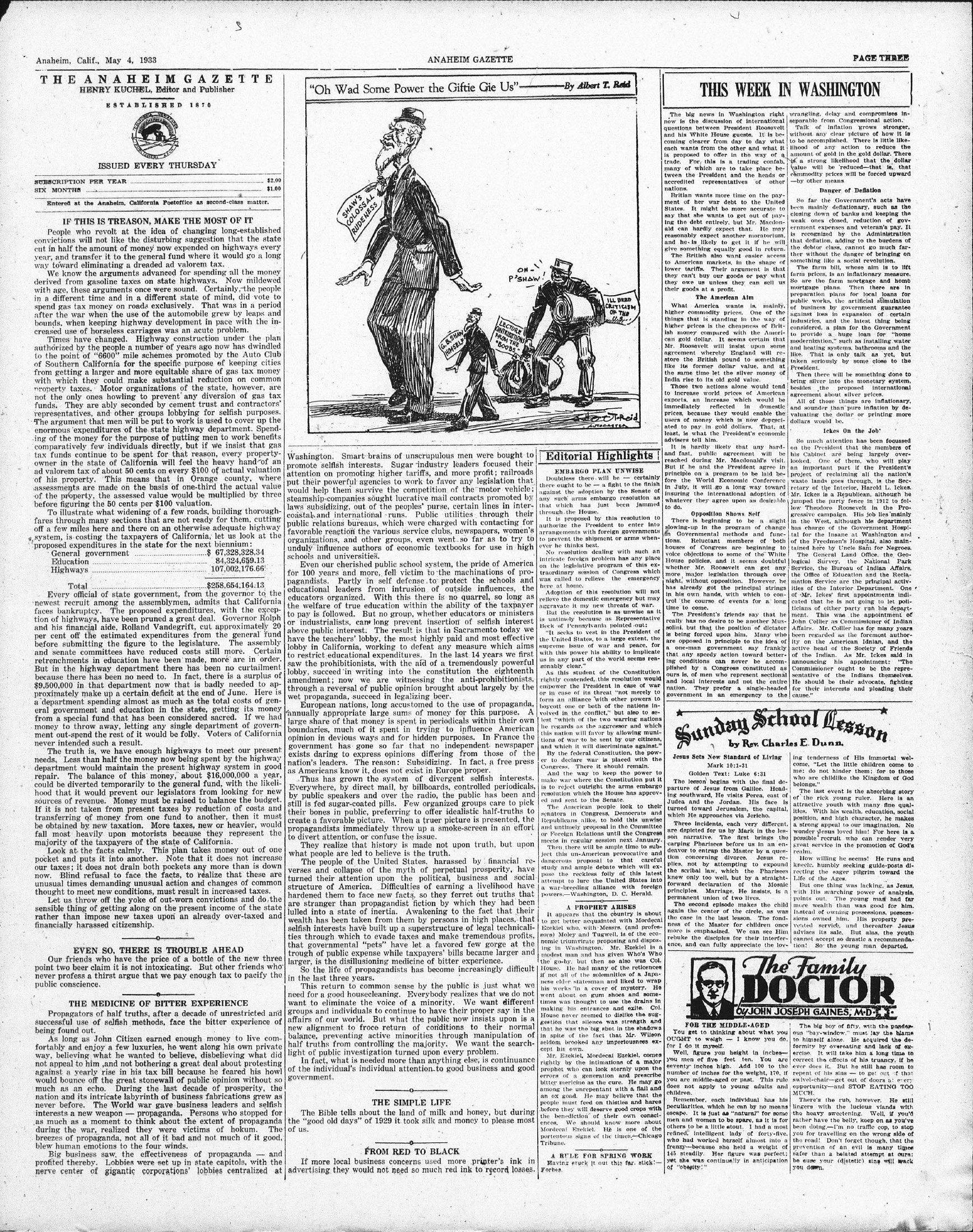
"Oh Wad Some Power the Giftie Gie Us"——By Albert T. Reid
SHAW'S COLOSSAL RUDENESS
OH- P'SHAW!
ILL BRED CRITICISM OF THE
G.B. SHAW HIMSELF
LECTURE CONTRIBUTIONS FROM THE "BOOBS"
Washington. Smart brains of unscrupulous men were bought to Editorial Highlights
Washington. Smart brains of unscrupulous men were bought to promote selfish interests. Sugar industry leaders focused their attention on promoting higher tariffs, and more profit; railroads put their powerful agencies to work to favor any legislation that would help them survive the competition of the motor vehicle; steamship companies sought lucrative mail contracts promoted by laws subsidizing, out of the peoples' purse, certain lines in intercoastal and international runs. Public utilities through their public relations bureaus, which were charged with contacting for favorable reaction the various service clubs, newspapers, women's organizations, and other groups, even went so far as to try to unduly influence authors of economic textbooks for use in high schools and universities.
Even our cherished public school system, the pride of America for 100 years and more, fell victim to the machinations of propagandists. Partly in self defense to protect the schools and educational leaders from intrusion of outside influences, the educators organized. With this there is no quarrel, so long as the welfare of true education within the ability of the taxpayer to pay is followed. But no group, whether educators or ministers or industrialists, can long prevent insertion of selfish interest above public interest. The result is that in Sacramento today we have the teachers' lobby, the most highly paid and most effective lobby in California, working to defeat any measure which aims to restrict educational expenditures. In the last 14 years we first saw the prohibitionists, with the aid of a tremendously powerful lobby, succeed in writing into the constitution the eighteenth amendment; now we are witnessing the anti-prohibitionists, through a reversal of public opinion brought about largely by the wet propaganda, succeed in legalizing beer.
European nations, long accustomed to the use of propaganda, annually appropriate large sums of money for this purpose. A large share of that money is spent in periodicals within their own boundaries, much of it spent in trying to influence American opinion in devious ways and for hidden purposes. In France the government has gone so far that no independent newspaper exists daring to express opinions differing from those of the nation's leaders. The reason: Subsidizing. In fact, a free press as Americans know it, does not exist in Europe proper.
Thus has grown the system of divergent selfish interests. Everywhere, by direct mail, by billboards, controlled periodicals, by public speakers and over the radio, the public has been and still is fed sugar-coated pills. Few organized groups care to pick their bones in public, preferring to offer idealistic half-truths to create a favorable picture. When a truer picture is presented, the propagandists immediately throw up a smoke-screen in an effort to divert attention, or confuse the issue.
They realize that history is made not upon truth, but upon what people are led to believe is the truth.
The people of the United States, harassed by financial reverses and collapse of the myth of perpetual prosperity, have
Editorial Highlights
EMBARGO PLAN UNWISE
Doubtless there will be — certainly there ought to be — a fight to the finish against the adoption by the Senate of any such arms embargo resolution as that which has just been jammed through the House.
It is proposed by this resolution to authorize the President to enter into arrangements with foreign governments to prevent the shipment or arms whenever he thinks best.
No resolution dealing with such an intricate foreign problem has any place on the legislative program of this extraordinary session of Congress which was called to relieve the emergency here at home.
Adoption of this resolution will not relieve the domestic emergency but may aggravate it my new threats of war.
But the resolution is as unwise as it is untimately because as Representative Beck of Pennsylvania pointed out:
"It seeks to vest in the President of the United States, to a large extent, the supreme issue of war and peace, for with this power his ability to implicate us in any part of the world seems reasonably clear."
As this student of the Constitution rightly contended, this resolution would empower the President in case of war or in case of its threat "not merely to form an alliance with other powers to boycott one or both of the nations involved in the conflict," but also to select "which of the two warring nations he regards as the aggressor and which this nation will favor by allowing munitions of war to be sent by our citizens, and which it will discriminate against."
By the federal Constitution, the power to declare war is placed with the Congress. There it should remain.
And the way to keep the power to make war where the Constitution put it is to reject outright the arms embargo resolution which the House has approved and sent to the Senate.
The American people look to their senators in Congress, Democrats and Republicans alike, to hold this unwise and untimely proposal in the Committee or Foreign Relations until the Congress meets in regular session next January.
Then there will be ample time to subject this un-American provocative and dangerous proposal to that careful study and ample debate which will ex-
Thus has grown the system of divergent selfish interests. Everywhere, by direct mail, by billboards, controlled periodicals, by public speakers and over the radio, the public has been and still is fed sugar-coated pills. Few organized groups care to pick their bones in public, preferring to offer idealistic half-truths to create a favorable picture. When a truer picture is presented, the propagandists immediately throw up a smoke-screen in an effort to divert attention, or confuse the issue.
They realize that history is made not upon truth, but upon what people are led to believe is the truth.
The people of the United States, harassed by financial reverses and collapse of the myth of perpetual prosperity, have turned their attention upon the political, business and social structure of America. Difficulties of earning a livelihood have hardened them to face new facts, so they ferret out truths that are stranger than propagandist fiction by which they had been lulled into a state of inertia. Awakening to the fact that their wealth has been taken from them by persons in high places, that selfish interests have built up a superstructure of legal technicalities through which to evade taxes and make tremendous profits, that governmental “pets” have let a favored few gorge at the trough of public expense while taxpayers’ bills became larger and larger, is the disillusioning medicine of bitter experience.
So the life of propagandists has become increasingly difficult in the last three years.
This return to common sense by the public is just what we need for a good housecleaning. Everybody realizes that we do not want to eliminate the voice of a minority. We want different groups and individuals to continue to have their proper say in the affairs of our world. But what the public now insists upon is a new alignment to froce return of conditions to their normal balance, preventing active minorities through manipulation of half truths from controlling the majority. We want the search-light of public investigation turned upon every problem.
In fact, what is needed more than anything else, is continuance of the individual’s individual attention to good business and good government.
THE SIMPLE LIFE
The Bible tells about the land of milk and honey, but during the “good old days” of 1929 it took silk and money to please most of us.
FROM RED TO BLACK
If more local business concerns used more printer’s ink in advertising they would not need so much red ink to record losses.
A PROPHET ARISES
It appears that the country is about to get better acquainted with Mordecai Ezekiel who, with Messrs. (and professors) Moley and Tugwell, is of the economic triumvirate proposing and disposing in Washington. Mr. Ezekiel is a modest man and has given Who’s Who the go-by, but then so also was Col. House. He had many of the reticences if not all of the solemnities of a Japanese elder statesman and liked to wrap his works in a cover of mystery. He went about on gum shoes and sometimes was thought to use the drains in making his entrances and exite. Col. House never seemed to dislike the suggestion that silence was strength and that he was the big shot in the shadows in spite of the fact that Mr. Wileon seldom brooked any imperiousness except his own.
Mr. Ezekiel, Mordecai Ezekiel, comes rightly by the intimations of a major prophet who can look sternly upon the errors of a generation and prescribe bitter medicine as the cure. He may go among the unrepentant with a flail and an ox good. He may believe that the people must feed on thistles and hares before they will deserve good crops with the benediction of their own consciences. We should know more about Mordecai Ezekiel. He is one of the portentous signs of the times—Chicago Tribune.
A RULE FOR SPRING WORK
Having struck it out this far, stick!—Forbes.
THIS WEEK IN WASHINGTON
The big news in Washington right now is the discussion of international questions between President Roosevelt and his White House guests. It is becoming clearer from day to day what each wants from the other and what it is proposed to offer in the way of a trade. For this is a trading confab, many of which are to take place between the President and the heads or accredited representatives of other nations.
Britian wants more time on the payment of her war debt to the United States. It might be more accurate to say that she wants to get out of paying the debt entirely, but Mr. Macdonald can hardly expect that. He may reasonably expect another moratorium, and he is likely to get it if he will give something equally good in return.
The British also want easier access to American markets, in the shape of lower tariffs. Their argument is that they can't buy our goods or pay what they owe us unless they can sell us their goods at a profit.
The American Aim
What America wants is, mainly, higher commodity prices. One of the things that is standing in the way of higher prices is the cheapness of British money compared with the American gold dollar. It seems certain that Mr. Roosevelt will insist upon some agreement whereby England will restore the British pound to something like its former dollar value, and at the same time let the silver money of India rise to its old gold value.
Those two actions alone would tend to increase world prices of American exports, an increase which would be immediately reflected in domestic prices, because they would enable the users of money which is now depreciated to pay in gold dollars. That, at least, is what the President's economic advisers tell him.
It is hardly likely that any hard-and fast, public agreement will be reached during Mr. Macdonald's visit wrangling, delay and compromises inseparable from Congressional action.
Talk of inflation grows stronger, without any clear picture of how it is to be accomplished. There is little likelihood of any action to reduce the amount of gold in the gold dollar. There is a strong likelihood that the dollar value will be 'reduced'—that is, that commodity prices will be forced upward—by other means.
Danger of Deflation
So far the Government's acts have been mainly deflationary, such as the closing down of banks and keeping the weak ones closed, reduction of government expenses and veteran's pay. It is recognized by the Administration that deflation, adding to the burdens of the debtor class, cannot go much farther without the danger of bringing on something like a social revolution.
The farm bill, whose aim is to lift farm prices, is an inflationary measure. So are the farm mortgage and home mortgage plans. Then there are in preparation plans for local loans for public works, the artificial stimulation of business by government guarantee against loss in expansion of certain industries, and the latest thing being considered, a plan for the Government to provide a huge loan for "home modernization," such as installing water and heating systems, bathrooms and the like. That is only talk as yet, but taken seriously by some close to the President.
Then there will be something done to bring silver into the monetary system, besides the proposed international agreement about silver prices.
All of those things are inflationary, and sounder than pure inflation by devaluating the dollar or printing more dollars would be.
Ickes On the Job'
So much attention has been focussed on the President that the members of his Cabinet are being largely over-
like its former dollar value, and at the same time let the silver money of India rise to its old gold value.
Those two actions alone would tend to increase world prices of American exports, an increase which would be immediately reflected in domestic prices, because they would enable the users of money which is now depreciated to pay in gold dollars. That, at least, is what the President's economic advisers tell him.
It is hardly likely that any hard-and fast, public agreement will be reached during Mr. Macdonald's visit. But if he and the President agree in principle on a program to be laid before the World Economic Conference in July, it will go a long way toward insuring the international adoption of whatever they agree upon as desirable to do.
Opposition Shows Self
There is beginning to be a slight slowing-up in the program of change in Governmental methods and functions. Reluctant members of both houses of Congress are beginning to voice objections to some of the White House policies, and it seems doubtful whether Mr. Roosevelt can get any more major legislation through over night, without opposition. However, he has already got the principal strings in his own hands, with which to control the course of events for a long time to come.
The President's friends say that he really has no desire to be another Mussolini, but that the position of dictator is being forced upon him. Many who are opposed in principle to the idea of a one-man government say frankly that any speedy action toward bettering conditions can never be accomplished by a Congress constituted as ours is, of men who represent sectional and local interests and not the entire nation. They prefer a single-headed government in an emergency to the
Sunday School Lesson
by Rev. Charles E. Dunn.
Jesus Sets New Standard of Living
Mark 10:1-31
Golden Text: Luke 6:31
The lesson begins with the final departure of Jesus from Galilee. He visits Perea, east of Judea and the Jordan. His face is turned toward Jerusalem, the capital, which He approaches via Jericho.
Three incidents, each very different, are depicted for us by Mark in the lesson narrative. The first brings the carping Pharisees before us in an endeavor to entrap the Master by a question concerning divorce. Jesus replies, not by attempting to expound the scribal law which the Pharisees like its former dollar value, and at the same time let the silver money of India rise to its old gold value.
Then there will be something done to bring silver into the monetary system, besides the proposed international agreement about silver prices.
All of those things are inflationary, and sounder than pure inflation by devaluating the dollar or printing more dollars would be.
Ickes On the Job'
So much attention has been focussed on the President that the members of his Cabinet are being largely overlooked. One of them, who will play an important part if the President's project of reclaiming all the nation's waste lands goes through, is the Secretary of the Interior, Harold L. Ickes. Mr. Ickes is a Republican, although he jumped the party fence in 1912 to follow Theodore Roosevelt in the Progressive campaign. His job lies mainly in the West, although his department has charge of the Government Hospital for the Insane at Washington and of the Freedmen's Hospital, also maintained here by Uncle Sam for Negroes.
The General Land Office, the Geological Survey, the National Park Service, the Bureau of Indian Affairs, the Office of Education and the Reclamation Service are the principal activities of the Interior Department. One of Mr. Ickes' first appointments indicated that he is not going to let politicians of either party run his department. This was the appointment of John Collier as Commissioner of Indian Affairs. Mr. Collier has for many years been regarded as the foremost authority on the American Idian, and the active head of the Society of Friends of the Indian. As Mr. Ickes said in announcing his appointment: "The Commissioner ought to be the representative of the Indians themselves. He should be their advocate, fighting for their interests and pleading their cause."
Sunday School Lesson
by Rev. Charles E. Dunn.
Jesus Sets New Standard of Living
Mark 10:1-31
Golden Text: Luke 6:31
The lesson begins with the final departure of Jesus from Galilee. He visits Perea, east of Judea and the Jordan. His face is turned toward Jerusalem, the capital, which He approaches via Jericho.
Three incidents, each very different, are depicted for us by Mark in the lesson narrative. The first brings the carping Pharisees before us in an endeavor to entrap the Master by a question concerning divorce. Jesus replies, not by attempting to expound the scribal law which the Pharisees like its former dollar value, and at the same time let the silver money of India rise to its old gold value.
Then there will be something done to bring silver into the monetary system, besides the proposed international agreement about silver prices.
All of those things are inflationary, and sounder than pure inflation by devaluating the dollar or printing more dollars would be.
Ickes On the Job'
So much attention has been focussed on the President that the members of his Cabinet are being largely overlooked. One of them, who will play an important part if the President's project of reclaiming all the nation's waste lands goes through, is the Secretary of the Interior, Harold L. Ickes. Mr. Ickes is a Republican, although he jumped the party fence in 1912 to follow Theodore Roosevelt in the Progressive campaign. His job lies mainly in the West, although his department has charge of the Government Hospital for the Insane at Washington and of the Freedmen's Hospital, also maintained here by Uncle Sam for Negroes.
The General Land Office, the Geological Survey, the National Park Service, the Bureau of Indian Affairs, the Office of Education and the Reclamation Service are the principal activities of the Interior Department. One of Mr. Ickes' first appointments indicated that he is not going to let politicians of either party run his department. This was the appointment of John Collier as Commissioner of Indian Affairs. Mr. Collier has for many years been regarded as the foremost authority on the American Idian, and the active head of the Society of Friends of the Indian. As Mr. Ickes said in announcing his appointment: "The Commissioner ought to be the representative of the Indians themselves. He should be their advocate, fighting for their interests and pleading their cause."
The lesson begins with the final departure of Jesus from Galilee. He visits Perea, east of Judea and the Jordan. His face is turned toward Jerusalem, the capital, which He approaches via Jericho.
Three incidents, each very different, are depicted for us by Mark in the lesson narrative. The first brings the carping Pharisees before us in an endeavor to entrap the Master by a question concerning divorce. Jesus replies, not by attempting to expound the scribal law, which the Pharisees knew only too well, but by a straightforward declaration of the Mosaic principles. Marriage, He insists, is a permanent union of two lives.
The second episode makes the child again the center of the circle, as was the case in the last lesson. The fondness of the Master for children once more is emphasized. We can see Him rebuke the disciples for their interference, and can fully appreciate the love.
For the Middle-Aged
You get to thinking about what you OUGHT to weigh — I know you do, for I do it myself.
Well, figure you height in inches—you men of five feet ten. You are seventy inches high. Add 100 to the number of inches for the weight, 170, if you are middle-aged or past. This rule does not apply to young adults and children.
Remember, each individual has his peculiarities, which he can by no means escape. It is just as "natural" for some men and women to be spare, as it is for others to be a little stout. I had a most refined, intelligent lady of forty-five, who had worked herself almost into a frenzy—because she held a weight of 145 steadily. Her figure was perfect; yet she was continually in anticipation of "obesity!"
The big boy of fifty, with the ponderous "bay-window," must lay the blame to himself alone. He acquired the deformity by overeating and lack of exercise. It will take him a long time to correct the effects of his truancy, if he ever does it. But he still has room to repent of his sins — to get out of that swivel-chair—get out of doors at every opportunity—and STOP EATING TOO MUCH.
There's the rub, however. He still lingers with the lucious vlands with the heavy sweetening. Well, if you'd rather have the belly, keep on as you've been doing. I'm no traffic cop, to stop you for travelling on the wrong side of the road! Don't forget though, that the prevention of an evil is many times safer than a belated attempt at cure; be sure your (dietetic) sins will track you down.