anaheim-gazette 1933-04-13
Scanned page
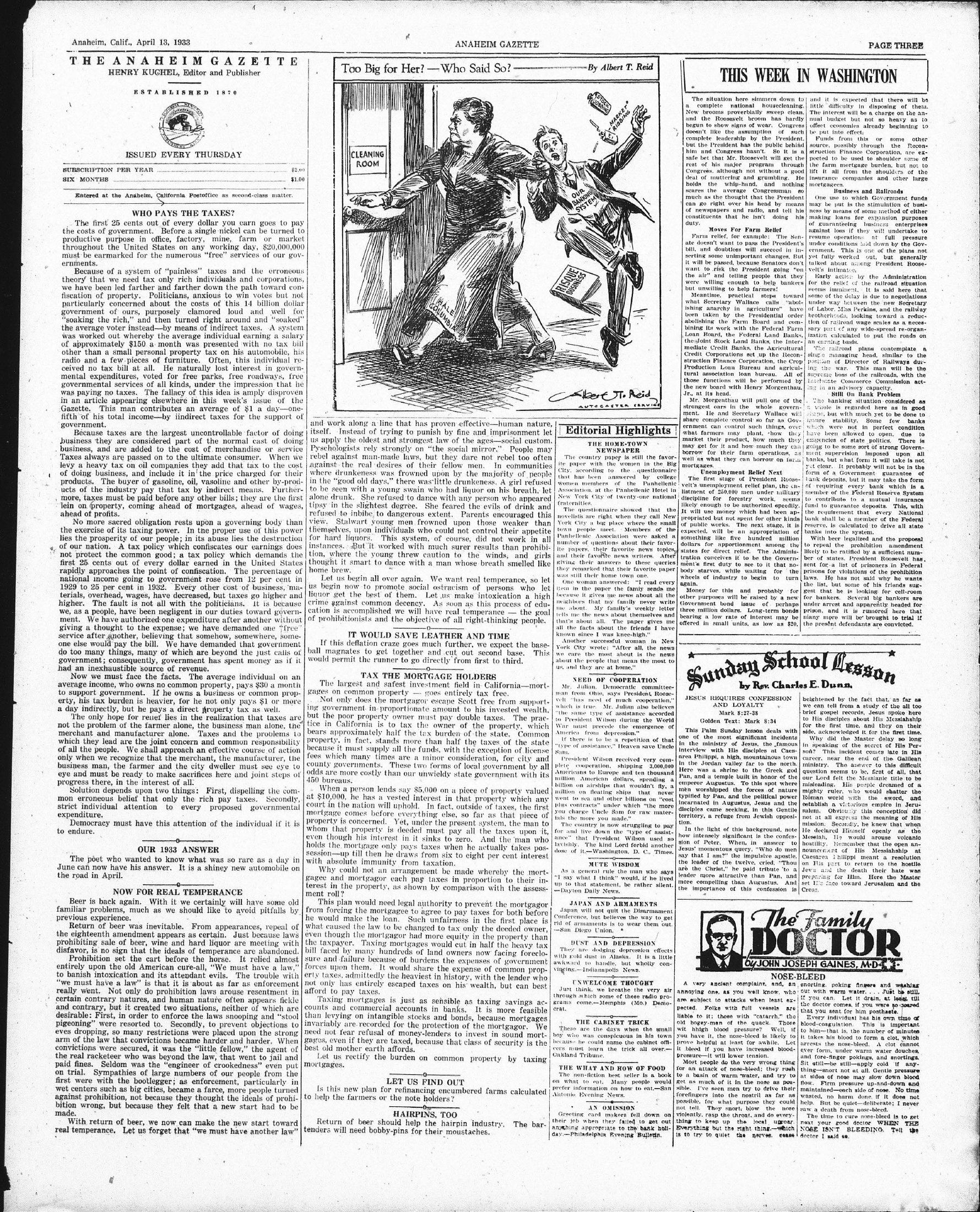
Searchable text
THE ANAHEIM GAZETTE
HENRY KUGHEL, Editor and Publisher
ESTABLISHED 1870
ISSUED EVERY THURSDAY
SUBSCRIPTION PER YEAR ... $2.00
SIX MONTHS ... $1.00
Entered at the Anaheim, California Postoffice as second-class matter.
WHO PAYS THE TAXES?
The first 25 cents out of every dollar you earn goes to pay the costs of government. Before a single nickel can be turned to productive purpose in office, factory, mine, farm or market throughout the United States on any working day, $20,000,000 must be earmarked for the numerous "free" services of our governments.
Because of a system of "painless" taxes and the erroneous theory that we need tax only rich individuals and corporations, we have been led farther and farther down the path toward confiscation of property. Politicians, anxious to win votes but not particularly concerned about the costs of this 14 billion dollar government of ours, purposely clamored loud and well for "soaking the rich," and then turned right around and "soaked" the average voter instead—by means of indirect taxes. A system was worked out whereby the average individual earning a salary of approximately $150 a month was presented with no tax bill other than a small personal property tax on his automobile, his radio and a few pieces of furniture. Often, this individual received no tax bill at all. He naturally lost interest in governmental expenditures, voted for free parks, free roadways, free governmental services of all kinds, under the impression that he was paying no taxes. The fallacy of this idea is amply disproven in an article appearing elsewhere in this week's issue of the Gazette. This man contributes an average of $1 a day—one-fifth of his total income—by iindirect taxes for the support of government.
Because taxes are the largest uncontrollable factor of doing business they are considered part of the normal cast of doing business, and are added to the cost of merchandise or service
radio and a few pieces of furniture. Often, this individual received no tax bill at all. He naturally lost interest in governmental expenditures, voted for free parks, free roadways, free governmental services of all kinds, under the impression that he was paying no taxes. The fallacy of this idea is amply disproven in an article appearing elsewhere in this week's issue of the Gazette. This man contributes an average of $1 a day—one-fifth of his total income—by iindirect taxes for the support of government.
Because taxes are the largest uncontrollable factor of doing business they are considered part of the normal cast of doing business, and are added to the cost of merchandise or service Taxes always are passed on to the ultimate consumer. When we levy a heavy tax on oil companies they add that tax to the cost of doing business, and include it in the price charged for their products. The buyer of gasoline, oil, vasoline and other by-products of the industry pay that tax by indirect means. Furthermore, taxes must be paid before any other bills; they are the first lein on property, coming ahead of mortgages, ahead of wages, ahead of profits.
No more sacred obligation rests upon a governing body than the exercise of its taxing power. In the proper use of this power lies the prosperity of our people; in its abuse lies the destruction of our nation. A tax policy which confiscates our earnings does not protect the common good; a tax policy which demands the first 25 cents out of every dollar earned in the United States rapidly approaches the point of confiscation. The percentage of national income going to government rose from 12 per cent in 1929 to 25 per cent in 1932. Every other cost of business, materials, overhead, wages, have decreased, but taxes go higher and higher. The fault is not all with the politicians. It is because we, as a people, have been negligent in our duties toward government. We have authorized one expenditure after another without giving a thought to the expense; we have demanded one "free" service after another, believing that somehow, somewhere, someone else would pay the bill. We have demanded that government do too many things, many of which are beyond the just calls of government; consequently, government has spent money as if it had an inexhaustible source of revenue.
Now we must face the facts. The average individual on an average income, who owns no common property, pays $30 a month to support government. If he owns a business or common property, his tax burden is heavier, for he not only pays $1 or more a day indirectly, but he pays a direct property tax as well.
The only hope for relief lies in the realization that taxes are not the problem of the farmer alone, the business man alone, the merchant and manufacturer alone. Taxes and the problems to which they lead are the joint concern and common responsibility of all the people. We shall approach an effective course of action only when we recognize that the merchant, the manufacturer, the business man, the farmer and the city dweller must see eye to eye and must be ready to make sacrifices here and joint steps of progress there, in the interest of all.
Solution depends upon two things: First, dispelling the common erroneous belief that only the rich pay taxes. Secondly, strict individual attention to every proposed governmental expenditure.
Democracy must have this attention of the individual if it is to endure.
OUR 1933 ANSWER
business man, the farmer and the city dweller must see eye to eye and must be ready to make sacrifices here and joint steps of progress there, in the interest of all.
Solution depends upon two things: First, dispelling the common erroneous belief that only the rich pay taxes. Secondly, strict individual attention to every proposed governmental expenditure.
Democracy must have this attention of the individual if it is to endure.
OUR 1933 ANSWER
The poet who wanted to know what was so rare as a day in June can now have his answer. It is a shiney new automobile on the road in April.
NOW FOR REAL TEMPERANCE
Beer is back again. With it we certainly will have some old familiar problems, much as we should like to avoid pitfalls by previous experience.
Return of beer was inevitable. From appearances, repeal of the eighteenth amendment appears as certain. Just because laws prohibiting sale of beer, wine and hard liquor are meeting with disfavor, is no sign that the ideals of temperance are abandoned.
Prohibition set the cart before the horse. It relied almost entirely upon the old American cure-all, "We must have a law," to banish intoxication and its attendant evils. The trouble with "we must have a law" is that it is about as far as enforcement really went. Not only do prohibition laws arouse resentment in certain contrary natures, and human nature often appears fickle and contrary, but it created two situations, neither of which are desirable: First, in order to enforce the laws snooping and "stool pigeoning" were resorted to. Secondly, to prevent objections to eves dropping, so many restrictions were placed upon the strong arm of the law that convictions became harder and harder. When convictions were secured, it was the "little fellow," the agent of the real racketeer who was beyond the law, that went to jail and paid fines. Seldom was the "engineer of crookedness" even put on trial. Sympathies of large numbers of our people from the first were with the bootlegger; as enforcement, particularly in wet centers such as big cities, became a farce, more people turned against prohibition, not because they thought the ideals of prohibition wrong, but because they felt that a new start had to be made.
With return of beer, we now can make the new start toward real temperance. Let us forget that "we must have another law"
ANAHEIM GAZETTE
Too Big for Her? — Who Said So? — By Albert T. Reid
CLEANING ROOM
STOCK JOBBING
MARKET RIBBING
OUR BANKING SYSTEM
RISQUE BUSINESS
Albert T. Reid
AUTOCASTER SERVICE
and work along a line that has proven effective—human nature,
itself. Instead of trying to punish by fine and imprisonment let
us apply the oldest and strongest law of the ages—social custom.
Psychologists rely strongly on “the social mirror.” People may
and work along a line that has proven effective—human nature,
itself. Instead of trying to punish by fine and imprisonment let
us apply the oldest and strongest law of the ages—social custom.
Psychologists rely strongly on "the social mirror." People may
rebel against man-made laws, but they dare not rebel too often
against the real desires of their fellow men. In communities
where drunkenness was frowned upon by the majority of people
in the "good old days," there was little drunkenness. A girl refused
to be seen with a young swain who had liquor on his breath, let
alone drunk. She refused to dance with any person who appeared
tipsy in the slightest degree. She feared the evils of drink and
refused to inbibe to dangerous extent. Parents encouraged this
view. Stalwart young men frowned upon those weaker than
themselves, upon individuals who could not control their appetite
for hard liquors. This system, of course, did not work in all
instances. But it worked with much surer results than prohibition,
where the young threw caution to the winds, and girls
thought it smart to dance with a man whose breath smelled like
home brew.
Let us begin all over again. We want real temperance, so let
us begin now to promote social ostracism of persons who let
liquor get the best of them. Let us make intoxication a high
crime against common decency. As soon as this process of education is accomplished we will have real temperance — the goal of prohibitionists and the objective of all right-thinking people.
IT WOULD SAVE LEATHER AND TIME
If this deflation craze goes much further, we expect the baseball magnates to get together and cut out second base. This would permit the runner to go directly from first to third.
TAX THE MORTGAGE HOLDERS
The largest and safest investment field in California—mortgages on common property — goes entirely tax free.
Not only does the mortgage escape Scott free from supporting government in proportionate amount to his invested wealth, but the poor property owner must pay double taxes. The practice in California is to tax the owner of the property, which bears approximately half the tax burden of the state. Common property, in fact, stands more than half the taxes of the state because it must supply all the funds, with the exception of license fees which many times are a minor consideration, for city and county governments. These two forms of local government by all odds are more costly than our unwieldy state government with its 450 bureaus.
When a person lends say $5,000 on a piece of property valued at $10,000, he has a vested interest in that property which any court in the nation will uphold. In fact, outside of taxes, the first mortgage comes before everything else, so far as that piece of property is concerned. Yet, under the present system, the man to whom that property is deeded must pay all the taxes upon it, even though his interest in it sinks to zero. And the man who holds the mortgage only pays taxes when he actually takes possession—up till then he draws from six to eight per cent interest.
Editorial Highlights
THE HOME-TOWN NEWSPAPER
The country paper is still the favorite paper with the women in the Big City, according to the questionnaire that has been answered by college women members of the Panhellenic Association, at the Panhellenic Hotel in New York City of twenty-one national fraternities.
The questionnaire showed that the novelists are right when they call New York City a big place where the small town people meet. Members of the Panhellenic Association were asked a number of questions about their favorite papers, their favorite news topics, and their favorite news writers. After giving their answers to these queries they remarked that their favorite paper was still their home town one.
One woman answered: "I read every item in the paper the family sends me because it gives me news about all the neighbors that my family never write me about. My family's weekly letter tells me the news about themselves and that's about all. The paper gives me all the facts about the friends I have known since I was knee-high."
Another successful woman in New York City wrote: "After all, the news we care the most about is the news about the people that mean the most to us, and they are at home."
NEED OF COOPERATION
Mr. Julian, Democratic committeeman from Ohio, says President Roosevelt "has need of much cooperation," which is true. Mr. Julian also believes "the same type of assistance accorded to President Wilson during the World War must precede the emergence of America from depression."
If there is to be a repetition of that "type of assistance," Heaven save Uncle Sam.
President Wilson received very complete cooperation, shipping 3,000,000 Americans to Europe and ten thousand million American dollars, spending a billion on airships that wouldn't fly, a million on floating ships that never went to sea and other billions on "cost plus contracts" under which "the more you charge Uncle Sam for raw materials the more you made."
The country is now struggling to pay for and live down the "type of assistance" that President Wilson used so lavishly. The kind Lord forbid another dose of it.—Washington, D.C., Times.
These two forms of local government by all odds are more costly than our unwieldy state government with its 450 bureaus.
When a person lends say $5,000 on a piece of property valued at $10,000, he has a vested interest in that property which any court in the nation will uphold. In fact, outside of taxes, the first mortgage comes before everything else, so far as that piece of property is concerned. Yet, under the present system, the man to whom that property is deeded must pay all the taxes upon it, even though his interest in it sinks to zero. And the man who holds the mortgage only pays taxes when he actually takes possession—up till then he draws from six to eight per cent interest with absolute immunity from taxation.
Why could not an arrangement be made whereby the mortgagee and mortgagor each pay taxes in proportion to their interest in the property, as shown by comparison with the assessment roll?
This plan would need legal authority to prevent the mortgagor from forcing the mortgagee to agree to pay taxes for both before he would make the loan. Such unfairness in the first place is what caused the law to be changed to tax only the deeded owner, even though the mortgagor had more equity in the property than the taxpayer. Taxing mortgages would cut in half the heavy tax bill faced by many hundreds of land owners now facing foreclosure and failure because of burdens the expenses of government forces upon them. It would share the expense of common property taxes, admittedly the heaviest in history, with the lender who not only has entirely escaped taxes on his wealth, but can best afford to pay taxes.
Taxing mortgages is just as sensible as taxing savings accounts and commercial accounts in banks. It is more feasible than levying on intangible stocks and bonds, because mortgages invariably are recorded for the protection of the mortgagor. We need not fear refusal of money-lenders to invest in sound mortgages, even if they are taxed, because that class of security is the best old mother earth affords.
Let us rectify the burden on common property by taxing mortgages.
LET US FIND OUT
Is this new plan for refinancing encumbered farms calculated to help the farmers or the note holders?
HAIRPINS, TOO
Return of beer should help the hairpin industry. The bar-tenders will need bobby-pins for their moustaches.
THIS WEEK IN WASHINGTON
The situation here simmers down to a complete national housecleaning. New brooms proverbially sweep clean, and the Roosevelt broom has hardly begun to show signs of wear. Congress doesn't like the assumption of such complete leadership by the President, but the President has the public behind him and Congress hasn't. So it is a safe bet that Mr. Roosevelt will get the rest of his major program through Congress, although not without a good deal of muttering and grumbling. He holds the whip-hand, and nothing scares the average Congressman so much as the thought that the President can go right over his head by means of newspapers and radio, and tell his constituents that he isn't doing his duty.
Moves For Farm Relief
Farm relief, for example: The Senate doesn't want to pass the President's bill, and doubtless will succeed in inserting some unimportant changes. But it will be passed, because Senators don't want to risk the President going "on the air" and telling people that they were willing enough to help bankers but unwilling to help farmers!
Meantime, practical steps toward what Secretary Wallace calls "abolishing anarchy in agriculture" have been taken by the Presidential order abolishing the Farm Board and combining its work with the Federal Farm Loan Board, the Federal Land Banks, the Joint Stock Land Banks, the Intermediate Credit Banks, the Agricultural Credit Corporations set up the Reconstruction Finance Corporation, the Crop Production Loan Bureau and agricultural association loan bureau. All of those functions will be performed by the new board with Henry Morgenthau, Jr., at its head.
Mr. Morgenthau will pull one of the strongest oars in the whole government. He and Secretary Wallace will share complete control so far as Government can control such things, over what farmers may plant, how they market their product, how much they may get for it and how much they can borrow for their farm operations and it is expected that there will be little difficulty in disposing of them. The interest will be a charge on the annual budget but not so heavy as to offset economies already beginning to be put into effect.
Funds from this or some other source, possibly through the Reconstruction Finance Corporation, are expected to be used to shoulder some of the farm mortgage burden, but not to lift it all from the shoulders of the insurance companies and other large mortgages.
Business and Railroads
One use to which Government funds may be put is the stimulation of business by means of some method of either making loans for expansion purposes of guaranteeing business enterprises against loss if they will undertake to resume operations at full pressure under conditions laid down by the Government. This is one of the plans not yet fully worked out, but generally talked about among President Roosevelt's intimates.
Early action by the Administration for the relief of the railroad situation seems imminent. It is said here that some of the delay is due to negotiations under way between the new Secretary of Labor, Miss Perkins, and the railway brotherhoods, looking toward a reduction of railroad wage scales as a necessary part of any wide-spread re-organization calculated to put the roads on an earning basis.
The railroad plans contemplate a single managing head, similar to the position of Director of Railways during the war. This man will be the supreme boss of the railroads, with the Intelsate Commerce Commission acting in an advisory capacity.
Still On Bank Problem
The banking situation considered as a whole is regarded here as in good shape, but with much yet to be done to insure stability. Some few banks which were not in perfect condition have been allowed to open, due to exigencies of state politics. There is going to be some sort of strong Governance supervision.
Highlights
HOME-TOWN
SPAPER
OOPERATION
nocratic committee says President Roosevelt much cooperation."
Julian also believes assistance accorded in during the World War the emergence of depression."
a repetition of that Heaven save Uncle received very commencing 3,000,000 and ten thousand dollars, spending a that wouldn't fly, ships that never her billions on "cost over which "the more Sam for raw maternale."
new struggling to pay the "type of assistant Wilson used so Lord forbid anotherington, D. C., Times.
Construction Finance Corporation, the Crop Production Loan Bureau and agricultural association loan bureau. All of those functions will be performed by the new board with Henry Morgenthau, Jr., at its head.
Mr. Morgenthau will pull one of the strongest oars in the whole government. He and Secretary Wallace will share complete control so far as Government can control such things, over what farmers may plant, how they market their product, how much they may get for it and how much they can borrow for their farm operations, as well as what they can borrow on farm mortgages.
Unemployment Relief Next
The first stage of President Roosevelt's unemployment relief plan, the enlistment of 250,000 men under military discipline for forestry work, seems likely enough to be authorized speedily. It will use money which had been appropriated but not spent for other kinds of public works. The next stage, it is expected, will be an appropriation of something like five hundred million dollars for apportionment among the states for direct relief. The Administration conceives it to be the Government's first duty to see to it that nobody starves, while waiting for the wheels of industry to begin to turn again.
Money for this and probably for other purposes will be raised by a new Government bond issue of perhaps three million dollars. Long-term bonds bearing a low rate of interest may be offered in small units, as low as $20,
heightened by the fact that, as far as we can tell from a study of the all too brief gospel records, Jesus spoke here to His disciples about His Messiahship for the first time, and they on their side, acknowledged it for the first time.
Why did the Master delay so long in speaking of the secret of His Person? This incident comes late in His career, near the end of the Gallilean ministry. The answer to this difficult question seems to be, first of all, that our Lord felt the Messianic title to be misleading. His people dreamed of a mighty ruler, who would shatter the Roman world with the sword, and establish a victorious empire in Jerusalem. Obviously this conception did not at all express the meaning of His mission. Secondly, he knew that when He declared Himself openly as the Messiah, He would arouse volcanic hostility. Remember that the open announcement of His Messiahship at Caesarea Philippi meant a revolution...
in the Jordan valley far to the north. Here was a shrine to the Greek god Pan, and a temple built in honor of the emperor Augustus. To this spot where men worshipped the forces of nature typified by Pan, and the political power incarnated in Augustus, Jesus and the disciples came seeking, in this Gentile territory, a refuge from Jewish opposition.
In the light of this background, note how intensely significant is the confession of Peter. When, in answer to Jesus' momentous query, "Who do men say that I am?" the impulsive apostle, the leader of the twelve, cried, "Thou art the Christ," he paid tribute to a leader more attractive than Pan, and more compelling than Augustus. And the importance of this confession is
A very ancient complaint, and, an annoying one, as you well know, who are subject to attacks when least expected. Folks with full vessels are liable to it; those with "catarrh," the old bogey-man of the quack. Those wit high blood pressure? Well, if you have it, the nose-bleed is likely to prove helpful at least for awhile. Let it bleed if you have increased blood-pressure—it will lower tension.
Most people do the very wrong thing for an attack of nose-bleed; they rush to a basin of warm water, and try to get as much of it in the nose as possible. I've seen men try to drive their forefingers into the nostril as far as possible, for what purpose they could not tell. They snort, blow the nose violently, rasp the throat, and do everything to keep up the local uproar. Everything but the right thing—which is to try to quiet the nerves, ease ministry. The answer to this difficult question seems to be, first of all, that our Lord felt the Messianic title to be misleading. His people dreamed of a mighty ruler, who would shatter the Roman world with the sword, and establish a victorious empire in Jerusalem. Obviously this conception did not at all express the meaning of His mission. Secondly, he knew that when He declared Himself openly as the Messiah, He would arouse volcanic hostility. Remember that the open announcement of His Messiahship at Caesarea Philippi meant a resolution on His part to return to the hostile Jews and the death their hate was preparing for Him. Here the Master set his face toward Jerusalem and the Cross.
The family doctor by John Joseph Gaines, MD
NOSE-BLEED
A very ancient complaint, and, an annoying one, as you well know, who are subject to attacks when least expected. Folks with full vessels are liable to it; those with "catarrh," the old bogey-man of the quack. Those wit high blood pressure? Well, if you have it, the nose-bleed is likely to prove helpful at least for awhile. Let it bleed if you have increased blood-pressure—it will lower tension.
Most people do the very wrong thing for an attack of nose-bleed; they rush to a basin of warm water, and try to get as much of it in the nose as possible. I've seen men try to drive their forefingers into the nostril as far as possible, for what purpose they could not tell. They snort, blow the nose violently, rasp the throat, and do everything to keep up the local uproar. Everything but the right thing—which is to try to quiet the nerves, ease ministry. The answer to this difficult question seems to be, first of all, that our Lord felt the Messianic title to be misleading. His people dreamed of a mighty ruler, who would shatter the Roman world with the sword, and establish a victorious empire in Jerusalem. Obviously this conception did not at all express the meaning of His mission. Secondly, he knew that when He declared Himself openly as the Messiah, He would arouse volcanic hostility. Remember that the open announcement of His Messiahship at Caesarea Philippi meant a resolution on His part to return to the hostile Jews and the death their hate was preparing for Him. Here the Master set his face toward Jerusalem and the Cross.
The time to cure nose-bleed is to get next your good doctor WHEN THE NOSE ISN'T BLEEDING. Tell the doctor I said so.