anaheim-gazette 1933-04-06
Scanned page
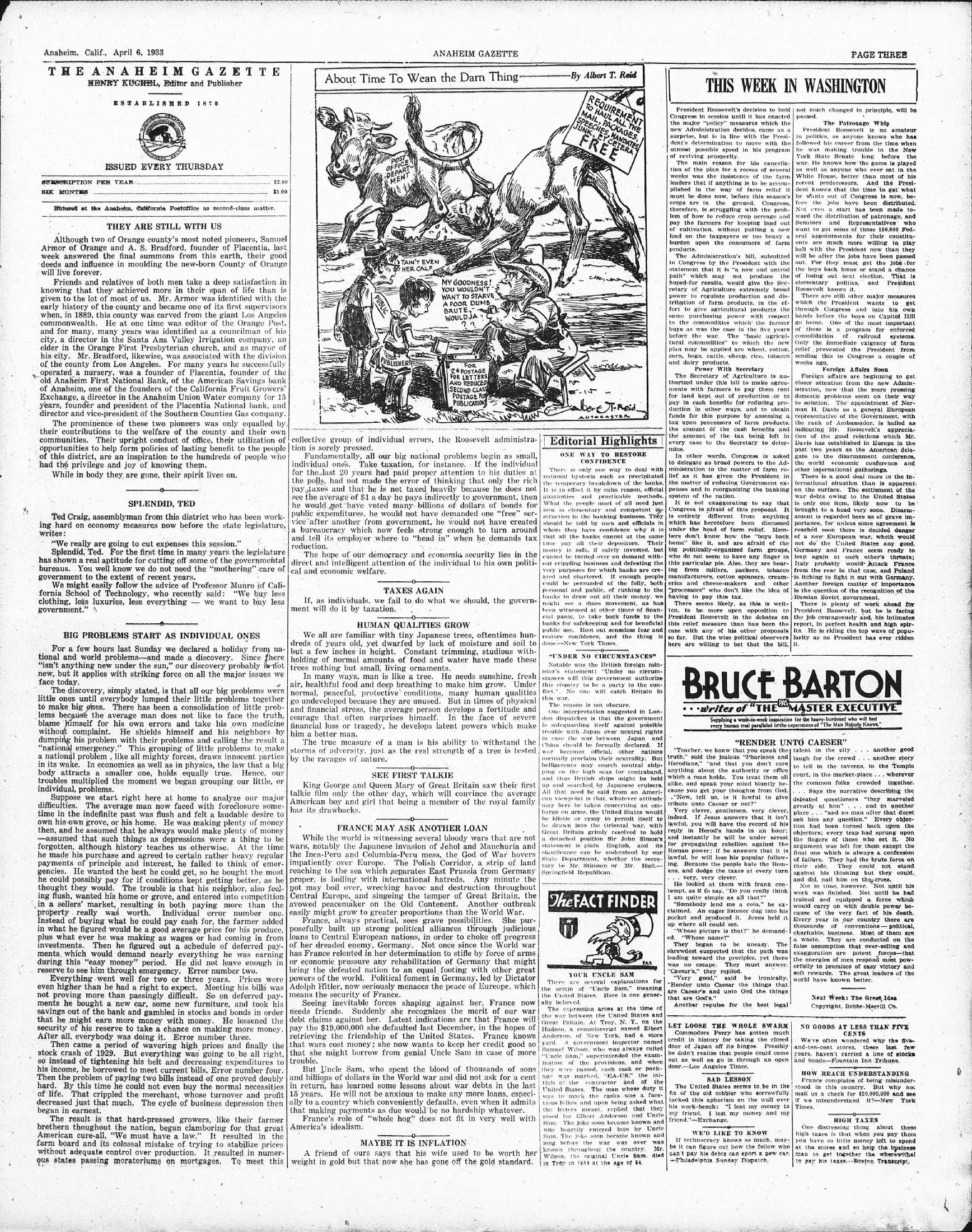
Searchable text
THE ANAHEIM GAZETTE
HENRY KUGHEL, Editor and Publisher
ESTABLISHED 1870
ISSUED EVERY THURSDAY
SUBSCRIPTION PER YEAR ... $2.00
SIX MONTHS ... $1.00
Entered at the Anaheim, California Postoffice as second-class matter.
THEY ARE STILL WITH US
Although two of Orange county's most noted pioneers, Samuel Armor of Orange and A. S. Bradford, founder of Placentia, last week answered the final summons from this earth, their good deeds and influence in moulding the new-born County of Orange will live forever.
Friends and relatives of both men take a deep satisfaction in knowing that they achieved more in their span of life than is given to the lot of most of us. Mr. Armor was identified with the early history of the county and became one of its first supervisors when, in 1889, this county was carved from the giant Los Angeles commonwealth. He at one time was editor of the Orange Post, and for many, many years was identified as a councilman of his city, a director in the Santa Ana Valley Irrigation company, an elder in the Orange First Presbyterian church, and as mayor of his city. Mr. Bradford, likewise, was associated with the division of the county from Los Angeles. For many years he successfully operated a nursery, was a founder of Placentia, founder of the old Anaheim First National Bank, of the American Savings bank of Anaheim, one of the founders of the California Fruit Growers' Exchange, a director in the Anaheim Union Water company for 15 years, founder and president of the Placentia National bank, and director and vice-president of the Southern Counties Gas company.
The prominence of these two pioneers was only equalled by their contributions to the welfare of the county and their own communities. Their upright conduct of office, their utilization of opportunities to help form policies of lasting benefit to the people of this district, are an inspiration to the hundreds of people who
of the county from Los Angeles. For many years he successfully operated a nursery, was a founder of Placentia, founder of the old Anaheim First National Bank, of the American Savings bank of Anaheim, one of the founders of the California Fruit Growers' Exchange, a director in the Anaheim Union Water company for 15 years, founder and president of the Placentia National bank, and director and vice-president of the Southern Counties Gas company.
The prominence of these two pioneers was only equalled by their contributions to the welfare of the county and their own communities. Their upright conduct of office, their utilization of opportunities to help form policies of lasting benefit to the people of this district, are an inspiration to the hundreds of people who had the privilege and joy of knowing them.
While in body they are gone, their spirit lives on.
SPLENDID, TED
Ted Craig, assemblyman from this district who has been working hard on economy measures now before the state legislature, writes:
"We really are going to cut expenses this session."
Splendid, Ted. For the first time in many years the legislature has shown a real aptitude for cutting off some of the governmental bureaus. You well know we do not need the "mothering" care of government to the extent of recent years.
We might easily follow the advice of Professor Munro of California School of Technology, who recently said: "We buy less clothing, less luxuries, less everything — we want to buy less government."
BIG PROBLEMS START AS INDIVIDUAL ONES
For a few hours last Sunday we declared a holiday from national and world problems—and made a discovery. Since there "isn't anything new under the sun," our discovery probably is not new, but it applies with striking force on all the major issues we face today.
The discovery, simply stated, is that all our big problems were little ones until everybody lumped their little problems together to make big ones. There has been a consolidation of little problems because the average man does not like to face the truth, blame himself for his own errors and take his own medicine without complaint. He shields himself and his neighbors by dumping his problem with their problems and calling the result a "national emergency." This grouping of little problems to make a national problem, like all mighty forces, draws innocent parties in its wake. In economics as well as in physics, the law that a big body attracts a smaller one, holds equally true. Hence, our troubles multiplied the moment we began grouping our little, or individual, problems.
Suppose we start right here at home to analyze our major difficulties. The average man now faced with foreclosure sometime in the indefinite past was flush and felt a laudable desire to own his own grove, or his home. He was making plenty of money then, and he assumed that he always would make plenty of money—assumed that such things as depressions were a thing to be forgotten, although history teaches us otherwise. At the time he made his purchase and agreed to certain rather heavy regular payments of principle and interest, he failed to think of emergencies. He wanted the best he could do to help the community.
Fundamentally, individual ones. To for the last 20 years the polls, had not paid taxes and that see the average of $he would not have public expenditures vice after another a bureaucracy which and tell its employ reduction.
The hope of our direct and intelligent cal and economic wIf, as individual ment will do it by
Suppose we start right here at home to analyze our major difficulties. The average man now faced with foreclosure sometime in the indefinite past was flush and felt a laudable desire to own his own grove, or his home. He was making plenty of money then, and he assumed that he always would make plenty of money—assumed that such things as depressions were a thing to be forgotten, although history teaches us otherwise. At the time he made his purchase and agreed to certain rather heavy regular payments of principle and interest, he failed to think of emergencies. He wanted the best he could get, so he bought the most he could possibly pay for if conditions kept getting better, as he thought they would. The trouble is that his neighbor, also feeling flush, wanted his home or grove, and entered into competition in a sellers' market, resulting in both paying more than the property really was worth. Individual error number one. Instead of buying what he could pay cash for, the farmer added in what he figured would be a good average price for his produce, plus what ever he was making as wages or had coming in from investments. Then he figured out a schedule of deferred payments which would demand nearly everything he was earning during this "easy money" period. He did not leave enough in reserve to see him through emergency. Error number two.
Everything went well for two or three years. Prices were even higher than he had a right to expect. Meeting his bills was not proving more than passingly difficult. So on deferred payments he bought a new car, some new furniture, and took his savings out of the bank and gambled in stocks and bonds in order that he might earn more money with money. He lessened the security of his reserve to take a chance on making more money. After all, everybody was doing it. Error number three.
Then came a period of wavering high prices and finally the stock crash of 1929. But everything was going to be all right, so instead of tightening his belt and decreasing expenditures to his income, he borrowed to meet current bills. Error number four. Then the problem of paying two bills instead of one proved doubly hard. By this time he could not even buy the normal necessities of life. That crippled the merchant, whose turnover and profit decreased just that much. The cycle of business depression then began in earnest.
The result is that hard-pressed growers, like their farmer brethern throughout the nation, began clamboring for that great American cure-all, "We must have a law." It resulted in the farm board and its colossal mistake of trying to stabilize prices without adequate control over production. It resulted in numerous states passing moratoriums on mortgages. To meet this
ANAHEIM GAZETTE
About Time To Wean the Darn Thing — By Albert T. Reid
REQUIREMENT
TO HAUL ALL THE
MAIL, PACKAGES,
SPEECHES, MANDATES
JUNK, ET CETERA
FREE
TAIN'T EVEN
HER CALF
MY GOODNESS!
YOU WOULDN'T
WANT TO STARVE
A POOR DUMB
BRUTE,
WOULDJA?
FOR
24 POSTAGE
FOR LETTERS
AND REDUCED
SECOND CLASS
POSTAGE FOR
PUBLICATION
Albert T. Reid
AUTOGASTER
collective group of individual errors, the Roosevelt administration is sorely pressed.
Fundamentally, all our big national problems begin as small,
Editorial Highlights
ONE WAY TO RESTORE
collective group of individual errors, the Roosevelt administration is sorely pressed.
Fundamentally, all our big national problems begin as small, individual ones. Take taxation, for instance. If the individual for the last 20 years had paid proper attention to his duties at the polls, had not made the error of thinking that only the rich pay taxes and that he is not taxed heavily because he does not see the average of $1 a day he pays indirectly to government, then he would not have voted many billions of dollars of bonds for public expenditures, he would not have demanded one “free” service after another from government, he would not have created a bureaucracy which now feels strong enough to turn around and tell its employer where to “head in” when he demands tax reduction.
The hope of our democracy and economic security lies in the direct and intelligent attention of the individual to his own political and economic welfare.
TAXES AGAIN
If, as individuals, we fail to do what we should, the government will do it by taxation.
HUMAN QUALITIES GROW
We all are familiar with tiny Japanese trees, oftentimes hundreds of years old, yet dwarfed by lack of moisture and soil to but a few inches in height. Constant trimming, studious withholding of normal amounts of food and water have made these trees nothing but small, living ornaments.
In many ways, man is like a tree. He needs sunshine, fresh air, healthful food and deep breathing to make him grow. Under normal, peaceful, protective conditions, many human qualities go undeveloped because they are unused. But in times of physical and financial stress, the average person develops a fortitude and courage that often surprises himself. In the face of severe financial loss or tragedy, he develops latent powers which make him a better man.
The true measure of a man is his ability to withstand the storms of adversity, just as the real strength of a tree is tested by the ravages of nature.
SEE FIRST TALKIE
King George and Queen Mary of Great Britain saw their first talkie film only the other day, which will convince the average American boy and girl that being a member of the royal family has its drawbacks.
FRANCE MAY ASK ANOTHER LOAN
While the world is witnessing several bloody wars that are not wars, notably the Japanese invasion of Jehol and Manchuria and the Inca-Peru and Columbia-Peru mess, the God of War hovers impatiently over Europe. The Polish Corridor, a strip of land reaching to the sea which separates East Prussia from Germany.
Editorial Highlights
ONE WAY TO RESTORE CONFIDENCE
There is only one way to deal with national hysteria such as precipitated the temporary breakdown of the banks. It is to offset it by calm reason, official guarantees and practicable methods. What the people most of all need just now is elementary and competent instruction in the banking business. They should be told by men and officials in whom they have confidence why it is that all the banks cannot at the same time pay all their depositors. Their money is safe, if safely invested, but cannot be turned over on demand without crippling business and defeating the very purposes for which banks are created and chartered. If enough people could be persuaded of the folly, both personal and public, of rushing to the banks to draw out all their money, we might see a mass movement, as has been witnessed at other times of financial panic, to take back funds to the banks for safekeeping and for beneficial public use. Root out senseless fear and restore confidence, and the thing is done.—New York Times.
“UNDER NO CIRCUMSTANCES”
Notable was the British foreign minister’s statement: “Under no circumstances will this government authorize this country to be a party to the conflict.” No one will catch Britain in this war.
The reason is not obscure.
One interpretation suggested in London dispatches is that the government is safeguarding itself against possible trouble with Japan over neutral rights in case the war between Japan and China should be formally declared. If war becomes official, other nations normally proclaim their neutrality. But belligerents may search neutral shipping on the high seas for contraband, and thus British ships might be held up and searched by Japanese cruisers. All that need be said from an American viewpoint is that, whatever attitude may here be taken concerning an embargo on arms, the United States would be idiotic or crazy to permit itself to be drawn into the Oriental war, with Great Britain grimly resolved to hold a detached position Sir John Simon's statement is plain English, and its significance can be understood by our State Department, whether the secretary be Mr. Stimson or Mr. Hull.—
SEE FIRST TALKIE
King George and Queen Mary of Great Britain saw their first talkie film only the other day, which will convince the average American boy and girl that being a member of the royal family has its drawbacks.
FRANCE MAY ASK ANOTHER LOAN
While the world is witnessing several bloody wars that are not wars, notably the Japanese invasion of Jehol and Manchuria and the Inca-Peru and Columbia-Peru mess, the God of War hovers impatiently over Europe. The Polish Corridor, a strip of land reaching to the sea which separates East Prussia from Germany proper, is boiling with international hatreds. Any minute the pot may boil over, wrecking havoc and destruction throughout Central Europe, and singeing the temper of Great Britain, the avowed peacemaker on the Old Continent. Another outbreak easily might grow to greater proportions than the World War.
France, always practical, sees grave possibilities. She purposefully built up strong political alliances through judicious loans to Central European nations, in order to choke off progress of her dreaded enemy, Germany. Not once since the World war has France relented in her determination to stifle by force of arms or economic pressure any rehabilitation of Germany that might bring the defeated nation to an equal footing with other great powers of the world. Political foment in Germany, led by Dictator Adolph Hitler, now seriously menaces the peace of Eureope, which means the security of France.
Seeing inevitable forces shaping against her, France now needs friends. Suddenly she recognizes the merit of our war debt claims against her. Latest indications are that France will pay the $19,000,000 she defaulted last December, in the hopes of retrieving the friendship of the United States. France knows that wars cost money; she now wants to keep her credit good so that she might borrow from genial Uncle Sam in case of more trouble.
But Uncle Sam, who spent the blood of thousands of sons and billions of dollars in the World war and did not ask for a cent in return, has learned some lessons about war debts in the last 15 years. He will not be anxious to make any more loans, especially to a country which conveniently defaults, even when it admits that making payments as due would be no hardship whatever.
France's role of "whole hog" does not fit in very well with America's idealism:
MAYBE IT IS INFLATION
A friend of ours says that his wife used to be worth her weight in gold but that now she has gone off the gold standard.
THIS WEEK IN WASHINGTON
President Roosevelt's decision to hold Congress in session until it has enacted the major "policy" measures which the new Administration decides, came as a surprise, but is in line with the President's determination to move with the utmost possible speed in his program of reviving prosperity.
The main reason for his cancellation of the plan for a recess of several weeks was the insistence of the farm leaders that if anything is to be accomplished in the way of farm relief it must be done now, before this season's crops are in the ground. Congress, therefore, is struggling with the problem of how to reduce crop acreage and pay the farmers for keeping land out of cultivation, without putting a new load on the taxpayers or too heavy a burden upon the consumers of farm products.
The Administration's bill, submitted to Congress by the President with the statement that it is "a new and untrod path" which may not produce the hoped-for results, would give the Secretary of Agriculture extremely broad power to regulate production and distribution of farm products, in the effort to give agricultural products the same purchasing power with respect to the commodities which the farmer buys as was the case in the five years before the war. The "basic agricultural commodities" to which the new plan may be applied are wheat, cotton, corn, hogs, cattle, sheep, rice, tobacco and dairy products.
Power With Secretary
The Secretary of Agriculture is authorized under this bill to make agreements with farmers to pay them rent for land kept out of production or to pay in cash benefits for reducing production in other ways, and to obtain funds for this purpose by assessing a tax upon processors of farm products, the amount of the cash benefits and the amount of the tax being left in every case to the Secretary to determine.
In other words, Congress is asked not much changed in principle, will be passed.
The Patronage Whip
President Roosevelt is no amateur in politics, as anyone knows who has followed his career from the time when he was making trouble in the New York State Senate long before the war. He knows how the game is played as well as anyone who ever sat in the White House, better than most of his recent predecessors. And the President knows that the time to get what he wants out of Congress is now, before the jobs have been distributed. Not even a start has been made toward the distribution of patronage, and Senators and Representatives who want to get some of those 150,000 Federal appointments for their constituents are much more willing to play ball with the President now than they will be after the jobs have been passed out. For they must get the jobs for the boys back home or stand a chance of losing out next election. That is elementary politics, and President Roosevelt knows it.
There are still other major measures which the President wants to get through Congress and into his own hands before the boys on Capitol Hill go home. One of the most important of these is a program for enforced consolidation of railroad systems. Only the immediate exigency of farm relief prevented the President from sending this to Congress a couple of weeks ago.
Foreign Affairs Soon
Foreign affairs are beginning to get closer attention from the new Administration, now that the more pressing domestic problems seem on their way to solution. The appointment of Norman H. Davis as a general European representative of the Government, with the rank of Ambassador, is hailed as indicating Mr. Roosevelt's appreciation of the good relations which Mr. Davis has established in Europe in the past two years as the American delegate to the disarmament conference.
RESTORE ENCE
away to deal with such as precipitated down of the banks.alm reason, official practicable methods,at of all need just and competent in business.They en and officials in confidence why it is not at the same depositors.Their safely invested,but on demand withand defeating the rich banks are creaIf enough people of the folly,both of rushing to the their money,we movement,as has over times of financial funds to the land for beneficial senseless fear and and the thing is es.
CUMSTANCES"
British foreign minender no circummenent authorize party to the con-catch Britain in obscure.uggested in Lon-nt the government against possible ever neutral rights seen Japan and really declared.If other nations neutrality.But each neutral ship-s for contraband,pos might be held Japanese cruisers,from an Ameri-whatever attitude concerning an em-mitted States would to permit itself to oriental war,with resolved to hold Sir John Simon's English,and its understood by our another the secre-or Mr. Hull.
Power With Secretary
The Secretary of Agriculture is authorized under this bill to make agreements with farmers to pay them rent for land kept out of production or to pay in cash benefits for reducing production in other ways, and to obtain funds for this purpose by assessing a tax upon processors of farm products,the amount of the cash benefits and the amount of the tax being left in every case to the Secretary to determine.
In other words,Congress is asked to delegate as broad powers to the Administration in the matter of farm relief as it has given the President in the matter of reducing Government expenses and in reorganizing the banking system of the nation.
It is not exaggerating to say that Congress is afraid of this proposal. It is entirely different from anything which has heretofore been discussed under the head of farm relief.Members don't know how the "boys back home" like it, and are afraid of the big politically-organized farm groups,who do not seem to have any finger in this particular pie.Also,they are hearing from millers,packers,tobacco manufacturers,cotton spinners,creameries and cheese-makers and other "processors" who don't like the idea of having to pay this tax.
There seems likely,as this is written,to be more open opposition to President Roosevelt in the debates on this relief measure than has been the case with any of his other proposals so far. But the wise political observers here are willing to bet that the bill,
Foreign Affairs Soon
Foreign affairs are beginning to get closer attention from the new Administration,now that the more pressing domestic problems seem on their way to solution.The appointment of Norman H.Davis as a general European representative of the Government,with the rank of Ambassador,is hailed as indicating Mr. Roosevelt's appreciation of the good relations which Mr.Davis has established in Europe in the past two years as the American delegate to the disarmament conference,the world economic conference and other international gatherings.
There is a good deal more to the international situation than is apparent on the surface.The settlement of the war debts owing to the United States is only one item,likely now to be brought to a head very soon.Disarmament is regarded here as of grave importance,for unless some agreement is reached soon there is decided danger of a new European war,which would not do the United States any good.Germany and France seem ready to leap again at each other's throats;Italy probably would Attack France from the rear in that case,and Poland is itching to fight it out with Germany.Another foreign matter of importance is the question of the recognition of the Russian Soviet government.
There is plenty of work ahead for President Roosevelt,but he is facing the job courageously and,his intimates report,in perfect health and high spirits.He is riding the top wave of popularity as no President has ever ridden it.
BRUCE BARTON
writes of "THE MASTER EXECUTIVE"
Supplying a week-to-week inspiration for the heavy-burdened who will fund every human trial paralleled in the experiences of "The Man Nobody Knows."
"RENDER UNTO CAESER"
"Teacher,we konw that you speak the truth," said the jealous "Pharisees and Herodians,""and that you don't care anything about the authority or office which a man holds. You treat them all alike,and speak your mind bluntly because you get your thoughts from God.-Now,tell us,is it lawful to give tribute unto Caesar or not?"
Very clever,gentlemen,very clever,indeed. If Jesus answers that it isn't lawful,you will have the record of his reply in Herod's hands in an hour;and instantly he will be under arrest for propagating rebellion against the Roman power;if he answers that it is lawful,he will lose his popular following.Because the people hate the Romans and dodge the taxes at every turn
talent in the city . . . another good laugh for the crowd . . . another story to tell in the taverns,in the Temple court,in the market-place . . . wherever the common folks crowded together. . . Says the narrative describing the defeated questioners "they marveled greatly at him" . . . and in another place . . . "and no man after that durst ask him any question." Every objection had been turned back upon the objectors;every trap had sprung upon the fingers of those who set it.No argument was left for them except the final one which is always a confession of failure. They had the brute force on their side. They could not stand
which a man holds. You treat them all alike, and speak your mind bluntly because you get your thoughts from God.
"Now, tell us, is it lawful to give tribute unto Caesar or not?"
Very clever, gentlemen, very clever, indeed. If Jesus answers that it isn't lawful, you will have the record of his reply in Herod's hands in an hour; and instantly he will be under arrest for propagating rebellion against the Roman power; if he answers that it is lawful, he will lose his popular following. Because the people hate the Romans, and dodge the taxes at every turn very, very clever.
He looked at them with frank contempt, as if so say, "Do you really think I am quite simple as all that?"
"Somebody lend me a coin," he exclaimed. An eager listener dug into his pocket and produced it. Jesus held it up where all could see.
"Whose picture is that?" he demanded. "Whose name?"
They began to be uneasy. The shrewdest suspected that the path was leading toward the precipice, yet there was no escape. They must answer. "Caesar's," they replied.
"Very good," said he ironically. "Render unto Caesar the things that are Caesar's and unto God the things that are God's."
Another repulse for the best legal court, in the market-place... wherever the common folks crowded together.
Says the narrative describing the defeated questioners "they marveled greatly at him"... and in another place... "and no man after that durst ask him any question." Every objection had been turned back upon the objectors; every trap had sprung upon the fingers of those who set it. No argument was left for them except the final one which is always a confession of failure. They had the brute force on their side. They could not stand against his thinking but they could, and did, nail him on the cross.
Not in time, however. Not until his work was finished. Not until he had trained and equipped a force which would carry on with double power because of the very fact of his death. Every year in our country there are thousands of conventions—political, charitable, business. Most of them are a waste. They are conducted on the false assumption that over-selling and exaggeration are potent forces—that the energies of men respond most powerfully to promises of easy victory and soft rewards. The great leaders of the world have known better.
Next Week: The Great Idea
Copyright, Bobbs-Merrill Co.
LET LOOSE THE WHOLE SWARM
Commodore Perry has gotten much credit in history for taking the closed door of Japan off its hinges. Possibly he didn't realize that people could come out as well as go in through an open door.—Los Angeles Times.
SAD LESSON
The United States seems to be in the fix of the old cobbler who sorrowfully tacked this aphorism on the wall over his work-bench: "I lent my money to my friend. I lost my money and my friend."—Exchange.
WE'D LIKE TO KNOW
If technocracy knows so much, maybe it can figure out how the fellow who can't pay his debts can sport a new car.—Philadelphia Sunday Dispatch.
NO GOODS AT LESS THAN FIVE CENTS
We've often wondered why the five-and-ten-cent stores, these last few years, haven't carried a line of stocks and bonds—Fountain Inn Tribune.
HOW REACH UNDERSTANDING
France complains of being misunderstood in this country. But why not mail us a check for $20,000,000 and see if we misunderstand it?—New York Times.
HIGH TAXES
One distressing thing about these high taxes is that when you pay them you have so little money left to spend at the stores and so help the business man to get together the wherewithal to pay his taxes.—Boston Transcript.