anaheim-gazette 1933-03-30
Scanned page
Searchable text
THE ANAHEIM GAZETTE
HENRY KUCHEL, Editor and Publisher
ESTABLISHED 1870
ISSUED EVERY THURSDAY
SUBSCRIPT PER YEAR ... $2.00
SIX MONTHS ... $1.00
Entered at the Anaheim, California Postoffice as second-class matter.
ASSEMBLY FACES CRUCIAL TEST.
Four of the most important bills before the state legislature passed the senate Monday. They immediately went to the assembly, where that group's action will determine whether it hearkens to the overwhelming demand for economies and rectifying injustices in present methods of taxation, or whether the assembly prefers to string along with organized minorities instead of fighting for the welfare of all the people.
The four measures which received the approval of the senate all pertain to our school system. The first repeals the teacher-tenure law, making it retroactive. This law has caused many California cities, Anaheim among them, in self defense to refuse to hire a teacher more than a probationary two years, no matter how good that teacher might be. Even the teachers themselves are dissatisfied with it and want it removed—that is, all the teachers excepting those whose positions under it become life sinecures. In justice to our schools and our teachers, let us dispose with the teacher-tenure law. The second bill permits local district boards to abandon kindergarten classes at the end of the school term. The present law compels schools to conduct kindergartens when a minimum number of about 15 children are entered. The school district and county must shoulder the entire cost, the state bearing none. Many districts have kindergartens, many have not. Undoubtedly they do some good, and the repeal leaves up to the local school board the responsibility of determining whether or not the good accomplished justifies the expense, instead of making mandatory a fixed expense when a certain
teachers excepting those whose positions under it become fire sinecures. In justice to our schools and our teachers, let us dispose with the teacher-tenure law. The second bill permits local district boards to abandon kindergarten classes at the end of the school term. The present law compels schools to conduct kindergartens when a minimum number of about 15 children are entered. The school district and county must shoulder the entire cost, the state bearing none. Many districts have kindergartens, many have not. Undoubtedly they do some good, and the repeal leaves up to the local school board the responsibility of determining whether or not the good accomplished justifies the expense, instead of making mandatory a fixed expense when a certain minority group of parents want their children in kindergarten. Away with the old law.
The third and fourth bills are the most important and far-reaching. Present requirements allow the district school board to fix the budget, which it then submits to the county superintendent of schools, who incorporates it with other districts and sends the total and district estimates to county auditor, who by law must set a tax rate that will raise every penny requested by the school boards. The county supervisors must approve this addition to the county tax bill. In other words, the county supervisors, who bear the brunt of criticism when the tax bill is high, at present have not a word to say about the amount of taxes for schools, one of the biggest items on the whole tax list. The third measure would modify the present law, permitting the school superintendent to return the budget back to the district board with recommendations, then submit the revised budget to the county board of supervisors, which would have revisory powers. The supervisors could cut down the budget, if they thought it too high. This would be done, sitting with the county superintendent, who would have the same powers as a supervisor, in the presence of the school board. When the school board realizes that the supervisors might question whether a certain amount is needed, more effort to keep expenses within the taxpayers' ability to pay would result. This is a much-needed revision of our school law, and deserves our whole-hearted support. It gives the governing board of the county some responsibility in the proper administration of our schools.
The fourth bill, which would require a vote of the people because it would alter the state constitution, is the crux of school economies. To almost every proposal to slash school costs the teachers' lobby, the most powerful in the state, answers that the state support of schools is paid by public utility taxes, and that we should tax the "monster" of big business more instead of cutting school costs and letting it off easier.
This bill directly affects every common property taxpayer in the county, because it proposes to alter the guaranteed sums which the county must now pay into the school budgets, and the county receives its income from taxes on real and personal property, certain commercial accounts and certain foreign bonds. From a guaranteed sum of $30 for every student in average daily attendance in elementary schools, the county would pay a minimum of $15 to $30; instead of a guaranteed $60 for every student in high schools, the county would pay a minimum of $30 to $60. Certain changes in requirements for expenditure of the present fixed sums by the state, $30 and $60 respectively for elementary and high school students, are incorporated.
At present the state constitution gives no leeway in the matter of county support, all of which must be raised by taxes directly upon real and personal property. Under the system of allowing the school boards to virtually determine for themselves how much to tell the people departments and defy the legislator.
As an example sidereal what recent mean. The senate chairman, recommends be transferred to dreds of recommend penses of branch deemed unnecessary formity with the other bills also affixes measures be 330 and 1759. The tion of the comm river to commerce recommendation.
Because the fixtures it sends out return address of graphed sheets ree articles opposing against the measure them and not know mission, would be legislature are may fish and game corp.
One might nat as a class have en expense of the tax affecting them.
But when the f paid out of gover earned taxpayers' sweat of the California th especially as it per time to eliminate replace it with p bidding.
DE
Traffic f alitio
Every year a exception in recent reason, Orange co to 56. But 1931 78, past the 1929
The great may prime of life. C thousands of auto
erty, certain commercial accounts and certain foreign bonds.
From a guaranteed sum of $30 for every student in average daily attendance in elementary schools, the county would pay a minimum of $15 to $30; instead of a guaranteed $60 for every student in high schools, the county would pay a minimum of $30 to $60. Certain changes in requirements for expenditure of the present fixed sums by the state, $30 and $60 respectively for elementary and high school students, are incorporated.
At present the state constitution gives no leeway in the matter of county support, all of which must be raised by taxes directly upon real and personal property. Under the system of allowing the school boards to virtually determine for themselves how much they want to spend, with no possible rebuke from the board of supervisors, the average amount paid per student in Orange county has exceeded greatly the constitutional requirements. On this amount the county schools last year made an admirable economy showing, but the number of reductions that can be made under a more flexible, responsibility-fixing measure, are by no means achieved, and if both of these bills pass the assembly and the people approve the fourth, we can look forward to a substantial decrease in our tax bill.
Because the most porterial lobby in the history of the state of California is opposing these changes in school law, the eyes of Californians are upon their assemblymen. Will or will not they obey the instructions they received at the polls last fall and liberalize the laws to permit economies, and that means in schools as well as other functions of government, to the end that our tax bills will be reduced?
Will our assemblymen see eye to eye with our senators for the need of tax reduction? The action of the assembly on these four measures will determine whether or not we can look forward to substantial reductions in the cost of government. All of the proposed changes in those four measures are designed to make school administration more responsive to the demands of the people in the school districts and county, instead of keeping school administration beyond the will of the people.
WHEN THE TAIL WAGS THE DOG
One arm of California's giant bureaucratic octupus reached out to every hamlet and village of the state this week in an attempt to turn the residents of this state against their own representatives at Sacramento.
The people of California elected the state senators and assemblymen and told them, with a mighty voice that could not be mistaken, to cut down expenditures because taxation already is too high. Naturally, when the legislature attempted to do the bidding of the people, many obstacles were expected.
Nobody ever dreamed, however, that the very bureaus of government would use the people's money to turn around and try
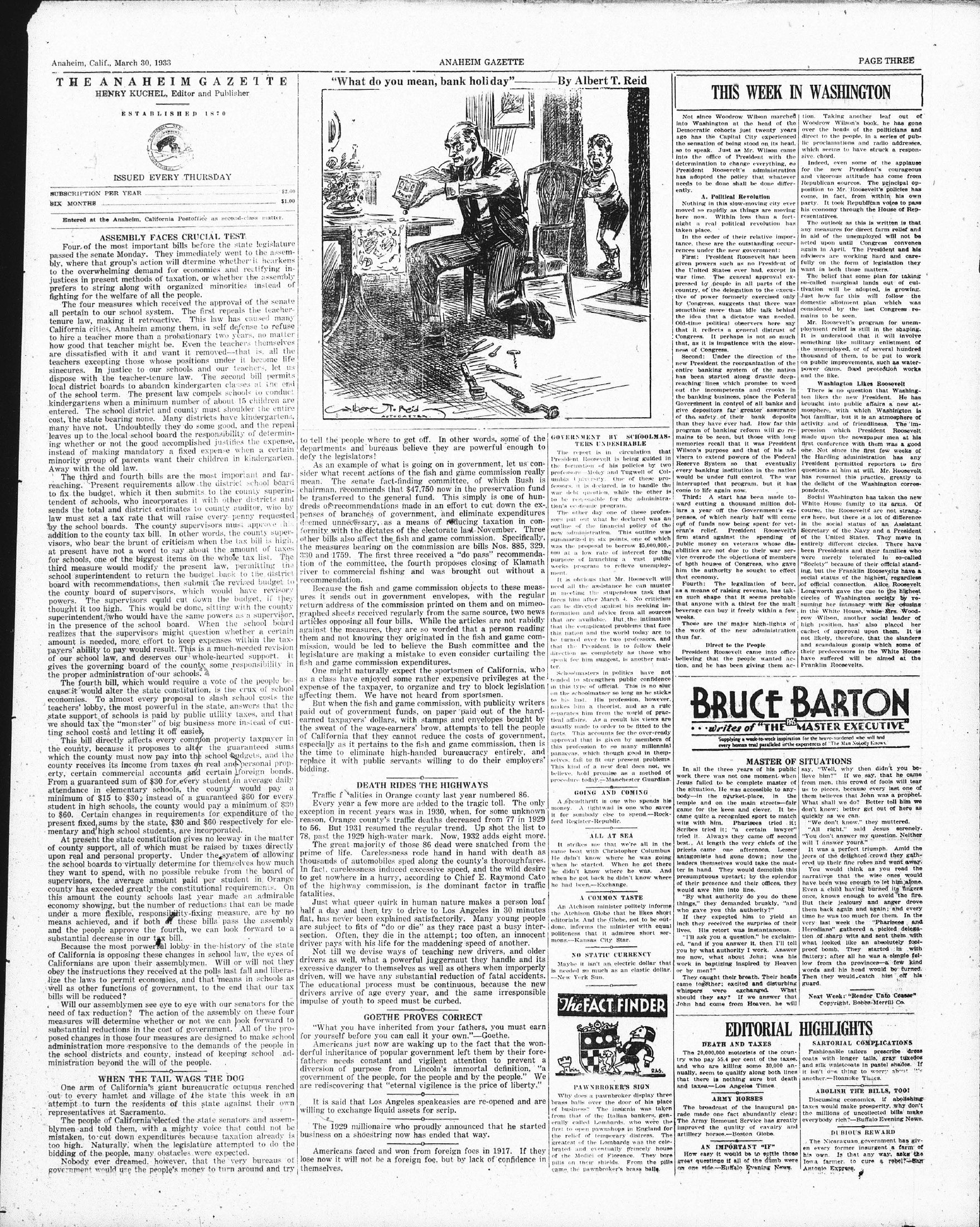
"What do you mean, bank holiday"——By Albert T. Reid
to tell the people where to get off. In other words, some of the departments and bureaus believe they are powerful enough to defy the legislators!
to tell the people where to get off. In other words, some of the departments and bureaus believe they are powerful enough to defy the legislators!
As an example of what is going on in government, let us consider what recent actions of the fish and game commission really mean. The senate fact-finding committee, of which Bush is chairman, recommends that $47,750 now in the preservation fund be transferred to the general fund. This simply is one of hundreds of recommendations made in an effort to cut down the expenses of branches of government, and eliminate expenditures deemed unnecessary, as a means of reducing taxation in conformity with the dictates of the electorate last November. Three other bills also affect the fish and game commission. Specifically, the measures bearing on the commission are bills Nos. 885, 329, 330 and 1759. The first three received a “do pass” recommendation of the committee, the fourth proposes closing of Klamath river to commercial fishing and was brought out without a recommendation.
Because the fish and game commission objects to these measures it sends out in government envelopes, with the regular return address of the commission printed on them and on mimeographed sheets received regularly from the same source, two news articles opposing all four bills. While the articles are not rabidly against the measures, they are so worded that a person reading them and not knowing they originated in the fish and game commission, would be led to believe the Bush committee and the legislature are making a mistake to even consider curtailing the fish and game commission expenditures.
One might naturally expect the sportsmen of California, who as a class have enjoyed some rather expensive privileges at the expense of the taxpayer, to organize and try to block legislation affecting them. We have not heard from sportsmen.
But when the fish and game commission, with publicity writers paid out of government funds, on paper paid out of the hard-earned taxpayers’ dollars, with stamps and envelopes bought by the sweat of the wage-earners’ brow, attempts to tell the people of California that they cannot reduce the costs of government, especially as it pertains to the fish and game commission, then is the time to eliminate high-handed bureaucracy entirely, and replace it with public servants willing to do their employers’ bidding.
DEATH RIDES THE HIGHWAYS
Traffic fatalities in Orange county last year numbered 86.
Every year a few more are added to the tragic toll. The only exception in recent years was in 1930, when, for some unknown reason, Orange county’s traffic deaths decreased from 77 in 1929 to 56. But 1931 resumed the regular trend. Up shot the list to 78, past the 1929 high-water mark. Now, 1932 adds eight more.
The great majority of those 86 dead were snatched from the prime of life. Carelessness rode hand in hand with death as thousands of automobiles sped along the county’s thoroughfares.
GOVERNMENT BY SCHOOLMASTERS UNDESIRABLE
The report is in circulation that President Roosevelt is being guided in the formation of his policies by two professors—Moley and Tugwell of Columbia University. One of these professors, it is declared, is to handle the war debt question, while the other is to be responsible for the administration's economic program.
The other day one of these professors put out what he declared was an outline of the financial policy of the new administration. This outline was summarized in six points, one of which was the proposal to borrow $5,000,000 at a low rate of interest for the purpose of launching a vast public works program to relieve unemployment.
It is obvious that Mr. Roosevelt will need all the assistance he can muster in meeting the stupendous task that faces him after March 4. No criticism can be directed against his seeking information and advice from all sources that are available. But, the intimation that the complicated problems that face this nation and the world today are to be turned over to two professors, and that the President is to follow their direction as completely as those who speak for him suggest, is another matter.
Schoolmasters in politics have not tended to strengthen public confidence in this type of official. This is no slur on the schoolmatser so long as he sticks to his last. His profession, however, makes him a theorist, and as a rule separates him from the world of practical affairs. As a result his views are usually made to order to be fitted to the facts. This accounts for the over-ready approval that is given by members of this profession to so many millennial panaceas, which though good in themselves, fail to fit our present problems. This kind of a new deal does not, we believe, hold promise as a method of procedure today.—Manchester Guardian.
GOING AND COMING
A spendthrift is one who spends his money. A tightwad is one who saves it for somebody else to spend.—Rockford Register-Republic.
ALL AT SEA
It strikes me that we're all in the same boat with Christopher Columbus. He didn't know where he was going when he started. When he got there
DEATH RIDES THE HIGHWAYS
Traffic fatalities in Orange county last year numbered 86.
Every year a few more are added to the tragic toll. The only exception in recent years was in 1930, when, for some unknown reason, Orange county's traffic deaths decreased from 77 in 1929 to 56. But 1931 resumed the regular trend. Up shot the list to 78, past the 1929 high-water mark. Now, 1932 adds eight more.
The great majority of those 86 dead were snatched from the prime of life. Carelessness rode hand in hand with death as thousands of automobiles sped along the county's thoroughfares. In fact, carelessness induced excessive speed, and the wild desire to get nowhere in a hurry, according to Chief E. Raymond Cato of the highway commission, is the dominant factor in traffic fatalities.
Just what queer quirk in human nature makes a person loaf half a day and then try to drive to Los Angeles in 30 minutes flat, has never been explained satisfactorily. Many young people are subject to fits of "do or die" as they race past a busy intersection. Often, they die in the attempt; too often, an innocent driver pays with his life for the maddening speed of another.
Not till we devise ways of teaching new drivers, and older drivers as well, what a powerful juggernaut they handle and its excessive danger to themselves as well as others when improperly driven, will we have any substantial reduction of fatal accidents. The educational process must be continuous, because the new drivers arrive of age every year, and the same irresponsible impulse of youth to speed must be curbed.
GOETHE PROVES CORRECT
“What you have inherited from your fathers, you must earn for yourself before you can call it your own.”—Goethe.
Americans just now are waking up to the fact that the wonderful inheritance of popular government left them by their forefathers needs constant and vigilent attention to prevent a diversion of purpose from Lincoln's immortal definition, “a government of the people, for the people and by the people.” We are rediscovering that “eternal vigilence is the price of liberty.”
It is said that Los Angeles speakeasies are re-opened and are willing to exchange liquid assets for scrip.
The 1929 millionaire who proudly announced that he started business on a shoestring now has ended that way.
Americans faced and won from foreign foes in 1917. If they lose now it will not be a foreign foe, but by lack of confidence in themselves.
THIS WEEK IN WASHINGTON
Not since Woodrow Wilson marched into Washington at the head of the Democratic cohorts just twenty years ago has the Capital City experienced the sensation of being stood on its head, so to speak. Just as Mr. Wilson came into the office of President with the determination to change everything, so President Roosevelt's administration has adopted the policy that whatever needs to be done shall be done differently.
A. Political Revolution
Nothing in this slow-moving city ever moved so rapidly as things are moving here now. Within less than a fortnight a real political revolution has taken place.
In the order of their relative importance, these are the outstanding occurrences under the new government:
First: President Roosevelt has been given powers such as no President of the United States ever had, except in war time. The general approval expressed by people in all parts of the country, of the delegation to the executive of power formerly exercised only by Congress, suggests that there was something more than idle talk behind the idea that a dictator was needed. Old-time political observers here say that it reflects a general distrust of Congress. It perhaps is not so much that, as it is impatience with the slowness of Congress.
Second: Under the direction of the new President the reorganization of the entire banking system of the nation has been started along drastic deep-reaching lines which promise to weed out the incompetents and crooks in the banking business, place the Federal Government in control of all banks and give depositors far greater assurance of the safety of their bank deposits than they have ever had. How far this program of banking reform will go remains to be seen, but those with long memories recall that it was President Wilson's purpose and that of his advisers to extend powers of the Federal tion. Taking another leaf out of Woodrow Wilson's book, he has gone over the heads of the politicians and direct to the people, in a series of public proclamations and radio addresses, which seems to have struck a responsive chord.
Indeed, even some of the applause for the new President's courageous and vigorous attitude has come from Republican sources. The principal opposition to Mr. Roosevelt's policies has come, in fact, from within his own party. It took Republican votes to pass his economy through the House of Representatives.
The outlook as this is written is that any measures for direct farm relief and in aid of the unemployed will not be acted upon until Congress convenes again in April. The President and his advisers are working hard and carefully on the form of legislation they want in both those matters.
The belief that some plan for taking so-called marginal lands out of cultivation will be adopted, is growing. Just how far this will follow the domestic allotment plan which was considered by the last Congress remains to be seen.
Mr. Roosevelt's program for unemployment relief is still in the shaping. It is understood that it will involve something like military enlistment of the unemployed, or of several hundred thousand of them, to be put to work on public improvements, such as water-power dams, flood protection works and the like.
Washington Likes Roosevelt
There is no question that Washington likes the new President. He has brought into public affairs a new atmosphere, with which Washington is not familiar, but it is an atmosphere of activity and of friendliness. The impression which President Roosevelt made upon the newspaper men at his first conference with them was a good one. Not since the first few weeks of the Harding administration has any
NEW SCHOOLMAS-RESIRABLE
circulation that is being guided in its policies by two and Tugwell of Col-One of these problems is to handle the while the other is for the administragram.
one of these professes declared was an special policy of the This outline was points, one of which borrow $5,000,000,-of interest for the g a vast public relieve unemployMr. Roosevelt will once he can muster dependous task that with 4. No criticism hast his seeking in from all sources But, the intimation problems that face world today are to two professors, and is to follow their likely as those who exist, is another matpolitics have not on public confidence al. This is no slur so long as he sticks profession, however, rest, and as a rule the world of prac-result his views are to be fitted to the for the over-ready men by members of too many millennial though good in them present problems. deal does not, we see as a method of Manchester Guardian.
COMING
one who spends his life one who saves to spend.—Rockie.
T SEA
it we're all in the Christopher Columbus here he was going When he got there
new President the reorganization of the entire banking system of the nation has been started along drastic deep-reaching lines which promise to weed out the incompetents and crooks in the banking business, place the Federal Government in control of all banks and give depositors far greater assurance of the safety of their bank deposits than they have ever had. How far this program of banking reform will go remains to be seen, but those with long memories recall that it was President Wilson's purpose and that of his advisers to extend powers of the Federal Reserve System so that eventually every banking institution in the nation would be under full control. The war interrupted that program, but it has come to life again now.
Third: A start has been made toward cutting a thousand million dollars a year off the Government's expenses, of which nearly half will come out of funds now being spent for veteran's relief. President Roosevelt's firm stand against the spending of public money on veterans whose disabilities are not due to their war service overrode the objections of members of both houses of Congress, who gave him the authority he sought to effect that economy.
Fourth: The legalization of beer, as a means of raising revenue, has taken such shape that it seems probable that anyone with a thirst for the malt beverage can buy it freely within a few weeks.
Those are the major high-lights of the work of the new administration thus far.
Direct to the People
President Roosevelt came into office believing that the people wanted action, and he has been giving them ac-
BRUCE BARTON
writes of "THE MASTER EXECUTIVE"
Supplying a week-to-week inspiration for the heavy-nurded who will find every human trial paralleled in the experiences of "The Man Nobody Knows.
MASTER OF SITUATIONS
In all the three years of his public work there was not one moment when Jesus failed to be complete master of the situation. He was accessible to anybody—in the market-place, in the temple and on the main streets—fair game for the keen and clever. It became quite a recognized sport to match wits with him. Pharisees tried it; Scribes tried it; "a certain lawyer" tried it. Always they came off second best. At length the very chiefs of the priests came one afternoon. Lesser antagonists had gone down; now the leaders themselves would take the mat-
say, "Well, why then didn't you believe him?" If we say, that he came from men, this crowd of fools will tear us to pieces, because every last one of them believes that John was a prophet. What shall we do? Better tell him we don't know; better get out of here as quickly as we can.
"We don't know." they muttered.
"All right," said Jesus serenely. "You don't answer my question. Neither will I answer yours."
It was a perfect triumph. Amid the jeers of the delighted crowd they gathered up their fine robes and went away.
EDITORIAL HIGHLIGHTS
DEATH AND TAXES
The 20,000,000 motorists of the country who pay 55.4 per cent of the taxes, and who are killing some 30,000 annually, seem to qualify along both lines that there is nothing sure but death and taxes.—Los Angeles Times.
ARMY HORSES
The broadcast of the inaugural parade made one fact abundantly clear: The Army Remount Service has greatly improved the quality of cavalry and artillery horses.—Boston Globe.
AN IMPORTANT "IF"
How easy it would be to settle those great questions if all of the dumb were on one side.—Buffalo Evening News.
SARTORIAL COMPLICATIONS
Fashionable tailors prescribe dress coats with longer tails, gray tuxedos and silk waistcoats in pastel shades. If it isn't one thing to worry about, another.—Roanoke Times.
ABOLISH THE BILLS, TOO!
Discussing economics, if abolishing taxes would make prosperity, why don't the millions of uncollected bills make everybody rich?—Buffalo Evening News.
DUBIOUS REWARD
The Nicaraguan government has given every former insurgent a farm of his own. Is that any way, asks the Iowa farmer, to cure a rebel?—Barn Antonio Express.