anaheim-gazette 1933-03-16
Scanned page
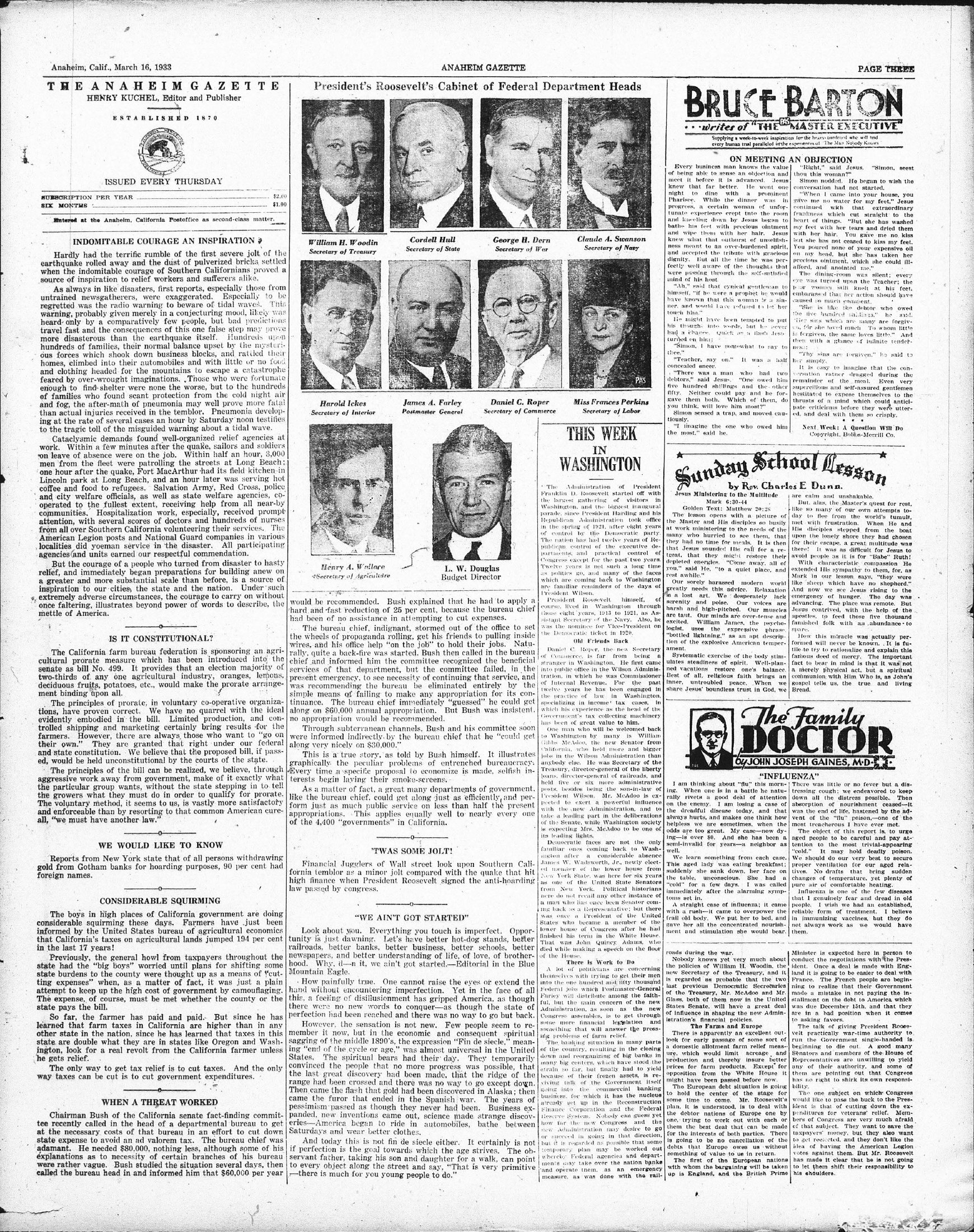
Searchable text
THE ANAHEIM GAZETTE
HENRY KUCHEL, Editor and Publisher
ESTABLISHED 1870
ISSUED EVERY THURSDAY
SUBSCRIPTION PER YEAR ... $2.00
SIX MONTHS ... $1.00
Entered at the Anaheim, California Postoffice as second-class matter.
INDOMITABLE COURAGE AN INSPIRATION
Hardly had the terrific rumble of the first severe jolt of the earthquake rolled away and the dust of pulverized bricks settled when the indomitable courage of Southern Californians proved a source of inspiration to relief workers and sufferers alike.
As always in like disasters, first reports, especially those from untrained newsgatherers, were exaggerated. Especially to be regretted was the radio warning to beware of tidal waves. This warning, probably given merely in a conjecturing mood, likely was heard only by a comparatively few people, but bad predictions travel fast and the consequences of this one false step may prove more disasterous than the earthquake itself. Hundreds upon hundreds of families, their normal balance upset by the mysterious forces which shook down business blocks, and rattled their homes, climbed into their automobiles and with little or no food and clothing headed for the mountains to escape a catastrophe feared by over-wrought imaginations. Those who were fortunate enough to find shelter were none the worse, but to the hundreds of families who found scant protection from the cold night air and fog, the after-math of pneumonia may well prove more fatal than actual injuries received in the temblor. Pneumonia developing at the rate of several cases an hour by Saturday noon testifies to the tragic toll of the misguided warning about a tidal wave.
Cataclysmic demands found well-organized relief agencies at work. Within a few minutes after the quake, sailors and soldiers on leave of absence were on the job. Within half an hour, 3,000
homes, climbed into their automobiles and with little or no food and clothing headed for the mountains to escape a catastrophe feared by over-wrought imaginations. Those who were fortunate enough to find shelter were none the worse, but to the hundreds of families who found scant protection from the cold night air and fog, the after-math of pneumonia may well prove more fatal than actual injuries received in the temblor. Pneumonia developing at the rate of several cases an hour by Saturday noon testifies to the tragic toll of the misguided warning about a tidal wave.
Cataclysmic demands found well-organized relief agencies at work. Within a few minutes after the quake, sailors and soldiers on leave of absence were on the job. Within half an hour, 3,000 men from the fleet were patrolling the streets at Long Beach; one hour after the quake, Fort MacArthur had its field kitchen in Lincoln park at Long Beach, and an hour later was serving hot coffee and food to refugees. Salvation Army, Red Cross, police and city welfare officials, as well as state welfare agencies, cooperated to the fullest extent, receiving help from all near-by communities. Hospitalization work, especially, received prompt attention, with several scores of doctors and hundreds of nurses from all over Southern California volunteering their services. The American Legion posts and National Guard companies in various localities did yoeman service in the disaster. All participating agencies and units earned our respectful commendation.
But the courage of a people who turned from disaster to hasty relief, and immediately began preparations for building anew on a greater and more substantial scale than before, is a source of inspiration to our cities, the state and the nation. Under such extremely adverse circumstances, the courage to carry on without once faltering, illustrates beyond power of words to describe, the mettle of America.
IS IT CONSTITUTIONAL?
The California farm bureau federation is sponsoring an agricultural prorate measure which has been introduced into the senate as bill No. 499. It provides that an election majority of two-thirds of any one agricultural industry, oranges, lemons, deciduous fruits, potatoes, etc., would make the prorate arrangement binding upon all.
The principles of prorate, in voluntary co-operative organizations, have proven correct. We have no quarrel with the ideal evidently embodied in the bill. Limited production, and controlled shipping and marketing certainly bring results for the farmers. However, there are always those who want to "go on their own." They are granted that right under our federal and state constitution. We believe that the proposed bill, if passed, would be held unconstitutional by the courts of the state.
The principles of the bill can be realized, we believe, through aggressive work away from government, make of it exactly what the particular group wants, without the state stepping in to tell the growers what they must do in order to qualify for prorate. The voluntary method, it seems to us, is vastly more satisfactory and enforceable than by resorting to that common American cure-all, "we must have another law."
WE WOULD LIKE TO KNOW
Reports from New York state that of all persons withdrawing gold from Gotham banks for hoarding purposes, 90 per cent had
WE WOULD LIKE TO KNOW
Reports from New York state that of all persons withdrawing gold from Gotham banks for hoarding purposes, 90 per cent had foreign names.
CONSIDERABLE SQUIRMING
The boys in high places of California government are doing considerable squirming these days. Farmers have just been informed by the United States bureau of agricultural economics that California’s taxes on agricultural lands jumped 194 per cent in the last 17 years!
Previously, the general howl from taxpayers throughout the state had the “big boys” worried until plans for shifting some state burdens to the county were thought up as a means of “cutting expenses” when, as a matter of fact, it was just a plain attempt to keep up the high cost of government by camouflaging. The expense, of course, must be met whether the county or the state pays the bill.
So far, the farmer has paid and paid. But since he has learned that farm taxes in California are higher than in any other state in the nation, since he has learned that taxes in this state are double what they are in states like Oregon and Washington, look for a real revolt from the California farmer unless he gets relief.
The only way to get tax relief is to cut taxes. And the only way taxes can be cut is to cut government expenditures.
WHEN A THREAT WORKED
Chairman Bush of the California senate fact-finding committee recently called in the head of a departmental bureau to get at the necessary costs of that bureau in an effort to cut down state expense to avoid an ad valorem tax. The bureau chief was adamant. He needed $80,000, nothing less, although some of his explanations as to necessity of certain branches of his bureau were rather vague. Bush studied the situation several days, then called the bureau head in and informed him that $60,000 per year
ANAHEIM GAZETTE
President's Roosevelt's Cabinet of Federal Department Heads
William H. Woodin
Secretary of Treasury
Cordell Hull
Secretary of State
George H. Dern
Secretary of War
Claude A. Swanson
Secretary of Navy
Harold Ickes
Secretary of Interior
James A. Farley
Postmaster General
Daniel C. Roper
Secretary of Commerce
Miss Frances Perkins
Secretary of Labor
THIS WEEK
IN
WASHINGTON
would be recommended. Bush explained that he had to apply a hard and fast reduction of 25 per cent, because the bureau chief had been of no assistance in attempting to cut expenses.
The bureau chief, indignant, stormed out of the office to set the wheels of propaganda rolling, get his friends to pulling inside wires, and his office help "on the job" to hold their jobs. Naturally, quite a back-fire was started. Bush then called in the bureau chief and informed him the committee recognized the beneficial services of that department, but the committee failed, in the present emergency, to see necessity of continuing that service, and was recommending the bureau be eliminated entirely by the simple means of failing to make any appropriation for its continuance. The bureau chief immediately "guessed" he could get along on $60,000 annual appropriation. But Bush was insistent, no appropriation would be recommended.
Through subterranean channels, Bush and his committee soon were informed indirectly by the bureau chief that he "could get along very nicely on $30,000."
This is a true story, as told by Bush himself. It illustrates graphically the peculiar problems of entrenched bureaucracy: Every time a specific proposal to economize is made, selfish interests begin laying their smoke-screens.
As a matter of fact, a great many departments of government, like the bureau chief, could get along just as efficiently and perform just as much public service on less than half the present appropriations. This applies equally well to nearly every one of the 4,400 "governments" in California.
'TWAS SOME JOLT!
Financial Jugglers of Wall street look upon Southern Californias
THIS WEEK IN WASHINGTON
The Administration of President Franklin D. Roosevelt started off with the largest gathering of visitors in Washington, and the biggest inaugural parade, since President Harding and his Republican Administration took office in the spring of 1921, after eight years of control by the Democratic party. The nation has had twelve years of Republican control of the executive departments, and practical control of Congress except for the past two years. Twelve years is not such a long time as politics go, and many of the faces which are coming back to Washington are familiar reminders of the days of President Wilson.
President Roosevelt himself, of course, lived in Washington through those eight years, 1913 to 1921, as Assistant Secretary of the Navy. Also, he was the nominee for Vice-President on the Democratic ticket in 1920.
Old Friends Back
Daniel C. Roper, the new Secretary of Commerce, is far from being a stranger in Washington. He first came into public office in the Wilson Administration, in which he was Commissioner of Internal Revenue. For the past twelve years he has been engaged in the practice of law in Washington, specializing in income tax cases, in which his experience as the head of the Government's tax collecting machinery has been of great value to him.
One man who will be welcomed back to Washington by many is William Gibbs McAdoo, the new Senator from California, who held more and bigger jobs in the Wilson Administration than anybody else. He was Secretary of the Treasury, director-general of the liberty loans, director-general of railroads, and held five or six more administrative posts, besides being the son-in-law of President Wilson. Mr. McAdoo is expected to exert a powerful influence with the new Administration, and to take a leading part in the deliberations of the Senate, while Washington society is expecting Mrs. McAdoo to be one of its leading lights.
Democratic faces are not the only familiar ones coming back to Washington after a considerable absence James W. Wadsworth, Jr., newly elected member of the lower house from
As a matter of fact, a great many departments of government, like the bureau chief, could get along just as efficiently and perform just as much public service on less than half the present appropriations. This applies equally well to nearly every one of the 4,400 "governments" in California.
'TWAS SOME JOLT!
Financial Jugglers of Wall street look upon Southern California temblor as a minor jolt compared with the quake that hit high finance when President Roosevelt signed the anti-hoarding law passed by congress.
"We AIN'T GOT STARTED"
Look about you. Everything you touch is imperfect. Opportunity is just dawning. Let's have better hot-dog stands, better railroads, better banks, better business, better schools, better newspapers, and better understanding of life, of love, of brotherhood. Why, d—n it, we ain't got started.—Editorial in the Blue Mountain Eagle.
How painfully true. One cannot raise the eyes or extend the hand without encountering imperfection. Yet in the face of all this, a feeling of disillusionment has gripped America, as though there were no new words to conquer—as though the state of perfection had been reached and there was no way to go but back.
However, the sensation is not new. Few people seem to remember it now, but in the economic and consequent spiritual sagging of the middle 1890's, the expression "Fin de siecle," meaning "end of the cycle or age," was almost universal in the United States. The spiritual bears had their day. They temporarily convinced the people that no more progress was possible, that the last great discovery had been made, that the ridge of the range had been crossed and there was no way to go except down. Then came the flash that gold had been discovered in Alaska; then came the furor that ended in the Spanish war. The years of pessimism passed as though they never had been. Business expanded, new inventions came out, science made strange discoveries—America began to ride in automobiles, bathe between Saturdays and wear better clothes.
And today this is not fin de siecle either. It certainly is not if perfection is the goal towards which the age strives. The observant father, taking his son and daughter for a walk, can point to every object along the street and say, "That is very primitive—there is much for you young people to do."
ON MEETING AN OBJECTION
Every business man knows the value of being able to sense an objection and meet it before it is advanced. Jesus knew that far better. He went one night to dine with a prominent Pharisee. While the dinner was in progress, a certain woman of unfortunate experience crept into the room and kneeling down by Jesus began to bathe his feet with precious ointment and wipe them with her hair. Jesus knew what that outburst of unselfishness meant to an over-burdened spirit, and accepted the tribute with gracious dignity. But all the time he was perfectly well aware of the thoughts that were passing through the self-satisfied mind of his host.
"Ah," said that cynical gentleman to himself, "if he were a prophet he would have known that this woman is a sinner, and would have refused to let her touch him."
He might have been tempted to put his thought into words, but he never had a chance. Quick as a flash Jesus turned on him:
"Simon, I have somewhat to say to thee."
"Teacher, say on." It was a half concealed sneeer.
"There was a man who had two debtors," said Jesus. "One owed him five hundred shillings and the other fifty. Neither could pay and he forgave them both. Which of them, do you think, will love him most?"
Simon sensed a trap, and moved cautiously.
"I imagine the one who owed him the most," said he.
"Right," said Jesus. "Simon, seest thou this woman?"
Simon nodded. He began to wish the conversation had not started.
"When I came into your house, you gave me no water for my feet," Jesus continued with that extraordinary frankness which cut straight to the heart of things. "But she has washed my feet with her tears and dried them with her hair. You gave me no kiss but she has not ceased to kiss my feet. You poured none of your expensive oil on my head, but she has taken her precious ointment, which she could ill-afford, and anointed me."
The dining-room was silent; every eye was turned upon the Teacher; the poor woman still knelt at his feet, embarrassed that her action should have caused so much comment.
"She is like the debtor who owed the five hundred shillings," he said. "Her sins which are many are forgiven, for she loved much. To whom little is forgiven, the same loves little." And then with a glance of infinite tenderness:
"Thy sins are forgiven," he said to her simply.
It is easy to imagine that the conversation rather dragged during the remainder of the meal. Even very supercilious and self-assured gentlemen hesitated to expose themselves to the thrusts of a mind which could anticipate criticisms before they were uttered, and deal with them so crisply.
Next Week: A Question Will Do
Copyright, Bobbs-Merrill Co.
Sunday School Lesson
by Rev. Charles E Dunn.
Jesus Ministering to the Multitude
Mark 6:30-44
Golden Text: Matthew 20:28
The lesson opens with a picture of the Master and His disciples so busily at work ministering to the needs of the many who hurried to see them, that they had no time for meals. It is then that Jesus sounded His call for a retreat, that they might restore their depleted energies. "Come away, all of you," said He. "to a quiet place, and rest awhile."
Our sorely harassed modern world greatly needs this advice. Relaxation is a lost art. We desperately lack serenity and poise. Our voices are harsh and high-pitched. Our muscles are taut. Our minds are over-tense and excited. William James, the psychologist, uses the expressive phrase "bottled lightning," as an apt description of the explosive American temperament.
Systematic exercise of the body stimulates steadiness of spirit. Well-planned vacations restore one's balance. Best of all, religious faith brings an inner, untroubled peace. When we share Jesus' boundless trust in God, we are calm and unshakable.
But, alas, the Master's quest for rest, like so many of our own attempts today to flee from the world's tumult, met with frustration. When He and His disciples stepped from the boat upon the lonely shore they had chosen for their escape, a great multitude was there! It was as difficult for Jesus to avoid people as it is for "Babe" Ruth!
With characteristic compassion He extended His sympathy to them, for, as Mark in our lesson says, "they were like sheep which have no shepherd." And now we see Jesus rising to the emergency of hunger. The day was advancing. The place was remote. But Jesus contrived, with the help of the apostles, to feed those five thousand famished folk with an abundance to spare.
How this miracle was actually performed will never be known. It is futile to try to rationalize and explain this famous deed of mercy. The important fact to bear in mind is that it was not a merely physical act, but a spiritual communion with Him Who is, as John's gospel tells us, the true and living Bread.
The Family Doctor
by JOHN JOSEPH GAINES, M.D.
"INFLUENZA"
I am thinking about "flu" this morning. When one is in a battle he naturally rivets a good deal of attention on the enemy. I am losing a case of the dreadful disease today, and that always hurts, and makes one think how helpless we are sometimes, when the odds are too great. My case—now dying—is over $80. And she has been a semi-invalid for years—a neighbor as well.
We learn something from each case. This aged lady was eating breakfast; suddenly she sank down her face on it.
It is easy to imagine that the conversation ratner dragged during the remainder of the meal. Even very supercilious and self-assured gentlemen hesitated to expose themselves to the thrusts of a mind which could anticipate criticisms before they were uttered, and deal with them so crisply.
Next Week: A Question Will Do
Copyright, Boblas-Merrill Co.
"IINFLUENZA"
I am thinking about "flu" this morning. When one is in a battle he naturally rivets a good deal of attention on the enemy. I am losing a case of the dreadful disease today, and that always hurts, and makes one think how helpless we are sometimes, when the odds are too great. My case—now dying—is over 80. And she has been a semi-invalid for years—a neighbor as well.
We learn something from each case. This aged lady was eating breakfast; suddenly she sank down, her face on the table, unconscious. She had a "cold" for a few days. I was called immediately after the alarming symptoms set in.
A straight case of influenza; it came with a rush—it came to overpower the frail old body. We put her to bed, and gave her all the concentrated nourishment and stimulation she would bear.
There was little or no fever but a distressing cough; we endeavored to keep down all the distress possible. Then absorption of nourishment ceased—it was the end of life, hastened by the advent of the "flu" poison,—one of the most treacherous I have ever met.
The object of this report is, to urge aged people to be careful and pay attention to the most trivial-appearing "cold." It may hold deadly poison. We should do our very best to secure proper ventilation for our aged relatives. No drafts that bring sudden changes of temperature, yet plenty of pure air of comfortable heating.
Influenza is one of the few diseases that I genuinely fear and dread in old people. I wish we had an established, reliable form of treatment. I believe in immunizing vaccines, but they do not always work as we would have them.
Roads during the war.
Nobody knows yet very much about the policies of William H. Woodin, the new Secretary of the Treasury, and it is regarded as probable that the two last previous Democratic Secretaries of the Treasury, Mr. McAdoo and Mr. Glass, both of them now in the United States Senate, will have a great deal of influence in shaping the new Administration's financial policies.
The Farms and Europe
There is apparently an excellent outlook for early passage of some sort of a domestic allotment farm relief measure, which would limit acreage and production and thereby insure better prices for farm products. Except for opposition from the White House it might have been passed before now.
The European debt situation is going to hold the center of the stage for some time to come. Mr. Roosevelt's plan, it is understood, is to deal with the debtor nations of Europe one by one, trying to work out with each or them the best deal that can be made for the interests of both parties. There is going to be no cancellation of the debts that Europe owes us without something of value to us in return.
The first of the European nations with whom the bargaining will be taken up is England, and the British Prime Minister is expected here in person to conduct the negotiations with the President. Once a deal is made with England it is going to be easier to deal with France. The French people are beginning to realize that their Government made a mistake in not paying the installment on the debt to America which was due December 15th, and that they are in a bad position when it comes to asking favors.
The talk of giving President Roosevelt practically war-time authority to run the Government single-handed is beginning to die out. A good many Senators and members of the House of Representatives are unwilling to yield any of their authority, and some of them are pointing out that Congress has no right to shirk its own responsibility.
The one subject on which Congress would like to pass the buck to the President is that of cutting down the expenditures for veterans' relief. Members of Congress are very much afraid of that subject. They want to save the taxpayers' money, but they also want to get reelected, and they don't like the idea of having the American Legion votes against them. But Mr. Roosevelt has made it clear that he is not going to let them shift their responsibility to his shoulders.