anaheim-gazette 1933-03-09
Scanned page
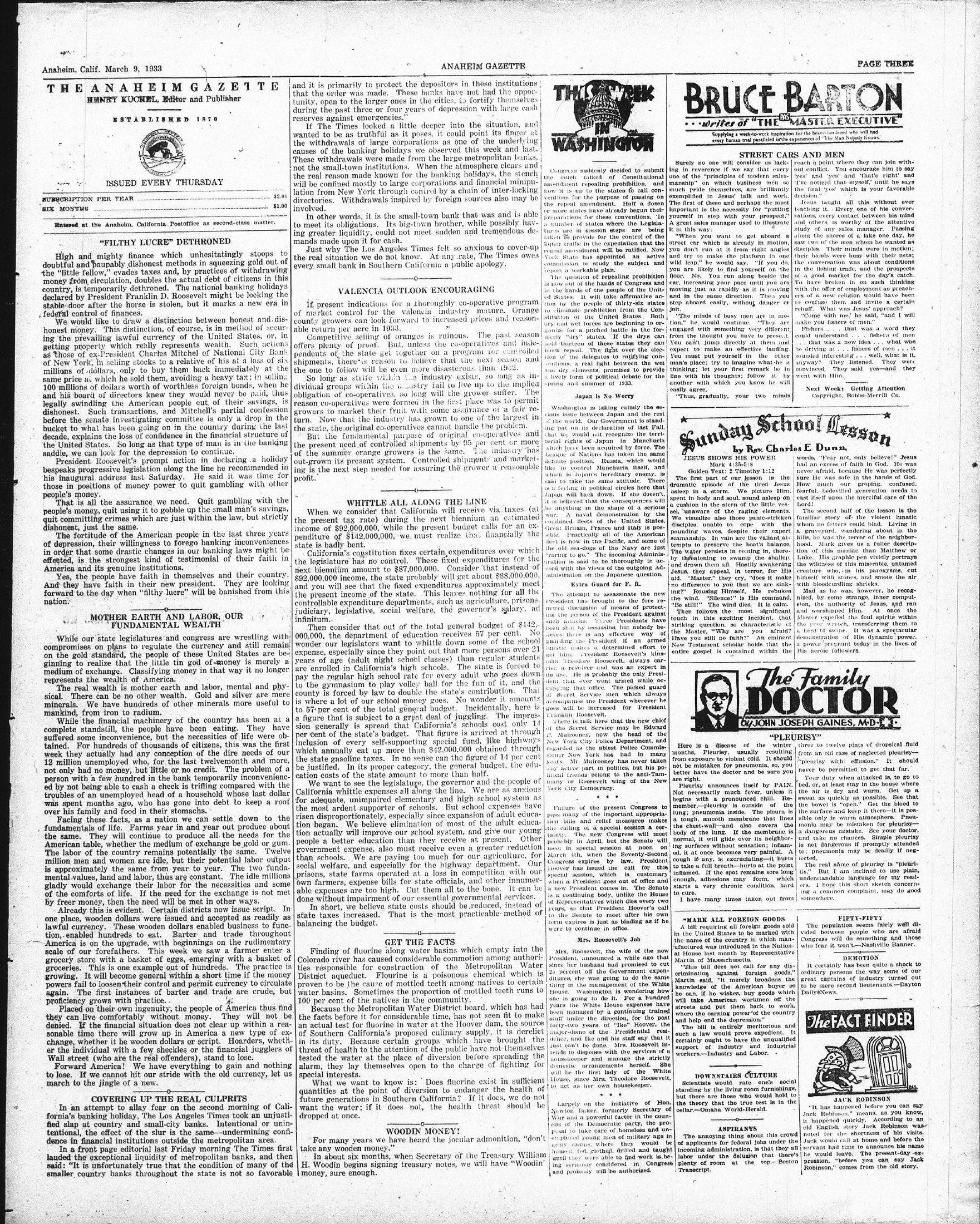
Searchable text
THE ANAHEIM GAZETTE
HENRY KUCHEL, Editor and Publisher
ESTABLISHED 1870
ISSUED EVERY THURSDAY
SUBSCRIPTION PER YEAR ... $2.00
SIX MONTHS ... $1.00
Entered at the Anaheim, California Postoffice as second-class matter.
"FILTHY LUCRE" DETHRONED
High and mighty finance which unhesitatingly stoops to doubtful and paupably dishonest methods in squeezing gold out of the "little fellow," evades taxes and, by practices of withdrawing money from circulation, doubles the actual debt of citizens in this country, is temporarily dethroned. The national banking holidays declared by President Franklin D. Roosevelt might be locking the stable door after the horse is stolen, but it marks a new era in federal control of finances.
We would like to draw a distinction between honest and dishonest money. This distinction, of course, is in method of securing the prevailing lawful currency of the United States, or, in getting property which really represents wealth. Such actions as those of ex-President Charles Mitchel of National City Bank of New York, in selling stocks to a relative of his at a loss of six millions of dollars, only to buy them back immediately at the same price at which he sold them, avoiding a heavy tax; in selling 100 millions of dollars worth of worthless foreign bonds, when he and his board of directors knew they would never be paid, thus legally swindling the American people out of their savings, is dishonest. Such transactions, and Mitchell's partial confession before the senate investigating committee is only a drop in the bucket to what has been going on in the country during the last decade, explains the loss of confidence in the financial structure of the United States. So long as that type of man is in the banking saddle, we can look for the depression to continue.
and it is primarily that the order was timely, open to the public during the past three reserves against embezzlement.
If The Times wanted to be as true to the withdrawals of causes of the bank as not the small-towns in the real reason made will be confined mostlation from New York directories. Withdrawal involved.
In other words, to meet its obligation ing greater liquidity mands made upon it.
Just why The Times the real situation w every small bank in
VALENTI
If present indicia of market control county growers can able return per acre.
Competitive sell offers plenty of properties of the state shipments, there is the one to follow with so long as string dividual groups with obligation of co-oper reason co-operative growers to market turn. Now that tha the state, the origin.
But the fundar the present need off of the summer or
of New York, in selling stocks to a relative of his at a loss of six millions of dollars, only to buy them back immediately at the same price at which he sold them, avoiding a heavy tax; in selling 100 millions of dollars worth of worthless foreign bonds, when he and his board of directors knew they would never be paid, thus legally swindling the American people out of their savings, is dishonest. Such transactions, and Mitchell's partial confession before the senate investigating committee is only a drop in the bucket to what has been going on in the country during the last decade, explains the loss of confidence in the financial structure of the United States. So long as that type of man is in the banking saddle, we can look for the depression to continue.
President Roosevelt's prompt action in declaring a holiday bespeaks progressive legislation along the line he recommended in his inaugural address last Saturday. He said it was time for those in positions of money power to quit gambling with other people's money.
That is all the assurance we need. Quit gambling with the people's money, quit using it to gobble up the small man's savings, quit committing crimes which are just within the law, but strictly dishonest, just the same.
The fortitude of the American people in the last three years of depression, their willingness to forego banking inconveniences in order that some drastic changes in our banking laws might be effected, is the strongest kind of testimonial of their faith in America and its genuine institutions.
Yes, the people have faith in themselves and their country. And they have faith in their new president. They are looking forward to the day when "filthy lucre" will be banished from this nation.
MOTHER EARTH AND LABOR, OUR FUNDAMENTAL WEALTH
While our state legislatures and congress are wrestling with compromises on plans to regulate the currency and still remain on the gold standard, the people of these United States are beginning to realize that the little tin god of money is merely a medium of exchange. Classifying money in that way it no longer represents the wealth of America.
The real wealth is mother earth and labor, mental and physical. There can be no other wealth. Gold and silver are mere minerals. We have hundreds of other minerals more useful to mankind, from iron to radium.
While the financial machinery of the country has been at a complete standstill, the people have been eating. They have suffered some inconvenience, but the necessities of life were obtained. For hundreds of thousands of citizens, this was the first week they actually had any conception of the dire needs of our 12 million unemployed who, for the last twelvemonth and more, not only had no money, but little or no credit. The problem of a person with a few hundred in the bank temporarily inconvenienced by not being able to cash a check is trifling compared with the troubles of an unemployed head of a household whose last dollar was spent months ago, who has gone into debt to keep a roof over his family and food in their stomachs.
Facing these facts, as a nation we can settle down to the fundamentals of life. Farms year in and year out produce about the same. They will continue to produce all the needs for the American table, whether the medium of exchange be gold or gum. The labor of the country remains potentially the same. Twelve million men and women are idle, but their potential labor output
WHITE
When we consider the present tax rate income of $92,000,000 per month of $142,000 state is badly bent.
California's constitution has next biennium among $92,000,000 income and you will see that the present income controllable expenditure judiciary, legislative infinitum.
Then consider 100,000,000, the department wonder our legislative expense, especially 12 years of age (adults are enrolled in California pay the regular high to the gymnasium county is forced by is where a lot of oil to 57 per cent of it a figure that is subjection generally is a per cent of the state inclusion of every which annually earn the state gasoline to be justified. In its cation costs of the We want to see California whittle for adequate, unimproved most ardent risen disproportionation began. We believe actually will in people a better ed government expense than schools. We social welfare and
not only had no money, but little or no credit. The problem of a person with a few hundred in the bank temporarily inconvenienced by not being able to cash a check is trifling compared with the troubles of an unemployed head of a household whose last dollar was spent months ago, who has gone into debt to keep a roof over his family and food in their stomachs.
Facing these facts, as a nation we can settle down to the fundamentals of life. Farms year in and year out produce about the same. They will continue to produce all the needs for the American table, whether the medium of exchange be gold or gum. The labor of the country remains potentially the same. Twelve million men and women are idle, but their potential labor output is approximately the same from year to year. The two fundamental values, land and labor, thus are constant. The idle millions gladly would exchange their labor for the necessities and some of the comforts of life. If the need for the exchange is not met by freer money, then the need will be met in other ways.
Already this is evident. Certain districts now issue script. In one place, wooden dollars were issued and accepted as readily as lawful currency. These wooden dollars enabled business to function, enabled hundreds to eat. Barter and trade throughout America is on the upgrade, with beginnings on the rudimentary scale of our forefathers. This week we saw a farmer enter a grocery store with a basket of eggs, emerging with a basket of groceries. This is one example out of hundreds. The practice is growing. It will become general within a short time if the money powers fail to loosen their control and permit currency to circulate again. The first instances of barter and trade are crude, but proficiency grows with practice.
Placed on their own ingenuity, the people of America thus find they can live comfortably without money. They will not be denied. If the financial situation does not clear up within a reasonable time there will grow up in America a new type of exchange, whether it be wooden dollars or script. Hoarders, whether the individual with a few sheckles or the financial jugglers of Wall street (who are the real offenders), stand to lose.
Forward America! We have everything to gain and nothing to lose. If we cannot hit our stride with the old currency, let us march to the jingle of a new.
COVERING UP THE REAL CULPRITS
In an attempt to allay fear on the second morning of California's banking holiday, The Los Angeles Times took an unjustified slap at country and small-city banks. Intentional or unintentional, the effect of the slur is the same—undermining confidence in financial institutions outside the metropolitan area.
In a front page editorial last Friday morning The Times first lauded the exceptional liquidity of metropolitan banks, and then said: "It is unfortunately true that the condition of many of the smaller country banks throughout the state is not so favorable
and it is primarily to protect the depositors in these institutions that the order was made. These banks have not had the opportunity, open to the larger ones in the cities, to fortify themselves during the past three or four years of depression with large cash reserves against emergencies."
If The Times looked a little deeper into the situation, and wanted to be as truthful as it poses, it could point its finger at the withdrawals of large corporations as one of the underlying causes of the banking holidays we observed this week and last. These withdrawals were made from the large-metropolitan banks, not the small-town institutions. When the atmosphere clears and the real reason made known for the banking holidays, the stench will be confined mostly to large corporations and financial minipulation from New York through control by a chain of inter-locking directories. Withdrawals inspired by foreign sources also may be involved.
In other words, it is the small-town bank that was and is able to meet its obligations. Its big-town brother, while possibly having greater liquidity, could not meet sudden and tremendous demands made upon it for cash.
Just why The Los Angeles Times felt so anxious to cover-up the real situation we do not know. At any rate, The Times owes every small bank in Southern California a public apology.
VALENCIA OUTLOOK ENCOURAGING
If present indications for a thoroughly co-operative program of market control for the valencia industry mature, Orange county growers can look forward to increased prices and reasonable return per acre in 1933.
Competitive selling of oranges is ruinous. The past season offers plenty of proof. But, unless the co-operatives and independents of the state get together on a program for controlled shipments, there is reason to believe that the next season and the one to follow will be even more disasterous than 1932.
So long as strife within the industry exists, so long as individual groups within the industry fail to live up to the implied obligation of co-operatives, so long will the grower suffer. The reason co-operatives were formed in the first place was to permit growers to market their fruit with some assurance of a fair return. Now that the industry has grown to one of the largest in the state, the original co-operatives cannot handle the problem.
But the fundamental purpose of original co-operatives and the present need of controlled shipments by 95 per cent or more of the summer orange growers is the same. The industry has
Congress suddenly decided to submit the much talked of Constitutional amendment repealing prohibition, and now it is up to the states to call conventions for the purpose of passing on the repeal amendment. Half a dozen or more states have already begun their preparations for these conventions. In a number of states where the Legislatures are in session steps are being taken to provide for the control of the liquor traffic in the expectation that the repeal amendment will be ratified. New York State has appointed an active commission to study the subject and report a workable plan.
The question of repealing prohibition is now out of the hands of Congress and in the hands of the people of the United States. It will take affirmative action by the people of thirty-six states to eliminate prohibition from the Constitution of the United States. Both dry and wet forces are beginning to organize for a pitched battle in the formerly "dry" states. If the drys can hold thirteen of these states they can block repeal. The fight over the election of the delegates to ratifying conventions, a real fight between the wet and dry elements, promises to provide a lively form of political debate for the spring and summer of 1933.
Japan Is No Worry
Washington is taking calmly the serious issue between Japan and the rest of the world. Our Government is standing pat on its declaration of last Fall, that we would not recognize the territorial rights of Japan in Manchuria which have been acquired by force. The League of Nations has taken the same
WHITTLE ALL ALONG THE LINE
When we consider that California will receive via taxes (at the present tax rate) during the next biennium an estimated income of $92,000,000, while the present budget calls for an expenditure of $142,000,000, we must realize that financially the state is badly bent.
California's constitution fixes certain expenditures over which the legislature has no control. These fixed expenditures for the next biennium amount to $87,000,000. Consider that instead of $92,000,000 income, the state probably will get about $88,000,000, and you will see that the fixed expenditures approximately meet the present income of the state. This leaves nothing for all the controllable expenditure departments, such as agriculture, prisons, judiciary, legislative, social welfare, the governor's salary, ad infinitum.
Then consider that out of the total general budget of $142,000,000, the department of education receives 57 per cent. No wonder our legislators want to whittle down some of the school expense, especially since they point out that more persons over 21 years of age (adult night school classes) than regular students are enrolled in California's high schools. The state is forced to pay the regular high school rate for every adult who goes down to the gymnasium to play volleyball for the fun of it, and the county is forced by law to double the state's contribution. That is where a lot of our school money goes. No wonder it amounts to 57 per cent of the total general budget. Incidentally, here is a figure that is subject to a great deal of juggling. The impression generally is spread that California's schools cost only 14 per cent of the state's budget. That figure is arrived at through inclusion of every self-supporting special fund, like highways which annually eat up more than $42,000,000 obtained through the state gasoline taxes. In no sense can the figure of 14 per cent be justified. In its proper category, the general budget, the education costs of the state amount to more than half.
We want to see the legislature, the governor and the people of California whittle expenses all along the line. We are as anxious for adequate, unimpaired elementary and high school system as the most ardent supporter of schools. But school expenses have risen disproportionately, especially since expansion of adult education began. We believe elimination of most of the adult education actually will improve our school system, and give our young people a better education than they receive at present. Other government expense, also must receive even a greater reduction than schools. We are paying too much for our agriculture, for social welfare and especially for the highway department. Our Washington is taking calmly the serious issue between Japan and the rest of the world. Our Government is standing pat on its declaration of last Fall, that we would not recognize the territorial rights of Japan in Manchuria which have been acquired by force. The League of Nations has taken the same definite position. Russia, which would like to control Manchuria itself, and which is Japan's hereditary enemy, is said to take the same attitude. There is a feeling in political circles here that Japan will back down. If she doesn't, it is believed that the consequences will be anything in the shape of a serious war. A naval demonstration by the combined fleets of the United States, Great Britain, France and Italy is possible. Practically all of the American fleet is now in the Pacific, and some of the old sea-dogs of the Navy are just "raring to go." The incoming Administration is said to be thoroughly in accord with the views of the outgoing Administration on the Japanese question.
Extra Guard for F.R.
The attempt to assassinate the new President has brought to the fore renewed discussion of means of protecting the person of the President against such attacks. Three Presidents have been shot by assassins, but nobody believes there is any effective way of guarding the President if an armed lunatic makes a determined effort to get him. President Roosevelt's kinsman Theodore Roosevelt, always carried a revolver and was an expert in its use. He is probably the only President that ever went armed while occupying that office. The picked guard of Secret Service men which always accompanies the President wherever he goes will be increased for President Franklin Roosevelt.
There is talk here that the new chief of the Secret Service may be Edward P. Mulrooney, now the head of the New York City Police Department, and regarded as the ablest Police Commissioner New York has had in many years. Mr. Mulrooney has never taken any active part in politics, but his political friends belong to the anti-Tammany or Roosevelt wing of the New York City Democracy.
Failure of the present Congress to pass many of the important appropriations bills and relief measures makes the calling of a special session a certainty. The new Congress will meet probably in April, but the Senate will meet in special session at noon on March 4th, when the Seventy-Second Congress expires by law. President
We want to see the legislature, the governor and the people of California whittle expenses all along the line. We are as anxious for adequate, unimpaired elementary and high school system as the most ardent supporter of schools. But school expenses have risen disproportionately, especially since expansion of adult education began. We believe elimination of most of the adult education actually will improve our school system, and give our young people a better education than they receive at present. Other government expense, also must receive even a greater reduction than schools. We are paying too much for our agriculture, for social welfare, and especially for the highway department. Our prisons, state farms operated at a loss in competition with our own farmers, expense bills for state officials, and other innumerable expenses are too high. Cut them all to the bone. It can be done without impairment of our essential governmental services.
In short, we believe state costs should be reduced, instead of state taxes increased. That is the most practicable method of balancing the budget.
GET THE FACTS
Finding of fluorine along water basins which empty into the Colorado river has caused considerable commotion among authorities responsible for construction of the Metropolitan Water District aqueduct. Flourine is a poisonous chemical which is proven to be the cause of mottled teeth among natives to certain water basins. Sometimes the proportion of mottled teeth runs to 100 per cent of the natives in the community.
Because the Metropolitan Water District board, which has had the facts before it for considerable time, has not seen fit to make an actual test for fluorine in water at the Hoover dam, the source of Southern California’s proposed culinary supply, it is derelict in its duty. Because certain groups which have brought the threat of health to the attention of the public have not themselves tested the water at the place of diversion before spreading the alarm, they lay themselves open to the charge of fighting for special interests.
What we want to know is: Does fluorine exist in sufficient quantities at the point of diversion to endanger the health of future generations in Southern California? If it does, we do not want the water; if it does not, the health threat should be dropped at once.
WOODIN MONEY!
For many years we have heard the jocular admonition, “don’t take any wooden money.”
In about six months, when Secretary of the Treasury William H. Woodin begins signing treasury notes, we will have “Woodin’ money, sure enough.
Failure of the present Congress to pass many of the important appropriations bills and relief measures makes the calling of a special session a certainty. The new Congress will meet probably in April, but the Senate will meet in special session at noon on March 4th, when the Seventy-Second Congress expires by law. President Hoover has issued the call for this special session, which is customary when a President goes out of office and a new President comes in. The Senate is a continuing body, unlike the House of Representatives which dies every two years, so that President Hoover’s call to the Senate to meet after his own term expires is just as binding as if he were to continue in office.
Mrs. Roosevelt’s Job
Mrs. Roosevelt, the wife of the new President, announced a while ago that since her husband had promised to cut 25 percent off the Government expenditures, she was going to do the same thing in the management of the White House. Washington is wondering how she is going to do it. For a hundred years the White House expenses have been managed by a continuing trained staff under the direction, for the past forty-two years, of “Ike” Hoover, the major-domo of the Presidential residence, and Ike and his staff say that it just cannot be done. Mrs. Roosevelt intends to dispense with the services of a housekeeper and manage the strictly domestic arrangements herself. She will be the first lady of the White House, since Mrs. Theodore Roosevelt, to act as her own housekeeper.
Largely on the initiative of Hon. Newton Baker, formerly Secretary of War and a powerful factor in the councils of the Democratic party, the proposal to take care of homeless and unemployed young men of military age in army camps, where they would be housed fed, clothed, drilled and taught until they were able to find work is being seriously considered in Congress and probably will be authorized.
STREET CARS AND MEN
Surely no one will consider us lacking in reverence if we say that every one of the "principles of modern salesmanship" on which business men so much pride themselves, are brilliantly exemplified in Jesus' talk and work. The first of these and perhaps the most important is the necessity for "putting yourself in step with your prospect." A great sales manager used to illustrate it in this way:
"When you want to get aboard a street car which is already in motion, you don't run at it from right angles and try to make the platform in one wild leap," he would say. "If you do, you are likely to find yourself on the floor. No. You run along beside the car, increasing your pace until you are moving just as rapidly as it is moving and in the same direction. Then you step aboard easily, without danger or jolt.
"The minds of busy men are in motion," he would continue. "They are engaged with something very different from the thought you have to preset. You can't jump directly at them and expect to make an effective landing. You must put yourself in the other man's place; try to imagine what he is thinking; let your first remark be in line with his thoughts; follow it by another with which you know he will easily agree."
Thus, gradually, your two minds reach a point where they can join without conflict. You encourage him to say 'yes' and 'yes' and 'that's right' and I've noticed that myself, until he says the final 'yes' which is your favorable decision."
Jesus taught all this without ever teaching it. Every one of his conversations, every contact between his mind and others, is worthy of the attentive study of any sales manager. Passing along the shores of a lake one day, he saw two of the men whom he wanted as disciples. Their minds were in motion; their hands were busy with their nets; the conversation was about conditions in the fishing trade, and the prospects of a good market for the day's catch. To have broken in on such thinking with the offer of employment as preachers of a new religion would have been to confuse them and invite a certain rebuff. What was Jesus' approach?
"Come with me," he said, "and I will make you fishers of men."
Fishers . . . that was a word they could understand . . . fishers of men . . . that was a new idea . . . what who he driving at . . . fishers of men . . . it sounded interesting . . . well, what is it, anyway? They listened. They were convinced. They said yes—and they went with Him.
Next Week: Getting Attention
Copyright, Bobbs-Merrill Co.
Sunday School Lesson
by Rev. Charles E. Dunn
JESUS SHOWS HIS POWER
Mark 4:35-5:8
Golden Text: 2 Timothy 1:12
The first part of our lesson is the dramatic episode of the tired Jesus asleep in a storm. We picture Him, spent in body and soul, sound asleep on a cushion in the stern of the little vessel, unaware of the raging elements. We visualize also those panic-striken disciples, unable to cope with the pounding waves, despite their expert seamanship. In vain are the valiant attempts to preserve the boat's balance. The water persists in coming in, thereby threatening to swamp the shallop, and drown them all. Hastily awakening Jesus, they appeal, in terror, for His aid. "Master," they cry, "does it make no difference to you that we are sinking?" Rousing Himself, He rebukes the wind. "Silence!" is His command. "Be still!" The wind dies. It is calm.
Then follows the most significant touch in this exciting incident, that striking question, so characteristic of the Master, "Why are you afraid? Have you still no faith?" An eminent New Testament scholar holds that the entire gospel is contained within the words, "Fear not, only believe!" Jesus had an excess of faith in God. He was never afraid, because He was perfectly sure He was safe in the hands of God. How much our groping, confused, fearful, bedevilled generation needs to cast itself upon the merciful care of the Lord!
The second half of the lesson is the familiar story of the violent lunatic whom no fetters could bind. Living in a graveyard, wandering about in the hills, he was the terror of the neighborhood. Mark gives us a fuller description of this maniac than Matthew or Luke. His graphic pen vividly portrays the wildness of this miserable, untamed creature who, in his paroxysms, cut himself with stones, and smote the air with bloodcurdling shrieks.
Mad as he was, however, he recognized, by some strange, inner compulsion, the authority of Jesus, and ran and worshipped Him. At once the Master expelled the foul spirits within the poor wretch, transferring them to a herd of swine. It was a spectacular demonstration of His dynamic power, a power pregnant today in the lives of His heroic followers.
The Family Doctor
by JOHN JOSEPH GAINES, M.D.
"PLEURISY"
Here is a disease of the winter months, Pleurisy, usually resulting from exposure to violent cold. It should not be mistaken for pneumonia, so, you better have the doctor and be sure you are right.
Pleurisy announces itself by PAIN. Not necessarily much fever, unless it begins with a pronounced chill. Remember—pleurisy is outside of the lung; pneumonia inside. The pleura is a tough, smooth membrane that lines the chest-wall—and also covers the body of the lung. If the membrane is normal, it will glide over its neighboring surfaces without sensation; inflamed, it at once becomes very painful. A cough if any, is excruciating—it hurts three to twelve pints of dropsical fluid from an old case of neglected pleurisy—"pleurisy with effusion." It should never be permitted to get that far.
Your duty when attacked is, to go to bed, or at least stay in the house where the air is dry and warm. Get up a sweat as quickly as possible. See that the bowel is "open." Get the blood to the surface and keep it there—it is possible only in warm atmosphere. Pneumonia may be mistaken for pleurisy—a dangerous mistake. See your doctor, and take no chances. Simple pleurisy is not dangerous if promptly attended to; pneumonia may be deadly if neglected.
The real name of pleurisy is "pleuri-
"MARK ALL FOREIGN GOODS"
A bill requiring all foreign goods sold in the United States to be marked with the name of the country in which manufactured was introduced in the National House last month by Representative Martin of Massachusetts.
"This bill does not call for any discrimination against foreign goods." Martin said, "it merely broadens the knowledge of the American buyer so he can, if he wishes, buy goods which will take American workmen off the streets and put them back to work, where the earning power of the country and help end the depression."
The bill is entirely meritorious and such a law would prove expedient. It certainly ought to have the unqualified support of industry and industrial workers.—Industry and Labor.
DOWNSTAIRS CULTURE
Scientists would rate one's social standing by the living room furnishings, but there are those who would hold to the theory that the true test is in the cellar.—Omaha World-Herald.
ASPIRANTS
The annoying thing about this crowd of applicants for federal jobs under the incoming administration, is that they all labor under the delusion that there's plenty of room at the top.—Boston Transcript.
FIFTY-FIFTY
The population seems fairly well divided between people who are afraid Congress will do something and those who fear it won't.—Nashville Banner.
DEMOTION
It certainly has been quite a shock to ordinary persons the way some of our great captains of industry turned out to be mere second lieutenants.—Dayton Daily News.
JACK ROBINSON
"It has happened before you can say Jack Robinson," means, as you know, it happened quickly. According to an old English story Jack Robinson was noted for the shortness of his visits. Jack would call at home and before the servant had time to announce his name he would leave. The present-day expression, "before you can say Jack Robinson," comes from the old story.