anaheim-gazette 1933-03-02
Scanned page
Searchable text
THE ANAHEIM GAZETTE
HENRY KUCHEL, Editor and Publisher
ESTABLISHED 1870
ISSUED EVERY THURSDAY
SUBSCRIPT PER YEAR ... $2.00
SIX MONTHS ... $1.00
Entered at the Anaheim, California Postoffice as second-class matter.
THE BITTER TRUTH
Like it or not, our government is in the hands of selfish interests.
We elect our legislators by popular majority, and then permit active, persistent, selfish minorities to govern us.
Paradoxical as that seems, it is the bitter truth. If you doubt our word for it, write to any California legislator you know to find out the facts. The more candid and honest he is, the more forcefully he will tell you that selfish interests run the government.
Here is the dilemma our legislators face: Every person in California is for economy—but the minute the legislature attempts to slash the expenses of a single department of government certain selfish interests set up a mighty howl at Sacramento. Letters and telegrams flood the offices of senators and assemblymen who dare propose the economy. Telephones begin incessant ringing. Friends of legislators begin calling. They have friends who have friends who have friends who might suffer a reduction in pay, or might even lose their jobs. The atmosphere is clouded with irrevelant arguments.
The result — inaction.
This situation remains true when discussing proposed economies for any department, whether agriculture, education, highway or social welfare. Try to cut expenses, and you step on somebody's toes. Try to make our government a little more efficient and cut out some of the unnecessary work, and the legislators hear a mighty howl from somebody's hurt feelings.
When motorists of California, for instance, wake up to the fact that the highway department is having a hard time to spend $42,000,000 — when the motorists learn that a great share
suffer a reduction in pay, or might even lose their jobs. The atmosphere is clouded with irrevelant arguments.
The result — inaction.
This situation remains true when discussing proposed economies for any department, whether agriculture, education, highway or social welfare. Try to cut expenses, and you step on somebody's toes. Try to make our government a little more efficient and cut out some of the unnecessary work, and the legislators hear a mighty howl from somebody's hurt feelings.
When motorists of California, for instance, wake up to the fact that the highway department is having a hard time to spend $42,000,000 — when the motorists learn that a great share of the gasoline tax is virtually being wasted through road improvements which are far ahead of demands, the automobile clubs of California—particularly the Auto Club of Southern California—will have less actual say in how the people of this state wish to spend their money. It is a sad commentary to find the state over-built in roads, with too much money lining the coffers of the highway department, and yet unable to spend a nickel for relief of other departments of government because the auto club officials stir up a veritable hornet’s nest every time the proposed use of the highway funds for payment of highway bond interest and redemption is suggested. The state out of its general fund spends $8,500,000 every two years for state highway bond interest and redemption. Why should not the $9,000,000 surplus in the highway department be transferred for highway bonds?
The automobile clubs say no. They rule. The taxpayers do not.
Sometimes the lobbyists team up. That is what has happened in regards to certain farm organizations and the educational lobby, the latter the most highly paid and effective in California. There is reason to believe that the farm organizations do not represent even a majority of the farmers. There is reason to believe that when the inside of the educational lobby is exposed, the thousands of honest, well-intentioned school teachers now alligned with their highly-paid lobbyists, will desert the present leadership for a more enlightened program.
The great inarticulate mass of taxpayers, the people who elect the officials and instruct them to economize, so far have not had much to say about our government. But this condition will not remain with us long. Growing signs indicate the taxpayer is beginning to revolt. And when he does revolt, the other extreme, that of slashing every conceivable form of government too far, may be tried. Income has dropped to a low point. State expense, and that includes nearly every department in state government, has climbed to a new high level. Out of every dollar earned in California, 30 cents goes to taxes. This appalling rate is confiscatory. The taxpayer will not remain silent.
If the selfish minorities continue to exercise their loud-mouthed control, they will be trampled under foot in the grand scramble to economize. If wise, they should see the handwriting on the wall and give in to a reasonable control by the people themselves.
We must give our elected representatives an opportunity to solve our problems. We must give them a free hand in making economies, restricting the growing bureaucracies of our government, and making them more efficient with less expediture.
Until we do this, we can look for continued control by minorities.
THE REAL PROBLEM
When the farmer tainly cannot pay his rent. The movement for agriculture is growing rapidly. A feeling that in the past it gave their honest property which cannot on its cost. In the past it pay has already been good many counties being curtailed.
As we see it, the economic readjustment spread and general effort start for everybody such a high percentage in the past for the eminent is one country needs without import.
We think that the under way must resulution of our own intolerable grower of crops or perous farmers in tha duce only enough to protected by the g Under the French p French farmers got 1932.
It seems to us that much intelligence to do to theirs.
One of the difficult matters have to face is the fact that the selves as taxpayers than it is in rural workers, owning no pressed upon them their belief is carefully cuposes as the “friend” the fact that every sumer.
The reason why reduction in public taxation have such a cians and officials o
control, they will be trampled under foot in the grand scramble to economize. If wise, they should see the handwriting on the wall and give in to a reasonable control by the people themselves.
We must give our elected representatives an opportunity to solve our problems. We must give them a free hand in making economies, restricting the growing bureaucracies of our government, and making them more efficient with less expedition.
Until we do this, we can look for continued control by minorities.
THE REAL PROBLEM
When we are discussing the problem of taxation, let us not be confused by the various subterfuges carefully placed by selfish interests for the purpose of dodging the issue.
To get a picture of the true tax situation in California and the nation, let us take a glance at the tax which has been called the "most equitable, the most painless" ever devised—the state gasoline tax. Last year, due partially to several gasoline wars, it showed a loss of only 3.6 per cent from the 1931 total.
But the first month in 1933, compared with January of 1932, shows a 12.4 per cent slump; revenues dropped from $3,035,629 to $2,669,278. The decrease is alarming. It indicates that the rosy, painless money path is beginning to sprout thorns.
There is no use dodging the issue. We must quite spending the taxpayer's money, because he has no money. The point of diminishing returns in the taxes already has been reached. Devising new schemes to take more money from the people will get us nowhere.
If we hang up screens to shut out the awful glare of truth, we will go walking down the path of bankruptcy. The only solution to our present taxation dilemma is to cut expenses. And every department of government must share alike.
THE FARMERS' PLIGHT
All over the United States, although more noticeably in the great central area between Pittsburgh and Denver known as the Mississippi Valley, there is a spirit of unrest among the farmers which, as we view it, foreshadows material and perhaps radical changes in our social and economic scheme of things. The demand of the farming population of America for relief from the double burden of high taxes and interest on mortgage indebtedness has never been so widely and efficiently organized as it seems to be now. In spite of everything that has been attempted in the way or relief, farm commodity prices continue at low levels. It is not
ANAHEIM GAZETTE
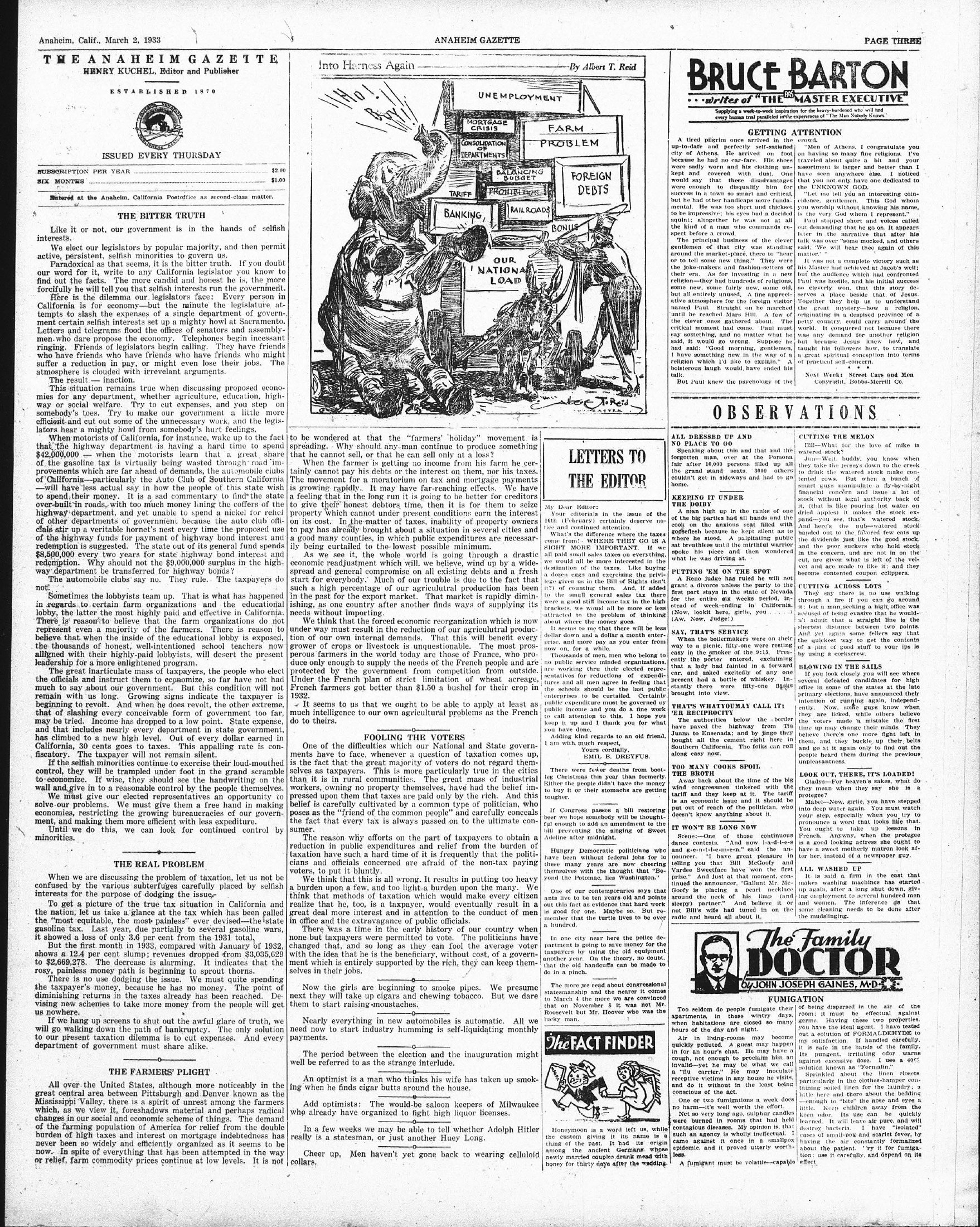
Into Harness Again
By Albert T. Reid
UNEMPLOYMENT
MORTGAGE CRISIS
CONSOLIDATION OF DEPARTMENTS
FARM PROBLEM
BALANCING BUBGET
TARIFF
PROHIBITION
FOREIGN DEBTS
BANKING
RAILROADS
BONUS
OUR NATIONAL LOAD
to be wondered at that the "farmers' holiday" movement is spreading. Why should any man continue to produce something that he cannot sell, or that he can sell only at a loss?
to be wondered at that the "farmers' holiday" movement is spreading. Why should any man continue to produce something that he cannot sell, or that he can sell only at a loss?
When the farmer is getting no income from his farm he certainly cannot pay his debts or the interest on them, nor his taxes. The movement for a moratorium on tax and mortgage payments is growing rapidly. It may have far-reaching effects. We have a feeling that in the long run it is going to be better for creditors to give their honest debtors time, then it is for them to seize property which cannot under present conditions earn the interest on its cost. In the matter of taxes, inability of property owners to pay has already brought about a situation in several cities and a good many counties, in which public expenditures are necessarily being curtailed to the lowest possible minimum.
As we see it, the whole world is going through a drastic economic readjustment which will, we believe, wind up by a widespread and general compromise on all existing debts and a fresh start for everybody. Much of our trouble is due to the fact that such a high percentage of our agriculutral production has been in the past for the export market. That market is rapidly diminishing, as one country after another finds ways of supplying its needs without importing.
We think that the forced economic reorganization which is now under way must result in the reduction of our agriculutral production of our own internal demands. That this will benefit every grower of crops or livestock is unquestionable. The most prosperous farmers in the world today are those of France, who produce only enough to supply the needs of the French people and are protected by the government from competition from outside. Under the French plan of strict limitation of wheat acreage, French farmers got better than $1.50 a bushel for their crop in 1932.
It seems to us that we ought to be able to apply at least as much intelligence to our own agricultural problems as the French do to theirs.
FOOLING THE VOTERS
One of the difficulties which our National and State governments have to face, whenever a question of taxation comes up, is the fact that the great majority of voters do not regard themselves as taxpayers. This is more particularly true in the cities than it is in rural communities. The great mass of industrial workers, owning no property themselves, have had the belief impressed upon them that taxes are paid only by the rich. And this belief is carefully cultivated by a common type of politician, who poses as the "friend of the common people" and carefully conceals the fact that every tax is always passed on to the ultimate consumer.
The reason why efforts on the part of taxpayers to obtain a reduction in public expenditures and relief from the burden of taxation have such a hard time of it is frequently that the politicians and officials concerned are afraid of the non-tax paying
LETTERS TO THE EDITOR
My Dear Editor:
Your editorials in the issue of the 16th (February) certainly deserve notice and continued attention.
What's the difference where the taxes come from? WHERE THEY GO IS A SIGHT MORE IMPORTANT. If we all paid small sales taxes on everything, we would all be more interested in the destination of the taxes. Like buying a dozen eggs and exercising the privilege given us in the Bill of Rights (isn't it?) of counting them. And, if added to the small general sales tax there were a good stiff income tax in the high brackets, we would all be more or less attracted to the problem of thinking about where the money goes.
It seems to me that there will be less dollar down and a dollar a month enterprise, and more pay as you enter from now on, for a while.
Thousands of men, men who belong to no public service minded organizations, are working thru their elected representatives for reductions of expenditures and all men agree in feeling that the schools should be the last public enterprises to be curtailed. Certainly public expenditure must be governed by public income and you do a fine work to call attention to this. I hope you keep it up and I thank you for what you have done.
Adding kind regards to an old friend, I am with much respect,
Yours cordially,
EMIL B. DREYFUS.
There were fewer deaths from bootleg Christmas this year than formerly. Either the people didn't have the money to buy it or their stomachs are getting tougher.
If Congress passes a bill restoring beer we hope somebody will be thoughtful enough to add an amendment to the bill preventing the singing of Sweet Adoline after midnight.
Hungry Democratic politicians who have been without federal jobs for these many years are now cheering
selves as taxpayers. This is more particularly true in the cities than it is in rural communities. The great mass of industrial workers, owning no property themselves, have had the belief impressed upon them that taxes are paid only by the rich. And this belief is carefully cultivated by a common type of politician, who poses as the "friend of the common people" and carefully conceals the fact that every tax is always passed on to the ultimate consumer.
The reason why efforts on the part of taxpayers to obtain a reduction in public expenditures and relief from the burden of taxation have such a hard time of it is frequently that the politicians and officials concerned are afraid of the non-tax paying voters, to put it bluntly.
We think that this is all wrong. It results in putting too heavy a burden upon a few, and too light a burden upon the many. We think that methods of taxation which would make every citizen realize that he, too, is a taxpayer, would eventually result in a great deal more interest and in attention to the conduct of men in office and the extravagance of public officials.
There was a time in the early history of our country when none but taxpayers were permitted to vote. The politicians have changed that, and so long as they can fool the average voter with the idea that he is the beneficiary, without cost, of a government which is entirely supported by the rich, they can keep themselves in their jobs.
Now the girls are beginning to smoke pipes. We presume next they will take up cigars and chewing tobacco. But we dare them to start raising moustaches.
Nearly everything in new automobiles is automatic. All we need now to start industry humming is self-liquidating monthly payments.
The period between the election and the inauguration might well be referred to as the strange interlude.
An optimist is a man who thinks his wife has taken up smoking when he finds cigar butts around the house.
Add optimists: The would-be saloon keepers of Milwaukee who already have organized to fight high liquor licenses.
In a few weeks we may be able to tell whether Adolph Hitler really is a statesman, or just another Huey Long.
Cheer up. Men haven't yet gone back to wearing celluloid collars.
If Congress passes a bill restoring beer we hope somebody will be thoughtful enough to add an amendment to the bill preventing the singing of Sweet Adoline after midnight.
Hungry Democratic politicians who have been without federal jobs for these many years are now cheering themselves with the thought that "Beyond the Potomac, lies Washington."
One of our contemporaries says that ants live to be ten years old and points out this fact as evidence that hard work is good for one. Maybe so. But remember that the turtle lives to be over a hundred.
In one city near here the police department is going to save money for the taxpayers by using the old equipment another year. On the theory, no doubt, that the old handcuffs can be made to do in a pinch.
The more we read about congressional statesmanship and the nearer it comes to March 4 the more we are convinced that on November 8 it was not Mr. Roosevelt but Mr. Hoover who was the lucky man.
Honeymoon is a word left us, while the custom giving it its name is a thing of the past. It had its origin among the ancient Germans whose newly married couples drank mead with honey for thirty days after the wedding.
GETTING ATTENTION
A tired pilgrim once arrived in the crowd.
up-to-date and perfectly self-satisfied city of Athens. He arrived on foot because he had no car-fare. His shoes were sadly worn and his clothing unkept and covered with dust. One would say that these disadvantages were enough to disqualify him for success in a town so smart and critical, but he had other handicaps more fundamental. He was too short and thickset to be impressive; his eyes had a decided squint; altogether he was not at all the kind of a man who commands respect before a crowd.
The principal business of the clever gentlemen of that city was standing around the market-place, there to "hear or to tell some new thing." They were the joke-makers and fashion-setters of their era. As for investing in a new religion—they had hundreds of religions, some new, some fairly new, some old, but all entirely unused. A fine appreciative atmosphere for the foreign visitor named Paul. Straight on he marched until he reached Mars Hill. A few of the clever ones gathered about. The critical moment had come. Paul must say something, and no matter what he said, it would go wrong. Suppose he had said: "Good morning, gentlemen, I have something new in the way of a religion which I'd like to explain." A boisterous laugh would, have ended his talk.
But Paul knew the psychology of the
"Men of Athens, I congratulate you on having so many fine religions. I've traveled about quite a bit and your assortment is larger and better than I have seen anywhere else. I noticed that you not only have one dedicated to the UNKNOWN GOD.
"Let me tell you an interesting coincidence, gentlemen. This God whom you worship without knowing his name, is the very God whom I represent."
Paul stopped short and voices called out demanding that he go on. It appears later in the narrative that after his talk was over "some mocked, and others said, 'We will hear thee again of this matter.'"
It was not a complete victory such as his Master had achieved at Jacob's well; but the audience which had confronted Paul was hostile, and his initial success so cleverly won, that this story deserves a place beside that of Jesus. Together they help us to understand the great mystery—how a religion, originating in a despised province of a petty country, could carry around the world. It conquered not because there was any demand for another religion but because Jesus knew how, and taught his followers how, to translate a great spiritual conception into terms of practical self-concern.
Next Week: Street Cars and Men
Copyright, Bobbs-Merrill Co.
OBSERVATIONS
ALL DRESSED UP AND NO PLACE TO GO
Speaking about this and that and the forgotten man over at the Pomona
CUTTING THE MELON
Bill—What tor the love of mike is watered stock?
OBSERVATIONS
ALL DRESSED UP AND NO PLACE TO GO
Speaking about this and that and the forgotten man, over at the Pomona fair after 10,000 persons filled up all the grand stand seats, 3000 others couldn't get in sideways and had to go home.
KEEPING IT UNDER THE DOIBY
A man high up in the ranks of one of the big parties had all hands and the cook on the anxious seat filled with gooseflesh because he kept silent as to where he stood. A palpitating public sat breathless until the mirthful warrior spoke his piece and then wondered what he was driving at.
PUTTING 'EM ON THE SPOT
A Reno judge has ruled he will not grant a divorce unless the party to the first part stays in the state of Nevada for the entire six weeks period, instead of week-ending in California. (Now, look it here, girlie, you...!) (Aw, Now, Judge!)
SAY, THAT'S SERVICE
When the boilermakers were on their way to a picnic, fifty-one were resting easy in the smoker of the 9:15. Presently the porter entered, exclaiming that a lady had fainted in a forward car, and asked excitedly of any one present had a bottle of whiskey. Instantly there were fifty-one flasks brought into view.
THAT'S WHAT YOU MAY CALL IT; 'ER RECIPROCITY
The authorities below the border have paved the highway from Tia Juana to Ensenada; and by jingo they bought all the cement right here in Southern California. The folks can roll along easy now.
TOO MANY COOKS SPOIL THE BROTH
Away back about the time of the big wind congressmen tinkered with the tariff and they keep at it. The tariff is an economic issue and it should be put out of reach of the politician, who doesn't know anything about it.
IT WON'T BE LONG NOW
Scene:—One of those continuous dance contests. "And now l-a-d-l-e-s and g-e-n-t-l-e-m-e-n," said the announcer. "I have great pleasure in telling you that Bill McGoofy and
CUTTING THE MELON
Bill—What tor the love of mike is watered stock?
Jim—Weil, buddy, you know when they take the jerseys down to the creek to drink the watered stock make contented cows. But when a bunch of smart guys manipulate a fly-by-night financial concern and issue a lot of stock without legal authority back of it, (that is like pouring hot water on dried apples) it makes the stock expand—you see, that's watered stock. And here's the nub—watered stock handed out to the favored few eats up the dividends just like the good stock, and the poor suckers who hold stock in the concern, and are not in on the cut, are given what is left of the velvet and are made to like it; and they become contented coupon clippers.
CUTTING ACROSS LOTS
They say there is no use walking through a fire if you can go around it; but a man seeking a high office was accused of being evasive that he wouldn't admit that a straight line is the shortest distance between two points. And yet again some fellers say that the quickest way to get the contents of a pint of good stuff to your ips is by using a corkscrew.
BLOWING IN THE SAILS
If you look closely you will see where several defeated candidates for high office in some of the states at the late primary elections, have announced their intention of running again, independently. Now, some guys know when they are licked, while others believe the voters made a mistake the first time up may change their minds. They believe there's one more fight left in them, and they buckle up their belts and go at it again only to find out the people heard them during the previous unpleasantness.
LOOK OUT, THERE, IT'S LOADED!
Gladys—For heaven's sakes, what do they mean when they say she is a protegee?
Mabel—Now, girlie, you have stepped into deep water again. You must watch your step, especially when you try to pronounce a word that looks like that. You ought to take up lessons in French. Anyway, when the protegee is a good looking actress she ought to have a sweet motherly matron look after her, instead of a newspaper guy.
THE BROTH
Away back about the time of the big wind congressmen tinkered with the tariff and they keep at it. The tariff is an economic issue and it should be put out of reach of the politician, who doesn't know anything about it.
IT WON'T BE LONG NOW
Scene:—One of those continuous dance contests. "And now l-a-d-l-e-s and g-e-n-t-l-e-m-e-n," said the announcer. "I have great pleasure in telling you that Bill McGoofy and Vardee Sweetface have won the first prize." And just at that moment, continued the announcer, "Gallant Mr. McGoofy is placing a pearl necklace around the neck of his limp (and sleepy) partner." And believe it or not Bill's wife had tuned in on the radio and heard all about it.
LOOK OUT, THERE, IT'S LOADED!
Gladys—For heaven's sakes, what do they mean when they say she is a protegee?
Mabel—Now, girlie, you have stepped into deep water again. You must watch your step, especially when you try to pronounce a word that looks like that. You ought to take up lessons in French. Anyway, when the protegee is a good looking actress she ought to have a sweet motherly matron look after her, instead of a newspaper guy.
ALL WASHED UP
It is said a firm in the east that makes washing machines has started up again, after a long shut down, giving employment to several hundred men and women. The inference is that some cleaning needs to be done after the mudslinging.
FUMIGATION
Too seldom do people fumigate their apartments, in these wintry days, when habitations are closed so many hours of the day and night.
Air in living-rooms may become quickly polluted. A guest may happen in for an hour's chat. He may have a cough, not enough to proclaim him an invalid—yet he may be what we call a "flu carrier." He may inoculate receptive victims in any house he visits, and do it without in the least being conscious of the act.
One or two fumigations a week does no harm—it's well worth the effort.
Not so very long ago, sulphur candles were burned in rooms that had held contagious diseases. My opinion is, that such an agency is wholly ineffectual. I came against it once in a smallpox epidemic, and it proved utterly worthless.
A fumigant must be volatile—capable of being dispersed in the air of the room; it must be effectual against germs. Having these two properties, you have the ideal agent. I have tested out a solution of FORMALDEHYDE to my satisfaction. If handled carefully, it is safe in the hands of the family. Its pungent, irritating odor warns against excessive dose. I use a 40% solution known as "Formalin."
Sprinkled about the linen closets particularly in the clothes-hamper containing soiled linen for the laundry; a little here and there about the bedding—enough to "bite" the nose and eyes a little. Keep children away from the keen odor. Its use can be quickly learned. It will leave air pure, and will destroy bacteria. I have "isolated" cases of small-pox and scarlet fever, by having the air constantly formalized about the patient. Try it for fumigation; use it carefully, and depend on its effect.