anaheim-gazette 1933-01-05
Scanned page
Searchable text
THE ANAHEIM GAZEITE
HENRY KUCHEL, Editor and Publisher
ESTABLISHED 1870
ISSUED EVERY THURSDAY
SUBSCRIPTION PER YEAR $2.00
SIX MONTHS $1.00
Entered at the Anaheim, California Postoffice as second-class matter.
YOU VS. POVERTY — A CHALLENGE
This is a brief for your welfare, and ours. We are patriotic enough, or, if you are willing to swallow internationalist propaganda while the rest of the world stuffs its own dinner basket out of the 75 billion dollar American market, selfish enough, to see the virtue of "Buy American." Better yet, we would carry the process one step farther, "Buy American, and buy in Anaheim."
Let's get down to brass tacks about the newest and most praiseworthy idea that has gripped America in many, many years. Before we settle down to figures, let's get the background which brought on the sudden realization that we are employing the rest of the world and letting our own people starve. Europe started and for centuries has practiced the movement of "buying at home." Only where Europeans can get a favorable balance, do they or have they bought elsewhere, except, of course, in cases of necessity. In this consideration, money comes foremost. Europe for the past decade has borrowed hundreds of millions of dollars of American money, and bought less American goods. The money was spent to erect factories and train workers to compete by American production methods with American products. Which means, they borrowed our money to eliminate our markets. In the meantime, they used international trade as a decoy, and America swallowed the bait, hook line and sinker. The only saving factor of the whole situation was the policy of tariff, which prevented a breakdown of our home markets until Europe and a greater portion of the rest of the world went on the double mone-
they or have they bought elsewhere, except, of course, in cases of necessity. In this consideration, money comes foremost. Europe for the past decade has borrowed hundreds of millions of dollars of American money, and bought less American goods. The money was spent to erect factories and train workers to compete by American production methods with American products. Which means, they borrowed our money to eliminate our markets. In the meantime, they used international trade as a decoy, and America swallowed the bait, hook line and sinker. The only saving factor of the whole situation was the policy of tariff, which prevented a breakdown of our home markets until Europe and a greater portion of the rest of the world went on the double monetary standard. That single move — a tremendous inflationary one in that it deflated values or made money more plentiful — enables those countries on the double standard to pay the difference of the average Hawley-Smoot tariff of 42 per cent, and still have 37 per cent foreign exchange profit. Because of depressed conditions in this country, the American people have not had the money to spend they had in the past, consequently they demand cheaper products, and the rest of the world is unscrupulous enough to fill the demands with below-standard merchandise. Now we are to the point at issue.
This cheap merchandise is costing us dearly. Here is an example: Japan has flooded this country with millions of electric light bulbs. Because of the low standards of living and the extremely low value of the yen, these bulbs have been sold at a profit in the United States at a less figure than lamps made to the standards which American manufacturers have given. In fact, the retail price of the Japanese lamps represent an apparent saving of $1,900,000. However, those same lamps are so inefficient they consume $11,000,000 more electric current than the American lamps giving the same amount of light. This changes the complexion. While the housewife saves a nickle or a dime on the original price of the lamp, she pays that much more nearly every month for her electric light bill. At the end of the year, she has paid 60 cents to 90 cents more for every Jap bulb than had she purchased a standard American-made bulb. So, instead of a saving of $1,900,000, she has squandered $9,100,000. More than that, she has taken $2,320,000 that would have gone to American labor, and paid Japanese help and Japanese profits. So the total immediate loss to the country on electric light bulbs alone, labor and inefficient lighting, is $11,420,000. There still is one more point to consider. Between 44 and 50 per cent of the Japanese bulbs are defective. Only an average of 1.6 per cent of the American makes prove defective. Thus the saving which the housewife intended when she bought the cheaper article, actually turns out to be an extravagance that is unfair to her family, unfair to her merchant and unfair to the 11 million unemployed Americans.
Next time you visit a dime store look about and see how much of its articles are made abroad. Then figure how many American men and women could be given employment were all that merchandise made in America. Our own observation indicates that more than three-fourths of the dime store merchandise, and a large share of the cheaper merchandise in many other stores, is foreign-made. Apply the lesson learned in the Japanese electric bulb example — and relatively the same proportion of efficiency and loss holds—and you will be ahead individually by purchasing American-made products. In addition, when you “Buy American” you put our own unemployed back to work, restoring their self-confidence and self-respect. That is better than feeding another country’s people and letting our own go hungry.
The same principle applies on a smaller scale to trading in vote-getting machine governor, or attempt senator in 1934. Royal ability to attend he ought to be at S ment and taxation po who make one of th workers, and finally a law-breaking negro
The question wh whether or not the active leadership will be working politically to pluck all the poli
Yankee farmers about 150 years ago siders. Connecticut another breed of R hounds at fox hun t meet the new me $250. if the offende $500 if the hunter i
The Connecticut damage to their co wild game. It is cl have been turned lo furnish sport, disap residents are depriv duck. just because making other loud of Revnard.
One farmer ever
men and women could be given employment were all that merchandise made in America. Our own observation indicates that more than three-fourths of the dime store merchandise, and a large share of the cheaper merchandise in many other stores, is foreign-made. Apply the lesson learned in the Japanese electric bulb example — and relatively the same proportion of efficiency and loss holds—and you will be ahead individually by purchasing American-made products. In addition, when you "Buy American" you put our own unemployed back to work, restoring their self-confidence and self-respect. That is better than feeding another country's people and letting our own go hungry.
The same principle applies on a smaller scale to trading in Anaheim. Purchase your goods from a reliable Anaheim merchant and you are guaranteed satisfaction. Buy from a fly-by-nighter or an out-of-town concern and you are not assured of satisfaction. Buying in Anaheim leaves the profits of the transaction in Anaheim for local development and expansion; buying elsewhere builds up the other community and indirectly tears down the value of your own holdings in Anaheim.
"Buy American, and buy in Anaheim."
WHAT IS THE IDEA, GOVERNOR?
Governor James Rolph seems to have taken a page out of Ma Ferguson's petticoat history at Texas, and is attempting to go her one better in the way of releasing prisoners, granting pardons and otherwise undoing a great portion of the work of California courts and prosecuting offices, into which the people of this state have poured millions of dollars for self-protection.
From the moment amiable Rolph donned the robes of California's leading socialite and official greeter — his office does not mean much more than that to him — he began a program of wholesale releasing of prisoners, followed by a system of appointing henchmen to important and strategical posts throughout the state. As soon as California repealed the Wright act, philanthropic Rolph decided that anybody who had violated the Wright act while it was a law should not suffer. He issued one of the greatest wholesale pardon lists ever recorded when the act was written off the books.
What appears to us as a dead give-away on Rolph's plans, however, came to light last night with the pardoning of a negro politician in Los Angeles: The politician, according to reports from the metropolis, had been sentenced to five years in prison following conviction on possession of a still in a house near Torrance. The law under which this man was convicted is still the law of the state. It was not affected by the vote of the people last November.
We have suspected right along that Rolph was building up a
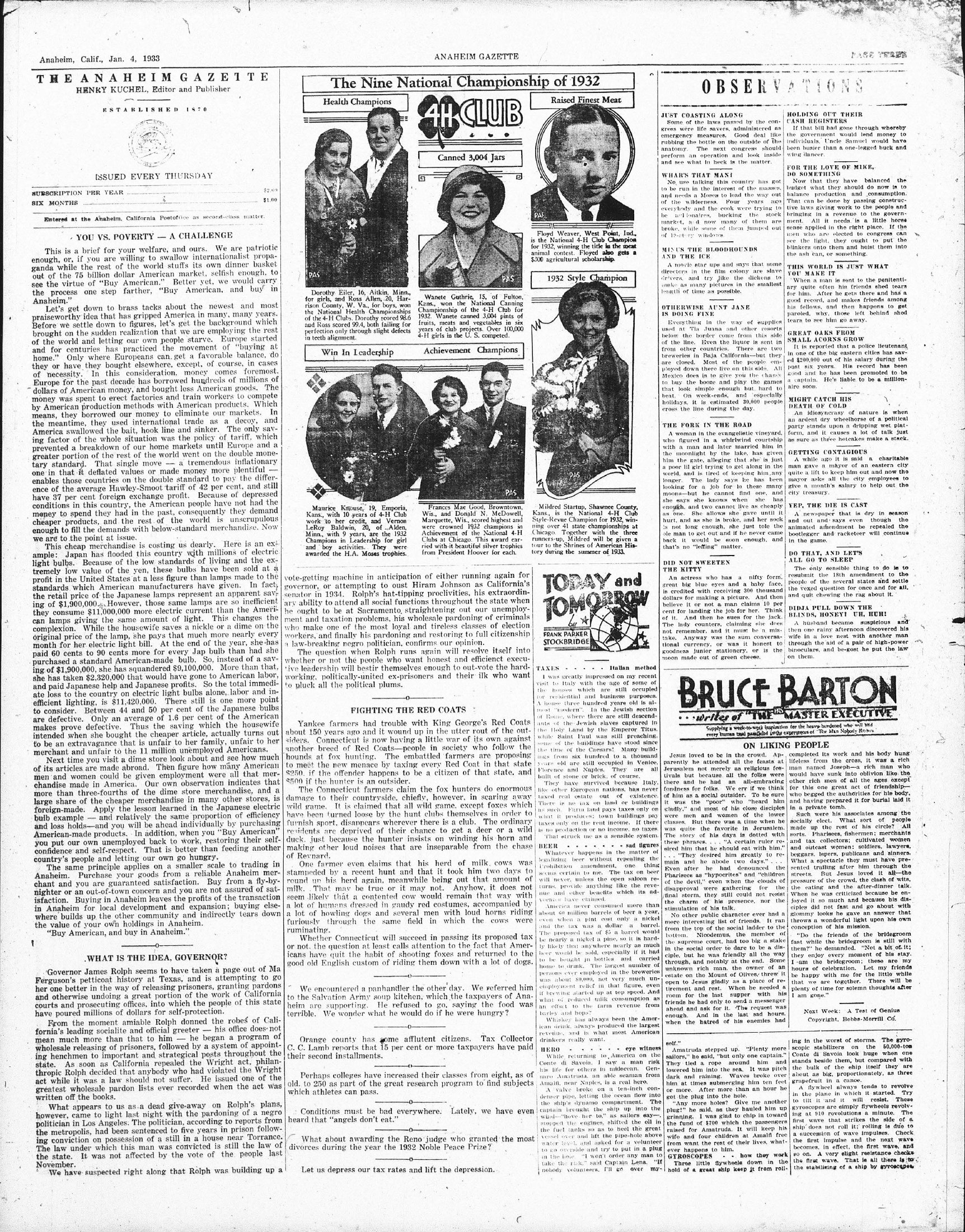
The Nine National Championship of 1932
Health Champions
Dorothy Eiler, 16, Aitkin, Minn., for girls, and Ross Allen, 20, Harrison County, W. Va., for boys, won the National Health Championships of the 4-H Clubs. Dorothy scored 98.6 and Ross scored 99.4, both failing for perfection only through slight defects in teeth alignment.
Raised Finest Meat
Floyd Weaver, West Point, Ind., is the National 4-H Club Champion for 1932, winning the title in the meat animal contest. Floyed also gets a $200 agricultural scholarship.
Canned 3,004 Jars
Wanete Guthrie, 15, of Fulton, Kans., won the National Canning Championship of the 4-H Club for 1932. Wanete canned 3,004 pints of fruits, meats and vegetables in six years of club projects. Over 100,000 4-H girls in the U.S. competed.
1932 Style Champion
Win In Leadership Achievement Champions
vote-getting machine in anticipation of either running again for governor, or attempting to oust Hiram Johnson as California’s senator in 1934. Rolph’s hat-tipping proclivities, his extraordinary ability to attend all social functions throughout the state when he ought to be at Sacramento, straightening out our unemployment and taxation problems, his wholesale pardoning of criminals who make one of the most loyal and tireless classes of election workers, and finally his pardoning and restoring to full citizenship a law-breaking negro politician, confirms our opinion.
The question when Rolph runs again will resolve itself into whether or not the people who want honest and efficient executive leadership will bestir themselves enough to out-vote the hardworking, politically-united ex-prisoners and their ilk who want to pluck all the political plums.
FIGHTING THE RED COATS
Yankee farmers had trouble with King George’s Red Coats about 150 years ago and it wound up in the utter rout of the outsiders. Connecticut is now having a little war of its own against another breed of Red Coats—people in society who follow the hounds at fox hunting. The embattled farmers are proposing to meet the new menace by taxing every Red Coat in that state $250, if the offender happens to be a citizen of that state, and $500 if the hunter is an outsider.
The Connecticut farmers claim the fox hunters do enormous damage to their countryside, chiefly, however, in scaring away wild game. It is claimed that all wild game, except foxes which have been turned loose by the hunt clubs themselves in order to furnish sport, disappears wherever there is a club. The ordinary residents are deprived of their chance to get a deer or a wild duck, just because the hunter insists on winding his horn and making other loud noises that are inseparable from the chase of Revnard.
One farmer even claims that his herd of milk cows was vote-getting machine in anticipation of either running again for governor, or attempting to oust Hiram Johnson as California’s senator in 1934. Rolph’s hat-tipping proclivities, his extraordinary ability to attend all social functions throughout the state when he ought to be at Sacramento, straightening out our unemployment and taxation problems, his wholesale pardoning of criminals who make one of the most loyal and tireless classes of election workers, and finally his pardoning and restoring to full citizenship a law-breaking negro politician, confirms our opinion.
The question when Rolph runs again will resolve itself into whether or not the people who want honest and efficient executive leadership will bestir themselves enough to out-vote the hardworking, politically-united ex-prisoners and their ilk who want to pluck all the political plums.
TAXES ... Itallan method
I was greatly impressed on my recent visit to Italy with the age of some of the houses which are still occupied for residential and business purposes. A house three hundred years old is almost “modern”. In the Jewish section of Rome, where there are still descendants of the Jewish slaves captured in the Holy Land by the Emperor Titus, while Saint Paul was still preaching, some of the buildings have stood since the time of the Caesars! Many buildings from six hundred to a thousand years old are still occupied in Venice, Florence and Naples. They are all built of stone or brick, of course.
They have survived because Italy, like other European nations, has never taxed real estate out of existence. There is no tax on land or buildings as such. Farm land pays taxes only on what it produces; town buildings pay taxes only on the rent income. If there is no production or no income, no taxes.
That struck me as a sensible system.
BEER ... sad figures
Whatever happens in the matter of legalizing beer without repealing the Prohibition amendment, one thing
The Connecticut farmers claim the fox hunters do enormous damage to their countryside, chiefly, however, in scaring away wild game. It is claimed that all wild game, except foxes which have been turned loose by the hunt clubs themselves in order to furnish sport, disappears wherever there is a club. The ordinary residents are deprived of their chance to get a deer or a wild duck, just because the hunter insists on winding his horn and making other loud noises that are inseparable from the chase of Revnard.
One farmer even claims that his herd of milk cows was stamped by a recent hunt and that it took him two days to round up his herd again, meanwhile being out that amount of milk. That may be true or it may not. Anyhow, it does not seem likely that a contented cow would remain that way with a lot of humans dressed in gaudy red costumes, accompanied by a lot of howling dogs and several men with loud horns riding furiously through the same field in which the cows were ruminating.
Whether Connecticut will succeed in passing its proposed tax or not, the question at least calls attention to the fact that Americans have quit the habit of shooting foxes and returned to the good old English custom of riding them down with a lot of dogs.
We encountered a panhandler the other day. We referred him to the Salvation Army soup kitchen, which the taxpayers of Anaheim are supporting. He refused to go, saying the food was terrible. We wonder what he would do if he were hungry?
Orange county has some affluent citizens. Tax Collector C. C. Lamb reports that 15 per cent or more taxpayers have paid their second installments.
Perhaps colleges have increased their classes from eight, as of old, to 250 as part of the great research program to find subjects which athletes can pass.
Conditions must be bad everywhere. Lately, we have even heard that "angels don't eat."
What about awarding the Reno judge who granted the most divorces during the year the 1932 Noble Peace Prize?
Let us depress our tax rates and lift the depression.
They have survived because Italy, like other European nations, has never taxed real estate out of existence. There is no tax on land or buildings as such. Farm land pays taxes only on what it produces; town buildings pay taxes only on the rent income. If there is no production or no income, no taxes.
That struck me as a sensible system.
BEER
Whatever happens in the matter of legalizing beer without repealing the Prohibition amendment, one thing seems certain to me. The tax on beer will never, unless the open saloon returns, provide anything like the revenue and other benefits which its advocates have claimed.
America never consumed more than about 60 million barrels of beer a year, even when a pint cost only a nickel and the tax was a dollar a barrel. The proposed tax of $5 a barrel would be nearly a nickel a pine, so it is hardly likely that anywhere nearly as much beer would be sold, especially if it had to be bought in bottles and carried home to drink. The largest number of persons ever employed in the breweries was about 80,000, not very much unemployment relief in that figure, even if brewing started up at top speed. And what of reduced milk consumption as an offset to the farm revenue from barley and hops?
Whiskey has always been the American drink, always produced the largest revenue, and is what most American drinkers really want.
HERO
While returning to America on the Conte di Savoia, I saw a man risk his life for others in middocean. Genaro Amatruda, an able seaman from Amaifi, near Naples, is a real hero.
A valve broke on a ten-inch condenser pipe, letting the ocean flow into the ship's dynamo compartment. The captain brought the ship up into the wind—"hove her to," as sailors say—stopped the engines, shifted the oil in the fuel tanks so as to heel the great vessel over and lift the pipe-hole above water level, and asked for a volunteer to go outside and try to put in a plug in the hole. "I won't order any man to take the risk," said Captain Lena. "If nobody volunteers, I'll go over my built of stone or brick, of course.
They have survived because Italy, like other European nations, has never taxed real estate out of existence. There is no tax on land or buildings as such. Farm land pays taxes only on what it produces; town buildings pay taxes only on the rent income. If there is no production or no income, no taxes.
That struck me as a sensible system.
BEER
Whatever happens in the matter of legalizing beer without repealing the Prohibition amendment, one thing seems certain to me. The tax on beer will never, unless the open saloon returns, provide anything like the revenue and other benefits which its advocates have claimed.
America never consumed more than about 60 million barrels of beer a year, even when a pint cost only a nickel and the tax was a dollar a barrel. The proposed tax of $5 a barrel would be nearly a nickel a pine, so it is hardly likely that anywhere nearly as much beer would be sold, especially if it had to be bought in bottles and carried home to drink. The largest number of persons ever employed in the breweries was about 80,000, not very much unemployment relief in that figure, even if brewing started up at top speed. And what of reduced milk consumption as an offset to the farm revenue from barley and hops?
Whiskey has always been the American drink, always produced the largest revenue, and is what most American drinkers really want.
HERO
While returning to America on the Conte di Savoia, I saw a man risk his life for others in middocean. Genaro Amatruda, an able seaman from Amaifi, near Naples, is a real hero.
A valve broke on a ten-inch condenser pipe, letting the ocean flow into the ship's dynamo compartment. The captain brought the ship up into the wind—"hove her to," as sailors say—stopped the engines, shifted the oil in the fuel tanks so as to heel the great vessel over and lift the pipe-hole above water level, and asked for a volunteer to go outside and try to put in a plug in the hole. "I won't order any man to take the risk," said Captain Lena. "If nobody volunteers, I'll go over my built of stone or brick, of course.
They have survived because Italy, like other European nations, has never taxed real estate out of existence. There is no tax on land or buildings as such. Farm land pays taxes only on what it produces; town buildings pay taxes only on the rent income. If there is no production or no income, no taxes.
That struck me as a sensible system.
BEER
Whatever happens in the matter of legalizing beer without repealing the Prohibition amendment, one thing seems certain to me. The tax on beer will never, unless the open saloon returns, provide anything like the revenue and other benefits which its advocates have claimed.
America never consumed more than about 60 million barrels of beer a year, even when a pint cost only a nickel and the tax was a dollar a barrel. The proposed tax of $5 a barrel would be nearly a nickel a pine, so it is hardly likely that anywhere nearly as much beer would be sold, especially if it had to be bought in bottles and carried home to drink. The largest number of persons ever employed in the breweries was about 80,000, not very much unemployment relief in that figure, even if brewing started up at top speed. And what of reduced milk consumption as an offset to the farm revenue from barley and hops?
Whiskey has always been the American drink, always produced the largest revenue, and is what most American drinkers really want.
HERO
While returning to America on the Conte di Savoia, I saw a man risk his life for others in middocean. Genaro Amatruda, an able seaman from Amaifi, near Naples, is a real hero.
A valve broke on a ten-inch condenser pipe, letting the ocean flow into the ship's dynamo compartment. The captain brought the ship up into the wind—"hove her to," as sailors say—stopped the engines, shifted the oil in the fuel tanks so as to heel the great vessel over and lift the pipe-hole above water level, and asked for a volunteer to go outside and try to put in a plug in the hole. "I won't order any man to take the risk," said Captain Lena. "If nobody volunteers, I'll go over my built of stone or brick, of course.
They have survived because Italy, like other European nations, has never taxed real estate out of existence. There is no tax on land or buildings as such. Farm land pays taxes only on what it produces; town buildings pay taxes only on the rent income. If there is no production or no income, no taxes.
That struck me as a sensible system.
BEER
Whatever happens in the matter of legalizing beer without repealing the Prohibition amendment, one thing seems certain to me. The tax on beer will never, unless the open saloon returns, provide anything like the revenue and other benefits which its advocates have claimed.
America never consumed more than about 60 million barrels of beer a year, even when a pint cost only a nickel and the tax was a dollar a barrel. The proposed tax of $5 a barrel would be nearly anickel a pine, so it is hardly likely that anywhere nearly as much beer would be sold, especially if it had to be bought in bottles and carried home to drink. The largest number of persons ever employed in the breweries was about 80,000, not very much unemployment relief in that figure, even if brewing started up at top speed. And what of reduced milk consumption as an offset to the farm revenue from barley and hops?
Whiskey has always been the American drink, always produced the largest revenue, and is what most American drinkers really want.
HERO
While returning to America on the Conte di Savoia, I saw a man risk his life for others in middocean. Genaro Amatruda, an able seaman from Amaifi, near Naples, is a real hero.
A valve broke on a ten-inch condenser pipe, letting the ocean flow into the ship's dynamo compartment. The captain brought the ship up into the wind—"hove her to," as sailors say—stopped the engines, shifted the oil in the fuel tanks so as to heel the great vessel over and lift the pipe-hole above water level, and asked for a volunteer to go outside and try to put in a plug in the hole. "I won't order any man to take the risk," said Captain Lena. "If nobody volunteers, I'll go over my built of stone or brick, of course.
They have survived because Italy, like other European nations, has never taxed real estate out of existence. There is no tax on land or buildings as such. Farm land pays taxes only on what it produces; town buildings pay taxes only on the rent income. If there is no production or no income, no taxes.
That struck me as a sensible system.
BEER
Whatever happens in the matter of legalizing beer without repealing the Prohibition amendment, one thing seems certain to me. The tax on beer will never, unless the open saloon returns,provide anything like the revenue and other benefits which its advocates have claimed.
America never consumed more than about 60 million barrels of beer a year,even when a pint cost only a nickel and the tax was a dollar a barrel. The proposed tax of $5 a barrel would be nearly a nickel a pine,so it is hardly likely that anywhere nearly as much beer would be sold,especially if it had to be bought in bottles and carried home to drink. The largest number of persons ever employed in the breweries was about 80,000,not very much unemployment relief in that figure,even if brewing started up at top speed。And what of reduced milk consumption as an offset to the farm revenue from barley and hops?
Whiskey has always been the American drink,always produced the largest revenue,and is what most American drinkers really want.
HERO
While returning to America on the Conte di Savoia,I saw a man risk his life for others in middocean.Genaro Amatruda,an able seaman from Amaifi,near Naples,is a real hero.
A valve broke on a ten-inch condenser pipe,lettingthe ocean flowintotheship'sdynamocompartment.Thecaptainbroughttheshipupintothewind-"hoveherto,"as sailors say-stoppedtheengines.shiftedtheolinfointhefueltankssoastoheelfeltgreatvesseloverandliftthepipe-holeabovewaterlevel,andaskedforavolunteertoogoversideandtrytotputinapuginthehoe."Iwontorderanymantotaketherisk."saidCaptainLena."Ifnobodyvolunteers.I'llgoovermybuiltofstoneorbrick.ofcourse.
They have survived because Italy,like other European nations,has never taxed real estate out of existence.ThereisnoTaxonlandorbuildingsassuch.Farmlandpaystaxonlyonwhatitproduces;townbuildingspaytaxonlyonrentincome.Answershaveclaimed.
America never consumed more than about 60 million barrels of beer a year,even when a pint cost only a nickel and the tax was a dollar a barrel.The proposed tax of $5a barrel would be nearlya nickela pine.soitishardlylikelythatwhereverynearlyasmuchbeerwouldbe Sold,thecantinue,thecantinue,thecantinue,thecantinue,thecantinue,thecantinue,thecantinue,thecantinue,thecantinue,thecantinue,thecantinue,thecantinue,thecantinue,thecantinue,thecantinue,thecantinue,thecantinue,thecantinue,thecantinue,thecantinue,thecantinue,thecantinue,thecantinue,thecantinue,thecantinue,thecantinue,thecantinue,thecantinue,thecantinue,thecantinue,thecantinue,thecantinue,thecantinue,thecantinue,thecantinue,thecantinue,thecantinue,thecantinue,thecantinue,thecantinue,thecantinue,thecantinue,thecantune.thecantune.thecantune.thecantune.thecantune.thecantune.thecantune.thecantune.thecantune.thecantune.thecantune.thecantune.thecantune.thecantune.thecantune.thecantune.thecantune.thecantune.thecantune.thecantune.thecantune.thecantune.thecantune.thecantune.thecantune.thecantune.thecantune.thecantune.thecantune.thecantune.thecantune.thecantune.thecantune.thecantune.thecantune.thecantune.thecantune.thecantune.thecantune.thecantune.thecantune.thecantune.thecantune.thecantune.thecantune.thecantune.thecantune.thecantune.thecantune.thecnt une.TheCANTUNE DRIVE PRIORITY IS THE MOST DIFFICULTY IN THE TRAVELING OF THEMATTERS WHICH ARE DEFINED BY THE REFERENCE TO THE GOVERNMENT OR OTHER REGULATIONS THAT ARE BASED ON THE EXPENDITURE OF THEMATTERS WHICH ARE DEFINED BY THE REFERENCE TO THE GOVERNMENT OR OTHER REGULATIONS THAT ARE BASED ON THE EXPENDITURE OF THEMATTERS WHICH ARE DEFINED BY THE REFERENCE TO THE GOVERNMENT OR OTHER REGULATIONS THAT ARE BASED ON THE EXPENDITURE OF THEMATTERS WHICH ARE DEFINED BY THE REFERENCE TO THE GOVERNMENT OR OTHER REGULATIONS THAT ARE BASED ON THE EXPENDITURE OF THEMATTERS WHICH ARE DEFINED BY THE REFERENCE TO THE GOVERNMENT OR OTHER REGULATIONS THAT ARE BASED ON THE EXPENDITURE OF THEMATTERS WHICH ARE DEFINED BY THE REFERENCE TO THE GOVERNMENT OR OTHER REGULATIONS THAT ARE BASED ON THE EXPENDITURE OF THEMATTERS WHICH ARE DEFINED BY THE REFERENCE TO THE GOVERNMENT OR OTHER REGULATIONS THAT ARE BASED ON THE EXPENDITURE OFTHEMATTERSWHICHAREDEFINEDBYTHEREFERENCETOTHEGOVERNMENTOROTHERREGULATIONSTHATAREDEFINEDBYTHEREFERENCETOTHEGOVERNMENTOROTHERREGULATIONSTHATAREDEFINEDBYTHEREFERENCETOTHEGOVERNMENTOROTHERREGULATIONSTHATAREDEFINEDBYTHEREFERENCETOTHEGOVERNMENTOROTHERREGULATIONSTHATAREDEFINEDBYTHEREFERENCETOTHEGOVERNMENTOROTHERREGULATIONSTHATAREDEFINEDBYTHEREFERENCETOTHEGOVERNMENTOROTHERREGULATIONSTHATAREDEFINEDBYTHEREFERENCETOTHEGOVERNMENTOROTHERREGULATIONSTHATAREDEFINEDBYTHEREFERENCETOTHEGOVERNMENTOROTHERREGULATIONSTHATAREDEFINEDBYTHEREFERENCETOTHEGOVERNMENTOROTHERREGULATIONSTHATAREDEFINEDBYTHEREFERENCETOTHEGOVERNMENTOROTHERREGULATIONSTHATAREDEFINEDBYTHEREFERENCETOTHEGOVERNMENTOROTHERREGULATIONSTHATAREDEFINEDBYTHEREFERENCETOTHEGOVERNMENTOROTHERREGULATIONSTHATAREDEFINEDBYTHEREFERENCETOTHEGOVERNMENTOROTHERREGULATIONSTHATAREDEFINEDBYTHEREFERENCETOTHEGOVERNMENTOROTHERREGULATIONSTHATAREDEFINEDBYTHEREFERENCETOTHEGOVERNMENTOROTHERREGULATIONSTHATAREDEFINEDBYTHEREFERENCETOTHEGOVERNMENTOROTHERREGULATIONSTHATAREDEFINEDBYTHEREFERENCETOTHEGOVERNMENTOROTHERREGULATIONSTHATAREDEFINEDBYTHEREFERENCETOTHEGOVERNMENTOROTHERREGULATIONSTHATAREDEFINEDBYTHEREFERENCETOTHEGOVERNMENTOROTHERREGULATIONSTHATAREDEFINEDBYTHEREFERENCETOTHEGOVERNMENTOROTHERREGULATIONSTHATAREDEFINEDBYTHEREFERENCETOTHEGOVERNMENTOROTHERREGULATIONSTHATAREDEFINEDBYTHEREFERENCETOTHEGOVERNMENTOROTHERREGULATIONSTHATAREDEFINEDBYTHEREFERENCETOTHEGOVERNMENTOROTHERREGULATIONSTHATAREDEFINEDBYTHEREFERENCETOTHEGOVERNMENTOROTHERREGULATIONSTHATAREDEFINEDBYTHEREFERENCETOTHEGOVERNMENTOROTHERREGULATIONSTHATAREDEFINEDBYTHEREFERENCETOTHEGOVERNMENTOROTHERREGULATIONSTHATAREDEFINEDBYTHEREFERENCETOTHEGOVERNMENTOROTHERREGULATIONSTHATAREDEFINEDBYTHEREFERENCETOTHEGOVERNMENTOROTHERREGULATIONSTHATAREDEFINEDBYTHEREFERENCETOTHEGOVERNMENTOROTHERREGULATIONSTHATAREDEFINEDBYTHEREFERENCETOTHEGOVERNMENTOROTHERREGULATIONSTHATAREDEFINEDBYTHEREFERENCETOTHEGOVERNMENTOROTHERREGULATIONSTHATAREDEFINEDBYTHEREFERENCETOTHEGOVERNMENTOROTHERREGULATIONSTHATAREDEFINEDBYTHEREFERNCENTHROUGHTHOUGHTHOUGHTHOUGHTHOUGHTHOUGHTHOUGHTHOUGHTHOUGHTHOUGHTHOUGHTHOUGHTHOUGHTHOUGHTHOUGHTHOUGHTHOUGHTHOUGHTHOUGHTHOUGHTHOUGHTHOUGHTHOUGHTHOUGHTHOUGHTHOUGHTHOUGHTHOUGHTHOUGHTHOUGHTHOUGHTHOUGHTHOUGHTHOUGHTHOUGHTHOUGHTHOUGHTHOUGHTHOUGHTHOUGHTHOUGHTHOUGHTHOUGHTHOUGHTHOUGHTHOUGHTHOUGHTHOUGHTHOUGT HOUGT HOUGT HOUGT HOUGT HOUGT HOUGT HOUGT HOUGT HOUGT HOUGT HOUGT HOUGT HOUGT HOUGT HOUGT HOUGT HOUGT HOOGT HOOGT HOOGT HOOGT HOOGT HOOGT HOOGT HOOGT HOOGT HOOGT HOOGT HOOGT HOOGT HOOGT HOOGT HOOGT HOOGT HOOGT HOOGT HOOGT HOOGT HOOGT HOOGT HOOGT HOOGT HOOGT HOOGT HOOGT HOOGT HOOGT HOOGT HOOGT HOOGT HOOGT HOOGT HOOGT HOOGT HOOGT HOOGT HOOGT HOOGT HOOGT HOOGT HOOGT HOOGT HOOGT HOOGT HOOGT HOOGT HOOGTT HOOGTT HOOGTT HOOGTT HOOGTT HOOGTT HOOGTT HOOGTT HOOGTT HOOGTT HOOGTT HOOGTT HOOGTT HOOGTT HOOGTT HOOGTT HOOGTT HOOGTT HOOGTT HOOGTT HOOGTT HOOGTT HOOGTT HOOGTT HOOGTT HOOGTT HOOGTT HOOGTT HOOGTT HOOGTT HOOGTT HOOGTT HOOGTT HOOGTT HOOGTT HOOGTT HOOGTT HOOGTT HOOGTT HOOGTT HOOGTT HOOGTT HOOGTT HOOGTT HOOGTT HOOGTT HOOGTT HOOGTT HOOGTT HOOGTT
OBSERVATIONS
JUST COASTING ALONG
Some of the laws passed by the congress were life savers, administered as emergency measures. Good deal like rubbing the bottle on the outside of the anatomy. The next congress should perform an operation and look inside and see what in heck is the matter.
WHAR'S THAT MAN!
No use talking this country has got to be run in the interest of the masses, and needs a Moses to lead the way out of the wilderness. Four years ago everybody and the cook were trying to be millionaires, bucking the stock market, and now many of them are broke, while some of them jumped out of 19-story windows.
MINUS THE BLOODHOUNDS AND THE ICE
A movie star ups and says that some directors in the film colony are slave drivers, and try like the dickens to make as many pictures in the smallest length of time as possible.
OTHERWISE AUNT JANE IS DOING FINE
Everything in the way of supplies used at Tla Juana and other resorts below the border come from this side of the line. Even the liquor is sent in from other countries. There are two breweries in Baja California—but they are closed. Most of the people employed down there live on this side. All Mexico does is to give you the chance to buy the booze and play the games that look simple enough but hard to beat. On week-ends, and especially holidays, it is estimated 30,000 people cross the line during the day.
THE FORK IN THE ROAD
A woman in the evangelistic vineyard, who figured in a whirlwind courtship with a man and later married him in the moonlight by the lake, has given him the gate alleging that she is just
HOLDING OUT THEIR CASH REGISTERS
If that bill had gone through whereby the government would lend money to individuals, Uncle Samuel would have been busier than a one-legged buck and wing dancer.
FOR THE LOVE OF MIKE, DO SOMETHING
Now that they have balanced the budget what they should do now is to balance production and consumption. That can be done by passing constructive laws giving work to the people and bringing in a revenue to the government. All it needs is a little horse sense applied in the right place. If the men who are elected to congress can see the light, they ought to put the blinkers onto them and hoist them into the ash can, or something.
THIS WORLD IS JUST WHAT YOU MAKE IT
When a man is sent to the penitentiary quite often his friends shed tears for him. After he gets there and has a good record, and makes friends among his fellows, and then happens to get paroled, why, those left behind shed tears to see him go away.
GREAT OAKS FROM SMALL ACORNS GROW
It is reported that a police lieutenant in one of the big eastern cities has saved $200,000 out of his salary during the past six years. His record has been good and he has been promoted to be a captain. He's liable to be a millionaire soon.
MIGHT CATCH HIS DEATH OF COLD
An idiosyncrasy of nature is when an ardent dry wheelhorse of a political party stands upon a dripping wet platform, and it causes a lot of talk just as sure as three hotcakes make a stack.
GETTING CONTAGIOUS
A while ago it is said a charitable
THE FORK IN THE ROAD
A woman in the evangelistic vineyard, who figured in a whirlwind courtship with a man and later married him in the moonlight by the lake, has given him the gate, alleging that she is just a poor lil girl trying to get along in the world, and is tired of keeping him any longer. The lady says he has been looking for a job for lo these many moons—but he cannot find one, and she says she knows when she has enough, and two cannot live as cheaply as one. She allows she gave until it hurt, and as she is broke, and her sock is not long enough, she just tole the ole man to get out and if he never came back it would be soon enough, and that's no "leffing" matter.
DID NOT SWEETEN THE KITTY
An actress who has a nifty form, great big blue eyes and a baby face, is credited with receiving 300 thousand dollars for making a picture. And then believe it or not a man claims 10 per cent for landing the job for her. Think of it. And then he sues for the jack. The lady counters, claiming she does not remember, and it must be a mistake. Anyway was the sum conversational currency, or was it honest to goodness junior stationery, or is the moon made out of green cheese.
DO THAT, AND LET'S ALL GO TO SLEEP
The only sensible thing to do is to resubmit the 18th amendment to the people of the several states and settle the vexed question for once and for all, and quit chewing the rag about it.
DIDJA PULL DOWN THE BLINDS, HONEY? UH, HUH!
A husband became suspicious and then one rainy afternoon discovered his wife in a love nest with another man through the aid of a pair of high-power binoculars, and be-gost he put the law on them.
ON LIKING PEOPLE
Jesus loved to be in the crowd. Apparently he attended all the feasts at Jerusalem not merely as religious festivals but because all the folks were there and he had an all-embracing fondness for folks. We err if we think of him as a social outsider. To be sure it was the "poor" who "heard him gladly," and most of his close disciples were men and women of the lower classes. But there was a time when he was quite the favorite in Jerusalem. The story of his days is dotted with these phrases... "A certain ruler resired him that he should eat with him." ... "They desired him greatly to remain and he abode two days." ... Even after he had denounced the past six years. His record has been good and he has been promoted to be a captain. He's liable to be a millionaire soon.
MIGHT CATCH HIS DEATH OF COLD
An idiosyncrasy of nature is when an ardent dry wheelhorse of a political party stands upon a dripping wet platform, and it causes a lot of talk just as sure as three hotcakes make a stack.
GETTING CONTAGIOUS
A while ago it is said a charitable man gave a mayor of an eastern city quite a lift to keep him out and now the mayor asks all the city employees to give a month's salary to help out the city treasury.
YEP, THE DIE IS CAST
A newspaper that is dry in season and out and says even though the animated amendment be repealed the bootlegger and racketeer will continue in the game.
DO THAT, AND LET'S ALL GO TO SLEEP
The only sensible thing to do is to resubmit the 18th amendment to the people of the several states and settle the vexed question for once and for all, and quit chewing the rag about it.
DIDJA PULL DOWN THE BLINDS, HONEY? UH, HUH!
A husband became suspicious and then one rainy afternoon discovered his wife in a love nest with another man through the aid of a pair of high-power binoculars, and be-gost he put the law on them.
BRUCE BARTON
writes of "THE MASTER EXECUTIVE"
Supplying a week-to-week inspiration for the heavy burdened who will bind every human trial paralyzed in the experiences of "The Man Nobody Knows."
ON LIKING PEOPLE
Jesus loved to be in the crowd. Apparently he attended all the feasts at Jerusalem not merely as religious festivals but because all the folks were there and he had an all-embracing fondness for folks. We err if we think of him as a social outsider. To be sure it was the "poor" who "heard him gladly," and most of his close disciples were men and women of the lower classes. But there was a time when he was quite the favorite in Jerusalem. The story of his days is dotted with these phrases... "A certain ruler resired him that he should eat with him." ... "They desired him greatly to remain and he abode two days." ... Even after he had denounced the past six years. His record has been good and he has been promoted to be a captain. He's liable to be a millionaire soon.
MIGHT CATCH HIS DEATH OF COLD
An idiosyncrasy of nature is when an ardent dry wheelhorse of a political party stands upon a dripping wet platform, and it causes a lot of talk just as sure as three hotcakes make a stack.
GETTING CONTAGIOUS
A while ago it is said a charitable man gave a mayor of an eastern city quite a lift to keep him out and now the mayor asks all the city employees to give a month's salary to help out the city treasury.
YEP, THE DIE IS CAST
A newspaper that is dry in season and out and says even though the animated amendment be repealed the bootlegger and racketeer will continue in the game.
DIDJA PULL DOWN THE BLINDS, HONEY? UH, HUH!
A husband became suspicious and then one rainy afternoon discovered his wife in a love nest with another man through the aid of a pair of high-power binoculars, and be-gost he put the law on them.
BRUCE BARTON
writes of "THE MASTER EXECUTIVE"
Supplying a week-to-week inspiration for the heavy burdened who will bind every human trial paralyzed in the experiences of "The Man Nobody Knows."
ON LIKING PEOPLE
Jesus loved to be in the crowd. Apparently he attended all the feasts at Jerusalem not merely as religious festivals but because all the folks were there and he had an all-embracing fondness for folks. We err if we think of him as a social outsider. To be sure it was the "poor" who "heard him gladly," and most of his close disciples were men and women of the lower classes. But there was a time when he was quite the favorite in Jerusalem. The story of his days is dotted with these phrases... "A certain ruler resired him that he should eat with him." ... "They desired him greatly to remain and he abode two days." ... Even after he had denounced the past six years. His record has been good and he has been promoted to be a captain. He's liable to be a millionaire soon.
MIGHT CATCH HIS DEATH OF COLD
An idiosyncrasy of nature is when an ardent dry wheelhorse of a political party stands upon a dripping wet platform, and it causes a lot of talk just as sure as three hotcakes make a stack.
GETTING CONTAGIOUS
A while ago it is said a charitable man gave a mayor of an eastern city quite a lift to keep him out and now the mayor asks all the city employees to give a month's salary to help out the city treasury.
YEP, THE DIE IS CAST
A newspaper that is dry in season and out and says even though the animated amendment be repealed the bootlegger and racketeer will continue in the game.
DIDJA PULL DOWN THE BLINDS, HONEY? UH, HUH!
A husband became suspicious and then one rainy afternoon discovered his wife in a love nest with another man through the aid of a pair of high-power binoculars, and be-gost he put the law on them.
BRUCE BARTON
writes of "THE MASTER EXECUTIVE"
Supplying a week-to-week inspiration for the heavy burdened who will bind every human trial paralyzed in the experiences of "The Man Nobody Knows."
sad figures in the matter of about repealing the present, one thing. The tax on beer is open saloon re-ing like the revels which its ad-umed more than sells of beer a year, most only a nickel and dollar a barrel. $5 a barrel would spike, so it is hard to be nearly as much especially if it had tables and carried the largest number of goods in the breweries but very much un-that figure, even at top speed. And risk consumption as form revenue from ships been the Amer- introduced the largest at most American eye witness America on the saw a man risk midocean. Gen-itable seaman from this is a real hero.
A ten-inch con- the ocean flow into compartment. The ship up into the sea as sailors say—shifted the oil in to heel the great pipe-hole above needed for a volunteer duty to put in a plug order any man to Captain Lena. "If I'll go over my trials but because all the folks were there and he had an all-embracing fondness for folks. We err if we think of him as a social outsider. To be sure it was the "poor" who "heard him gladly," and most of his close disciples were men and women of the lower classes. But there was a time when he was quite the favorite in Jerusalem. The story of his days is dotted with these phrases. "A certain ruler resired him that he should eat with him." "They desired him greatly to remain and he abode two days." Even after he had denounced the Pharisees as "hypocrites" and "children of the devil," even when the clouds of disapproval were gathering for the final storm, they still could not resist the charm of his presence, nor the stimulation of his talk.
No other public character ever had a more interesting list of friends. It ran from the top of the social ladder to the bottom. Nicodemus, the member of the supreme court, had too big a stake in the social order to dare to be a disciple, but he was friendly all the way through, and notably at the end. Some unknown rich man, the owner of an estate on the Mount of Olives, threw it open to Jesus gladly as a place of retirement and rest. When he needed a room for the last supper with his friends he had only to send a messenger ahead and ask for it. The request was enough. And in the last sad hours, when the hatred of his enemies had solf."
Amatruda stepped up. "Plenty more sailors," he said, "but only one captain." They tied a rope around him and lowered him into the sea. It was pitch dark and raining. Waves broke over him at times submerging him ten feet or more. After more than an hour he got the plug into the hole.
"Any more holes? Give me another plug!" he said, as they hauled him up grinning. I was glad to chip in toward the fund of $700 which the passengers raised for Amatruda. It will keep his wife and four children at Amalfi free from want the rest of their lives, whatever happens to him.
GYROSCOPES - how they work
Three little flywheels down in the hold of a great ship keep it from rolling in the worst of storms. The gyroscopic stabilizers on the 60,000-ton Conte di Savola look huge when one stands beside them, but compared with the bulk of the ship itself they are about as big, proportionately, as three grapefruit in a canoe.
A flywheel always tends to revolve in the plane in which it started. Try to tilt it and it will resist. These gyroscopes are simply flywheels revolving at 910 revolutions a minute. The first wave that strikes the side of a ship does not roll it; rolling is due to a succession of wave impulses. Check the first impulse and the next wave becomes, in effect, the first wave, and so on. A very slight resistance checks the first wave. That is all there is to the stabilizing of a ship by gyroscopes.