anaheim-gazette 1932-12-08
Scanned page
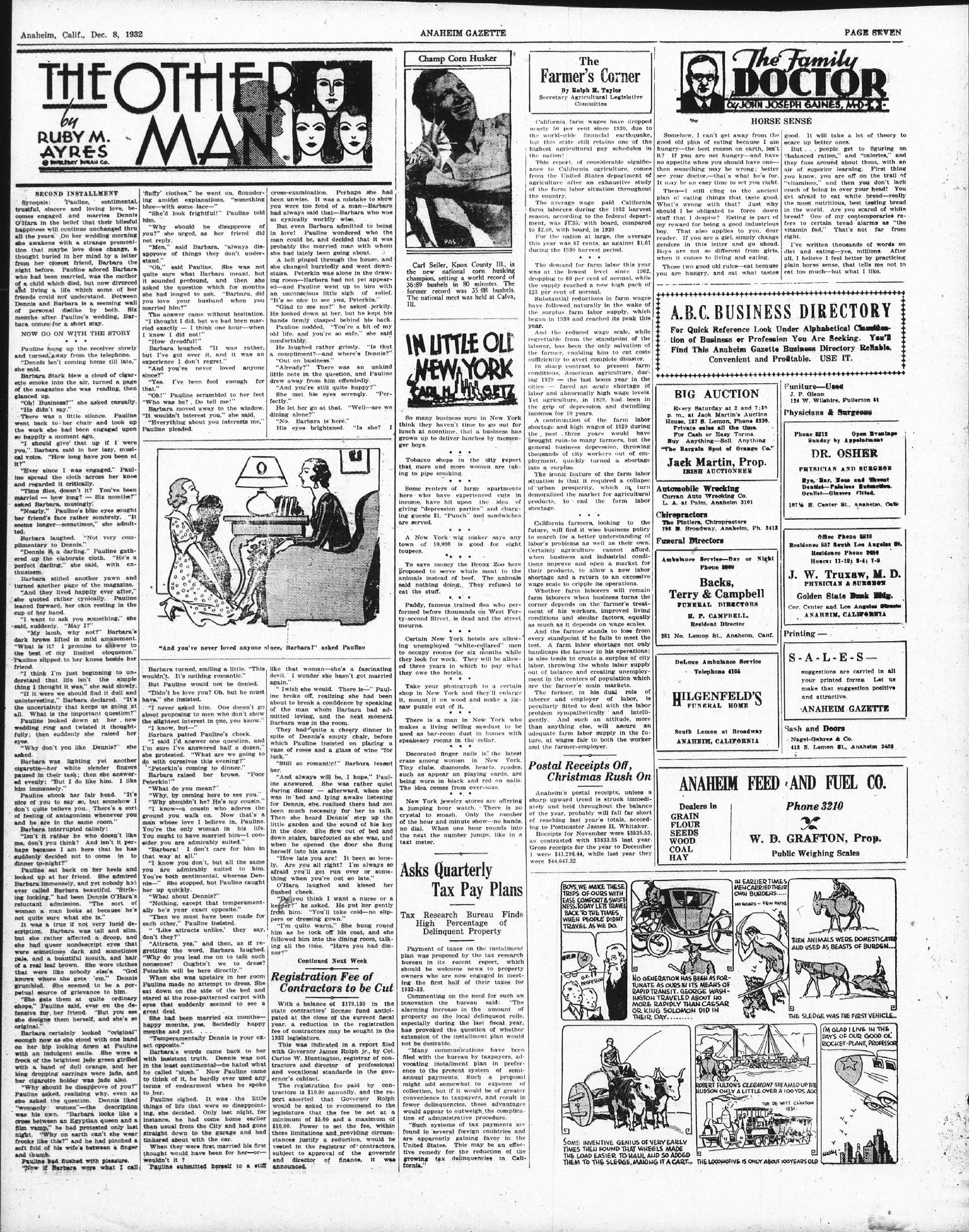
Searchable text
SECOND INSTALLMENT
Synopsis: Pauline, sentimental, trustful, sincere and loving love, becomes engaged and marries Dennis O'Hara in the belief that their blissful happiness will continue unchanged thru all the years. On her wedding morning she awakens with a strange premonition that maybe love does change, a thought buried in her mind by a letter from her closest friend, Barbara the night before. Pauline adored Barbara who had been married, was the mother of a child which died, but now divorced and living a life which some of her friends could not understand. Between Dennis and Barbara is a seeming wall of personal dislike by both. Six months after Pauline's wedding, Barbara comes for a short stay.
NOW GO ON WITH THE STORY
Pauline hung up the receiver slowly and turned away from the telephone. "Dennis isn't coming home till late," she said.
Barbara Stark blew a cloud of cigarette smoke into the air, turned a page of the magazine she was reading, then glanced up.
"Oh! Business?" she asked casually.
"He didn't say."
There was a little silence. Pauline went back to her chair and took up the work she had been engaged upon so happily a moment ago.
"I should give that up if I were you," Barbara said in her lazy, musical voice. "How long have you been at fluffy clothes," he went on, floundering amidst explanations, "something blue—with some lace—"
"She'd look frightful!" Pauline told him.
"Why should he disapprove of you?" she urged, as her friend did not reply.
"Men," said Barbara, "always disapprove of things they don't understand."
"Oh," said Pauline. She was not quite sure what Barbara meant, but it sounded profound, and then she asked the question which for months she had longed to ask. "Barbara, did you love your husband when you married him?"
The answer came without hesitation. "I thought I did, but we had been married exactly — I think one hour—when I knew I did not!"
"How dreadful!"
Barbara laughed. "It was rather, but I've got over it, and it was an experience I don't regret."
"And you've never loved anyone since?"
"Yes. I've been fool enough for that."
"Oh!" Pauline scrambled to her feet "Who was he? Do tell me!"
Barbara moved away to the window. "It wouldn't interest you," she said.
"Everything about you interests me," Pauline pleaded.
cross-examination. Perhaps been unwise. It was a mistake you were too fond of a man had always said that—Barbara so cynically worldly wise.
But even Barbara admitted in love! Pauline wondered man could be, and decided that probably the married man would she had lately been going about A bell pinged through the bus she changed hurriedly and wist stairs. Peterkin was alone in the room—Barbara had not yet—and Pauline went up to an unconscious little sigh "It's so nice to see you, Peter."
"Glad to see me?" he asked. He looked down at her, but his hands firmly clasped behind Pauline nodded. "You're a old life, and you're so safe," comfortably.
He laughed rather grimly. a compliment?—and where's "Out on business."
"Already?" There was an little note in the question, and drew away from him offended "And you're still quite happy She met his eyes serenely."
He let her go at that. "We dining alone?" "No. Barbara is here." His eyes brightened. "Is
"Dennis isn't coming home till late, she said.
Barbara Stark blew a cloud of cigarette smoke into the air, turned a page of the magazine she was reading, then glanced up.
"Oh! Business?" she asked casually.
"He didn't say."
There was a little silence. Pauline went back to her chair and took up the work she had been engaged upon so happily a moment ago.
"I should give that up if I were you," Barbara said in her lazy, musical voice. "How long have you been at it?"
"Ever since I was engaged." Pauline spread the cloth across her knee and regarded it critically.
"Time flies, doesn't it? You've been married — how long? — Six months?" asked Barbara, musingly.
"Nearly," Pauline's blue eyes sought her friend's face rather sombrely. "It seems longer—sometimes," she admitted.
Barbara laughed. "Not very complimentary to Dennis."
"Dennis is a darling." Pauline gathered up the elaborate cloth. "He's a perfect darling," she said, with enthusiasm.
Barbara stilled another yawn and turned another page of the magazine.
"And they lived happily ever after," she quoted rather cynically. Pauline leaned forward, her chin resting in the cup of her hand.
"I want to ask you something," she said, suddenly. "May I?"
"My lamb, why not?" Barbara's dark brows lifted in mild amazement. "What is it? I promise to answer to the best of my limited eloquence." Pauline slipped to her knees beside her friend.
"I think I'm just beginning to understand that life isn't the simple thing I thought it was," she said slowly.
"If it were we should find it dull and uninteresting," Barbara declared. "It's the uncertainty that keeps us going at all. What is the important question?"
Pauline looked down at her new wedding ring and twisted it thoughtfully; then suddenly she raised her eyes.
"Why don't you like Dennis?" she asked.
Barbara was lighting yet another cigarette—her white slender fingers paused in their task; then she answered evenly: "But I do like him. I like him immensely."
Pauline shook her fair head. "It's nice of you to say so, but somehow I don't quite believe you. There's a sort of feeling of antagonism whenever you and he are in the same room."
Barbara interrupted calmly:
"Isn't it rather he who doesn't like me, don't you think? And isn't it perhaps because I am here that he has suddenly decided not to come in to dinner to-night?"
Pauline sat back on her heels and experience I don't regret.
"And you've never loved anyone since?"
"Yes. I've been fool enough for that."
"Oh!" Pauline scrambled to her feet "Who was he?. Do tell me!"
Barbara moved away to the window. "It wouldn't interest you," she said.
"Everything about you interests me," Pauline pleaded.
"And you've never loved anyone since, Barbara!" asked Pauline
Barbara turned, smiling a little. "This wouldn't. It's nothing romantic."
But Pauline would not be denied.
"Didn't he love you? Oh, but he must have," she insisted.
"I never asked him. One doesn't go about proposing to men who don't show the slightest interest in one, you know."
"I know, but—"
Barbara patted Pauline's cheek.
"I said I'd answer one question, and I'm sure I've answered half a dozen," she protested. "What are we going to do with ourselves this evening?"
"Peterkin's coming to dinner."
Barbara raised her brows. "Poor Peterkin!"
"What do you mean?"
"Why, by coming here to see you."
"Why shouldn't he? He's my cousin."
"I know—a cousin who adores the ground you walk on. Now that's a man whose love I believe in, Pauline. You're the only woman in his life. You ought to have married him—I consider you are admirably suited."
"Barbara! I don't care for him in that way at all."
"I know you don't, but all the same you are admirably suited to him."
Like that woman—she's a fervent devil. I wonder she hasn't gone again."
"I wish she would. There is ine broke off, realizing she about to break a confidence by of the man whom Barbara mitted loving, and the next Barbara was in the room.
They had quite a cheery spite of Dennis's empty chair which Pauline insisted on vase of roses and a glass of luck."
"Still so romantic!" Barbora her.
"And always will be, I hope ine answered. She was raiding dinner — afterward, was in bed and lying awake for Dennis, she realized there been much necessity for her. Then she heard Dennis' stepping little garden and the sound in the door. She flew out of down stairs, barefooted as she when he opened the door herself into his arms."
"How late you are! It been very early. Are you all right? I'm
paused in their task; then she answered evenly: "But I do like him. I like him immensely."
Pauline shook her fair head. "It's nice of you to say so, but somehow I don't quite believe you. There's a sort of feeling of antagonism whenever you and he are in the same room."
Barbara interrupted calmly:
"Isn't it rather he who doesn't like me, don't you think? And isn't it perhaps because I am here that he has suddenly decided not to come in to dinner to-night?"
Pauline sat back on her heels and looked up at her friend. She admired Barbara immensely, and yet nobody had ever called Barbara beautiful. "Striking looking," had been Dennis O'Hara's reluctant admission. "The sort of woman a man looks at because he's not quite sure what she is."
It was a true if not very lucid description. Barbara was tall and slim, but she rather affected a droop, and she had queer nondescript eyes that were sometimes dark and sometimes pale, and a beautiful mouth, and hair of a real leaf brown. She wore clothes that were like nobody else's. "God knows where she gets 'em." Dennis grumbled. She seemed to be a perpetual source of grievance to him.
"She gets them at quite ordinary shops." Pauline said, ever on the defensive for her friend. "But you see she designs them herself, and she's so original."
Barbara certainly looked "original" enough now as she stood with one hand on her hip looking down at Pauline with an indulgent smile. She wore a frock of the brightest jade green girdled with a band of dull orange, and her long dropping earrings were jade, and her cigarette holder was jade also.
"Why should he disapprove of you?" Pauline asked, realizing why, even as she asked the question. Dennis liked "womanly women"—the description was his own. "Barbara looks like a cross between an Egyptian queen and a film vamp," he had protested only last night. "Why on earth can't she wear frocks like this?" and he had pinched a soft fold of his wife's between a finger and thumb.
Pauline had flushed with pleasure. "Now if Barbara wore what I call Barbara raised her brows. "Poor Peterkin!" "What do you mean?" "Why, by coming here to see you." "Why shouldn't he? He's my cousin." "I know—a cousin who adores the ground you walk on. Now that's a man whose love I believe in, Pauline. You're the only woman in his life. You ought to have married him—I consider you are admirably suited." "Barbara! I don't care for him in that way at all."
"I know you don't, but all the same you are admirably suited to him. You're both sentimental, whereas Dennis—" She stopped, but Pauline caught her up quickly.
"What about Dennis?" "Nothing, except that temperamentally he's your exact opposite." "Then we must have been made for each other," Pauline insisted.
"'Like attracts unlike,' they say, don't they?' "Attracts, yes," and then, as if regretting the word, Barbara laughed. "Why do you lead me on to talk such nonsense? Oughtn't we to dress? Peterkin will be here directly."
When she was upstairs in her room Pauline made no attempt to dress. She sat down on the side of the bed and stared at the rose-patterned carpet with eyes that suddenly seemed to see a great deal.
She had been married six months—happy months, yes, decidedly happy months and yet.
"Temperamentally Dennis is your exact opposite."
Barbara's words came back to her with insistent truth. Dennis was not in the least sentimental—he hated what he called "slosh." Now Pauline came to think of it, he hardly ever used any terms of endearment when he spoke to her.
Pauline sighed. It was the little things of life that were so disappointing, she decided. Only last night, for instance, he had come home earlier than usual from the City and had gone straight down to the garage and had tinkered about with the car.
When they were first married his first thought would have been for her—wouldn't it?
Paoline submitted herself to a stiff
"And always will be, I hope line answered. She was raided during dinner — afterward, was in bed and lying awake for Dennis, she realized there been much necessity for her. Then she heard Dennis' stealing little garden and the sound of in the door. She flew out of down stairs, barefooted as she when he opened the door herself into his arms.
"How late you are! It been fairly. Are you all right? I'm afraid you'll get run over thing when you're out so late."
O'Hara laughed and kissed cheek.
"Do you think I want a keeper?" he asked. He put himself from him: "You'll take cold pers or dressing gown."
"I'm quite warm." She hurried him as he took off his coat followed him into the dining room all the time. "Have you ner?"
ANAHEIM GAZETTE
Champ Corn Husker
Carl Seiler, Knox County Ill., is the new national corn husking champion, setting a world record of 36:89 bushels in 80 minutes. The former record was 35:08 bushels. The national meet was held at Calva, Ill.
IN LITTLE OLD NEW YORK GETZ
So many business men in New York think they haven't time to go out for lunch at noontime, that a business has grown up to deliver lunches by messenger boys.
The Farmer's Corner
By Ralph H. Taylor
Secretary Agricultural Legislative Committee
California farm wages have dropped nearly 50 per cent since 1930, due to the world-wide financial earthquake, but this state still retains one of the highest agricultural pay schedules in the nation!
This report, of considerable significance to California agriculture, comes from the United States department of agriculture after an exhaustive study of the farm labor situation throughout the country.
The average wage paid California farm laborers during the 1932 harvest season, according to the federal department, was $7.35; with board, compared to $2.60, with board, in 1930.
For the nation at large, the average this year was $7 cents, as against $1.61 during the 1930 harvest period.
The demand for farm labor this year was at the lowest level since 1902, dropping to 60 per cent of normal, while the supply reached a new high pack of 123 per cent of normal.
Substantial reductions in farm wages have followed naturally in the wake of the surplus farm labor supply, which began in 1930 and reached its peak this year.
And the reduced wage scale, while regrettable from the standpoint of the laborer, has been the only salvation of the farmer, enabling him to cut costs sufficiently to avert complete disaster.
In sharp contrast to present farm conditions, American agriculture, during 1929 — the last boom year in the cities — faced an acute shortage of labor and abnormally high wage levels. Yet agriculture, in 1929, had been in the grip of depression and dwindling incomes for 10 years.
A continuation of the farm labor shortage and high wages of 1929 during the past three years would have brought ruin to many farmers, but the general business depression, throwing thousands of city workers out of employment.
So many business men in New York think they haven't time to go out for lunch at noontime, that a business has grown up to deliver lunches by messenger boys.
Tobacco shops in the city report that more and more women are taking to pipe smoking.
Some renters of large apartments here who have experienced cuts in income, have hit upon the idea of giving "depression parties" and charging guests $1. "Punch" and sandwiches are served.
A New York wig maker says any town of 10,000 is good for eight toupees.
To save money the Bronx Zoo here proposed to serve whale meat to the animals instead of beef. The animals said nothing doing. They refused to eat the stuff.
Paddy, famous trained flea who performed before thousands on West Forty-second Street, is dead and the street mourns.
Certain New York hotels are allowing unemployed "white-collared" men to occupy rooms for six months while they look for work. They will be allowed three years in which to pay what they owe the hotels.
Take your photograph to a certain shop in New York and they'll enlarge it, mount it on wood and make a jigsaw puzzle out of it.
There is a man in New York who makes a living selling sawdust to be used as bar-room dust in homes with speakeasy rooms in the cellar.
Decorated finger nails is the latest craze among women in New York. Tiny clubs, diamonds, hearts, spades, such as appear on playing cards, are being worn in black and red on nails. The idea comes from over-seas.
New York jewelry stores are offering a jumping hour watch. There is no crystal to smash. Only the number of the hour and minute show—no hands, no dial. When one hour rounds into the next the number jumps, like in a taxi meter.
In sharp contrast to present farm conditions, American agriculture, during 1929—the last boom year in the cities—faced an acute shortage of labor and abnormally high wage levels. Yet agriculture, in 1929, had been in the grip of depression and dwindling incomes for 10 years.
A continuation of the farm labor shortage and high wages of 1929 during the past three years would have brought ruin-to-many farmers, but the general business depression, throwing thousands of city workers out of employment, quickly turned a shortage into a surplus.
The ironic feature of the farm labor situation is that it required a collapse of urban prosperity, which in turn demoralized the market for agricultural products, to end the farm labor shortage.
California farmers, looking to the future, will find it wise business policy to search for a better understanding of labor's problems as well as their own. Certainly agriculture cannot afford, when business and industrial conditions improve and open a market for their products, to allow a new labor shortage and a return to an excessive wage scale to cripple its operations.
Whether farm laborers will remain farm laborers when business turns the corner depends on the farmer's treatment of his workers, improved living conditions and similar factors, equally as much as it depends on wage scales.
And the farmer stands to lose from every standpoint if he fails to meet the test. A farm labor shortage not only handicaps the farmer in his operations; is also tends to create a surplus of city labor, throwing the whole labor supply out of balance and creating unemployment in the centers of population which are the farmer's main markets.
The farmer, in his dual role of laborer and employer of labor, is peculiarly fitted to deal with the labor problem sympathetically and intelligently. And such an attitude, more than anything else, will assure an adequate farm labor supply in the future, at wages fair to both the worker and the farmer-employer.
Postal Receipts Off,
Christmas Rush On
Anaheim's postal receipts, unless a sharp upward trend is struck immediately and held throughout the balance of the year, probably will fall far short of reaching last year's totals, according to Postmaster James H. Whitaker.
Receipts for November were $3525.53, as contrasted with $3833.35 last year. Gross receipts for the year to December 1 were $41,298.44, while last year they were $44,647.32.
New York jewelry stores are offering a jumping hour watch. There is no crystal to smash. Only the number of the hour and minute show—no hands, no dial. When one hour rounds into the next the number jumps, like in a taxi meter.
Asks Quarterly Tax Pay Plans
Tax Research Bureau Finds High Percentage of Delinquent Property
Payment of taxes on the installment plan was proposed by the tax research bureau in its recent report, which should be welcome news to property owners who are now engaged in meeting the first half of their taxes for 1932-33.
Commenting on the need for such an innovation the bureau said: "The alarming increase in the amount of property on the local delinquent rolls, especially during the last fiscal year, has provoked the question of whether extension of the installment plan would not be desirable.
"Many communications have been filed with the bureau by taxpayers, advocating installment plan in preference to the present system of semiannual payments. Such a proposal might add somewhat to expense of collection, but if it would be of greater convenience to taxpayers, and result in fewer delinquencies, these advantages would appear to outweigh the complication of administrative procedure.
"Such systems of tax payments are found in several foreign countries and are apparently gaining favor in the United States. This may be an effective remedy for the reduction of the growing tax delinquencies in California."
Somehow, I can’t get away from the good old plan of eating because I am hungry—the best reason on earth, isn’t it? If you are not hungry—and have no appetite when you should have one—then something may be wrong; better see your doctor,—that’s what he’s for. It may be an easy time to set you right.
Then—I still cling to the ancient plan of eating things that taste good. What’s wrong with that? Just why should I be obligated to force down stuff that I despise? Eating is part of my reward for being a good industrious boy. That also applies to you, dear reader. If you are a girl, simply change genders in this letter and go ahead. Boys are not so different from girls, when it comes to living and eating.
Those two good old rules—eat because you are hungry, and eat what tastes good. It will take a lot of theory to scare up better ones.
But... people get to figuring on "balanced ration," and "calories," and they fuss around about them, with an air of superior learning. First thing you know, you are off on the trail of "vitamines," and then you don’t lack much of being in over your head! You get afraid to eat white bread—really the most nutritious, best tasting bread in the world. Are you scared of white bread? One of my contemporaries refers to certain bread alarms as "the vitamin fad." That's not far from right.
I've written thousands of words on diet and eating—yes, millions. After all, I believe I feel better by practicing plain horse sense, that tells me not to eat too much—but what I like.
A.B.C. BUSINESS DIRECTORY
For Quick Reference Look Under Alphabetical Classification of Business or Profession You Are Seeking. You’ll Find This Anaheim Gazette Business Directory Reliable, Convenient and Profitable. USE IT.
BIG AUCTION
Every Saturday at 2 and 7:30 p.m., at Jack Martin's Auction House, 187 S. Lemon, Phone 3220. Private sales all the time. For Cash or Easy Terms. Buy Anything—Sell Anything.
"The Bargain Spot of Orange Co."
Furniture—Used
J. P. Glenn
124 W. Wilshire, Fullerton 51
Physicians & Surgeons
Phone 3212 Open Evenings
Sunday by Appointment
DR. OSHER
BIG AUCTION
Every Saturday at 2 and 7:30 p.m., at Jack Martin's Auction House, 187 S. Lemon, Phone 3220. Private sales all the time. For Cash or Easy Terms. Buy Anything—Sell Anything. "The Bargain Spot of Orange Co."
Jack Martin, Prop.
IRISH AUCTIONEER
Automobile Wrecking
Curran Auto Wrecking Co.
L. A. at Palm, Anaheim 3101
Chiropractors
The Pintlers, Chiropractors
108 N. Broadway, Anaheim, Ph. 3413
Funeral Directors
Ambulance Service—Day or Night
Phone 3209
Backs,
Terry & Campbell
FUNERAL DIRECTORS
H. P. CAMPBELL.
Resident Director
251 No. Lemon St., Anaheim, Calif.
DeLuxe Ambulance Service
Telephone 4105
HILGENFELD'S
FUNERAL HOME
South Lemon at Broadway
ANAHEIM, CALIFORNIA
Furniture—Used
J. P. Glenn
124 W. Wilshire, Pullerton 51
Physicians & Surgeons
Phone 3212 Open Evenings
Sunday by Appointment
DR. OSHER
PHYSICIAN AND SURGEON
Eye, Bar, Neck and Throat
Dentist—Palate Extraction.
Occlusion—Glasses Fitted.
107½ E. Center St., Anaheim, Calif.
Office Phone 3218
Residence 887 South Los Angeles St.
Residence Phone 2610
Hours: 11-12; 2-4; 7-8
J. W. Truxaw, M. D.
PHYSICIAN & SURGEON
Golden State Bank Midg.
Cor. Center and Los Angeles District
ANAHEIM, CALIFORNIA
Printing —
S-A-L-E-S —
suggestions are carried in all your printed forms. Let us make that suggestion positive and attractive.
ANAHEIM GAZETTE
Sash and Doors
Nagel-Gehres & Co.
418 S. Lemon St., Anaheim 2403
ANAHEIM FEED AND FUEL CO.
Dealers in
GRAIN
FLOUR
SEEDS
WOOD
COAL
HAY
Phone 3210
W. D. GRAFTON, Prop.
Public Weighing Scales
ANAHEIM FEED AND FUEL CO.
Dealers in
GRAIN
FLOUR
SEEDS
WOOD
COAL
HAY
Phone 3210
W. D. GRAFTON, Prop.
Public Weighing Scales
NO GENERATION HAS BEEN AS FOR-TUNATE AS OURS IN ITS MEANS OF RAPID TRANSIT. GEORGE WASHINGTON TRAVELED ABOUT NO MORE RAPIDLY THAN CAESAR OR KING SOLOMON DID IN THEIR DAY...
THEN ANIMALS WERE DOMESTICATED AND USED AS BEASTS OF BURDEN.
THE SLEDGE WAS THE FIRST VEHICLE.
ROBERT FULTON'S CLERMONT STEAMED UP THE HUDSON ONLY A LITTLE OVER A 100 YRS. AGO.
THE LOCOMOTIVE IS ONLY ABOUT 100 YEARS OLD.
I'M GLAD I LIVE IN THE DAYS OF OUR GOOD OL' ROCKET-PLANE, PROFESSOR