anaheim-gazette 1932-11-24
Scanned page
Searchable text
FINAL INSTALLMENT
John had refreshed himself in the dressing room. He looked in the mirror appraisingly. The deep tan of the open was being leeched out by the city of shadows. He smiled so like Gilbert Van Horn. He hardly cared. What did Josephine want?
After dinner they sat in the familiar library. "I leased the house, you know, after Gilbert's death. They changed almost everything, everything but this. I love the room." A fire was crackling in the open hearth, a wide deep chair, Van Horn's chair, was near the glow of flames. John, standing till Josephine curled on the lounge, sat down. Tashi brought a tray and Josephine lit a cigarette. Then she jumped up, John had a cigar and she lit a match, cupped the flame in her hands and held it for him, bending close to him. Tashi had gone.
Josephine drew her feet up on the lounge, and propped by cushions, blew smoke wreaths toward the fire. Tashi returned with a tray. Both took Curaco.
"John, you must tell me about your adventures, in South America."
For a long while they talked, aimlessly. The noises of the city were dim. Memories grew about the flames. John glanced up at the painting of Gilbert Van Horn, lifelike under the light.
Then they sat in silence. Suddenly Josephine reached in a fold of her men would forget him, long before his death.
Such dreams came to him. He tried to enthuse himself with visions of Josephine, with mind pictures of soft nights, velvet nights of love, and long delicious mornings, in bed. "Rats," he kept repeating. The inactivity of the afternoon was wearying.
He dared not look out on the streets. He had dinner in the club.
He arranged to give up his room. "I'll be back for my small trunk tonight. A motor trip: Hold my mail."
John grew nervous, as the time came for his departure. He kept wondering what he would do. Josephine certainly was a superb woman. The experiences of the night before kept gripping him. He hardly knew whether she had captured him. Several messages came for him at the last moment. "Tell everybody I'm gone, for a few days."
Mr. Wild of the old aqueduct fight came in as John was leaving. He had not seen Wild for years. It was with a genuine pang of regret that he hurried out, and walked up Fifth Avenue in the cool dusk. So he severed one of those loyalties men feel for each other, those strong bonds of friendship transcending even love; love which demands carry him away, to make him perhaps she had seen him taints were drawn to. Ever might be coming down, run toward him. The great caress him. It would carry them away from the city, forever.
The lines of the short lion in his hand. He had no need peruse them.
Dear John,
Can you join me at nine night, at my Wall Street arranging hundred million dollars? We must stop pluck begin to rebuild the tenement you full charge of constructor and Chief Engineer needs you.
Almon
The house door opened; Tashi, but John Green writing, turned hastily and toward Madison Avenue, a Avenue, toward Third. Had the block his attention waft to a lighted window of a resident and within was a paused his steps. A motif with child on her lap, both in smiling assurance into the father bending over
Josephine drew her feet up on the lounge, and propped by cushions, blew smoke wreaths toward the fire. Tashi returned with a tray. Both took Curaco.
"John, you must tell me about your adventures, in 'South America.'"
For a long while they talked, aimlessly. The noises of the city were dim. Memories grew about the flames. John glanced up at the painting of Gilbert Van Horn, lifelike under the light.
Then they sat in silence. Suddenly Josephine reached in a fold of her bodice and drew forth a package, handling it to John. "These belong to you, John—I've kept them, you see." The letters were in his hand, the outpourings of his fresh enthusiasm, the ones in which he told her of the aqueduct, and of his plans. She had kept them through it all. She stood before him, against the firelight, a presence outlined, her shimmering dress allame. An uneasy fear held his breath. "John," and then she was on her knees, her head buried in his lap, sobbing. Her soft breasts pressed against his knees, her hair glowed under him in the light. "I have always loved you—always!" She looked up, tears glistened like stars; oh, she was beautiful!
His cigar had fallen, he lifted her, her face so close to his. The years sped away. Over the mantelpiece, Gilbert Van Horn looked down on them while Josephine poured out her heart. John, caressing her, his hungry soul crying for love, held her close. Life, what is it? What are the things that count? Why are we here? In the subconscious half-light of the mind, under the patter of love, he seemed to know. Josephine, in feverish impulse, poured forth her strong affection. She had jilted him, and now, at last, she had relented!
"I am tired of this place. We will leave, John, leave it all. We will travel, we will live in sunshine. The world has much to offer us." Josephine and John sat on the wide lounge, he held her, her head on his shoulder, her hands clasping his. It had been a long, long road, but at last, at last—
"You know I've sold the house, they are going to build an annex to the hotel next door. Everything is changing, the people are changing. The best New Yorkers now live abroad most of the time. Oh, John, how glad I am that you found me."
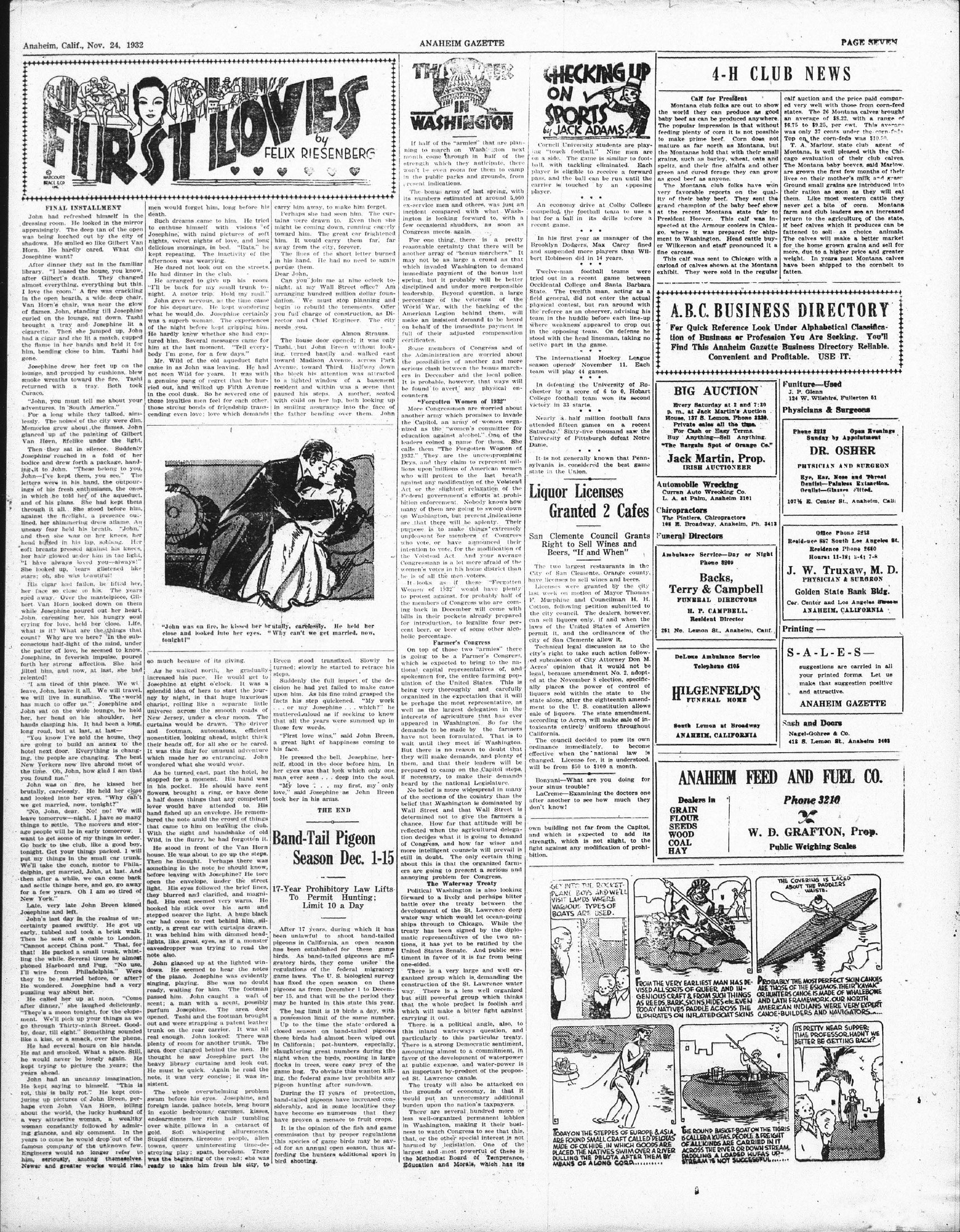
John was on fire, he kissed her brutally, carelessly. He held her close and looked into her eyes. "Why can't we get married, now, tonight?"
"No, John, dear. No! no! We will leave tomorrow—night. I have so many things to settle. The movers and storage people will be in early tomorrow. I want to get some of my things in order. Go back to the club, like a good boy, tonight. Get your things packed. I will put my things in the small car trunk. We'll take the coach, motor to Philadelphia."
so much because of its giving.
As he walked north, he gradually increased his pace. He would get to Josephine at eight o'clock. It was a splendid idea of hers to start the journey by night, in that huge luxurious chariot, rolling like a separate little universe across the smooth roads of New Jersey, under a clear moon. The curtains would be drawn. The driver and footman, automatons, efficient nonentities, looking ahead, might think their heads off, for all she or he cared. It was this flair for unusual adventure which made her so entrancing. John wondered what she would wear.
As he turned east, past the hotel, he stopped for a moment. His hand was in his pocket. He should have sent flowers, brought a ring, or have done a half dozen things that any competent lover would have attended to. His hand fished up an envelope. He remembered the note amid the crowd of things that came to him on leaving the club. With the sight and handshake of old Wild, in the flurry, he had forgotten it.
He stood in front of the Van Horn house. He was about to go up the steps. Then he thought. Perhaps there was something in the note he should know,
Breen stood transfixed. turned; slowly he started to steps.
Suddenly the full import cision he had yet failed to upon him. As his fine mind facts his step quickened... or my Josephine... muttered aloud as if seeking that all the years were sure those few words.
"First love wins," said J a great light of happiness his face.
He pressed the bell. Joseph self stood in the door before her eyes was that look whi man ever sees... deep in
"My love ... my first love," said Josephine as J took her in his arms.
THE END
John was on fire, he kissed her brutally, carelessly. He held her close and looked into her eyes. "Why can't we get married, now, tonight?"
"No, John, dear. No! no! We will leave tomorrow—night. I have so many things to settle. The movers and storage people will be in early tomorrow. I want to get some of my things in order. Go back to the club, like a good boy, tonight. Get your things packed. I will put my things in the small car trunk. We'll take the coach, motor to Philadelphia, get married, John, at last. And then after a while, we can come back and settle things here, and go, go away for a few years. Oh I am so tired of New York."
Late, very late John Breen kissed Josephine and left.
John's last day in the realms of uncertainty passed swiftly. He got up early, tubbed and took a brisk walk. Then he sent off a cable to London. "Cannot accept China post." That, for that! He packed a small trunk, whistling the while. Several times he almost phoned Harboard and Pug. "No use, I'll wire from Philadelphia." Were they to be married before, or after? He wondered. Josephine had a very puzzling way about her.
He called her up at noon. "Come after dinner," she laughed deliciously. "There's a moon tonight, for the elopement. We'll pick up your things as we go through Thirty-ninth Street. Goodby, dear, till eight." Something sounded like a kiss, or a smack, over the phone.
He had several hours on his hands. He sat and smoked. What a place. Still, he would never be lonely again. He kept trying to picture the years; the years ahead.
John had an uncanny imagination. He kept saying to himself. "This is rot, this is bally rot." He kept conjuring up pictures of John Breen, perhaps even John Van Horn, lolling about the world, the lucky husband of a very attractive woman, a wealthy woman constantly followed by admiring glances, and sly comment. In the years to come he would drop out of the famous company of the unknown few. Engineers would no longer refer to him, seriously, among themselves.
Newer and greater works would rise,
As he turned east past the hotel, he stopped for a moment. His hand was in his pocket. He should have sent flowers, brought a ring, or have done a half dozen things that any competent lover would have attended to. His hand fished up an envelope. He remembered the note amid the crowd of things that came to him on leaving the club. With the sight and handshake of old Wild, in the flurry, he had forgotten it.
He stood in front of the Van Horn house. He was about to go up the steps. Then he thought. Perhaps there was something in the note he should know, before leaving with Josephine? He tore open the envelope, under the street light. His eyes followed the brief lines, they blurred and clarified, and magnified. His coat seemed very warm. He hooked his stick over his arm and stepped nearer the light. A huge black car had come to rest behind him, silently, a great car with curtains drawn. It was behind him with dimmed headlights, like great eyes, as if a monster eavesdropper was trying to read the note also.
John glanced up at the lighted windows. He seemed to hear the notes of the piano. Josephine was evidently singing, playing. She was no doubt ready, waiting for him. The footman passed him. John caught a waft of scent; a man with a scent, possibly parfum Josephine. The area door opened. Tashi and the footman brought out and were strapping a patent leather trunk on the rear carrier. It was all real enough. John looked: There was plenty of room for another trunk. The area door clanged behind the men. He thought he saw Josephine part the heavy library curtains and look out. He must be quick. Again he read the note, it was very concise; it was insistent.
The whole overwhelming problem swam before his eyes. Josephine, and foreign lands, palace hotels, long hours in exotic bedrooms; caresses, kisses, endearments her rich hair tumbling over white pillows in a cataract of gold. Soft whispering allurements. Stupid dinners, tiresome people, alien towns, queer uninteresting time-destroying play; spats, boredom. There was the beginning of the road; she was ready to take him from his city, to
After 17 years, during which he been unlawful to shoot pigeons in California, an owl has been established for these birds. As band-tailed pigeons gratory birds, they come regulations of the federal game laws. The U.S. biologist has fixed the open season on pigeons as from December 15, and that will be the may be hunted in this state.
The bag limit is 10 birds per possession limit of the said bird.
Up to the time the state closed season on band-tailed pigeons have insiderably, and in some local areas have become so numerous that have proven a menace to them.
It is the opinion of the fish commission that by proper species of game birds fed for an annual open season fording the hunters addition bird shooting.
ANAHEIM GAZETTE
If half of the "armies" that are planning to march on Washington next month come through in half of the strength which they anticipate, there won't be even room for them to camp in the public parks and grounds, from present indications.
The bonus army of last spring, with its numbers estimated at around 5,000 ex-service men and others, was just an incident compared with what Washington is looking forward to, with a few occasional shudders, as soon as Congress meets again.
For one thing, there is a pretty reasonable certainty that there will be another array of "bonus marchers." It may not be as large a crowd as that which invaded Washington to demand immediate payment of the bonus last spring, but it probably will be better disciplined and under more responsible leadership. Beyond question, a large percentage of the veterans of the World War, with the backing of the American Legion behind them, will make an insistent demand to be heard on behalf of the immediate payment in full of their adjusted compensation certificates.
Some members of Congress and of the Administration are worried about the possibilities of another and more serious clash between the bonus marchers in December and the local police. It is probable, however, that ways will be found to avert any physical encounters.
"Forgotten Women of 1932"
More Congressmen are worried about another army which promises to invade the Capitol, an army of women organized as the "women's committee for education against alcohol." One of the leaders coined a name for them. She calls them "The Forgotten Women of 1932." They are the uncompromising
Cornell University students are playing "touch football." Nine men are on a side. The game is similar to football, with tackling eliminated. Each player is eligible to receive a forward pass, and the ball can be run until the carrier is touched by an opposing player.
An economy drive at Colby College compelled the football team to use a hat for a ball in its drills before a recent game.
In his first year as manager of the Brooklyn Dodgers, Max Carey fined and suspended more players than Wilbert Robinson did in 14 years.
Twelve-man football teams were tried out in a recent game between Occidental College and Santa Barbara State. The twelfth man, acting as a field general, did not enter the actual physical contest, but ran around with the referee as an observer, advising his team in the huddle before each line-up where weakness appeared to crop out in the opposing team. On defense he stood with the head linesman, taking no active part in the game.
The International Hockey League season opened November 11. Each team will play 44 games.
In defeating the University of Rochester by a score of 6 to 0, Hobart College football team won its second victory in 33 starts.
Nearly a half million football fans attended fifteen games on a recent Saturday. Sixty-five thousand saw the University of Pittsburgh defeat Notre Dame.
It is not generally known that Penn-
Liquor Licenses Granted 2 Cafes
San Clemente Council Grants Right to Sell Wines and Beers, "If and When"
The two largest restaurants in the City of San Clemente, Orange county, have licenses to sell wines and beers.
Licenses were granted by the city last week on motion of Mayor Thomas F. Murphine and Councilman H. H. Cotton, following petition submitted to the city council. The dealers, however, can sell liquors only, if and when the laws of the United States of America permit it, and the ordinances of the city of San Clemente allow it.
Technical legal discussion as to the city's right to take such action followed submission of City Attorney Don M. Acres' opinion that it would not be legal, because amendment No. 2, adopted at the November 8 election, specifically places the power of control of liquors sold within the state to the state alone, after the eighteenth amendment to the U.S. constitution allows sale of liquors. The state amendment, according to Acres, will make sale of intoxicants entirely uniform throughout California.
The council decided to pass its own ordinance immediately, to become effective when the national law is changed. License fee, it is understood, will be from $50 to $100 a month.
Bonyani—What are you doing for your sinus trouble?
LaCreme—Examining the doctors one after another to see how much they don't know!
own building not far from the Capitol, and which is expected to add its strength, which is not slight, to the fight against any modification of prohibition.
THE END
Hand-Tail Pigeon Season Dec. 1-15
A Year Prohibitory Law Lifts To Permit Hunting; Limit 10 a Day
After 17 years, during which it has been unlawful to shoot band-tailed pigeons in California, an open season has been established for these game birds. As band-tailed pigeons are military birds, they come under the regulations of the federal migratory game laws. The U.S. biological survey is fixed the open season on these pigeons as from December 1 to December 15, and that will be the period they may be hunted in this state this year.
The bag limit is 10 birds a day, with possession limit of the same number. Up to the time the state ordered a based season on band-tailed pigeons these birds had almost been wiped out California; pot-hunters, especially, daughtering great numbers during the night when the birds, roosting in large rocks in trees, were easy prey of the mite hog. To obviate this wanton killing, the federal game law prohibits any pigeon hunting after sundown.
During the 17 years of protection, band-tailed pigeons have increased considerably, and in some localities they have become so numerous that they have proven a menace to fruit crops.
It is the opinion of the fish and game commission that by proper regulations its species of game birds may be savaged for an annual open season, thus affording the hunters additional sport in and shooting.
No belief is more widespread in many of the sections of the country than the belief that Washington is dominated by Wall Street and that Wall Street is determined not to give the farmers a chance. How far that attitude will be reflected when the agricultural delegation decides what it is going to demand of Congress, and how far wiser and more intelligent counsels will prevail is still in doubt. The only certain thing about this is that the organized farmers are going to present a serious and annoying problem for Congress.
The Waterway Treaty
Political Washington is also looking forward to a lively and perhaps bitter battle over the treaty between the development of the St. Lawrence deep water way which would let ocean-going ships through to Chicago. While the treaty has been signed by the diplomatic representatives of the two nations, it has yet to be ratified by the United States Senate. And public sentiment in favor of it is far from being one-sided.
There is a very large and well organized group which is demanding the construction of the St. Lawrence water way. There is a less well organized but still powerful group which thinks that the whole project is foolish and which will make a bitter fight against carrying it out.
There is a political angle, also, to this inland waterways question, and particularly to this particular treaty. There is a strong Democratic sentiment, amounting almost to a commitment, in favor of the development of waterpower at public expense, and water-power is an important by-product of the proposed St. Lawrence canals.
The treaty will also be attacked on the grounds of economy, in that it would put an unnecessary additional burden upon the nation's taxpayers.
There are several hundred more or less well-organized permanent lobbies in Washington, making it their business to watch Congress to see that this, that, or the other special interest is not harmed by legislation. One of the largest and most powerful of these is the Methodist Board of Temperance, Education and Morals, which has its
4-H CLUB NEWS
Calf for President
Montana club folks are out to show the world they can produce as good baby beef as can be produced anywhere. The popular impression is that without feeding plenty of corn it is not possible to make prime beef. Corn does not mature as far north as Montana, but the Montanas hold that with their small grains, such as barley, wheat, oats and speltz, and their fine alfalfa and other green and cured forage they can grow as good beef as anyone.
The Montana club folks have won very favorable reports on the quality of their baby beef. They sent the grand champion of the baby beef show at the recent Montana state fair to President Hoover. This calf was inspected at the Armour coolers in Chicago, where it was prepared for shipment to Washington. Head cattle buyer Wilkerson and staff pronounced it a fine carcass.
This calf was sent to Chicago with a carload of calves shown at the Montana exhibit. They were sold in the regular calf auction and the price paid compared very well with those from corn-feed states. The 26 Montana calves brought an average of $8.22, with a range of $6.75 to $9.25, per cwt. This average was only 37 cents under the corn-fed Top on the corn-feds was $10.50.
T. A. Marlow, state club agent of Montana, is well pleased with the Chicago evaluation of their club calves. The Montana baby beeves, said Marlow, are grown the first few months of their lives on their mother's milk and grass. Ground small grains are introduced into their ration as soon as they will eat them. Like most western cattle they never get a bite of corn. Montana farm and club leaders see an increased return to the agriculture of the state, if beef calves which it produces can be fattened to sell as choice animals. The calves will make a better market for the home grown grains and sell for more, due to a higher price and greater weight. In years past Montana calves have been shipped to the cornbelt to fatten.
A.B.C. BUSINESS DIRECTORY
For Quick Reference Look Under Alphabetical Classification of Business or Profession You Are Seeking. You'll Find This Anaheim Gazette Business Directory Reliable. Convenient and Profitable. USE IT.
BIG AUCTION
Every Saturday at 2 and 7:30 p.m., at Jack Martin's Auction House, 137 S. Lemon, Phone 2290.
Private sales all the time.
For Cash or Easy Terms.
Buy Anything—Sell Anything.
"The Bargain Spot of Orange Co."
Furniture—Used
J. P. Glenn
124 W. Wilshire, Fullerton 51
Physicians & Surgeons
Phone 2212 Open Evenings
Sunday by Appointment
DR. OSHER
BIG AUCTION
Every Saturday at 2 and 7:30 p.m., at Jack Martin's Auction House, 137 S. Lemon, Phone 3229. Private sales all the time. For Cash or Easy Terms. Buy Anything—Sell Anything. "The Bargain Spot of Orange Co."
Jack Martin, Prop. IRISH AUCTIONEER
Automobile Wrecking
Curran Auto Wrecking Co.
L. A. at Palm, Anaheim 3101
Chiropractors
The Pintlers, Chiropractors
108 E. Broadway, Anaheim, Ph. 2413
Funeral Directors
Ambulance Service—Day or Night Phone 8209
Backs, Terry & Campbell FUNERAL DIRECTORS
H. P. CAMPBELL, Resident Director
261 No. Lemon St., Anaheim, Calif.
DeLuxe Ambulance Service
Telephone 4105
HILGENFELD'S FUNERAL HOME
South Lemon at Broadway ANAHEIM, CALIFORNIA
Furniture—Used
J. P. Glenn
124 W. Wilshire, Fullerton 51
Physicians & Surgeons
Phone 3212 Open Evenings Sunday by Appointment
DR. OSHER
PHYSICIAN AND SURGEON
Eye, Ear, Nose and Throat Dentist—Palms Extraction.
Oculist—Glasses Clitted.
107½ E. Center St., Anaheim, Calif.
Office Phone 3218
Residence 887 South Los Angeles St.
Residence Phone 2640
Hours: 11-12; 2-4; 7-8
J. W. Truxaw, M. D.
PHYSICIAN & SURGEON
Golden State Bank Bldg.
Cor. Center and Los Angeles Sweets ANAHEIM, CALIFORNIA
Printing —
S-A-L-E-S—
suggestions are carried in all your printed forms. Let us make that suggestion positive and attractive.
ANAHEIM GAZETTE
Sash and Doors
Nagel-Gohree & Co.
418 S. Lemon St., Anaheim 2403
ANAHEIM FEED AND FUEL CO.
Dealers in
GRAIN
FLOUR
SEEDS
WOOD
COAL
HAY
Phone 3210
W. D. GRAFTON, Prop.
Public Weighing Scales
ANAHEIM FEED AND FUEL CO.
Dealers in
GRAIN
FLOUR
SEEDS
WOOD
COAL
HAY
Phone 3210
W. D. GRAFTON, Prop.
Public Weighing Scales
FROM THE VERY EARLIEST MAN HAS DEVISED ALL SORTS OF QUEER AND INGENIOUS CRAFT & FROM SUCH THINGS AS REEDS, BARK, SKINS, HIDES etc. EVEN TODAY NATIVES PADDLE ACROSS THE EUPHRATES ON INFLATED GOAT SKINS
PROBABLY THE MOST PERFECT SKIN CANOES ARE THOSE OF THE ESKIMOS. THEIR "KAYAK" OR HUNTERS CANOE IS MADE OF WHALEBONE AND LATH FRAMEWORK. OUR NORTH AMERICAN INDIANS WERE VERY EXPERT CANOE-BUILDERS AND NAVIGATORS.
THE ROUND BASKET-BOAT ON THE TIGRIS IS CALLED KUFAS. PEOPLE & FREIGHT OF ALL KINDS ARE CARRIED IN IT ACROSS THE RIVER OR DOWN STREAM. PADDLING A LOADED KUFAS UPSTREAM IS NOT SUCCESSFUL.