anaheim-gazette 1932-11-24
Scanned page
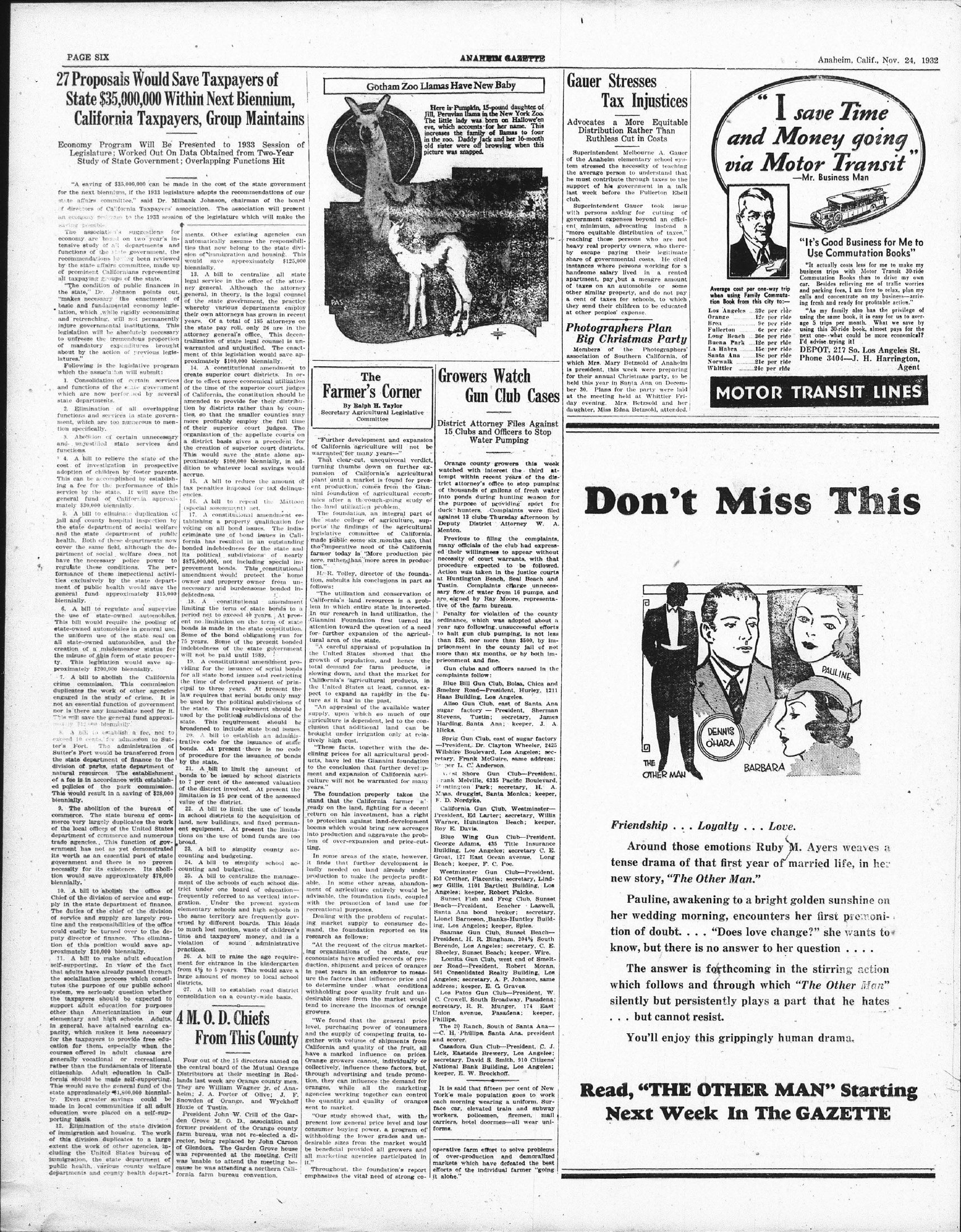
Searchable text
27 Proposals Would Save Taxpayers of State $35,000,000 Within Next Biennium, California Taxpayers, Group Maintains
Economy Program Will Be Presented to 1933 Session of Legislature; Worked Out On Data Obtained from Two-Year Study of State Government; Overlapping Functions Hit
"A saving of $35,000,000 can be made in the cost of the state government for the next biennium, if the 1933 legislature adopts the recommendations of our state affairs committee," said Dr. Milbank Johnson, chairman of the board of directors of California Taxpayers' association. The association will present an economy program to the 1933 session of the legislature which will make the saving possible.
The association's suggestions for economy are based on two year's intensive study of all departments and functions of the state government, the recommendations having been reviewed by the state affairs committee, made up of prominent Californians representing all taxpaying groups of the state.
"The condition of public finances in the state," Dr. Johnson points out, "makes necessary the enactment of basic and fundamental economy legislation, which while rigidly economizing and retrenching, will not permanently injure governmental institutions. This legislation will be absolutely necessary to unfreeze the tremendous proportion of mandatory expenditures brought about by the action of previous legislatures."
Following is the legislative program which the association will submit:
1. Consolidation of certain services and functions of the state government which are now performed by several state departments.
2. Elimination of all overlapping functions and services in state government, which are too numerous to mention specifically.
3. Abolition of certain unnecessary and unjustified state services and functions.
4. A bill to relieve the state of the ments. Other existing agencies can automatically assume the responsibilities that now belong to the state division of immigration and housing. This would save approximately $125,000 biennially.
13. A bill to centralize all state legal service in the office of the attorney general. Although the attorney general, in theory, is the legal counsel of the state government, the practice whereby various departments employ their own attorneys has grown in recent years. Of a total of 185 attorneys on the state pay roll, only 26 are in the attorney general's office. This decentralization of state legal counsel is unwarranted and unjustified. The enactment of this legislation would save approximately $100,000 biennially.
14. A constitutional amendment to create superior court districts. In order to effect more economical utilization of the time of the superior court judges of California, the constitution should be amended to provide for their distribution by districts rather than by counties, so that the smaller counties may more profitably employ the full time of their superior court judges. The organization of the appellate courts on a district basis gives a precedent for the creation of superior court districts. This would save the state alone ap-
Following is the legislative program which the association will submit:
1. Consolidation of certain services and functions of the state government which are now performed by several state departments.
2. Elimination of all overlapping functions and services in state government, which are too numerous to mention specifically.
3. Abolition of certain unnecessary and unjustified state services and functions.
4. A bill to relieve the state of the cost of investigation in prospective adoption of children by foster parents. This can be accomplished by establishing a fee for the performance of this service by the state. It will save the general fund of California approximately $30,000 biennially.
5. A bill to eliminate duplication of jail and county hospital inspection by the state department of social welfare and the state department of public health. Both of these departments now cover the same field, although the department of social welfare does not have the necessary police power to regulate these conditions. The performance of these inspections exclusively by the state department of public health would save the general fund approximately $15,000 biennially.
6. A bill to regulate and supervise the use of state-owned automobiles. This bill would require the pooling of state-owned automobiles in general use, the uniform use of the state seal on all state-owned automobiles, and the creation of a misdemeanor status for the misuse of this form of state property. This legislation would save approximately $200,000 biennially.
7. A bill to abolish the California crime commission. This commission duplicates the work of other agencies engaged in the study of crime. It is not an essential function of government nor is there any immediate need for it. This will save the general fund approximately $12,000 biennially.
8. A bill to establish a fee, not to exceed 10 cents, for admission to Sutter's Fort. The administration of Sutter's Fort would be transferred from the state department of finance to the division of parks, state department of natural resources. The establishment of a fee is in accordance with established policies of the park commission. This would result in a saving of $28,000 biennially.
9. The abolition of the bureau of commerce. The state bureau of commerce very largely duplicates the work of the local offices of the United States department of commerce and numerous trade agencies. This function of government has not as yet demonstrated its worth as an essential part of state government and there is no proven necessity for its existence. Its aboliment is approximately $100,000 biennially.
14. A constitutional amendment to create superior court districts. In order to effect more economical utilization of the time of the superior court judges of California, the constitution should be amended to provide for their distribution by districts rather than by counties, so that smaller counties may more profitably employ the full time of their superior court judges. The organization of the appellate courts on a district basis gives a precedent for the creation of superior court districts. This would save the state alone approximately $100,000 biennially, in addition to whatever local savings would accrue.
15. A bill to reduce the amount of tax penalties imposed for tax delinquencies.
16. A bill to repeal the Mattoon (special assessment) act.
17. A constitutional amendment establishing a property qualification for voting on all bond issues. The indiscriminate use of bond issues in California has resulted in an outstanding bonded indebtedness for the state and its political subdivisions of nearly $875,000,000, not including special improvement bonds. This constitutional amendment would protect the home owner and property owner from unnecessary and burdensome bonded indebtedness.
18. A constitutional amendment limiting the term of state bonds to a period not to exceed 40 years. At present no limitation on the term of state bonds is made in the state constitution. Some of the bond obligations run for 75 years. Some of the present bonded indebtedness of the state government will not be paid until 1989.
19. A constitutional amendment providing for the issuance of serial bonds for all state bond issues and restricting the time of deferred payment of principal to three years. At present the law requires that serial bonds only may be used by the political subdivisions of the state. This requirement should be used by the political subdivisions of the state. This requirement should be broadened to include state bond issues.
20. A bill to establish an administrative code for the issuance of states bonds. At present there is no code of procedure for the issuance of bonds by the state.
21. A bill to limit the amount of bonds to be issued by school districts to 7 per cent of the assessed valuation of the district involved. At present the limitations on the use of bond funds are too broad.
22. A bill to limit the use of bonds in school districts to the acquisition of land, new buildings, and fixed permanent equipment. At present the limitations on the use of bond funds are too broad.
23. A bill to simplify county accounting and budgeting.
24. A bill to simplify school accounting and budgeting.
"Further development of California laws warranted for many that clear-cut turning thumbs pansion of C plant until a major production, mini foundation mills after a t he land utilization. The foundation the state college ports the finding legislative com made public some the imperative farmer today is acre, rather than tion."
H.R.Tolley, tion, submits his follows:
"The utilization California's land lem in which em In our research Giannini Found attention towards for further exp utural area of th e
"A careful appl iation the United State growth of popu tal total demand fo slowing down, ad California's agr gect to expand ture as it has in"
"An appraisal supply, upon w agriculture is dep lusion that add brought under i tively high cost."
"These facts, clining prices for ducts, have led th e to the conclusion ment and expansion culture will not l l years."
The foundation stand that the O ready on the land return on his im trotection aga booms which wo into production al oem of over-expe ting.
In some areas it finds that fu badly needed or
9. The abolition of the bureau of commerce. The state bureau of commerce very largely duplicates the work of the local offices of the United States department of commerce and numerous trade agencies. This function of government has not yet demonstrated its worth as an essential part of state government and there is no proven necessity for its existence. Its abolition would save approximately $78,000 biennially.
10. A bill to abolish the office of Chief of the division of service and supply in the state department of finance. The duties of the chief of the division of service and supply are largely routine and the responsibilities of the office could easily be turned over to the deputy director of finance. The elimination of this position would save approximately $10,000 biennially.
11. A bill to make adult education self-supporting. In view of the fact that adults have already passed through the socialization process which constitutes the purpose of our public school system, we seriously question whether the taxpayers should be expected to support adult education for purposes other than Americanization in our elementary and high schools. Adults in general, have attained earning capacity, which makes it less necessary for the taxpayers to provide free education for them, especially when the courses offered in adult classes are generally vocational or recreational, rather than the fundamentals of literate citizenship. Adult education in California should be made self-supporting. This would save the general fund of the state approximately $1,800,000 biennially. Even greater savings could be made in local communities if all adult education were placed on a self-supporting basis.
12. Elimination of the state division of immigration and housing. The work of this division duplicates to a large extent the work of other agencies, including the United States bureau of immigration, the state department of public health, various county welfare departments and county health departments and bonds to be issued by school districts to 7 per cent of the assessed valuation of the district involved. At present the limitation is 15 per cent of the assessed value of the district.
22. A bill to limit the use of bonds in school districts to the acquisition of land, new buildings, and fixed permanent equipment. At present the limitations on the use of bond funds are too broad.
23. A bill to simplify county accounting and budgeting.
24. A bill to simplify school accounting and budgeting.
25. A bill to centralize the management of the schools of each school district under one board of education—frequently referred to as vertical integration. Under the present system elementary schools and high schools in the same territory are frequently governed by different boards. This leads to much lost motion, waste of children's time and taxpayers' money, and is a violation of sound administrative practices.
26. A bill to raise the age requirement for entrance in the kindergarten from 4½ to 5 years. This would save a large amount of money to local school districts.
27. A bill to establish road district consolidation on a county-wide basis.
4 M. O. D. Chiefs From This County
Four out of the 15 directors named on the central board of the Mutual Orange Distributors at their meeting in Redlands last week are Orange county men. They are William Wagner Jr. of Anaheim; J. A. Porter of Olive; J. F. Snowden of Orange, and Wyckhoff Hoxie of Tustin.
President John W. Crill of the Garden Grove M. O. D., association and former president of the Orange county farm bureau, was not re-elected a director, being replaced by John Carson of Glendora. The Garden Grove house was represented at the meeting. Crill was unable to attend the meeting because he was attending a northern California farm bureau convention.
The foundation stand that the O ready on the land return on his income to protection against booms which would into production a lemma of over-exploiting.
In some areas it finds that badly needed or production mayable. In some it mentions agriculture advisable, the fourth with the promoter recreational purpose.
Dealing with the ing market support mand, the found research as follow:
"At the request ing organizations economists have se duction, shipment in past years in nature the factors tha to determine un withholding poor desirable sizes frend tend to increase growers."
"We found that level, purchasing and the supply o gether with volu California and qu have a marked Orange growers o collectively, influence through advertis ion, they can inf oranges, while agencies working tha quantity and sent to market."
"Our study she present low gener al consumer buying withholding tha desirable sizes fro be beneficial pro all marketing agen it."
Throughout, th emphasizes the vi
Gotham Zoo Llamas Have New Baby
Here is Pumpkin, 15-pound daughter of Jill, Peruvian llama in the New York Zoo. The little lady was born on Hallowe'en eve, which accounts for her name. This increases the family of llamas to four in the zoo. Daddy Jack and her 16-month old sister were off browsing when this picture was snapped.
The Farmer's Corner
By Ralph H. Taylor
Secretary Agricultural Legislative Committee
Growers Watch Gun Club Cases
District Attorney Files Against 15 Clubs and Officers to Stop Water Pumping
Gauer Stresses Tax Injustice
Advocates a More Equitable Distribution Rather Than Ruthless Cut in Costs
Superintendent Melbourne A. Gaucer of the Anaheim elementary school stressed the necessity of teaching the average person to understand that he must contribute through taxes to support of his government in a last week before the Fullerton Elk club.
Superintendent Gauer took issue with persons asking for cutting government expenses beyond an efficient minimum, advocating instead for "more equitable distribution of taxes reaching those persons who are heavy real property owners, who they by escape paying their legitimate share of governmental costs. He cited instances where persons working for handsome salary lived in a rent apartment, pay but a meagre amount of taxes on an automobile or other similar property, and do not pay a cent of taxes for schools, to which they send their children to be educated at other peoples' expense.
Photographers Plan Big Christmas Party
Members of the Photographers association of Southern California, which Mrs. Mary Betzsold of Anaheim is president, this week were preparing for their annual Christmas party, to hold this year in Santa Ana on December 30. Plans for the party were laid at the meeting held at Whittier Friday evening. Mrs. Betzsold and Miss Edna Betzsold, attend
The Farmer’s Corner
By Ralph H. Taylor
Secretary Agricultural Legislative Committee
“Further development and expansion of California agriculture will not be warranted for many years—”
That clear-cut, unequivocal verdict, turning thumbs down on further expansion of California’s agricultural plant until a market is found for present production, comes from the Giannini foundation of agricultural economics after a thorough-going study of the land utilization problem.
The foundation, an integral part of the state college of agriculture, supports the findings of the agricultural legislative committee of California, made public some six months ago, that the imperative need of the California farmer today is “More production per acre, rather than more acres in production.”
H. R. Tolley, director of the foundation, submits his conclusions in part as follows:
“The utilization and conservation of California’s land resources is a problem in which entire state is interested. In our research in land utilization, the Giannini Foundation first turned its attention toward the question of a need for further expansion of the agricultural area of the state.
"A careful appraisal of population in the United States showed that the growth of population, and hence the total demand for farm products, is slowing down, and that the market for California’s agricultural products, in the United States at least, cannot expect to expand as rapidly in the future as it has in the past.
"An appraisal of the available water supply, upon which so much of our agriculture is dependent, led to the conclusion that additional land can be brought under irrigation only at relatively high cost.
"These facts, together with the declining prices for all agricultural products, have led the Giannini foundation to the conclusion that further development and expansion of California agriculture will not be warranted for many years."
The foundation properly takes the stand that the California farmer is ready on the land, fighting for a decent return on his investment, has a right to protection against land-development booms which would bring new acreages into production and aggravate the problem of over-expansion and price-cutting.
In some areas of the state, however, it finds that further development is badly needed on land already under orange county growers this week watched with interest the third attempt within recent years of the district attorney's office to stop pumping of thousands of gallons of fresh water into ponds during hunting season for the purpose of providing sport for duck hunters. Complaints were filed against 13 clubs Thursday afternoon by Deputy District Attorney W. A. Menton.
Previous to filing the complaints, many officials of the club had expressed their willingness to appear without necessity of court warrants, with that procedure expected to be followed. Action was taken in the justice courts at Huntington Beach, Seal Beach and Tustin. Complaints charge unnecessary flow of water from 16 pumps, and are signed by Ray Moore, representative of the farm bureau.
Penalty for violation of the county ordinance, which was adopted about a year ago following unsuccessful efforts to halt gun club pumping, is not less than $25, nor more than $500, by imprisonment in the county jail of not more than six months, or by both imprisonment and fine.
Gun clubs and officers named in the complaints follow:
Blue Bill Gun Club, Bolsa, Chica and Smelzer Road—President, Hurley, 1211 Haas Building, Los Angeles.
Alliso Gun Club, east of Santa Ana sugar factory — President, Sherman Stevens, Tustin; secretary, James Harding, Santa Ana; keeper, J. A. Hicks.
Sprig Gun Club, east of sugar factory — President, Dr. Clayton Wheeler, 2425 Wilshire Boulevard, Los Angeles; secretary, Frank McGuire, same address; supervisor L. C. Anderson.
West Shore Gun Club—President, Frank Melville, 6335 Pacific Boulevard, Huntington Park; secretary, H. A. Maas, druggist, Santa Monica; keeper, F. D. Nordyke.
California Gun Club, Westminster—President, Ed Larter; secretary, Willis Warner, Huntington Beach; keeper, Roy E. Davis.
Blue Wing Gun Club—President, George Adams, 435 Title Insurance Building, Los Angeles; secretary C. E. Groat, 127 East Ocean avenue, Long Beach; keeper, F. C. Poe.
The foundation properly takes the stand that the California farmer already on the land, fighting for a decent return on his investment, has a right to protection against land-development booms which would bring new acreages into production and aggravate the problem of over-expansion and price-cutting.
In some areas of the state, however, it finds that further development is badly needed on land already under production to make the projects profitable. In some other areas, abandonment of agriculture entirely would be advisable, the foundation finds, coupled with the promotion of land use for recreational purposes.
Dealing with the problem of regulating market supply to consumer demand, the foundation reported on its research as follows:
"At the request of the citrus marketing organizations of the state, our economists have studied records of production, shipment and prices of oranges in past years in an endeavor to measure the factors that influence price and to determine under what conditions withholding poor quality fruit and undesirable sizes from the market would tend to increase the incomes of orange growers.
"We found that the general price level, purchasing power of consumers and the supply of competing fruits, together with volume of shipments from California and quality of the fruit, all have a marked influence on prices. Orange growers cannot, individually or collectively, influence these factors, but, through advertising and trade promotion, they can influence the demand for oranges, while all the marketing agencies working together can control the quantity and quality of oranges sent to market.
Our study showed that, with the present low general price level and low consumer buying power, a program of withholding the lower grades and undesirable sizes from the market would be beneficial provided all growers and all marketing agencies participated in it."
Throughout, the foundation's report emphasizes the vital need of strong co-operative farm effort to solve problems of over-production and demoralized markets which have defeated the best efforts of the individual farmer "going it alone."
Stresses Tax Injustices
Is a More Equitable Solution Rather Than Less Cut in Costs
Indent Melbourne A. Gauer
Indent elementary school system and the necessity of teaching the person to understand that attribute through taxes to the his government in a talk before the Fullerton Ebell
Indent Gauer took issue asking for cutting of expenses beyond an efficience, advocating instead a stable distribution of taxes," those persons who are not property owners, who there paying their legitimate governmental costs. He cited here persons working for a salary lived in a rented pay but a meagre amount on an automobile or some other property, and do not pay taxes for schools, to which their children to be educated peoples' expense.
Graphers Plan Christmas Party
of the Photographers' of Southern California, of Mary Betzsold of Anaheim, this week were preparing annual Christmas party, to be held in Santa Ana on December for the party were laid at Whittier Friug. Mrs. Betzsold and her Miss Edna Betzsold, attended.
"I save Time and Money going via Motor Transit"
—Mr. Business Man
"It's Good Business for Me to Use Commutation Books"
"It actually costs less for me to make my business trips with Motor Transit 30-ride Commutation Books than to drive my own car. Besides relieving me of traffic worries and parking fees, I am free to relax, plan my calls and concentrate on my business—arriving fresh and ready for profitable action."
"As my family also has the privilege of using the same book, it is easy for us to average 5 trips per month. What we save by using this 30-ride book, almost pays for the next one--what could be more economical? I'd advise trying it!
DEPOT, 217 So. Los Angeles St.
Phone 3404—J. H. Harrington,
Agent
MOTOR TRANSIT LINES
MOTOR TRANSIT LINES
Don't Miss This
Friendship . . . Loyalty . . . Love.
Around those emotions Ruby M. Ayers weaves a tense drama of that first year of married life, in her
Friendship . . . Loyalty . . . Love.
Around those emotions Ruby M. Ayers weaves a tense drama of that first year of married life, in her new story, "The Other Man."
Pauline, awakening to a bright golden sunshine on her wedding morning, encounters her first premonition of doubt. . . "Does love change?" she wants to know, but there is no answer to her question . . .
The answer is forthcoming in the stirring action which follows and through which "The Other Man" silently but persistently plays a part that he hates . . . but cannot resist.
You'll enjoy this grippingly human drama.