anaheim-gazette 1932-09-29
Scanned page
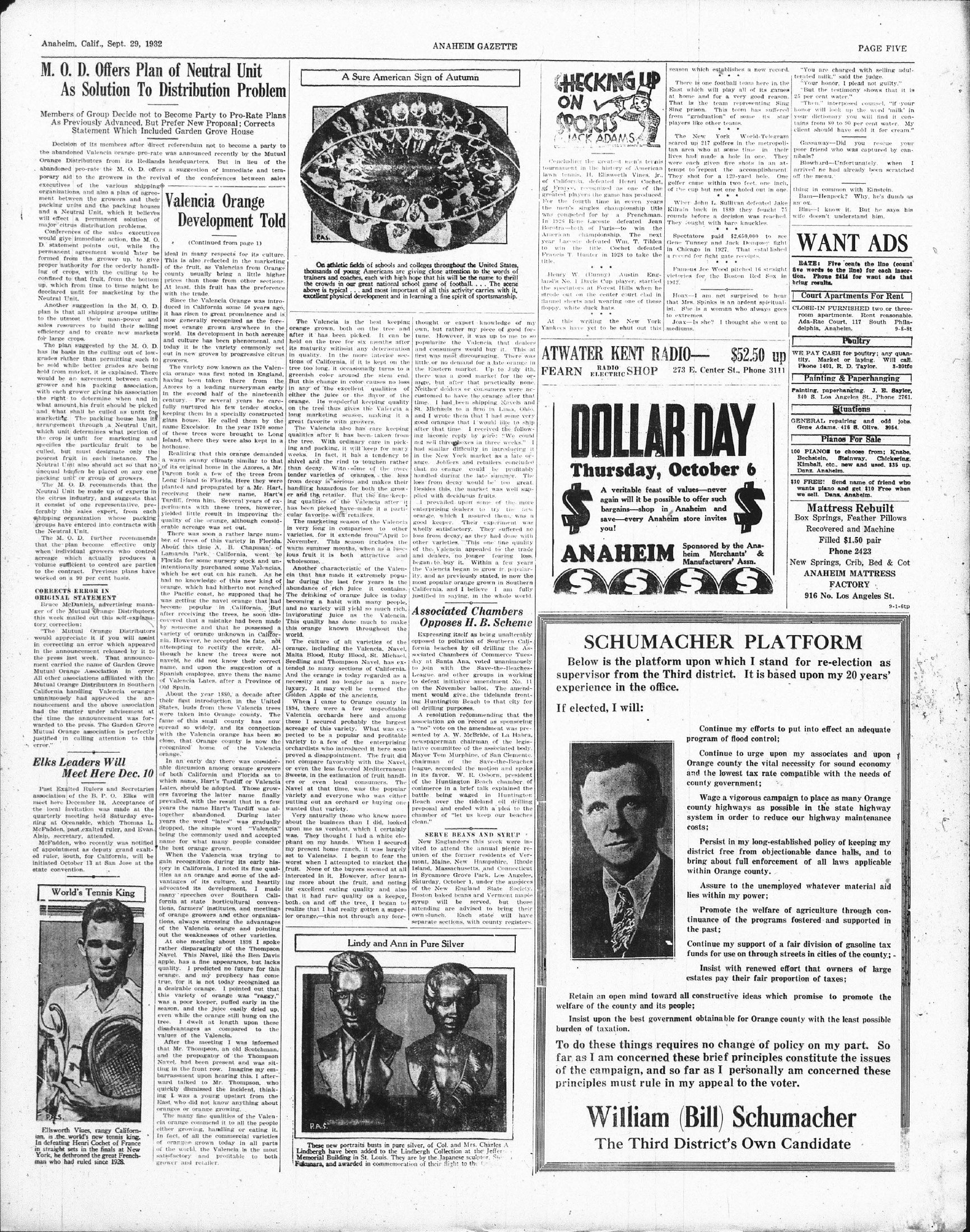
Searchable text
M. O. D. Offers Plan of Neutral Unit As Solution To Distribution Problem
Members of Group Decide not to Become Party to Pro-Rate Plans As Previously Advanced, But Prefer New Proposal; Corrects Statement Which Included Garden Grove House
Decision of its members after direct referendum not to become a party to the abandoned Valencia orange pro-rate was announced recently by the Mutual Orange Distributors from its Redlands headquarters. But in lieu of the abandoned pro-rate the M. O. D. offers a suggestion of immediate and temporary aid to the growers in the revival of the conferences between sales executives of the various shipping organizations, and also a plan of agreement between the growers and their packing units and the packing houses and a Neutral Unit, which it believes will effect a permanent solution of major citrus distribution problems.
Conferences of the sales executives would give immediate action, the M. O. D. statement points out, while the permanent agreement would later be formed from the grower up, to give proper authority for the orderly handling of crops, with the culling to be confined to that fruit, from the bottom up, which from time to time might be declared unfit for marketing by the Neutral Unit.
Another suggestion in the M. O. D. plan is that all shipping groups utilize to the utmost their man-power and sales resources to build their selling efficiency and to create new markets for large crops.
The plan suggested by the M. O. D. has its basis in the culling out of low-grades rather than permitting such to be sold while better grades are being held from market, it is explained. There would be an agreement between each grower and his packing association, with each grower giving his association the right to determine when and in what amount his fruit should be picked and what shall be culled as unfit for marketing. The packing house has its arrangement through a Neutral Unit, which unit determines what portion of the crop is unfit for marketing and specifies the particular fruit to be culled, but must designate only the poorest fruit in each instance.
Valencia Orange Development Told
(Continued from page 1)
Ideal in many respects for its culture. This is also reflected in the marketing of the fruit, as Valencias from Orange county usually bring a little higher prices than those from other sections. At least, this fruit has the preference with the trade.
Since the Valencia Orange was introduced in California some 50 years ago, it has risen to great prominence and is now generally recognized as the foremost orange grown anywhere in the world. Its development in both acreage and culture has been phenomenal, and today it is the variety commonly set out in new groves by progressive citrus growers.
The variety now known as the Valencia orange was first noted in England, having been taken there from the Azores by a leading nurseryman early in the second half of the nineteenth century. For several years he carefully nurtured his few tender stocks, keeping them in a specially constructed glass house. He called them by the name Excelsior. In the year 1870 some of these trees were brought to Long Island, where they were also kept in a hothouse.
Realizing that this orange demanded a warm climate, it became one of the most popular fruits in California. The Valencia is the orange grown, both on or after it has been picked off on the tree for its maturity without any quality. In the months of California, if it tree too long, it occasion greenish color around it. But this change in color in any of the excellent either the juice or the orange. Its wonderful taste on the tree thus gives long marketing season great favorite with growers.
The Valencia also has qualities after it has been cut the tree. With ordinary ing and packing, it will weeks. In fact, it has
be sold while better grades are being held from market, it is explained. There would be an agreement between each grower and his packing association, with each grower giving his association the right to determine when and in what amount his fruit should be picked and what shall be culled as unfit for marketing. The packing house has its arrangement through a Neutral Unit, which unit determines what portion of the crop is unfit for marketing and specifies the particular fruit to be culled, but must designate only the poorest fruit in each instance. The Neutral Unit also should act so that no unequal burden be placed on any one packing unit or group of growers.
The M. O. D. recommends that the Neutral Unit be made up of experts in the citrus industry, and suggests that it consist of one representative, preferably the sales expert, from each shipping organization whose packing groups have entered into contracts with the Neutral Unit.
The M. O. D. further recommends that the plan become effective only when individual growers who control acreage which actually produces a volume sufficient to control are parties to the contract. Previous plans have worked on a 90 per cent basis.
CORRECTS ERROR IN ORIGINAL STATEMENT
Bruce McDaniels, advertising manager of the Mutual Orange Distributors, this week mailed out this self-explanatory correction:
"The Mutual Orange Distributors would appreciate it if you will assist in correcting an error which appeared in the announcement released by it to the press last week. That announcement carried the name of Garden Grove Mutual Orange Association in error. All other associations affiliated with the Mutual Orange Distributors in Southern California handling Valencia oranges unanimously had approved the announcement and the above association had the matter under advisement at the time the announcement was forwarded to the press. The Garden Grove Mutual Orange association is perfectly justified in calling attention to this error."
Elks Leaders Will Meet Here Dec. 10
Past Exalted Rulers and Secretaries association of the B. P. O. Elks will meet here December 10. Acceptance of the local invitation was made at the quarterly meeting held Saturday evening at Oceanside, which Thomas L. McFadden, past exalted ruler, and Evan Alsip, secretary, attended.
McFadden, who recently was notified of appointment as deputy grand exalted ruler, south, for California, will be initiated October 13 at San Jose at the state convention.
The variety now known as the Valencia orange was first noted in England, having been taken there from the Azores by a leading nurseryman early in the second half of the nineteenth century. For several years he carefully nurtured his few tender stocks, keeping them in a specially constructed glass house. He called them by the name Excelsior. In the year 1870 some of these trees were brought to Long Island, where they were also kept in a hothouse.
Realizing that this orange demanded a warm sunny climate similar to that of its original home in the Azores, a Mr. Parson took a few of the trees from Long Island to Florida. Here they were planted and propagated by a Mr. Hart, receiving their new name, Hart's Tardiff, from him. Several years of experiments with these trees, however, yielded little result in improving the quality of the orange, although considerable acreage was set out.
There was soon a rather large number of trees of this variety in Florida. About this time A. B. Chapman of Lamanda Park, California, went to Florida for some nursery stock and intentionally purchased some Valencias, which he set out on his ranch. As he had no knowledge of this new kind of orange, which had hitherto not reached the Pacific coast, he supposed that he was getting the navel orange that had become popular in California. But after receiving the trees, he soon discovered that a mistake had been made by someone and that he possessed a variety of orange unknown in California. However, he accepted his fate, not attempting to rectify the error. Although he knew the trees were not navels, he did not know their correct name, and upon the suggestion of a Spanish employee, gave them the name of Valencia Lates, after Province of Old Spain.
About the year 1880, a decade after their first introduction in the United States, buds from these Valencia trees were taken into Orange county. The fame of this small county has now spread so widely, and its connection with the Valencia orange has been so close, that Orange county is now the recognized home of the Valencia orange.
In an early day there was considerable discussion among orange growers of both California and Florida as to which name, Hart's Tardiff or Valencia Lates, should be adopted. Those growers favoring the latter name finally prevailed, with the result that in a few years the name Hart's Tardiff was altogether abandoned. During later years the word "lates" was gradually dropped, the simple word "Valencia" being the commonly used and accepted name for what many people consider the best orange grown.
When the Valencia was trying to gain recognition during its early history in California, I noted its fine qualities of California, it is too long, it occasionally greenish color around it. But this change in color in any of the excellent either the juice or the orange. Its wonderful beauty on the tree thus gives long marketing season great favorite with growers.
The Valencia also has qualities after it has been the tree. With ordinary packing and packing, it will weeks. In fact, it has shivel and the rind to thinner decay. Witn some tender varieties of orange from decay is serious and handling hazardous for her and the retailer. Buting qualities of the Valencia has been picked have unusual favorite with retailers.
The marketing season is very long in comparison to varieties for it extends November. This season warm summer months, with juices fruit it is both a wholesome.
Another characteristic that has made it excilar during the last few abundance of rich juice is becoming a habit with it and no variety will yield invigorating juice as this quality has done with this orange known throughout world.
The culture of all valencia, including the Malta Blood, Ruby Blood Seedling and Thompson is tended to many sections And the orange is today necessary and no longer luxury. It may well be Golden Apple of the ancestry.
When I came to Oran 1894, there were a few Valencia orchards here these I secured probably acreage of this variety. Pected to be a popular variety to a few of the orchardists who introduced proved a disappointment. Not compare favorably wi or even the less favored Sweets, in the estimation or even local coors Navel at that time, wav variety and everyone ww putting out an orchard wanted that variety.
Very naturally those ww about the business than upon me as verdant, wha was. They thought I ha phant on my hands. We my present home ranch set to Valencias. I began worst when I attempted fruit. None of the buyers
Past Exalted Rulers and Secretaries association of the B. P. O. Elks will meet here December 10. Acceptance of the local invitation was made at the quarterly meeting held Saturday evening at Oceanside, which Thomas L. McFadden, past exalted ruler, and Evan Alsip, secretary, attended.
McFadden, who recently was notified of appointment as deputy grand exalted ruler, south, for California, will be initiated October 13 at San Jose at the state convention.
World's Tennis King
Ellsworth Vines, rangy Californian, is the world's new tennis king. In defeating Henri Cochet of France in straight sets in the finals at New York, he dethroned the great Frenchman who had ruled since 1928.
When the Valencia was trying to gain recognition during its early history in California, I noted its fine qualities as an orange and some of the advantages of its culture, and heartily advocated its development. I made many speeches over Southern California at state horticultural conventions, farmers' institutes, and meetings of orange growers and other organizations, always stressing the advantages of the Valencia orange and pointing out the weaknesses of other varieties.
At one meeting about 1898 I spoke rather disparagingly of the Thompson Navel. This Navel, like the Ben Davis apple, has a fine appearance, but lacks quality. I predicted no future for this orange, and my prophecy has come true, for it is not today recognized as a desirable orange. I pointed out that this variety of orange was "raggy," was a poor keeper, puffed early in the season, and the juice easily dried up, even while the orange still hung on the tree. I dwelt at length upon these disadvantages as compared to the values of the Valencia.
After the meeting I was informed that Mr. Thompson, an old Scotchman, and the propagator of the Thompson Navel, had been present and was sitting in the front row. Imagine my embarrassment upon hearing this. I afterward talked to Mr. Thompson, who quickly dismissed the incident, thinking I was a young upstart from the East who did not know anything about oranges or orange growing.
The many fine qualities of the Valencia orange commend it to all the people either growing, handling or eating it. In fact, of all the commercial varieties of oranges grown today in all parts of the world, the Valencia is the most satisfactory and profitable to both grower and retailer.
A Sure American Sign of Autumn
On athletic fields of schools and colleges throughout the United States, thousands of young Americans are giving close attention to the words of trainers and coaches, each with high hope that his will be the name to thrill the crowds in our great national school game of football. The scene above is typical...and most important of all this activity carries with it, excellent physical development and in learning a fine spirit of sportsmanship.
The Valencia is the best keeping orange grown, both on the tree and after it has been picked. It can be held on the tree for six months after its maturity without any deterioration in quality. In the more interior sections of California, if it is kept on the tree too long, it occasionally turns to a greenish color around the stem end. But this change in color causes no loss in any of the excellent qualities of either the juice or the flavor of the orange. Its wonderful keeping quality on the tree thus gives the Valencia a long marketing season, making it a great favorite with growers.
The Valencia also has rare keeping qualities after it has been taken from the tree. With ordinary care in picking and packing, it will keep for many weeks. In fact, it has a tendency to thought or export knowledge of my own, but rather my piece of good fortune. However, it was up to me to so popularize the Valencia that dealers and consumers would buy it. This at first was most discouraging. There was little or no demand for a late-orange in the Eastern market. Up to July 4th, there was a good market for the orange, but after that practically none. Neither dealers or consumers were accustomed to have the orange after that time. I had been shipping Navels and St. Michaels to a firm in Lima, Ohio, and I wrote them that I had some very good oranges that I would like to ship after that time. I received the following laconic reply by wire: "We could not sell three boxes in three weeks." I had similar difficulty in introducing it in the New York market as a late or-
tions of California, it is kept on the tree too long, it occasionally turns to a greenish color around the stem end. But this change in color causes no loss in any of the excellent qualities of either the juice or the flavor of the orange. Its wonderful keeping quality on the tree thus gives the Valencia a long marketing season, making it a great favorite with growers.
The Valencia also has rare keeping qualities after it has been taken from the tree. With ordinary care in picking and packing, it will keep for many weeks. In fact, it has a tendency to shivel and the rind to toughen rather than decay. Witn some of the more tender varieties of oranges, the loss from decay is serious and makes their handling hazardous for both the grower and the retailer. But the fine-keeping qualities of the Valencia after it has been picked have made it a particular favorite with retailers.
The marketing season of the Valencia is very long in comparison to other varieties, for it extends from April to November. This season includes the warm summer months, when as a luscious fruit it is both attractive and wholesome.
Another characteristic of the Valencia that has made it extremely popular during the last few years is the abundance of rich juice it contains. The drinking of orange juice is today becoming a habit with many people, and no variety will yield so much rich, invigorating juice as the Valencia. This quality has done much to make this orange known throughout the world.
The culture of all varieties of the orange, including the Valencia, Navel, Malta Blood, Ruby Blood, St. Michael, Seedling and Thompson Navel, has extended to many sections of California. And the orange is today regarded as a necessity and no longer as a mere luxury. It may well be termed the Golden Apple of the ancients.
When I came to Orange county in 1894, there were a few unprofitable Valencia orchards here and among these I secured probably the largest acreage of this variety. What was expected to be a popular and profitable variety to a few of the enterprising orchardists who introduced it here soon proved a disappointment. The fruit did not compare favorably with the Navel, or even the less favored Mediterranean Sweets, in the estimation of fruit handlers or even local consumers. The Navel at that time, was the popular variety and everyone who was either putting out an orchard or buying one wanted that variety.
Very naturally those who knew more about the business than I did, looked upon me as verdant, which I certainly was. They thought I had a white elephant on my hands. When I secured my present home ranch, it was largely set to Valencias. I began to fear the worst when I attempted to market the fruit. None of the buyers seemed at all little or no demand for a late-orange in the Eastern market. Up to July 4th, there was a good market for the orange, but after that practically none. Neither dealers or consumers were accustomed to have the orange after that time. I had been shipping Navels and St. Michaels to a firm in Lima, Ohio, and I wrote them that I had some very good oranges that I would like to ship after that time. I received the following laconic reply by wire: "We could not sell three boxes in three weeks." I had similar difficulty in introducing it in the New York market as a late orange. Jobbers and retailers concluded that no orange could be profitably handled during the late summer. The loss from decay would be too great. Besides this, the market was well supplied with deciduous fruits.
I prevailed upon some of the more enterprising dealers to try the new orange, which I assured them, was a good keeper. Their experiment was wholly satisfactory. They suffered no loss from decay, as they had done with other varieties. This one fine quality of the Valencia appealed to the trade and dealers, no longer fearing loss, began to buy it. Within a few years the Valencia began to grow in popularity, and as previously stated, is now the most popular orange grown in Southern California, and I believe I am fully justified in saying, in the whole world.
Associated Chambers Opposes H. B. Scheme
Expressing itself as being unalterably opposed to pollution of Southern California beaches by oil drilling the Associated Chambers of Commerce Tuesday at Santa Ana, voted unanimously to join with the Save-the-Beaches League, and other groups in working to defeat initiative amendment No. 11 on the November ballot. The amendment would give the tidelands fronting Huntington Beach to that city for oil drilling purposes.
A resolution recommending that the association go on record as sponsoring a "no" vote on the amendment was presented by A. W. McBride, of La Habra, newspaperman chairman of the legislative committee of the associated body. Mayor Tom Murphine, of San Clemente, chairman of the Save-the-Beaches league, seconded the motion and spoke in its favor. W. R. Osborn, president of the Huntington Beach chamber of commerce in a brief talk explained the battle being waged in Huntington Beach over the tideland oil drilling proposal and ended with a plea to the chamber of "let us keep our beaches clean."
SERVE BEANS AND SYRUP
New Englanders this week were invited to attend the annual picnic reunion of the former residents of Vermont, Maine, New Hampshire, Rhode Island, Massachusetts, and Connecticut
Sweets, in the estimation of fruit handlers or even local consumers. The Navel at that time, was the popular variety and everyone who was either putting out an orchard or buying one wanted that variety.
Very naturally those who knew more about the business than I did, looked upon me as verdant, which I certainly was. They thought I had a white elephant on my hands. When I secured my present home ranch, it was largely set to Valenclas. I began to fear the worst when I attempted to market the fruit. None of the buyers seemed at all interested in it. However, after learning more about the fruit, and noting its excellent eating quality and also that it had rare quality as a keeper, both on and off the tree, I began to realize that I had really gotten a superior orange—this not through any foreseeable event.
SERVE BEANS AND SYRUP
New Englanders this week were invited to attend the annual picnic reunion of the former residents of Vermont, Maine, New Hampshire, Rhode Island, Massachusetts, and Connecticut in Sycamore Grove Park, Los Angeles, Saturday, October 1, under the auspices of the New England State Society. Boston baked beans and Vermont maple syrup will be served, but those attending are advised to bring their own lunch. Each state will have separate sections, with county registers.
Lindy and Ann in Pure Silver
These new portraits busts in pure silver, of Col. and Mrs. Charles A. Lindbergh have been added to the Lindbergh Collection at the Jefferson Memorial Building in St. Louis. They are by the Japanese sculptor Suzuki Fukunara, and awarded in commemoration of their flight to the California coast in its favor. W. R. Osborn, president of the Huntington Beach chamber of commerce in a brief talk explained the battle being waged in Huntington Beach over the tideland oil drilling proposal and ended with a plea to the chamber of "let us keep our beaches clean."
Retain an open mind toward all welfare of the county and its people.
Insist upon the best government burden of taxation.
To do these things require far as I am concerned the principles must rule in my opinion.
William (The Third Daughter)
PAGE FIVE
season which establishes a new record.
There is one football team here in the East which will play all of its games at home and for a very good reason. That is the team representing Sing Sing prison. This team has suffered from "graduation" of some its star players like other teams.
The New York World-Telegram scared up 217 golfers in the metropolitan area who at some time in their lives had made a hole in one. They were each given five shots in an attempt to repeat the accomplishment. They shot for a 129-yard hole. One golfer came within two feet, one inch, of the cup but not one holed out in one.
Wher John L. Sullivan defeated Jake Kilrain back in 1889 they fought 75 rounds before a decision was reached. They fought with bare knuckles.
Spectators paid $2,650,000 to see Gene Tunney and Jack Dempsey fight in Chicago in 1927. That established a record for fight gate receipts.
Famous Joe Wood pitched 16 straight victories for the Boston Red Sox in 1912.
Hoax—I am not surprised to hear that Mrs. Spinks is an ardent spiritualist. She is a woman who always goes to extremes.
Joax—Is she? I thought she went to mediums.
"You are charged with selling adulterated milk," said the judge.
"Your honor, I plead not guilty."
But the testimony shows that it is 25 per cent water."
Then," interposed counsel, "if your honor will look up the word 'milk' in your dictionary you will find it contains from 80 to 90 per cent water. My client should have sold it for cream."
Gassaway—Did you rescue your poor friend who was captured by cannibals?
Blowhard—Unfortunately, when I arrived he had already been scratched off the menu.
thing in common with Einstein.
Bam—Henpeck? Why, he's dumb as an ox.
Bim—I know it. But he says his wife doesn't understand him.
WANT ADS
RATE: Five cents the line (count five words to the line) for each insertion. Phone 2414 for want ads that bring results.
Court Apartments For Rent
CLOSE-IN FURNISHED two or three room apartments. Rent reasonable. Ada-Rae Court, 117 South Philadelphia, Anaheim. 9-8-8t
Poultry
WE PAY CASH for poultry; any quantity. Market or laying. Will call. Phone 1401, R. D. Taylor. 3-20tfo
Painting & Paperhanging
Painting, paperhanging. J. E. Saylor, 840 S. Los Angeles St., Phone 2761.
Situations
GENERAL repairing and odd jobs. Gene Adams, 416 S. Olive. 9954.
Planos For Sale
100 PIANOS to choose from; Knabe, Bechstein, Steinway, Chickering.
DOLLAR DAY
Saturday, October 6
veritable feast of values—never
rain will it be possible to offer such
mergains—shop in Anaheim and
save—every Anaheim store invites
you!
ANAHEIM
Sponsored by the Anaheim Merchants' &
Manufacturers' Assn.
MATTRESS REBUILT
Box Springs, Feather Pillows
Recovered and Machine
Filled $1.50 pair
Phone 2423
New Springs, Crib, Bed & Cot
ANAHEIM MATTRESS
FACTORY
916 No. Los Angeles St.
HUMACHER PLATFORM
is the platform upon which I stand for re-election as
from the Third district. It is based upon my 20 years'
e in the office.
I will:
Continue my efforts to put into effect an adequate program of flood control;
Continue to urge upon my associates and upon Orange county the vital necessity for sound economy and the lowest tax rate compatible with the needs of county government;
Wage a vigorous campaign to place as many Orange county highways as possible in the state highway system in order to reduce our highway maintenance costs;
Persist in my long-established policy of keeping my district free from objectionable dance halls, and to bring about full enforcement of all laws applicable within Orange county.
and the lowest tax rate compatible with the needs of county government;
Wage a vigorous campaign to place as many Orange county highways as possible in the state highway system in order to reduce our highway maintenance costs;
Persist in my long-established policy of keeping my district free from objectionable dance halls, and to bring about full enforcement of all laws applicable within Orange county.
Assure to the unemployed whatever material aid lies within my power;
Promote the welfare of agriculture through continuance of the programs fostered and supported in the past;
Continue my support of a fair division of gasoline tax funds for use on through streets in cities of the county;
Insist with renewed effort that owners of large estates pay their fair proportion of taxes;
open mind toward all constructive ideas which promise to promote the county and its people;
in the best government obtainable for Orange county with the least possible limitation.
These things requires no change of policy on my part. So I am concerned these brief principles constitute the issues campaign, and so far as I personally am concerned these must rule in my appeal to the voter.
William (Bill) Schumacher
the Third District's Own Candidate