anaheim-gazette 1932-08-11
Scanned page
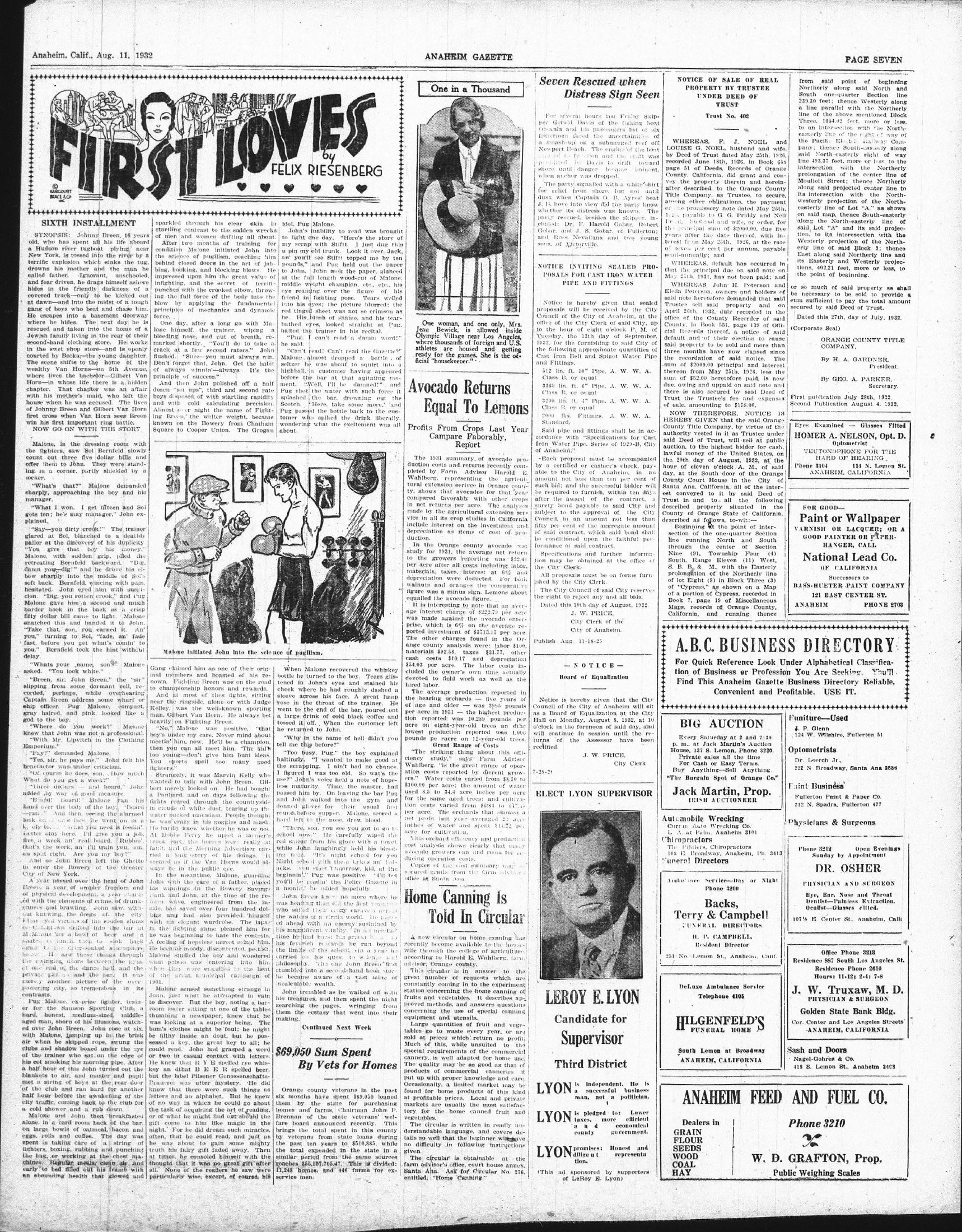
Searchable text
FIRST LOVES by FELIX RIESENBURG
SIXTH INSTALLMENT
SYNOPSIS: Johnny Breen, 16 years old, who has spent all his life aboard a Hudson river tugboat plying near New York, is tossed into the river by a terrific explosion which sinks the tug, drowns his mother and the man he called father. Ignorant, unschooled, and fear driven, he drags himself ashore hides in the friendly darkness of a covered truck—only to be kicked out at dawn—and into the midst of a tough gang of boys who beat and chase him. He escapes into a basement doorway where he hides. The next day he is rescued and taken into the home of a Jewish family living in the rear of their second-hand clothing store. He works in the swet shop store—and is openly courted by Becka—the young daughter. The scene shifts to the home of the wealthy Van Horns—on 5th Avenue, where lives the bachelor—Gilbert Van Horn—in whose life there is a hidden chapter. That chapter was an affair with his mother's maid, who left the house when he was accused. The lives of Johnny Breen and Gilbert Van Horn first cross when Van Horn sees Breen win his first important ring battle.
NOW GO ON WITH THE STORY
Malone, in the dressing room with the fighters, saw Sol Bernfeld slowly count out three five dollar bills and sparkled through his clear skin in startling contrast to the sodden wrecks of men and women drifting all about.
After two months of training for condition Malone initiated John into the science of pugilism, coaching him behind closed doors in the art of jabbing, hooking, and blocking blows. He impressed upon him the great value of infighting, and the secret of terrifying punches with the crooked elbow, throwing the full force of the body into the blow by applying the fundamental principles of mechanics and dynamic force.
One day, after a long go with Malone himself, the trainer, wiping a bleeding nose, and out of breath, remarked shortly. "You'll do to take a crack at a few second raters." John flushed. "Shure—you must always win. Don't forget that, John. Get the habit of always winnin'—always. It's the principle of success."
And then John polished off a half dozen "set ups", third and second rate boys disposed of with startling rapidity and with cold calculating precision. Almost over night the name of Fighting Breen," the welter weight, became known on the Bowery from Chatham Square to Cooper Union. The Grogan idol, Pug Malone.
John's inability to read to light one day, "Here" my scrap with Stiftt. I pin my old trunk. Look an' you'll see Stiftt topp pounds," and Pug held to John. John took the at the full length wood-cored middle weight champion, eye roaming over the friend in fighting pose, into his eyes; the picture red tinged sheet was not he. His blush of shine, bathed eyes, looked strained the trainer in his "Pug. I can't read a c he said.
"Can't read! Can't read Malone almost dropped me seltzer he was about to highball, in customer have before the bar at that moment. "Well, I'll be da Pug shot the water with splashed the bar, drown Scotch. "Here, take some Pug passed the bottle back toomer who spiked the d wondering what the excite about.
Malone, in the dressing room with the fighters, saw Sol Bernfeld slowly count out three five dollar bills and offer them to John. They were standing in a corner, partly shielded by a tocker.
"What's that?" Malone demanded sharply, approaching the boy and his manager.
"What I won. I get fifteen and Sol gets ten; he's may manager." John explained.
"Say—you dirty crook!" The trainer glared at Sol, blanched to a deathly pallor at the discovery of his duplicity. "You give that boy his money." Malone, with sudden grip, piled the retreating Bernfeld backward. "Dig, damn you—dig!" and he drove his elbow sharply into the middle of Sol's soft back. Bernfeld, wincing with pain, hesitated. John eyed him with suspicion. "Dig, you rotten crook," and Pug Malone gave him a second and much harder hook in the back as a crisp fifty dollar bill came to light. Malone snatched this and handed it to John. "Take that, son, you earned it. An' you," turning to Sol, "fade, an' fade fast, before you get what's comin' to you." Bernfield took the hint without delay.
"Whats your name, son?" Malone asked. "You look white."
"Breen, sir; John Breen," the "sir" slipping from some dormant cell, recorded, perhaps, while overhearing Captain Breen address some wharf or ship officer. Pug Malone, compact, gray haired, and pink, looked like a god to the boy.
"Where do you work?" Malone knew that John was not a professional.
"With Mr. Lipvitch in the Clothing Emporium."
"Pay?" demanded Malone.
"Yes, sir, he pays me." John felt his benefactor was under criticism.
"Of course he does, son. How much What do you get a week?"
"Three dollars — and board," John added by way of good measure.
"Board! Board!" Malone ran his hand over the body of the boy, "Board—rate." And then, seeing the alarmed look on his face, he went on in a k-yd to... what you need is feedin', better stay here. I'll give you a job, five a week an' real board. Rubbin', that's the work, an' I'll train you, son, an spat right. Are you my boy?"
And so John Breen left the Ghetto to enter the Bowery of the Greater
Gang claimed him as one of their original members and boasted of his renown. Fighting Breen was on the road to championship honors and rewards.
And at most of these fights, sitting near the ringside, alone or with Judge Kelley, was the well-known sporting man. Gilbert Van Horn. He always bet heavily on Fighting Breen.
"No," Malone was positive, "that boy's under my care. Never mind about meetin' him, now. He'll be a champion, then you can all meet him. The kid's too young—don't give him bum ideas. You sports spoil too many good fighters."
Strangely, it was Marvin Kelly who wanted to talk with John Breen. Gilbert merely looked on. He had bought a Panhard, and on days following the fights roared through the countryside in clouds of white dust, tearing up the water packed macadam. People thought he was crazy in his goggles and mask. He hardly knew whether he was or not. At Dobbs Ferry he upset a farmer's truck cart, the horses were really at fault, and the Morning Advertiser carried a long story of his doings. It seemed as if the Van Horns would always be in the public eye.
When Malone recovered bottle he turned to the boytened in John's eyes and cheek where he had rought sleeve across his face. A rose in the throat of the went to the end of the bar a large drink of cold black tossed it off. When the coke returned to John.
"Why in the name of her tell me this before?"
"Too busy, Pug," the boy haltingly, "I wanted to mite the scrapping. I ain't had I figured I was too old. use?" John's voice held a less maturity. Time, the passed him by. On leaving and John walked into the donned gloves for their round, before supper. Malone hard left to the nose, drew.
There, son, you see your school now." He carefully red smear from his glove while John laughingly held need. "It's night school with them keyacks. You start tomorrow..."
Of course he does, son. How much What do you get a week?
"Three dollars — and board." John added by way of good measure.
"Board! Board!" Malone ran his hand over the body of the boy, "Board —rate." And then, seeing the alarmed look on his face, he went on in a k, dly to what you need is feelin' better stay here. I give you a job, five, a week an' real board. Rubbin' that's the work, an' I'll train you, son, an spit right. Are you my boy?
And so John Breen left the Ghetto to enter the Bowery of the Greater City of New York.
A year passed over the head of John Breen, a year of ampler freedom and of physical development, a year charged with the elements of crime, of drunk-gainers and brawling. John saw without knowing, the dregs of the city. He had you victims of the soaked slums or Calcutta drifted into the bar at McManus for a bowl of beer and a saunter on lunch, then to sink back again to the Cing-sailed atmosphere he saw these things through the swinging doors between the gym at one end of the dance hall, and the private parlor and the bar. It was merely another picture of the overpowering city, so tremendous in its contrasts.
Pug Malone, ex-prize fighter, trainer for the Samson Sporting Club, a hard, honest, medium-sized, middle-aged man, shorn of his illusions, watched over John Breen. John rose at six, with Malone, jumping up in the brisk air when he skipped rope, swung the clubs and shadow boxed under the eye of the trainer who sat on the edge of his cot smoking his morning pipe. After a half hour of this John turned out the blankets to air, and master and pupil met a string of boys at the rear door of the club and ran hard for another half hour before the awakening of the city traffic, coming back to the club for a cold shower and a rub down.
Malone and John then breakfasted alone in a card room back of the bar, on large bowls of oatmeal, bacon and eggs, rolls and coffee. The day was spent in taking care of a string of fighters, boxing, rubbing and punching the bag, or working at the chest machines. Regular meals, clean air and early to bed filled out his frame with an abounding health that glowed and strangely, it was Marvin Kelly who wanted to talk with John Breen. Gilbert merely looked on. He had bought a Panhard, and on days following theights roared through the countryside in clouds of white dust, tearing up the water packed macadam. People thought he was crazy in his goggles and mask. He hardly knew whether he was or not. At Dobbs Ferry he upset a farmer's truck cart, the horses were really at fault, and the Morning Advertiser carried along story of his doings. It seemed as if the Van Horns would always be in the public eye.
In the meantime, Malone, guarding John with the care of a father, placed his winnings in the Bowery Savings Bank and John, at the time of the reform wave, engineered from the inside, had saved over four hundred dollars and had also provided himself with an elegant wardrobe. The lapse in the fighting game pleased him for he was beginning to hate the contests. A feeling of hopeless unrest seized him. He became moody, discontented, petish. Malone studied the boy and wondered what poison was entering into him when they were engulfed in the heat of the great municipal campaign of 1901.
Malone sensed something strange in Joan, just what he attempted in vain to discover. But the boy, noting a barroom loater sitting at one of the tables thumbing a newspaper, knew that he was looking at a superior being. The burn's clothes might be foul; he might be filthy inside an dout, but he possessed a key, the great key to all; he could read. John had grasped a word or two in casual contact with letters. He knew that R Y E spelled rye whiskey an dthat B E E R spelled beer, but the label Pilsener Genossenschafts-Prauererei was utter mystery. He did know that there were such things as letters and an alphabet. But he knew of no way in which he could go about the task of acquiring the art of reading, or of what he might find out should the gift come to him like magic in the night. For he did dream such miracles, often that he could read, and just as he was about to gain some mighty truth his fairy gift faded away. Then at times, he consolled himself with the thought that it was no great gift after all. None of the readers he saw were particularly wise, except, of course, his figureled I was too old.
Use?" John's voice held a less maturity. Time, the passed him by. On leaving and John walked into the donned gloves for their round, before supper. Malone hard left to the nose, drew.
"There, son, you see your school now." He carefully red scarf from his glove while John laughingly helping need. "It's night school with them keyacks. You start tomorrow beginnin'" Pug was positive you'll be readin' the Police a month' he added hope.
John Green knew no more was heading than did the fish who sailed their crazy carcass waters of a virgin world ahead with an energy his magnificent vitality. In time he had burst his press his feverish research he the limits of the school. It carried on his ques't philosophy. "This day John stumbled into a second-Ram he became aware of a vexcalculable wealth.
John trembled as he walked his treasures, and then speeched searching the pages, writing them the ecstasy that were making.
Continued Next W
$69,050 Sum Spend By Vets for
Orange county veterans six months have spent $90 them by the state for homes and farms. Chairman Brennan of the state veteran board announced recrives the total spent in by veterans from state law the past ten years to $520 total expended in the similar period from the reach $55,557,705.47. This 11,248 homes and 446 fare service men.
ANAHEIM GAZETTE
VES by FELIX RIESENBERG
Idol. Pug Malone.
John's inability to read was brought to light one day. "Here's the story of my scrap with Stifttt. I just dug this pin my old trunk. Look it over, Jack, you'll see Stifttt topped me by ten pounds," and Pug held out the paper to John. John took the paper, glanced at the full length wood-cut of Malone, middle weight champion, etc., etc., his eye roaming over the figure of his friend in fighting pose. Tears welled into his eyes; the picture blurred; the red tinged sheet was not so crimson as he. His blush of shine, and his tear-batched eyes, looked straight at Pug, halted the trainer in his recital.
"Pug, I can't read a damm word!" he said.
"Can't read! Can't read the Gazette?" Malone almost dropped a bottle of seltzer he was about to squirt into a mighball, a customer having appeared before the bar at that agitating moment. "Well, I'll be damned!" and Pug shot the water with such force it splashed the bar, drowning out the Scotch. "Here, take some more," and Pug passed the bottle back to the customer who spiked the drink liberally, wondering what the excitement was all about.
One in a Thousand
Seven Rescued when Distress Sign Seen
For several hours last Friday Skipper Gerald Davis of the fishing boat Ocania and his passengers list of six fishermen faced the uncertainties of a swash-up on a submerged reef off Newport Beach. The engine of the boat required to function and the craft was perilated by Davis to drift toward shore until danger became imminent, when anchor was dropped.
The party signalled with a white shirt for relief from shore, but not until dusk when Captain O. B. Ayres' boat J. B. hove into view did the party know whether its distress was known. The party rescued, besides the skipper, included: Dr. F. Harold Gobar, Robert Gobar, and J. S. Gobar, of Fullerton; and Ross Nevallans and two young sons, of Victorville.
NOTICE INVITING SEALED PROPOSALS FOR CAST IRON WATER PIPE AND FITTINGS
Notice is hereby given that sealed proposals will be received by the City Council of the City of Anaheim, at the office of the City Clerk of said City, up to the hour of eight o'clock P.M. of Tuesday, the 13th day of September, 1932, for the furnishing to said City of the following approximate quantities of Cast Iron Bell and Spigot Water Pipe and Fittings.
512 lin. ft. 10" Pipe, A. W. W. A. Class B, or equal
3360 lin. ft. 6" Pipe, A. W. W. A. Class B, or equal
3200 lin. ft. 4" Pipe, A. W. W. A. Class B, or equal
2000 lbs. Fittings, A. W. W. A. Standard.
Said pipe and fittings shall be in accordance with "Specifications for Cast Iron Water Pipe, Series of 1929-B, City of Anaheim."
Avocado Returns Equal To Lemons
Profits From Crops Last Year Campare Faborably, Report
The 1931 summary of avocado pro-
Avocado Returns Equal To Lemons
Profits From Crops Last Year Campare Faborably, Report
The 1931 summary of avocado production costs and returns recently completed by Farm Advisor Harold E. Wahlberg, representing the agricultural extension service in Orange county, shows that avocados for that year compared favorably with other crops in net returns per acre. The analyses made by the agricultural extension service in all its crop studies in California include interest on the investment and depreciation as items of cost of production.
In the Orange county avocado test study for 1931, the average net return to the growers reporting was $22.40 per acre after all costs including labor, materials, taxes, interest at 6% and depreciation were deducted. For both walnuts and oranges the comparative figure was a minus sign. Lemons about equalled the avocado figure.
It is interesting to note that an average interest charge of $222.79 per acre was made against the avocado enterprise, which is 6% on the average reported investment of $3713.17 per acre. The other charges found in the Orange county analysis were: labor $106, materials $92.58, taxes $31.77, other cash costs $10.17 and depreciation $54.03 per acre. The labor costs included the owner's own time actually devoted to field work as well as the hired labor.
The average production reported in the bearing orchards — five years of age and older — was 3995 pounds per acre in 1931 — the highest production reported was 10,289 pounds per acre on eight-year-old trees an dthe lowest production reported was 1,006 pounds per acre on 12-year-old trees.
Great Range of Costs
"The striking thing about this efficiency study," says Farm Advisor Wahlberg, "is the great range of operation costs reported by different growers." Water costs varied from $8.50 to $100.00 per acre; the amount of water used 8.5 to 34.4 acre inches per acre for the same aged trees; and cultivation costs varied from $684 to $47.10 per acre. The orchards that showed a net profit last year averaged 22 acres of water and spent $14.22 per acre for cultivation.
This orchard efficiency and production cost analysis shows clearly that many avocado growers can and room for reducing operation costs.
Copies of the cost summary may be obtained from the City of Anaheim."
Each proposal must be accompanied by a certified or cashier's check, payable to the City of Anaheim, in an amount not less than ten per cent of such bid; and the successful bidder will be required to furnish, within ten days after the award of the contract, a surety bond payable to said City and subject to the approval of the City Council, in an amount not less than fifty per cent of the aggregate amount of said contract, which said bond shall be conditioned upon the faithful performance of said contract.
Specifications and further information may be obtained at the office of the City Clerk.
All proposals must be on forms furnished by the City Clerk.
The City Council of said City reserves the right to reject any and all bids.
Dated this 10th day of August, 1932.
J. W. PRICE.
City Clerk of the
City of Anaheim.
Publish Aug. 11-18-25
NOTICE
Board of Equalization
Notice is hereby given that the City Council of the City of Anaheim will sit as a Board of Equalization at the City Hall on Monday, August 8, 1932, at 10 o'clock in the forenoon of said day, and will continue in session until the returns of the Assessor have been rectified.
J. W. PRICE.
City Clerk
7-28-2t
ELECT LYON SUPERVISOR
Home Canning Is Told In Circular
A new circular on home canning has recently become available to the housewife through the college of agriculture according to Harold E. Wahlberg, farm advisor, Orange county.
This circular is in answer to the great number of requests which are constantly coming in to the experiment station concerning the home canning of fruits and vegetables. It describes approved methods, and answers questions concerning the use of special canning equipment and utensils.
Large quantities of fruit and vegetables go to waste every year, or are sold at prices which return no profit. Much of this, while unsuited to the special requirements of the commercial cannery, is well adapted for home use. The quality may be as good as that of products of commercial canneries if put up with proper knowledge and care. Occasionally, a limited market may be found for home products of this kind at profitable prices. Local and private markets are usually the most satisfactory for the home canned fruit and vegetables.
The circular is written in readily understandable language, and covers details so well that the beginner will have no difficulty in following instructions given.
The circular is obtainable at the farm advisor's office, court house annex, Santa Aha. Ask for Circular No. 276, entitled, "Home Canning."
NOTICE OF SALE OF REAL PROPERTY BY TRUSTEE UNDER DEED OF TRUST
Trust No. 402
WHEREAS, F. J. NOEL and LOUISE G. NOEL, husband and wife, by Deed of Trust dated May 25th, 1926, recorded June 18th, 1926, in Book 65x page 51 of Deeds, Records of Orange County, California, did grant and convey the property therein and herein-after described, to the Orange County Title Company, as Trustee, to secure, among other obligations, the payment of the promissory note dated May 25th, 1926, payable to G. G. Priddy and Nell Priddy, husband and wife, or order, for the principal sum of $2000.00, due five years after the date thereof, with interest from May 25th, 1926, at the rate of seven per cent per annum, payable semi-annually; and
WHEREAS, default has occurred in that the principal due on said note on May 25th, 1931, has not been paid; and
WHEREAS, John H. Peterson and Eleda Peterson, owners and holders of said note heretofore demanded that said Trustee sell said property and on April 26th, 1932, duly recorded in the office of the County Recorder of said County, in Book 551, page 139 of Official Records thereof, a notice of said default and of their election to cause said property to be sold and more than three months have now elapsed since the recordation of said notice. The sum of $2000.00 principal and interest thereon from May 25th, 1926, less the sum of $52.00 heretofore paid, is now due, owing and uppaid on said note and there is also secured by said Deed of Trust the Trustee's fee and expenses of sale, amounting to $158.00.
NOW THEREFORE, NOTICE IS HEREBY GIVEN that the said Orange County Title Company, by virtue of the authority vested in it as Trustee under said Deed of Trust, will sell at public auction, to the highest bidder for cash, lawful money of the United States, on the 20th day of August 1932.
or so much of said property as shall be necessary to be sold to provide a sum sufficient to pay the total amount secured by said Deed of Trust.
Dated this 27th day of July, 1932.
(Corporate Seal)
ORANGE COUNTY TITLE COMPANY.
By H. A. GARDNER,
President.
By GEO. A. PARKER,
Secretary.
First publication July 28th, 1932.
Second Publication August 4, 1932.
NOW THEREFORE, NOTICE IS HEREBY GIVEN that the said Orange County Title Company, by virtue of the authority vested in it as Trustee under said Deed of Trust, will sell at public auction, to the highest bidder for cash, lawful money of the United States, on the 20th day of August, 1932, at the hour of eleven o'clock A.M., of said day, at the South door of the Orange County Court House in the City of Santa Ana, California, all of the interest conveyed to it by said Deed of Trust in and to all the following described property situated in the County of Orange State of California, described as follows, to-wit:
Beginning at the point of intersection of the one-quarter Section line running North and South through the center of Section Nine (9), Township Four (4) South, Range Eleven (11) West, S. B. B. & M., with the Easterly prolongation of the Northerly line of lot Eight (8) in Block Three (3) of "Cypress," as shown on a Map of a portion of Cypress, recorded in Book 7, page 19 of Miscellaneous Maps, records of Orange County, California, and running thence
A.B.C. BUSINESS DIRECTORY
For Quick Reference Look Under Alphabetical Classification of Business or Profession You Are Seeking. You'll Find This Anaheim Gazette Business Directory Reliable, Convenient and Profitable. USE IT.
BIG AUCTION
Every Saturday at 2 and 7:30 p.m., at Jack Martin's Auction House, 137 S. Lemon, Phone 3220.
Private sales all the time
For Cash or Easy Terms.
Buy Anything—Sell Anything.
"The Bargain Spot of Orange Co."
Jack Martin, Prop.
IRISH AUCTIONEER
Funiture—Used
4. P. Glenn
124 W. Wilshire, Fullerton 51
Optometrists
Dr. Loerch Jr.
222 N Broadway, Santa Ana 2586
Paint Business
Fullerton Paint & Paper Co.
212 N. Spadra, Fullerton 477
Physicians & Surgeons
Phone 3212 Open Evenings
Sunday by Appointment
DR. OSHER
"The Bargain Spot of Orange Co."
Jack Martin, Prop.
IRISH AUCTIONEER
Automobile Wrecking
Currin Auto Wrecking Co.
L. A. at Palm, Anaheim 3101
Chiropractors
The Pintlers, Chiropractors
108 E. Broadway, Anaheim, Ph. 3413
Funeral Directors
Ambulance Service—Day or Night
Phone 3209
Backs,
Terry & Campbell
FUNERAL DIRECTORS
H. P. CAMPBELL.
Resident Director
251 No. Lemon St., Anaheim, Calif.
DeLuxe Ambulance Service
Telephone 4105
HILGENFELD'S
FUNERAL HOME
South Lemon at Broadway
ANAHEIM, CALIFORNIA
Paint Business
Fullerton Paint & Paper Co.
212 N. Spadra, Fullerton 477
Physicians & Surgeons
Phone 3212 Open Evenings
Sunday by Appointment
DR. OSHER
PHYSICIAN AND SURGEON
Eye, Ear, Nose and Throat
Dentist—Painless Extraction.
Oculist—Glasses clitted.
107½ E. Center St., Anaheim, Calif.
Office Phone 3218
Residence 887 South Los Angeles St.
Residence Phone 2610
Hours: 11-12; 2-4; 7-8
J. W. Truxaw, M. D.
PHYSICIAN & SURGEON
Golden State Bank Bldg.
Cor. Center and Los Angeles Streets
ANAHEIM, CALIFORNIA
Sash and Doors
Nagel-Gohres & Co.
418 S. Lemon St., Anaheim 2403
ANAHEIM FEED AND FUEL CO.
Dealers in
GRAIN
FLOUR
SEEDS
WOOD
COAL
HAY
Phone 3210
W. D. GRAFTON, Prop.
Public Weighing Scales