anaheim-gazette 1932-08-11
Scanned page
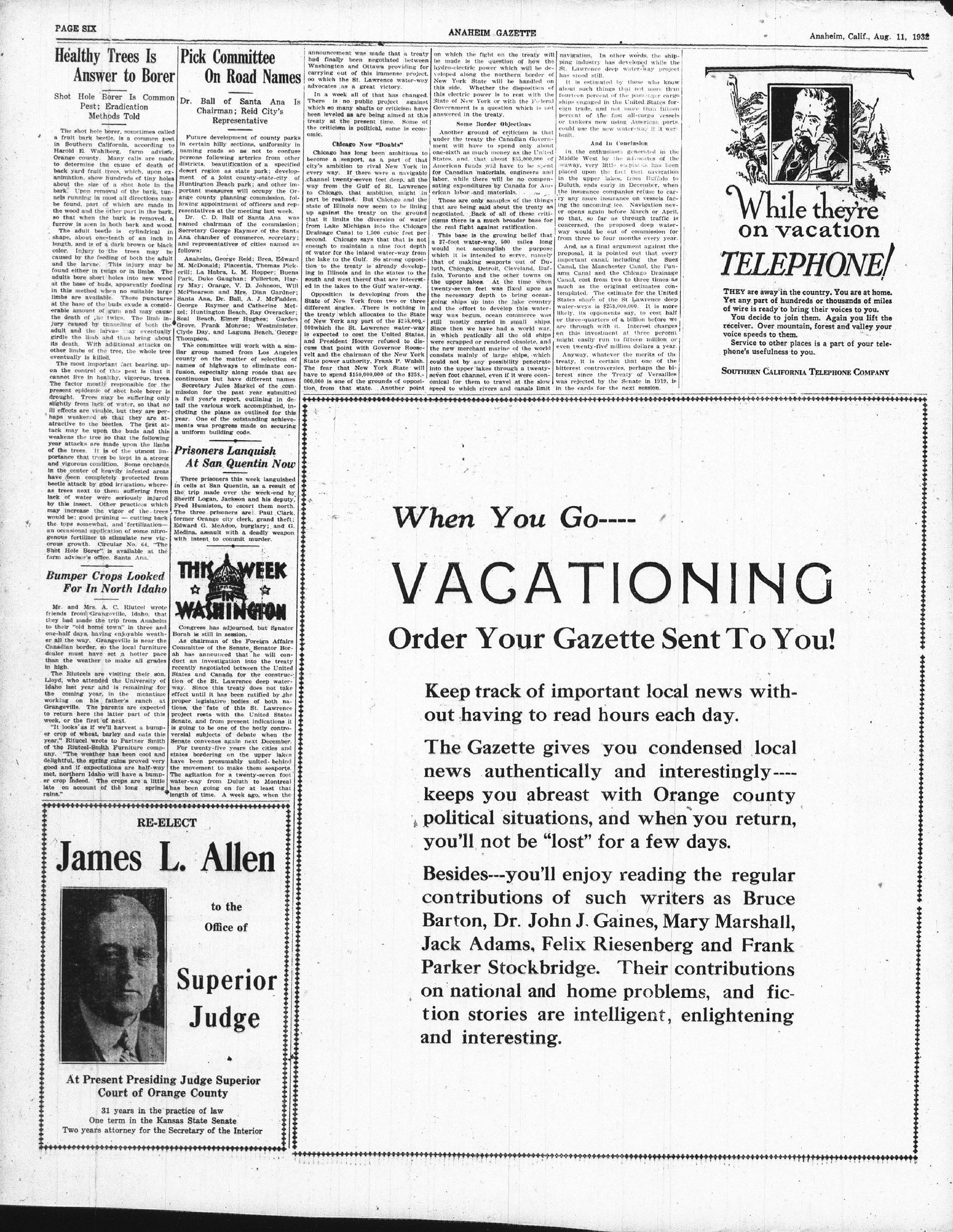
Searchable text
Healthy Trees Is Answer to Borer
Shot Hole Borer Is Common Pest; Eradication Methods Told
The shot hole borer, sometimes called a fruit bark beetle, is a common pest in Southern California, according to Harold E. Wahlberg, farm advisor, Orange county. Many calls are made to determine the cause of death of back yard fruit trees, which, upon examination, show hundreds of tiny holes about the size of a shot hole in the bark. Upon removal of the bark, tunnels running in most all directions may be found, part of which are made in the wood and the other part in the bark, so that when the bark is removed, a furrow is seen in both bark and wood.
The adult beetle is cylindrical in shape, about one-tenth of an inch in length, and is of a dark brown or black color. Injury to the trees may be caused by the feeding of both the adult and the larvae. This injury may be found either in twigs or in limbs. The adults bore short holes into new wood at the base of buds, apparently feeding in this method when no suitable large limbs are available. These punctures at the base of the buds exude a considerable amount of gum and may cause the death of the twigs. The limb injury caused by tunneling of both the adult and the larvae may eventually girdle the limb and thus bring about its death. With additional attacks on other limbs of the tree, the whole tree eventually is killed.
The most important fact bearing upon the control of this pest is that it cannot live in healthy, vigorous trees. The factor mostly responsible for the present epidemic of shot hole borer is drought. Trees may be suffering only slightly from lack of water, so that no ill effects are visible, but they are perhaps weakened so that they are attractive to the beetles. The first attack may be upon the buds and this weakens the tree so that the following year attacks are made upon the limbs of the trees. It is of the utmost importance that trees be kept in a strong
Pick Committee On Road Names
Dr. Ball of Santa Ana Is Chairman; Reid City's Representative
Future development of county parks in certain hilly sections, uniformity in naming roads so as not to confuse persons following arteries from other districts, beautification of a specified desert region as state park; development of a joint county-state-city of Huntington Beach park; and other important measures will occupy the Orange county planning commission, following appointment of officers and representatives at the meeting last week.
Dr. C. D. Ball of Santa Ana was named chairman of the commission; Secretary George Raymer of the Santa Ana chamber of commerce, secretary; and representatives of cities named as follows:
Anaheim, George Reid; Brea, Edward M. McDonald; Placentia, Thomas Pickerill; La Habra, L. M. Hopper; Buena Park, Duke Gaughan; Fullerton, Harry May; Orange, V. D. Johnson, Will McPhearson and Mrs. Dian Gardner; Santa Ana, Dr. Ball, A. J. McFadden, George Raymer and Catherine Metzel; Huntington Beach, Ray Overacker; Seal Beach, Elmer Hughes; Garden Grove, Frank Monroe; Westminster, Clyde Day, and Laguna Beach, George Thompson.
The committee will work with a similar group named from Los Angeles county on the matter of selection of names of highways to eliminate confusion, especially along roads that are continuous but have different names.
Secretary Jules Markel of the commission for the past year submitted a full year's report, outlining in detail the various work accomplished, including the plans as outlined for this year. One of the outstanding achievements was progress made on securing a uniform building code.
Prisoners Lanquish
The most important fact bearing upon the control of this pest is that it cannot live in healthy, vigorous trees. The factor mostly responsible for the present epidemic of shot hole borer is drought. Trees may be suffering only slightly from lack of water, so that no ill effects are visible, but they are perhaps weakened so that they are attractive to the beetles. The first attack may be upon the buds and this weakens the tree so that the following year attacks are made upon the limbs of the trees. It is of the utmost importance that trees be kept in a strong and vigorous condition. Some orchards in the center of heavily infested areas have been completely protected from beetle attack by good irrigation, whereas trees next to them suffering from lack of water were seriously injured by this insect. Other practices which may increase the vigor of the trees would be: good pruning — cutting back the tops somewhat, and fertilization—an occasional application of some nitrogenous fertilizer to stimulate new vigorous growth. Circular No. 64, "The Shot Hole Borer", is available at the farm advisor's office. Santa Ana.
Bumper Crops Looked For In North Idaho
Mr. and Mrs. A. C. Riutcel wrote friends from Grangeville, Idaho, that they had made the trip from Anaheim to their "old home town" in three and one-half days, having enjoyable weather all the way. Grangeville is near the Canadian border, so the local furniture dealer must have set a hotter pace than the weather to make all grades in high.
The Riutcels are visiting their son, Lloyd, who attended the University of Idaho last year and is remaining for the coming year, in the meantime working on his father's ranch at Grangeville. The parents are expected to return here the latter part of this week, or the first of next.
"It looks as if we'll harvest a bumper crop of wheat, barley and oats this year," Riutcel wrote to Partner Smith of the Riutcel-Smith Furniture company. "The weather has been cool and delightful, the spring rains proved very good and if expectations are half-way met, northern Idaho will have a bumper crop indeed. The crops are a little late on account of the long spring rains."
Prisoners Lanquish At San Quentin Now
Three prisoners this week languished in cells at San Quentin, as a result of the trip made over the week-end by Sheriff Logan, Jackson and his deputy, Fred Humiston, to escort them north. The three prisoners are: Paul Clark, former Orange city clerk, grand theft; Edward G. McAdoo, burglary; and G. Medina, assault with a deadly weapon with intent to commit murder.
Congress has adjourned, but Senator Borah is still in session.
As chairman of the Foreign Affairs Committee of the Senate, Senator Borah has announced that he will conduct an investigation into the treaty recently negotiated between the United States and Canada for the construction of the St. Lawrence deep waterway. Since this treaty does not take effect until it has been ratified by the proper legislative bodies of both nations, the fate of this St. Lawrence project rests with the United States Senate, and from present indications it is going to be one of the hotly controversial subjects of debate when the Senate convenes again next December.
For twenty-five years the cities and states bordering on the upper lakes have been presumably united behind the movement to make them seaports. The agitation for a twenty-seven foot water-way from Duluth to Montreal has been going on for at least that length of time. A week ago, when the names of highways to eliminate confusion, especially along roads that are continuous but have different names.
Secretary Jules Markel of the commission for the past year submitted a full year's report, outlining in detail the various work accomplished, including the plans as outlined for this year. One of the outstanding achievements was progress made on securing a uniform building code.
THK WEEK WASHINGTON
RE-ELECT
James L. Allen
RE-ELECT
James L. Allen
to the
Office of
Superior
Judge
At Present Presiding Judge Superior
Court of Orange County
31 years in the practice of law
One term in the Kansas State Senate
Two years attorney for the Secretary of the Interior
announcement was made that a treaty had finally been negotiated between Washington and Ottawa providing for carrying out of this immense project, oo which the St. Lawrence water-way advocates as a great victory.
In a week all of that has changed. There is no public project against which so many shafts or criticism have been leveled as are being aimed at this treaty at the present time. Some of the criticism is political, some is economic.
Chicago Now “Doubts”
Chicago has long been ambitious to become a seaport, as a part of that city’s ambition to rival New York in every way. If there were a navigable channel twenty-seven feet deep, all the way from the Gulf of St. Lawrence to Chicago, that ambition might in part be realized. But Chicago and the state of Illinois now seem to be lining up against the treaty on the ground that it limits the diversion of water from Lake Michigan into the Chicago Drainage Canal to 1,500 cubic feet per second. Chicago says that that is not enough to maintain a nine foot depth of water for the inland water-way from the lake to the Gulf. So strong opposition to the treaty is already developing in Illinois and in the states to the south and west therof that are interstied in the lakes to the Gulf water-way.
Opposition is developing from the State of New York from two or three different angles. There is nothing in the treaty which allocates to the State of New York any part of the $258,000,000which the St. Lawrence water-way is expected to cost the United States, and President Hoover refused to discuss that point with Governor Roosevelt and the chairman of the New York State power authority, Frank P. Walsh. The fear that New York State will have to spend $150,000,000 of the $258,000,000 is one of the grounds of opposition from that state. Another point on which the fight on the treaty will be made is the question of how the hydro-electric power which will be developed along the northern border of New York State will be handled on this side. Whether the disposition of this electric power is to rest with the State of New York or with the Federal Government is a question which is not answered in the treaty.
Some Border Objections
Another ground of criticism is that under the treaty the Canadian Government will have to spend only about one-sixth as much money as the United States, and that about $55,000,000 of American funds will have to be spent for Canadian materials, engineers and labor, while there will be no compensating expenditures by Canada for American labor-and materials.
Those are only samples of the things that are being said about the treaty as negotiated. Back of all of these criticisms there is a much broader base for the real fight against ratification.
This base is the growing belief that a 27-foot water-way, 500 miles long would not accomplish the purpose which it is intended to serve, namely that of making seaports out of Duluth, Chicago, Detroit, Cleveland, Buffalo, Toronto and the other towns on the upper lakes. At the time when twenty-seven feet was fixed upon as the necessary depth to bring ocean-going ships up into the lake country and the effort to develop this waterway was begun, ocean commerce was still mostly carried in small ships. Since then we have had a world war, in which practically all the old ships were scrapped or rendered obsolete, and the new merchant marine of the world consists mainly of large ships, which could not by any possibility penetrate into the upper lakes through a twenty-seven foot channel, even if it were economical for them to travel at the slow speed to which rivers and canals limit navigation. In other words, the shipping industry has developed while the St. Lawrence deep water-way project has stood still.
It is estimated by those who know about such things that not more than fourteen percent of the passenger cars engaged in the United States for eign trade, and not more than fifteen percent of the fast all-cargo vessels or tankers now using American ports could use the new water-way if it were built.
And In Conclusion
In the enthusiasm generated in the Middle West by the advocates of the seaway, very little emphasis has been placed upon the fact that navigation in the upper lakes, from Buffalo to Duluth, ends early in December, where the insurance companies refuse to carry any more insurance on vessels facing the oncoming ice. Navigation never opens again before March or April so that, so far as through traffic concerned, the proposed deep water-way would be out of commission from three to four months every year.
And, as a final argument against this proposal, it is pointed out that even important canal, including the Sudan Canal, the Manchester Canal, the Panama Canal and the Chicago Drainage Canal, cost from two to three times as much as the original estimates contemplated. The estimate for the United States share of the St. Lawrence deep water-ways is $258,000,000. It is most likely its opponents say, to cost half or three-quarters of a billion before we are through with it. Interest charges on this investment at three percent might easily run to fifteen million or even twenty-five million dollars a year.
Anyway, whatever the merits of this treaty, it is certain that one of the bitterest controversies, perhaps the biggest since the Treaty of Versailles was rejected by the Senate in 1919, lies in the cards for the next session.
When You Go----
VACATION
Order Your Gazette S
Keep track of important loca
out having to read hours ea
The Gazette gives you com
news authentically and in
keeps you abreast with On
political situations, and whe
you’ll not be “lost” for a few
keeps you abreast with Our political situations, and when you'll not be "lost" for a few
Besides---you'll enjoy reading contributions of such writers Barton, Dr. John J. Gaines, Mr Jack Adams, Felix Riesenbeck, Parker Stockbridge. Their on national and home problem stories are intelligent, and interesting.
While they're on vacation
TELEPHONE!
THEY are away in the country. You are at home. Yet any part of hundreds or thousands of miles of wire is ready to bring their voices to you.
You decide to join them. Again you lift the receiver. Over mountain, forest and valley your voice speeds to them.
Service to other places is a part of your telephone's usefulness to you.
SOUTHERN CALIFORNIA TELEPHONE COMPANY
TIONING
Mazette Sent To You!
important local news with
hours each day.
you condensed local
and interestingly----
with Orange county
and when you return,
for a few days.
with Orange county
and when you return,
for a few days.
by reading the regular
uch writers as Bruce
Gaines, Mary Marshall,
Riesenberg and Frank
. Their contributions
ne problems, and ficelligent, enlightening