anaheim-gazette 1932-06-09
Scanned page
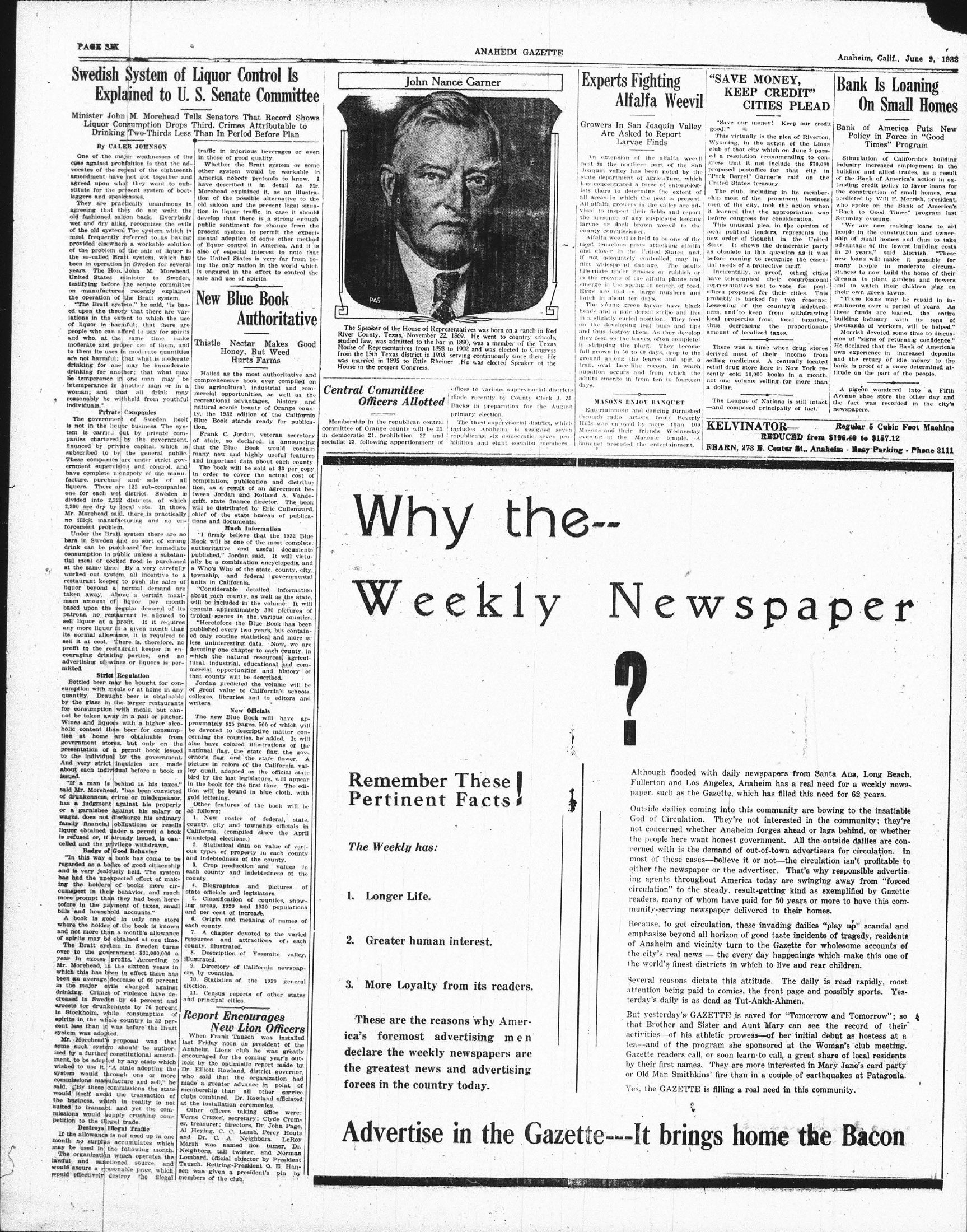
Searchable text
Swedish System of Liquor Control Is Explained to U. S. Senate Committee
Minister John M. Morehead Tells Senators That Record Shows Liquor Consumption Drops Third, Crimes Attributable to Drinking Two-Thirds Less Than In Period Before Plan
By CALEB JOHNSON
One of the major weaknesses of the case against prohibition is that the advocates of the repeal of the eighteenth amendment have not got together and agreed upon what they want to substitute for the present system of bootleggers and speakeasies.
They are practically unanimous in agreeing that they do not waht the old fashioned saloon back. Everybody wet and dry alike, recognizes the evils of the old system. The system which is most frequently referred to as having provided elsewhere a workable solution of the problem of the sale of liquor is the so-called Bratt system, which has been in operation in Sweden for several years. The Hon. John M. Morehead, United States minister to Sweden, testifying before the senate committee on manufactures recently explained the operation of the Bratt system.
"The Bratt system," he said, "is based upon the theory that there are variations in the extent to which the use of liquor is harmful; that there are people who can afford to pay for spirits and who, at the same time, make moderate and proper use of them, and to them its uses in moderate quantities are not harmful; that what is moderate drinking for one may be immoderate drinking for another; that what may be temperance in one man may be intemperance in another man or in a woman; and that all drink may reasonably be withheld from youthful individuals."
Private Companies
The government of Sweden itself is not in the liquor business. The system is carried out by private companies chartered by the government, financed by private capital, which is subscribed to by the general public. These companies are under strict traffic in injurious beverages or even in those of good quality.
Whether the Bratt system or some other system would be workable in America nobody pretends to know. I have described it in detail as Mr. Morehead explained it, as an illustration of the possible alternative to the old saloon and the present legal situation in liquor traffic, in case it should develop that there is a strong enough public sentiment for change from the present system to permit the experimental adoption of some other method of liquor control in America. And it is also of especial interest to note that the United States is very far from being the only nation in the world which is engaged in the effort to control the sale and use of spirits.
New Blue Book Authoritative
Thistle Nectar Makes Good Honey, But Weed Hurts Farms
Hailed as the most authoritative and comprehensive book ever compiled on the agricultural, industrial and commercial opportunities, as well as the recreational advantages, history and natural scenic beauty of Orange county, the 1932 edition of the California Blue Book stands ready for publication.
Frank C. Jordan, veteran secretary of state, so declared, in announcing that the Blue Book would contain many new and highly useful features
drinking for one may be immoderate drinking for another; that what may be temperance in one man may be intemperance in another man or in a woman; and that all drink may reasonably be withheld from youthful individuals."
Private Companies
The government of Sweden itself is not in the liquor business. The system is carried out by private companies chartered by the government, financed by private capital, which is subscribed to by the general public. These companies are under strict government supervision and control, and have complete monopoly of the manufacture, purchase and sale of all liquors. There are 122 sub-companies, one for each wet district. Sweden is divided into 2,322 districts, of which 2,200 are dry by local vote. In those, Mr. Morehead said, there is practically no illicit manufacturing and no enforcement problem.
Under the Bratt system there are no bars in Sweden and no sort of strong drink can be purchased for immediate consumption in public unless a substantial meal of cooked food is purchased at the same time. By a very carefully worked out system, all incentive to a restaurant keeper to push the sales of liquor beyond a normal demand are taken away. Above a certain maximum amount of liquor per month based upon the regular demand of its patrons, no restaurant is allowed to sell liquor at a profit. If it requires any more liquor in a given month than its normal allowance, it is required to sell it at cost. There is, therefore, no profit to the restaurant keeper in encouraging drinking parties, and no advertising of wines or liquors is permitted.
Strict Regulation
Bottled beer may be bought for consumption with meals or at home in any quantity. Draught beer is obtainable by the glass in the larger restaurants for consumption with meals, but cannot be taken away in a pail or pitcher. Wines and liquors with a higher alcoholic content than beer for consumption at home are obtainable from government stores, but only on the presentation of a permit book issued to the individual by the government. And very strict inquiries are made about each individual before a book is issued.
“If a man is behind in his taxes,” said Mr. Morehead, “has been convicted of drunkenness, crime or misdemeanor, has a judgment against his property or a garnishee against his salary or wages, does not discharge his ordinary family financial obligations or resells liquor obtained under a permit a book is refused or, if already issued, is cancelled and the privilege withdrawn.
Badge of Good Behavior
“In this way a book has come to be regarded as a badge of good citizenship and is very valuable.”
Hailed as the most authoritative and comprehensive book ever compiled on the agricultural, industrial and commercial opportunities, as well as the recreational advantages, history and natural scenic beauty of Orange county, the 1932 edition of the California Blue Book stands ready for publication.
Frank C. Jordan, veteran secretary of state, so declared, in announcing that the Blue Book would contain many new and highly useful features and important data about each county.
The book will be sold at $3 per copy in order to cover the actual cost of compilation; publication and distribution, as a result of an agreement between Jordan and Rolland A. Vandegrift, state finance director. The book will be distributed by Eric Cullenward, chief of the state bureau of publications and documents.
Much Information
“I firmly believe that the 1932 Blue Book will be one of the most complete, authoritative and useful documents published,” Jordan said. It will virtually be a combination encyclopedia and a Who's Who of the state, county, city, township, and federal governmental units in California.
“Considerable detailed information about each county, as well as the state, will be included in the volume. It will contain approximately 300 pictures of typical scenes in the various counties.
“Heretofore the Blue Book has been published every two years, but contained only routine statistical and more or less uninteresting data. Now, we are devoting one chapter to each county, in which the natural resources, agricultural, industrial, educational and commercial opportunities and history of that county will be described.
Jordan predicted the volume will be of great value to California's schools, colleges, libraries and to editors and writers.
New Officials
The new Blue Book will have approximately 825 pages, 500 of which will be devoted to descriptive matter concerning the counties, he added. It will also have colored illustrations of the national flag, the state flag, the governor's flag, and the state flower. A picture in colors of the California valley quail, adopted as the official state bird by the last legislature, will appear in the book for the first time. The edition will be bound in blue cloth, with gold lettering.
Other features of the book will be as follows:
1. New roster of federal, state, county, city and township officials in California. (compiled since the April municipal elections.)
2. Statistical data on value of various types of property in each county and indebtedness of the county.
3. Crop production and values in
"If a man is behind in his taxes," said Mr. Morehead, "has been convicted of drunkenness, crime or misdemeanor, has a judgment against his property or a garnishee against his salary or wages, does not discharge his ordinary family financial obligations or resells liquor obtained under a permit a book is refused or, if already issued, is cancelled and the privilege withdrawn.
Badge of Good Behavior
In this way a book has come to be regarded as a badge of good citizenship and is very jealously held. The system has had the unexpected effect of making the holders of books more circumspect in their behavior, and much more prompt than they had been herefore in the payment of taxes, small bills and household accounts."
A book is good in only one store where the holder of the book is known and not more than a month's allowance of spirits may be obtained at one time.
The Bratt system in Sweden turns over to the government $31,000,000 a year in excess profits. According to Mr. Morehead, in the sixteen years in which this has been in effect there has been an average decrease of 66 percent in the major evils charged against drinking. Crimes of violence have decreased in Sweden by 44 percent and arrests for drunkenness by 76 percent in Stockholm, while consumption of spirits in the whole country is 32 percent less than it was before the Bratt system was adopted.
Mr. Morehead's proposal was that some such system should be authorized by a further constitutional amendment, to be adopted by any state which wished to use it. "A state adopting the system would through one or more commissions manufacture and sell," he said. "By these commissions the state would itself avoid the transaction of the business, which in reality is not suited to transact, and yet the commissions would supply crushing competition to the illegal trade.
Destroys Illegal Traffic
If the allowance is not used up in one month no surplus accumulates which may be used in the following month.
The organization which operates the lawful and sanctioned source, and would assure a reasonable price, which would effectively destroy the illegal bird by the last legislature, will appear in the book for the first time. The edition will be bound in blue cloth, with gold lettering.
Other features of the book will be as follows:
1. New roster of federal, state, county, city and township officials in California. (compiled since the April municipal elections.)
2. Statistical data on value of various types of property in each county and indebtedness of the county.
3. Crop production and values in each county and indebtedness of the county.
4. Biographies and pictures of state officials and legislators.
5. Classification of counties, showing areas, 1920 and 1930 populations and per cent of increase.
6. Origin and meaning of names of each county.
7. A chapter devoted to the varied resources and attractions of each county, illustrated.
8. Description of Yosemite valley, illustrated.
9. Directory of California newspapers, by counties.
10. Statistics of the 1930 general election.
11. Census reports of other states and principal cities.
Report Encourages New Lion Officers
When Frank Tausch was installed last Friday noon as president of the Anaheim Lions club he was greatly encouraged for the coming year's outlook by the optimistic report made by Dr. Elliott Rowland, district governor, who said that the organization had made a greater advance in point of membership than all other service clubs combined. Dr. Rowland officiated at the installation ceremonies.
Other officers taking office were: Verne Cruzen, secretary; Clyde Cromer, treasurer; directors, Dr. John Page, Al Heying, C. C. Lamb, Percy Houts and Dr. C. A. Neighbors. LeRoy Marsh was named lion tamer, Dr. Neighbors, tail twister, and Norman Lombard, official objector by President Tausch. Retiring-President O. E. Hansen was given a president's pin by members of the club.
John Nance Garner
The Speaker of the House of Representatives was born on a ranch in Red River County, Texas, November 22, 1869. He went to country schools, studied law, was admitted to the bar in 1890, was a member of the Texas House of Representatives from 1898 to 1902 and was elected to Congress from the 15th Texas district in 1903, serving continuously since then. He was married in 1895 to Ettie Rheiner. He was elected Speaker of the House in the present Congress.
Central Committee Officers Allotted
Membership in the republican central committee of Orange county will be 23, in democratic 21, prohibition 22 and socialist 23, following apportionment of offices to various supervisorial districts made recently by County Clerk J. M. Backs in preparation for the August primary election.
The third supervisorial district, which includes Anaheim, is assigned seven republicans, six democratic, seven prohibition and eight socialist members.
Experts Fighting Alfalfa Week
Growers In San Joaquin Wet Are Asked to Report Larvae Finds
An extension of the alfalfa pest in the northern part of the Joaquin valley has been noted by state department of agriculture. It has concentrated a force of entomologists there to determine the extent all areas in which the pest is present. All alfalfa growers in the valley are visited to inspect their fields and note the presence of any suspicious larvae or dark brown weevil that county commissioner.
Alfalfa weevil is held to be one of most tenacious pests attacking grasses and clover in the United States if not adequately controlled, making widespread damage. The hibernate under grasses or rubbish in the crowns of the alfalfa plants emerge in the spring in search of Eggs are laid in large numbers hatch in about ten days.
The young green larvae have heads and a pale dorsal stripe and in a slightly curled position. They on the developing leaf buds and thus destroy them. As they feed on the leaves, often completely stripping the plant. They be full grown in 50 to 60 days, drop to ground among the leaves and sew frail, oval, lace-like cocoon, in a pupation occurs and from which adults emerge in from ten to four days.
MASONS ENJOY BANQUET
Entertainment and dancing furr through radio artists from Be Hills was enjoyed by more than Masons and their friends Wednesday at the Masonic temple banquet preceded the entertainment
Central Committee Officers Allotted
Membership in the republican central committee of Orange county will be 23,
in democratic 21, prohibition 22 and socialist 23, following apportionment of offices to various supervisorial districts made recently by County Clerk J. M.
Backs in preparation for the August primary election.
The third supervisorial district, which includes Anaheim, is assigned seven republicans, six democratic, seven prohibition and eight socialist members.
Why the--
Weekly Ne
Remember These Pertinent Facts!
The Weekly has:
Remember These Pertinent Facts!
The Weekly has:
1. Longer Life.
2. Greater human interest.
3. More Loyalty from its readers.
These are the reasons why America's foremost advertising men declare the weekly newspapers are the greatest news and advertising forces in the country today.
Advertise in the Gazette---It bri
Anaheim, Calif., June 9, 1982
Berts Fighting Alfalfa Weevil
In San Joaquin Valley Are Asked to Report Larvae Finds
Extension of the alfalfa weevil in the northern part of the San valley has been noted by the department of agriculture, which concentrated a force of entomologists to determine the extent of its presence in which the pest is present.
Farmers in the valley are advised to inspect their fields and report evidence of any suspicious looking or dark brown weevil to the commissioner.
Weevil is held to be one of the necarious pests attacking alfalfa over in the United States, and adequately controlled, may indesperd damage. The adults under grasses or rubbish or towns of the alfalfa plants and on the spring in search of food are laid in large numbers and about ten days.
Yung green larvae have black and a pale dorsal stripe and liveently curled position. They feed developing leaf buds and tips to destroy them. As they develop on the leaves, often completeing the plant. They become eaten in 50 to 60 days, drop to the among the leaves and spin a nail, lace-like cocoon, in which it occurs and from which the emerge in from ten to fourteen months ENJOY BANQUET
Attachment and dancing furnished radio artists from Beverly is enjoyed by more than 100 and their friends Wednesday at the Masonic temple. A preceded the entertainment.
"SAVE MONEY, KEEP CREDIT" CITIES PLEAD
"Save our money! Keep our credit good!"
This virtually is the plea of Riverton, Wyoming, in the action of the Lions club of that city which on June 2 passed a resolution recommending to congress that it not include the $70,000 proposed postoffice for that city in "Pork Barrel" Garner's raid on the United States treasury.
The club, including in its membership most of the prominent business men of the city, took the action when it learned that the appropriation was before congress for consideration.
This unusual plea, in the opinion of local political leaders, represents the new order of thought in the United State. It shows the democratic party as obsolete in this question as it was before coming to recognize the essential needs of a protective tariff.
Incidentally, as proof, other cities have telegraphed their congressional representatives not to vote for post-offices proposed for their cities. This probably is backed for two reasons: Lessening of the country's indebtedness, and to keep from withdrawing local properties from local taxation, thus decreasing the proportionate amount of localized taxes.
There was a time when drug stores derived most of their income from selling medicines. A centrally located retail drug store here in New York recently sold 50,000 books in a month, not one volume selling for more than a dollar.
The League of Nations is still intact—and composed principally of tact.
Bank Is Loaning On Small Homes
Bank of America Puts New Policy in Force in "Good Times" Program
Stimulation of California's building industry increased employment in the building and allied trades, as a result of the Bank of America's action in extending credit policy to favor loans for the construction of small homes, was predicted by Will F. Morrish, president, who spoke on the Bank of America's "Back to Good Times" program last Saturday evening.
"We are now making loans to aid people in the construction and ownership of small homes and thus to take advantage of the lowest building costs in 20 years," said Morrish. "These new loans will make it possible for many people in moderate circumstances to now build the home of their dreams, to plant gardens and flowers and to watch their children play on their own green lawns."
"These loans may be repaid in installments over a period of years. As these funds are loaned, the entire building industry with its tens of thousands of workers, will be helped."
Morrish devoted some time to discussion of "signs of returning confidence." He declared that the Bank of America's own experience in increased deposits and the return of idle money to the bank is proof of a more determined attitude on the part of the people.
A pigeon wandered into a Fifth Avenue shoe store the other day and the fact was recorded in the city's newspapers.
KELVINATOR— Regular 5 Cubic Foot Machine REDUCED from $196.40 to $157.12
EBARN, 278 N. Center St., Anaheim - Easy Parking - Phone 3111
Newspaper?
Although flooded with daily newspapers from Santa Ana, Long Beach, Fullerton and Los Angeles, Anaheim has a real need for a weekly newspaper, such as the Gazette, which has filled this need for 62 years.
Outside dailies coming into this community are bowing to the insatiable God of Circulation. They're not interested in the community; they're not concerned whether Anaheim forges ahead or lags behind, or whether the people here want honest government. All the outside dailies are concerned with is the demand of out-of-town advertisers for circulation. In most of these cases—believe it or not—the circulation isn't profitable to either the newspaper or the advertiser. That's why responsible advertising.
Although housed with daily newspapers from Santa Ana, Long Beach, Fullerton and Los Angeles, Anaheim has a real need for a weekly newspaper, such as the Gazette, which has filled this need for 62 years.
Outside dailies coming into this community are bowing to the insatiable God of Circulation. They're not interested in the community; they're not concerned whether Anaheim forges ahead or lags behind, or whether the people here want honest government. All the outside dailies are concerned with is the demand of out-of-town advertisers for circulation. In most of these cases—believe it or not—the circulation isn't profitable to either the newspaper or the advertiser. That's why responsible advertising agents throughout America today are swinging away from "forced circulation" to the steady, result-getting kind as exemplified by Gazette readers, many of whom have paid for 50 years or more to have this community-serving newspaper delivered to their homes.
Because, to get circulation, these invading dailies "play up" scandal and emphasize beyond all horizon of good taste incidents of tragedy, residents of Anaheim and vicinity turn to the Gazette for wholesome accounts of the city's real news — the every day happenings which make this one of the world's finest districts in which to live and rear children.
Several reasons dictate this attitude. The daily is read rapidly, most attention being paid to comics, the front page and possibly sports. Yesterday's daily is as dead as Tut-Ankh-Ahmen.
But yesterday's GAZETTE is saved for "Tomorrow and Tomorrow"; so that Brother and Sister and Aunt Mary can see the record of their activities—of his athletic prowess—of her initial debut as hostess at a tea—and of the program she sponsored at the Woman's club meeting. Gazette readers call, or soon learn to call, a great share of local residents by their first names. They are more interested in Mary Jane's card party or Old Man Smithkins' fire than in a couple of earthquakes at Patagonia.
Yes, the GAZETTE is filling a real need in this community.
---It brings home the Bacon