anaheim-gazette 1931-10-08
Scanned page
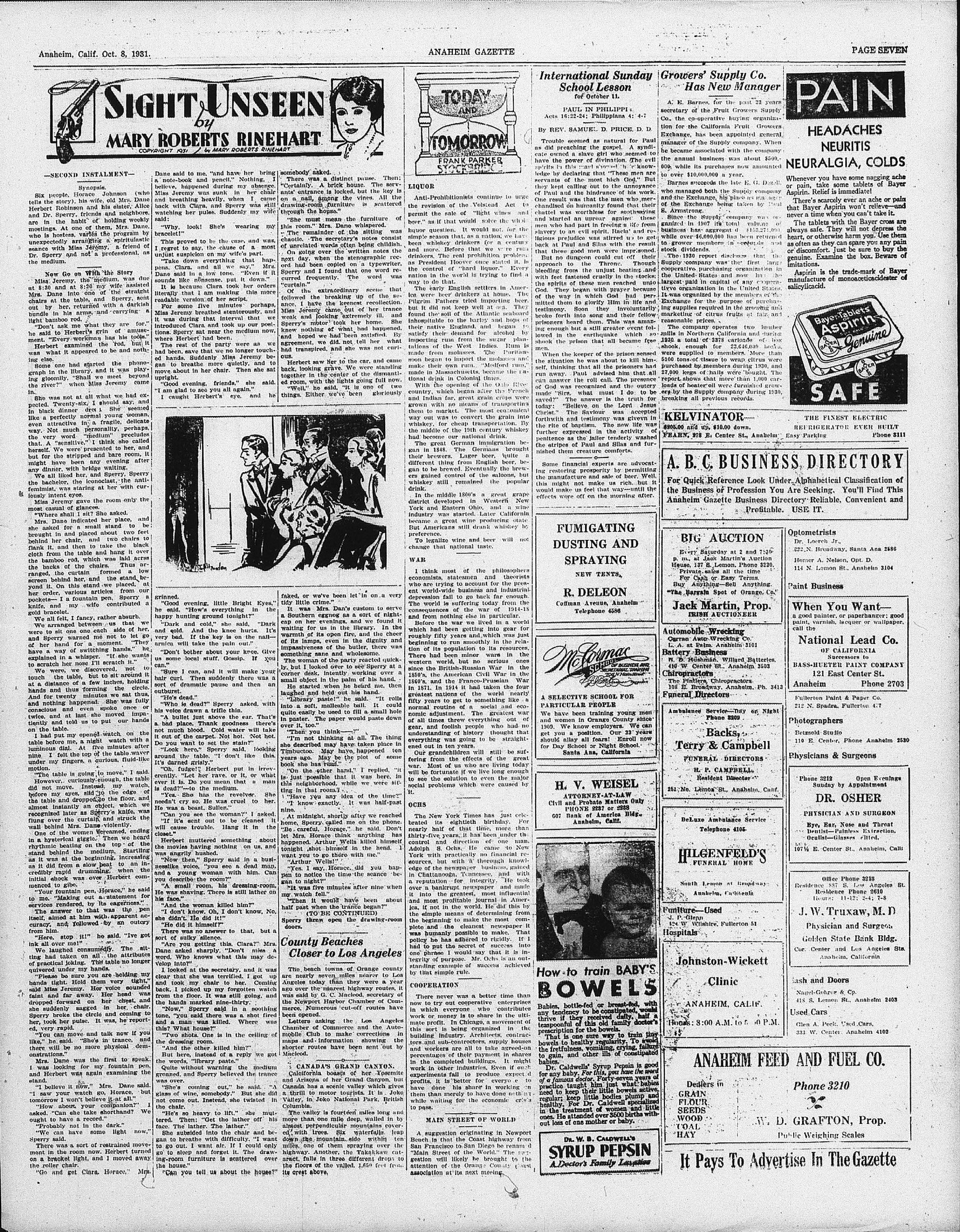
Searchable text
Anaheim, Calif. Oct. 8, 1931.
SIGHT UNSEEN by MARY ROBERTS RINEHART
COPYRIGHT 1931 BY MARY ROBERTS RINEHART
—SECOND INSTALMENT—
Synopsis.
Six people, Horace Johnson (who tells the story), his wife, old Mrs. Dane Herbert Robinson and his eldest, Alice and Dr. Sperry, friends and neighbors, are in the habit of holding weekly meetings. At one of them, Mrs. Dane, who is hostess, varies the program by unexpectedly arranging a spiritualistic soance with Miss Jeremy, a friend of Dr. Sperry and not a professional, as the medium.
Now Go on With the Story
Miss Jeremy, the medium, was due at 8:30 and at 8:20 my wife assisted Mrs. Dane into one of the straight chairs at the table, and Sperry, sent out by her, returned with a darkish bundle in his arms, and carrying a light bamboo rod.
"Don't ask me what they are for," he said to Herbert's grin of amusement. "Every workman has his tools."
Herbert examined the rod, but it was what it appeared to be nothing else.
Some one had started the phonograph in the library, and it was playing gloomily. "Shall we meet beyond the river?" when Miss Jeremy came in.
She was not at all what we had expected. Twenty-six I should say, and in black dinner dress She seemed like a perfectly normal young woman, even attractive in a fragile, delicate way. Not much personality, perhaps, the very word "medium" precludes that. A "sensitive." I think she called herself. We were presented to her, and but for the stripped and bare room, it Dane said to me, "and have her bring a note-book and penell." Nothing, I believe, happened during my absence. Miss Jeremy was sunk in her chair and breathing heavily, when I came back with Clara, and Sperry was still watching her pulse. Suddenly my wife said:
"Why, look! She's wearing my bracelet!"
This proved to be the case, and was, I regret to say, the cause of a most unjust suspicion on my wife's part.
"Take down everything that happens, Clara, and all we say." Mrs. Dane said in a low tone. "Even if it sounds like nonsense, put it down."
It is because Clara took her orders literally that I am making this more readable version of her script.
For some five minutes perhaps, Miss Jeremy breathed stentorously, and it was during that interval that we introduced Clara and took up our positions. Sperry sat near the medium now, where Herbert had been.
The rest of the party were as we had been, save that we no longer touched hands. Suddenly Miss Jeremy began to breathe more quietly, and to move about in her chair. Then she sat upright.
"Good evening, friends," she said. "I am glad to see you all again."
I caught Herbert's eye, and he somebody asked.
There was a distinct "Certainly." A brick houseants' entrance is locked, on a nail, among the drawing-room furniture through the house.
"She must mean the this room." Mrs. Dane woke.
The remainder of the chaotic. The secretary's of unrelated words often On going over the writen next day, when the steward had been copied on Sperry and I found that curred frequently. The "curtain."
Of the extraordinary followed the breaking uance. I have the keener Miss Jeremy came out weak and looking extrema Sperry's motor took her knew nothing of what I and hoped we had been agreement, we did not had transpired, and she ous.
Herbert saw her to the back, looking grave. We together in the center of ed room, with the lights go "Well," he said, "it is things. Either we've been
Some one had started the photograph in the library, and it was playing gloomily, "Shall we meet beyond the river?" when Miss Jeremy came in.
She was not at all what we had expected. Twenty-six, I should say, and in black dinner dress I seemed like a perfectly normal young woman, even attractive in a fragile, delicate way. Not much personality, perhaps, the very word "medium" precludes that. A "sensitive," I think she called herself. We were presented to her, and but for the stripped and bare room, it might have been any evening after any dinner, with bridge waiting.
We all liked her, and Sperry, Sperry the bachelor, the iconoclast, the anti-feminist, was staring at her with curiously intent eyes.
Miss Jeremy gave the room only the most casual of glances.
"Where shall I sit? She asked.
Mrs. Dane indicated her place, and she asked for a small stand to be brought in and placed about two feet behind her chair, and two chairs to flank it, and then to take the black cloth from the table and hang it over the bamboo rod, which was laid across the backs of the chairs. Thus arranged, the curtain formed a low screen behind her, and the stand beyond it. On this stand we placed, at her order, various articles from our pockets—I a fountain pen, Sperry a knife, and my wife contributed a gold bracelet.
We all felt, I fancy, rather absurd.
We arranged between us that we were to sit one one each side of her, and Sperry warned me not to let go of her hand for a moment. "They have a way of switching hands," he explained in a whisper. "If she wants to scratch her nose I'll scratch it."
We were, we discovered, not to touch the table, but to sit around it at a distance of a few inches, holding hands and thus forming the circle. And for twenty minutes we sat thus, and nothing happened. She was fully conscious and even spoke once or twice, and at last she moved impatiently and told us to put our hands on the table.
I had put my opened watch on the table before me, a night watch with a luminous dial. At five minutes after nine I felt the top of the table waver under my fingers, a curious fluid-like motion.
"The table is going to move," I said.
However, curiously enough, the table did not move. Instead, my watch, before my eyes, slid to the edge of the table and dropped to the floor, and almost instantly an object, which we recognized later as Sperry's knife, was flung over the curtain and struck the wall behind Mrs. Dane violently.
One of the women hereamed, ending in a hysterical giggle. Then we heard rhythmic beating on the top of the stand behind the medium. Startling as it was at the beginning, increasing as it did from a slow beat to an in-
grinned.
"Good evening, little Bright Eyes," he said. "How's everything in the happy hunting ground tonight?"
"Dark and cold," she said. "Dark and cold. And the knee hurts. It's very bad. If the key is on the nail—arnica will take the pain out."
"Don't bother about your knee. Give us some local stuff. Gossip. If you can."
"Sure I can, and it will make your hair curl. Then suddenly there was a sort of dramatic pause and then an outburst.
"He's dead."
"Who is dead?" Sperry asked, with his voice drawn a trifle thin.
"A bullet just above the ear. That's a bad place. Thank goodness there's not much blood. Cold water will take it out of the carpet. Not hot. Not hot. Do you want to set the stain?"
"Look here." Sperry said, looking around the table. "I don't like this. It's darned grisly."
"Oh, fudge!" Herbert put in irreverently. "Let her rave, or it, or what ever it is. Do you mean that a man is dead?"—to the medium.
"Yes. She has the revolver. She needn't cry so. He was cruel to her. He was a beast. Sullen."
"Can you see the woman?" I asked.
"If it's sent out to be cleaned it will cause trouble. Hang it in the closet."
Herbert muttered something about the movies having nothing on us, and was angrily hushed.
"Now then," Sperry said in a businesslike voice, "you see a dead man."
Herbert saw her to the back, looking grave. We together in the center of ed room, with the lights go "Well," he said. "It is things. Either we've been grinned."
"Good evening, little Bright Eyes," he said. "How's everything in the happy hunting ground tonight?"
"Dark and cold," she said. "Dark and cold. And the knee hurts. It's very bad. If the key is on the nail—arnica will take the pain out."
"Don't bother about your knee. Give us some local stuff. Gossip. If you can."
"Sure I can, and it will make your hair curl. Then suddenly there was a sort of dramatic pause and then an outburst.
"He's dead."
"Who is dead?" Sperry asked, with his voice drawn a trifle thin.
"A bullet just above the ear. That's a bad place. Thank goodness there's not much blood. Cold water will take it out of the carpet. Not hot. Not hot. Do you want to set the stain?"
"Look here." Sperry said, looking around the table. "I don't like this. It's darned grisly."
"Oh, fudge!" Herbert put in irreverently. "Let her rave, or it, or what ever it is. Do you mean that a man is dead?"—to the medium.
"Yes. She has the revolver. She needn't cry so. He was cruel to her. He was a beast. Sullen."
"Can you see the woman?" I asked.
"If it's sent out to be cleaned it will cause trouble. Hang it in the closet."
Herbert muttered something about the movies having nothing on us, and was angrily hushed.
"Now then," Sperry said in a businesslike voice, "you see a dead man."
Herbert saw her to the back, looking grave. We together in the center of ed room, with the lights go "Well," he said. "It is things. Either we've been grinned."
"The table is going to move. I said However, curiously enough, the table did not move. Instead, my watch, before my eyes, sald to the edge of the table and dropped to the floor, and almost instantly an object, which we recognized later as Sperry's knife, was flung over the curtain and struck the wall behind Mrs. Dane violently.
One of the women screamed, ending in a hysterical giggle. Then we heard rhythmic beating on the top of the stand behind the medium. Startling as it was at the beginning, increasing as it did from a slow beat to an incredibly rapid drumming, when the initial shock was over Herbert commenced to gibe.
"Your fountain pen, Horace," he said to me. "Making out a statement for services rendered, by its cagerness."
The answer to that was the pen itself, aimed at him with apparent accuracy, and followed by an outcry from him.
"Here, stop it!" he said. "I've got ink all over me!"
We laughed consumedly. The sitting had taken on all the attributes of practical joking. The table no longer quivered under my hands.
"Please be sure you are holding my hands tight. Hold them very tight," said Miss Jeremy. Her voice sounded faint and far away. Her head was dropped forward on her chest, and she suddenly sagged in her chair. Sperry broke the circle and coming to her, took her pulse. It was, he reported, very rapid.
"You can move and talk now if you like," he said. "She's in trance, and there will be no more physical demonstrations."
Mrs. Dane was the first to speak. I was looking for my fountain pen, and Herbert was again examining the etand.
"I believe it now," Mrs. Dane said. "I saw your watch go, Horace, but tomorrow I won't believe it at all."
"How about your companion?" I asked. "Can she take shorthand? We ought to have a record."
"Probably not in the dark."
"We can have some light now," Sperry said.
There was a sort of restrained movement in the room now. Herbert turned on a bracket light, and I moved away the roller chair.
"Go and get Clara, Horace," Mrs.
Let her rave, or it, or what ever it is. Do you mean that a man is dead?"—to the medium.
"Yes. She has the revolver. She needn't cry so. He was cruel to her. He was a beast. Sullen."
Can you see the woman?" I asked.
If it's sent out to be cleaned it will cause trouble. Hang it in the closet.
Herbert muttered something about the movies having nothing on us, and was angrily hushed.
Now then, Sperry said in a businesslike voice, "you see a dead man, and a young woman with him. Can you describe the room?"
A small room, his dressing-room, He was shaving. There is still lather on his face.
And the woman killed him?
I don't know. Oh, I don't know, No, she didn't. He did it!
He did it himself?
There was no answer to that, but a sort of sulky silence.
Are you getting this, Clara?" Mrs. Dane asked sharply. "Don't miss a word. Who knows what this may develop into?"
I looked at the secretary, and it was clear that she was terrified. I got up and took my chair to her. Coming back, I picked up my forgotten watch from the floor. It was still going, and the hands marked nine-thirty.
Now, Sperry said in a soothing tone, "you said there was a shot fired and a man was killed. Where was this? What house?"
Two shots. One is in the ceiling of the dressing room.
And the other killed him?
But here, instead of a reply we got the words, "library paste."
Quite without warning the medium groaned, and Sperry believed the trance was over.
She's coming out," he said. "A glass of wine, somebody." But she did not come out. Instead, she twisted in the chair.
He's so heavy to lift," she muttered. Then: "Get the lather off his face. The lather. The lather."
She subsided into the chair and began to breathe with difficulty. "I want to go out. I want air. If I could only go to sleep and forget it. The drawing-room furniture is scattered over the house."
Can you tell us about the house?"
Is just possible that it is this neighborhood while ting in that room.
Have you any idea of home, Sperry called me? Be careful, Horace," he let Mrs. Horace think happened. Arthur Wells tonight shot himself in want you to go there with Arthur Wells!
Yes. I say, Horace, do pen to notice the time they gan to night?
It was five minutes after my watch fell.
Then it would have half past when the trance (TO BE CONTINUING) Sperry threw open the doors.
County Beachers Closer to Los Angeles
The beach towns of California boasts of and Arizona of her Grand Canada has a scenic valley a thrill to motor tourist Valley, in Joko National Columbia.
The valley is fourteen more than one mile deep almost perpendicular mowed with trees. Six wedge down the mountain slider miles, one of them spraveled highway. Another, the arcta falls in three different floors of the valled its crest above.
somebody asked.
There was a distinct pause. Then;
"Certainly. A brick house. The servants' entrance is locked, but the key is on a nail, among the vines. All the drawing-room furniture is scattered through the house."
"She must mean the furniture of this room." Mrs. Dano whispered.
The remainder of the sitting was chaotic. The secretary's notes consist of unrelated words often being childish.
On going over the written notes the next day, when the stenographic record had been copied on a typewriter, Sperry and I found that one word recurred frequently. The word was "curtain."
Of the extraordinary scene that followed the breaking up of the seance, I have the keenest recollection. Miss Jeremy came out of her trance weak and looking extremely ill, and Sperry's motor took her home. She knew nothing of what had happened, and hoped we had been satisfied. By agreement, we did not tell her what had transpired, and she was not curious.
Herbert saw her to the car, and came back, looking grave. We were standing together in the center of the dismantled room, with the lights going full now.
"Well," he said, "it is one of two things. Either we've been gloriously
TODAY AND TOMORROW FRANK PARKER STOECHRIC
LIQUOR
Anti-Prohibitionists continue to urge the revision of the Volstead Act to permit the sale of "light wines and beer," as if that would solve the whirl liquor question. It would not, for the simple season that, as a nation, we have been whistler drinks for a century and more. Before that we were run drinkers. The real prohibition problem, as President Hoover once stated it, is the control of "hard liquor." Every nation in the world is trying to find a way to do that.
The early English settlers in America were beer drinkers at home. The Pilgrim Fathers tried importing beer, but it did not keep well at sea. They found the soil of the Atlantic seaboard inhospitable to the barley and hops of their native England, and began to satisfy their demand for alcohol by importing rum from the sugar plantations of the West Indies. Rum is made from molasses. The Puritan soon began to import the molasses and make their own rum. "Medford rum," made in Massachusetts, became the national drink in Colonial times.
With the opening of the Ohio River country, which began after the French and Indian far, great grain crops were grown with no means of transporting them to market. The most economical way out was to convert the grain into whiskey, for cheap transportation. By the middle of the 19th century whiskey had become our national drink.
The great German immigration began in 1848. The Germans brought their brewers. Lager beer, quite a
International Sunday School Lesson
for October 11.
PAUL IN PHILIPPI
Acts 16:22-24; Philippians 4:4-7
By REV. SAMUEL D. PRICE, D. D.
Trouble seemed as natural for Paul as did preaching the gospel. A syndicate owned a slave girl who seemed to have the power of divination. The evil spirits in this mad showed their knowledge by declaring that "These men are servants of the most high God." But they kept calling out to the annoyance of Paul and the hindrance of his work.
One result was that the men who merchandised on humanity found that their chattel was worthless for soothsaying and started an uproar against these men who had part in freeing a life from slavery to an evil spirit. Racial and religious prejudice was stirred up to get back at Paul and Silas with the result that these good men were imprisoned.
But no dungeon could cut off their approach to the Throne. Though bleeding from the unjust beating and with feet fastened cruelly in the stocks; the spirits of these men reached unto God. They began with prayer because of the way in which God had permitted them to glorify Him in life and testimony. Soon they involuntarily broke forth into song and their fellow prisoners heard them. This was amazing enough but a still greater event followed in the earthquake which so shook the prison that all became free men.
When the keeper of the prison sensed the situation he was about to kill himself, thinking that all the prisoners had run away. Paul advised him that all can answer the roll call. The presence of God was recognized and the outcry made "Sirs, what must I do to be saved?" The answer is the truth for today: "Believe on the Lord Jesus Christ." The Saviour was accepted forthwith and testimony was givenvn in the rite of baptism. The new life was further expressed in the activity of penitence as the jailer tenderly washed the stripes of Paul and Silas and furnished them creature comforts.
faked, or we've been let in on a very tidy little crime."
It was Mrs. Dan's custom to serve a Southern eggnog as a sort of nightcap on her evenings, and we found it waiting for us in the library. In the warmth of its open fire, and the cheer of its lamps, even in the dignity and impassiveness of the butler, there was something sane and wholesome.
The woman of the party reacted quickly, but I looked over to see Sperry at a corner desk, intently working over a small object in the palm of his hand.
He started when he heard me, then laughed and held out his hand.
"Library paste!" he said. "It rolls into a soft, malleable ball. It could quite easily be used to fill a small hole in paster. The paper would paste down over it, too."
"Then you think—?"
"I'm not thinking at all. The thing she described may have taken place in Timbutcoo. May have happened ten years ago. May be the plot of some book she has read."
"On the other hand," I replied, "it is just possible that it was here, in this neighborhood, while we were sitting in that room."
"Have you any idea of the time2?"
"I know exactly. It was half-past nine."
At midnight, shortly after we reached home, Sperry called me on the phone. "Be careful, Horace," he said. Don't let Mrs. Horace think anything has happened. Arthur Wells killed himself tonight, shot himself in the head. I want you to go there with me."
"Arthur Wells!"
Yes, I say, Horace, did you hap-
make their own run. "Medford run," made in Massachusetts, became the national drink in Colonial times.
With the opening of the Ohio River country, which began after the French and Indian far, great grain crops were grown with no means of transporting them to market. The most economical way out was to convert the grain into whiskey, for cheap transportation. By the middle of the 19th century whiskey had become our national drink.
The great German immigration began in 1848. The Germans brought their brewers. Lager beer, quite a different thing from English beer, began to be brewed. Eventually the brewers gained control of the saloons, but whiskey still remained the popular drink.
In the middle 1800's a great grape district developed in Western New York and Eastern Ohio, and a wine industry was started. Later California became a great wine producing state. But Americans still drank whiskey by preference.
To legalize wine and beer will not change that national taste.
WAR
I think most of the philosophers economists, statesmen and theorists who are trying to account for the present world-wide business and industrial depression fall to go back far enough. The world is suffering today from the consequences of the war of 1914-18 and from nothing else in particular.
Before the war we lived in a world which had been getting into gear for roughly fifty years and which was just beginning to run smoothly in the relation of its population to its resources. There had been minor wars in the western world, but no serious ones since the British-Russian War in the 1850's, the American Civil War in the 1860's, and the Franco-Prussian War in 1871. In 1914 it had taken the four greatest nations of the world nearly fifty years to get to something like a normal routine of a social and economic adjustment. The greatest war of all times threw everything out of gear, and foolish people who had no understanding of history thought that everything was going to be straightened out in ten years.
Our grandchildren will still be suffering from the effects of the great war. Most of us who are living today will be fortunate if we live long enough to see the solution to even the major social problems which were caused by it.
OCHS
The New York Times has just celebrated its eighth birthday. For nearly half of that time, more than thirty-five years, it has been under the control and direction of one man, Adolph S. Ochs. He came to New York with practically no financial resources, but with a thorough knowledge of the newspaper business, gained
County Beaches
Closer to Los Angeles
The beach towns of Orange county are nearly seven miles nearer to Los Angeles today than they were a year ago over the nearest highway routes. It was said by G. C. Macleod, secretary of the Newport Harbor Chamber of Commerce. Numerous cut-off routes have been opened.
Letters asking the Los Angeles Chamber of Commerce and the Automobile Club to make corrections in maps and information showing the shorter routes have been sent out by Macleod.
CANADA'S GRAND CANYON.
California boasts of her Yosemite and Arizona of her Grand Canyon, but Canada has a scenic valley which gives a thrill to motor tourists. It is Joko Valley, in Joko National Park, British Columbia.
The valley is fourteen miles long and more than one mile deep, walled in by almost perpendicular mountains covered with trees. Six waterfalls leap down the mountain side within ten miles, one of them spraying over the highway. Another, the Takakkaw cut-aract, falls in three different drops to the floors of the valled. 1,650 feet from its crest above.
OCHS
The New York Times has just celebrated its eighteenth birthday. For nearly half of that time, more than thirty-five years, it has been under the control and direction of one man, Adolph S. Ochs. He came to New York with practically no financial resources, but with a thorough knowledge of the newspaper business, gained in Chattanooga, Tennessee, and with a reputation for integrity. He took over a bankrupt newspaper and made it into the greatest, most influential and most profitable journal in America, if not in the world. He did this by the simple means of determining from the beginning to make the most complete and the cleanest newspaper it was humanly possible to make. That policy he has adhered to rigidly. If I had to put the secret of success into one phrase I would say that it is integrity of purpose. Mr. Ochs is an outstanding example of success achieved by that simple rule.
COOPERATION
There never was a better time than now to try out cooperative enterprises in which everyone who contributes work or money is to share in the ultimate profit. In Chicago, a movement of this sort is being organized in the building industry. Architects, contractors and sub-contractors, supply houses and workers are all to take agreed-on percentages of their payment in shares in the completed buildings. It might work in other industries. Even if such experiments fail to produce expected profits, it is better for every e to have done his share in working on them than merely to have done nothing while waiting for the economic crisis to pass.
MAIN STREET OF WORLD
A suggestion originating in Newport Beach is that the Coast highway from San Francisco to San Diego be renamed "Main Street of the World." The suggestion will likely be brought to the attention of the Orange County association at its next meeting.
How to train BABY'S BOWELS
Babies, bottle-fed or breast-fed, with any tendency to be constipated, would thrive if they received daily, half a teaspoonful of this old family doctor's prescription for the bowels.
That is one sure way to train tiny bowels to healthy regularity. To avoid the fretfulness, vomiting, crying, failure to gain, and other ills of constipated babies.
Dr. Caldwell's Syrup Pepsin is good for any baby. For this, you have the word of a famous doctor. Forty-seven years of practice taught him just what babies need to keep their little bowels active, regular; keep little bodies plump and healthy. For Dr. Caldwell specialized in the treatment of women and little ones. He attended over 3500 births without loss of one mother or baby.
Dr. W. B. Caldwell's SYRUP PEPSIN
A Doctor's Family Laziness
Growers' Supply Co. Has New Manager
A. E. Barnes, for the past 23 years secretary of the Fruit Growers Supply Co., the co-operative buying organization for the California Fruit Growers Exchange, has been appointed general manager of the Supply company. When he became associated with the company the annual business was about $500,000, while its purchases now amounted to over $10,000,000 a year.
Barnes succeeds the late E. G. Dazell who managed both the Supply company and the Exchange, his place as manager of the Exchange being taken by Paul S. Armstrong.
Since the Supply company was organized in 1907 its total volume of business has aggregated $153,271,000 while over $6,000,000 has been returned to grower members in orgsands and stock dividends.
The 1930 report discloses that the Supply company was the first large cooperative purchasing organization in the United States and now has the largest paid in capital of any cooperative organization in the United States. It was organized by the members of the Exchange for the purpose of purchasing supplies required in the growing and marketing of citrus fruits at fair and reasonable prices.
The company operates two lumber mills in Northern California and during 1930 a total of 3378 carloads of box shook, enough for 23,646,000 boxes were supplied to members. More than 5100 tons of tissue to wrap citrus were purchased by members during 1930, and 27,000 kegs of halls were bought. The report shows that more than 1,000 carloads of beater oil were furnished growers by the Supply company during 1930, breaking all previous records.
Aspirin is the trade-mark of Bayer manufacture of monoacetic acidester of salicylic acid.
KELVINATOR—
$805.00 and up, $10.00 down.
FEARN, 278 E. Center St., Anaheim
Easy Parking
Phone 3111
KELVINATOR—THE FINEST ELECTRIC REFRIGERATOR EVER BUILT
$205.00 and up, $10.00 down.
FEARN, 278 E. Center St., Anaheim Easy Parking Phone 3111
A. B. C. BUSINESS DIRECTORY
For Quick Reference Look Under Alphabetical Classification of the Business or Profession You Are Seeking. You'll Find This Anaheim Gazette Business Directory Reliable, Convenient and Profitable. USE IT.
BIG AUCTION
Every Saturday at 2 and 7:30 p.m., at Jack Martin's Auction House, 137 S. Lemon, Phone 3220.
Private sales all the time
For Cash or Easy Terms.
Buy Anything—Sell Anything.
The Bargain Spot of Orange Co.
Jack Martin, Prop.
IRISH AUCTIONEER
Automobile Wrecking
Curran Auto Wrecking Co.
L. A. at Palm, Anaheim 3101
Battery Business
M. D. Hushman, Willard Batteries,
419 W Center St., Anaheim 3503
Chiropractors
The Pinters, Chiropractors.
108 E. Broadway, Anaheim, Ph. 3413
Funeral Directors
Ambulance Service—Day or Night
Phone 3209
Backs,
Terry & Campbell
FUNERAL DIRECTORS
H. P. CAMPBELL,
Resident Director
251 No. Lemon St., Anaheim, Calif.
DeLuxe Ambulance Service
Telephone 4105
HILGENFELD'S
FUNERAL HOME
Optometrists
Dr. Loerch Jr.
222 N. Broadway, Santa Ana 2586
Homer A. Nelson, Opt. D.
114 N. Lemon St., Anaheim 3104
Paint Business
When You Want—a good painter, or paper hanger; good paint, varnish, lacquer or wallpaper, call the National Lead Co.
OF CALIFORNIA Successors to BASS-HUETER PAINT COMPANY
121 East Center St.
Anaheim Phone 2703
Fullerton Paint & Paper Co.
212 N. Spadra, Fullerton 477
Photographers
Betzsold Studio
119 E. Center, Phone Anaheim 2530
Physicians & Surgeons
Phone 3212 Open Evenings
Sunday by Appointment
DR. OSHER
PHYSICIAN AND SURGEON
Eye, Ear, Nose and Throat Dentist—Painless Extraction.
Ocullus—Glasses clitted.
107½ E. Center St., Anaheim, Calif
Resident Director
251 No. Lemon St., Anaheim, Calif.
DeLuxe Ambulance Service
Telephone 4105
HILGENFELD'S
FUNKAL HOME
South Lemon at Broadway
Anaheim, California
Funiture—Used
J. P. Glepn
124 W. Wilshire, Fullerton 51
Hospitals
Johnston-Wickett
Clinic
ANAHEIM, CALIF.
Hours: 8:00 A.M. to 5:00 P.M.
Phone 3212 Open Evenings
Sunday by Appointment
DR. OSHER
PHYSICIAN AND SURGEON
Bye, Ear, Nose and Throat
Dentist—Painless Extraction.
Ocullus—Glasses elitd.
107½ E. Center St., Anaheim, Calif.
Office Phone 3218
Residence 887 S. Los Angeles St.
Residence Phone 2610
Hours: 11-12; 2-4; 7-8
J. W. Truxaw, M. D
Physician and Surgeon:
Golden State Bank Bldg.
Cor. Center and Los Angeles Sta.
Anaheim, California
Cash and Doors
Nagel-Gohres & Co.
418 S. Lemon St., Anaheim 2403
Used Cars
Glen A. Peck, Used Cars,
333 W. Center, Anaheim 4102
ANAHEIM FEED AND FUEL CO.
Dealers in
GRAIN
FLOUR
SEEDS
WOOD
COAL
HAY
Phone 3210
W. D. GRAFTON, Prop.
Public Weighing Scales
It Pays To Advertise In The Gazette