anaheim-gazette 1931-10-08
Scanned page
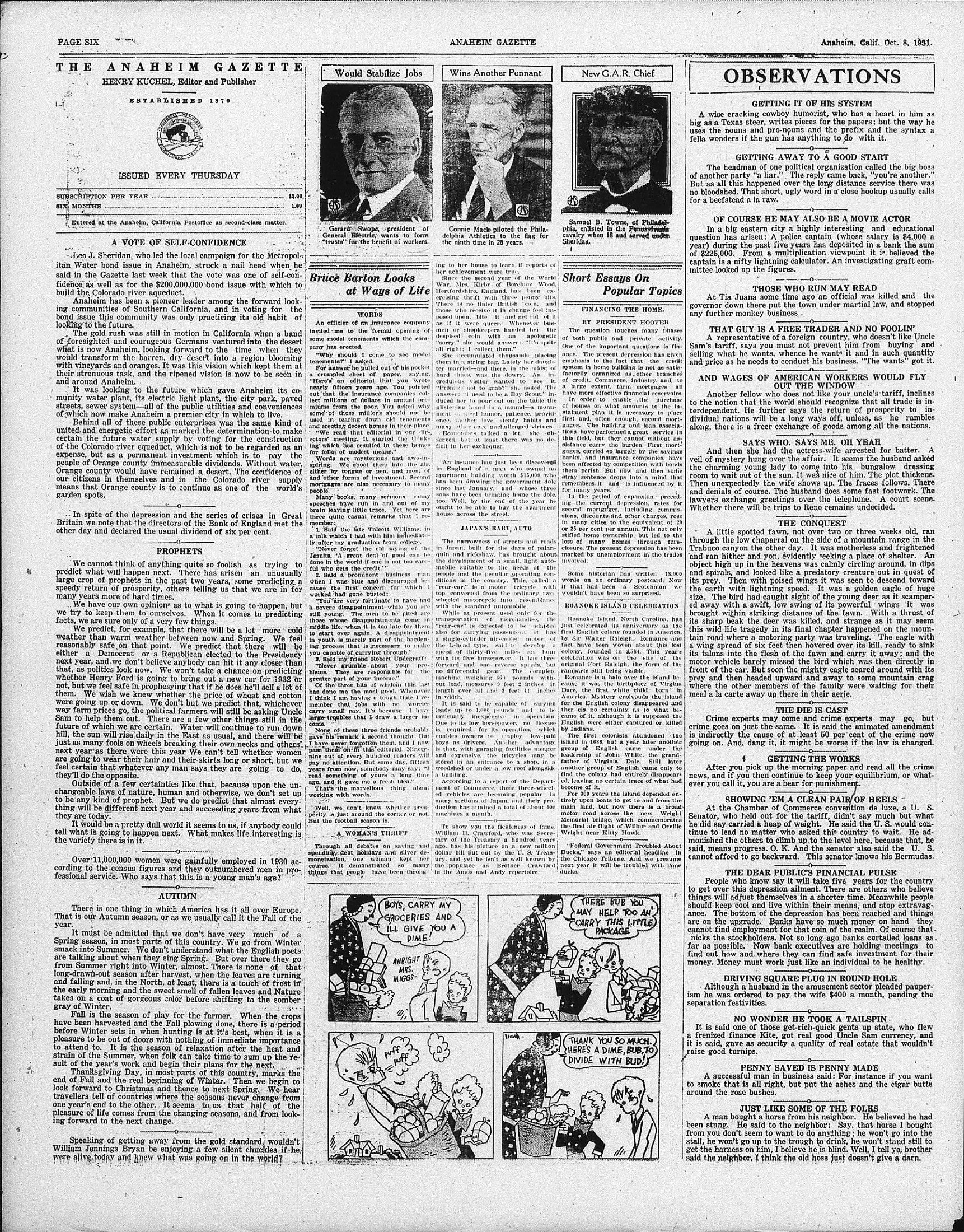
Searchable text
THE ANAHEIM GAZETTE
HENRY KUCHEL, Editor and Publisher
ESTABLISHED 1870
ISSUED EVERY THURSDAY
SUBSCRIPTION PER YEAR $2.00
SIX MONTHS 1.00
Entered at the Anaheim, California Postoffice as second-class matter.
A VOTE OF SELF-CONFIDENCE
Leo J. Sheridan, who led the local campaign for the Metropolitan Water bond issue in Anaheim, struck a nail head when he said in the Gazette last week that the vote was one of self-confidence as well as for the $200,000,000 bond issue with which to build the Colorado river aqueduct.
Anaheim has been a pioneer leader among the forward looking communities of Southern California, and in voting for the bond issue this community was only practicing its old habit of looking to the future.
The gold rush was still in motion in California when a band of foresighted and courageous Germans ventured into the desert what is now Anaheim, looking forward to the time when they would transform the barren, dry desert into a region blooming with vineyards and oranges. It was this vision which kept them at their strenuous task, and the ripened vision is now to be seen in and around Anaheim.
It was looking to the future which gave Anaheim its community water plant, its electric light plant, the city park, paved streets, sewer system—all of the public utilities and conveniences of which now make Anaheim a premier city in which to live.
Behind all of these public enterprises was the same kind of united and energetic effort as marked the determination to make certain the future water supply by voting for the construction of the Colorado river aqueduct, which is not to be regarded as an expense, but as a permanent investment which is to pay the
with vineyards and oranges. It was this vision which kept them at their strenuous task, and the ripened vision is now to be seen in and around Anaheim.
It was looking to the future which gave Anaheim its community water plant, its electric light plant, the city park, paved streets, sewer system—all of the public utilities and conveniences of which now make Anaheim a premier city in which to live.
Behind all of these public enterprises was the same kind of united and energetic effort as marked the determination to make certain the future water supply by voting for the construction of the Colorado river equeduct, which is not to be regarded as an expense, but as a permanent investment which is to pay the people of Orange county immeasurable dividends. Without water, Orange county would have remained a desert. The confidence of our citizens in themselves and in the Colorado river supply means that Orange county is to continue as one of the world's garden spots.
In spite of the depression and the series of crises in Great Britain we note that the directors of the Bank of England met the other day and declared the usual dividend of six per cent.
PROPHETS
We cannot think of anything quite so foolish as trying to predict what will happen next. There has arisen an unusually large crop of prophets in the past two years, some predicting a speedy return of prosperity, others telling us that we are in for many years more of hard times.
We have our own opinions as to what is going to happen, but we try to keep them to ourselves. When it comes to predicting facts, we are sure only of a very few things.
We predict, for example, that there will be a lot more cold weather than warm weather between now and Spring. We feel reasonably safe on that point. We predict that there will be either a Democrat or a Republican elected to the Presidency next year, and we don't believe anybody can hit it any closer than that, as politics look now. We won't take a chance on predicting whether Henry Ford is going to bring out a new car for 1932 or not, but we feel safe in prophesying that if he does he'll sell a lot of them. We wish we knew whether the price of wheat and cotton were going up or down. We don't but we predict that, whichever way farm prices go, the political farmers will still be asking Uncle Sam to help them out. There are a few other things still in the future of which we are certain. Water will continue to run down hill, the sun will rise daily in the East as usual, and there will be just as many fools on wheels breaking their own necks and others' next year as there were this year. We can't tell whether women are going to wear their hair and their skirts long or short, but we feel certain that whatever any man says they are going to do, they'll do the opposite.
Outside of a few certainties like that, because upon the unchangeable laws of nature, human and otherwise, we don't set up to be any kind of prophet. But we do predict that almost everything will be different next year and succeeding years from what they are today.
It would be a pretty dull world it seems to us, if anybody could tell what is going to happen next. What makes life interesting is the variety there is in it.
Over 11,000,000 women were gainfully employed in 1930 according to the census figures and they outnumbered men in pro-
Outside of a few certainties like that, because upon the unchangeable laws of nature, human and otherwise, we don't set up to be any kind of prophet. But we do predict that almost everything will be different next year and succeeding years from what they are today.
It would be a pretty dull world it seems to us, if anybody could tell what is going to happen next. What makes life interesting is the variety there is in it.
Over 11,000,000 women were gainfully employed in 1930 according to the census figures and they outnumbered men in professional service. Who says that this is a young man's age?
AUTUMN
There is one thing in which America has it all over Europe. That is our Autumn season, or as we usually call it the Fall of the year.
It must be admitted that we don't have very much of a Spring season, in most parts of this country. We go from Winter smack into Summer. We don't understand what the English poets are talking about when they sing Spring. But over there they go from Summer right into Winter, almost. There is none of that long-drawn-out season after harvest, when the leaves are turning and falling and, in the North, at least, there is a touch of frost in the early morning and the sweet smell of fallen leaves and Nature takes on a coat of gorgeous color before shifting to the somber gray of Winter.
Fall is the season of play for the farmer. When the crops have been harvested and the Fall plowing done, there is a period before Winter sets in when hunting is at it's best, when it is a pleasure to be out of doors with nothing of immediate importance to attend to. It is the season of relaxation after the heat and strain of the Summer, when folk can take time to sum up the result of the year's work and begin their plans for the next.
Thanksgiving Day, in most parts of this country, marks the end of Fall and the real beginning of Winter. Then we begin to look forward to Christmas and thence to next Spring. We hear travellers tell of countries where the seasons never change from one year's end to the other. It seems to us that half of the pleasure of life comes from the changing seasons, and from looking forward to the next change.
Speaking of getting away from the gold standard, wouldn't William Jennings Bryan be enjoying a few silent chuckles if he were alive today and knew what was going on in the world?
ANAHEIM GAZETTE
Would Stabilize Jobs
Gerard Swope, president of General Electric, wants to form "trusts" for the benefit of workers.
Wins Another Pennant
Connie Mack piloted the Philadelphia Athletics to the flag for the ninth time in 28 years.
New G.A.R. Chief
Samuel B. Towne, of Philadelphia, enlisted in the Pennsylvania cavalry when 18 and served under Sheridan.
Bruce Barton Looks at Ways of Life
WORDS
An officer of an insurance company invited me to the formal opening of some model tenements which the company has erected.
"Why should I come to see model tenements?" I asked.
For answer he pulled out of his pocket a crumpled sheet of paper, saying, "Here's an editorial that you wrote nearly fifteen years ago. You pointed out that the insurance companies collect millions of dollars in annual premiums from the poor. You asked why some of those millions should not be used in tearing down old tenements and erecting decent homes in their place."
"We read that editorial in our directors' meeting. It started the thinking which has resulted in these homes for folks of modest means."
ing to her house to learn if reports of her achievement were true.
Since the second year of the World War, Mrs. Kirby of Boreham Wood, Hertfordshire, England, has been exercising thrift with three penny bits. There is no tinier British coin, and those who receive it in change feel imposed upon, bite it and get rid of it as if it were queer. Whenever busmen or shopkeepers handed her the despised coin with an apologetic "sorry," she would answer: "It's quite all right; I collect them."
She accumulated thousands, placing them in a string bag. Lately her daughter married—and there, in the midst of hard times was the dowry. An incredulous visitor wanted to see it. "Promis" not to grab?" she asked. The answer: "I used to be a Boy Scout." induced her to pour out on the table the glistening hoard in a mound—a monument to good humor, patience, providence, another love, steady habits and many other once unchallenged virtues.
Economists talked a lot, she observed, but at least there was no deficit in her exchequer.
Short Essays On Popular Topics
FINANCING THE HOME.
BY PRESIDENT HOOVER
The question touches many phases of both public and private activity. One of the important questions is finance. The present depression has given emphasis to the fact that the credit system in home building is not as satisfactorily organized as other branches of credit. Commerce, industry, and, to a large extent, farm mortgages all have more effective financial reservoirs.
In order to enable the purchase of homes on what amounts to the instalment plan it is necessary to place first and, often enough, second mortgages. The building and loan associations have performed a great service in this field, but they cannot without assistance carry the burden. First mortgages, carried so largely by the savings banks, and insurance companies, have...
For answer he pulled out of his pocket a crumpled sheet of paper, saying, "Here's an editorial that you wrote nearly fifteen years ago. You pointed out that the insurance companies collect millions of dollars in annual premiums from the poor. You asked why some of those millions should not be used in tearing down old tenements and erecting decent homes in their place.
"We read that editorial in our directors' meeting. It started the thinking which has resulted in these homes for folks of modest means."
Words are mysterious and awake-inspiring. We shoot them into the air, other by tongue or pen, and most of and other forms of investment. Second mortgages are also necessary to many people.
Many books, many sermons, many speeches have run in and out of my brain leaving little trace. Yet here are three quite casual remarks that I remember:
1. Said the late Talcott Williams, in a talk which I had with him immediately after my graduation from college.
"Never forget the old saying of the Jesuits, 'A great deal of good can be done in the world if one is not too careful who gets the credit.'"
2. Said a prominent business man when I was blue and discouraged because the first concern for which I worked had gone bust:
"You are very fortunate to have had a severe disappointment while you are still young. The men to be pitted are those whose disappointments come in middle life, when it is too late for them to start over again. A disappointment in youth is merely part of the hardening process that is necessary to make you capable of carrying through."
3. Said my friend Robert Updegraff:
"Never grumble about your problems. They are responsible for the greater part of your income."
Of the three bits of wisdom this last has done me the most good. Whenever I think I am having a tough time I remember that jobs with no worries carry small pay. It's because I have large troubles that I draw a larger income.
None of these three friends probably gave his remark a second thought. But I have never forgotten them, and I now pass them on in this editorial. Ninety-nine out of every hundred readers will pay no attention. But some day, fifteen years from now, somebody may say: "I read something of yours a long time ago, and it gave me a fresh idea."
That's the marvellous thing about working with words.
Well, we don't know whether prosperity is just around the corner or not. But the football season is.
A WOMAN'S THRIFT
Through all debates on saving and spending, debt holidays and silver demonetization, one woman kept her course. It demonstrated so many them in a string bag. Lately her daughter married—and there, in the midst of hard times, was the dowry. An incredulous visitor wanted to see it.
"Promis not to grab?" she asked. The answer: "I used to be a Boy Scout." induced her to pour out on the table glistening board in a mound—a monument to good humor, patience, providence, another love, steady habits and many other once unchallenged virtues.
Economists talked a lot, she observed but at least there was no deficit in her exchequer.
An instance has just been discovered in England of a man who owned an apartment building worth $15,000 who has been drawing the government due since last January, and whose three sons have been bringing home the dole, too. Well, by the end of the year he ought to be able to buy the apartment house across the street.
JAPAN'S BABY AUTO
The narrowness of streets and roads in Japan, built for the days of palanquin and rickshaw, has brought about the development of a small, light automobile suitable to the needs of the people and the peculiar operating conditions in the country. This called a "rear-car," is a motor tricycle with top, converted from the ordinary two-wheeled motorcycle into resemblance with the standard automobile.
While at present used only for the transportation of merchandise, the "rear-car" is expected to be adapted also for carrying passengers. It has a single-cylinder air-cooled motor of the L-head type, said to develop a speed of thirty-five miles an hour with its five horsepower. It has three forward and one reverse speeds, but no differential gear. The complete machine, weighing 650 pounds without load, measures 9 feet 2 inches in length over all and 3 feet 11 inches in width.
It is said to be capable of carrying up to 1,000 pounds and to be unusually inexpensive in operation. Due to its low horsepower, no license is required for its operation, which enables owners to employ low-paid boys as drivers. Another advantage is that, with garaging facilities meager and expensive, the tricycles may be stored in an entrance to a shop, in a woodshed or under a low roof alongside a building.
According to a report of the Department of Commerce, these three-wheeled vehicles are becoming popular in many sections of Japan, and their production has attained a total of about 400 machines a month.
To show you the flickleness of fame, William H. Crawford, who was Secretary of the Treasury a hundred years ago, has his picture on a new million dollar bill put out by the U.S. Treasury, and yet he isn't as well known by the populace as Brother Crawford them in a string bag. Lately her daughter married—and there, in the midst of hard times, was the dowry. An incredulous visitor wanted to see it.
"Promis not to grab?" she asked. The answer: "I used to be a Boy Scout." induced her to pour out on the table glistening board in a mound—a monument to good humor, patience, providence, another love, steady habits and many other once unchallenged virtues.
Economists talked a lot, she observed but at least there was no deficit in her exchequer.
In order to enable the purchase of homes on what amounts to the instalment plan it is necessary to place first and, often enough, second mortgages. The building and loan associations have performed a great service in this field, but they cannot without assistance carry the burden. First mortgages, carried so largely by the savings banks, and insurance companies, have been affected by competition with bonds them perish. But now and then some stray sentence drops into a mind that remembers it and is influenced by it for many years.
In the period of expansion preceding the current depression, rates for second mortgages, including commissions, discounts, and other charges, rose in many cities to the equivalent of 20 or 25 per cent per annum. This not only stifled home ownership, but led to the loss of many homes through foreclosure. The present depression has been marked by unemployment in the trades involved.
Some historian has written 18,000 words on an ordinary postcard. Now if that had been a Scotchman we wouldn't have been so surprised.
ROANOKE ISLAND CELEBRATION
Roanoke Island, North Carolina, has just celebrated its anniversary as the first English colony founded in America, by Sir Walter Raleigh. Romance and fact have been woven with this lost colony, founded in 1584. This year's celebration was on the site of the original Fort Raleigh, the form of the ramparts still being visible.
Romance is a halo over the island because it was the birthplace of Virginia Dare, the first white child born in America. Mystery enslaves the island for the English colony disappeared and ther els no certainty as to what became of it, although it is supposed the English were either captured or killed by Indians.
The first colonists abandoned the island in 1686, but a year later another group of English came under the leadership of John White, the grandfather of Virginia Dale. Still later another group of English came only to find the colony had entirely disappeared, leaving no certain trace of what had become of it.
For 300 years the island depended entirely upon boats to get to and from main land, but now there is a broad motor road across the new Wright Memorial bridge, which commemorates the first air flight of Wilbur and Orville Wright near Kitty Hawk.
"Federal Government Troubled About Ducks," says an editorial headline in the Chicago Tribune. And we presume next year it will be troubled with lame
read something of yours a long time ago, and it gave me a fresh idea."
That's the marvellous thing about working with words.
Well, we don't know whether prosperity is just around the corner or not. But the football season is.
A WOMAN'S THRIFT
Through all debates on saving and spending, debt holidays and silver demonetization, one woman kept her course. It demonstrated so many things that people have been thronging in a building.
According to a report of the Department of Commerce, these three-wheeled vehicles are becoming popular in many sections of Japan, and their production has attained a total of about 400 machines a month.
To show you the fickleness of fame, William H. Crawford, who was Secretary of the Treasury a hundred years ago, has his picture on a new million dollar bill put out by the U.S. Treasury, and yet he isn't as well known by the populace as Brother Crawford in the Amos and Andy repertoire.
"Federal Government Troubled About Ducks," says an editorial headline in the Chicago Tribune. And we presume next year it will be troubled with lame ducks.
OBSERVATIONS
GETTING IT OF HIS SYSTEM
A wise cracking cowboy humorist, who has a heart in him as big as a Texas steer, writes pieces for the papers; but the way he uses the nouns and pro-nouns and the prefix and the syntax a fella wonders if the gun has anything to do with it.
GETTING AWAY TO A GOOD START
The headman of one political organization called the big boss of another party “a liar.” The reply came back, “you’re another.” But as all this happened over the long distance service there was no bloodshed. That short, ugly word in a close hookup usually calls for a beefstead a la raw.
OF COURSE HE MAY ALSO BE A MOVIE ACTOR
In a big eastern city a highly interesting and educational question has arisen: A police captain (whose salary is $4,000 a year) during the past five years has deposited in a bank the sum of $225,000. From a multiplication viewpoint it is believed the captain is a nifty lightning calculator. An investigating graft committee looked up the figures.
THOSE WHO RUN MAY READ
At Tia Juana some time ago an official was killed and the governor down there put the town under martial law, and stopped any further monkey business.
THAT GUY IS A FREE TRADER AND NO FOOLIN'
A representative of a foreign country, who doesn't like Uncle Sam's tariff, says you must not prevent him from buying and selling what he wants, whence he wants it and in such quantity and price as he needs to conduct his business. "The wants" got it.
AND WAGES OF AMERICAN WORKERS WOULD FLY OUT THE WINDOW
Another fellow who does not like your uncle's tariff, inclines to the notion that the world should recognize that all trade is interdependent. He further says the return of prosperity to individual nations will be a long ways off, unless, as he rambles along, there is a freer exchange of goods among all the nations.
SAYS WHO. SAYS ME. OH YEAH
And then she had the actress-wife arrested for batter. A veil of mystery hung over the affair. It seems the husband asked
AND WAGES OF AMERICAN WORKERS WOULD FLY OUT THE WINDOW
Another fellow who does not like your uncle's tariff, inclines to the notion that the world should recognize that all trade is interdependent. He further says the return of prosperity to individual nations will be a long ways off, unless, as he rambles along, there is a freer exchange of goods among all the nations.
SAYS WHO. SAYS ME. OH YEAH
And then she had the actress-wife arrested for batter. A veil of mystery hung over the affair. It seems the husband asked the charming young lady to come into his bungalow dressing room to wait out of the sun. It was nice of him. The plot thickens. Then unexpectedly the wife shows up. The fraces follows. There and denials of course. The husband does some fast footwork. The lawyers exchange greetings over the telephone. A court scene. Whether there will be trips to Reno remains undecided.
THE CONQUEST
A little spotted fawn, not over two or three weeks old, ran through the low chaparral on the side of a mountain range in the Trabuco canyon the other day. It was motherless and frightened and ran hither and yon, evidently seeking a place of shelter. An object high up in the heavens was calmly circling around, in dips and spirals, and looked like a predatory creature out in quest of its prey. Then with poised wings it was seen to descend toward the earth with lightning speed. It was a golden eagle of huge size. The bird had caught sight of the young deer as it scampered away with a swift, low swing of its powerful wings it was brought within striking distance of the fawn. With a thrust of its sharp beak the deer was killed, and strange as it may seem this wild life tragedy in its final chapter happened on the mountain road where a motoring party was traveling. The eagle with a wing spread of six feet then hovered over its kill, ready to sink its talons into the flesh of the fawn and carry it away; and the motor vehicle barely missed the bird which was then directly in front of the car. But soon the mighty eagle soared around with its prey and then headed upward and away to some mountain crag where the other members of the family were waiting for their meal a la carte away up there in their aerie.
THE DIE IS CAST
Crime experts may come and crime experts may go, but crime goes on just the same. It is said the animated amendment is indirectly the cause of at least 50 per cent of the crime now going on. And, dang it, it might be worse if the law is changed.
GETTING THE WORKS
After you pick up the morning paper and read all the crime news, and if you then continue to keep your equilibrium, or whatever you call it, you are a bear for punishment.
SHOWING 'EM A CLEAN PAIR OF HEELS
At the Chamber of Commerce convention de luxe, a U. S. Senator, who held out for the tariff, didn't say much but what he did say carried a heap of weight. He said the U. S. would continue to lead no matter who asked this country to wait. He admonished the others to climb up to the level here, because that, he said, means progress. O. K. And the senator also said the U. S. cannot afford to go backward. This senator knows his Bermudas.
SHOWING 'EM A CLEAN PAIR OF HEELS
At the Chamber of Commerce convention de luxe, a U. S. Senator, who held out for the tariff, didn't say much but what he did say carried a heap of weight. He said the U. S. would continue to lead no matter who asked this country to wait. He admonished the others to climb up to the level here, because that, he said, means progress. O. K. And the senator also said the U. S. cannot afford to go backward. This senator knows his Bermudas.
THE DEAR PUBLIC'S FINANCIAL PULSE
People who know say it will take five years for the country to get over this depression ailment. There are others who believe things will adjust themselves in a shorter time. Meanwhile people should keep cool and live within their means, and stop extravagance. The bottom of the depression has been reached and things are on the upgrade. Banks have so much money on hand they cannot find employment for that coin of the realm. Of course that nicks the stockholders. Not so long ago banks curtailed loans as far as possible. Now bank executives are holding meetings to find out how and where they can find safe investment for their money. Money must work just like an individual to be healthy.
DRIVING SQUARE PLUG IN ROUND HOLE
Although a husband in the amusement sector pleaded pauperism he was ordered to pay the wife $400 a month, pending the separation festivities.
NO WONDER HE TOOK A TAILSPIN
It is said one of those get-rich-quick gents up state, who flew a frenized finance Kite, got real good Uncle Sam currency, and it is said, gave as security a quality of real estate that wouldn't raise good turnips.
PENNY SAVED IS PENNY MADE
A successful man in business said: For instance if you want to smoke that is all right, but put the ashes and the cigar butts around the rose bushes.
JUST LIKE SOME OF THE FOLKS
A man bought a horse from his neighbor. He believed he had been stung. He said to the neighbor: Say, that horse I bought from you don't seem to want to do anything; he won't go into the stall, he won't go up to the trough to drink, he won't stand still to get the harness on him, I believe he is blind. Well, I tell ye, brother said the neighbor, I think the old hoss just doesn't give a darn.