anaheim-gazette 1931-07-02
Scanned page
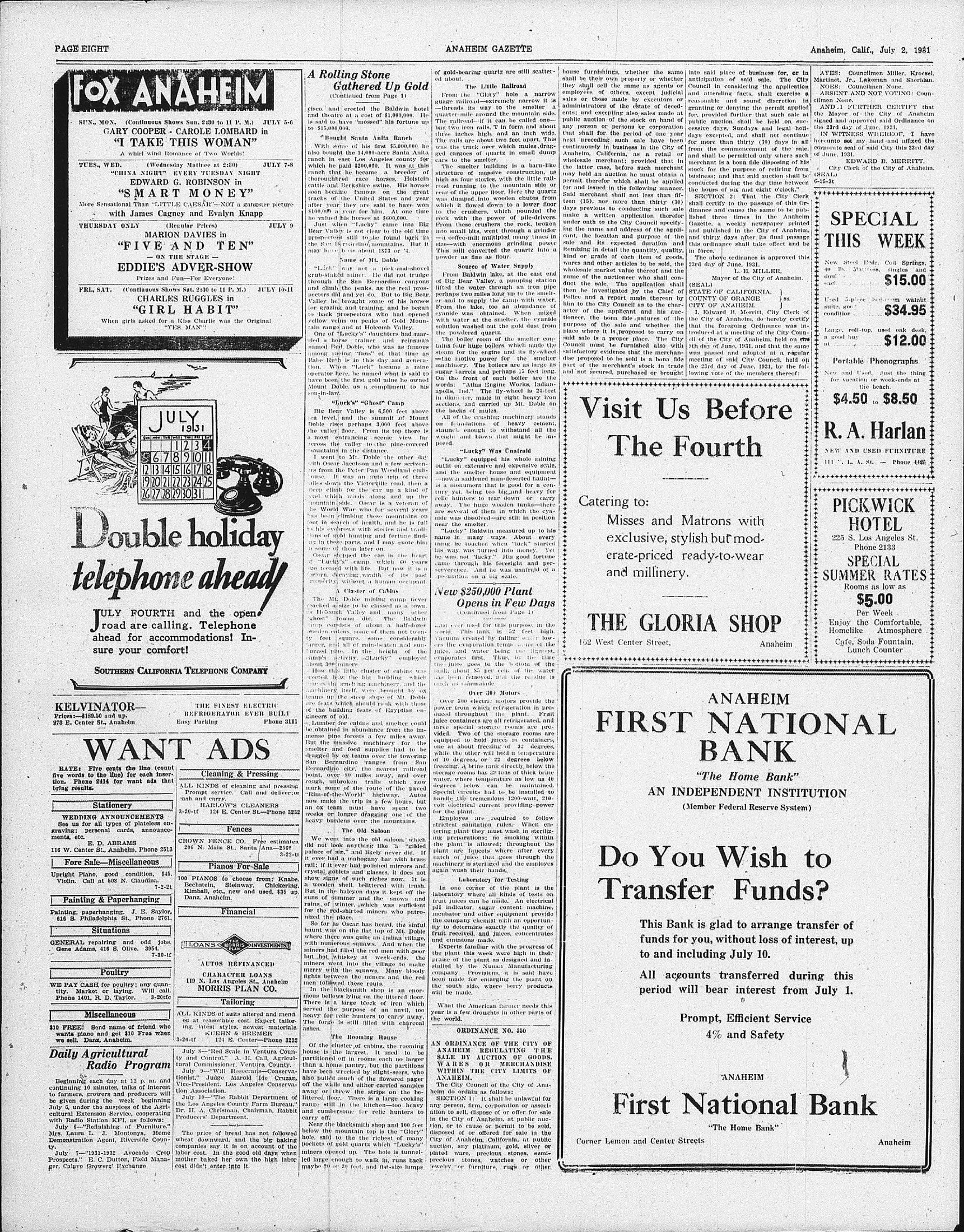
Searchable text
FOX ANAHEIM
SUN., MON. (Continuous Shows Sun. 2:30 to 11 P.M.) JULY 5-6
GARY COOPER - CAROLE LOMBARD in
"I TAKE THIS WOMAN"
A whirl wind Romance of Two Worlds!
TUES., WED. (Wednesday Matinee at 2:30) JULY 7-8
"CHINA NIGHT" EVERY TUESDAY NIGHT
EDWARD G. ROBINSON in
"SMART MONEY"
More Sensational Than "LITTLE CAESAR"—NOT a gangster picture with James Cagney and Evalyn Knapp
THURSDAY ONLY (Regular Prices) JULY 9
MARION DAVIES in
"FIVE AND TEN"
— ON THE STAGE —
EDDIE'S ADVER-SHOW
Prizes and Fun—For Everyone!
FRI., SAT. (Continuous Shows Sat. 2:30 to 11 P.M.) JULY 10-11
CHARLES RUGGLES in
"GIRL HABIT"
When girls asked for a Kiss Charlie was the Original "YES MAN"!
JULY 1931
Double holiday
telephone ahead
JULY FOURTH and the open road are calling. Telephone ahead for accommodations! Insure your comfort!
SOUTHERN CALIFORNIA TELEPHONE COMPANY
KELVINATOR—
Prices—$189.50 and up.
278 E. Center St., Anaheim
THE FINEST ELECTRIC REFRIGERATOR EVER BUILT
Easy Parking Phone 3111
WANT ADS
RATE: Five cents the line (count five words to the line) for each insertion. Phone 2414 for want ads that bring results.
Stationery
WEDDING ANNOUNCEMENTS
See us for all types of plateless engraving; personal cards, announcements, etc.
E. D. ABRAMS
116 W. Center St., Anaheim, Phone 2513
Fore Sale—Miscellaneous
Cleaning & Pressing
ALL KINDS of cleaning and pressing
Prompt service. Call and deliver; or cash and carry.
HARLOW'S CLEANERS
3-20-tf 124 E. Center St.—Phone 3232
Fences
CROWN FENCE CO. Free estimates.
206 N. Main St., Santa Ana—2560
3-22-ti
Pianos For Sale
Daily Agricultural Radio Program
Beginning each day at 12 p.m. and continuing 10 minutes, talks of interest to farmers, growers and producers will be given during the week beginning July 6, under the auspices of the Agricultural Extension Service, cooperating with Radio Station KFI, as follows:
July 6—"Refinishing of Furniture."
Mrs. Laura L. J. Montonya, Home Demonstration Agent, Riverside County.
July 7—"1931-1932 Avocado Crop Prospects." E. C. Dutton, Field Manager, Calavo Growers' Exchange
July 8—"Red Scale in Ventura County and Control." A. H. Call, Agricultural Commissioner, Ventura County.
July 9—"Will Rosecrans—Conservationist." Judge Marold Ide Cruzan, Vice-President, Los Angeles Conservation Association.
July 10—"The Rabbit Department of the Los Angeles County Farm Bureau." Dr. H. A. Chrisman, Chairman, Rabbit Producers' Department.
The price of bread has not followed wheat downward, and the big baking companies say it is on account of the labor cost. In the good old days when mother baked her own the high labor cost didn't enter into it.
A Rolling Stone Gathered Up Gold
(Continued from Page 1)
cisco, and erected the Baldwin hotel and theatre at a cost of $1,000,000. He is said to have "mossed" his fortune up to $15,000,000.
Bought Santa Anita Ranch
With some of his first $5,000,000 he also bought the 14,000-acre Santa Anita ranch in east Los Angeles county for which he paid $200,000. It was at this ranch that he became a breeder of thoroughbred race horses. Holstein cattle and Berkshire swine. His horses soon became famous on the great tracks of the United States and year after year they are said to have won $100,000 a year for him. At one time he valued his horses at $600,000.
Just when "Lucky" came into Big Bear Valley is not clear to the old time prospectors still to be found back in the San Bernardino mountains. But it may have been about 1873 or '4.
Name of Mt. Doble
"Luck" was not a pick-and-shovel grub-staked miner. He did not trudge through the San Bernardino canyons and climb the peaks, as the real prospectors did and yet do. But to Big Bear Valley he brought some of his horses for grazing and training, and he began to back prospectors who had opened yellow veins on peaks of Gold Mountain range and at Holcomb Valley.
One of "Lucky's" daughters had married a horse trainer and reinsman named Bud Doble, who was as famous among racing "fans" of that time as Babe Ruth is in this day and generation. When "Luck" became a mine operator here, he named what is said to have been the first gold mine he owned Mount Doble, as a compliment to his son-in-law.
"Luck's" "Ghost" Camp
Big Bear Valley is 6,500 feet above sea level, and the summit of Mount Doble rises perhaps 3,000 feet above the valley floor. From its top there is a most entrancing scenic view far across the valley to the pine-covered mountains in the distance.
I went to Mt. Doble the other day of gold-bearing quartz are still scattered about.
The Little Railroad
From the "Glory" hole a narrow gauge railroad—extremely narrow it is—threads its way to the smelter a quarter-mile around the mountain side. The railroad—if it can be called one—has two iron rails, T in form and about three inches high, and an inch wide. The rails are about two feet apart. This was the track over which mules dragged cargoes of quartz in small dump cars to the smelter.
The smelter building is a barn-like structure of massive construction, as high as four stories, with the little railroad running to the mountain side or rear of the upper floor. Here the quartz was dumped into wooden chutes from which it flowed down to a lower floor to the crushers, which pounded the rock with the power of pile-drivers. From these crushers the rock, broken into small bits, went through a grinder—a coffee-mill multiplied many times in size—with enormous grinding power. This mill converted the quartz into a powder as fine as flour.
Source of Water Supply
From Baldwin lake, at the east end of Big Bear Valley, a pumping station lifted the water through an iron pipe perhaps two miles long up to the smelter and to supply the camp with water. From the lake, too an abundance of cyanide was obtained. When mixed with water at the smelter, the cyanide solution washed out the gold dust from the powdered quartz.
The boller room of the smelter contains four huge boilers, which made the steam for the engine and its fly-wheel—the motive power for the smelter machinery. The boilers are as large as sugar barrels and perhaps 15 feet long. On the front of each boiler are the words: "Atlas Engine Works, Indianapolis, Ind." The fly-wheel is 24-feet in diameter, made in eight heavy iron sections, and carried up Mt. Doble on the backs of mules.
All of the crushing machinery stands on foundations of heavy cement, staunch enough to withstand all the weight and blows that might be imposed.
"Lucky" Was Unafraid
"Lucky" equipped his whole mining house furnishings, whether the same shall be their own property or whether they shall sell the same as agents on employees of others, except judicials sales or those made by executors or administrators of the estate of decedents; and excepting also sales made at public auction of the stock on hand or any person or persons or corporation that shall for the period of one year next preceding such sale have been continuously in business in the City of Anaheim, California, as a retail or wholesale merchant; provided that in the latter case, before such merchant may hold an auction he must obtain a permit thereof which shall be applied for and issued in the following manner: Said merchant shall not less than fifteen (15), nor more than thirty (30) days previous to conducting such sale make a written application thereof under oath to the City Council specifying the name and address of the applicant, the location and purpose of the sale and its expected duration and itemizing in detail the quantity, quality kind or grade of each item of goods wares and other articles to be sold, the wholesale market value thereof and the name of the auctioneer who shall conduct the sale. The application shall then be investigated by the Chief of Police and a report made thereon by him to the City Council as to the character of the applicant and his auctioneer, the bona fide pictures of the purpose of the sale and whether the place where it is proposed to carry out sale is a proper place. The City Council must be furnished also with satisfactory evidence that the merchant disposed to be sold is a bona fide part of the merchant's stock in trade and not secured, purchased or brought.
When "Luck" became a mine operator here, he named what is said to have been the first gold mine he owned Mount Doble, as a compliment to his son-in-law.
"Luck's" "Ghost" Camp
Big Bear Valley is 6,500 feet above sea level, and the summit of Mount Doble rises perhaps 3,000 feet above the valley floor. From its top there is a most entrancing scenic view far across the valley to the pine-covered mountains in the distance.
I went to Mt. Doble the other day with Oscar Jacobi and a few serviers from the Peter Pan Woodland clubhouse. It was an auto trip of three miles down the Victoryville road, then a steep climb for the car up a kind of road which winds along and up the mountain side. Oscar is a veteran of the World War who for several years has been climbing these mountains on foot in search of health, and he is full of his eyebrows with stories and traditions of gold hunting and fortune finding in these parts, and I may quote him a some of them later on.
Oscar stopped the car in the heart of "Lucky's" camp, which 60 years ago teemed with life. But now it is a dormant decaying wreck of its past prosperity without a human occupant.
A Cluster of Cabins
The Mt. Doble mining camp never reached a size to be classed as a town, Holcomb Valley and many other ghost towns did. The Baldwin camp consists of about a half-dozen wooden cabins, some of them not twenty feet square, some considerably larger, and all of rain-beaten and sun-turned pine. In the height of the camp's activity, "Lucky" employed about 300 miners.
How this little cluster of cabins was erected, how the big building which houses the smelting machinery, and the machinery itself, were brought by ox teams up the steep slope of Mt. Doble are feats which should rank with those of the building feats of Egyptian engineers of old.
Lumber for cabins and smelter could be obtained in abundance from the immense pine forests a few miles away. But the massive machinery for the smelter and food supplies had to be dragged by ox teams over the towering San Bernardino ranges from San Bernardino city; the nearest railroad point, over 80 miles away, and over rough, unbroken trails which now mark some of the route of the paved "Rim-of-the-World" highway. Autos now make the trip in a few hours, but an ox team must have spent two weeks or longer dragging one of the heavy burdens over the mountains.
The Old Saloon
We went into the old saloon, which did not look anything like a "gilded palace of sin," and likely never did. If it ever had a mahogany bar with brass rail; if it ever had polished mirrors and crystal rabbits, the boilers are as large as sugar barrels and perhaps 15 feet long. On the front of each boiler are the words: "Atlas Engine Works, Indianapolis, Ind." The fly-wheel is 24-feet in diameter, made in eight heavy iron sections, and carried up Mt. Doble on the backs of mules.
All of the crushing machinery stands on foundations of heavy cement, staunch enough to withstand all the weight and blows that might be imposed.
"Lucky" Was Unafraid
"Lucky" equipped his whole mining outfit on extensive and expensive scale, and the smelter house and equipment—now a saddened man-deserted haunt—is a monument that is good for a century yet, being too big and heavy for relieving hunters to tear down or carry away. The huge wooden tanks—there are several of them in which the cyanide was dissolved—are still in position near the smelter.
"Lucky" Baldwin measured up to his name in many ways. About every thing he touched when "luck" started his way was turned into money. Yet he was not "lucky." His good fortune came through his foresight and perseverance. And he was unafraid of a speculation on a big scale.
New $250,000 Plant Opens in Few Days
(Continued from Page 1)
and ever used for this purpose, in the world. This tank is 52 feet high. Vacuum created by falling water lowers the evaporation temperature of the juice, and water being the lightest, evaporates first. Thus, by the time the juice goes to the bottom of the tank, about 85 per cent of the water has been removed, and the residue is thick as marmalade.
Over 300 Motors
Over 300 electric motors provide the power from which refrigeration is produced throughout the plant. Fruit juice containers are all refrigerated, and three special storage rooms are provided. Two of the storage rooms are equipped to hold juices in containers, one at about freezing of 32 degrees, while the other will hold a temperature of 10 degrees, or 22 degrees below freezing. A brine tank directly below the storage rooms has 39 tons of thick brine water, where temperature as low as 40 degrees below can be maintained. Special circuits had to be installed to handle the tremendous 1200-watt, 210-volt electrical current providing power for the plant.
Employees are required to follow strictest sanitation rules. When entering plant they must wash in sterilizing preparations; no smoking within the plant is allowed; throughout the plant are faucets where after every batch of juice that goes through the machinery is sterilized and the employees again wash their hands.
The Old Saloon
We went into the old saloon, which did not look anything like a "gilded palace of sin," and likely never did. If it ever had a mahogany bar with brass rail; if it ever had polished mirrors and crystal goblets and glasses, it does not show signs of such riches now. It is a wooden shell, belittered with trash. But in the balcony days it kept off the suns of summer and the snows and rains of winter, which was sufficient for the red-shirted miners who patronized the place.
So far as Oscar has heard, the sinful haunt was on the flat top of Mt. Doble where there was quite an Indian village, with numerous squaws. And when the miners had filled the red men with poor but hot whiskey at week-ends, the miners went into the village to make merry with the squaws. Many bloody fights between the miners and the red men followed these routs.
In the blacksmith shop is an enormous bellows lying on the littered floor. There is a large block of iron which served the purpose of an anvil, too heavy for relic hunters to carry away. The forge is still filled with charcoal ashes.
The Rooming House
Of the cluster of cabins, the rooming house is the largest. It used to be partitioned off in rooms each no larger than a home pantry, but the partitions have been wrecked by slight-seers, who also pulled much of the flowered paper off the walls and either carried samples away or threw the strips on the littered floor. There is a large cooking range still in the kitchen—too heavy and cumbersome for relic hunters to carry off.
Near the blacksmith shop and 100 feet below the mountain top is the "Glory" hole, said to the richest of many pockets of gold quartz which "Lucky's" miners opened up. The hole is tunnelled large enough to walk in, runs back maybe 20 or 30 feet, and fist-size lumps
AN ORDINANCE OF THE CITY OF ANAHEIM REGULATING THE SALE BY AUCTION OF GOODS, WARES OR MERCHANDISE WITHIN THE CITY LIMITS OF ANAHEIM.
The City Council of the City of Anaheim do ordain as follows:
SECTION 1: It shall be unlawful for any person, firm, corporation or association to sell, dispose of or offer for sale in the City of Anaheim, California, at public auction, any platinum, gold, silver or plated ware, precious stones, semi-precious stones, watches or other jewelry or furniture, rugs or other
Anaheim, Calif., July 2, 1931
Innings, whether the same own property or whether all the same as agents or others, except judicial cases made by executors or persons or corporation of the estate of decedent, excepting also sales made at the stock on hand of persons or corporation for the period of one year using such sale have been in business in the City of California, as a retail or merchant; provided that in case, before such merchant the auction he must obtain a warrant which shall be applied in the following manner: it shall not less than fifteen more than thirty (30) days to conducting such sale written application therefor in the City Council specify and address of the application and purpose of the expected duration and detail the quantity, quality, price of each item of goods, other articles to be sold, the market value thereof and the auctioneer who shall conceive. The application shall investigated by the Chief of the report made thereon by City Council as to the charitable applicant and his aucu-pona fide natures of the sale and whether the suit is proposed to carry on in proper place. The City will be furnished also with evidence that the merchant to be sold is a bona fide merchant's stock in trade, purchased or brought into said place of business for, or in anticipation of said sale. The City Council in considering the application and attending facts, shall exercise a reasonable and sound discretion in granting or denying the permit applied for, provided further that such sale at public auction shall be held on successive days. Sundays and legal holidays excepted, and shall not continue for more than thirty (30) days in all from the commencement of the sale, and shall be permitted only where such merchant is a bona fide disposing of his stock for the purpose of retiring from business; and that said auction shall be conducted during the day time between the hours of six and eight o'clock.
SECTION 2: That the City Clerk shall certify to the passage of this Ordinance and cause the same to be published three times in the Anaheim Gazette, a weekly newspaper printed and published in the City of Anaheim, and thirty days after its final passage this ordinance shall take effect and be in force.
The above ordinance is approved this 23rd day of June, 1931.
L. E. MILLER,
Mayor of the City of Anaheim.
(SEAL)
STATE OF CALIFORNIA,
COUNTY OF ORANGE,
CITY OF ANAHEIM.
I. Edward B. Merritt, City Clerk of the City of Anaheim, do hereby certify that the foregoing Ordinance was introduced at a meeting of the City Council of the City of Anaheim, held on the 9th day of June, 1931, and that the same was passed and adopted at a regular meeting of said City Council, held on the 23rd day of June, 1931, by the following vote of the members thereof:
AYES: Councilmen Miller, Kroesel, Martinet, Jr., Lakeman and Sheridan.
NOES: Councilmen None.
ABSENT AND NOT VOTING: Councilmen None.
AND I FURTHER CERTIFY that the Mayor of the City of Anaheim signed and approved said Ordinance on the 23rd day of June, 1931.
IN WITNESS WHEREOF, I have hereunto set my hand and affixed the corporate seal of said City this 23rd day of June, 1931.
EDWARD B. MERRITT,
City Clerk of the City of Anaheim.
(SEAL)
6-25-3t
SPECIAL THIS WEEK
New Steel Eds., Coll Springs,
40 lb. Mattress, singles and doubles
$15.00
Used 5-piece bedroom walnut suite, good condition
$34.95
Large, roll-top, used oak desk, a good buy at
$12.00
Portable Phonographs
New and Used. Just the thing for vacation or week-ends at the beach.
$4.50 to $8.50
R. A. Harlan
NEW AND USED FURNITURE
Visit Us Before The Fourth
Bring to:
Misses and Matrons with exclusive, stylish but moderate-priced ready-to-wear and millinery.
THE GLORIA SHOP
West Center Street,
Anaheim
PICKWICK HOTEL
225 S. Los Angeles St.
Phone 2133
SPECIAL SUMMER RATES
Rooms as low as $5.00
Per Week
Enjoy the Comfortable, Homelike Atmosphere
Cafe, Soda Fountain, Lunch Counter
ANAHEIM
FIRST NATIONAL BANK
"The Home Bank"
AN INDEPENDENT INSTITUTION
(Member Federal Reserve System)
Do You Wish to
"The Home Bank"
AN INDEPENDENT INSTITUTION
(Member Federal Reserve System)
Do You Wish to Transfer Funds?
This Bank is glad to arrange transfer of funds for you, without loss of interest, up to and including July 10.
All accounts transferred during this period will bear interest from July 1.
Prompt, Efficient Service
4% and Safety
ANAHEIM
First National Bank
"The Home Bank"
Lemon and Center Streets
Anaheim