anaheim-gazette 1931-03-19
Scanned page
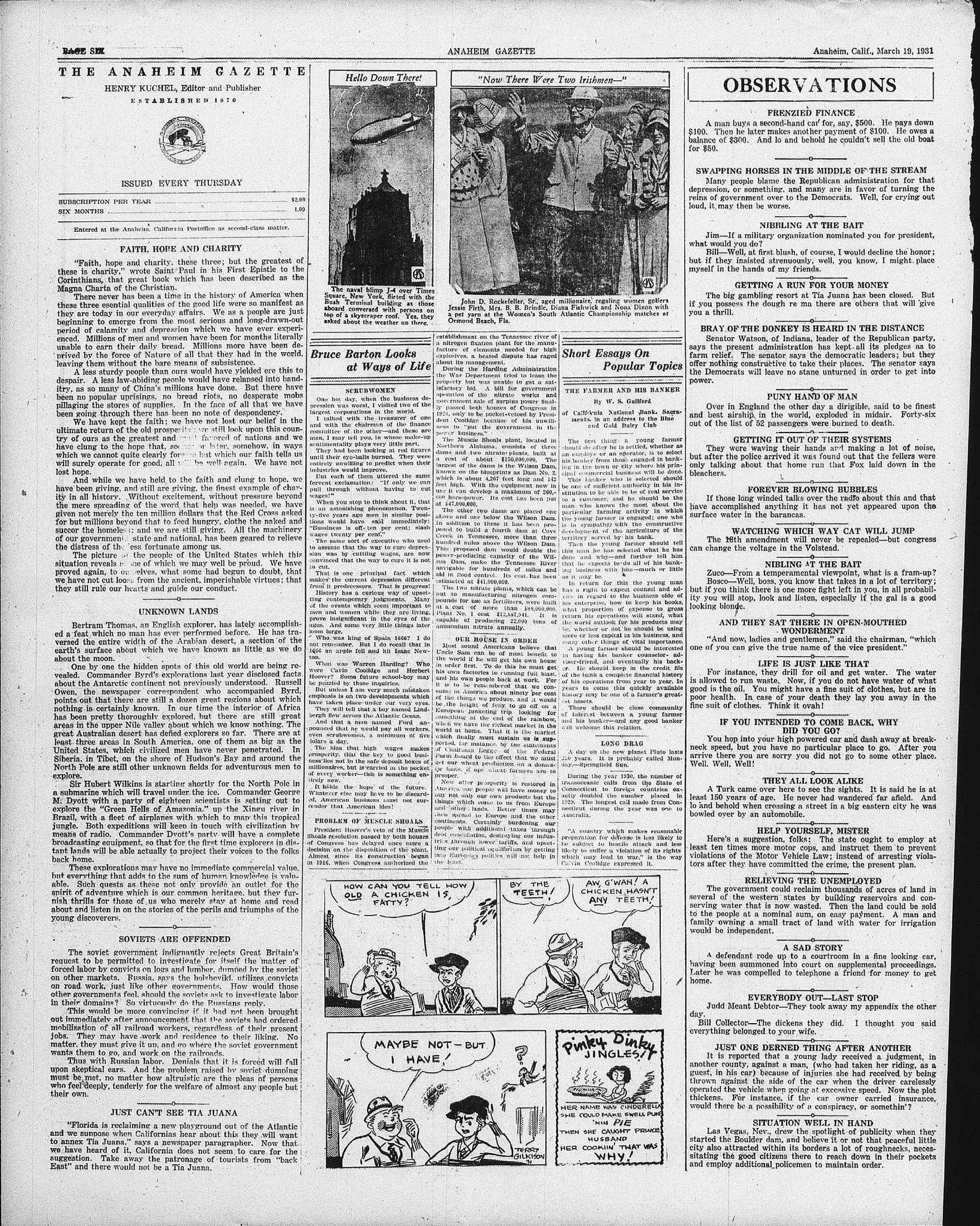
Searchable text
THE ANAHEIM GAZETTE
HENRY KUCHEL, Editor and Publisher
ESTABLISHED 1870
ISSUED EVERY THURSDAY
SUBSCRIPTION PER YEAR ... $2.00
SIX MONTHS ... 1.00
Entered at the Anaheim, California Postoffice as second-class matter.
FAITH, HOPE AND CHARITY
“Faith, hope and charity, these three; but the greatest of these is charity,” wrote Saint Paul in his First Epistle to the Corinthians, that great book which has been described as the Magna Charta of the Christian.
There never has been a time in the history of America when these three essential qualities of the good life were so manifest as they are today in our everyday affairs. We as a people are just beginning to emerge from the most serious and long-drawn-out period of calamity and depression which we have ever experienced. Millions of men and women have been for months literally unable to earn their daily bread. Millions more have been deprived by the force of Nature of all that they had in the world, leaving them without the bare means of subsistence.
A less sturdy people than ours would have yielded ere this to despair. A less law-abiding people would have relapsed into banditry, as so many of China’s millions have done. But there have been no popular uprisings, no bread riots, no desperate mobs pillaging the stores of supplies. In the face of all that we have been going through there has been no note of despondency.
We have kept the faith; we have not lost our belief in the ultimate return of the old prosperity; we still look upon this country of ours as the greatest and most favored of nations and we have clung to the hope that, sooner or later, somehow, in ways which we cannot quite clearly foresee but which our faith tells us
A less sturdy people than ours would have yielded ere this to despair. A less law-abiding people would have relapsed into banditry, as so many of China's millions have done. But there have been no popular uprisings, no bread riots, no desperate mobs pillaging the stores of supplies. In the face of all that we have been going through there has been no note of despondency.
We have kept the faith; we have not lost our belief in the ultimate return of the old prosperity; we still look upon this country of ours as the greatest and most favored of nations and we have clung to the hope that, sooner or later, somehow, in ways which we cannot quite clearly foresee but which our faith tells us will surely operate for good, all will be well again. We have not lost hope.
And while we have held to the faith and clung to hope, we have been giving, and still are giving, the finest example of charity in all history. Without excitement, without pressure beyond the mere spreading of the word that help was needed, we have given not merely the ten million dollars that the Red Cross asked for but millions beyond that to feed hungry, clothe the naked and succor the homeless; and we are still giving. All the machinery of our government state and national, has been geared to relieve the distress of the less fortunate among us.
The picture of the people of the United States which this situation reveals is one of which we may well be proud. We have proved again, to ourselves, what some had begun to doubt, that we have not cut loose from the ancient, imperishable virtues; that they still rule our hearts and guide our conduct.
UNKNOWN LANDS
Bertram Thomas, an English explorer, has lately accomplished a feat which no man has ever performed before. He has traversed the entire width of the Arabian desert, a section of the earth's surface about which we have known as little as we do about the moon.
One by one the hidden spots of this old world are being revealed. Commander Byrd's explorations last year disclosed facts about the Antarctic continent not previously understood. Russell Owen, the newspaper correspondent who accompanied Byrd, points out that there are still a dozen great regions about which nothing is certainly known. In our time the interior of Africa has been pretty thoroughly explored, but there are still great areas in the upper Nile valley about which we know nothing. The great Australian desert has defied explorers so far. There are at least three areas in South America, one of them as big as the United States, which civilized men have never penetrated. In Siberia, in Tibet, on the shore of Hudson's Bay and around the North Pole are still other unknown fields for adventurous men to explore.
Sir Hubert Wilkins is starting shortly for the North Pole in a submarine which will travel under the ice. Commander George M. Dyott with a party of eighteen scientists is setting out to explore the "Green Hells of Amazonia." up the Xingu river in Brazil, with a fleet of airplanes with which to map this tropical jungle. Both expeditions will keep in touch with civilization by means of radio. Commander Dvott's party will have a complete broadcasting equipment, so that for the first time explorers in distant lands will be able actually to project their voices to the folks back home.
SCRUIT
One hot day, we pression was worst largest corporation I talked with it and with the chair committee of the men, I may tell you sentimentality play They had been until their eye-ball entirely unwilling industries would in But each of the fervent exclamation pull through with wages! When you stop it is an astonishing twenty-five years ago actions would have "Bussiness is off-wages twenty per cent The same sort o to assume that the slon was by cutt convinced that they to cut That is one pr makes the current from it predecessor History has a citing contemporary of the events while men and women prove insignificant ages. And some v loom large Who was king o not remember. But 1666 an apple fell ton. What was War were Cavin Cook Hoover? Some fur be puzzled by those But unless I am emphasis is on two have taken place They will tell that bergh flow across t And that a man nounced that he even scrubwomen, dolars a day. The idea that h prosperity, that thness lies not in the millionaires, but is of every worker—threely new It holds the ho Whatever else may ed, American bush render that Ameri
PROBLEM OF
President Hoover Shoals resolution passed of Congress has d decision on the disp Almost since its in 1916, when Com
Sir Hubert Wilkins is starting shortly for the North Pole in a submarine which will travel under the ice. Commander George M. Dyott with a party of eighteen scientists is setting out to explore the "Green Hells of Amazonia." up the Xingu river in Brazil, with a fleet of airplanes with which to map this tropical jungle. Both expeditions will keep in touch with civilization by means of radio. Commander Dvott's party will have a complete broadcasting equipment, so that for the first time explorers in distant lands will be able actually to project their voices to the folks back home.
These explorations may have no immediate commercial value, but everything that adds to the sum of human knowledge is valuable. Such quests as these not only provide an outlet for the spirit of adventure which is our common heritage, but they furnish thrills for those of us who merely stay at home and read about and listen in on the stories of the perils and triumphs of the young discoverers.
SOVIETS ARE OFFENDED
The soviet government indignantly rejects Great Britain's request to be permitted to investigate for itself the matter of forced labor by convicts on logs and lumber, dumped by the soviet on other markets. Russia says the bolsheviks utilize convicts on road work, just like other governments. How would those other governments feel, should the soviets ask to investigate labor in their domains? So virtuously do the Russians reply.
This would be more convincing if it had not been brought out immediately after announcement that the soviets had ordered mobilization of all railroad workers, regardless of their present jobs. They may have work and residence to their liking. No matter, they must give it up, and go where the soviet government wants them to go, and work on the railroads.
Thus with Russian labor. Denials that it is forced will fall upon skeptical ears. And the problem raised by Soviet dumping must be met, no matter how altruistic are the pleas of persons who feel deeply, tenderly for the welfare of almost any people but their own.
JUST CAN'T SEE TIA JUANA
"Florida is reclaiming a new playground out of the Atlantic and we sunpose when Californias hear about this they will want to annex Tia Juana," says a newspaper paragrapher. Now that we have heard of it, California does not seem to care for the suggestion. Take away the patronage of tourists from "back East" and there would not be a Tia Juana.
Hello Down There!
The naval blimp J-4 over Times Square, New York, flirted with the Bush Terminal building as those aboard conversed with persons on top of a skyscraper roof. Yes, they asked about the weather un there.
"Now There Were Two Irishmen—"
John D. Rockefeller, Sr., aged millionaire, regaling women golfers Jessie Firth, Mrs. B. B. Brindle, Diana Fishwick and Nona Dixon with a pet yarn at the Women's South Atlantic Championship matches at Ormond Beach, Fla.
Bruce Barton Looks at Ways of Life
SCRUBWOMEN
One hot day, when the business depression was worst, I visited two of the largest corporations in the world.
I talked with the treasurer of one and with the chairman of the finance committee of the other—and these are men, I may tell you, in whose make-up sentimentality plays very little part.
They had been looking at red figures until their eyes balls burned. They were establishment on the Tennessee river of a nitrogen fixation plant for the manufacture of elements needed for high explosives, a heated dispute has raged about its management.
During the Harding Administration the War Department tried to lease the property but was unable to get a satisfactory bid. A bill for government operation of the nitrate works and government sale of surplus power finally passed both houses of Congress in 1928, only to be pocket-vetied by President Coolidge because of his unwillness to "put the government in the power business."
The Muscle Shoals plant, located in Northern Alabama, consists of three dams and two nitrate plants, built at
Short Essays On Popular Topics
THE FARMER AND HIS BANKER
By W. S. Gullford
of California National Bank. Sacramento, in an address to the Blue and Gold Dairy Club
The first thing a young farmer should do after he is settled, whether as an employee or an operator, is to select
at Ways of Life
SCRUBWOMEN
One hot day, when the business depression was worst, I visited two of the largest corporations in the world.
I talked with the treasurer of one and with the chairman of the finance committee of the other—and these are men, I may tell you, in whose make-up sentimentality plays very little part.
They had been looking at red figures until their eye-balls burned. They were entirely unwilling to predict when their industries would improve.
But each of them uttered the same fervent exclamation: "If only we can pull through without having to cut wages!"
When you stop to think about it, that is an astonishing phenomenon. Twenty-five years ago men in similar positions would have said immediately: "Bussiness is off ten per cent; slash wages twenty per cent."
The same sort of executive who used to assume that the way to cure depression was by cutting wages, are now convinced that the way to cure it is not to cut.
That is one principal fact which makes the current depression different from it predecessors. That is progress!
History has a curious way of upsetting contemporary judgments. Many of the events which seem important to men and women while they are living, prove insignificant in the eyes of the ages. And some very little things later loom large.
Who was king of Spain 1666? I do not remember. But I do recall that in 1666 an apple fell and hit Isaac Newton.
What was Warren Harding? Who were Cavin Coolidge and Herbert Hoover? Some future school-boy may be puzzled by those inquiries.
But unless I am very much mistaken emphasis is on two developments which have taken place under our very eyes. They will tell that a boy named Lindbergh flew across the Atlantic Ocean.
And that a man named Ford announced that he would pay all workers, even scrubwomen, a minimum of five dollars a day.
The idea that high wages makes prosperity, that the key to good business lies not in the safe deposit boxes of millionaires, but is carried in the pocket of every worker—this is something entirely new.
It holds the hope of the future. Whatever else may have to be discarded, American business must not surrender that American idea!
PROBLEM OF MUSCLE SHOALS
President Hoover's veto of the Muscle Shoals resolution passed by both houses of Congress has delayed once more a decision on the disposition of the plant. Almost since its construction began in 1916, when Congress authorized the about its management.
During the Harding Administration the War Department tried to lease the property but was unable to get a satisfactory bid. A bill for government operation of the nitrate works and government sale of surplus power finally passed both houses of Congress in 1928, only to be pocket-vetored by President Coolidge because of his unwillness to "put the government in the power business."
The Muscle Shoals plant, located in Northern Alabama, consists of three dams and two nitrate plants, built at a cost of about $150,000,000. The largest of the dams is the Wilson Dam, known on the blueprints as Dam No. 2, which is about 4,267 feet long and 142 feet high. With the equipment now in use it can develop a maximum of 260,000 horsepower. Its cost has been put at $47,000,000.
The other two dams are placed one above and one below the Wilson Dam. In addition to these it has been proposed to build a fourth dam at Cove Creek in Tennessee, more than three hundred miles above the Wilson Dam. This proposed dam would double the power-producing capacity of the Wilson Dam, make the Tennessee River navigable for hundreds of miles and aid in flood control. Its cost has been estimated at $41,000,000.
The two nitrate plants, which can be put to manufacturing nitrogen compounds for use as fertilizers, were built at a cost of more than $80,000,000. Plant No. 1 cost $12,887,941. It is capable of producing 22,000 tons of ammonium nitrate annually.
OUR HOUSE IN ORDER
Most sound Americans believe that Uncle Sun can be of most benefit to the world if he will get his own house in order first. To do this he must get his own factors to running full blast, and his own people back at work. For it is to be remembered that we consume in America about ninety per cent of the things we produce, and it would be the height of folly to go off on a European junketing trip looking for something at the end of the rainbow, when we have the richest market in the world at home. That it is the market which finally must sustain us is supported, for instance, by the statements of Chairman Legge of the Federal Farm Board to the effect that we must get our wheat production on a domestic basis, if opioe wheat farmers are to prosper.
Now after prosperity is restored in America our people will have money to buy not only our own products but the things which come to us from Europe and other lands. Better times may then spread to Europe and the other continents. Certainly burdening our people with additional taxes through debt cancellation, destroying our industries through lower tariffs, and upsetting our political equilibrium by getting into European politics will not help in the least.
Popular Topics
THE FARMER AND HIS BANKER
By W. S. Gullford
of California National Bank. Sacramento. In an address to the Blue and Gold Dalry Club
The first thing a young farmer should do after he is settled, whether as an employee or an operator, is to select his banker from those engaged in banking in the town or city where his principal commercial business will be done.
This banker who is selected should be one of sufficient authority in his institution to be able to be of real service to a customer, and he should be the man who knows the most about the particular farming activity in which the young farmer is engaged; one who is sympathy with the constructive development of the agriculture of the territory served by his bank.
Then the young farmer should tell this man he has selected what he has done and why—and further tell him that he expects to do all of his banking business with him—much or little as it may be.
In return for this the young man has a right to expect counsel and advice in regard to the business side of his enterprise, how to keep his books, what proportion of expense to gross return his operations will stand, what the world outlook for his products may be, whether or not he should be using more or less capital in his business, and many other things of vital importance.
A young farmer should be interested in having his banker counselor-adviser-friend, and eventually his backer. He should keep in the credit file of the bank a complete financial history of his operations from year to year. In years to come this quickly available history may be one of a farmer’s greatest assets.
There should be close community of interest between a young farmer and his banker—and any good banker will welcome this relation.
LONG DRAG
A day on the new planet Pluto lasts 250 years. It is probably called Monday—Springfield Sun.
During the year 1930, the number of transoceanic calls from the State of Connecticut to foreign countries exactly doubled the number placed in 1929. The longest call made from Connecticut during the year was over to Australia.
"A country which makes reasonable preparation for defense is less likely to be subject to hostile attack and less likely to suffer a violation of its rights which may lead to war," is the way Calvin Coolidge expressed it.
PROBLEM OF MUSCLE SHOALS
President Hoover's veto of the Muscle Shoals resolution passed by both houses of Congress has delayed once more a decision on the disposition of the plant. Almost since its construction began in 1916, when Congress authorized the
Now after prosperity is restored in America our people will have money to buy not only our own products but the things which come to us from Europe and other lands. Better times may then spread to Europe and the other continents. Certainly burdening our people with additional taxes through debt cancellation, destroying our industries through lower tariffs, and upsetting our political equilibrium by getting into European politics will not help in the least.
HOW CAN YOU TELL HOW OLD A CHICKEN IS, FATTY?
BY THE TEETH!
AW, G'WAN! A CHICKEN HASN'T ANY TEETH!
MAYBE NOT—BUT I HAVE!
Pinky Dinky JINGLES!
HER NAME WAS CINDERELLA
SHE COULD MAKE SWELL PUNG 'KIN PIE
THEN SHE CAUGHT PRINCE HUSBAND
HER COOKIIN' THAT WAS WHY!
OBSERVATIONS
FRENZIED FINANCE
A man buys a second-hand car for, say, $500. He pays down $100. Then he later makes another payment of $100. He owes a balance of $300. And lo and behold he couldn't sell the old boat for $50.
SWAPPING HORSES IN THE MIDDLE OF THE STREAM
Many people blame the Republican administration for that depression, or something, and many are in favor of turning the reins of government over to the Democrats. Well, for crying out loud, it may then be worse.
NIBBLING AT THE BAIT
Jim—If a military organization nominated you for president, what would you do?
Bill—Well, at first blush, of course, I would decline the honor; but if they insisted strenuously, well, you know, I might place myself in the hands of my friends.
GETTING A RUN FOR YOUR MONEY
The big gambling resort at Tia Juana has been closed. But if you possess the dough re ma there are others that will give you a thrill.
BRAY OF THE DONKEY IS HEARD IN THE DISTANCE
Senator Watson, of Indiana, leader of the Republican party, says the present administration has kept all its pledges as to farm relief. The senator says the democratic leaders; but they offer nothing constructive to take their places. The senator says the Democrats will leave no stane unturned in order to get into power.
PUNY HAND OF MAN
Over in England the other day a dirigible, said to be finest and best airship in the world, exploded in midair. Forty-six out of the list of 52 passengers were burned to death.
GETTING IT OUT OF THEIR SYSTEMS
They were waving their hands and making a lot of noise, but after the police arrived it was found out that the fellers were
PUNY HAND OF MAN
Over in England the other day a dirigible, said to be finest and best airship in the world, exploded in midair. Forty-six out of the list of 52 passengers were burned to death.
GETTING IT OUT OF THEIR SYSTEMS
They were waving their hands and making a lot of noise, but after the police arrived it was found out that the fellers were only talking about that home run that Fox laid down in the bleachers.
FOREVER BLOWING BUBBLES
If those long winded talks over the radio about this and that have accomplished anything it has not yet appeared upon the surface water in the barancas.
WATCHING WHICH WAY CAT WILL JUMP
The 18th amendment will never be repealed—but congress can change the voltage in the Volstead.
NIBLING AT THE BAIT
Zuco—From a temperamental viewpoint, what is a fram-up?
Bosco—Well, boss, you know that takes in a lot of territory; but if you think there is one more fight left in you, in all probability you will stop, look and listen, especially if the gal is a good looking blonde.
AND THEY SAT THERE IN OPEN-MOUTHED WONDERMENT
"And now, ladies and gentlemen," said the chairman, "which one of you can give the true name of the vice president."
LIFE IS JUST LIKE THAT
For instance, they drill for oil and get water. The water is allowed to run waste. Now, if you do not have water of what good is the oil. You might have a fine suit of clothes, but are in poor health. In case of your death they lay you away in the fine suit of clothes. Think it ovah!
IF YOU INTENDED TO COME BACK, WHY DID YOU GO?
You hop into your high powered car and dash away at break-neck speed, but you have no particular place to go. After you arrive there you are sorry you did not go to some other place. Well. Well. Well!
THEY ALL LOOK ALIKE
A Turk came over here to see the sights. It is said he is at least 150 years of age. He never had wandered far afield. And lo and behold when crossing a street in a big eastern city he was bowled over by an automobile.
HELP YOURSELF, MISTER
Here's a suggestion, folks: The state ought to employ at least ten times more motor cops, and instruct them to prevent violations of the Motor Vehicle Law; instead of arresting violators after they have committed the crime, the present plan.
THEY ALL LOOK ALIKE
A Turk came over here to see the sights. It is said he is at least 150 years of age. He never had wandered far afield. And lo and behold when crossing a street in a big eastern city he was bowled over by an automobile.
HELP YOURSELF, MISTER
Here's a suggestion, folks: The state ought to employ at least ten times more motor cops, and instruct them to prevent violations of the Motor Vehicle Law; instead of arresting violators after they have committed the crime, the present plan.
RELIEVING THE UNEMPLOYED
The government could reclaim thousands of acres of land in several of the western states by building reservoirs and conserving water that is now wasted. Then the land could be sold to the people at a nominal sum, on easy payment. A man and family owning a small tract of land with water for irrigation would be independent.
A SAD STORY
A defendant rode up to a courtroom in a fine looking car, having been summoned into court on supplemental proceedings. Later he was compelled to telephone a friend for money to get home.
EVERYBODY OUT—LAST STOP
Judd Meant Debtor—They took away my appendix the other day.
Bill Collector—The dickens they did. I thought you said everything belonged to your wife.
JUST ONE DERNED THING AFTER ANOTHER
It is reported that a young lady received a judgment, in another county, against a man, (who had taken her riding, as a guest, in his car) because of injuries she had received by being thrown against the side of the car when the driver carelessly operated the vehicle when going at excessive speed. Now the plot thickens. For instance, if the car owner carried insurance, would there be a possibility of a conspiracy, or somethin'?
SITUATION WELL IN HAND
Las Vegas, Nev., drew the spotlight of publicity when they started the Boulder dam, and believe it or not that peaceful little city also attracted within its borders a lot of roughnecks, necessitating the good citizens there to reach down in their pockets and employ additional policemen to maintain order.