anaheim-gazette 1931-01-15
Scanned page
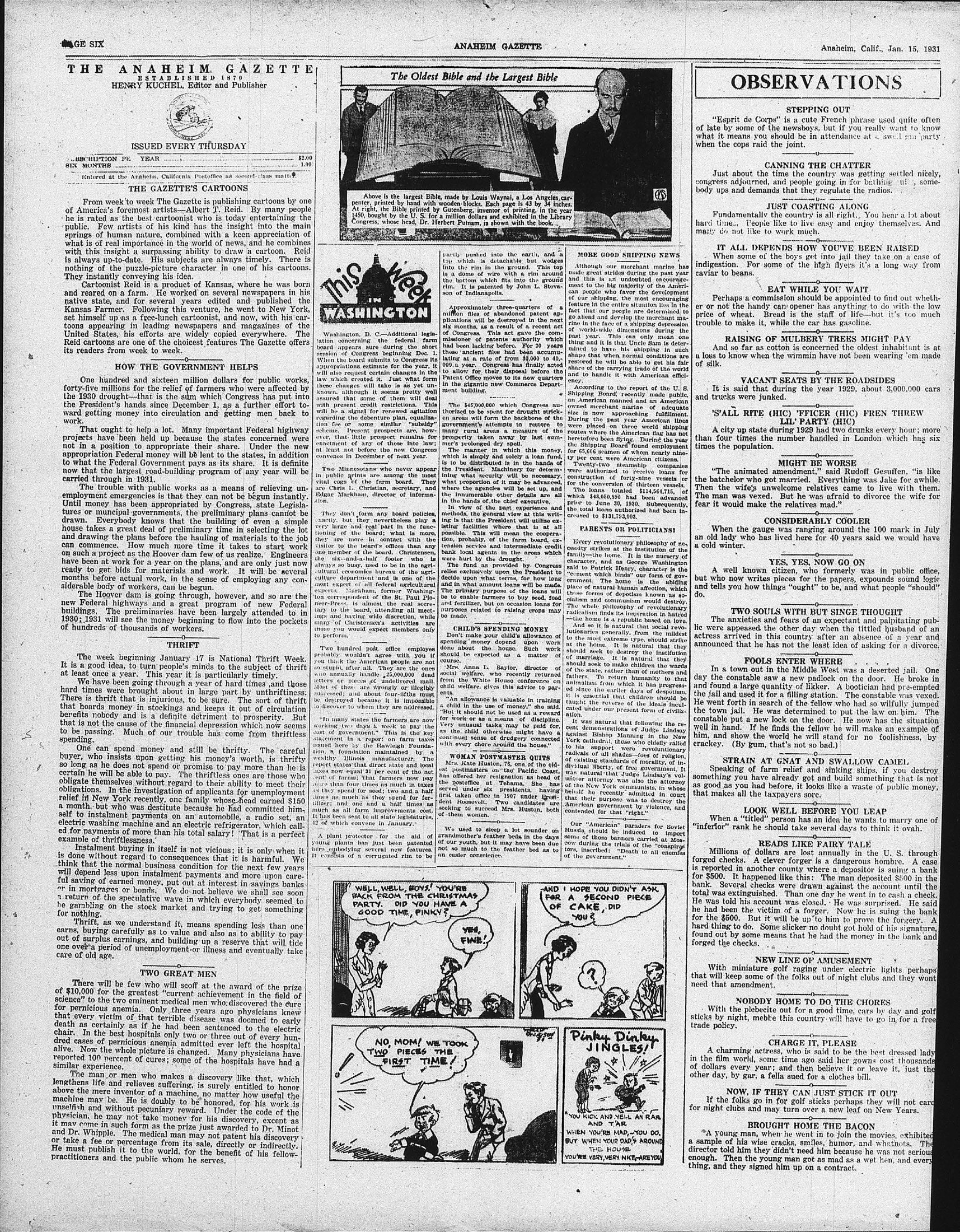
Searchable text
THE ANAHEIM GAZETTE
ESTABLISHED 1870
HENRY KUCHEL, Editor and Publisher
ISSUED EVERY THURSDAY
SUBSCRIPTION PE YEAR $2.00
SIX MONTHS 1.00
Entered at the Anaheim, California Postoffice as second-class matte.
THE GAZETTE'S CARTOONS
From week to week The Gazette is publishing cartoons by one of America's foremost artists—Albert T. Reid. By many people he is rated as the best cartoonist who is today entertaining the public. Few artists of his kind has the insight into the main springs of human nature, combined with a keen appreciation of what is of real importance in the world of news, and he combines with this insight a surpassing ability to draw a cartoon. Reid is always up-to-date. His subjects are always timely. There is nothing of the puzzle-picture character in one of his cartoons. They instantly conveying his idea.
Cartoonist Reid is a product of Kansas, where he was born and reared on a farm. He worked on several newspapers in his native state, and for several years edited and published the Kansas Farmer. Following this venture, he went to New York, set himself up as a free-lunch cartoonist, and now, with his cartoons appearing in leading newspapers and magazines of the United States, his efforts are widely copied everywhere. The Reid cartoons are one of the choicest features The Gazette offers its readers from week to week.
HOW THE GOVERNMENT HELPS
One hundred and sixteen million dollars for public works, forty-five millions for the relief of farmers who were affected by the 1930 drought—that is the sum which Congress has put into the President's hands since December 1, as a further effort toward getting money into circulation and getting men back to work.
That ought to help a lot. Many important Federal highway projects have been held up because the states concerned were not in a position to appropriate their share. Under the new appropriation Federal money will be lent to the states, in addition
HOW THE GOVERNMENT HELPS
One hundred and sixteen million dollars for public works, forty-five millions for the relief of farmers who were affected by the 1930 drought—that is the sum which Congress has put into the President’s hands since December 1, as a further effort toward getting money into circulation and getting men back to work.
That ought to help a lot. Many important Federal highway projects have been held up because the states concerned were not in a position to appropriate their share. Under the new appropriation Federal money will be lent to the states, in addition to what the Federal Government pays as its share. It is definite now that the largest road-building program of any year will be carried through in 1931.
The trouble with public works as a means of relieving unemployment emergencies is that they can not be begun instantly. Until money has been appropriated by Congress, state Legislatures or municipal governments, the preliminary plans cannot be drawn. Everybody knows that the building of even a simple house takes a great deal of preliminary time in selecting the lot and drawing the plans before the hauling of materials to the job can commence. How much more time it takes to start work on such a project as the Hoover dam few of us realize. Engineers have been at work for a year on the plans, and are only just now ready to get bids for materials and work. It will be several months before actual work, in the sense of employing any considerable body of workers, can be begun.
The Hoover dam is going through, however, and so are the new Federal highways and a great program of new Federal buildings. The preliminaries have been largely attended to in 1930; 1931 will see the money beginning to flow into the pockets of hundreds of thousands of workers.
THRIFT
The week beginning January 17 is National Thrift Week. It is a good idea, to turn people’s minds to the subject of thrift at least once a year. This year it is particularly timely.
We have been going through a year of hard times, and those hard times were brought about in large part by unthriftiness. There is thrift that is injurious, to be sure. The sort of thrift that hoards money in stockings and keeps it out of circulation benefits nobody and is a definite detriment to prosperity. But that is not the cause of the financial depression which now seems to be passing. Much of our trouble has come from thriftless spending.
One can spend money and still be thrifty. The careful buyer, who insists upon getting his money’s worth, is thrifty so long as he does not spend or promise to pay more than he is certain he will be able to pay. The thriftless ones are those who obligate themselves without regard to their ability to meet their obligations. In the investigation of applicants for unemployment relief in New York recently, one family whose head earned $150 a month, but who was destitute because he had committed himself to instalment payments on an automobile, a radio set, an electric washing machine and an electric refrigerator, which called for payments of more than his total salary! That is a perfect example of thriftlessness.
Instalment buying in itself is not vicious; it is only when it is done without regard to consequences that it is harmful. We think that the normal business condition for the next few years will also require law which creates these changes known, although assured that with present conditions will be a sign regarding the tion fee or scheme. Pres ever, that little enactment of at least not convenes in D.
Two Minnesin in public print vital cogs of are Chris L.
Edgar Markhaion.
They don’t exactly, but very large and tioning of thie they are most visitor to thie one member othe six-and-always so busi cultural economic culture depart most expert o experts. Marton correspond neer-Press. Is tary to the bo ingings and having many of Christ those you wou to perform.
In many st working two cost of govern statement in issued here by tion, a founda wealthy Illinois report states tha taxes now equent of farms; more than four as they spend dines as much tiller; and on much as all fa it has been sen 12 of which co
certain he will be able to pay. The thriftless ones are those who obligate themselves without regard to their ability to meet their obligations. In the investigation of applicants for unemployment relief in New York recently, one family whose head earned $150 a month, but who was destitute because he had committed himself to instalment payments on an automobile, a radio set, an electric washing machine and an electric refrigerator, which called for payments of more than his total salary! That is a perfect example of thriftlessness.
Instalment buying in itself is not vicious; it is only when it is done without regard to consequences that it is harmful. We think that the normal business condition for the next few years will depend less upon instalment payments and more upon careful saving of earned money, put out at interest in savings banks or in mortgages or bonds. We do not believe we shall see soon a return of the speculative wave in which everybody seemed to be gambling on the stock market and trying to get something for nothing.
Thrift, as we understand it, means spending less than one earns, buying carefully as to value and also as to ability to pay out of surplus earnings, and building up a reserve that will tide one over a period of unemployment-or illness and eventually take care of old age.
TWO GREAT MEN
There will be few who will scoff at the award of the prize of $10,000 for the greatest "current achievement in the field of science" to the two eminent medical men who discovered the cure for pernicious anemia. Only three years ago physicians knew that every victim of that terrible disease was doomed to early death as certainly as if he had been sentenced to the electric chair. In the best hospitals only two or three out of every hundred cases of pernicious anemia admitted ever left the hospital alive. Now the whole picture is changed. Many physicians have reported 100 percent of cures; some of the hospitals have had a similar experience.
The man or men who makes a discovery like that, which lengthens life and relieves suffering, is surely entitled to honor above the mere inventor of a machine, no matter how useful the machine may be. He is doubly to be honored, for his work is unselfish and without pecuniary reward. Under the code of the physician, he may not take money for his discovery, except as it may come in such form as the prize just awarded to Dr. Minot and Dr. Whipple. The medical man may not patent his discovery or take a fee or percentage from its sale, directly or indirectly. He must publish it to the world, for the benefit of his fellow-practitioners and the public whom he serves.
The Oldest Bible and the Largest Bible
Above is the largest Bible, made by Louis Waynai, a Los Angeles carpenter, printed by hand with wooden blocks. Each page is 43 by 34 inches. At right, the Bible printed by Gutenberg, inventor of printing, in the year 1450, bought by the U.S. for a million dollars and exhibited in the Library Congress, whose head, Dr. Herbert Putnam, is shown with the book.
Washington, D.C.—Additional legislation concerning the federal farm board appears sure during the short session of Congress beginning Dec. 1. When the board submits to Congress its appropriations estimate for the year, it will also request certain changes in the law which created it. Just what form these changes will take is as yet unknown, although it seems pretty well assured that some of them will deal with present credit restrictions. This will be a signal for renewed agitation regarding the debenture plan, equalization fee or some similar "subsidy" scheme. Present prospects are, however, that little prospect remains for enactment of any of these into law; at least not before the new Congress convenes in December of next year.
partly pushed into the earth, and a top which is detachable but wodges into the rim in the ground. This top is a dome of wire with a rim around the bottom which fits into the ground rim. It is patented by John L. Steva-son of Indianapolis.
Approximately three-quarters of a million files of abandoned patent applications will be destroyed in the next six months, as a result of a recent act of Congress. This act gave the commissioner of patents authority which had been lacking before. For 20 years these ancient files had been accumulating at a rate of from $0,000 to 40,000 a year. Congress has finally acted to allow for their disposal before the Patent Office moves to its new quarters in the gigantic new Commerce Department building.
The $45,000,000 which Congress authorized to be spent for drought stricken areas will form the backbone of the government's attempts to restore to many rural areas a measure of the prosperity taken away by last summer's prolonged dry spell.
The manner in which this money, which is simply and solely a loan fund,
Although our merchant marine made great strides during the past year and this is an undoubted encouragement to the big majority of the American people who favor the development of our shipping, the most encourage feature in the entire situation lies in fact that our people are determined to go ahead and develop the merchant marine in the face of a shipping depression of world-wide dimensions during past year. This can only mean thing and it is that Uncle Sam is determined to have his shipping in shape that when normal conditions restored he will be able to get his share of the carrying trade of the war and to handle it with American efficiency.
According to the report of the U.S. Shipping Board, recently made put an American manned and an American owned merchant marine of adequate size is now approaching fulfillment. During the past year American life were placed on three world shipping routes where the American flag has heretofore been flying. During the year the Shipping Board found employment for 65,606 seamen of whom nearly ninety per cent were American citizens.
works, detected by about into comfort to back to highway and were the new addition definite will be making uninstantly. Legislation not be simple in the lot of the job but work engineers must now several may conceive the Federal aid to pockets.
Week. thrift and those fitness: thrift circulation. But seems driftless. Careful thrifty he is case who take their payment $150 and him set, an call perfect when it. We years
A plant protector for the aid of young plants has just been patented here embodying several new features. It consists of a corrugated rim to be appropriations estimate for the year, it will also request certain changes in the law which created it. Just what form these changes will take is as yet unknown, although it seems pretty well assured that some of them will deal with present credit restrictions. This will be a signal for renewed agitation regarding the debenture plan, equalization fee or some similar "subsidy" scheme. Present prospects are, however, that little prospect remains for enactment of any of these into law; at least not before the new Congress convenes in December of next year.
Two Minnesotaans who never appear in public prints are among the most vital cogs of the farm board. They are Chris L. Christian, secretary, and Edgar Markham, director of information.
They don't form any board policies, exactly, but they nevertheless play a very large and real part in the functioning of the board; what is more, they are more in contact with the visitor to the board's offices than any one member of the board. Christensen, the six—and a-half footer who is always so busy, used to be in the agricultural economics bureau of the agriculture department and is one of the most expert of all federal agricultural experts. Markham, former Washington correspondent of the St. Paul Pioneer-Press, is almost the real secretary to the board, attending all meetings and having wide discretion, while many of Christensen's activities are those you would expect members only to perform.
Two hundred post office employees probably wouldn't agree with you if you think the American people are not so stupid, after all. They are the ones who annually handle 25,000,000 dead letters or pieces of undelivered mail. Most of them are wrongly or illegibly addressed; and about four-fifths must be destroyed because it is impossible to discover to whom they are addressed.
"In many states the farmers are now working two days a week to pay the cost of government." This is the key statement in a report on farm taxes issued here by the Hawleigh Foundation, a foundation maintained by a wealthy Illinois manufacturer. The report states that direct state and local taxes now equal 31 per cent of the net cent of farms; that farmers now pay more than four times as much in taxes as they spend for seed; two and a half times as much as they spend for fertilizer; and one and a half times as much as all farm improvements cost. It has been sent to all state legislatures, 12 of which convene in January.
A plant protector for the aid of young plants has just been patented here embodying several new features. It consists of a corrugated rim to be appropriations estimate for the year, it will also request certain changes in the law which created it. Just what form these changes will take is as yet unknown, although it seems pretty well assured that some of them will deal with present credit restrictions. This will be a signal for renewed agitation regarding the debenture plan, equalization fee or some similar "subsidy" scheme. Present prospects are, however, that little prospect remains for enactment of any of these into law; at least not before the new Congress convenes in December of next year.
Two Minnesotaans who never appear in public prints are among the most vital cogs of the farm board. They are Chris L. Christian, secretary, and Edgar Markham, director of information.
They don't form any board policies, exactly, but they nevertheless play a very large and real part in the functioning of the board; what is more, they are more in contact with the visitor to the board's offices than any one member of the board. Christensen, the six—and a-half footer who is always so busy, used to be in the agricultural economics bureau of the agriculture department and is one of the most expert of all federal agricultural experts. Markham, former Washington correspondent of the St. Paul Pioneer-Press, is almost the real secretary to the board, attending all meetings and having wide discretion, while many of Christensen's activities are those you would expect members only to perform.
Two hundred post office employees probably wouldn't agree with you if you think the American people are not so stupid, after all. They are the ones who annually handle 25,000,000 dead letters or pieces of undelivered mail. Most of them are wrongly or illegibly addressed; and about four-fifths must be destroyed because it is impossible to discover to whom they are addressed.
"In many states the farmers are now working two days a week to pay the cost of government." This is the key statement in a report on farm taxes issued here by the Hawleigh Foundation, a foundation maintained by a wealthy Illinois manufacturer. The report states that direct state and local taxes now equal 31 per cent of the net cent of farms; that farmers now pay more than four times as much in taxes as they spend for seed; two and a half times as much as they spend for fertilizer; and one and a half times as much as all farm improvements cost. It has been sent to all state legislatures, 12 of which convene in January.
A plant protector for the aid of young plants has just been patented here embodying several new features. It consists of a corrugated rim to be appropriations estimate for the year, it will also request certain changes in the law which created it. Just what form these changes will take is as yet unknown, although it seems pretty well assured that some of them will deal with present credit restrictions. This will be a signal for renewed agitation regarding the debenture plan, equalization fee or some similar "subsidy" scheme. Present prospects are, however, that little prospect remains for enactment of any of these into law; at least not before the new Congress convenes in December of next year.
Two Minnesotaans who never appear in public prints are among the most vital cogs of the farm board. They are Chris L. Christian, secretary, and Edgar Markham, director of information.
They don't form any board policies, exactly, but they nevertheless play a very large and real part in the functioning of the board; what is more, they are more in contact with the visitor to the board's offices than any one member of the board. Christensen, the six—and a-half footer who is always so busy, used to be in the agricultural economics bureau of the agriculture department and is one of the most expert of all federal agricultural experts. Markham, former Washington correspondent of the St. Paul Pioneer-Press, is almost the real secretary to the board, attending all meetings and having wide discretion, while many of Christensen's activities are those you would expect members only to perform.
Two hundred post office employees probably wouldn't agree with you if you think the American people are not so stupid, after all. They are the ones who annually handle 25,000,000 dead letters or pieces of undelivered mail. Most of them are wrongly or illegibly addressed; and about four-fifths must be destroyed because it is impossible to discover to whom they are addressed.
"In many states the farmers are now working two days a week to pay the cost of government." This is the key statement in a report on farm taxes issued here by the Hawleigh Foundation, a foundation maintained by a wealthy Illinois manufacturer. The report states that direct state and local taxes now equal 31 per cent of the net cent of farms; that farmers now pay more than four times as much in taxes as they spend for seed; two and a half times as much as they spend for fertilizer; and one and a half times as much as all farm improvements cost. It has been sent to all state legislatures, 12 of which convene in January."
A plant protector for the aid of young plants has just been patented here embodying several new features. It consists of a corrugated rim to be appropriations estimate for the year, it will also request certain changes in the law which created it. Just what form these changes will take is as yet unknown, although it seems pretty well assured that some of them will deal with present credit restrictions. This will be a signal for renewed agitation regarding the debenture plan, equalization fee or some similar "subsidy" scheme. Present prospects are, however, that little prospect remains for enactment of any of these into law; at least not before the new Congress convenes in December of next year.
Two Minnesotaans who never appear in public prints are among the most vital cogs of the farm board. They are Chris L. Christian, secretary, and Edgar Markham, director of information.
They don't form any board policies, exactly, but they nevertheless play a very large and real part in the functioning of the board; what is more, they are more in contact with the visitor to the board's offices than any one member of the board. Christensen, the six—and a-half footer who is always so busy, used to be in the agricultural economics bureau of the agriculture department and is one of the most expert of all federal agricultural experts. Markham, former Washington correspondent of the St. Paul Pioneer-Press, is almost the real secretary to the board, attending all meetings and having wide discretion, while many of Christensen's activities are those you would expect members only to perform.
Two hundred post office employees probably wouldn't agree with you if you think the American people are not so stupid, after all. They are the ones who annually handle 25,000,000 dead letters or pieces of undelivered mail. Most of them are wrongly or illegibly addressed; and about four-fifths must be destroyed because it is impossible to discover to whom they are addressed.
"In many states the farmers are now working two days a week to pay the cost of government." This is the key statement in a report on farm taxes issued here by the Hawleigh Foundation, a foundation maintained by a wealthy Illinois manufacturer. The report states that direct state and local taxes now equal 31 per cent of the net cent of farms; that farmers now pay more than four times as much in taxes as they spend for seed; two and a half times as much as they spend for fertilizer; and one and a half times as much as all farm improvements cost. It has been sent to all state legislatures, 12 of which convene in January."
A plant protector for the aid of young plants has just been patented here embodying several new features. It consists of a corrugated rim to be appropriations estimate for the year, it will also request certain changes in the law which created it. Just what form these changes will take is as yet unknown, although it seems pretty well assured that some of them will deal with present credit restrictions. This will be a signal for renewed agitation regarding the debenture plan, equalization fee or some similar "subsidy" scheme. Present prospects are, however, that little prospect remains for enactment of any of these into law; at least not before the new Congress convenes in December of next year.
Two Minnesotaans who never appear in public prints are among the most vital cogs of the farm board. They are Chris L. Christian, secretary, and Edgar Markham, director of information.
They don't form any board policies, exactly, but they nevertheless play a very large and real part in the functioning of the board; what is more, they are more in contact with the visitor to the board's offices than any one member of the board. Christensen, the six—and a-half footer who is always so busy, used to be in the agricultural economics bureau of the agriculture department and is one of the most expert of all federal agricultural experts. Markham, former Washington correspondent of the St. Paul Pioneer-Press, is almost the real secretary to the board, attending all meetings and having wide discretion, while many of Christensen's activities are those you would expect members only to perform.
Two hundred post office employees probably wouldn't agree with you if you think the American people are not so stupid, after all. They are the ones who annually handle 25,000,000 dead letters or pieces of undelivered mail. Most of them are wrongly or illegibly addressed; and about four-fifths must be destroyed because it is impossible to discover to whom they are addressed.
"American" paraders for Soviet Russia should be induced to impose some those banners carried at Moscow during trials of the "consplorators," inscribed: "Death to all enemies of the government."
A plant protector for the aid of young plants has just been patented here, embodying several new features. It consists of a corrugated rim to be used to sleep a lot sounder on grandmother's feather beds in the days of our youth, but it may have been due not so much to the feather bed as to an easier conscience.
WELL, WELL, BOYS! YOU'RE BACK FROM THE CHRISTMAS PARTY. DID YOU HAVE A GOOD TIME, PINKY?
YES, FINE!
AND I HOPE YOU DIDN'T ASK FOR A SECOND PIECE OF CAKE, DID YOU?
NO, MOM! WE TOOK TWO PIECES THE FIRST TIME!
Pinky Dinky JINGLES!
YOU KICK AND YELL AN RAR AND T'AIR
WHEN YOU'RE MAD, -YOU DO.
BUT WHEN YOUR DAD'S AROUND THE HOUSE
YOU'RE VERY,VERY NICE-ARE YOU
OBSERVATIONS
STEPPING OUT
"Esprit de Corps" is a cute French phrase used quite often of late by some of the newsboys, but if you really want to know what it means you should be in attendance at a swelgirl party when the cops raid the joint.
CANNING THE CHATTER
Just about the time the country was getting settled nicely, congress adjourned, and people going in for bathing suits, somebody ups and demands that they regulate the radios.
JUST COASTING ALONG
Fundamentally the country is all right. You hear a lot about hard times. People like to live easy and enjoy themselves. And many do not like to work much.
IT ALL DEPENDS HOW YOU'VE BEEN RAISED
When some of the boys get into jail they take on a case of indigestion. For some of the high flyers it's a long way from caviar to beans.
EAT WHILE YOU WAIT
Perhaps a commission should be appointed to find out whether or not the handy can opener has anything to do with the low price of wheat. Bread is the staff of life—but it's too much trouble to make it, while the car has gasoline.
RAISING OF MULBERY TREES MIGHT PAY
And so far as cotton is concerned the oldest inhabitant is at a loss to know when the wimmin have not been wearing 'em made of silk.
VACANT SEATS BY THE ROADSIDES
It is said that during the year 1929, about 3,000,000 cars and trucks were junked.
'S'ALL RITE (HIC) 'FFICER (HIC) FREN THREW LIL' PARTY (HIC)
A city up state during 1929 had two drunks every hour; more than four times the number handled in London which has six times the population.
VACANT SEATS BY THE ROADSIDES
It is said that during the year 1929, about 3,000,000 cars and trucks were junked.
'S'ALL RITE (HIC) 'FFICER (HIC) FREN THREW LIL' PARTY (HIC)
A city up state during 1929 had two drunks every hour; more than four times the number handled in London which has six times the population.
MIGHT BE WORSE
"The animated amendment," said Rudoff Gesuffen. "is like the batchelor who got married. Everything was Jake for awhile. Then the wife's unwelcome relatives came to live with them. The man was vexed. But he was afraid to divorce the wife for fear it would make the relatives mad."
CONSIDERABLY COOLER
When the gauge was ranging around the 100 mark in July an old lady who has lived here for 40 years said we would have a cold winter.
YES, YES, NOW GO ON
A well known citizen, who formerly was in public office, but who now writes pieces for the papers, expounds sound logic and tells you how things "ought" to be, and what people "should" do.
TWO SOULS WITH BUT SINGE THOUGHT
The anxieties and fears of an expectant and palpitating public were appeased the other day when the tittled husband of an actress arrived in this country after an absence of a year and announced that he has not the least idea of asking for a divorce.
FOOLS ENTER WHERE
In a town out in the Middle West was a deserted jail. One day the constable saw a new padlock on the door. He broke in and found a large quantity of likker. A bootician had pre-empted the jail and used it for a filling station. The constable was vexed. He went forth in search of the fellow who had so wilfully jumped the town jail. He was determined to put the law on him. The constable put a new lock on the door. He now has the situation well in hand. If he finds the fellow he will make an example of him, and show the world he will stand for no foolishness, by crackey. (By gum, that's not so bad.)
STRAIN AT GNAT AND SWALLOW CAMEL
Speaking of farm relief and sinking ships, if you destroy something you have already got and build something that is not as good as you had before, it looks like a waste of public money, that makes all the taxpayers sore.
LOOK WELL BEFORE YOU LEAP
When a "titled" person has an idea he wants to marry one of "inferior" rank he should take several days to think it ovah.
READS LIKE FAIRY TALE
Millions of dollars are lost annually in the U.S. through forged checks. A clever forger is a dangerous hombre. A case is reported in another county where a depositor is suing a bank
LOOK WELL BEFORE YOU LEAP
When a "titled" person has an idea he wants to marry one of "inferior" rank he should take several days to think it ovah.
READS LIKE FAIRY TALE
Millions of dollars are lost annually in the U.S. through forged checks. A clever forger is a dangerous hombre. A case is reported in another county where a depositor is suing a bank for $500. It happened like this: The man deposited $500 in the bank. Several checks were drawn against the account until the total was extinguished. Than one day he went in to cash a check. He was told his account was closed. He was surprised. He said he had been the victim of a forger. Now he is suing the bank for the $500. But it will be up to him to prove the forgery. A hard thing to do. Some slicker no doubt got hold of his signature, found out by some means that he had the money in the bank and forged the checks.
NEW LINE OF AMUSEMENT
With miniature golf raging under electric lights perhaps that will keep some of the folks out of night clubs and they wont need that amendment.
NOBODY HOME TO DO THE CHORES
With the plebecite out for a good time, cars by day and golf sticks by night, mebbe this country will have to go in for a free trade policy.
CHARGE IT, PLEASE
A charming actress, who is said to be the best dressed lady in the film world, some time ago said her gowns cost thousands of dollars every year; and then believe it or leave it, just the other day, by gar, a fella sued for a clothes bill.
NOW, IF THEY CAN JUST STICK IT OUT
If the folks go in for golf sticks perhaps they will not care for night clubs and may turn over a new leaf on New Years.
BROUGHT HOME THE BACON
A young man, when he went in to join the movies, exhibited a sample of his wise cracks, smiles, humor, and whatnots. The director told him they didn't need him because he was not serious enough. Then the young man got as mad as a wet hen, and every thing, and they signed him up on a contract.