anaheim-gazette 1931-01-08
Scanned page
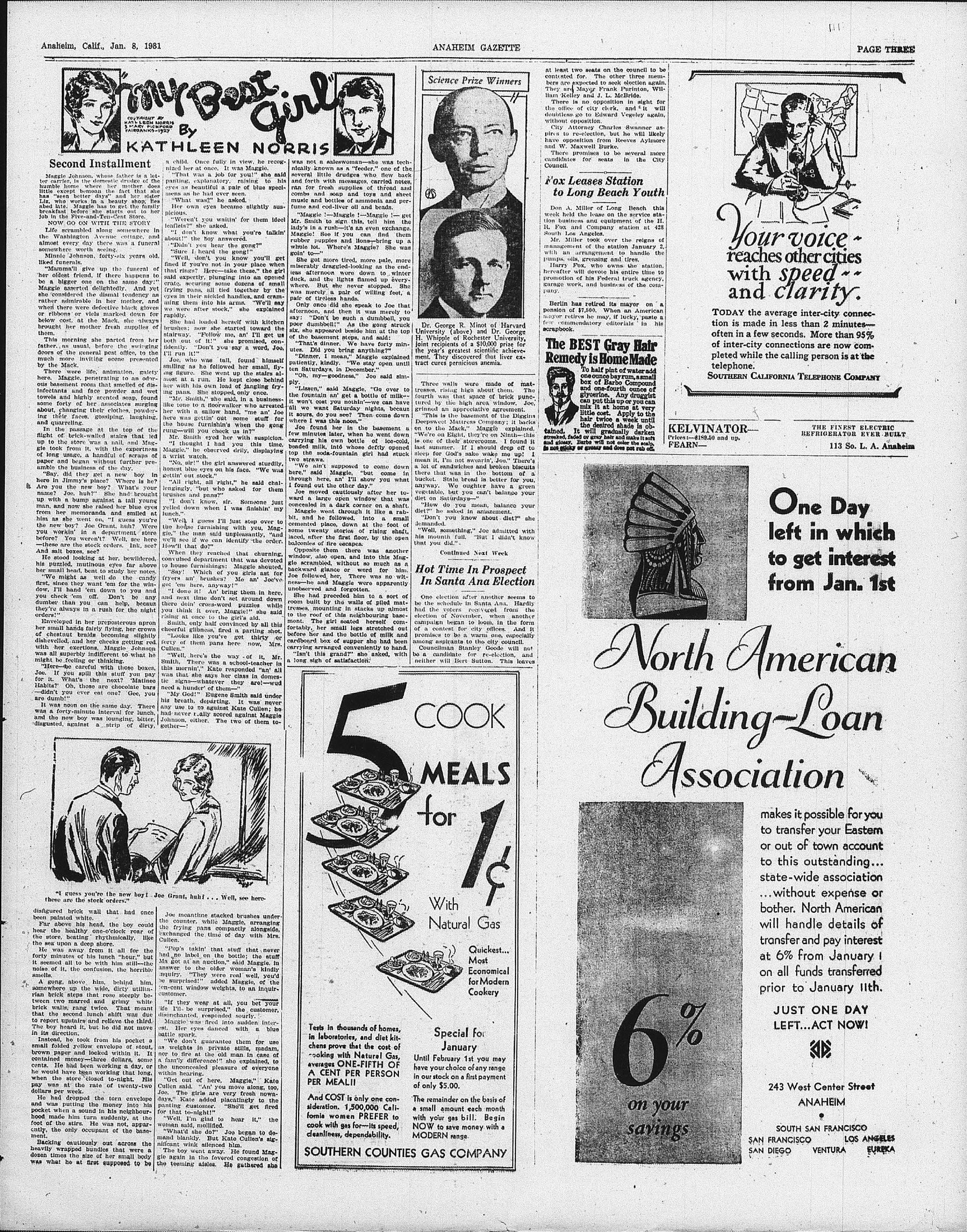
Searchable text
Anaheim, Calif., Jan. 8, 1981
Second Installment
Maggie Johnson, whose father is a letter carrier, is the domestic drudge of the humble home where her mother does little except bemoan the fact that she has "seen better days" and her sister Liz, who works in a beauty shop, lies abed late. Maggie has to get the family breakfast before she starts out to her job in the Five-and-Ten-Cent Store.
NOW GO ON WITH THE STORY
Life scrambled along somewhere in the Washington Avenue cottage, and almost every day there was a funeral somewhere worth seeing.
Mumma will give up the funeral of her oldest friend, if there happens to be a bigger one on the same day; Maggie asserted delightedly. And yet she considered the dismal tendency as rather admirable in her mother, and when there were defective black gloves or ribbons or vels marked down for below cost, at the Mack, she always brought her mother fresh supplies of them.
This morning she parted from her father, as usual, before the swinging doors of the general post office, to the much more inviting scene presented by the Mack.
There were life, animation, gaiety here. Maggie, penetrating to an odorous basement room that smelled of disinfectants and face powder and wet towels and highly scented soap, found some forty of her associates surging about, changing their clothes, powdering their faces, gossiping, laughing, and quarrelling.
In the passage at the top of the flight of brick-walled stairs that led up to the store was a nail, and Maggie took from it, with the expertness of long usage, a handful of scrapes of a child. Once fully in view, he recognized her at once. It was Maggie.
"That was a job for you!" she said painting, explanatory, raising to his eyes as beautiful a pair of blue specimens as he had ever seen.
"What was?" he asked.
Her own eyes became slightly suspicious.
"Weren't you waitin' for them ideal leaflets?" she asked.
"I don't know what you're talkin' about!" the boy answered.
"Didn't you hear the gong?"
"Sure I heard the gong!"
Well, don't you know you'll get fined if you're not in your place when that rings? Here—take these," the girl expertly plunging into an opened crate, securing some dozens of small frying pans, all tied together by the eyes in their nickel handles, and cramming them into his arms. "We'll say we were after stock," she explained rapidly.
She had loaded herself with kitchen brushes; now she started toward the stairway. "Follow me, an' I'll get us both out of it!" she promised, confidently. "Don't you say a word, Joe, I'll run it!"
Joe, who was tall, found himself smiling as he followed her small, flying figure. She went up the stairs almost at a run. He kept close behind her with his own load of jangling frying pans. She stopped only once.
Mr. Smith," she said, in a business-like tone to a floorwalker who arrested her with a sallow hand. "me an' Joe here was gettin' out some stuff for the house furnishin' when the gong rung—will you check us in?"
Mr. Smith eyed her with suspicion.
"I thought I had you this time, Maggie," he observed drily, displaying a wrist watch.
was not a saleswoman nically known as a "teen several little drudges and forth with message ran for fresh supplies combs and soap and music and bottles of amuse and cod-liver oil."
"Maggie!—Maggie! Mr. Smith to sign this lady's in a rush—it's an Maggie! See if you are rubber puppies and litle whole lot. Where's My goin' to—"
She got more tired, miserably dragged-looking less afternoon wore o duck, and the lights flame where. But she never was merely a pair of pair of tireless hands.
Only once did she spake afternoon, and then it say: "Don't be such a poor dumbbell!" As the six she appeared beside of the basement steps,
"That's dinner. We utes. Did you bring an Dinner, I mean," Mr patiently kindly. "We ten Saturdays, in December Oh, my—goodness," ply.
"Lissen," said Maggie the fountain an' get a it won't cost you nothing all we want Saturday it sours, do you see? T where I was this noon."
Joe found her in few minutes later, when carrying his own bottle beaded milk, into whose top the soda-fountain
There were life, animation, galley here. Maggie, penetrating to an odorous basement room that smelled of disinfectants and face powder and wet towels and highly scented soap, found some forty of her associates surging about, changing their clothes, powdering their faces, gossiping, laughing, and quarreling.
In the passage at the top of the flight of brick-walled stairs that led up to the store was a nail, and Maggie took from it, with the expertness of long usage, a handful of scrapes of paper and began without further preamble the business of the day.
"Say, did they get a new boy in here in Jimmy's place? Where is he? Are you the new boy? What's your name? Joe, huh?" She had brought up with a bump against a tall young man, and now she raised her blue eyes from her memoranda and smiled at him as she went on, "I guess you're the new boy? Joe Grant, huh? Were you workin' in a department store before? You weren't? Well, see here—these are the stock orders. Ink, see? And salt boxes, see?
He stood looking at her, bewildered, his puzzled, mutinous eyes far above her small head, bent to study her notes.
"We might as well do the candy first, since they want 'em for the window. I'll hand 'em down to you and you check 'em off. Don't be any dumber than you can help, because they're always in a rush for the night orders!"
Enveloped in her preposterous apron her small hands fairly flying, her crown of chestnut braids becoming slightly dishevelled, and her cheeks getting red with her exertions, Maggie Johnson was all superbly indifferent to what he might be feeling or thinking.
"Here—be careful with those boxes, Joe. If you spill this stuff you pay for it. What's the next? Matinee Habits? Oh, those are chocolate bars—didn't you ever eat one? Gee, you are dumb!"
It was noon on the same day. There was a forty-minute interval for lunch, and the new boy was lounging, bitter, disgusted, against a strip of dirty, smiling as he followed her small, flying figure. She went up the stairs almost at a run. He kept close behind her with his own load of jangling frying pans. She stopped only once.
"Mr. Smith," she said, in a business-like tone to a floorwalker who arrested her with a sallow hand, "me an' Joe here was gettin' out some stuff for the house furnishin' when the gong rung—will you check us in?"
Mr. Smith eyed her with suspicion.
"I thought I had you this time, Maggie," he observed drily, displaying a wrist watch.
"No, sir!" the girl answered sturdily, honest blue eyes on his face. "We was gettin' out stock."
"All right, all right," he said challengingly, "but who asked for them brushes and pans?"
"I don't know, sir. Someone just yelled down when I was finishin' my lunch."
"Well I guess I'll just stop over to the house furnishing with you, Maggie," the man said unpleasantly, "and we'll see if we can identify the order. How'll that do?"
When they reached that churning, convulsed department that was devoted to house furnishings: Maggie shouted, "Say! Which of you girls ast for fryers an' brushes? Me an' Joe've got 'em here, anyway!"
"I done it! An' bring them in here, and next time don't set around down there doin' cross-word puzzles while you think it over, Maggie!" she said rising at once to the girl's aid.
Smith, only half convinced by all this cheerful glibness, fired a parting shot.
"Looks like you've got thirty or forty of them pans here now, Mrs. Cullen."
"Well, here's the way—of it, Mr. Smith. There was a school-teacher in this mornin'," Kate responded "an' all was that she says her class in domestic signs—whatever they are!—wud need a hunder' of them—"
"My God!" Eugene Smith said under his breath, departing. It was never any use to go against Kate Cullen; he had never really scored against Maggie Johnson either. The two of them together—!
"I guess you're the new boy! Joe Grant, huh! . . . Well, see here these are the stock orders."
disfigured brick wall that had once been painted white.
Far above his head, the boy could hear the healthy one-o'clock roar of the store, beating rhythmically, like the sea upon a deep shore.
He was away from it all for the forty minutes of his lunch "hour," but it seemed all to be with him still—the noise of it, the confusion, the horrible smells.
A gong, above him, behind him, somewhere up the wide, dirty utilitarian brick steps that rose steeply between two marred and grimy white brick walls, rang twice. That meant that the second lunch shift was due to report upstairs and relieve the third. The boy heard it, but he did not move in its direction.
Instead, he took from his pocket a small folded yellow envelope of stout, brown paper and looked within it. It contained money—three dollars, some cents. He had been working a day, or he would have been working that long, when the store closed to-night. His pay was at the rate of twenty-two dollars per week.
He had dropped the torn envelope and was putting the money into his pocket when a sound in his neighbourhood made him turn suddenly, at the foot of the stirs. He was not, apparently, the only occupant of the basement.
Backing cautiously out across the heavily wrapped bundles that were a dozen times the size of her small body was what he at first supposed to be
Joe meantime stacked brushes under the counter, while Maggie, arranging the frying pans compactly alongside, exchanged the time of day with Mrs. Cullen.
"Pop's takin' that stuff that never had no label on the bottle; the stuff Ma got at an auction," said Maggie, in answer to the older woman's kindly inquiry. "They were real well, you'd be surprised!" added Maggie, of the ten-cent window weights, to an inquirer-customer.
"If they wear at all, you bet your life I'll be surprised," the customer, disenchanted, responded sourly.
Maggie was fired into sudden interest. Her eyes danced with a blue battle spark.
"We don't guarantee them for use as weights in private stills, madam, nor to fire at the old man in case of a family difference!" she explained, to the unconcealed pleasure of everyone within hearing.
"Get out of here, Maggie," Kate Cullen said. "An' you move along, too, Joe. The girls are very fresh nowadays," Kate added placatingly to the panting customer. "She'll get fired for that to-night!"
"Well, I'm glad to hear it," the woman said, mollified.
"What'd she do?" Joe began to demand blankly. But Kate Cullen's significant wink silenced him.
The boy went away. He found Maggie again in the fevored congestion of the teeming alley. He gathered she
was not a saleswoman—she was technically known as a "feeder," one of the several little drudges who flew back and forth with messages, carried notes, ran for fresh supplies of thread and combs and soap and toys and sheet music and bottles of ammonia and perfume and cod-liver oil and beads.
"Maggie!—Maggie!—Maggie!—get Mr. Smith to sign this, tell him the lady's in a rush—it's an even exchange. Maggie! See if you can find them rubber puppies and lions—bring up a whole lot. Where's Maggie? She was goin' to—"
She got more tired, more pale, more miserably dragged-looking as the endless afternoon wore down to winter duck, and the lights flamed up everywhere. But she never stopped. She was merely a pair of willing feet, a pair of tireless hands.
Only once did she speak to Joe that afternoon, and then it was merely to say: "Don't be such a dumbbell, you poor dumbbell!" As the gong struck six, she appeared beside him at the top of the basement steps, and said:
"That's dinner. We have forty minutes. Did you bring anything?"
"Dinner, I mean." Maggie explained patiently, kindly. "We stay open until ten Saturdays, in December."
"Oh, my—goodness," Joe said simply.
"Lissen," said Maggie, "Go over to the fountain an' get a bottle of milk—it won't cost you nothin—we can have all we want Saturday nights, because it sours, do you see? Then come down where I was this noon."
Joe found her in the basement a few minutes later, when he went down carrying his own bottle of ice-cold, beaded milk, into whose deftly opened top the soda-fountain girl had stuck two straws.
Science Prize Winners
Dr. George R. Minot of Harvard University (above) and Dr. George H. Whipple of Rochester University, joint recipients of a $10,000 prize for the year's greatest scientific achievement. They discovered that liver extract cures pernicious anemia.
Three walls were made of mattresses, rising high about them. The fourth was that space of brick punctured by the high area window. Joe, grinned an appreciative agreement.
"This is the basement of the Diggins Deep-sweet Mattress Company; it backs on to the Mack," Maggie explained.
"We're on Eight, they're on Ninth—this is one of their storerooms. I found it last summer. If I should drop off to sleep for God's sake wake me up! I mean it. I'm not sleeping. Lollipop at least two seats on the council to be contested for. The other three members are expected to seek election again. They are Mayor Frank Purinton, William Kelley and J. L. McBride.
There is no opposition in sight for the office of city clerk, and it will doubtless go to Edward Vegeley again, without opposition.
City Attorney Charles Swanner aspires to re-election, but he will likely have opposition from Reeves Aylmore and W. Maxwell Burke.
There promises to be several more candidates for seats in the City Council.
Fox Leases Station to Long Beach Youth
Don A. Miller of Long Beach this week held the lease on the service station business and equipment of the H.R. Fox and Company station at 428 South Los Angeles.
Mr. Miller took over the reigns of management of the station January 2, with an arrangement to handle the pumps, oils, greasing and tires.
Harry Fox, who owns the station, hereafter will devote his entire time to promotion of his Federal truck agency, garage work, and business of the company.
Berlin has retired its mayor on a pension of $7,500. When an American mayor retires he may, if lucky, paste a few commendatory editorials in his scrapbook.
The BEST Gray Hair Remedy is Home Made
To half pint of water add one ounce bayrum, small box of Barbo Compound and one-fourth ounce of glycerine. Any druggist can put this up or you can mix it at home at very little cost. Apply to the hair twice a week until the desired shade is obtained. It will gradually darken streaked, faded or gray hair and make it soft and glossy. Barbe will not color the scalp, is not sticky or greasy and does not rub off.
patently, kindly. "We stay open until ten Saturdays, in December."
"Oh, my—goodness," Joe said simply.
"Lissen," said Maggie, "Go over to the fountain an' get a bottle of milk—it won't cost you nothin'—we can have all we want Saturday nights, becauz it sours, do you see? Then come down where I was this noon."
Joe found her in the basement a few minutes later, when he went down carrying his own bottle of ice-cold, beaded milk, into whose deftly opened top the soda-fountain girl had stuck two straws.
"We ain't supposed to come down here," said Maggie, "but come in through here, an' I'll show you what I found out the other day."
Joe moved cautiously after her toward a large open window that was concealed in a dark corner on a shaft.
Maggie went through it like a rabbit, and he followed, into a small cemented place, down at the foot of some twenty stories of rising shaft, laced, after the first floor, by the open balconies of fire escapes.
Opposite them there was another window, also open, and into this Maggie scrambled, without so much as a backward glance or word for him. Joe followed her. There was no witness—the he and Maggie were apparently unobserved and forgotten.
She had preceded him to a sort of room built by the walls of piled mattresses, mounting in stacks up almost to the roof of this neighbouring basement. The girl seated herself comfortably, her small legs stretched out before her and the bottle of milk and cardboard box of supper she had been carrying arranged conveniently to hand.
"Isn't this grand?" she asked, with a long sigh of satisfaction.
Three walls were made of mattresses, rising high about them. The fourth was that space of brick punctured by the high area window. Joe, grinned an appreciative agreement.
"This is the basement of the Diggins Deep sweet Mattress Company; it backs on to the Mack," Maggie explained.
"We're on Eight, they're on Ninth—this is one of their storerooms. I found it last summer. If I should drop off to sleep for God's sake wake me up! I mean it, I'm not swearin', Joe." There's a lot of sandwiches and broken biscuits there that was in the bottom of a bucket. Stala bread is better for you, anyway. We oughter have a green vegetable, but you can't balance your diet on Saturdays—"
"How do you mean, balance your diet?" he asked in amazement.
"Don't you know about diet?" she demanded.
"Well, something," Joe admitted with his mounth full. "But I didn't know that you did."
Continued Next Week
Hot Time In Prospect
In Santa Ana Election
One election after another seems to be the schedule in Santa Ana. Hardly had the voters recovered from the election of November, when another campaign began to loom, in the form of a contest for city offices. And it promises to be a warm one, especially among aspirants to the city council.
Councillman Stanley Goode will not be a candidate for re-election, and neither will Bert Sutton. This leaves
MEALS
for 1¢
With Natural Gas
Quickest...
Most Economical
for Modern Cookery
Tests in thousands of homes,
in laboratories, and diet kitchens prove that the cost of cooking with Natural Gas,
averages ONE-FIFTH OF A CENT PER PERSON PER MEAL II
And COST is only one consideration. 1,500,000 California women PREFER to cook with gas for—its speed, cleanliness, dependability.
Special for January
Until February 1st you may have your choice of any range in our stock on a first payment of only $5.00.
The remainder on the basis of a small amount each month with your gas bill. Begin NOW to save money with a MODERN range.
SOUTHERN COUNTIES GAS COMPANY
Your voice reaches other cities with speed and clarity.
TODAY the average inter-city connection is made in less than 2 minutes—often in a few seconds. More than 95% of inter-city connections are now completed while the calling person is at the telephone.
SOUTHERN CALIFORNIA TELEPHONE COMPANY
KELVINATOR—
Prices: $189.50 and up.
FEARN—
THE FINEST ELECTRIC REFRIGERATOR EVER BUILT
113 So. L. A. Anaheim
telephone.
SOUTHERN CALIFORNIA TELEPHONE COMPANY
KELVINATOR—
Prices: $189.50 and up.
FEARN—
THE FINEST ELECTRIC REFRIGERATOR EVER BUILT
113 So. L. A. Anaheim
One Day left in which to get interest from Jan. 1st
North American Building-Loan Association
makes it possible for you to transfer your Eastern or out of town account to this outstanding...
makes it possible for you to transfer your Eastern or out of town account to this outstanding...state-wide association...without expense or bother. North American will handle details of transfer and pay interest at 6% from January 1 on all funds transferred prior to January 11th.
JUST ONE DAY LEFT...ACT NOW!
243 West Center Street
ANAHEIM
SOUTH SAN FRANCISCO
SAN FRANCISCO LOS ANGELES
SAN DIEGO VENTURA EUREKA