anaheim-gazette 1930-01-23
Scanned page
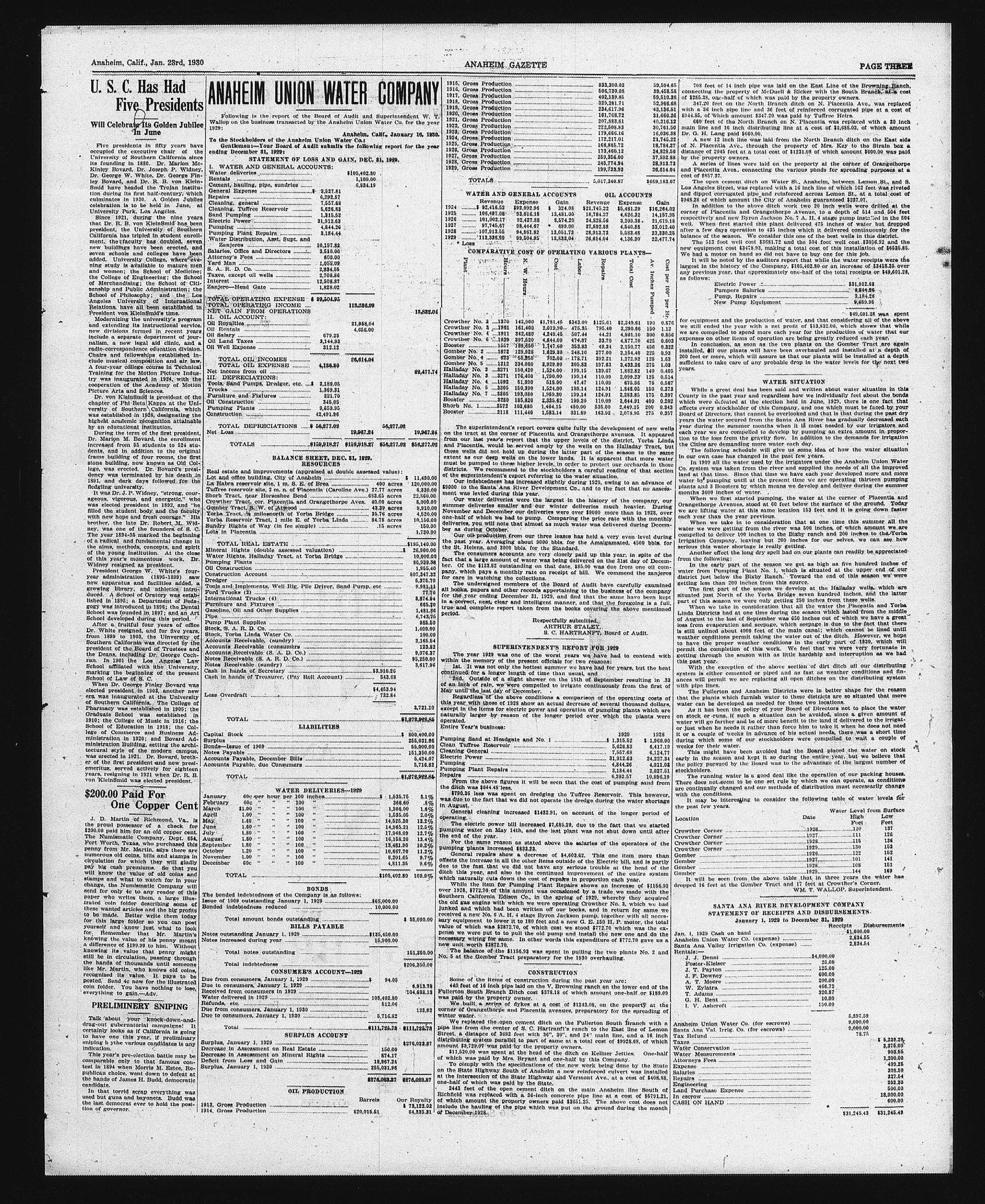
Searchable text
U. S. C. Has Had Five Presidents
Will Celebrate Its Golden Jubilee in June
Five presidents in fifty years have occupied the executive chair of the University of Southern California since its founding in 1880. Dr. Marlon McKinley Bovard, Dr. Joseph P. Widney, Dr. George W. White, Dr. George Finley Bovard, and Dr. R. B. von KleinSmid have headed the Trojan institution during its first half-century, which culminates in 1930. A Golden Jubilee celebration is to be held in June, at University Park, Los Angeles.
Since 1921, during the nine years that Dr. R. B. von KleinSmid has been president, the University of Southern California has tripled in student enrollment, the faculty has doubled, seven new buildings have been erected, and seven schools and colleges have been added. University College, where evening study is available to mature men and women; the School of Medicine; the College of Engineering; the School of Merchandising; the School of Citizenship and Public Administration; the School of Philosophy; and the Los Angeles University of International Relations, have all been established in President von KleinSmid's time.
Modernizing the university's program and extending its instructional service, new divisions formed in recent years include a separate department of journalism, a new legal aid clinic, and a radio-correspondence education division. Chairs and fellowships established include musical composition and air law. A four-year college course in Technical Training for the Motion Picture Industry was inaugurated in 1924, with the cooperation of the Academy of Motion Picture Arts and Sciences.
Dr. von KleinSmid is president of the chapter of Phil Beta Kappa at the University of Southern California, which was established in 1928, designating the highest academic recognition attainable by an educational institution.
During the term of the first president, Dr. Marion M. Bovard, the enrollment increased from 55 students to 524 students.
ANAHEIM UNION WATER
Following is the report of the Board of Audit and Wallop on the business transacted by the Anaheim Union 1929:
To the Stockholders of the Anaheim Union Water Co:
Gentlemen:—Your Board of Audit submits the following December 31, 1929:
STATEMENT OF LOSS AND GAIN, DECEMBER 31, 1929:
I. WATER AND GENERAL ACCOUNTS:
Water deliveries $105,402
Rentals 1,100
Cement, hauling, pipe, sundries 6,834
General Expense $3,527.81
Repairs 6,292.57
Cleaning, general 7,557.68
Cleaning, Tuffree Reservoir 5,626.83
Sand Pumping 1,315.52
Electric Power 31,912.63
Pumping 4,844.26
Pumping Plant Repairs 3,184.44
Water Distribution, Asst. Supt. and Zanjeros 10,197.82
Salaries, Office and Directors 3,510.00
Attorney's Fees 600.00
Yard Man 1,055.09
S. A. R. D. Co. 2,834.55
Taxes, except oil wells 2,708.86
Interest 12,508.87
Zanjero—Head Gate 1,828.02
TOTAL OPERATING EXPENSE $99,504.95
TOTAL OPERATING INCOME ... 113,386
NET GAIN FROM OPERATIONS
II. OIL ACCOUNT:
Oil Royalties ... 21,958
Oil Rentals ... 4,656
Oil Salary ... 679.25
Oil Land Taxes ... 3,144.93
Oil Well Expense ... 312.12
TOTAL OIL INCOMES ... 4,186.20
Net income from oil
III. DEPRECIATIONS:
Tools, Sand Pumps, Dredger, etc... $2,189.05
Trucks ... 1,369.31
Furniture and Fixtures ... 221.70
Oil Construction ... 345.05
Pumping Plants ... 9,659.95
Construction ... 42,491.96
TOTAL DEPRECIATIONS ... $58,277.02
Net Loss ... 19,967
TOTALS ... $159,918.27
Chairs and fellowships established include musical composition and air law. A four-year college course in Technical Training for the Motion Picture Industry was inaugurated in 1924, with the cooperation of the Academy of Motion Picture Arts and Sciences.
Dr. von KleinSmid is president of the chapter of Phil Beta Kappa at the University of Southern California, which was established in 1928, designating the highest academic recognition attainable by an educational institution.
During the term of the first president, Dr. Marion M. Bovard, the enrollment increased from 55 students to 524 students, and in addition to the original frame building of four rooms, the first stone building, now known as Old College, was erected. Dr. Bovard's presidency was terminated by his death in 1891, and dark days followed for the fledgling university.
It was Dr. J. P. Widney, "strong, courageous, vigorous, and energetic," who was elected president in 1892, and "he filled the student body and the faculty with new hope and fresh courage." His brother, the late Dr. Robert M. Widney, was one of the founders of S. C. The year 1894-95 marked the beginning of a radical and fundamental change in the aims, methods, concepts, and spirit of the young institution. At the close of this year's momentous work, Dr. Widney resigned as president.
President George W. White's four-year administration (1895-1899) saw new apparatus and facilities added, a growing library, and athletics introduced. A School of Oratory was established in 1895; a Department of Pedagogy was introduced in 1896; the Dental School was founded in 1897; and an Art School developed during this period.
After a fruitful four years of office Dr. White resigned, and for five years, from 1899 to 1903, the University of Southern California was directed by the president of the Board of Trustees and the Deans, including Dr. George Cochran. In 1901 the Los Angeles Law School affiliated with the University, marking the beginning of the present School of Law of S. C.
When Dr. George Finley Bovard was elected president in 1903, another new era was inaugurated at the University of Southern California. The College of Pharmacy was established in 1905; the Graduate School was established in 1910; the College of Music in 1916; the School of Education in 1918; the College of Commerce and Business Administration in 1920; and Bovard Administration Building, setting the architectural style of the modern campus, was erected in 1921. Dr. Bovard, brother of the first president and now presi-emeritus, served actively for eighteen years, resigning in 1921 when Dr. R. B. von KleinSmid was elected president.
$200.00 Paid For One Copper Cent
J. D. Martin of Richmond, Va., is the proud possessor of a check for $200.00 paid him for an old copper cent. The Numismatic Company, Dept. 654, Fort Worth, Texas, who purchased this penny from Mr. Martin says there are...
$200.00 Paid For One Copper Cent
J. D. Martin of Richmond, Va., is the proud possessor of a check for $200.00 paid him for an old copper cent. The Numismatic Company, Dept. 654, Fort Worth, Texas, who purchased this penny from Mr. Martin, says there are numerous old coins, bills and stamps in circulation for which they will gladly pay big cash premiums. So that you will know the value of old coins and stamps and what to watch for in your change, the Numismatic Company will send for only 4c to any reader of this paper who writes them, a large illustrated coin folder describing some of these wanted articles and the big profits to be made. Better write them today for this large folder so you can post yourself and know just what to look for. Remember that Mr. Martin's knowing the value of his penny meant a difference of $199.99 to him. Without knowing its value that penny might still be in circulation, passing through the hands of thousands until someone like Mr. Martin, who knows old coins, recognized its value. It pays to be posted. Send 4c now for the illustrated coin folder. You have nothing to lose, everything to gain—Adv.
PRELIMINERY SNIPING
Talk about your knock-down-and-drag-out gubernatorial campaigns! It certainly looks as if California is going to have one this year, if preliminary sniping by the various candidates is any indication.
This year's pre-election battle may be comparable only to that famous contest in 1894 when Morris M. Estee, Republican choice, went down to defeat at the hands of James H. Budd, democratic candidate.
In that torrid scrap everything was used but guns and bayonets. Budd was the last democrat ever to hold the position of governor.
TOTAL
WATER DELIVERIES—1929
January 60c per hour per 100 inches
February 60c " " " 100"
March $1.00 " " " 100"
April 1.00 " " " 100"
May 1.40 " " " 100"
June 1.60 " " " 100"
July 1.80 " " " 100"
August 1.80 " " " 100"
September 1.80 " " " 100"
October 1.20 " " " 100"
November 1.00 " " " 100"
December 60c " " " 100"
TOTAL
BONDS
The bonded indebtedness of the Company is as follows:
Issue of 1909 outstanding January 1, 1929
Bonded indebtedness reduced
Total amount bonds outstanding
BILLS PAYABLE
Notes outstanding January 1, 1929
Notes increased during year
Total notes outstanding
Total indebtedness
CONSUMER'S ACCOUNT—1929
Due from consumers, January 1, 1929
Due to consumers, January 1, 1929
Received from consumers in 1929
Water delivered in 1929
Refunds, etc.
Due from consumers, January 1, 1930
Due to consumers, January 1, 1930
Total
SURPLUS ACCOUNT
Surplus, January 1, 1929
Decrease in Assessment on Real Estate
Decrease in Assessment on Mineral Rights
Deficit from Loss and Gain
Surplus, January 1, 1930
OIL PRODUCTION
Barron
1913, Gross Production
1914, Gross Production
UNION WATER COMPANY
of the Board of Audit and Superintendent W. T.
and Superintendent by the Anaheim Union Water Co. for the year
Anaheim, Calif., January 16, 1930.
Board of Audit submits the following report for the year
OF LOSS AND GAIN, DEC. 21, 1929.
ACCOUNTS:
$105,402.80
1,100.00
6,334.19
TOTALS
5,017,340.87 $669,183.07
WATER AND GENERAL ACCOUNTS
OIL ACCOUNTS
Revenue Expense Gain Revenue Expense Gain
1924 $92,416.52 $92,092.96 $324.08 $21,745.22 $5,481.29 $16,264.02
1925 106,497.08 93,016.18 13,481.00 18,784.27 4,626.32 14,157.95
1926 101,002.17 92,427.88 8,674.29 24,828.56 3,209.38 21,619.18
1927 97,745.67 98,444.67 * 699.00 37,592.88 4,540.88 33,012.40
1928 107,913.55 94,861.82 13,051.73 28,913.73 5,583.48 23,330.25
1929 113,336.99 99,504.95 13,832.04 26,614.04 4,136.30 22,477.74
Loss
Comparative Cost of Operating Various Plants—
Plant Hours K.W.Hours Cost Labor Repairs Total Cost Av.Inches Pumped Cost per 100' per Hr.
Crowther No. 2 ...1370 142,900 $1,781.45 $343.00 $125.61 $2,249.61 190 0.876
Crowther No. 3 ...1961 161,400 2,019.90 475.35 795.40 3,290.66 150 1.12
Crowther No. 4 ...1911 342,480 4,249.45 507.44 44.21 4,801.10 300 0.856
Crowther No. 6 ...1939 397,520 4,844.00 474.37 33.70 4,877.70 425 0.603
Booster ...1557 189,656 1,747.60 353.83 49.34 2,150.77 450 0.322
Gomber No. 2 ...1872 129,928 1,629.30 248.10 277.00 2,154.40 225 0.93
Gomber No. 4 ...623 55,855 702.00 178.71 392.21 1,272.92 125 1.63
Gomber No. 5 ...1212 234,080 2,929.90 305.83 197.63 3,433.36 275 1.03
Halladay No. 2 ...3271 150,420 1,524.00 199.15 139.67 1,862.82 140 0.405
Halladay No. 3 ...3271 176,400 1,790.00 199.14 110.09 2,099.23 125 0.514
Halladay No. ...1592 ...51,890 ...518.00 ...47.47 ...110.09 ...675.56 ...75 ...0.567
Halladay No. ...3305 ...150,390 ...1,524.00 ...199.14 ...124.91 ...1,848.05 ...150 ...0.373
Halladay No...3305 ...193,080 ...1,959.80 ...199.14 ...124.91 ...2,883.35 ...175 ...0.397
Booster ...3280 ...185,820 ...2,335.62 ...199.20 ...110.09 ...2,644.91 ...400 ...0.202
Shorb No...3572 ...103,680 ...1,464.15 ...450.00 ...535.00 ...2,449.15 ...200 ...0.343
Booster ...21l8 ...11l,440 ...1,583.14 ...33l..8y .....6l..9z .....2,o78..vS .....27S .....o:S
The superintendent's report covers quite fully the development of new wells on the tract at the corner of Placentia and Orangethorpe avenues It appeared from our last year's report that the upper levels of the district Yorba Linda and Placentia would be served amply by the wells on the Halladay Tract but
The superintendent's report covers quite fully the development of new wells on the tract at the corner of Placentia and Orangethorpe avenues. It appeared from our last year's report that the upper levels of the district, Yorba Linda and Placentia, would be served amply by the wells on the Halladay Tract, but these wells did not hold up during the latter part of the season to the same extent as our deep wells on the lower lands. It is apparent that more water must be pumped to these higher levels, in order to protect our orchards in those districts. We recommend to the stockholders a careful reading of that section of the superintendent's report referring to the water situation.
Our indebtedness has increased slightly during 1925, owing to an advance of $9000 to the Santa Ana River Development Co., and to the fact that no assessment was levied during this year.
Our water deliveries were the largest in the history of the company, our summer deliveries smaller and our winter deliveries much heavier. During November and December our deliveries were over $8000 more than in 1928, over one-half of which we had to pump. Comparing the price rate with the monthly deliveries, you will note that almost as much water was delivered during December as during October.
Our oil production from our three leases has held a very even level during the past year. Averaging about 9000 bbls, for the Amalgamated, 4500 bbls, for the St. Helens, and 3000 bbls, for the Standard.
The consumers accounts are very closely paid up this year, in spite of the fact that a large amount of water was being delivered on the 31st day of December. Of the $123.82 outstanding on that date, $85.00 was due from one oil company, which pays a monthly rate on receipt of bill. We commend the zanjeros for care in watching the collections.
The undersigned members of the Board of Audit have carefully examined all books, papers and other records appertaining to the business of the company for the year ending December 31, 1929, and find that the same have been kept in a correct, neat, clear and intelligent manner, and that the foregoing is a full, true and complete report taken from the books covering the above mentioned period.
Respectfully submitted,
ARTHUR STALEY,
S. C. HARTRANFT, Board of Audit.
SUPERINTENDENT'S REPORT FOR 1929
The year 1929 was one of the worst years we have had to contend within the memory of the present officials for two reasons:
1st. It was not only the hottest summer we have had for years, but the heat continued for a longer length of time than usual, and
2nd. Outside of a slight shower on the 18th of September resulting in .33 of an inch of rain, we were compelled to irrigate continuously from the first of May until the last day of December.
Regardless of the above conditions a comparison of the operating costs of this year with those of 1928 show an actual decrease of several thousand dollars, except in the items for electric power and operation of pumping plants which are naturally larger by reason of the longer period over which the plants were operated.
Entire Year's business:
Pumping Sand at Headgate and No. 1: $1,315.52; $1,960.00
Clean Tuffree Reservoir: $5,628.83; $6,417.19
Cleaning General: $7,557.68; $6,124.77
Electric Power: $31,912.63; $24,227.74
Pumping: $4,844.26; $4,011.03
Pump Plant Repairs: $3,184.44; $2,027.51
Repairs: $6,292.57; $10,896.19
From the above figures it will be seen that the cost of pumping sand from the ditch was $644.48 less.
$790.36 less was spent on dredging the Tuffree Reservoir. This however, was due to the fact that we did not operate the dredge during the water shortage in August.
General cleaning increased $1432.91, on account of the longer period of operating.
The electric power bill increased $7,685.29, due to the fact that we started pumping water on May 14th, and the last plant was not shut down until after the end of the year.
For the same reason as stated above the salaries of the operators of the pumping plants increased $833.23.
Electric Power 31,912.63 24,227.34
Pumping 4,844.26 4,011.03
Pumping Plant Repairs 3,184.44 2,027.51
Repairs 6,292.57 10,896.19
From the above figures it will be seen that the cost of pumping sand from the ditch was $644.48 less.
$790.36 less was spent on dredging the Tuffree Reservoir. This however, was due to the fact that we did not operate the dredge during the water shortage in August.
General cleaning increased $1432.91, on account of the longer period of operating.
The electric power bill increased $7,685.29, due to the fact that we started pumping water on May 14th, and the last plant was not shut down until after the end of the year.
For the same reason as stated above the salaries of the operators of the pumping plants increased $833.23.
General repairs show a decrease of $4,603.62. This one item more than offsets the increase in all the other items outside of the Electric bill, and is partly due to the fast that we did not have any serious trouble at the head of the ditch this year, and also to the continued improvement of the entire system which naturally cuts down the cost of repairs in proportion each year.
While the item for Pumping Plant Repairs shows an increase of $1156.93 over 1928, $772.70 of this amount was occasioned by a trade we made with the Southern California Edison Co., in the spring of 1929, whereby they acquired the old gas engine with which we were operating Crowther No. 3, which we had junked and which had been written off our books, and in return for same we received a new No. 6 A. H. 4 stage Byron Jackson pump, together with all necessary equipment to lower it to 180 feet and a new G. E. 150 H. P. motor, the total value of which was $2872.70, of which cost we stood $772.70 which was the expense we were put to to pull the old pump and install the new one and do the necessary wiring for same. In other words this expenditure of $772.70 gave us a new unit worth $2872.70.
The balance of the $1156.93 was spent in pulling the two plants No. 2 and No. 5 at the Gomber Tract preparatory for the 1930 overhauling.
CONSTRUCTION
Some of the items of construction during the past year are:
440 feet of 16 inch pipe laid on the V. Browning ranch on the lower end of the Fullerton South Branch Ditch cost $378.18 of which amount one-half or $189.09 was paid by the property owner.
We built a series of dykes at a cost of $1243.08, on the property at the corner of Orangethorpe and Placentia avenues, preparatory for the spreading of winter water.
We replaced the open cement ditch on the Fullerton South Branch with a pipe line from the center of S. C. Hartranft's ranch to the East line of Lemon Street, a distance of 3692 feet with 36", 30", and 24" main line, and a 16 inch distributing system parallel to part of same at a total cost of $9928.68, of which amount $3,729.07 was paid by the property owners.
$11,520.00 was spent at the head of the ditch on Kellner Jetties. One-half of which was paid by Mrs. Bryant and one-half by this Company.
To comply with the specifications of the new work being done by the State on the State Highway South of Anaheim a new reinforced culvert was installed at the intersection of the State Highway and Vermont Ave., at a cost of $408.88, one-half of which was paid by the State.
2443 feet of the open cement ditch on the main Anaheim line South of Richfield was replaced with a 36-inch concrete pipe line at a cost of $5791.21, of which amount the property owners paid $3651.25. The above cost does not include the hauling of the pipe which was put on the ground during the month of December 1928.
708 feet of 14 inch pipe was laid on the East Line of the Browning Ranch,
connecting the property of McDuell & Ricker with the South Branch, at a cost
of $285.38, one-half of which was paid by the property owners.
347.20 feet on the North Branch ditch on N. Placentia Ave., was replaced
with a 36 inch pipe line and 36 feet of reinforced corrugated pipe at a cost of
$944.85, of which amount $347.20 was paid by Tuffree Heirs.
660 feet of the North Branch on N. Placentia was replaced with a 30 inch
main line and 16 inch distributing line at a cost of $1,688.03, of which amount
Dr. G. H. Lang paid $660.00.
A new 12 inch line was laid from the North Branch ditch on the East side
of N. Placentia Ave., through the property of Mrs. Key to the Strain box a
distance of 2045 feet at a total cost of $1231.08 of which amount $600.00 was paid
by the property owners.
A series of lines were laid on the property at the corner of Orangethorpe
and Placentia Aves., connecting the various ponds for spreading purposes at a
cost of $857.37.
The open cement ditch on Water St., Anaheim, between Lemon St., and S.
Los Angeles Street, was replaced with a 16 inch line of which 162 feet was riveted
and dipped corrugated pipe and reinforced across Lemon St., at a total cost of
$948.28 of which amount the City of Anaheim guaranteed $237.07.
In addition to the above ditch work two 20 inch wells were drilled at the
corner of Placentia and Orangethorpe Avenue, to a depth of 514 and 504 feet
respectively and new Byron Jackson No. 7 A.H. 4 stage pump installed in the 504
well. When first started this plant delivered 475 inches of water but dropped
after a few days operation to 435 inches which it delivered continuously for the
balance of the season. We consider this one of the best wells in this district.
The 513 foot well cost $3681.72 and the 504 foot well cost $3056.92 and the
new equipment cost $3478.93, making a total cost of this installation of $6535.85.
We had a motor on hand so did not have to buy one for this job.
It will be noted by the auditors report that while the water receipts were the
largest in the history of the Company, $105,402.80 or an increase of $3458.25 over
any previous year, that approximately one-half of the total receipts or $49,601.28,
as follows:
Electric Power ... $31,912.68
Pumpers Salaries ... $4,844.26
Pump, Repairs ... $3,184.26
New Pump Equipment ... $9,659.95
$49,601.28 was spent
for equipment and the production of water, and that considering all of the above
we still ended the year with a net profit of $13,832.00, which shows that while
we are compelled to spend more each year for the production of water that our
expenses on other items of operation are being greatly reduced each year.
In conclusion, as soon as the two plants on the Gomber Tract are again
installed, all our plants will have been overhauled and installed at a depth of
200 feet or more, which will assure us that our plants will be installed at a depth
sufficient to take care of any probable drop in the water levels for the next two
years.
WATER SITUATION
While a great deal has been said and written about water situation in this
County in the past year and regardless how we individually feel about the bonds
which were defeated at the election held in June, 1929, there is one fact that
effects every stockholder of this Company, and one which must be faced by your
Board of Directors, that cannot be overlooked and that is that during the past dry
years the water secured from the Santa Ana River has gradually decreased each
year during the summer months when it is most needed by our irrigators and
each year we are compelled to develop by pumping an extra amount in proportion
to the loss from the gravity flow. In addition to the demands for irrigation
the Cities are demanding more water each day.
WATER SITUATION
While a great deal has been said and written about water situation in this County in the past year and regardless how we individually feel about the bonds which were defeated at the election held in June, 1929, there is one fact that effects every stockholder of this Company, and one which must be faced by your Board of Directors, that cannot be overlooked and that is that during the past dry years the water secured from the Santa Ana River has gradually decreased each year during the summer months when it is most needed by our irrigators and each year we are compelled to develop by pumping an extra amount in proportion to the loss from the gravity flow. In addition to the demands for irrigation the Cities are demanding more water each day.
The following schedule will give us some idea of how the water situation in our own case has changed in the past few years.
In 1909 all the water used by the irrigators under the Anaheim Union Water Co. system was taken from the river and supplied the needs of all the improved land at that time. Since that time we have each year developed more and more water by pumping until at the present time we are operating thirteen pumping plants and 3 Boosters by which means we develop and deliver during the summer months 3600 inches of water.
When we first started pumping, the water at the corner of Placentia and Orangethorpe Avenues, stood at 60 feet below the surface of the ground. Today we are lifting water at this same location 153 feet and it is going down faster each year than the year previous.
When we take in to consideration that at one time this summer all the water we were getting from the river was 500 inches, of which amount we are compelled to deliver 100 inches to the Bixby ranch and 200 inches to the Yorba Irrigation Company, leaving but 200 inches for our selves, we can see how serious this water shortage is really getting.
Another effect the long dry spell had on our plants can readily be appreciated from the following:
In the early part of the season we get as high as five hundred inches of water from Pumping Plant No. 1, which is situated at the upper end of our district just below the Bixby Ranch. Toward the end of this season we were getting less than 200 inches from this source.
The first part of the season we develop at the Halladay wells, which are situated just North of the Yorba Bridge seven hundred inches, and the latter part of this season we were only getting 250 inches from these wells.
When we take in consideration that all the water the Placentia and Yorba Linda Districts had at one time during the season which lasted from the middle of August to the last of September was 650 inches out of which we have a great loss from evaporation and seepage, which seepage is due to the fact that there is still unlined about 4000 feet of the main canal; which cannot be lined until weather conditions permit taking the water out of the ditch. However, we hope to have the proper weather conditions in the early part of 1930, which will permit the completion of this work. We feel that we were very fortunate in getting through the season with as little hardship and interruption as we had this past year.
With the exception of the above section of dirt ditch all our distributing system is either cemented or piped and as fast as weather conditions and finances will permit we are replacing all open ditches on the distributing system with pipe lines.
The Fullerton and Anaheim Districts were in better shape for the reason that the plants which furnish water to these districts are so situated that more water can be developed as needed for these two locations.
As it has been the policy of your Board of Directors not to place the water on stock or runs, if such a situation can be avoided, since a given amount of water will go farther and be of more benefit to the land if delivered to the irrigator just when he needs it rather than force him to take it when he does not need it or a couple of weeks in advance of his actual needs, there was a short time during which some of our stockholders were compelled to wait a couple of weeks for their water.
This might have been avoided had the Board placed the water on stock early in the season and kept it so during the entire year, but we believe that the policy pursued by the Board was to the advantage of the largest number of stockholders.
The running water is a good deal like the operation of our packing houses. There does not seem to be one set rule by which we can operate, as conditions are continually changed and our methods of distribution must necessarily change with the conditions.
It may be interesting to consider the following table of water levels for the past few years.
SANTA ANA RIVER DEVELOPMENT COMPANY
STATEMENT OF RECEIPTS AND DISBURSEMENTS.
January 1, 1929 to December 31, 1929
Receipts Disbursements
Jan. 1, 1929 Cash on hand $1,600.00
Anaheim Union Water Co. (expense) 2,834.55
Santa Ana Valley Irrigation Co. (expense) 2,834.54
Rentals:
J. J. Denni $4,000.00
Foster-Kleiser 25.00
J. T. Payton 125.00
J. F. Downey 600.00
A. T. Moore 200.00
W. Zylatra 466.72
T. Adams 320.87
G. H. Bent 10.00
I. V. Ashcroft 150.00
5,897.59
9,000.00
9,000.00
78.75
$ 5,239.28
3,375.00
903.85
1,200.00
499.25
308.50
327.54
292.30
500.00
18,000.00
600.00
$31,245.43 $31,245.43