anaheim-gazette 1929-12-19
Scanned page
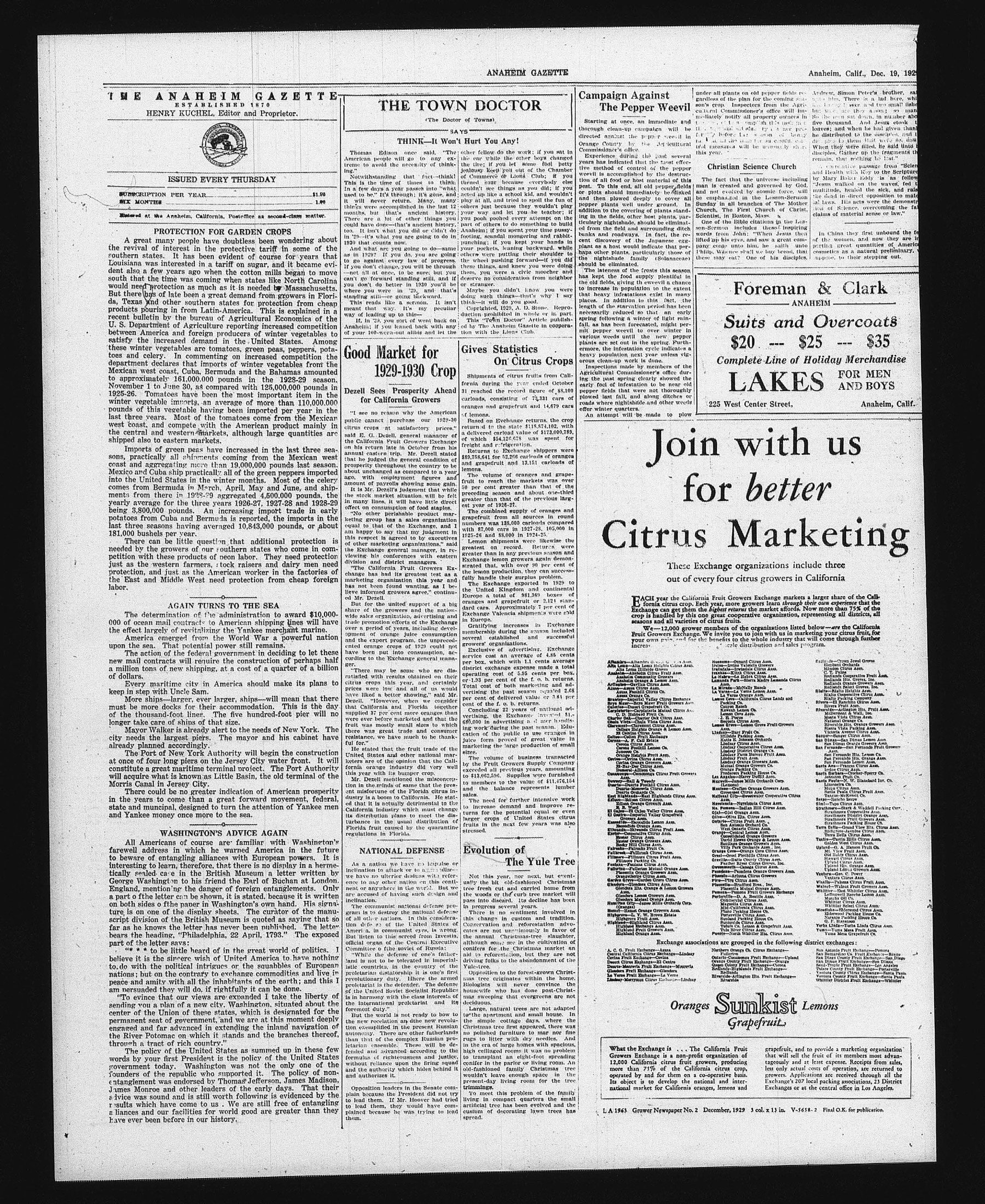
Searchable text
THE ANAHEIM GAZETTE
ESTABLISHED 1870
HENRY KUCHEL, Editor and Proprietor.
ISSUED EVERY THURSDAY
SUBSCRIPTION PER YEAR.....$1.50
SIX MONTHS.....1.00
Entered at the Anaheim, California, Postoffice as second-class matter.
PROTECTION FOR GARDEN CROPS
A great many people have doubtless been wondering about the revival of interest in the protective tariff in some of the southern states. It has been evident of course for years that Louisiana was interested in a tariff on sugar, and it became evident also a few years ago when the cotton mills began to move south that the time was coming when states like North Carolina would need protection as much as it is needed by Massachusetts. But there has of late been a great demand from growers in Florida, Texas and other southern states for protection from cheap products pouring in from Latin-America. This is explained in a recent bulletin by the bureau of Agricultural Economics of the U.S. Department of Agriculture reporting increased competition between America and foreign producers of winter vegetables to satisfy the increased demand in the United States. Among these winter vegetables are tomatoes, green peas, peppers, potatoes and celery. In commenting on increased competition the department declares that imports of winter vegetables from the Mexican west coast, Cuba, Bermuda and the Bahamas amounted to approximately 161,000,000 pounds in the 1928-29 season. November 1 to June 30, as compared with 125,000,000 pounds in 1925-26. Tomatoes have been the most important item in the winter vegetable imports, an average of more than 110,000,000 pounds of this vegetable having been imported per year in the last three years. Most of the tomatoes come from the Mexican west coast, and compete with the American product mainly in the central and western markets, although large quantities are shipped also to eastern markets.
Imports of green peas have increased in the last three soo
toes and celery. In commenting on increased competition the department declares that imports of winter vegetables from the Mexican west coast, Cuba, Bermuda and the Bahamas amounted to approximately 161,000,000 pounds in the 1928-29 season. November 1 to June 30, as compared with 125,000,000 pounds in 1925-26. Tomatoes have been the most important item in the winter vegetable imports, an average of more than 110,000,000 pounds of this vegetable having been imported per year in the last three years. Most of the tomatoes come from the Mexican west coast, and compete with the American product mainly in the central and western markets, although large quantities are shipped also to eastern markets.
Imports of green peas have increased in the last three seasons, practically all shipments coming from the Mexican west coast and aggregating more than 19,000,000 pounds last season. Mexico and Cuba ship practically all of the green peppers imported into the United States in the winter months. Most of the celery comes from Bermuda in March, April, May and June, and shipments from there in 1928-29 aggregated 4,500,000 pounds, the yearly average for the three years 1926-27, 1927-28 and 1928-29 being 3,800,000 pounds. An increasing import trade in early potatoes from Cuba and Bermuda is reported, the imports in the last three seasons having averaged 10,843,000 pounds, or about 181,000 bushels per year.
There can be little question that additional protection is needed by the growers of our southern states who come in competition with these products of neon labor. They need protection just as the western farmers stock raisers and dairy men need protection, and just as the American worker in the factories of the East and Middle West need protection from cheap foreign labor.
AGAIN TURNS TO THE SEA
The determination of the administration to award $10,000-000 of ocean mail contracts to American shipping lines will have the effect largely of revitalizing the Yankee merchant marine.
America emerged from the World War a powerful nation upon the sea. That potential power still remains.
The action of the federal government in deciding to let these new mail contracts will require the construction of perhaps half a million tons of new shipping, at a cost of a quarter of a billion dollars.
Every maritime city in America should make its plans to keep in step with Uncle Sam.
More ships—larger, ever larger, ships—will mean that there must be more docks for their accommodation. This is the day of the thousand-foot liner. The five hundred-foot pier will no longer take care of ships of that size.
Mayor Walker is already alert to the needs of New York. The city needs the largest piers. The mayor and his cabinet have already planned accordingly.
The Port of New York Authority will begin the construction at once of four long piers on the Jersey City water front. It will constitute a great maritime terminal project. The Port Authority will acquire what is known as Little Basin, the old terminal of the Morris Canal in Jersey City.
There could be no greater indication of American prosperity in the years to come than a great forward movement, federal, state and municipal, designed to turn the attention of Yankee men and Yankee money once more to the sea.
WASHINGTON'S ADVICE AGAIN
All Americans of course are familiar with Washington's farewell address in which he warned America in the future...
WASHINGTON'S ADVICE AGAIN
All Americans of course are familiar with Washington's farewell address in which he warned America in the future to beware of entangling alliances with European powers. It is interesting to learn, therefore, that there is no display in a hermetically sealed case in the British Museum a letter written by George Washington to his friend the Earl of Buchan at London. England, mentioning the danger of foreign entanglements. Only a part of the letter can be shown, it is stated, because it is written on both sides of the paper in Washington's own hand. His signature is on one of the display sheets. The curator of the manuscript division of the British Museum is quoted as saying that so far as he knows the letter has never been published. The letter bears the heading, "Philadelphia, 22 April, 1793." The exposed part of the letter saves:
"*** to be little heard of in the great world of politics. I believe it is the sincere wish of United America to have nothing to do with the political intrigues or the squabbles of European nations; but on the contrary to exchange commodities and live in peace and amity with all the inhabitants of the earth; and this I am persuaded they will do, if rightfully it can be done.
To evince that our views are expanded I take the liberty of sending you a plan of a new city. Washington, situated about the center of the Union of these states, which is designated for the permanent seat of government, and we are at this moment deeply engaged and far advanced in extending the inland navigation of the River Potomac on which it stands and the branches thereof, through a tract of rich country."
The policy of the United States as summed up in these few words by your first President is the policy of the United States government today. Washington was not the only one of the founders of the republic who supported it. The policy of non-entanglement was endorsed by Thomas Jefferson, James Madison, James Monroe and other leaders of the early days. That their advice was sound and is still worth following is evidenced by the results which have come to us. We are still free of entangling alliances and our facilities for world good are greater than they have ever been before in our history.
THE TOWN DOCTOR
(The Doctor of Towns)
SAYS
THINK—It Won't Hurt You Any!
Thomas Edison once said, "The American people will go to any extreme to avoid the necessity of thinking."
Notwithstanding that fact—think! This is the time of times to think. In a few days, a year passes into "what used to be." It's through; it's gone, and it will never return. Many, many things were accomplished in the last 12 months, but that's ancient history.
There are a lot of other things you could have done—that's ancient history, too. It isn't what you did or didn't do in '29—it's what you are going to do in 1930 that counts now.
And what are you going to do—same as in 1927? If you do, you are going to go against every law of progress. If you don't change, you will be through—not all at once, to be sure, but you can't go forward standing still, and if you don't do better in 1930 you'll be where you were in '29, and that's standing still—or going backward.
This reads like a sermon. It isn't meant that way. It's my peculiar way of leading up to this.
If in '29, you sort of went back on Anaheim; if you leaned back with any of your 100-worn-out alibis and let the other fellow do the work; if you sat in the car while the other boys changed the tire; if you let some fool petty jealousy keep you out of the Chamber of Commerce or Lion's Club; if you turned sour because everybody else couldn't see things as you did; if you acted up like a school kid, and wouldn't play at all, and tried to spoil the fun of others just because they wouldn't play your way and let you be teacher; if you pooh poohed every attempt on the part of others to do something to build Anaheim; if you spent your time pussy-footing, scandal mongering and rabbit-punching; if you kept your hands in your pockets, leaning backward, while others were putting their shoulder to the wheel pushing forward—if you did these things, and knew you were doing them, you were a clive moocher and deserve no consideration from neighbor or stranger.
Maybe you didn't know you were doing such things—that's why I say think—it will do you good.
Copyrighted, 1929, A. D. Stone. Reproduction prohibited in whole or in part.
This "Town Doctor" Article published by The Anaheim Gazette in cooperation with the Lions Club.
Good Market for 1929-1930 Crop
Dezell Sees Prosperity Ahead for California Growers
"I see no reason why the American public cannot purchase our 1929-30 citrus crops at satisfactory prices," said E. G. Dezell, general manager of the California Fruit Growers Exchange on his return late in October from his other fellow do the work; if you sat in the car while the other boys changed the tire; if you let some fool petty jealousy keep you out of the Chamber of Commerce or Lion's Club; if you turned sour because everybody else couldn't see things as you did; if you acted up like a school kid, and wouldn't play at all, and tried to spoil the fun of others just because they wouldn't play your way and let you be teacher; if you pooh poohed every attempt on the part of others to do something to build Anaheim; if you spent your time pussy-footing, scandal mongering and rabbit-punching; if you kept your hands in your pockets, leaning backward, while others were putting their shoulder to the wheel pushing forward—if you did these things, and knew you were doing them, you were a clive moocher and deserve no consideration from neighbor or stranger.
Maybe you didn't know you were doing such things—that's why I say think—it will do you good.
Copyrighted, 1929, A. D. Stone. Reproduction prohibited in whole or in part.
This "Town Doctor" Article published by The Anaheim Gazette in cooperation with the Lions Club.
Gives Statistics On Citrus Crops
Shipments of citrus fruits from California during the year ended October 31 reached the record figure of $8,100 carloads, consisting of 74,331 cars of oranges and grapefruit and 14,679 cars of lemons.
Based on Evechange returns, the crop returned to the state $118,574.102, with a delivered carload value of $173,000,789, of which $54,126,678 was spent for freight and refrigeration.
Campaign Against The Pepper Weevil
Starting at once, an immediate and thorough clean-up campaign will be directed against the pepper weevil in Orange County by the Agricultural Commissioner's office.
Experience during the past several years has indicated that the most effective method of control of the pepper weevil is accomplished by the destruction of all food or host material of this pest. To this end, all old pepper fields or plots should immediately be disliked and then plowed deeply to cover all popper plants well under ground. In addition to the covering of plants standing in the fields, other host plants, particularly nightshade, should be eliminated.
The lateness of the frosts this season has kept the food supply plentiful in the old fields, giving to eweevil a chance to increase in population to the extent that heavy infestations exist in many places. In addition to this fact, the length of the starvation period has been necessarily reduced so that an early spring following a winter of light rainfall, as has been forecasted, might permit popper weevil to over winter in various weeds until the new pepper plants are set out in the spring. Furthermore, the infestation cycle indicates a heavy population next year unless vigorous clean-up work is done.
Inspections made by members of the Agricultural Commissioner's office during the past spring clearly showed the early foe of infestation to be near old popper fields that were not thoroughly plowed last fall, and along ditches or roads where nightshade and other weeds offer winter quarters.
An attempt will be made to plow
Good Market for 1929-1930 Crop
Dezell Sees Prosperity Ahead for California Growers
"I see no reason why the American public cannot purchase our 1929-30 citrus crops at satisfactory prices," said E. G. Dezell, general manager of the California Fruit Growers Exchange on his return late in October from his annual easter trip. Mr. Dezell stated that he judged the general condition of prosperity throughout the country to be about unchanged as compared to a year ago, with employment figures and amount of payrolls showing some gain.
It is Mr. Dezell's judgment that while the stock market situation will be felt in many lines, it will have little direct effect on consumption of food staples.
"No other perishable product marketing group has a sales organization equal to that of the Exchange, and I am happy to say that my judgment in this respect is agreed to by executives of other marketing organizations," said the Exchange general manager, in reviewing his conferences with eastern division and district managers.
"The California Fruit Growers Exchange has had its greatest test as a marketing organization this year and has not been found wanting, as I believe informed growers agree," continued Mr. Dezell.
But for the united support of a big share of the growers and the nationwide sales organization, advertising and trade promotion efforts of the Exchange over a period of years, including development of orange juice consumption and the export program, the unprecedented orange crops of 1929 could not have been put into consumption, according to the Exchange general manager.
"There may be some who are disatisfied with results obtained on their citrus crops this year, and certainly prices were low and all of us would have liked a better showing," said Mr. Dezell.
"However, when we consider that California and Florida together supplied 37 per cent more oranges than were ever before marketed and that the fruit was mostly small sizes to which there was great trade and consumer resistance, we have much to be thankful for."
He stated that the fruit trade of the United States and other national marketers are of the opinion that the California orange industry did very well this year with its bumper crop.
Mr. Dezell mentioned the misconception in the minds of same that the present misfortune of the Florida citrus industry is a boom to California. He stated that it is actually detrimental to the California industry which must change its distribution plans to meet the disturbance in the usual distribution of Florida fruit caused by the quarantine regulations in Florida.
On Citrus Crops
Shipments of citrus fruits from California during the year ended October 31 reached the record figure of $8,100 carloads, consisting of 73,331 cars of oranges and grapefruit and 14,679 cars of lemons.
Based on Exchange returns, the crop returned to the state $118,574,102, with a delivered carload value of $173,000,789, of which $54,126,578 was spent for freight and refrigeration.
Returns to Exchange shippers were $89,758,641 for $22,266 carloads of oranges and grapefruit and 13,151 carloads of lemons.
The volume of oranges and grapefruit to reach the markets was over 50 per cent greater than that of the preceding season and about one-third greater than that of the previous largest year of 1928-27.
The combined supply of oranges and grapefruit from all sources in round numbers was 138,000 carloads compared with $8,000 cars in 1927-28, 105,000 in 1925-26 and 88,000 in 1924-25.
Lemon shipments were likewise the greatest on record. Returns were greater than in any previous season and Exchange lemon growers again demonstrated that, with over 90 per cent of the lemon production, they can successfully handle their surplus problem.
The Exchange exported in 1929 to the United Kingdom and continental Europe a total of 981,369 boxes of oranges and grapefruit or 2,121 standard cars. Approximately 7 per cent of Exchange Valencia shipments were sold in Europe.
Gratifying increases in Exchange membership during the season included several established and successful growers' organizations.
Exclusive of advertising. Exchange service cost an average of 4.85 cents per box, which with 1.1 cents average district exchange expense made a total operating cost of 5.95 cents per box or 1.93 per cent of the f. o. b. returns.
Total cost of both marketing and advertising the past season equaled 2.68 per cent of delivered value or 3.81 per cent of the f. o. b. returns.
Concluding 22 years of national advertising, the Exchange invested $1,680,000 in advertising a mer handling work during the past season. Education of the public to use oranges in juice form proved of great value in marketing the large production of small sizes.
The volume of business transacted by the Fruit Growers Supply Company exceeded all previous years, amounting to $13,062,596. Supplies were furnished to members to the value of $11,476,154 and the balance represents lumber sales.
The need for further intensive work to increase demand and improve returns for the potential equal or even larger crops of United States citrus fruits in the next few years was also stressed.
Evolution of
NATIONAL DEFENSE
As a nation we have no impulse or inclination to attack or to aggrandize we have no anterior designs with reference to any other nation on this continent or anywhere in the world. But we are accused of having such design and inclination.
The communist national defense program is to destroy the national defense of all other nations. In this consideration defends of the United States of America, in communist eyes, is wrong. But listen to this screed from Izvestia, official organ of the Central Executive Committee o the soviet of Russia:
"While the defense of one's fatherland is not to be tolerated in imperialistic countries, in the country of the proletarian distrusts it is one's first revolutionary duty. Here the armed proletariat is the defender. The defense of the United Soviet Socialist Republics is in harmony with the class interests of the international proletariat and its foremost duty."
But the world is not ready to bow to the new recollation ard the new revolution exemplified in the present Russian autonomy. There are other fatherlands than that of the complex Russian proletarian ensemble. These will be defended and advanced according to the formulas of righteousness and justice, without reliance upon the firing squad and the authority which hides behind it and authorizes it.
Opposition leaders in the Senate complain because the President did not try to lead them. If Mr. Hoover had tried to lead them, they would have complained because he was trying to lead them.
The volume of business transacted by the Fruit Growers Supply Company exceeded all previous years, amounting to $13,062,596. Supplies were furnished to members to the value of $11,476,154 and the balance represents lumber sales.
The need for further intensive work to increase demand and improve returns for the potential equal or even larger crops of United States citrus fruits in the next few years was also stressed.
Evolution of The Yule Tree
Not this year, nor next, but eventually the bit old-fashioned Christmas tree fresh cut and carried home from the woods or the curb tree market will pass into discard. Its decline has been in progress several years.
There is no sentiment involved in this change in custom and tradition. Conservation and reforestation advocates are not unanimously in favor of the annual Christmas-tree slaughter, although some see in the cultivation of conifers for the Christmas market an aid to reforestation, but they are not driving folks to the abandonment of the Yule-tree.
Opposition to the forest-grown Christmas tree originates within the home. Biologists will never convince the housewife who has done post-Christmas sweeping that evergreens are not deciduous.
Large, natural trees are not adapted to the apartment and small house. In the simple cottage days, where the Christmas tree first appeared, there was no polished furniture to mar nor fine rugs to litter with dry needles. And in the era of large homes with spacious, high ceilings rooms it was no problem to transplant an eight-foot spreading conifer in the parlor or living room. An old-fashioned family Christmas tree wouldn't leave enough space in the present-day living room for the tree trimmings.
To meet this problem of the family living in compact quarters the small artificial tree has been evolved and the custom of decorating lawn trees has spread.
Sign Against Pepper Weevil
once, an immediate and up campaign will be hast the pepper weevil in by the Agricultural's office.
During the past several indicated that the most effect of control of the pepper amplified by the destruction or host material of this end, all old pepper fields old immediately be diskeed deeply to cover all well under ground.
In covering of plants stands, other host plants, parishade, should be eliminated field and surrounding ditch roadsways.
In fact, the re-ey of the Japanese eggplant would indicate that per-amply, particularly those of the family (Solanaceae) dominated.
The fact that the universe including man is created and governed by God, and not evolved by atomic force, will be emphasized in the Lesson-Sermon Sunday in all branches of The Mother Church, The First Church of Christ, Scientist, in Boston, Mass.
One of the Bible citations in the Lesson-Sermon includes these inspiring words from John: "When Jesus then lifted up his eyes, and saw a great company come unto him, he saith unto Philip, Whence shall we buy bread, that these may eat? One of his disciples,
Andrew, Simon Peter's brother, said unto him, There is a lad here, whither he lives and two small fish but who are they among; so many So the men sat down, in number about five thousand. And Jesus stook them; and when he had given than he distributed to the disciples, and thou didst them that were set down. When they were filled, he said unto his disciples, Gather up the fragments there remain, that nothing be lost."
A creative passage from "Sclerosis and Health with Key to the Scripture" by Mary Baker Eddy is as follows: "Jesus walked on the waves, fed multitude, headed the sick, and raised the dead in direct opposition to maltal laws. His acts were the demonstration of Science, overcoming the faux claims of material sense or law."
In China they first unbound the feathers of the women, and now they are importing great quantities of America cosmetics as a natural preliminary purpose, to their stepping out.
Foreman & Clark
ANAHEIM
Suits and Overcoats
$20 --- $25 --- $35
Complete Line of Holiday Merchandise
LAKES FOR MEN AND BOYS
225 West Center Street,
Anaheim, Calif.
Complete Line of Holiday Merchandise
LAKES FOR MEN AND BOYS
225 West Center Street, Anaheim, Calif.
Join with us
for better
Citrus Marketing
These Exchange organizations include three
out of every four citrus growers in California
Each year the California Fruit Growers Exchange markets a larger share of the Calfornia citrus crop. Each year, more growers learn through their own experience that the
Exchange can get them the highest returns the market affords. Now more than 75% of the
crop is handled by this one great cooperative organization, representing all districts, all
seasons and all varieties of citrus fruits.
We—12,000 grower members of the organizations listed below—are the California
Fruit Growers Exchange. We invite you to join with us in marketing your citrus fruit, for
your own gain and for the benefits to the whole industry that will come through further
scale distribution and sales program.
Husane—Ornard Citrus Asn.
Irvine—Irvine Valencia Citrus Asn.
Irvineland—Irvine Valley Citrus Asn.
La Havas—La Hobra Citrus Asn.
Lamanda Park—Sierra Madre Lamanda Citrus
Asn.
La Madera—McNally Ranch
La Verne—La Verne Lemon Asn.
La Verne Orange Asn.
Lamanda Juvenile Citrus Lands and
Packing Co.
Canyon Ranch
Kawash Lemon Co.
Lemon Farm Asn.
J. B. Porus
Bequeta Citrus Asn.
Lemon Grove—Lemon Grove Fruit Growers
Lladda—Burr Fruit Co.
Hillside Packing Asn.
Kawash Lemon Orchards
Lindley Citrus Asn.
Lindley Cooperative Citrus Asn.
Lindley District Orange Co.
San Bernardino Fruit Asn.
Lindley Pruit Asn.
Lindley Orange Growers Asn.
Mutual Orange Growers Co.
Producers Packing House Co.
Les Angeles—Harry Dumill Asn.
Maxwell—James Mills Orchards Corp.
Montess—Craft Orange Growers Asn.
Greenpoint Citrus Asn.
National City—Sweetwater Cooperative Citrus
Navelesta—Navelesta Citrus Asn.
Ne. Pamena—Indian Hill Citrus Asn.
Ojal—Ojal Orange Asn.
Olive-Oltte Citrus Asn.
Oxtertite Citrus Orchard Co.
San Bernardino Fruit Asn.
West Ontario Citrus Asn.
Orange—Central Lemon Asn.
Complaint Orange Growers
David Hebes Orange & Lemon Asn.
Santiago Orange Growers Asn.
Uplia Park Orchards Inc.
Redlands—Crown Jewel Groves
Elephant Orchards
Missoula Citrus Asn.
Co. Tahoe Citrus Asn.
Redlands Cooperative Fruit Asn.
Redlands Hit. Greens Inc.
Redlands Orange Growers Asn.
Redlands Select Growers Inc.
Rhallis—Rhallo Heights Asn.
Rhallo Cooperative Citrus Asn.
Riverside-12 Ranchito Citrus Asn.
Ilvera Fruit Asn.
Riverside-Arlington Hills Fruit Asn.
Malibu Mount & Wall Inc.
Monte Vista Parking Company
Sierra Avenue Citrus Asn。
Sanger—Sanger Citrus Asn。
San Dimas—San Dimas Orange Growers Asn。
San Fernandez-San Ferrando Fruit Growers
Asn。
San Fernando Hills-Lemon Co。
San Fernando Hills-Orange Asn。
San Fernando Lemons Asn。
Santa Ana—Francesco Citrus Asn。
Santa Barbara—Crocker-Sperry Co。
Johnston Fruit Co。
Santa Paula-N.W. Blanchard Inv. Co.
Lincolnville Co。
Mupu Citrus Asn。
Santa Paula Citrus Fruit Asn。
Tempe-Macullo Co。
Sequoia-Lambo Sapepe。
Simil-Topo Citrus Asn。
Strathmore-Stark & Waddell Packing Corr。
Strathmore Cooperative Asns。
Strathmore Bittert Oranges。
Strathmore Fruit Growers Asn。
Strathmore Packing House Co。
Terma Bella-Grand View Ilias Citrus Asn。
Victoria-Jackson Citrus Asn。
Tustin-Tartin Hills Citrus Asn。
Golden West Citrus Asn。
Uplia Park Orchards Inc。
Exchange associations are grouped in the following district exchanges:
G. Fruit Exchange—Anusa
Mall California Citrus Exchange—Lindsey
N. Fruit Exchange—Covina
E. Murwella Fruit Exchange—Mountvila
R. Fruit Exchange—La Verne
Maryrman Citrus Exchange—Lindsey
Northern Oranges Co. Citrus Exchange—
Ontario-Coamonga Fruit Exchange—Upland
Orange County Fruit Exchange—Orange
Queen Colony Fruit Exchange—Corona
Redlands
Riverside-Arlington Hills. Pruit Exchange—Riverside
San Antonio Fruit Exchange—Pemona
Hermitage Co. Fruit Exchange—Bistio
San Diego County Fruit Exchange—San Diego
San Dimas Fruit Exchange—San Dimas
Neal-Treep Fruit Exchange—Los Angeles
Duarte County Fruit Exchange—Powerville
Ventura County Fruit Exchange—Santa Paula
Whittier Districts Fruit Exchange—Whittier
Oranges Sunkist Lemons Grapefruit
What the Exchange is ... The California Fruit Growers Exchange is a non-profit organization of 2000 California citrus fruit growers, producing more than 75% of the California citrus crop, operated by and for them on a co-operative basis. Object is to develop the national and international market for California oranges, lemons and grapefruit, and to provide a marketing organization that will sell the fruit of its members most advantageously and at least expense. Receipts from sales, less only actual costs of operation, are returned to growers. Applications are received through all the Exchange's 207 local packing associations, 23 District Exchanges or at the central office in Los Angeles.
1963 Grower Newspaper No. 2 December, 1929 3 col. x 13 in. V-5658-2 Final O.K. for publication.