anaheim-gazette 1929-11-21
Scanned page
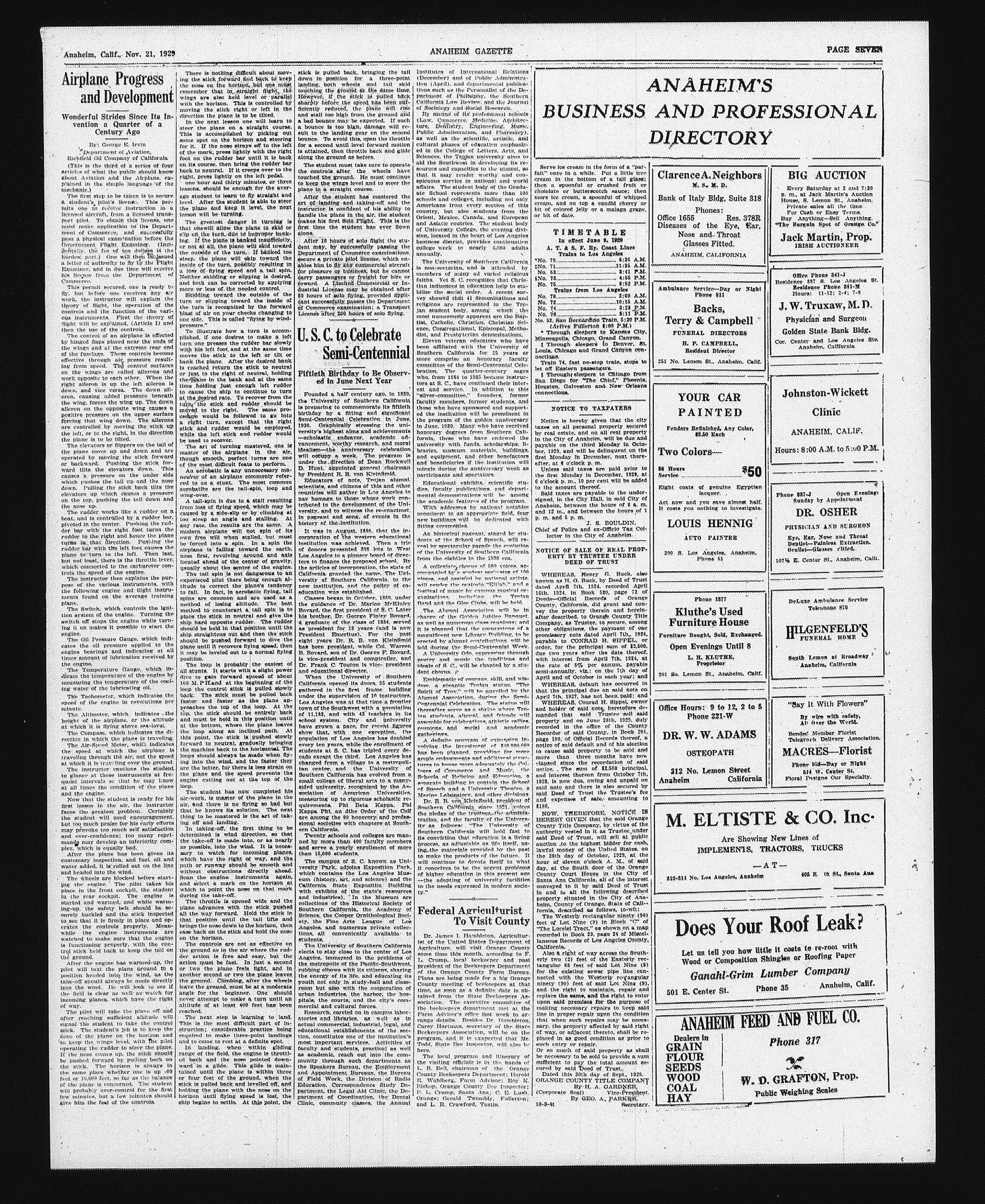
Searchable text
Airplane Progress and Development
Wonderful Strides Since Its Invention a Quarter of a Century Ago
By: George E. Irvin
Department of Aviation,
Richfield Oil Company of California
(This is the third of a series of four articles of what the public should know about Aviation and the Airplane, explained in the simple language of the mechanic.)
The first step to be taken is to secure a student's pilot's license. This permits one to receive instruction in a licensed aircraft, from a licensed transport pilot. To obtain this license, one must make application to the Department of Commerce, and successfully pass a physical examination before the Government Flight Examiner. (Incidentally, the fee of ten dollars is the hardest part.) One will then be issued a letter of authority to fly by the Flight Examiner, and in due time will receive his license from the Department of Commerce.
This permit secured, one is ready to fly, but before one receives any air work, the instructor will explain the theory of flight, the operation of the controls and the function of various instruments. First the theory of flight will be explained, (Article I) and then the use of the controls.
The control of an airplane is effected by hinged flaps placed near the ends of the wings and at the extreme rear end of the fuselage. These controls become effective through air pressure resulting from speed. The control surfaces on the wings are called ailerons and work opposite to each other. When the right aileron is up the left aileron is down, and vice versa. The down aileron, causing added pressure beneath the wing, forces the wing up. The down aileron on the opposite wing causes a positive pressure on the upper surface forcing that wing down. The ailerons are controlled by moving the stick up the left, or to the right, in the direction the plane is to be tilted.
The elevators or flippers on the tail of there is nothing difficult about moving the stick forward and back to keep the nose on the horizon, but one must remember that in straight flight, the wings are also held level or parallel with the horizon. This is controlled by moving the stick right or left in the direction the plane is to be tilted.
In the next lesson one will learn to steer the plane on a straight course. This is accomplished by picking out some spot on the horizon and steering for it. If the nose strays off to the left of the mark, press lightly with the right foot on the rudder bar until it is back on its course, then bring the rudder bar back to neutral. If it creeps over to the right, press lightly on the left pedal.
One hour and thirty minutes, or three lessons, should be enough for the average student to learn to fly straight and level. After the student is able to steer the plane and keep it level, the next lesson will be turning.
The greatest danger in turning is that onewill allow the plane to skid or slip on the turn, due to improper banking. If the plane is banked insufficiently, or not at all, the plane will skid toward outside of the turn. If banked too steep, the plane will skip toward inside of the turn, possibly resulting in a loss of flying speed and a tall spin. Neither skidding or slipping is desired, and both can be corrected by applying more or less of the needed control.
Skidding toward the outside of the turn or slipping toward the inside of the turn is recognized by the forward blast of air on your cheeks changing to one side. This is called "flying by wind-pressure."
To illustrate how a turn is accomplished, if one desires to make a left turn one presses the rudder bar slowly with his left foot, and at the same time moves the stick to the left or tilt or bank the plane. After the desired bank is reached return the stick to neutral or just to the right of neutral, holding the plane in the bank and at the same time holding just enough left rudder to cause the ship to continue to turn at the desired rate. To recover from the turn, the stick and rudder should be moved to the right. The same procedure would be followed to go into a right turn, except that the right stick and rudder would be employed, while the left stick and rudder would be used to recover.
The art of turning mastered, one is stick is pulled back, breaking down in position for landing, both wheels are touching the ground at However, if the stick sharply before the speed efficiently reduced, the fighter and stall too high from it a bounce is too high, due to the landing gear bounce. To avoid this, one for a second until level 1 attained, then throttle along the ground as before.
The student must take care of controls after he touched the ground. He must keep his wings level at plane in a straight course.
After the student has heard art of landing and taking instructor is confident of handle the plane in an makes his first Solo Flight first time he student leaves alone.
After 10 hours of solo flight may, by successful Department of Commerce secure a private pilot license ables him to fly any for pleasure or business carry passengers or freeware. A Limited Commercial License may be 50 hours of solo flying; cant successfully passes to Commerce examination License after 200 hours.
U.S.C.to Cele Semi-Century Fiftieth Birthday to ed in June Next
Founded a half century ago is preparing to commemorate birthday by a fitting Semi-Centennial Celebration 1930. Graphically stresses university's highest aims and scholastic endeavor. Vancement worthy research...
The elevators or flippers on the tail of the plane move up and down and are operated by moving the stick forward or backward. Pushing the stick forward tilts the elevators down. This causes a pressure on the under side which pushes the tail up and the nose down. Pulling the stick back tilts the elevators up which causes a pressure on the top, pushing the tail down and the nose up.
The rudder works like a rudder on a boat, and is controlled by a rudder bar, plowed in the center. Pushing the rudder bar with the right foot turns the rudder to the right and hence the plane turns in that direction. Pushing the rudder bar with the left foot causes the plane to turn to the left. Then last, but not least, there is the throttle lever, which connected to the carburetor controls the speed of the engine.
The instructor then explains the purpose of the various instruments, with the following engine and flight instruments found on the average training plane.
The Switch, which controls the ignition system of the engine. Turning the switch off stops the engine while turning it on makes it possible to start the engine.
The Oil Pressure Gauge, which indicates the oil pressure applied to the engine bearings and indicating at all times amount of lubrication received by the engine.
The Temperature Gauge, which indicate the temperature of the engine by measuring the temperature of the cooling water of the lubricating oil.
The Tachometer, which indicates the speed of the engine in revolutions per minute.
The Altimeter, which indicates the height of the airplane, or the altitude at which it is flying above sea-level.
The Compass, which indicates the direction in which the plane is traveling.
The Air-Speed Meter, which indicates the speed at which the airplane is traveling through the air, not the speed at which it is travelling over the ground.
The instructor cautions the student to glance at these instruments at frequent intervals so that he may know at all times the condition of the plane and the engine.
Now that the student is ready for his first lesson in the air, the instructor faces the greatest problem. Certainly the student will need encouragement, but too much praise for his early efforts may provoke too much self satisfaction and over-confidence; too many reprimands may develop an inferiority complex, which is equally bad.
These controls become effective through air pressure resulting from speed. The control surfaces on the wings are called alterons and work opposite to each other. When the right alleron is up the left alleron is down, and vice versa. The down alleron, causing added pressure beneath the wing, forces the wing up. The down alleron on the opposite wing causes a positive pressure on the upper surface forcing that wing down. The alterons are controlled by moving the stick up the left, or to the right, in the direction the plane is to be tilted.
The elevators or flippers on the tail of the plane move up and down and are operated by moving the stick forward or backward. Pushing the stick forward tilts the elevators down. This causes a pressure on the under side which pushes the tail up and the nose down. Pulling the stick back tilts the elevators up which causes a pressure on the top, pushing the tail down and the nose up.
The rudder works like a rudder on a boat, and is controlled by a rudder bar, plowed in the center. Pushing the rudder bar with the right foot turns the rudder to the right and hence the plane turns in that direction. Pushing the rudder bar with the left foot causes the plane to turn to the left. Then last, but not least, there is the throttle lever, which connected to the carburetor controls the speed of the engine.
The instructor then explains the purpose of the various instruments, with the following engine and flight instruments found on the average training plane.
The Switch, which controls the ignition system of the engine. Turning the switch off stops the engine while turning it on makes it possible to start the engine.
The Oil Pressure Gauge, which indicates the oil pressure applied to the engine bearings and indicating at all times amount of lubrication received by the engine.
The Temperature Gauge, which indicate
The instructor cautions the student to glance at these instruments at frequent intervals so that he may know at all times the condition of the plane and the engine.
Now that the student is ready for his first lesson in the air, the instructor faces the greatest problem. Certainly the student will need encouragement, but too much praise for his early efforts may provoke too much self satisfaction and over-confidence; too many reprimands may develop an inferiority complex, which is equally bad.
After the plane has been given its customary inspection, and fuel, oil and water added, it is rolled out on the line and headed into the wind.
The wheels are blocked before starting the engine. The pilot takes his place in the front cockpit, the student in the rear cockpit. The engine is started and warmed, and while warming-up, the safety belt should be securely buckled and the stick inspected to see that it is firmly in place and operates the controls properly. Meanwhile the engine instruments are watched to make sure that the engine is functioning properly, with the control stick held back to keep the tail on the ground.
After the engine has warmed-up, the pilot will taxi the plane around to a position headed into the wind, as the take-off should always be made directly into the wind. He will look to see if the field is clear as well as watch for incoming planes, which have the right of way.
The pilot will take the plane off and after reaching sufficient altitude will signal the student to take the control stick. The student's job is to keep the nose of the plane on the horizon and to keep the wings level, with the pilot operating the rudder to steer the plane. If the nose comes up, the stick should be pushed forward by pulling back on the stick. The horizon is always in the same place whether one is up -00 feet or 10,000 feet, so far as the balance of the plane is concerned. The student will probably over-control for the first few minutes, but a few minutes should give him the feel of the controls.
The student has now completed his air-work, is master of the plane in the air, and there is no flying so bad but that he knows its solution. The next thing to be mastered is the art of taking off and landing.
In taking-off, the first thing to be determined is wind direction, so that the take-off is made into, or as nearly as possible, into the wind. It is necessary to watch for incoming planes, which have the right of way, and the path or runway should be smooth and without obstructions directly ahead. Scan the engine instruments again, and select a mark on the horizon at which to point the nose on that mark during the take-off.
The throttle is opened wide and the plane advances with the stick pushed all the way forward. Hold the stick in that position until the tail lifts and brings the nose down to the horizon, then ease back on the stick and hold the nose on the horizon.
The controls are not as effective on the ground as in the air where the rudder action is free and easy, but the action must be fast. In just a second or two the plane feels light, and in another second or two the plane leaves the ground. Climbing, after the wheels leave the ground, must be at a moderate angle for the beginner. One should never attempt to make a turn until an altitude of at least 400 feet has been reached.
The next step is learning to land. This is the most difficult part of instruction; considerable practice being required to make three-point landings and to come to rest at a definite spot.
In landing, when within gliding range of the field, the engine is throttled back and the nose pointed downward in a glide. This glide is maintained until the plane is within three or four feet of the ground, when the stick is pulled back and levelled off, holding the plane with the nose on the horizon until flying speed is lost, the ship begins to settle. At this point, the loops should always be made when lying into the wind, and the faster they are better, for there is less strain on the plane and the speed prevents the engine cutting out at the top of the loop.
The student has now completed his air-work, is master of the plane in the air, and there is no flying so bad but that he knows its solution. The next thing to be mastered is the art of taking off and landing.
In taking-off, the first thing to be determined is wind direction, so that the take-off is made into, or as nearly as possible, into the wind. It is necessary to watch for incoming planes, which have the right of way, and the path or runway should be smooth and without obstructions directly ahead. Scan the engine instruments again, and select a mark on the horizon at which to point the nose on that mark during the take-off.
The throttle is opened wide and the plane advances with the stick pushed all the way forward. Hold the stick in that position until the tail lifts and brings the nose down to the horizon, then ease back on the stick and hold the nose on the horizon.
The controls are not as effective on the ground as in the air where the rudder action is free and easy, but the action must be fast. In just a second or two the plane feels light, and in another second or two the plane leaves the ground. Climbing, afterthe wheels leavethe ground,mustbeatatmoderateangleforthebeginner.Oneshouldneverattempttomaketurnuntilaltitudeofatleast400feethasbeenreached.
The next step is learning to land.Thisisthemostdifficultpartofinstruction;considerablepracticebeingrequiredtomakethree-pointlandingsandtocometorestatadefinitespot.
In landingwhenwithinglidingrangeofthefield,theengineisthrottledbackandthenosepointeddownwardinaglide.Thisglideismaintaineduntiltheplaneiswithinthreeorfourfeetoftheground,whenthestickispullsedbackandlevelledoff,andholdingtheplanewiththenoseonthehorizonuntilflyingspeedislost,theshipbeginstosettle.Atthispoint,thecodeexceptthethird.Ichangedfroma villagetancenter,andtheSouthernCaliforniahassmallcollegeofliberalasideduniversity.recognizationofAmericanmeasurementuptotrigorousrequirements.PhiBetaKappaPhi,andtheOrdenareamongthe99honoredsocietieswithchairernCalifornia.
Twenty schoolsandcompiledbymore than400friendsandserveayearendthan15,000students.
The campus of S.C.Versity Park,adjoinestwhichcontainstheLosum(historyart,andscience,theCooperOrnithology,theFineArtsLeAngeles,andnumerousservicesallconvenientlystudents.
TheUniversityofSouthElectorstostayclosetotheAngeles,immersedinthermetropolisoftheParkrubbingelbowswithitsownenergyofitslife,andyouthnotonlyinstudyingroombutalsowiththeurbanindustries,thehuritapitals,thecourts,andmercialandculturalforests.
Research,carrieodininstoriesandlibraries,andactualcommercialIndustrialeducationalestablishment constitutesoneofthemostimportantservicesfacultyandstudents,practicesacademic,reachoutmunitythroughsuchoftheSpeakersBureau,theAppointmentBureauofFieldWork,theDivEducation,Corresponderdepartment,theLegalAidDepartmentofCoordinationClinic,communityclasses.
stick is pulled back, bringing the tail down in position for a three-point landing, both wheels and tail skid sharply before the speed has been sufficiently reduced, the plane will rise and stall too high from the ground and a bad bounce may be expected. If such a bounce is too high, damage will result to the landing gear on the second bounce. To avoid this, open the throttle for a second until level forward motion is attained, then throttle back and glide along the ground as before.
The student must take care to operate the controls after the wheels have touched the ground. He must continue to keep the wings level and to steer the plane in a straight course.
After the student has mastered the art of landing and taking-off and the instructor is confident of his ability to handle the plane in the air, the student makes his first Solo Flight. This is the first time the student has ever flown alone.
After 10 hours of solo flight the student may, by successfully passing the Department of Commerce examinations, secure a private pilot license, which enables him to fly any commercial aircraft for pleasure or business, but he cannot carry passengers or freight for life or reward. A Limited Commercial or Industrial License may be obtained after 50 hours of solo flying, provided applicant successfully passes the Department of Commerce examination; a Transport License after 200 hours of solo flying.
U.S.C. to Celebrate Semi-Centennial Fiftieth Birthday to Be Observed in June Next Year
Founded a half century ago, in 1880, the University of Southern California is preparing to commemorate its fiftieth birthday by a fitting and significant Semi-Centennial Celebration in June, 1930. Graphically stressing the university's highest aims and achievements—scholastic endeavor, academic advancement, worthy research, and moral feeliness—the anniversary celebration Institutes of International Relations (December) and of Public Administration (April), and departmental publications such as the Personalist of the Department of Phillipsiphy, the Southern California Law Review, and the Journal of Sociology and Social Research.
By means of its professional schools (Law, Commerce, Medicine, Architecture, Dentistry, Engineering, Music, Public Administration, and Pharmacy), as well as the scientific, artistic, and cultural phases of education emphasized in the College of Letters, Arts, and Sciences, the Truman university aims to aid the Southwest in developing its resources and capacities to the utmost, so that it may render worthy and conspicuous service in national and world affairs. The student body of the Graduate School represents more than 100 schools and colleges, including not only Americans from every section of this country, but also students from the Orient, Mexico, Canada, and European Andalatic countries. The student body of University College, the evening division, located in the heart of Los Angeles business district, provides continuation college work to nearly 6,000 adults annually.
The University of Southern California is non-sectarian, and is attended by members of many ad varied religious faiths. Yet S.C. recognizes that Christian influences in education help to stabilize the social order. A recent survey showed that 41 denominations and religions are represented in the Trojan student body, among which the most numerously apparent are the Baptist, Catholic, Christian, Christian Science, Congregational, Episcopal Methodist, and Presbyterian denominations.
Eleven veteran educators who have been affiliated with the University of Southern California for 25 years or more comprise an honorary faculty committee of the Semi-Centennial Celebration. The quarter-century sages who, from 1884 to 1905 became instructors at S.C., have continued their interest and service. In addition to this "silver-committee," founders, former faculty members, former students, and those who have sponsored and supported the institution will be prominent in the program of the golden anniversary in June, 1930. Many who have received honorary degrees from Southern California, these who have endowed the university with funds, scholarships, materials buildings.
Serve ice cream in the form of a "parfait" once in a while. Put a little ice cream in the bottom of a tall glass; then a spoonful or crushed fruit or chiolate or butterscotch sauce; then more ice cream, a spoonful of whipped cream, and on top a candid cherry or bit of colored jelly or a malaga grape, or bit of date.
TIMETABLE
In effect June 9, 1929
A. T. & S. F. Ry. Coast Lines
Trains to Los Angeles
*No. 79...6:35 A.M.
*No. 71...11:25 A.M.
*No. 53...8:41 P.M.
$No. 73...4:55 P.M.
No. 75...8:52 P.M.
Trains from Los Angeles
No. 78...2:08 A.M.
No. 72...10:15 A.M.
No. 74...3:28 P.M.
No. 76...8:11 P.M.
No. 52 San Bernardino Train; 5:20 P.M.
(Arlvse Fullerton 6:00 P.M.)
*Through sleepers to Kansas City,
Minneapolis, Chicago, Grand Canyon.
† Through sleepers to Denver, St. Louis, Chicago and Grand Canyon connections.
Train 74, fast no-stop train, stops to let off Eastern passengers.
‡ Through sleepers to Chicago from San Diego for "The Chief," Phoenix, Houston, Galveston and New Orleans connections.
NOTICE TO TAXPAYERS
Notice is hereby given that the city taxes on all personal property secured by real estate, and on all real property in the City of Anaheim, will be due and payable on the third Monday in October.
Fiftieth Birthday to Be Observed in June Next Year
Founded a half century ago, in 1880, the University of Southern California is preparing to commemorate its fiftieth birthday by a fitting and significant Semi-Centennial Celebration in June, 1930. Graphically stressing the university's highest aims and achievements—scholastic endeavor, academic advancement, worthy research, and moral idealism—the anniversary celebration will occupy a week. The program is under the direction of Dean Rockwell D. Hunt, appointed general chairman by President R. B. von KleinSmid.
Educators of note, Trojan alumni, scientists, and citizens of this and other countries will gather in Los Angeles to pay homage to those whose work contributed to the development of the University, and to witness the re-enactment, in pageant and song, of events in the history of the institution.
It was in August, 1880, that the incorporation of the western educational institution was achieved. Then a trio of donors presented 308 lots in West Los Angeles to a pioneer board of directors to finance the proposed school. By the articles of incorporation, the state of California granted the name. The University of Southern California, to the new institution, and the policy of coeducation was established.
Classes began in October, 1880, under the guidance of Dr. Marlon McKinley Bovard, the first president of S. C. Later his brother, Dr. George Finley Bovard, a graduate of the class of 1884, served as president for 18 years (and is now President Emeritus). For the past eight years Dr. R. B. von KleinSmid has been president, while Col. Warren B. Bovard, son of Dr. George F. Bovard, is vice-president and comptroller, and Dr. Frank C. Touton is vice-president and educational director.
When the University of Southern California opened its doors, 55 students gathered in the first frame building under the supervision of 10 instructors. Los Angeles was at that time a frontier town of the Southwest with a population of 11,183, and with 43 teachers in its school system. City and university have grown a pace, for recent figures show that, with one exception, the population of Los Angeles has doubled every ten years, while the enrollment of students at S. C. has tripled every decade except the third. Los Angeles has changed from a village to a metropolitan center, and the University of Southern California has evolved from a small college of liberal arts to a many-aided university, recognized by the Association of American Universities, measuring up to rigorous scholastic requirements. Phi Beta Kappa, Phi Kappa Phi, an dthe Order of the Colf are among the 99 honorary and professional societies with chapters at Southern California.
Twenty schools and colleges are manned by more than 400 faculty members and serve a yearly enrollment of more than 625 years.
Train 74, fast no-stop train, stops to let off Eastern passengers.
Through sleepers to Chicago from San Diego for "The Chief," Phoenix, Houston, Galveston and New Orleans connections.
NOTICE TO TAXPAYERS
Notice is hereby given that the city taxes on personal property secured by real estate, and on all real property in the City of Anaheim, will be due and payable on the third Monday in October, 1929, and will be delinquent on the first Monday in December, next thereafter, at 6 o'clock p.m.
Unless said taxes are paid prior to the first Monday in December, 1929, at 6 o'clock p.m., 10 per cent will be added to the amount thereof.
Said taxes are payable to the undersigned, in the City Hall, in said City of Anaheim, between the hours of 8 a.m. and 12 m., and between the hours of 1 p.m. and 5 p.m.
J. S. BOULDIN,
Chief of Police and ex-Officio Tax Collector in the City of Anaheim.
NOTICE OF SALE OF REAL PROPERTY BY TRUSTEE UNDER DEED OF TRUST
WHEREAS Henry G. Buck, also known as H. G. Buck, by Deed of Trust dated April 7th, 1924, recorded April 16th, 1924, in Book 520, page 73 of Deeds—Official Records of Orange County, California, did grant and convey the property therein and hereinafter described, to Orange County Title Company, as Trustee; to secure among other obligations, the payment of one promissory note dated April 7th, 1924, payable to CONRAD H. SIPPEL, or order, for the principal sum of $2,500 due two years after the date thereof, with interest from April 7th, 1924; at the rate of 8% per annum, payable semi-annually, viz.; on the 7th day of April and of October in each year; and WHEREAS default has occurred in that the principal due on said note on April 7th, 1927, has not been paid; and WHEREAS Conrad H. Sippel owner and holder of said note heretofore demanded that said Trustee sell said property and on June 28th, 1929, duly recorded in the office of the County Recorder of said County, in Book 291, page 190; of Official Records thereof,a notice of said default and of his election to cause said property to be sold and more than three months have now clapped since the recordation of said notice. The sum of $2,500 principal,and interest thereon from October 7th,1928.is now due, owing and unpaid on said note and there is also secured by said Deed of Trust the Trustee's fee and expenses of sale; amounting to $180.
NOW THEREFORE NOTICE IS HEREFORE GIVEN that the said Orange County Title Company, by virtue of the authority vested in it an Trustee under said Deed of Trust, will sell at public auction to the highest bidder for cash,hawful money of the United States.on
cade except the third. Los Angeles has changed from a village to a metropolitan center, and the University of Southern California has evolved from a small college of liberal arts to a many-aided university, recognized by the Association of American Universities, measuring up to rigorous scholastic requirements. Phi Beta Kappa, Phi Kappa Phi, an dthe Order of the Colf are among the 99 honorary and professional societies with chapters at Southern California.
Twenty schools and colleges are manned by more than 400 faculty members and serve a yearly enrollment of more than 15,000 students.
The campus of S. C. known as University Park, adjoins Exposition Park, which contains the Los Angeles Museum (history, art, and science) and the California State Expositin Building with exhibits of the state's resources and industries). In the Museum are collections of the Historical Society of Southern California, the Academy of Science, the Cooper Ornithological Society, the Fine Arts League of Los Angeles, and numerous private collections, all conveniently available to students.
The University of Southern California elects to stay close to the center of Los Angeles, immersed in the problems of the metropolis of the Pacific-Southwest, rubbing elbows with its citizens, sharing the energy of its life, and educating its youth not only in study-hall and classroom but also with the cooperation of urban industries, the harbor, the hospitals, the courts, and the city's commercial and cultural forces.
Research carried on in campus laboratories and libraries, as well as in actual commercial, industrial, legal, and educational establishments of the section, constitutes one of the institution's most important services. Activities of faculty and students, practical as well as academic, reach out into the community through such departments as the Speakers Bureau, the Employment and Appointment Bureaua, the Bureau of Field Work, the Division of Radio Education, Correspondence Study Department, the Legal Aid Clinic, the Department of Coordination, the Dental Clinic, community classes, the Annual sample endowments and additional structures to house more adequately the College of Commerce and Music, the Schools of Religion and Education, a separate building to contain the School of Speech and a University Theatre, a Marine Laboratory, and other divisions.
Dr. R. B. von KleinSmid, president of Southern California since 1921, voices the pledge of the trustees: the administration, and the faculty of the University as follows: "The University of Southern California will hold fast to its conviction that education is a living process, as adjustable as life itself, using the materials provided by the past to make the products of the future. It will continue to devote itself to what it conceives to be the urgent problems of higher education in this present age—the adapting of university facilities to the needs expressed in modern society."
Federal Agriculturist To Visit County
Dr. James I. Hambleton, Agriculturist of the United States Department of Agriculture, will visit Orange County some time this month, according to F. L. Crump, local beekeeper and past president of the Beekeepers Department of the Orange County Farm Bureau. Plans are being made for a big Orange County meeting of beekeepers at that time, as soon as a definite date is obtained from the State Beekeepers Association. The executive committee of the beekeepers department met at the Farm Advisor's office last week to arrange details. Besides Dr. Hambleton, Carey Hartman, secretary of the State Beekeepers Association, will be on the program, and it is expected that Mr. Todd, State Bee Inspector, will also be here.
The local program and itinerary of the visiting officials is in the hands of L. B. Bell, chairman of the Orange County Beekeepers Department; Harold E. Wahlberg, Farm Advisor; Roy K. Bishop, Orange County Bee Inspector; P. L. Crump, Santa Ana; C. E. Lush, Orange; Gerald Twombly, Fullerton; and L. B. Crawford, Tustin.
NOW THEREFORE NOTICE IS HEREBY GIVEN that the said Orange County Title Company, by virtue of the authority vested in it as Trustee under said Deed of Trust, will sell at public auction to the highest bidder for cash, lawful money of the United States, on the 26th day of October, 1929, at the hour of eleven o'clock A.M., of said day, at the South door of the Orange County Court House in the City of Santa Ana California, all of the interest conveyed to it by said Deed of Trust in and to all the following described property situated in the City of Anaheim, County of Orange, State of California, described as follows: to-wit:
The Westerly rectangular ninety (90) feet of Lot Nine (9) in Block "C" of "The Lorelei Tract," as shown on a map recorded in Book 29, page 24 of Miscellaneous Records of Los Angeles County, California.
Also a right of way across the Southerly two (2) feet of the Easterly rectangular 68 feet of said Lot Nine (9) for the existing sewer pipe line connected with the Westerly rectangular ninety (90) feet of said Lot Nine (9), and the right to maintain, repair and replace the same, and the right to enter upon said premises for the purpose of making necessary repairs to keep said line in proper repair upon the condition that when such repairs may be necessary, the property affected by said right of way or adjacent thereto shall be replaced in as good condition as prior to each entry or repair.
Or so much of said property as shall be necessary to be sold to provide a sum sufficient to pay the total amount secured by said Deed of Trust.
Dated this 30th day of Sept., 1929.
ORANGE COUNTY TITLE COMPANY
By H. A. GARDNER,
(Corporate Seal)
Vice-President.
By GEO. A. PARKER,
Secretary.
ANAHEIM'S
ESS AND PROFESSIONAL
DIRECTORY
Clarence A. Neighbors
M. S., M. D.
Bank of Italy Bldg, Suite 318
Phones:
Office 1655 Res. 378R
Diseases of the Eye, Ear,
Nose and Throat
Glasses Fitted.
ANAHEIM, CALIFORNIA
BIG AUCTION
Every Saturday at 2 and 7:30
p.m., at Jack Martin's Auction
House, S. Lemon St., Anaheim.
Private sales all the time.
For Cash or Easy Terms.
Buy Anything—Sell Anything.
"The Bargain Spot of Orange Co."
Jack Martin, Prop.
IRISH AUCTIONEER
Ambulance Service—Day or Night
Phone 311
Backs,
Terry & Campbell
FUNERAL DIRECTORS
H. P. CAMPBELL,
Resident Director
251 No. Lemon St., Anaheim, Calif.
Office Phone 341-J
Residence 557 S. Los Angeles St.
Residence Phone 341-M
Hours: 11-12; 2-4; 7-8
J. W. Truxaw, M. D.
Physician and Surgeon
Golden State Bank Bldg.
Cor. Center and Los Angeles St.
Anaheim, California
YOUR CAR PAINTED
Fenders Refinished, Any Color,
$2.50 Each
Johnston-Wickett
Clinic
ANAHEIM, CALIF.
Hours: 8:00 AM to 5:00 PM
YOUR CAR PAINTED
Fenders Refinished, Any Color,
$2.50 Each
Two Colors—
86 Hours Service $50
Eight coats of genuine Egyptian lacquer.
Act now and you save almost half.
It costs you nothing to investigate.
LOUIS HENNIG
AUTO PAINTER
200 S. Los Angeles, Anaheim,
Phone 51
Johnston-Wickett Clinic
ANAHEIM, CALIF.
Hours: 8:00 A.M. to 5:00 P.M.
Phone 887-J Open Evening:
Sunday by Appointment
DR. OSHER
PHYSICIAN AND SURGEON
Eye, Ear, Nose and Throat
Dentist—Painless Extraction.
Oculist—Glasses fitted.
107½ E. Center St., Anaheim, Calif.
Phone 1877
Kluthe’s Used Furniture House
Furniture Bought, Sold, Exchanged.
Open Evenings Until 8
L. H. KLUTHE,
Proprietor
201 So. Lemon St., Anaheim, Calif.
DeLuxe Ambulance Service
Telephone 870
HILGENFELD’S FUNERAL HOME
South Lemon at Broadway
Anaheim, California
Office Hours: 9 to 12, 2 to 5
Phone 221-W
DR. W. W. ADAMS
OSTEOPATH
312 No. Lemon Street
Anaheim California
"Say It With Flowers"
By wire with safety,
All Over the World.
Bonded Member Florist
Telegraph Delivery Association.
MACRES—Florist
Phone 952-Day or Night
514 W. Center St.
Floral Designs Our Specialty.
M. ELTISTE & CO. Inc.
Are Showing New Lines of IMPLEMENTS, TRACTORS, TRUCKS
312 No. Lemon Street
Anaheim California
M. ELTISTE & CO. Inc.
Are Showing New Lines of
IMPLEMENTS, TRACTORS, TRUCKS
—AT—
312-311 No. Los Angeles, Anaheim 405 E. th St., Santa Ana
Does Your Roof Leak?
Let us tell you how little it costs to re-root with
Wood or Composition Shingles or Roofing Paper
Ganahl-Grim Lumber Company
501 E. Center St. Phone 35 Anaheim, Calif.
ANAHEIM FEED AND FUEL CO.
Dealers in
GRAIN
FLOUR
SEEDS
WOOD
COAL
HAY
Phone 317
W. D. GRAFTON, Prop.
Public Weighing Scales