anaheim-gazette 1929-11-21
Scanned page
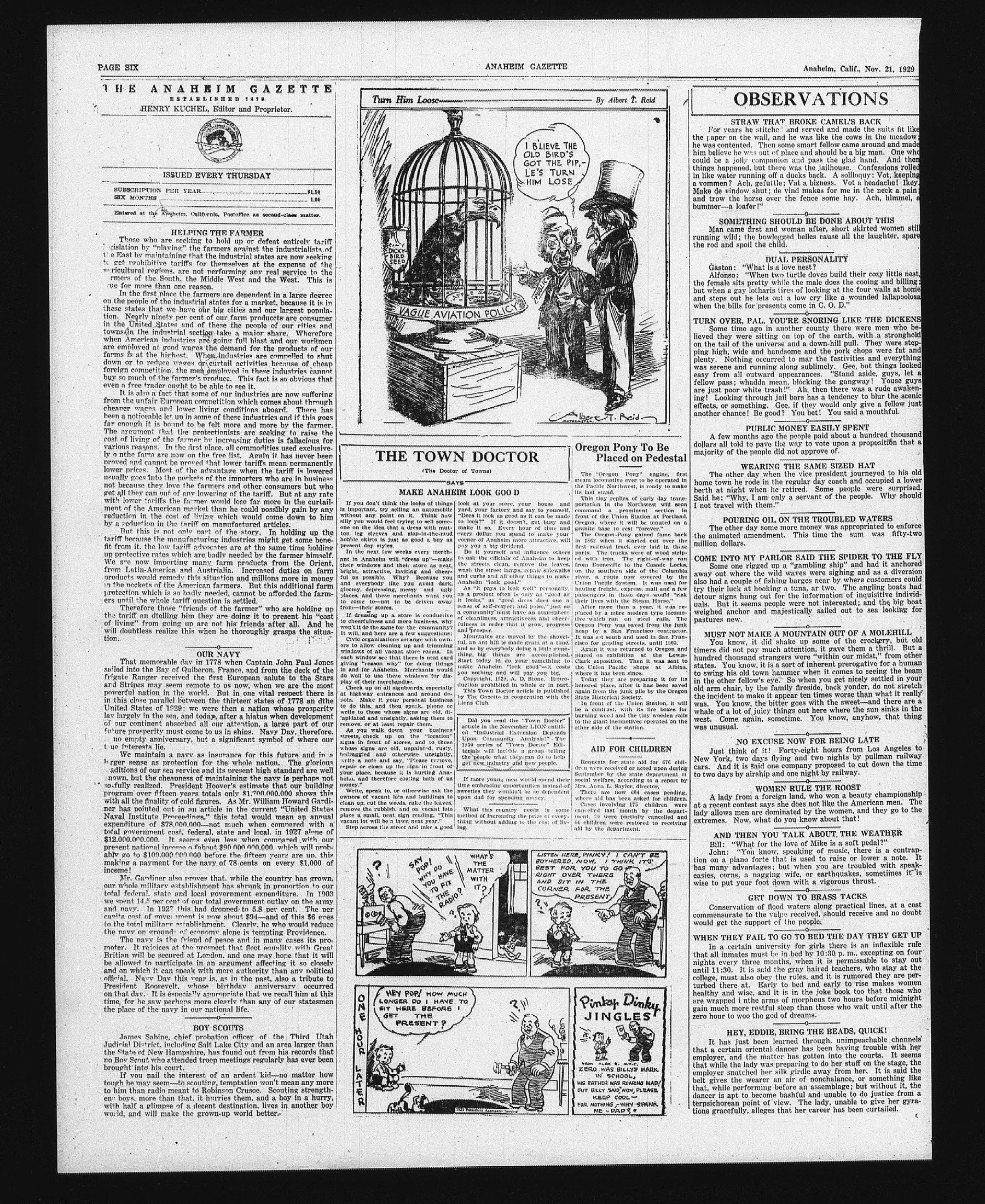
Searchable text
THE ANAHEIM GAZETTE
ESTABLISHED 1870
HENRY KUCHEL, Editor and Proprietor.
ISSUED EVERY THURSDAY
SUBSCRIPT PER YEAR.....$1.50
SIX MONTHS.....1.00
Entered at the Anaheim, California, Postoffice as second-class matter.
HELPING THE FARMER
Those who are seeking to hold up or defeat entirely tariff legislation by "playing" the farmers against the industrialists of the East by maintaining that the industrial states are now seeking to get prohibitive tariffs for themselves at the expense of the agricultural regions, are not performing any real service to the farmers of the South, the Middle West and the West. This is due for more than one reason.
In the first place the farmers are dependent in a large degree on the people of the industrial states for a market, because it is in these states that we have our big cities and our largest population. Nearly ninety per cent of our farm products are consumer in the United States and of these the people of our cities and towns in the industrial section take a major share. Wherefore when American industries are going full blast and our workmen are employed at good wages the demand for the products of our farms is at the highest. When industries are compelled to shut down or to reduce wages or curtail activities because of cheap foreign competition, the men employed in these industries cannot buy so much of the farmer's produce. This fact is so obvious that even a free trader ought to be able to see it.
It is also a fact that some of our industries are now suffering from the unfair European competition which comes about through cheaper wages and lower living conditions aboard. There has been a noticeable let-up in some of these industries and if this goes far enough it is bound to be felt more and more by the farmer. The argument that the protectionists are seeking to raise the cost of living of the farmer by increasing duties is fallacious for various reasons. In the first place, all commodities used exclusive-
farms is at the highest. When industries are compelled to shut down or to reduce wages or curtail activities because of cheap foreign competition, the men employed in these industries cannot buy so much of the farmer's produce. This fact is so obvious that even a free trader ought to be able to see it.
It is also a fact that some of our industries are now suffering from the unfair European competition which comes about through cheaper wages and lower living conditions aboard. There has been a noticeable let up in some of these industries and if this goes far enough it is bound to be felt more and more by the farmer. The argument that the protectionists are seeking to raise the cost of living of the farmer by increasing duties is fallacious for various reasons. In the first place, all commodities used exclusively on the farm are now on the free list. Again it has never been proved and cannot be proved that lower tariffs mean permanently lower prices. Most of the advantage when the tariff is lowered usually goes into the pockets of the importers who are in business not because they love the farmers and other consumers but who get all they can out of any lowering of the tariff. But at any rate with lower tariffs the farmer would lose far more in the curtailment of the American market than he could possibly gain by any reduction in the cost of living which would come down to him by a reduction in the tariff on manufactured articles.
But this is not only part of the story. In holding up the tariff because the manufacturing industries might get some benefit from it, the low tariff advocates are at the same time holding up protective rates which are badly needed by the farmer himself. We are now importing many farm products from the Orient, from Latin-America and Austrialia. Increased duties on farm products would remedy this situation and millions more in money in the pockets of the American farmers. But this additional farm protection which is so badly needed, cannot be afforded the farmers until the whole tariff question is settled.
Therefore those "friends of the farmer" who are holding up the tariff an dtelling him they are doing it to present his "cost of living" from going up are not his friends after all. And he will doubtless realize this when he thoroughly grasps the situation.
OUR NAVY
That memorable day in 1778 when Captain John Paul Jones sailed into the Bay of Quiberon, France, and from the deck of the frigate Ranger received the first European salute to the Stars and Stripes may seem remote to us now, when we are the most powerful nation in the world. But in one vital respect there is in this close parallel between the thirteenth states of 1778 an dthe United States of 1929: we were then a nation whose prosperity lay largely in the sea, and today, after a hiatus when development of our continent absorbed all our attention, a large part of our future prosperity must come to us in ships. Navy Day, therefore, no empty anniversary, but a significant symbol of where our true interests lie.
We maintain a navy as insurance for this future and in a larger sense as protection for the whole nation. The glorious traditions of our sea service and its present high standard are well known, but the cheapness of maintaining the navy is perhaps not so fully realized. President Hoover's estimate that our building program over fifteen years totals only $1,700,000,000 shows this with all the finality of cold figures. As Mr. William Howard Gardiner has pointed out in an article in the current "United States Naval Institute Proceedings," this total would mean an annual expenditure of $78,000,000—not much when compared with a total government cost, federal, state and local, in 1927 alone of $12,000,000,000. It seems even less when compared with our present national income a fabul $90,000,000,000 which will prob-
We maintain a navy as insurance for this future and in a larger sense as protection for the whole nation. The glorious traditions of our sea service and its present high standard are well known, but the cheapness of maintaining the navy is perhaps not so fully realized. President Hoover's estimate that our building program over fifteen years totals only $1,700,000,000 shows this with all the finality of cold figures. As Mr. William Howard Gardiner has pointed out in an article in the current "United States Naval Institute Proceedings," this total would mean an annual expenditure of $78,000,000—not much when compared with a total government cost, federal, state and local. In 1927 alone of $12,000,000,000. It seems even less when compared with our present national income a fabout $90,000,000,000 which will probably go to $100,000,000,000 before the fifteen years are up, this making a payment for the navy of 78 cents on every $1,000 of income!
Mr. Gardiner also proves that, while the country has grown, our whole military establishment has shrunk in proportion to our total federal, state and local government expenditure. In 1903 we spent 14.5 per cent of our total government outlay on the army and navy. In 1927 this had dropped to 5.8 per cent. The per capita cost of government is now about $94—and of this $6 goes to the total military establishment. Clearly, he who would reduce the navy on grounds of economy alone is tempting Providence.
The navy is the friend of peace and in many cases its promoter. It rejoices at the prospect that fleet equality with Great Britian will be secured at London, and one may hope that it will be allowed to participate in an argument affecting it so closely and on which it can speak with more authority than any political official. Navy Day this year is, as in the past, also a tribute to President Roosevelt, whose birthday anniversary occurred on that day. It is especially appropriate that we recall him at this time, for he saw perhaps more clearly than any of our statesmen the place of the navy in our national life.
BOY SCOUTS
James Sabine, chief probation officer of the Third Utah Judicial District, including Salt Lake City and an area larger than the State of New Hampshire, has found out from his records that no Boy Scout who attended troop meetings regularly has ever been brought into his court.
If you nail the interest of an ardent kid—no matter how tough he may seem—to scouting, temptation won't mean any more to him than radio meant to Robinson Crusoe. Scouting strengthens boys, more than that, it hurries them, and a boy in a hurry, with half a glimpse of a decent destination, lives in another boy world, and will make the grown-up world better.
ANAHEIM GAZETTE
Turn Him Loose
By Albert T. Reid
I BLIEVE THE
OLD BIRD'S
GOT THE PIP,
LE'S TURN
HIM LOSE
VAGUE AVIATION POLICY
Albert T. Reid
THE TOWN DOCTOR
(The Doctor of Towns)
SAYS
MAKE ANAHEIM LOOK GOOD
If you don’t think the looks of things is important, try selling an automobile without any paint on it. Think how silly you would feel trying to sell one on the idea that a dress with mutton leg sleeves and slop-in-the-mud hobble skirts is just as good a buy as present day styles.
In the next few weeks every merchant in Anaheim will “dress up”—make their windows and their store as neat, bright, attractive, inviting and cheerful as possible. Why? Because you and everybody like you avoid dark, gloomy, depressing, messy and ugly places, and these merchants want you to come to—not to be driven away from—their stores.
If dressing up a store is conductive to cheerfulness and more business, why won’t it do the same for the community? It will, and here are a few suggestions:
Civic organizations arrange with owners to allow cleaning up and trimming windows of all vacant store rooms. In each window see that there is neat card giving "reason why" for doing things in and for Anaheim. Merchants would do well to use these windows for display of their merchandise.
Check up on all signboards, especially at highway entrances and around depots. Make it your personal business to do this, and then speak, phone or write to those whose signs are old, dislapped and unsightly, asking them to remove, or at least repair them.
As you walk down your business streets, check up on the "location" signs in front of stores, and to those whose signs are old, unpainted, rusty, bedraggled and otherwise unsightly, write a note and say: "Please remove, repair or clean up the sign in front of your place, because it is hurting Anaheim, and therefore costing both of us money."
Write, speak to, or otherwise ask the owners of vacant lots and buildings to clean up, cut the weeds, rake the leaves, remove the rubbish, and on vacant lots place a small, neat sign reading: "This vacant lot will be a lawn next year."
Step across the street and take a good look at your store, your house and yard, your factory and say to yourself, "Does it look as good as it can be made to look?" If it doesn't, get busy and make it so. Every hour of time and every dollar you spend to make your corner of Anaheim more attractive, will pay you a big dividend.
Do it yourself and influence others to ask the officials of Anaheim to keep the streets clean, remove the leaves, wash the street lamps, repair sidewalks and curbs and all other things to make Anaheim "look good."
As it pays to look well personally, as a product often is only as "good as it looks," as "good dress does one a sense of self-respect and police," just so a community must have an atmosphere of cleanliness, attractiveness and cheerfulness in order that it grow, progress and prosper.
Mountains are moved by the shovelful, an ant hill is made grain at a time, and so by everybody doing a little something, big things are accomplished. Start today to do your something to make Anaheim "look good"—it costs you nothing and will pay you big.
Copyright, 1929, A. D. Stone. Reproduction prohibited in whole or in part.
This Town Doctor article is published by The Gazette in cooperation with the Lions Club.
Did you read the "Town Doctor" article in the November LION entitled "Industrial Extension Depends Upon Community Analysis"? The 1930 series of "Town Doctor" Editorials will include a group telling the people what they can do to help get new industry and new people.
If more young men would spend their time embracing opportunities instead of sweeties they wouldn't be so dependent upon dad for spending money.
What this country needs is some method of increasing the price of everything without adding to the cost of living.
Oregon Pony To Be Placed on Pedestal
The "Oregon Pony" engine, first steam locomotive ever to be operated in the Pacific Northwest, is ready to make its last stand.
This tiny replica of early day transportation in the Northwest will soon command a prominent section in front of the Union Station at Portland. Oregon, where it will be mouted on a granite base to rest "forever."
The Oregon-Pony gained fame back in 1862 when it started out over the first railroad track ever laid in those parts. The tracks were of wood striped with iron. The right-of-way ran from Booneville to the Casade Lockes, on the southern side of the Columbia river, a route now covered by the Union Pacific System. It was used for hauling freight, express, mail and a few passengers in those days would "risk their lives with the Steam Horse."
After more than a year, it was replaced by a more modern type locomotive which ran on steel rails. The Oregon Pony was saved from the junk heap by a San Francisco contractor. It was set south and used in San Francisco for grading streets, until 1905.
Again it was returned to Oregon and placed on exhibition at the Lewis-Clark exposition. Then it was sent to the Union Pacific shops at Albina, where it has been since.
Today they are preparing it for its honored place, after it has been saved again from the junk pile by the Oregon State Historical Society.
In front of the Union Station, it will be a contrast, with its fire boxes for burning wood and the tiny wooden rails to the giant locomotives operated on the other side of the station.
AID FOR CHILDREN
Requests for state aid for 676 children were received or acted upon during September by the state department of social welfare, according to a report by Mrs. Anna L. Saylor, director.
There are now 604 cases pending; where aid has been asked for children.
Cases involving 175 children were cancelled last month by the department; 29 were partially cancelled and 44 children were restored to receiving aid by the department.
The glorious standard are well perhaps not our building shows this Howard Gardin United States on an annual event with a 1927 alone of men up. This $6 fee would reduce Providence cases its pro- with Great that it will so closely any political tribute to occurred him at this statesmen matter how many more strength in a hurry, another boy
If more young men would spend their time embracing opportunities instead of sweeties they wouldn't be so dependent upon dad for spending money.
What this country needs is some method of increasing the price of everything without adding to the cost of living.
LISTEN HERE, PINKY! I CAN'T BE BOTHERED, NOW, I THINK IT'S BEST FOR YOU TO GO RIGHT OVER THERE AND SIT IN THE CORNER FOR THE PRESENT
HEY POP! HOW MUCH LONGER DO I HAVE TO SIT HERE BEFORE I GET THE PRESENT?
Pinky Dinky JINGLES
FROM ALEX E. NYC C
ZERO WAS BILLY'S MARK IN SCHOOL,
HIS FATHER WAS ROARING MAP!
BUT BILLY SAID, NOW, PLEASE KEEP COOL—FOR NOTHING - WHY SPANK ME - DAD?
OBSERVATIONS
STRAW THAT BROKE CAMEL'S BACK
For years he stitched and served and made the suits fit like the paper on the wall, and he was like the cows in the meadow; he was contented. Then some smart fellow came around and made him believe he was out of place and should be a big man. One who could be a jolly companion and pass the glad hand. And then things happened, but there was the jailhouse. Confessions rolled in like water running off a ducks back. A sollloquy: Vot, keeping a vommen? Ach, gefuttle; Vat a bizness. Vot a headache! Ikey. Make de window shut; de vind makes for me in the neck a pain; and trow the horse over the fence some hay. Ach, himmel, a bummer—a loafer!”
SOMETHING SHOULD BE DONE ABOUT THIS
Man came first and woman after, short skirted women still running wild; the bowlegged belles cause all the laughter, spare the rod and spoil the child.
DUAL PERSONALITY
Gaston: "What is a love nest?
Alfonso: "When two turtle doves build their cozy little nest, the female sits pretty while the male does the cooing and billing; but when a gay lotharis tires of looking at the four walls at home and steps out he lets out a low cry like a wounded lallapoolosa when the bills for presents come in C. O. D."
TURN OVER, PAL, YOU'RE SNORING LIKE THE DICKENS
Some time ago in another county there were men who believed they were sitting on top of the earth, with a stronghold on the tail of the universe and a down-hill pull. They were stepping high, wide and handsome and the pork chops were fat and plenty. Nothing occurred to mar the festivities and everything was serene and running along sublimely. Gee, but things looked easy from all outward appearances. "Stand aside, guys, let a fellow pass; whadda mean, blocking the gangway! Youse guys are just poor white trash!" Ah, then there was a rude awakening! Looking through jail bars has a tendency to blur the scenic effects, or something. Gee, if they would only give a fellow just another chance! Be good? You bet! You said a mouthful.
PUBLIC MONEY EASILY SPENT
A few months ago the people paid about a hundred thousand dollars all told to pave the way to vote upon a proposition that a
PUBLIC MONEY EASILY SPENT
A few months ago the people paid about a hundred thousand dollars all told to pave the way to vote upon a proposition that a majority of the people did not approve of.
WEARING THE SAME SIZED HAT
The other day when the vice president journeyed to his old home town he rode in the regular day coach and occupied a lower berth at night when he retired. Some people were surprised. Said he: "Why, I am only a servant of the people. Why should I not travel with them."
POURING OIL ON THE TROUBLED WATERS
The other day some more money was appropriated to enforce the animated amendment. This time the sum was fifty-two million dollars.
COME INTO MY PARLOR SAID THE SPIDER TO THE FLY
Some one rigged up a "gambling ship" and had it anchored away out where the wild waves were sighing and as a diversion also had a couple of fishing barges near by where customers could try their luck at hooking a tuna, ar two. The angling boats had detour signs hung out for the information of inquisitive individuals. But it seems people were not interested; and the big boat weighed anchor and majestically sailed out to sea looking for pastures new.
MUST NOT MAKE A MOUNTAIN OUT OF A MOLEHILL
You know, it did shake up some of the crockery, but old timers did not pay much attention, it gave them a thrill. But a hundred thousand strangers were "within our midst," from other states. You know, it is a sort of inherent prerogative for a human to swing his old town hammer when it comes to seeing the beam in the other fellow's eye. So when you get nicely settled in your old arm chair, by the family fireside, back yonder, do not stretch the incident to make it appear ten times worse than what it really was. You know, the bitter goes with the sweet—and there are a whale of a lot of juicy things out here where the sun sinks in the west. Come again, sometime. You know, anyhow, that thing was unusual.
NO EXCUSE NOW FOR BEING LATE
Just think of it! Forty-eight hours from Los Angeles to New York, two days flying and two nights by pullman railway cars. And it is said one company proposed to cut down the time to two days by airship and one night by railway.
WOMEN RULE THE ROOST
A lady from a foreign land, who won a beauty championship at a recent contest says she does not like the American men. The lady allows men are dominated by the women, and they go to the extremes. Now, what do you know about that!
AND THEN YOU TALK ABOUT THE WEATHER
Bill: "What for the love of Mike is a soft pedal?"
New York, two days flying and two nights by pullman railway cars. And it is said one company proposed to cut down the time to two days by airship and one night by railway.
WOMEN RULE THE ROOST
A lady from a foreign land, who won a beauty championship at a recent contest says she does not like the American men. The lady allows men are dominated by the women, and they go to the extremes. Now, what do you know about that!
AND THEN YOU TALK ABOUT THE WEATHER
Bill: "What for the love of Mike is a soft pedal?"
John: "You know, speaking of music, there is a contraption on a piano forte that is used to raise or lower a note. It has many advantages; but when you are troubled with speak-easies, corns, a nagging wife, or earthquakes, sometimes it is wise to put your foot down with a vigorous thrust.
GET DOWN TO BRASS TACKS
Conservation of flood waters along practical lines, at a cost commensurate to the value received, should receive and no doubt would get the support of the people.
WHEN THEY FAIL TO GO TO BED THE DAY THEY GET UP
In a certain university for girls there is an inflexible rule that all inmates must be in bed by 10:30 p.m., excepting on four nights every three months, when it is permissable to stay out until 11:30. It is said the gray haired teachers, who stay at the college, must also obey the rules, and it is rumored they are perturbed there at. Early to bed and early to rise makes women healthy and wise, and it is in the joke book too that those who are wrapped in the arms of morpheus two hours before midnight gain much more restful sleep than those who wait until after the zero hour to woo the god of dreams.
HEY, EDDIE, BRING THE BEADS, QUICK!
It has just been learned through, unimpeachable channels that a certain oriental dancer has been having trouble with her employer, and the matter has gotten into the courts. It seems that while the lady was preparing to do her stuff on the stage, the employer snatched her silk girdle away from her. It is said the belt gives the wearer an air of nonchalance, or something like that, while performing before an assemblage; but without it, the dancer is apt to become bashful and unable to do justice from a terpsichorean point of view. The lady, unable to give hergyra-tions gracefully, alleges that her career has been curtailed.