anaheim-gazette 1929-11-14
Scanned page
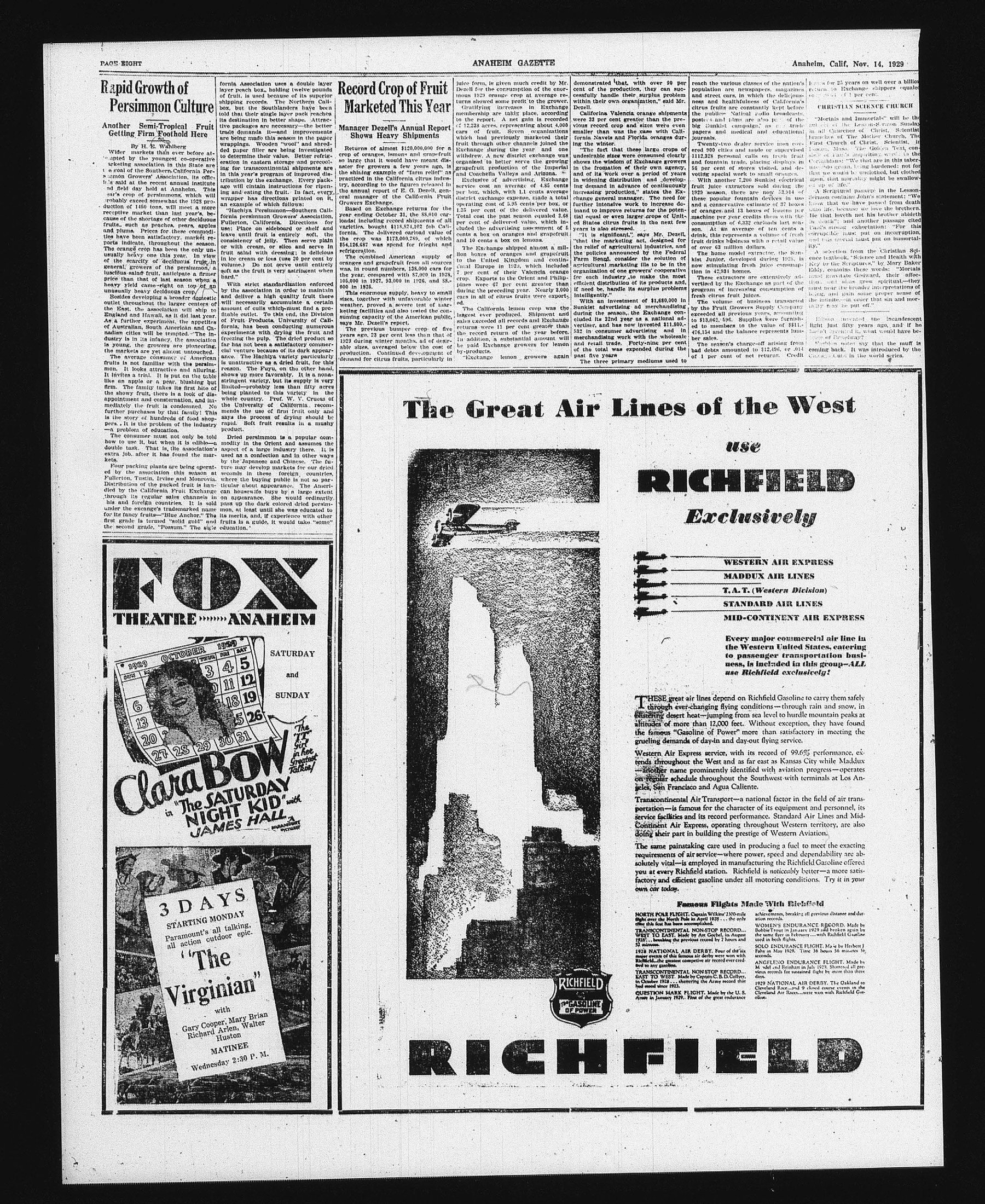
Searchable text
Rapid Growth of Persimmon Culture
Another Semi-Tropical Fruit Getting Firm Foothold Here
By H. E. Wohlberg
Wider markets than ever before attempted by the youngest co-operative marketing association in this State are the goal of the Southern California Persimmon Growers' Association, its office is said at the recent annual institute and field day held at Anaheim. This year's crop of persimmons, which will probably exceed somewhat the 1928 production of 1450 tons, will meet a more receptive market than last year's, because of the shortage of other deciduous fruits, such as peaches, pears, apples and plums. Prices for these commodities have been satisfactory, market reports indicate, throughout the season. The orange crop has been the only unusually heavy one this year. In view of the scarcity of deciduous fruit in general, growers of the persimmon, a luscious salad fruit, anticipate a firmer price than that of last season when a heavy yield came right on top of an unusually heavy deciduous crop.
Besides developing a broader domestic outlet throughout the larger centers of the East, the association will ship to England and Hawaii, as it did last year. As a further experiment, the appetites of Australian, South American and Canadian cities will be tempted. The industry is in its infancy, the association is young, the growers are pioneering, the markets are yet almost untouched.
The average consumer of American fruits is not familiar with the persimmon. It looks attractive and alluring. It invites a trial. It is put on the table like an apple or a pear, blushing but firm. The family takes its first bite of the showy fruit, there is a look of disappointment and consternation, and immediately the fruit is condemned. No further purchases by that family! This is the story of hundreds of food shoppers. It is the problem of the industry—a problem of education.
The consumer must not only be told how to use it, but when it is edible—a double task. That is the association's formula Association uses a double layer layer peach box, holding twelve pounds of fruit, is used because of its superior shipping records. The Northern Calibox, but the Southlanders have been told that their single layer pack reaches its destination in better shape. Attractive packages are necessary—the better trade demands it—and improvements are being made this season in the paper wrappings. Wooden "wool" and shredded paper filler are being investigated to determine their value. Better refrigeration in eastern storage and precooling for transcontinental shipments are in this year's program of improved distribution by the exchange. Every package will contain instructions for ripening and eating the fruit. In fact, every wrapper has directions printed on it, an example of which follows:
"Hachiya Persimmon—Southern California persimmon Growers' Association, Fullerton, California. Directions for use: Place on sideboard or shelf and leave until fruit is entirely soft, the consistency of jelly. Then serve plain or with cream, or slice and serve in fruit salad with dressing; is delicious in ice cream or ice (use 20 per cent by volume.) Do not serve until entirely soft as the fruit is very astringent when hard."
With strict standardization enforced by the association in order to maintain and deliver a high quality fruit there will necessarily accumulate a certain amount of culls which must find a profitable outlet. To this end, the Division of Fruit Products, University of California, has been conducting numerous experiments with drying the fruit and freezing the pulp. The dried product so far has not been a satisfactory commercial venture because of its dark appearance. The Hachiya variety particularly is unattractive as a dried fruit, for this reason. The Fuyu, on the other hand, shows up more favorably. It is a non-stringent variety, but its supply is very limited—probably less than fifty acres being planted to this variety in the whole country. Prof. W. V. Cruess of the University of California recommends the use of firm fruit only and says the process of drying should be rapid. Soft fruit results in a mushy product.
Dried persimmon is a popular commodity in the Orient and assumes the aspect of a large industry there."
The average consumer of American fruits is not familiar with the persimmon. It looks attractive and alluring. It invites a trial. It is put on the table like an apple or a pear, blushing but firm. The family takes its first bite of the showy fruit, there is a look of disappointment and consternation, and immediately the fruit is condemned. No further purchases by that family! This is the story of hundreds of food shoppers. It is the problem of the industry—a problem of education.
The consumer must not only be told how to use it, but when it is edible—a double task. That is, the association's extra job, after it has found the markets.
Four packing plants are being operated by the association this season at Fullerton, Tustin, Irvine and Monrovia. Distribution of the packed fruit is handled by the California Fruit Exchange through its regular sales channels in his and foreign countries. It is sold under the exchange's trademarked name for its fancy fruits—"Blue Anchor." The first grade is termed "solid gold" and the second grade, "Possum." The sigleance. The Hachiya variety particularly is unattractive as a dried fruit, for this reason. The Fuyu, on the other hand, shows up more favorably. It is a non-stringent variety, but its supply is very limited—probably less than fifty acres being planted to this variety in the whole country. Prof. W. V. Cruess of the University of California recommends the use of firm fruit only and says the process of drying should be rapid. Soft fruit results in a mushy product.
Dried persimmon is a popular commodity in the Orient and assumes the aspect of a large industry there. It is used as a confection and in other ways by the Japanese and Chinese. The future may develop markets for our dried seconds in these foreign countries, where the buying public is not so particular about appearance. The American housewife buys by a large extent on appearance. She would ordinarily pass up the dark colored dried persimmon, at least until she was educated to its merits, and, if experience with other fruits is a guide, it would take "some" education."
FOX THEATRE ANAHEIM
1929 OCTOBER SATURDAY
and
SUNDAY
Clara BOW
in "The Saturday Night Kid" with JAMES HALL
Clara BOW
in "The SATURDAY NIGHT KID" with JAMES HALL
3 DAYS
STARTING MONDAY
Paramount's all talking,
all action outdoor epic.
"The Virginian"
with
Gary Cooper, Mary Brian
Richard Arlen, Walter
Huston
MATINEE
Wednesday 2:30 P.M.
Record Crop of Fruit Marketed This Year
Manager Dezell's Annual Report Shows Heavy Shipments
Returns of almost $120,000,000 for a crop of oranges, lemons and grapefruit so large that it would have meant disaster for growers a few years ago, is the shining example of "farm relief" practiced in the California citrus industry, according to the figures released in the annual report of E. G. Dezell, general manager of the California Fruit Growers Exchange.
Based on Exchange returns for the year ending October 31, the $8,010 carloads (including record shipments of all varieties), bought $118,874,102 fob California. The delivered earlond value of the crop was $173,000,789, of which $54,126,687 was spend for freight and refrigeration.
The combined American supply of oranges and grapefruit from all sources was, in round numbers, 138,000 cars for the year, compared with 87,000 in 1928, 105,000 in 1927, 93,000 in 1926, and 88,000 in 1925.
This enormous supply, heavy to small sizes, together with unfavorable winter weather, proved a severe test of marketing facilities and also tested the consuming capacity of the American public, says Mr. Dezell's report.
The previous bumper crop of five years ago, 23 per cent less than that of 1929 during winter months, ad of desirable sizes, averaged below the cost of production. Continued development of demand for citrus fruits, particularly in juice form, is given much credit by Mr. Dezell for the consumption of the enormous 1929 orange crop at average returns showed some profit to the grower.
Gratifying increases in Exchange membership are taking place, according to the report. A net gain is recorded of 12,238 acres, representing about 4,000 cars of fruit. Seven organizations which had previously marketed their fruit through other channels joined the Exchange during the year and one withdrew. A new district exchange was organized to better serve the growing grapefruit production of the Imperial and Coachella Valleys and Arizona.
Exclusive of advertising, Exchange service cost an average of 4.85 cents per box, which with 1.1 cents average district exchange expense, made a total operating cost of 5.95 cents per box, or 1.35 per cent of the delivered value. Total cost the past season equaled 2.68 per cent of delivered value, which included the advertising assessment of 5 cents a box on oranges and grapefruit and 10 cents a box on lemons.
The Exchange shipped almost a million boxes of oranges and grapefruit to the United Kingdom and continental Europe in 1929, which included 7 per cent of their Valencia orange crops. Exports to the Orient and Philippines were 67 per cent greater than during the preceding year. Nearly 3,000 cars in all of citrus fruits were exported.
The California lemon crop was the largest ever produced. Shipment and sales exceeded all records and Exchange returns were 11 per cent greater than the record return of the year before. In addition, a substantial amount will be paid Exchange growers for lemon by-products.
"Exchange lemon growers again demonstrated that, with over 90 per cent of the production, they can successfully handle their surplus problem within their own organization," said Mr. Dezell.
California Valencia orange shipments were 33 per cent greater than the previous record crop and sizes were even smaller than was the case with California Navels and Florida oranges during the winter.
"The fact that these large crops of undesirable sizes were consumed clearly shows the wisdom of Exchange growers in the formation of their own agency, and of its work over a period of years in widening distribution and developing demand in advance of continuously increasing production," states the Exchange general manager. The need for further intensive work to increase demand to improve returns for the potential equal or even larger crops of United States citrus fruits in the next few years is also stressed.
"It is significant," says Mr. Dezell, "that the marketing act, designed for the relief of agricultural industries, and the policies announced by the Federal Farm Board, consider the solution of agricultural marketingills to be in the organization of one growers' cooperative for each industry to make the most efficient distribution of its products and, if need be, handle its surplus problems intelligently."
With an investment of $1,680,000 in Sunklist advertising ad merchandising during the season, the Exchange concluded its 22nd year as a national advertiser, and has now invested $11,800-532 in consumer advertising and in merchandising work with the wholesale and retail trade. Forty-nine per cent of the total was expended during the past five years.
The three primary mediums used to
The Great Air Lines
THESE great air through ever-changing desert heat altitudes of more than the famous "Gasolina" grueling demands on Western Air Express tends throughout the another name pro on regular schedule geles, San Francisco.
Transcontinental Air portation—is famous service facilities and Continent Air Exp doing their part in The same painstaking
NORTH POLE FLIGHT. Our flight over the North Pole in time this fest has been accounted for.
TRANSCONTINENTAL NORTH WEST TO EAST. Made by by 1928...breaking the previous 52 minutes.
1928 NATIONAL AIR DIVISION major events of this famous airfield...the greatest competed to any gasoline.
TRANSCONTINENTAL NORTH EAST TO WEST. Made by by in October 1928...shattering had wood since 1923.
QUESTION MARK FLIGHT. Army in January 1929.. First
Anaheim, Calif., Nov. 14, 1929
that these large crops of oranges were consumed clearly from their own agency, over a period of years distribution and development of continuously fruit in the next few presses.
says Mr. Dezell, acting act, designed for agricultural industries, announced by the Federal considerer the solution of marketing lilies to be in the one growers' cooperative try to make the most of its products and handle its surplus problems investment of $1,680,000 in raising ad merchandising year as a national ad advertising and in work with the wholesale e. Forty-nine per cent is expended during the primary mediums used to reach the various classes of the nation's population are newspapers, magazines and street cars, in which the delicuousness and healthfulness of California's citrus fruits are constantly kept before the public. National radio broadcasts, posters and films are also part of the big Sunkist campaign, as trade papers and medical and educational journals.
Twenty-two dealer service men covered 900 cities and made or supervised 1112,328 personal calls on fresh fruit and fountain trade, placing displays in 56 per cent of stores visited, and devoting special work to small oranges.
With another 7,200 Sunkist electrical fruit juice extractors sold during the 1929 season, there are now 53,914 of these popular fountain devices in use and a conservative estimate of 37 boxes of oranges and 13 boxes of lemons per machine per year credits them with the consumption of 6,332 carloads last season. At an average of ten cents a drink, this represents a volume of fresh fruit drinks business with a retail value of over 63 million dollars.
The home model extractor, the Sunkist Junior, developed during 1925, is now stimulating fresh juice consumption in 42,934 homes.
These extractors are extensively advertised by the Exchange as part of the program of increasing consumption of fresh citrus fruit juices.
The volume of business transacted by the Fruit Growers Supply Company exceeded all previous years, amounting to $13,062,596. Supplies were furnished to members to the value of $$11,476,154 and the balance represents lunar sales.
The season's charge-off arising from bad debts amounted to $12,496, or .014 of 1 per cont of net returns. Credit losses for 25 years on well over a billion return to Exchange shippers equaled one half of 1 per cent.
CHRISTIAN SCIENCE CHURCH
"Mortals and Immortals" will be the subject of the Lesson-Sermon Sunday in all Churches of Christ, Scientist branches of The Mother Church, The First Church of Christ, Scientist, In Lossion, Mass. "The Golden Text consists of Paul's inspirational words to the Corinthians: "We that are in this tabernacle grean, being burdened; not for that we would be unclothed, but clothed upon, that mortality might be swallowed up of life."
A Scriptural passage in the Lesson-Sermon contains John's statement: "We know that we have passed from death unto life, because we love the brethern. He that loveth not his brother abideth in death"; and another passage cited Paul's strong exhortation: "For this corruptible must put on incorruption, and this mortal must put on immortality."
A selection from the Christian Science textbook, "Science and Health with Key to the Scriptures," by Mary Baker Eddy, contains these words: "Mortals must gravitate Godward, their affection and ideas grow spiritual—they must near the broader interpretations of being, and gain some proper sense of the infinite—in order that sin and mortality may be put off."
Edison invented the incandescent light just fifty years ago, and if he hadn't invented it, what would have been of Broadway?
Pearson notes say that the muff is coming back. It was introduced by the Chicago Cubs in the world series.
Lines of the West
use
RICHFIELD
Exclusively
WESTERN AIR EXPRESS
MADDUX AIR LINES
T.A.T. (Western Division)
STANDARD AIR LINES
MID-CONTINENT AIR EXPRESS
Every major commercial air line in the Western United States, catering to passenger transportation business, is included in this group—ALL use Richfield exclusively!
THESE great air lines depend on Richfield Gasoline to carry them safely through ever-changing flying conditions—through rain and snow, in blistering desert heat—jumping from sea level to hurdle mountain peaks at altitudes of more than 12,000 feet. Without exception, they have found the famous "Gasoline of Power" more than satisfactory in meeting the grueling demands of day-in and day-out flying service.
Western Air Express service, with its record of 99.6% performance, extends throughout the West and as far east as Kansas City while Maddux — another name prominently identified with aviation progress — operates on regular schedule throughout the Southwest with terminals at Los Angeles, San Francisco and Agua Caliente.
Transcontinental Air Transport—a national factor in the field of air transportation—is famous for the character of its equipment and personnel, its service facilities and its record performance. Standard Air Lines and Mid-Continent Air Express, operating throughout Western territory, are also doing their part in building the prestige of Western Aviation.
The same painstaking care used in producing a fuel to meet the exacting
tends throughout the West and as far east as Kansas City while Maddux—another name prominently identified with aviation progress—operates on regular schedule throughout the Southwest with terminals at Los Angeles, San Francisco and Agua Caliente.
Transcontinental Air Transport—a national factor in the field of air transportation—is famous for the character of its equipment and personnel, its service facilities and its record performance. Standard Air Lines and Mid-Continent Air Express, operating throughout Western territory, are also doing their part in building the prestige of Western Aviation.
The same painstaking care used in producing a fuel to meet the exacting requirements of air service—where power, speed and dependability are absolutely vital—is employed in manufacturing the Richfield Gasoline offered you at every Richfield station. Richfield is noticeably better—a more satisfactory and efficient gasoline under all motoring conditions. Try it in your own car today.
Famous Flights Made With Richfield
NORTH POLE FLIGHT. Captain Wilkins 2300-mile flight over the North Pole in April 1928...the only other feat has been accomplished.
TRANSCONTINENTAL NON-STOP RECORD...WEST TO EAST. Made by Art Goebel, in August 1928...breaking the previous record by 7 hours and 52 minutes.
1928 NATIONAL AIR DERBY. Four of the six major events of this famous air derby were won with Richfield—the greatest competitive air record ever credited to any gasoline.
TRANSCONTINENTAL NON-STOP RECORD...EAST TO WEST. Made by Captain C.B.D. Collyer, in October 1928...shattering the Army record that had stood since 1923.
QUESTION MARK FLIGHT. Made by the U.S. Army in January 1929..First of the great endurance achievements, breaking all previous distance and duration records.
WOMEN'S ENDURANCE RECORD. Made by Bobbie Trout in January 1929 and broken again by the same flyer in February...with Richfield Gasoline used in both flights.
SOLO ENDURANCE FLIGHT. Made by Herbert J Fahy in May 1929. Time 36 hours 56 minutes 36 seconds.
ANGFLENO ENDURANCE FLIGHT. Made by Mabel and Reinhart in July 1929. Shattered all previous records for sustained flight by more than three days.
1929 NATIONAL AIR DERBY. The Oakland to Cleveland Race...and 9 closed course events in the Cleveland Air Races...were won with Richfield Gasoline.