anaheim-gazette 1929-11-14
Scanned page
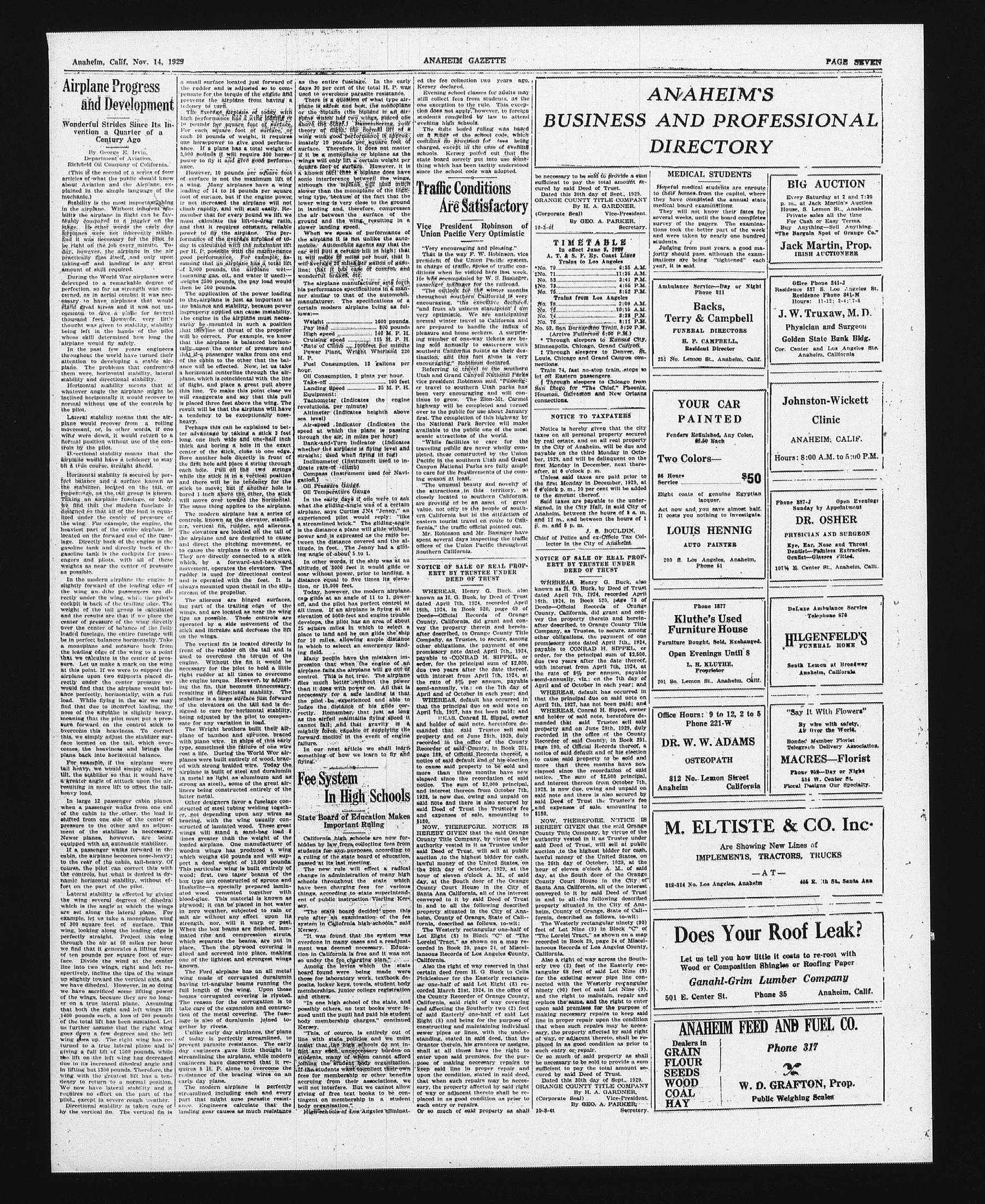
Searchable text
Airplane Progress and Development
Wonderful Strides Since Its Invention a Quarter of a Century Ago
By George E. Irvin
Department of Aviation
Richfield Oil Company of California.
(This is the second of a series of four articles of what the public should know about Aviation and the Airplane, explained in the simple language of the mechanic.)
Stability is the most important thing in the airplane. Without inherent stability the airplane in flight can be favorably compared to a juggler on the lunge. Its other words the early day airplanes were not inherently stable and it was necessary for the pilot to be right on the job every minute. Today, however, the airplane in the air practically flies itself, and only upon taking-off and landing is any great amount of skill required.
During the World War airplanes were deleveled to a remarkable degree of perfection, so far as strength was concerned, as in aerial combat it was necessary to have airplanes that would stand great stress and it was not uncommon to dive a plane for several thousand feet. However, very little thought was given to stability, stability being left in the hands of the pilot whose skill determined how long the airplane would fly safely.
In the past few years engineers throughout the world have turned their attention to developing a stable airplane. The problems that confronted them were horizontal stability, lateral stability and directional stability.
Horizontal stability means that at whatever angle the airplane might be inclined horizontally it would recover to normal without use of the controls by the pilot.
Lateral stability means that the airplane would recover from a rolling movement, or, in other words, if one wing were down, it would return to a normal position without use of the controls by the pilot.
A small surface located just forward of the rudder and is adjusted so to compensate for the torque of the engine and prevents the airplane from having a tendency to turn.
The average airplane of today with high performance has a wing loading of 10 pounds per square foot of surface. For each square foot of surface, or each 10 pounds of weight, it requires one horsepower to give good performance. If a plane has a total weight of 3,000 pounds it will require 300 horsepower to fly it and give good performance.
However, 10 pounds per square foot of surface is not the maximum lift of a wing. Many airplanes have a wing loading of 14 to 16 pounds per square foot of surface, but if the engine power is not increased the airplane will not climb rapidly, and will stall easily. Remember that for every pound we lift we must calculate the lift-to-drag ratio, and that it requires constant, reliable power to fly the airplane. The performance of the average airplane of today is calculated with the maximum lift per H.P. possible with the maintenance good performance. For example, assuming that an airplane has a total lift of 3,000 pounds, the airplane wet—meaning gas, oil, and water used)—weights 2500 pounds, the pay load would then be 500 pounds.
The application of the power loading to the airplane is just as important as the balance and stability because power improperly applied can cause instability. The engine in the airplane must necessarily be mounted in such a position that the line of thrust of the propeller will be correct. For example, we know that the airplane is balanced horizontally upon the center of pressure and that if a passenger walks from one end of the cabin to the other that the balance will be effected. Now, let us take a horizontal centerline through the airplane, which is coincidental with the line of flight, and place a great pull above this line. To make this point clear we will exaggerate and say that this pull is placed three feet above the wing. The result will be that the airplane will have a tendency to be exceptionally nose-heavy.
Perhaps this can be explained to better advantage by taking a stick 2 feet long, one inch wide and one-half inch thick and boring a hole in it exactly as the entire fuselage. Days 30 per cent of the used to overcome parasite there is a question of plane is safest and best, or the biplane (the biplane which had two wings above its other). Reimin theory of flight: the wing with good performm imately 10 pounds per surface. Therefore, it did if it be a monoplane or wings will only lift a certain square foot of surface.
A known fact that a big some interference between although the biplane w ower than the monoplane wing type; because of the lower wing is very close in landing and, therefore, the air between the suv ground and the wing slower landing speed.
When we speak of p eairplanes it is not unmobile. Automobiles ager car will pull a certain hit it will make 80 miles per hour will make 20 miles per line; that it has caused wonderful brakes, etc.
The airplane manufactures his performance specifically similar to that of manufaturer. The specs certain modern airplanes low:
Weight
Pay load
High speed
Cruising speed
Rate of Climb
Power Plant, Wright H.P.
Fuel Consumption, 1 hour.
Oil Consumption, 2 pints.
Take-off
Landing Speed
Equipment:
Tachometer (Indicates revolutions, per minute)
Altimeter (Indicates sea level)
Air-speed Indicator speed at which the plane travels through the air in miles Bank-and-Turn Indica whether
throughout the world have turned their attention to developing a stable airplane. The problems that confronted them were, horizontal stability, lateral stability and directional stability.
Horizontal stability means that at whatever angle the airplane might be inclined horizontally it would recover to normal without use of the controls by the pilot.
Lateral stability means that the airplane would recover from a rolling movement, or, in other words, if one wing were down, it would return to a normal position without use of the controls by the pilot.
Directional stability means that the airplane would have a tendency to stay bill a true course, straight ahead.
Horizontal stability is secured by perfect balance and a surface known as the stabilizer, located on the tail, or empilage, as the tail group is known. Taking an airplane fuselage, or body, we find that the modern fuselage is designed so that all of the load is equalized under the center of pressure of the wing. For example, the engine, the heaviest part of the entire airplane, is located on the forward end of the fuselage. Directly back of the engine is the gasoline tank and directly back of the gasoline tank is the cockpits for passengers and pilots, with all of these weights as near the center of pressure as possible.
In the modern airplane the engine is slightly forward of the leading edge of the wing and dthe passengers are directly under the wing, while the pilot's cockpit is back of the trailing edge. The weight of the tail group is calculated and the results are that if we place the center of pressure of the wing directly over the center of balance of the fully loaded fuselage, the entire fuselage will be in perfect balance horizontally. Take a monoplane and measure back from the leading edge of the wing to a point that we calculate is the center of pressure. Let us make a mark on the wing at this point. If we were to support the airplane upon two supports placed directly under the center pressure we would find that the airplane would balance perfectly, horizontally, with a full load. While flying in the air we may find that due to incorrect loading, the nose of the airplane is slightly heavy, meaning that the pilot must put a pressure forward on the control stick to overcome this heaviness. To correct this, we simply adjust the stabilizer surface located on the tail, which overcomes the heaviness and brings the plane back into horizontal balance.
For example, if the airplane were tall heavy, we would simply adjust, or tilt, the stabilizer so that it would have a greater angle of attack upon the air, resulting in more lift to offset the tail-heavy load.
In large 12 passenger cabin planes, when a passenger walks from one end of the cabin to the other, the load is shifted from one side of the center of pressure to the other and an adjustment of the stabilizer is necessary. Newer planes, however, are being equipped with an automatic stabilizer.
If a passenger walks forward in the aircraft waits from one end of the cabin to the other that the balance will be effected. Now, let us take a horizontal line through the airplane, which is coincidental with the line of flight, and place a great pull above this line. To make this point clear we will exaggerate and say that this pull is placed three feet above the wing. The result will be that the airplane will have a tendency to be exceptionally nose-heavy.
Perhaps this can be explained to better advantage by taking a stick 2 feet long, one inch wide and one-half inch thick and boring a hole in the exact center of the stick, close to one edge. Bore another hole directly in front of the first hole and place a string through each hole. Pull off this string while the stick is in a vertical position and there will be no tendency for the stick to move; but if another hole is bored 1 inch above the other, the stick will move over toward the horizontal. The same thing applies to the airplane.
The modern airplane has a series of controls, known as the elevator, stabilizer, vertical fin, rudder, and alterors. The elevators are located on the tail of the airplane and are designed to cause and direct the pitching movement, or to cause the airplane to climb or dive. They are directly connected to a stick which, by a forward-and-backward movement, operates the elevators. The rudder is used for directional control and is operated with the feet. It is always mounted upon that tail in the slipstream of the propeller.
The alterors are hinged surfaces, integral part of the trailing edge of the wings, and are located as near the wing tips as possible. These controls are operated by a side movement of the stick and increase and decrease the lift on the wings.
The vertical fin is located directly in front of the rudder on the tail and is used to overcome the torque of the engine. Without the fin it would be necessary for the pilot to hold a little right rudder at all times to overcome the engine torque. However, by adjusting the fin, this becomes unnecessary, resulting in directional stability. The stabilizer is a large surface just forward of the elevators on the tail and is designed to care for horizontal stability, being adjusted by the pilot to compensate for any variation in load.
The Wright brothers built their airplane of bamboo and spruce, braced with plano wire. In ships of this early type, sometimes failure of one wire cost a life. During World War planes were built entirely of wood, braced with strong braided wire. Today the airplane is built of steel and duralumin (a metal as light as aluminum and as strong as steel), some of the great airliners being constructed entirely of latter metal.
Other designers favor a fuselage constructed of steel tubing welding together, not depending upon any wires as bracing, with the wing usually constructed of laminated wood. These great wings will stand a sand-bag load 5 times greater than the weight of the loaded airplane. One manufacturer of wooden wings has produced a wing
H. P.
Fuel Consumption,
1 hour.
Oil Consumption,
2 pints.
Take-off.
Landing Speed
Equipment:
Tachometer (Indicates revolutions per minute).
Altimeter (Indicates sea level).
Air-speed Indicator speed at which the plane through the air in miles Bank-and-Turn Indica whether the airplane is for straight; used whet flyin Incinlometer (Instume d rate-of-climb)
Compass (Instrument gatlo.)
Oil Pressure Gadget.
Oil Temperature Gauge.
In the early days it oi whatthe gliding-anglewairplane,says Curtiss JNexperienced pilot woulda streamlined brick." Thisisthe distancea plane wh powerandis expressedattweenthedistancecovertitude.infeet.TheJen ingangleofabout5to10
In other wordsifthealtitudeof3000feetitsoarwithoutpower,priordistanceequaltofivetiomor15,000feet.
Todayhowever,them capglideatanangleofforand,thepilothasperalltimes.Ifanairplane elevationof5000feetanddevelops,thepilothasan25squaremilesinwhichplacelandandhecanfor10milesallowinginwhichtoselectanengfield.
Many people have thpepressionthatwhentheairplanefalls,theairplanecontrol.Thisisnottruefilesmuchbetterwiththantitdoeswithpowernecessaryforasafelethiopilot-beexperiencejudgeofthedistanceofrectly.Rememberthatastheairfallmalntailscannotfail;andthatmightyforcecapableofforwardmotionintheeailure.
In our next articlew somethingofhowwele飞ing.
Fee System
In High
State Board of Educ
Important R
California high schoolbiddenbylawfromcollegestudentsforanypurposes
For example, if the airplane were tall heavy, we would simply adjust, or tilt, the stabilizer so that it would have a greater angle of attack upon the air, resulting in more lift to offset the tail-heavy load.
In large 12 passenger cabin planes, when a passenger walks from one end of the cabin to the other, the load is shifted from one side of the center of pressure to the other and an adjustment of the stabilizer is necessary. Newer planes, however, are being equipped with an automatic stabilizer.
If a passenger walks forward in the cabin, the airplane becomes nose-heavy; to the rear of the cabin, tail-heavy. Of course, the pilot can correct this with the controls, but what is desired is dynamic horizontal stability without effort on the part of the pilot.
Lateral stability is effected by giving the wing several degrees of dihedral which is the angle at which the wings are set along the lateral plane. For example, let us take a monoplane wing of 300 square feet of surface. This wing, looking along the leading edge is perfectly straight. Project this wing through the air at 60 miles per hour we find that it generates a lifting force of ten pounds per square foot of surface. Divide the wind at the center line into two wings, right and left respectively, incline the tips of the wings up slightly toward the vertical axis, and we have dihedral. However, in so doing we have sacrificed some lifting power of the wings, because they are no longer on a true lateral plane. Assuming that both the right and left wings lift 1400 pounds each, a loss of 200 pounds of the total lift has been sustained. Let us further assume that the right wing goes down a few degrees and the left wing goes up. The right wing has returned to a true lateral plane and is giving a full lift of 1500 pounds, while the lift on the left wing has decreased due to its increased dihedral angle and in lifting but 1300 pounds. Therefore, the wing with the greatest lift has a tendency to return to a normal position.
We now have lateral stability and it requires no effort on the part of the pilot, except in severe rough weather.
Directional stability is taken care of by the vertical fin. The vertical fin is planes were built entirely of wood, braced with strong braided wire. Today the airplane is built of steel and duralumin (a metal as light as aluminum and as strong as steel), some of the great airliners being constructed entirely of the latter metal.
Other designers favor a fuselage constructed of steel tubing welding together, not depending upon any wires as bracing, with the wing usually constructed of laminated wood. These great wings will stand a sand-bag load 8 times greater than the weight of the loaded airplane. One manufacturer of wooden wings has produced a wing which weighs 450 pounds and will support a dead weight of 13,000 pounds. This particular wing is built entirely of wood; first, two taper beams of the box type are constructed of spruce and Haskellite—a specially prepared laminated wood cemented together with blood-glue. This material is known as plywood; it can be placed in hot water in zero weather, subjected to rain or salt air without any effect upon its strength, nor, will it warp or peel. When the box beams are finished, laminated ribs and compression struts, which separate the beams, are put in place. Then the plywood covering is glued and screwed into place, making one of the lightest and strongest wings known.
The Ford airplane has an all metal wing made of corrugated duralumin having tri-angular beams running the full length of the wing. Upon these beams corrugated covering is riyeted. The reason for the corrugation is to take care of the expansion and contraction of the metal covering. The fuselage is also of duralumin joined together by rivets.
Unlike early day airplanes, the plane today is perfectly streamlined, to prevent parasite resistance. The early day engineers gave little thought to streamlining the airplane, while modern engineers have discovered that it requires S.H.P. alone to overcome the resistance of the bracing wires on an early day plane.
The modern airplane is perfectly streamlined including each and every part that might cause parasite resistance. Engineers calculate that the landing gear causes as much resistance
Fee System In High State Board of Education Important R
California high schools blind by law from college students for any purpose a ruling of the state board passed at its last meeting.
The new rule will change in administration schools throughout the state have been charging fees things, according to state ent of public instruction sey.
"The state board decide rule after an examination system in Callofrnla high Kersey."
"It was found that overdone in many cases ment was deemed necation in California is free so under the fee charging Among the levies who board found were those for laboratory work posits, locker keys, towels memberships, junior college and others.
"In one high school of possibly others, no text sued until the pupil had body membership charge Kersey."
"This, of course, is o line with state police insist that the high school fillet any such unnecess students, many of whom joining the student body If the students want to fees for membership or accruing from their ar will not interfere. But we giving of free text book ingent on membership body organization."
High schools of Los An
ANAHEIM GAZETTE
as the entire fuselage. In the early days 30 per cent of the total H.P. was used to overcome parasite resistance.
There is a question of what type airplane is safest and best, the monoplane or the biplane (the biplane is an airplane which has two wings, placed one above the other). Remembering your theory of night: the normal lift of a wing with good performance is approximately 10 pounds per square foot of surface. Therefore, it does not matter if it be a monoplane or biplane as the wings will only lift a certain weight per square foot of surface. However, it is a known fact that a biplane does have some interference between the wings, although the biplane still and much slower than the monoplane of the high-wing type, because of the fact that the lower wing is very close to the ground in landing and, therefore, compresses the air between the surface of the ground and the wing resulting in a slower landing speed.
When we speak of performance of the airplanes it is not unlikes the automobile. Automobile agents say that the car will pull a certain hill in high; that it will make 80 miles per hour; that it will average 20 miles per gallon of gasoline; that it will cause control and wonderful brakes, etc.
The airplane manufacturer sets forth his performance specifications in a manner similar to that of the automobile manufacturer. The specifications of a certain modern airplane being as follows:
Weight ... 1600 pounds.
Pay load ... 800 pounds.
High speed ... 140 M.P.H.
Cruising speed ... 115 M.P.H.
Rate of climb ... 1000 feet per minute.
Power Plant, Wright Whirlland 220 H.P.
Fuel Consumption, 13 gallons per hour.
Oil Consumption, 2 pints per hour.
Take-off ... 100 feet.
Landing Speed ... 35 M.P.H.
Equipment:
Tachometer (Indicates the engine revolutions, per minute)
Altimeter (Indicates height above sea level)
Air-speed Indicator (Indicates the speed at which the plane is passing through the air, in miles per hour)
Bank-and-Turn Indicator (Indicates whether the aircraft is going level and ed the fee collection two years ago, Kersey declared.
Evening school classes for adults may still collect fees from students, as the one exception to the rule. This exception does not apply, however, to foreign students compelled by law to attend evening high schools.
The state board ruling was based on a prior of the school code, which contains no provision for fees being charged, except in the case of evening schools. Kersey pooled out that the state board merely put into use something which has been tacitly understood since the school code was adopted.
Traffic Conditions Are Satisfactory
Vice President Robinson of Union Pacific Very Optimistic
"Very encouraging and pleasing."
That is the way F.W. Robinson, vice president of the Union Pacific system, in charge of traffic, spoke of traffic conditions when he visited here last week. He was accompanied by W.S. Businger, passenger manager for the railroad.
"The outlook for the winter months throughout southern California is very encouraging," the executive declared, "and from abusiness standpoint I am very optimistic. We are anticipating normal winter travel to California and are prepared to handle the influx of pleasure and home seakers. A surprising number of one-way tickets are being sold annually to easterners with southern California points as their destination, and this fleet alone is very encouraging." Robinson declared.
Referring to travel to the southern Utah and Grand Canyon National Parks vice president Robinson said, "Passenger travel to southern Utah parks has been very encouraging and will continue to grow. The Zion-Mt. Carmel highway will be completed and turned over to the public for use about January first. The completion of this highway by the National Park Service will make available to the public one of the most scenic attractions of the world.
"While facilities to care for the traveling public are never wholly com-
be necessary to be sold to provide a sum sufficient to pay the total amount secured by said Deed of Trust.
Dated this 30th day of Sept., 1929.
ORANGE COUNTY TITLE COMPANY
By H.A.GARDNER,
(Corporate Seal).
Vice-President.
By GEO. A.PARKER,
Secretary.
TIMETABLE
In effect June 9, 1929
A.T. & S.F. By Coast Lines
Trains to Los Angeles
*No. 79 ... 6:35 A.M.
*No. 71 ... 11:26 A.M.
No. 53 ... 3:41 P.M.
No. 73 ... 4:55 P.M.
No. 75 ... 8:52 P.M.
Trains from Los Angeles
No. 78 ... 2:08 A.M.
No. 79 ... 10:15 A.M.
No. 74 ... 2:28 P.M.
No. 76 ... 8:11 P.M.
No. 52, San Bernardino Trailt, 6:20 P.M.)
(Arrive Fullerton 6:00 P.M.)
* Through sleepers to Kansas City, Minneapolis, Chicago, Grand Canyon.
* Through sleepers to Denver, St. Louis, Chicago and Grand Canyon connections.
Train 74, fast no-stop train, stops to let off Eastern passengers.
$Through sleepers to Chicago from San Diego for "The Chief," Phoenix, Houston, Galveston and New Orleans connections.
NOTICE TO TAXPAYERS
Notice is hereby given that the city taxes on all personal property secured by real estate, and on all real property in the City of Anaheim, will be due and
Fuel Consumption, 13 gallons per hour.
Oil Consumption, 2 pints per hour.
Take-off, 100 feet.
Landing Speed, 35 M.P.H.
Equipment:
Tachometer (Indicates the engine revolutions, per minute)
Altimeter (Indicates height above sea level)
Air-speed Indicator (Indicates the speed at which the plane is passing through the air, in miles per hour)
Bank-and-Turn Indicator (Indicates whether the airplane is flying level and straight; used when flying in fog)
Inclinometer (Instrument used to indicate rate-of-climb)
Compass (Instrument used for Navigational).
Oil Pressure Gauge.
Oil Temperature Gauge.
In the early days it often was to ask what the gliding-angle was of a certain airplane, says Curtiss JN4 "Jenny," an experienced pilot would reply: "like a streamlined brick." The gliding-angle is the distance a plane will glide without power and is expressed as the ratio between the distance covered and the altitude, in feet. The Jenny had a gliding angle of about 5 to 1.
In other words, if the ship was at an altitude of 3000 feet it would glide or soar without power, prior to landing, a distance equal to five times its elevation, or 15,000 feet.
Today, however, the modern airplane can glide at an angle of 11 to 1, power off, and the pilot has perfect control at all times. If an airplane is flying at an elevation of 6000-feet and engine trouble develops, the pilot has an area of about 25 square miles in which to select a place to land and he can glide the ship for 10 miles, allowing ample distance in which to select an emergency landing field.
Many people have the mistaken impression that when the engine of an airplane fails, the airplane will go out of control. This is not true. The airplane files much better without the power than it does with power on. All that is necessary for a safe landing is that the pilot be experienced and able to judge the distance of his glide correctly. Remember, that just as long as the airfield maintains flying speed it cannot fail; and that gravity is a mighty force capable of supplying the forward motion in the event of engine failure.
In our next article we shall learn something of how we learn to fly and flying."
Fee System In High Schools
State Board of Education Makes Important Ruling
California high schools are now forbidden by law from collecting fees from students for any purposes according to
NOTICE OF SALE OF REAL PROPERTY BY TRUSTEE UNDER DEED OF TRUST
WHEREAS, Henry G. Buck, also known as H. G. Buok, by Deed of Trust dated April 7th, 1924, recorded April 16th, 1924, in Book 520, page 69 of Deeds—Official Records of Orange County, California, did grant and convey the property therein and herein after described, to Orange County Title Company, as Trustee, to secure, among other obligations, the payment of one promissory note dated April 7th, 1924, payable to CONRAD H. SIPPEL, or order, for the principal sum of $2,000, due two years after the date thereof, with interest from April 7th, 1924, at the rate of 8% per annum, payable semi-annually, viz.: on the 7th day of April and of October in each year; and WHEREAS, default has occurred in that the principal due on said note on April 7th, 1927, has not been paid; and WHEREAS, Conrad H. Sippel, owner and holder of said note, heretofore demanded that said Trustee sell said property and on June 28th, 1929, duly recorded in the office of the County Recorder of said County, in Book 201, page 189, of Official Records thereof, a notice of said default and of his election to cause said property to be sold and more than three months have now elapsed since the recordation of said notice. The sum of $2,000 principal, and interest thereon from October 7th, 1928, is now due, owing and unpaid on said note and there is also secured by said Deed of Trust the Trustee's fee and expenses of sale, amounting to $180.
NOW, THEREFORE NOTICE IS HEREBY GIVEN that the said Orange County Title Company, by virtue of the authority vested in it as Trustee under said Deed of Trust will sell at public auction to the highest bidder for cash.
Louis, Chicago and Grand Canyon connections.
Train 74, fast no-stop train, stops to let off Eastern passengers.
$ Through sleepers to Chicago from San Diego for "The Chief," Phoenix, Houston, Galveston and New Orleans connections.
NOTICE TO TAXPAYERS
Notice is hereby given that the city taxes on all personal property secured by real estate, and on all real property in the City of Anaheim, will be due and payable on the third Monday in October, 1929, and will be delinquent on the first Monday in December, next thereafter, at 6 o'clock p.m.
Unless said taxes are paid prior to the first Monday in December, 1929, at 6 o'clock p.m., 10 per cent will be added to the amount thereof.
Said taxes are payable to the undersigned, in the City Hall, in said City of Anaheim, between the hours of 8 a.m. and 12 m., and between the hours of 1 p.m. and 6 p.m.
J. B. BOULDIN,
Chief of Police and ex-Officio Tax Collector in the City of Anaheim.
NOTICE OF SALE OF REAL PROPERTY BY TRUSTEE UNDER DEED OF TRUST
WHEREAS, Henry G. Buck, also known as H. G. Buck, by Deed of Trust dated April 7th, 1924, recorded April 16th, 1924, in Book 520, page 78 of Deeds—Official Records of Orange County, California, did grant and convey the property therein and hereafter described, to Orange County Title Company, an Trustee, to secure among other obligations,the payment of one promissory note dated April 7th,,1924,payable to CONRAD H. SIPPEL,或orderfortheprincipalsumof$2,$00,duetwoyearstafterthedatethereofwithinterestfromApril7th,1924.attherateof8%perannuum,payablesemi-annually,viz:onthe7thdayofAprilandofOctoberineachyear;andWHEREASdefaulthasoccurredinthattheprincipaldueonsaidnoteonApril7th,1927,hastnotbeenpaid;andWHEREASConradH.Sippelownerandholderofsaidnote,HeretoforemandedthatsaldTrusteesellsapropertyandonJune28th,1929,dulyrecordedintheofficeoftheCountyRecorderofsaidCounty,在Book201,page189,officialRecordsthereof,a noticeofsaiddefaultandofhiselectiontocausesaidpropertytobesoldandmorethanthreemonthshavenoelapsedsincetherecordationsofsaidnotice.Thesumof$2,$00principal,andinterestthereonfromOctober7th,1928.isnowdue,owingandunpaidonsaidnoteandthereisalsosecuredbysaldDeedofTrusttheTrustee'sfeeandexpensesofsale,amountingto$180.
NOW.THEREFORE.NOTICEIBHEREYGIVENthatthesaldOrangeCountyTitleCompany,byserviceoftheauthorityvestedinitasTrusteesundersaldDeedOfTrustwillsellatpublicauctiontothehighestbidderforsales
Fee System
In High Schools
State Board of Education Makes Important Ruling
California high schools are now forbidden by law from collecting fees from students for any purposes, according to a ruling of the state board of education, passed at its last meeting.
The new rule will effect a radical change in administration of many high schools throughout the state which have been charging fees for various things, according to state superintendent of public instruction Vierling Kersey.
"The state board decided upon this rule after an examination of the fee system in California high schools," said Kersey.
"It was found that the system was overdone in many cases and a readjustment was deemed necessary. Education in California is free and it was not so under the fee charging plan."
Among the levies which the state board found were being made were those for laboratory work, textbook deposits, locker keys, towels, student body memberships, junior college registration and others.
"In one high school of the state, and possibly others, no text books were issued until the pupil had paid his student body membership charges," continued Kersey.
"This, of course, is entirely out of line with state policies and we must insist that the high schools do not interfere any such unnecessary burden on students, many of whom cannot afford joining the student body organization. If the students want to collect their own fees for membership or other benefits accruing from their associations, we will not interfere. But we cannot allow giving of free text books to be contingent on membership in a student body organization."
High schools of Los Angeles eliminate notice of said default and of his election to cause said property to be sold and more than three months have now elapsed since the recordation of said notice. The sum of $2,000 principal, and interest thereon from October 7th, 1928, is now due, owing and unpaid on said note and there is also secured by said Deed of Trust the Trustee's fee and expenses of sale, amounting to $180.
NOW, THEREFORE, NOTICE IS HEREBY GIVEN that the said Orange County Title Company, by virtue of the authority vested in it as Trustee under said Deed of Trust, will sell at public auction, to the highest bidder for cash, lawful money of the United States, on the 26th day of October, 1928, at the hour of eleven o'clock A.M., of said day, at the South door of the Orange County Court House in the City of Santa Ana California, all of the interest conveyed to it by said Deed of Trust in and to all the following described property situated in the City of Anaheim, County of Orange, State of California, described as follows, to-wit:
The Westerly rectangular one-half of Lot Eight (8) in Block "C" of "The Lorelel Tract," as shown on a map recorded in Book 29, page 24, of Miscellaneous Records of Los Angeles County, California.
Also the right of way reserved in that certain deed from H. G. Buck to Celia Picklesimer for the Easterly rectangular one-half of said Lot Eight (8) recorded March 21st, 1924, in the office of the County Recorder of Orange County, California, said right of way covering and affecting the Southerly two (2) feet of said Easterly one-half of said Lot Eight (8) and being for the purpose of constructing and maintaining individual sewer pipes or lines, with the understanding, stated in said deed, that the Grantor therein, his grantees or assigns shall at all times have the right to enter upon said premises, for the purpose of making necessary repairs to keep said line in proper repair and upon the condition stated in said deed, that when such repairs may be necessary, the property affected by said right of way or adjacent thereto shall be replaced in as good condition as prior to such entry or repairs.
Or so much of said property as shall cause said property to be sold and more than three months have now elapsed since the recordation of said notice. The sum of $2,500 principal, and interest thereon from October 7th, 1928, is now due, owing and unpaid on said note and there is also secured by said Deed of Trust the Trustee's fee and expenses of sale, amounting to $180.
NOW, THEREFORE, NOTICE IS HEREBY GIVEN that the said Orange County Title Company, by virtue of the authority vested in it as Trustee under said Deed of Trust, will sell at public auction to the highest bidder for cash, lawful money of the United States, on the 26th day of October, 1929, at the hour of eleven o'clock A.M., of said day, at the South door of the Orange County Court House in the City of Santa Ana California, all of the interest conveyed to it by said Deed of Trust in and to all the following described property situated in the City of Anaheim, County of Orange, State of California, described as follows, to-wit:
The Westerly rectangular ninety (90) feet of Lot Nine (9) in Block "C" of "The Lorelel Tract," as shown on a map recorded in Book 29, page 24 of Miscellaneous Records of Los Angeles County, California.
Also a right of way across the Southern two (2) feet of the Easterly rectangular 68 feet of said Lot Nine (9) for the existing sewer pipe line connected with the Westerly rectangular ninety (90) feet of said Lot Nine (9), and the right to maintain, repair and replace the same, and the right to enter upon said premises for the purpose of making necessary repairs to keep said line in proper repair and upon the condition stated in said deed, that when such repairs may be necessary, the property affected by said right of way or adjacent thereto shall be replaced in as good condition as prior to such entry or repair.
Or so much of said property as shall be necessary to be sold to provide a sum sufficient to pay the total amount secured by said Deed of Trust.
Dated this 30th day of Sept., 1929,
ORANGE COUNTY TITLE COMPANY
By H. A. GARDNER,
(Corporate Seal)
Vice-President.
By GEO. A. PARKER:
Secretary.
ANAHEIM'S
ESS AND PROFESSIONAL
DIRECTORY
MEDICAL STUDENTS
Hopeful medical students are enroute to their homes from the capitol, where they have completed the annual state medical board examinations.
They will not know their fates for several weeks, until the board completes survey of the papers. The examinations took the better part of the week and were taken by nearly one hundred students.
Judging from past years, a good majority should pass, although the examinations are being "tightened" each year, it is said.
BIG AUCTION
Every Saturday at 2 and 7:30 p.m., at Jack Martin's Auction House, S. Lemon St., Anaheim. Private sales all the time. For Cash or Easy Terms.
Buy Anything—Sell Anything.
"The Bargain Spot of Orange Co."
Jack Martin, Prop.
IRISH AUCTIONEER
Ambulance Service—Day or Night
Phone 811
Backs,
Terry & Campbell
FUNERAL DIRECTORS
H. P. CAMPBELL,
Resident Director
251 No. Lemon St., Anaheim, Calif.
Office Phone 341-J
Residence 857 S. Los Angeles St.
Residence Phone 84L-M
Hours: 11-12; 2-4; 7-8
J. W. Truxaw, M. D.
Physician and Surgeon
Golden State Bank Bldg.
Cor. Center and Los Angeles St.
Anaheim, California
YOUR CAR PAINTED
Fenders Refinished, Any Color,
$2.50 Each
Johnston-Wickett Clinic
ANAHEIM; CALIF.
YOUR CAR PAINTED
Fenders Refinished, Any Color,
$2.50 Each
Two Colors—
86 Hours
Service $50
Eight coats of genuine Egyptian lacquer.
Act now and you save almost half.
It costs you nothing to investigate.
LOUIS HENNIG
AUTO PAINTER
200 S. Los Angeles, Anaheim,
Phone 51
Johnston-Wickett Clinic
ANAHEIM; CALIF.
Hours: 8:00 A.M. to 5:00 P.M.
Phone 557-J Open Evenings
Sunday by Appointment
DR. OSHER
PHYSICIAN AND SURGEON
Eye, Ear, Nose and Throat
Dentist—Painless Extraction.
Occlus—Glasses Fitted.
107½ E. Center St., Anaheim, Calif.
Phone 1877
Kluthe’s Used Furniture House
Furniture Bought, Sold, Exchanged.
Open Evenings Until 8
L. H. KLUTHE,
Proprietor
201 So. Lemon St., Anaheim, Calif.
DeLuxe Ambulance Service
Telephone 870
HILGENFELD’S
FUNERAL HOME
South Lemon at Broadway
Anaheim, California
Office Hours: 9 to 12, 2 to 5
Phone 221-W
DR. W. W. ADAMS
OSTEOPATH
812 No. Lemon Street
Anaheim California
"Say It With Flowers"
By wire with safety.
All Over the World.
Bonded Member Florist
Telegraph Delivery Association.
MACRES—Florist
Phone 952-Day or Night
514 W. Center St.
Floral Designs Our Specialty.
M. ELTISTE & CO. Inc.
Are Showing New Lines of
OSTEOPATH
812 No. Lemon Street
Anaheim California
MACRES—Florist
Phone 952—Day or Night
514 W. Center St.
Floral Designs Our Specialty.
M. ELTISTE & CO. Inc.
Are Showing New Lines of
IMPLEMENTS, TRACTORS, TRUCKS
—AT—
312-314 No. Los Angeles, Anaheim 405 E. 7th St., Santa Ana
Does Your Roof Leak?
Let us tell you how little it costs to re-roof with
Wood or Composition Shingles or Roofing Paper.
Ganahl-Grim Lumber Company
501 E. Center St. Phone 35 Anaheim, Calif.
ANAHEIM FEED AND FUEL CO.
Dealers in
GRAIN
FLOUR
SEEDS
WOOD
COAL
HAY
Phone 317
W. D. GRAFTON, Prop.
Public Weighing Scales