anaheim-gazette 1929-10-24
Scanned page
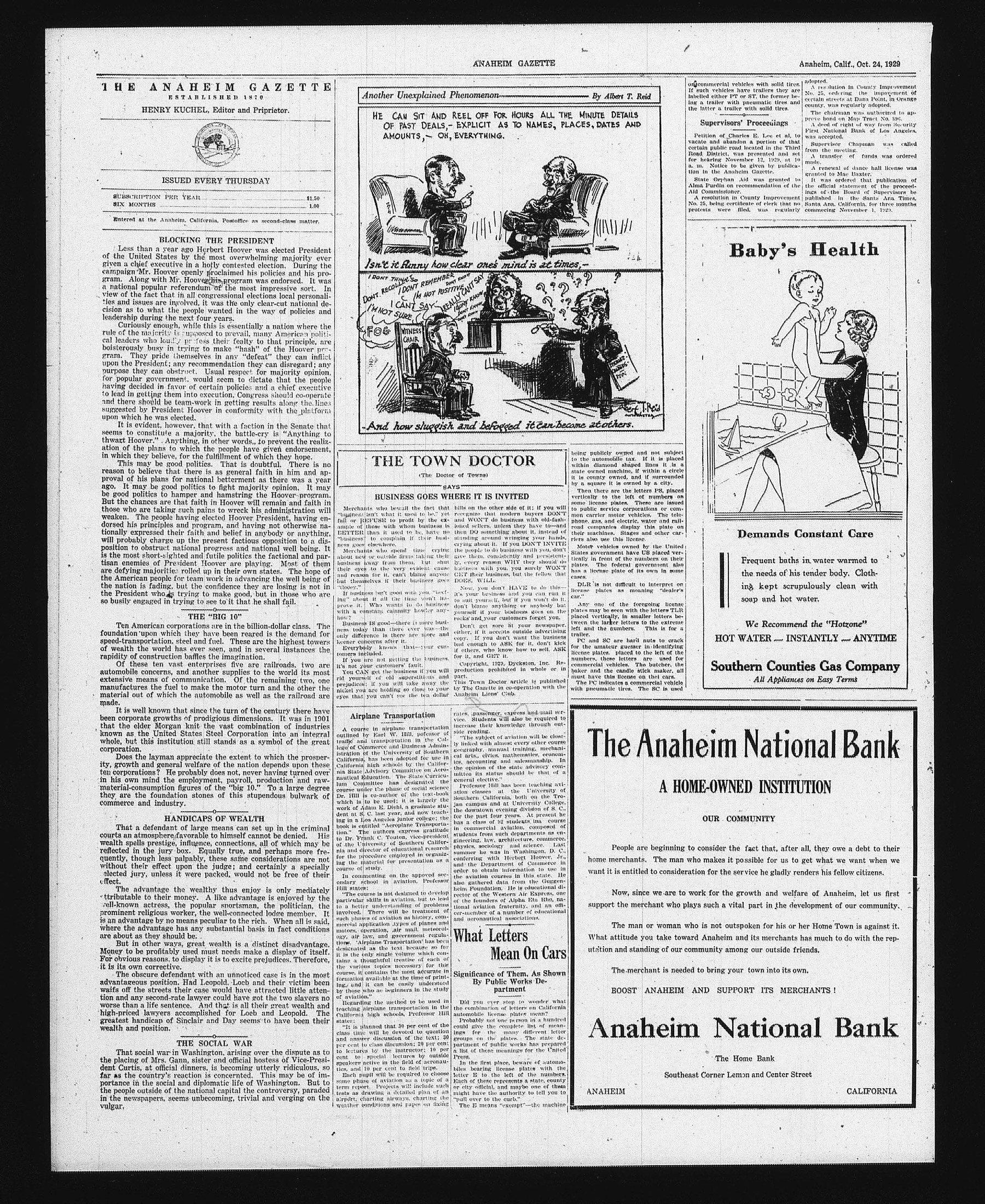
Searchable text
THE ANAHEIM GAZETTE
ESTABLISHED 1870
HENRY KUCHEL, Editor and Priprietor.
ISSUED EVERY THURSDAY
SUBSCRIPTION PER YEAR.....$1.50
SIX MONTHS.....1.00
Entered at the Anaheim, California, Postoffice as second-class matter.
BLOCKING THE PRESIDENT
Less than a year ago Herbert Hoover was elected President of the United States by the most overwhelming majority ever given a chief executive in a hotly contested election. During the campaign Mr. Hoover openly proclaimed his policies and his program. Along with Mr. Hoover's program was endorsed. It was a national popular referendum of the most impressive sort. In view of the fact that in all congressional elections local personalities and issues are involved, it was the only clear-cut national decision as to what the people wanted in the way of policies and leadership during the next four years.
Curiously enough, while this is essentially a nation where the rule of the majority is supposed to prevail, many American political leaders who loudly profess their fealty to that principle, are boisterously busy in trying to make "hash" of the Hoover program. They pride themselves in any "defeat" they can inflict upon the President; any recommendation they can disregard; any purpose they can obstruct. Usual respect for majority opinion, for popular government, would seem to dictate that the people having decided in favor of certain policies and a chief executive to lead in getting them into execution, Congress should co-operate and there should be team-work in getting results along the lines suggested by President Hoover in conformity with the platform upon which he was elected.
It is evident, however, that with a faction in the Senate that seems to constitute a majority, the battle-cry is "Anything to thwart Hoover." Anything, in other words., to prevent the realization of the plans to which the people have given endorsement.
They pride themselves in any "defeat" they can inflict upon the President; any recommendation they can disregard; any purpose they can obstruct. Usual respect for majority opinion, for popular government, would seem to dictate that the people having decided in favor of certain policies and a chief executive to lead in getting them into execution, Congress should co-operate and there should be team-work in getting results along the lines suggested by President Hoover in conformity with the platform upon which he was elected.
It is evident, however, that with a faction in the Senate that seems to constitute a majority, the battle-cry is "Anything to thwart Hoover." Anything, in other words, to prevent the realization of the plans to which the people have given endorsement, in which they believe, for the fulfillment of which they hope.
This may be good politics. That is doubtful. There is no reason to believe that there is as general faith in him and approval of his plans for national betterment as there was a year ago. It may be good politics to fight majority opinion. It may be good politics to hamper and hamstring the Hoover program. But the chances are that faith in Hoover will remain and faith in those who are taking such pains to wreck his administration will weaken. The people having elected Hoover President, having endorsed his principles and program, and having not otherwise nationally expressed their faith and belief in anybody or anything, will probably charge up the present factious opposition to a disposition to obstruct national progress and national well being. It is the most short-sighted and futile politics the factional and partisan enemies of President Hoover are playing. Most of them are defying majorities rolled up in their own states. The hope of the American people for team work in advancing the well being of the nation is fading, but the confidence they are losing is not in the President who is trying to make good, but in those who are so busily engaged in trying to see to it that he shall fail.
THE "BIG 10"
Ten American corporations are in the billion-dollar class. The foundation upon which they have been reared is the demand for speed-transportation, steel and fuel. These are the highest towers of wealth the world has ever seen, and in several instances the rapidity of construction baffles the imagination.
Of these ten vast enterprises five are railroads, two are automobile concerns, and another supplies to the world its most extensive means of communication. Of the remaining two, one manufactures the fuel to make the motor turn and the other the material out of which the automobile as well as the railroad are made.
It is well known that since the turn of the century there have been corporate growths of prodigious dimensions. It was in 1901 that the elder Morgan knit the vast combination of industries known as the United States Steel Corporation into an integral whole, but this institution still stands as a symbol of the great corporation.
Does the layman appreciate the extent to which the prosperity, growth and general welfare of the nation depends upon these ten corporations? He probably does not, never having turned over in his own mind the employment, payroll, production and raw-material-consumption figures of the "big 10." To a large degree they are the foundation stones of this stupendous bulwark of commerce and industry.
HANDICAPS OF WEALTH
That a defendant of large means can set up in the criminal courts an atmosphere favorable to himself cannot be denied. His wealth spells prestige, influence, connections, all of which may be reflected in the jury box. Equality true and perhaps more far
Does the layman appreciate the extent to which the prosperity, growth and general welfare of the nation depends upon these ten corporations? He probably does not, never having turned over in his own mind the employment, payroll, production and raw-material-consumption figures of the "big 10." To a large degree they are the foundation stones of this stupendous bulwark of commerce and industry.
HANDICAPS OF WEALTH
That a defendant of large means can set up in the criminal courts an atmosphere favorable to himself cannot be denied. His wealth spells prestige, influence, connections, all of which may be reflected in the jury box. Equally true, and perhaps more frequently, though less palpably, these same considerations are not without their effect upon the judge; and certainly a specially selected jury, unless it were packed, would not be free of their effect.
The advantage the wealthy thus enjoy is only mediately attributable to their money. A like advantage is enjoyed by the well-known actress, the popular sportsman, the politician, the prominent religious worker, the well-connected lodge member. It is an advantage by no means peculiar to the rich. When all is said, where the advantage has any substantial basis in fact conditions are about as they should be.
But in other ways, great wealth is a distinct disadvantage. Money to be profitably used must needs make a display of itself. For obvious reasons, to display it is to excite prejudices. Therefore, it is its own corrective.
The obscure defendant with an unnoticed case is in the most advantageous position. Had Leopold, Loeb and their victim been waifs off the streets their case would have attracted little attention and any second-rate lawyer could have got the two slayers no worse than a life sentence. And that is all their great wealth and high-priced lawyers accomplished for Loeb and Leopold. The greatest handicap of Sinclair and Day seems to have been their wealth and position.
THE SOCIAL WAR
That social war in Washington, arising over the dispute as to the placing of Mrs. Gann, sister and official hostess of Vice-President Curtis, at official dinners, is becoming utterly ridiculous, so far as the country's reaction is concerned. This may be of importance in the social and diplomatic life of Washington. But to the people outside of the national capital the controversy, paraded in the newspapers, seems unbecoming, trivial and verging on the vulgar.
Another Unexplained Phenomenon By Albert T. Reid
HE CAN SIT AND REEL OFF FOR HOURS ALL THE MINUTE DETAILS OF PAST DEALS, EXPLICIT AS TO NAMES, PLACES, DATES AND AMOUNTS, OH, EVERYTHING.
Isn't it funny how clear one's mind is at times,
I DON'T THINK SO I DON'T REMEMBER I M NOT POSITIVE I CANT SAY I M NOT SURE FOG
-And how sluggish and befoged it can become at others.
THE TOWN DOCTOR
(The Doctor of Towns)
SAYS
BUSINESS GOES WHERE IT IS INVITED
Merchants who bewail the fact that "business isn't what it used to be," yet fail or REFUSE to profit by the example of those with whom business is BETTER than it used to be, have no "business" to complain if their business goes elsewhere.
Merchants who spend time crying about new or outside firms taking their business away from them, but shut their eyes to the very evident cause and reason for it, can't blame anyone but themselves if their business goes "tooey."
If business isn't good with you, "beefing" about it all the time won't improve it. Who wants to do business with a constant calamity howler anyhow?
Business IS good—there is more business today than there ever was—the only difference is there are more and keener concerns after it.
Everybody knows that—your customers included.
If you are not getting the business, it's not your customers' fault.
You CAN get the business if you will rid yourself of old superstitions and prejudices; if you will take away the nickel you are holding so close to your eyes that you can't see the ten dollar bills on the other side of it; if you will recognize that modern buyers DON'T and WONT do business with old-fashioned sellers, unless they have to—and then DO something about it, instead of standing around wringing your hands, crying about it. If you DON'T INVITE the people to do business with you, don't give them, consistently and persistently, every reason WHY they should do business with you, you surely WON'T GET their business, but the fellow that DOES, WILL.
Now, you don't HAVE to do this—it's your business and you can run it to suit yourself, but if you won't do it, don't blame anything or anybody but yourself if your business goes on the rocks and your customers forget you.
Don't get sore at your newspaper, either, if it accepts outside advertising copy. If you don't want the business lead enough to ASK for it, don't kick if others, who know how to sell, ASK for it, and GET it.
Copyright, 1929, Dyckston, Inc. Reproduction prohibited in whole or in part.
This Town Doctor article is published by The Gazette in co-operation with the Anaheim Lions' Club.
Airplane Transportation
A course in airplane transportation outlined by Earl W. Hill, professor of traffic and transportation in the College of Commerce and Business Administration of the University of Southern California, has been adopted for use in California high schools by the California State Advisory Committee on Aeronautical Education. The State Curriculum Committee has designated the course under the phase of social science Dr. Hill is co-author of the text-book which is to be used; it is largely the work of Adam E. Diehl, a graduate student at S.C. last year, and now teaching in a Los Angeles junior college; the book is entitled "Aeroplane Transportation." The authors express gratitude to Dr. Frank C. Touton, vice-president of the University of Southern California and director of educational research rates, passenger, express and mail service. Students will also be required to increase their knowledge through outside reading.
"The subject of aviation will be closely linked with almost every other course geography, manual training, mechanical arts, civics, mathematics, economics, accounting and salesmanship. In the opinion of the state advisory committee its status should be that of a general elective."
Professor Hill has been teaching aviation classes at the University of Southern California, both on the Trojan campus and at University College, the downtown evening division of S.C., for the past four years. At present he has a class of 32 students in course in commercial aviation, composed of students from such departments as engineering, law, architecture, commerce, physics, sociology and science. Last
California, has been adopted for use in California high schools by the California State Advisory Committee on Aeronautical Education. The State Curriculum Committee has designated the course under the phase of social science Dr. Hill is co-author of the text-book which is to be used; it is largely the work of Adam E. Diehl, a graduate student at S.C. last year, and now teaching in a Los Angeles Junior college; the book is entitled "Aeroplane Transportation." The authors express gratitude to Dr. Frank C. Touton, vice-president of the University of Southern California and director of educational research for the procedure employed in organizing the material for presentation as a course of study.
In commenting on the approved secondary school in aviation, Professor Hill states:
"The course is not designed to develop particular skills in aviation, but to lead to a better understanding of problems involved. There will be treatment of such phases of aviation as history, commercial application, types of planes and motors, operation, air mail, meteorology, air law, and government regulations." Airplane Transportation has been designated as the text because so far it is the only single volume which contains a thoughtful treatise of each of the various topics necessary for this course, it contains the most accurate information available at the time of printing, and it can be easily understood by those who ac beginners in the study of aviation."
Regarding the method to be used in teaching airplane transportation in the California high schools, Professor Hill states:
"It is planned that 30 per cent of the class time will be devoted to question and answer discussion of the text; 30 per cent to class discussion; 20 per cent to lectures by the instructor; 10 per cent to special lectures by outside speakers active in the field of aeronautics, and 10 per cent to field trips.
Each pupil will be required to choose some phase of aviation as a topic of a term report. Projects will include such tests as drawing a detailed plan of an airport, charting airways, charting the weather conditions and papers on fixing cal arts, civics, mathematics, economics, accounting and salesmanship. In the opinion of the state advisory committee its status should be that of a general elective."
Professor Hill has been teaching aviation classes at the University of Southern California, both on the Trojan campus and at University College, the downtown evening division of S.C., for the past four years. At present he has a class of 32 students in a course in commercial aviation, composed of students from such departments as engineering, law, architecture, commerce, physics, sociology and science. Last summer he was in Washington, D.C., conferring with Herbert Hoover, Jr., and the Department of Commerce in order to obtain information to use in the aviation courses in this state. He also gathered data from the Guggenheim Foundation. He is educational director of the Western Air Express, one of the founders of Alpha Eta Rho, national aviation fraternity, and an officer-member of a number of educational and aeronautical associations.
What Letters Mean On Cars
Significance of Them, As Shown By Public Works Department
Did you ever stop to wonder what the combination of letters on California automobile license plates mean?
Probably not one person in a hundred could give the complete list of meanings for the many different letter groups on the plates. The state department of public works has prepared a list of these meanings for the United Press.
In the first place, beware of automobiles bearing license plates with the letter E to the left of the numbers. Each of these represents a state, county or city official, and maybe one of them might have the authority to tell you to "pull over to the curb."
The E means "exempt"—the machine
or commercial vehicles with solid tires. If such vehicles have trailers they are labelled either PT or ST, the former being a trailer with pneumatic tires and the latter a trailer with solid tires.
Supervisors' Proceedings
Petition of Charles E. Lee et al., to vacate and abandon a portion of that certain public road located in the Third Road District, was presented and set for hearing November 12, 1929, at 10 a.m. Notice to be given by publication in the Anaheim Gazette.
State Orphan Aid was granted to Alma Purdin on recommendation of the Aid Commissioner.
A resolution in County Improvement No. 25, being certificate of clerk that no protests were filed, was regularly adopted.
A resolution in County Improvement No. 25, ordering the improvement of certain streets at Dana Point, in Orange county, was regularly adopted.
The chairman was authorized to approve bond on Map Tract No. 396.
A deed of right of way from Security First National Bank of Los Angeles, was accepted.
Supervisor Chapman was called from the meeting.
A transfer of funds was ordered made.
A renewal of dance hall license was granted to Mae Daxter.
It was ordered that publication of the official statement of the proceedings of the Board of Supervisors be published in the Santa Ana Times, Santa Ana, California, for three months commencing November 1, 1929.
Demands Constant Care
Frequent baths in water warmed to the needs of his tender body. Clothing kept scrupulously clean with soap and hot water.
We Recommend the "Hotzone"
HOT WATER — INSTANTLY — ANYTIME
Southern Counties Gas Company
All Appliances on Easy Terms
e Anaheim National Bank
A HOME-OWNED INSTITUTION
OUR COMMUNITY
A HOME-OWNED INSTITUTION
OUR COMMUNITY
people are beginning to consider the fact that, after all, they owe a debt to their merchants. The man who makes it possible for us to get what we want when we is entitled to consideration for the service he gladly renders his fellow citizens.
Now, since we are to work for the growth and welfare of Anaheim, let us first the merchant who plays such a vital part in the development of our community.
The man or woman who is not outspoken for his or her Home Town is against it. Attitude you take toward Anaheim and its merchants has much to do with the rep- and standing of our community among our outside friends.
The merchant is needed to bring your town into its own.
BOOST ANAHEIM AND SUPPORT ITS MERCHANTS!
Anaheim National Bank
The Home Bank
Southeast Corner Lemon and Center Street
CALIFORNIA