anaheim-gazette 1929-10-10
Scanned page
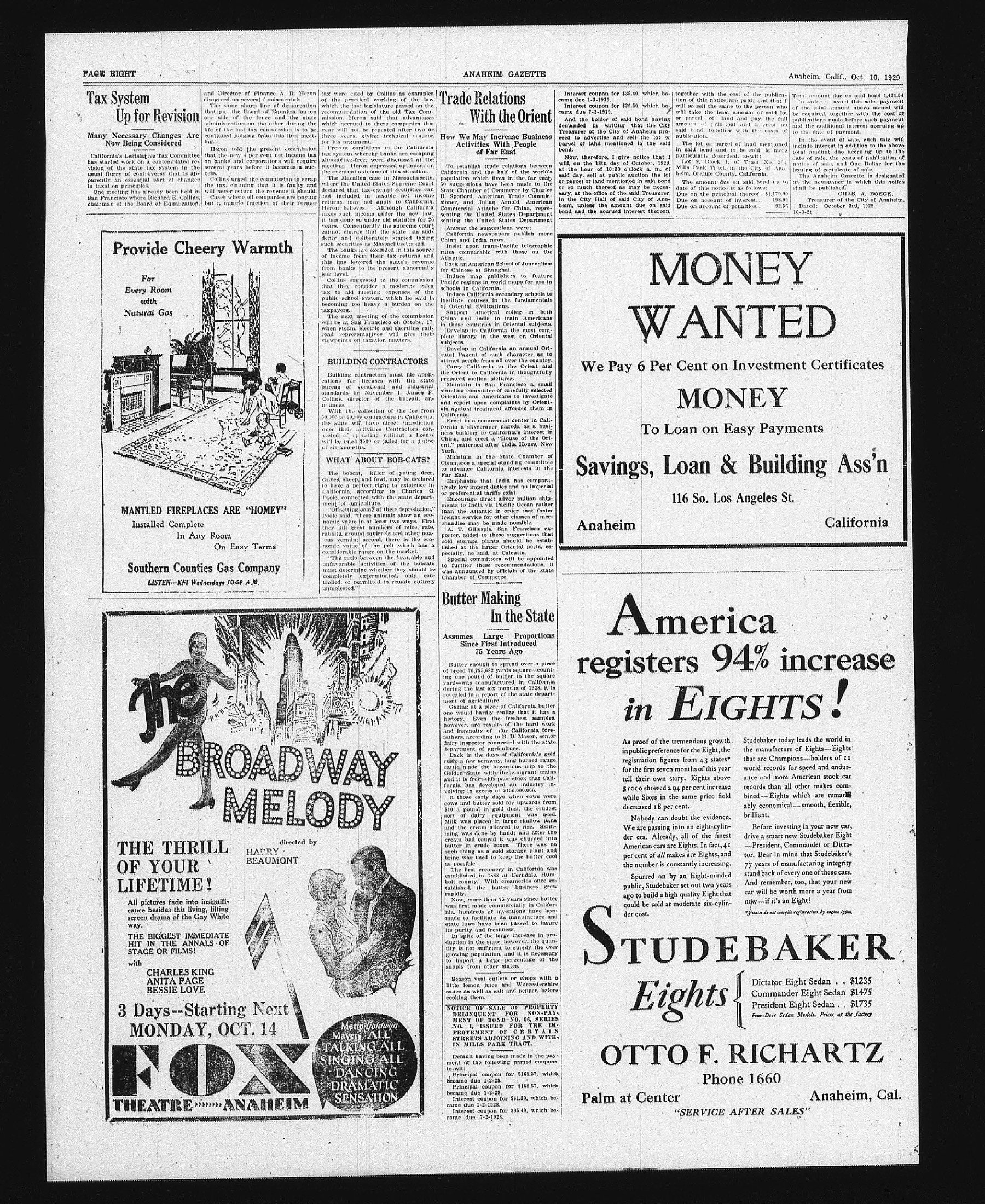
Searchable text
Tax System
Up for Revision
Many Necessary Changes Are Now Being Considered
California's Legislative Tax Committee has started work on a contemplated revision of the state tax system in the usual flurry of controversy that is apparently an essential part of changes in taxation principles.
One meeting has already been held in San Francisco where Richard E. Collins, chairman of the Board of Equalization, and Director of Finance A. R. Heron disagreed on several fundamentals.
The same sharp line of denarication that put the Board of Equalization on one side of the fence and the state administration on the other during the life of the last tax commission is to be continued judging from this first meeting.
Heron told the present commission that the new 4 per cent net income tax on banks and corporations will require several years before it becomes a success.
Collins urged the commission to scrap the tax, claiming that it is faulty and will never return the revenue it should.
Cases where oil companies are paying but a minute fraction of their former tax were cited in which the last levy recommendation mission. Heron which accrued the year will not be three years, give for his argument.
Present condition tax system where almost tax-free meeting. Heron the eventual outflow.
The Macallen where the United declared that tax not included in returns, may not Heron believes taxes such income it has done so久 years. Consequently cannot charge them deny and delibit such securities at.
The banks are of income from this has lowered from banks to low level.
Collins suggests that they construe tax to aid need public school system becoming too high taxpayers.
The next meeting will be at San Francisco when steam, elec road represent viewpoints on tax.
BUILDING
Building contractions for lie bureau of vocational standards by N. Collins, director of ences.
With the coll 50,360 to 60,900 of the state will be over their active vested of office will be final $500 of six xmortha.
MANTLED FIREPLACES ARE "HOMEY"
Installed Complete
In Any Room
On Easy Terms
Southern Counties Gas Company
LISTEN—KFI Wednesdays 10:50 A.M.
The Broadway Melody
THE THRILL directed by
BROADWAY
MELODY
THE THRILL
OF YOUR
LIFETIME!
All pictures fade into insignificance besides this living, lilting screen drama of the Gay White way.
THE BIGGEST IMMEDIATE HIT IN THE ANNALS OF STAGE OR FILMS!
with
CHARLES KING
ANITA PAGE
BESSIE LOVE
3 Days--Starting Next MONDAY, OCT. 14
FOX
THEATRE ANAHEIM
ANAHEIM GAZETTE
Trade Relations With the Orient
How We May Increase Business Activities With People of Far East
To establish trade relations between California and the half of the world's population which lives in the far east, 50 suggestions have been made to the State Chamber of Commerce by Charles B. Spofford, American Trade Commissioner, and Julian Arnold, American Commercial Attache for China, representing the United States Department senting the United States Department Among the suggestions were:
California newspapers publish more China and India news.
Insist upon trans-Pacific telegraphic rates comparable with those on the Atlantic.
Back an American School of Journalism for Chinese at Shanghai.
Induce map publishers to feature Pacific regions in world maps for use in schools in California.
Induce California secondary schools to institute courses in the fundamentals of Oriental civilizations.
Support American colleg in both China and India to train Americans in those countries in Oriental subjects.
Develop in California the most complete library in the west on Oriental subjects.
Develop in California an annual Oriental Pagent of such character as to attract people from all over the country.
Carry California to the Orient and the Orient to California in thoughtfully prepared motion pictures.
Maintain in San Francisco a small standing committee of carefully selected Orientalists and Americans to investigate and report upon complaints by Orientalists against treatment afforded them in California.
Erect in a commercial center in California a skyscraper pagoda as a business building to California's interest in China, and erect a "House of the Orient," patterned after India House, New
R. Heron intials,
marcaction on the state
curing the tax is to be first meetnion income tax will require
a sucto scrap faulty and it should
are paying dirt former
tax were cited by Collins as examples of the practical working of the law which the last legislature passed on the recommendation of the old Tax Commission. Heron said that advantages which accrued to these companies this year will not be repeated after two or three years, giving technical reasons for his argument.
Present conditions in the California tax system whereby banks are escaping almost tax-free; were discussed at the meeting. Heron expressed optimism on the eventual outcome of this situation.
The Macallen case in Massachusetts, where the United States Supreme Court declared that tax-exempt securities can not included in taxable net income returns, may not apply to California. Heron believes. Although California taxes such income under the new law, it has done so under old statutes for 20 years. Consequently the supreme court cannot charge that the state has suddenly and deliberately started taxing such securities as Massachusetts did.
The banks are excluded in this source of income from their tax returns and this has lowered the state's revenue from banks to its present abnormally low level.
Collins suggested to the commission that they consider a moderate sales tax to aid meeting expenses of the public school system, which he said is becoming too heavy a burden on the taxpayers.
The next meeting of the commission will be at San Francisco on October 17, when steam, electric and shortline railroad representatives will give their viewpoints on taxation matters.
BUILDING CONTRACTORS
Building contractors must file applications for licenses with the state bureau of vocational and industrial standards by November 1, James F. Collins, director of the bureau, announces.
With the collection of the fee from 50,960 to 60,000 contractors in California, the state will have direct jurisdiction over their activities Contractors convicted of operating without a license will be final $500 or jailed for a period of six months.
BUILDING CONTRACTORS
Building contractors must file applications for licenses with the state bureau of vocational and industrial standards by November 1. James F. Collins, director of the bureau, announces.
With the collection of the fee from 50,960 to 60,000 contractors in California, the state will have direct jurisdiction over their activities Contractors convicted of operating without a license will be fined $500 or jailed for a period of six months.
WHAT ABOUT BOB-CATS?
The bobcat, killer of young deer, calves, sheep, and fowl, may be declared to have a perfect right to existence in California, according to Charles G. Poole, connected with the state department of agriculture.
"Offsetting some of their depredation," Poole said, "these animals show an economic value in at least two ways. First they kill great numbers of mice, rats, rabbits, ground squirrels and other hoofed vermin; second, there is the economic value of the pelt which has a considerable range on the market.
"The ratio between the favorable and unfavorable activities of the bobcats must determine whether they should be completely exterminated, only controlled, or permitted to remain entirely unmolested."
Butter Making
In the State
Assumes Large Proportions Since First Introduced 75 Years Ago
Butter enough to spread over a piece of bread 76,785,682 yards square—counting one pound of butter to the square yard—was manufactured in California during the last six months of 1928, it is revealed in a report of the state department of agriculture.
Gazing at a piece of California butter one would hardly realize that it has a history. Even the freshest samples, however, are results of the hard work and ingenuity of our California forefathers, according to B. D. Mason, senior dairy inspector connected with the state department of agriculture.
Back in the days of California's gold rush, a few scrawny, long horned range cattle made the hazardous trip to the Golden State with the emigrant trains and it is from this poor stock that California has developed an industry involving in excess of $150,000,000.
In those early days when cows were cows and butter sold for upwards from $10 a pound in gold dust, the crudest sort of dairy equipment was used. Milk was placed in large shallow pans and the cream allowed to rise. Skimming was done by hand; and after the cream had soured it was churned into butter in crude boxes. There was no mental Pagent of such character as to attract people from all over the country.
Carry California to the Orient and the Orient to California in thoughtfully prepared motion pictures.
Maintain in San Francisco a small standing committee of carefully selected Orientalis and Americans to investigate and report upon complaints by Orientalis against treatment afforded them in California.
Erect in a commercial center in California a skyscraper pagoda as a business building to California's interest in China, and erect a "House of the Orient," patterned after India House, New York.
Maintain in the State Chamber of Commerce a special standing committee to advance California interests in the Far East.
Emphasize that India has comparatively low import duties and no Imperial or preferential tariffs exist.
Encourage direct silver bullion shipments to India via Pacific Ocean rather than the Atlantic in order that faster freight service for other classes of merchandise may be made possible.
A. T. Gillespie, San Francisco exporter, added to these suggestions that cold storage plants should be established at the larger Oriental ports, especially, he said, at Calcutta.
Special committees will be appointed to further these recommendations. It was announced by officials of the State Chamber of Commerce.
Butter Making
In the State
Assumes Large Proportions Since First Introduced 75 Years Ago
Butter enough to spread over a piece of bread 76,785,682 yards square—counting one pound of butter to the square yard—was manufactured in California during the last six months of 1928, it is revealed in a report of the state department of agriculture.
Gazing at a piece of California butter one would hardly realize that it has a history. Even the freshest samples, however, are results of the hard work and ingenuity of our California forefathers, according to B. D. Mason, senior dairy inspector connected with the state department of agriculture.
Back in the days of California's gold rush, a few scrawny, long horned range cattle made the hazardous trip to the Golden State with the emigrant trains and it is from this poor stock that California has developed an industry involving in excess of $150,000,000.
In those early days when cows were cows and butter sold for upwards from $10 a pound in gold dust, the crudest sort of dairy equipment was used. Milk was placed in large shallow pans and the cream allowed to rise. Skimming was done by hand; and after the cream had soured it was churned into butter in crude boxes. There was no mental Pagent of such character as to attract people from all over the country.
Carry California to the Orient and the Orient to California in thoughtfully prepared motion pictures.
Maintain in San Francisco a small standing committee of carefully selected Orientalis and Americans to investigate and report upon complaints by Orientalis against treatment afforded them in California.
Erect in a commercial center in California a skyscraper pagoda as a business building to California's interest in China, and erect a "House of the Orient," patterned after India House, New York.
Maintain in the State Chamber of Commerce a special standing committee to advance California interests in the Far East.
Emphasize that India has comparatively low import duties and no Imperial or preferential tariffs exist.
Encourage direct silver bullion shipments to India via Pacific Ocean rather than the Atlantic in order that faster freight service for other classes of merchandise may be made possible.
A. T. Gillespie, San Francisco exporter, added to these suggestions that cold storage plants should be established at the larger Oriental ports, especially, he said, at Calcutta.
Special committees will be appointed to further these recommendations. It was announced by officials of the State Chamber of Commerce.
Butter Making
In the State
Assumes Large Proportions Since First Introduced 75 Years Ago
Butter enough to spread over a piece of bread 76,785,682 yards square—counting one pound of butter to the square yard—was manufactured in California during the last six months of 1928, it is revealed in a report of the state department of agriculture.
Gazing at a piece of California butter one would hardly realize that it has a history. Even the freshest samples, however, are results of the hard work and ingenuity of our California forefathers, according to B. D. Mason, senior dairy inspector connected with the state department of agriculture.
Back in the days of California's gold rush, a few scrawny, long horned range cattle made the hazardous trip to the Golden State with the emigrant trains and it is from this poor stock that California has developed an industry involving in excess of $150,000,000.
In those early days when cows were cows and butter sold for upwards from $10 a pound in gold dust, the crudest sort of dairy equipment was used. Milk was placed in large shallow pans and the cream allowed to rise. Skimming was done by hand; and after the cream had soured it was churned into butter in crude boxes. There was no mental Pagent of such character as to attract people from all over the country.
Carry California to the Orient and the Orient to California in thoughtfully prepared motion pictures.
Maintain in San Francisco a small standing committee of carefully selected Orientalis and Americans to investigate and report upon complaints by Orientalis against treatment afforded them in California.
Erect in a commercial center in California a skyscraper pagoda as a business building to California's interest in China, and erect a "House of the Orient," patterned after India House, New York.
Maintain in the State Chamber of Commerce a special standing committee to advance California interests in the Far East.
Emphasize that India has comparatively low import duties and no Imperial or preferential tariffs exist.
Encourage direct silver bullion shipments to India via Pacific Ocean rather than the Atlantic in order that faster freight service for other classes of merchandise may be made possible.
A. T. Gillespie, San Francisco exporter, added to these suggestions that cold storage plants should be established at the larger Oriental ports, especially, he said, at Calcutta.
Special committees will be appointed to further these recommendations. It was announced by officials of the State Chamber of Commerce.
Butter Making
In the State
Assumes Large Proportions Since First Introduced 75 Years Ago
Butter enough to spread over a piece of bread 76,785,682 yards square—counting one pound of butter to the square yard—was manufactured in California during the last six months of 1928, it is revealed in a report of the state department of agriculture.
Gazing at a piece of California butter one would hardly realize that it has a history. Even the freshest samples, however, are results of the hard work and ingenuity of our California forefathers, according to B. D. Mason, senior dairy inspector connected with the state department of agriculture.
Back in the days of California's gold rush,a few scrawny,Long horned range cattle made the hazardous trip to the Golden State withthe emigrant trains and it is from this poor stock thatCalifornia has developed an industry involving in excessof $150,000,000.
In those early days when cows were cows and butter sold for upwards from $10 a pound in gold dust,the crudest sort of dairy equipment was used.Milk was placed in large shallow pans andthe cream allowedto rise.Skimming was done by hand;and afterthe cream had souredit was churned intobutterincrudeboxesThere was no mentalPagentofsuchcharacterasattotractpeoplefromalloverthecountry.CarryCaliforniatotheOrientandtheOrienttoCaliforniainthoughtfullypreparedmotionpictures.MaintaininSanFranciscoasmallstandingcommitteeofcarefullyselectedOrientalisandAmericanstoInvestigateandreportuponcomplaintsbyOrientalisagainsttreatmentaffordedtheminCalifornia.ErectinancommercialcenterinCaliforniaaskyscraperpagodaasabusinessbuildingtoCalifornia'sinterestinChina,anderecta"HouseoftheOrient,"patternedafterIndiaHouse.NewYork.MaintaininTheStateChamberOfCommerceaspecialstandingcommitteetoadvanceCaliforniainterestsintheFarEast.EmphasizethatIndiahascomparativelylowimportdutiesandnoImperialorpreferentialtariffsexist.Asproofofthetreemendinpublicpreferencefortheregistrationfiguresfromforthefirstsevenmonths telltheirownstory.Emit$1000showeda94percoilwhileSixesinthesamedecreased18percent.Nobodycan doubtthentheWearepassingintoanderera.Already.allAmericancarsareEights
IN those early days when cows were cows and butter sold for upwards from $10 a pound in gold dust, the crudest sort of dairy equipment was used. Milk was placed in large shallow pans and the cream allowed to rise. Skimming was done by hand; and after the cream had soured it was churned into butter in crude boxes. There was no such thing as a cold storage plant and brine was used to keep the butter cool as possible.
The first creamery in California was established in 1888 at Ferndale, Humbolt county. With creameries once established, the butter business grew rapidly.
Now, more than 75 years since butter was first made commercially in California, hundreds of inventions have been made to facilitate its manufacture and state laws have been passed to insure its purity and freshness.
In spite of the large increase in production in the state, however, the quantity is not sufficient to supply the ever growing population, and it is necessary to import a large percentage of the supply from other states.
Season veal cutlets or chops with a little lemon juice and Worcestershire sauce as well as salt and pepper, before cooking them.
NOTICE OF SALE OF PROPERTY DELINQUENT FOR NON-PAYMENT OF BOND NO. 96, SERIES NO. 1, ISSUED FOR THE IMPROVEMENT OF CERTAIN STREETS ADJOINING AND WITHIN MILLS PARK TRACT.
Default having been made in the payment of the following named coupons, to-wit:
Principal coupon for $168.57, which became due 1-2-28.
Principal coupon for $168.57, which became due 1-2-29.
Interest coupon for $41.30, which became due 1-2-1928.
Interest coupon for $35.40, which became due 7-2-1928.
Anaheim, Calif., Oct. 10, 1929
give notice that I
y of October, 1929,
o'clock a.m. of
public auction the lot
may be necesthe said Treasurer,
said City of Anamount due on said
interest thereon,
together with the cost of the publication of this notice are paid; and that I
will so sell the same to the person who
will take the least amount of said lot
or parcel of land and pay the full
amount of principal and interest on
said bond together with the costs of
publication.
The lot or parcel of land mentioned
in said bond and to be sold, is more
particularly described, to-wit:
Lot 9, Block 1, of Tract No. 304,
Mills Park Tract, in the City of Anaheim, Orange County, California.
The amount due on said bond up to
date of this notice is as follows:
Due on the principal thereof $1,179.99
Due on account of interest... 198.99
Due on account of penalties... 92.56
Total amount due on said bond 1,471.54
In order to avoid this sale, payment
of the total amount above named will
be required, together with the cost of
publications made before such payment
and the additional interest accruing up
to the date of payment.
In the event of sale, such sale will
include interest in addition to the above
total amount due accruing up to the
date of sale, the costs of publication of
notice of sale, and One Dollar for the
issuing of certificate of sale.
The Anaheim Gazette is designated
as the newspaper in which this notice
shall be published.
CHAS. A. BOEGE,
Treasurer of the City of Anaheim.
Dated: October 3rd, 1929.
10-3-2t
day 6 Per Cent on Investment Certificates
MONEY
To Loan on Easy Payments
ings, Loan & Building Ass'n
116 So. Los Angeles St.
California
America registers 94% increase in EIGHTS!
As proof of the tremendous growth in public preference for the Eight, the registration figures from 43 states* for the first seven months of this year tell their own story. Eights above $1000 showed a 94 per cent increase while Sixes in the same price field decreased 18 per cent.
Nobody can doubt the evidence. We are passing into an eight-cylinder era. Already, all of the finest American cars are Eights. In fact, 41 Studebaker today leads the world in the manufacture of Eights—Eights that are Champions—holders of 11 world records for speed and endurance and more American stock car records than all other makes combined—Eights which are remarkably economical—smooth, flexible, brilliant.
Before investing in your new car, drive a smart new Studebaker Eight —President, Commander or Dicta-
registration figures from 43 states* for the first seven months of this year tell their own story. Eights above $1000 showed a 94 per cent increase while Sixes in the same price field decreased 18 per cent.
Nobody can doubt the evidence. We are passing into an eight-cylinder era. Already, all of the finest American cars are Eights. In fact, 41 per cent of all makes are Eights, and the number is constantly increasing.
Spurred on by an Eight-minded public, Studebaker set out two years ago to build a high quality Eight that could be sold at moderate six-cylinder cost.
TUDEBAKER
Eights
Dictator Eight Sedan . . $1235
Commander Eight Sedan $1475
President Eight Sedan . . $1735
Four-Door Sedan Models. Prices at the factory
OTTO F. RICHARTZ
Phone 1660
at Center Anaheim, Cal.
“SERVICE AFTER SALES”