anaheim-gazette 1929-10-10
Scanned page
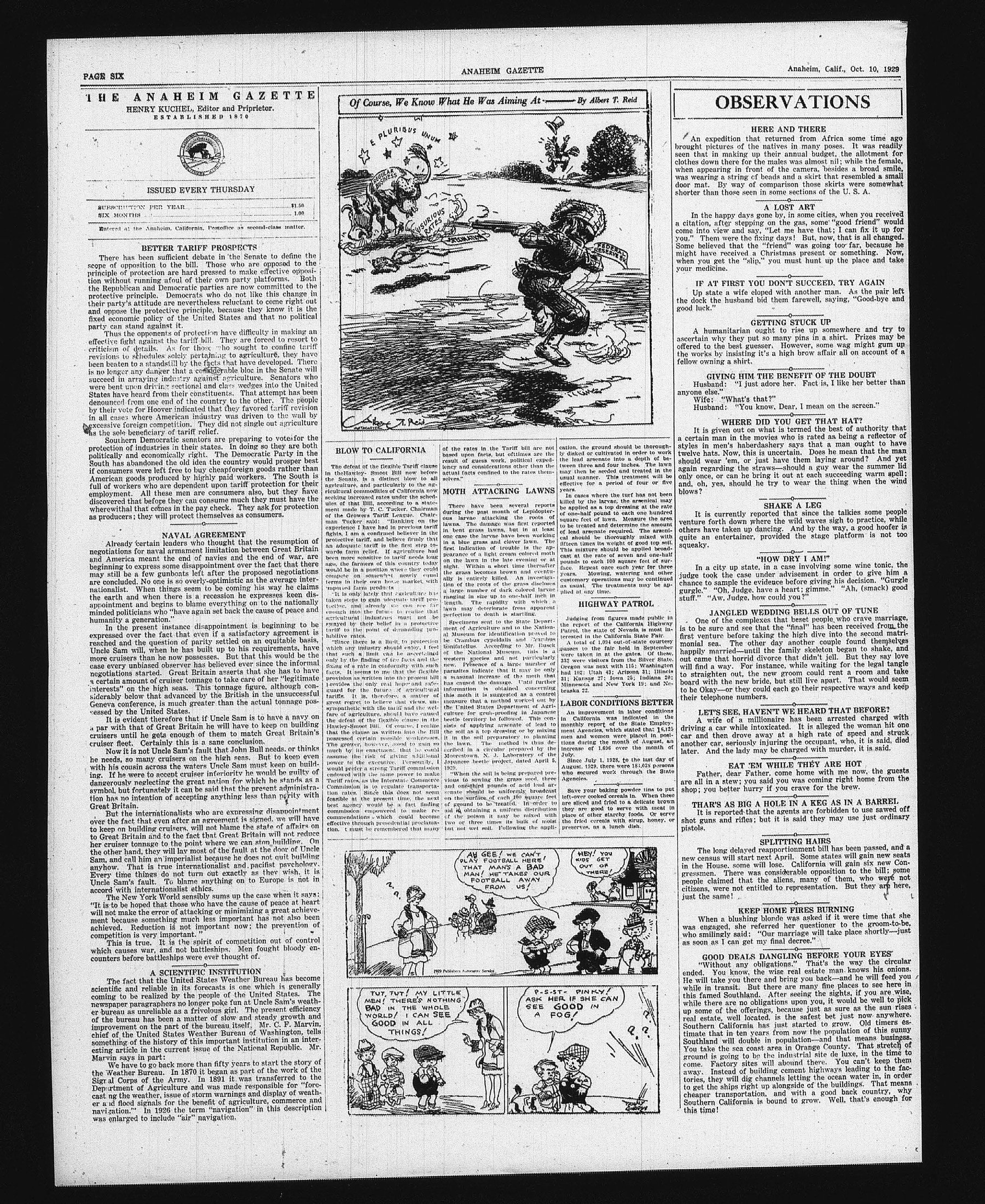
Searchable text
THE ANAHEIM GAZETTE
HENRY KUCHEL, Editor and Priprietor.
ESTABLISHED 1870
ISSUED EVERY THURSDAY
SUBSCRIPTION PER YEAR $1.50
SIX MONTHS 1.00
Entered at the Anaheim, California, Postoffice as second-class matter.
BETTER TARIFF PROSPECTS
There has been sufficient debate in the Senate to define the scope of opposition to the bill. Those who are opposed to the principle of protection are hard pressed to make effective opposition without running afoul of their own party platforms. Both the Republican and Democratic parties are now committed to the protective principle. Democrats who do not like this change in their party's attitude are nevertheless reluctant to come right out and oppose the protective principle, because they know it is the fixed economic policy of the United States and that no political party can stand against it.
Thus the opponents of protection have difficulty in making an effective fight against the tariff bill. They are forced to resort to criticism of details. As for those who sought to confine tariff revisions to schedules solely pertaining to agriculture, they have been beaten to a standstill by the facts that have developed. There is no longer any danger that a considerable bloc in the Senate will succeed in arraying industry against agriculture. Senators who were bent upon driving sectional and class wedges into the United States have heard from their constituents. That attempt has been denounced from one end of the country to the other. The people by their vote for Hoover indicated that they favored tariff revision in all cases where American industry was driven to the wall by excessive foreign competition. They did not single out agriculture as the sole beneficiary of tariff relief.
Southern Democratic senators are preparing to votes for the protection of industries in their states. In doing so they are both
revisions to schedules solely pertaining to agriculture, they have been beaten to a standstill by the facts that have developed. There is no longer any danger that a considerable bloc in the Senate will succeed in arraying industry against agriculture. Senators who were bent upon driving sectional and class wedges into the United States have heard from their constituents. That attempt has been denounced from one end of the country to the other. The people by their vote for Hoover indicated that they favored tariff revision in all cases where American industry was driven to the wall by excessive foreign competition. They did not single out agriculture as the sole beneficiary of tariff relief.
Southern Democratic senators are preparing to vote for the protection of industries in their states. In doing so they are both politically and economically right. The Democratic Party in the South has abandoned the old idea the country would prosper best if consumers were left free to buy cheap foreign goods rather than American goods produced by highly paid workers. The South is full of workers who are dependent upon tariff protection for their employment. All these men are consumers also, but they have discovered that before they can consume much they must have the wherewithal that comes in the pay check. They ask for protection as producers; they will protect themselves as consumers.
NAVAL AGREEMENT
Already certain leaders who thought that the resumption of negotiations for naval armament limitation between Great Britain and America meant the end of navies and the end of war, are beginning to express some disappointment over the fact that there may still be a few gunboats left after the proposed negotiations are concluded. No one is so overly-optimistic as the average internationalist. When things seem to be coming his way he claims the earth and when there is a recession he expresses keen disappointment and begins to blame everything on to the nationally minded politicians who "have again set back the cause of peace and humanity a generation."
In the present instance disappointment is beginning to be expressed over the fact that even if a satisfactory agreement is reached and the question of parity settled on an equitable basis, Uncle Sam will, when he has built up to his requirements, have more cruisers than he now possesses. But that this would be the case every unbiased observer has believed ever since the informal negotiations started. Great Britain asserts that she has to have a certain amount of cruiser tonnage to take care of her "legitimate interests" on the high seas. This tonnage figure, although considerably below that advanced by the British in the unsuccessful Geneva conference, is much greater than the actual tonnage possessed by the United States.
It is evident therefore that if Uncle Sam is to have a navy on a par with that of Great Britain he will have to keep on building cruisers until he gets enough of them to match Great Britain's cruiser fleet. Certainly this is a sane conclusion.
Now it is not Uncle Sam's fault that John Bull needs, or thinks he needs, so many cruisers on the high seas. But to keep even with his cousin across the waters Uncle Sam must keep on building. If he were to accept cruiser inferiority he would be guilty of dangerously neglecting the great nation for which he stands as a symbol, but fortunately it can be said that the present administration has no intention of accepting anything less than parity with Great Britain.
But the internationalists who are expressing disappointment over the fact that even after an agreement is signed, we will have to keep on building cruisers, will not blame the state of affairs on to Great Britain and to the fact that Great Britain will not reduce her cruiser tonnage to the point where we can stop building. On the other hand they will lay most of the fault at the door of Uncle
he needs, so many cruisers on the high seas. But to keep even with his cousin across the waters Uncle Sam must keep on building. If he were to accept cruiser inferiority he would be guilty of dangerously neglecting the great nation for which he stands as a symbol, but fortunately it can be said that the present administration has no intention of accepting anything less than parity with Great Britain.
But the internationalists who are expressing disappointment over the fact that even after an agreement is signed, we will have to keep on building cruisers, will not blame the state of affairs on to Great Britain and to the fact that Great Britain will not reduce her cruiser tonnage to the point where we can stop building. On the other hand, they will lay most of the fault at the door of Uncle Sam, and call him an imperialist because he does not quit building anyhow. That is true internationalist and pacifist psychology. Every time things do not turn out exactly as they wish, it is Uncle Sam's fault. To blame anything on to Europe is not in accord with internationalist ethics.
The New York World sensibly sums up the case when it says: "It is to be hoped that those who have the cause of peace at heart will not make the error of attacking or minimizing a great achievement because something much less important has not also been achieved. Reduction is not important now; the prevention of competition is very important."
This is true. It is the spirit of competition out of control which causes war, and not battleships. Men fought bloody encounters before battleships were ever thought of.
A SCIENTIFIC INSTITUTION
The fact that the United States Weather Bureau has become scientific and reliable in its forecasts is one which is generally coming to be realized by the people of the United States. The newspaper paragraphers no longer poke fun at Uncle Sam's weather bureau as unreliable as a frivolous girl. The present efficiency of the bureau has been a matter of slow and steady growth and improvement on the part of the bureau itself. Mr. C. F. Marvin, chief of the United States Weather Bureau of Washington, tells something of the history of this important institution in an interesting article in the current issue of the National Republic. Mr. Marvin says in part:
We have to go back more than fifty years to start the story of the Weather Bureau. In 1870 it began as part of the work of the Signal Corps of the Army. In 1891 it was transferred to the Department of Agriculture and was made responsible for "forecasting the weather, issue of storm warnings and display of weather and flood signals for the benefit of agriculture, commerce and navigation." In 1926 the term "navigation" in this description was enlarged to include "air" navigation.
Of Course, We Know What He Was Aiming At——By Albert T. Reid
E PLURIOUS UNUM
REGULAR BUSINESS
VISURIOUS RATES
FEDERAL RESERVE
BLOW TO CALIFORNIA
The defeat of the flexible Tariff clause in the Hawley-Smoot Bill now before the Senate, is a distinct blow to all agriculture, and particularly to the agricultural commodities of California now seeking increased rates under the schedules of that Bill, according to a statement made by T. C. Tucker, Chairman of the Growers Tariff League. Chairman Tucker said: "Banking on the experience I have had in previous tariff fights, I am a confirmed believer in the protective tariff, and believe firmly that an adequate tariff is the first step towards farm relief. If agriculture had been more sensitive to tariff needs long ago, the farmers of this country today would be in a position where they could compete on somewhat nearly equal terms in their own home market, with imported farm products.
"It is only lately that agriculture has taken steps to gain adequate tariff protection, and already we can see enough into the future to realize that agricultural industries must not be swayed by their belief in a protective tariff to the point of demanding prohibitive rates."
Since there is a limit to protection which any industry should enjoy, I feel that such a limit can be asserted only by the finding of the facts and the fixing of a rate in conformity with such facts. It seems to me that the flexible provision as written into the present bill provides the only real hope and safeguard for the futures of agricultural tariffs. It is, therefore, a matter of great regret to believe that views, unsympathetic with the tariff and the welfare of agriculture, should have caused the defeat of the flexible clause in the Hawley-Smoot Bill. Of course, I realize that the clause as written into the Bill possessed certain possible weaknesses. The grower, however, stood to gain so much by its enactment, that he could assume the risk of giving additional power to the executive. Personally, I would prefer a strong Tariff commission endowed with the same power to make Tariff rates, as the Interstate Commerce Commission is to regulate transportation rates. Since this does not seem feasible at the present time, the next best agency would be a fact finding commission empowered to make recommendations which could become effective through presidential proclamation. It must be remembered that many of the rates in the Tariff bill are not based upon facts, but oftimes are the result of guess work, political expedition and considerations other than the actual facts confined to the rates themselves."
MOTH ATTACKING LAWNS
There have been several reports during the past month of Lepidopterous larvae attacking the roots of lawns. The damage was first reported in bent grass lawns, but in at least one case the larvae have been working in a blue grass and clover lawn. The first indication of trouble is the appearance of a light cream colored moth on the lawn in the late evening or at night. Within a short time thereafter the grass becomes brown and eventually is entirely killed. An investigation of the roots of the grass discloses a large number of dark colored larvae ranging in size up to one-half inch in length. The rapidity with which a lawn may deteriorate from apparent perfection to death is startling.
Specimens sent to the State Department of Agriculture and to the National Museum for identification proved to be Crambus cypeldalis and Grumbus bonifatellus. According to Mr. Busck of the National Museum, this is a western species and not particularly new. Presence of a large number of parasites indicate that it may be only a seasonal increase of the moth that has caused the damage. Until further information is obtained concerning this moth it is suggested as a control measure that a method worked out by the United States Department of Agriculture for grub-proofing in Japanese beetle territory be followed. This consists of applying arsenate of lead to the soil as a top dressing or by mixing it in the soil preparatory to planting the lawn. The method is thus described in a circular prepared by the Moorestown, N. J. Laboratory of the Japanese beetle project, dated April 5, 1929.
"When the soil is being prepared previous to sowing the grass seed, three and one-third pounds of acid lead arsenate should be uniformly broadcast on the surface of each 160 square feet of ground to be treated. In order to aid in obtaining a uniform distribution of the poison it may be mixed with two or three times its bulk of moist but not wet soil. Following the application, the ground should be thoroughly disked or cultivated in order to work the lead arsenate into a depth of between three and four inches. The lawn may then be seeded and treated in usual manner. This treatment will be effective for a period of four or five years.
In cases where the turf has not been killed by the larvae, the arsenical may be applied as a top dressing at the rate of one-half pound to each one hundred square feet of lawn. Measure the area to be treated and determine the amount of lead arsenate required. The arsenical should be thoroughly mixed with fifteen times its weight of good top soil. This mixture should be applied broadcast at the rate of seven and one-half pounds to each 100 square feet of surface. Repeat once each year for three years. Mowing, watering and other customary operations may be continued as usual. The treatments may be applied at any time."
HIGHWAY PATROL
Judging from figures made public in the report of the California Highway Patrol, the state of Nevada is most interested in the California State Fair.
A total of 1,094 out-of-state courtesy passes to the fair held in September were taken in at the gates. Of these, 332 were visitors from the Silver State. Oregon was next with 115; Washington had 102; Utah 43; Arizona 31; Illinois 31; Kansas 27; Iowa 25; Indiana 20; Minnesota and New York 19; and Nebraska 22.
LABOR CONDITIONS BETTER
An improvement in labor conditions in California was indicated in the monthly report of the State Employment Agencies, which stated that 16,125 men and women were placed in positions during the month of August, an increase of 1,696 over the month of July.
Since July 1, 1928, to the last day of August, 1929, there were 18,028 persons who secured work through the State Agencies.
Save your baking powder tins to put left-over cooked cereals in. When these are sliced and fried to a delicate brown they are good to serve with meat in place of other starchy foods. Or serve the fried cereals with sirup, honey, or preserves, as a lunch dish.
assume the risk of giving additional power to the executive. Personally, I would prefer a strong Tariff commission endowed with the same power to make Tariff rates, as the Interstate Commerce Commission is to regulate transportation rates. Since this does not seem feasible at the present time, the next best agency would be a fact finding commission empowered to make recommendations which could become effective through presidential proclamation. It must be remembered that many
"When the soil is being prepared previous to sowing the grass seed, three and one-third pounds of acid lead uracrate should be uniformly broadcast on the surface of each 160 square feet of ground to be treated. In order to obtain a uniform distribution of the poison it may be mixed with two or three times its bulk of moist but not wet soil. Following the appli-
AH GEE! WE CAN'T PLAY FOOTBALL HERE! THAT MAN'S A BAD MAN! HE TAKES OUR FOOTBALL AWAY FROM US!
HEY! YOU KIDS GET OUT OF THERE!
TUT, TUT! MY LITTLE MEN! THERE'S NOTHING BAD IN THE WHOLE WORLD! I CAN SEE GOOD IN ALL THINGS!
P-S-ST- PINKY! ASK HER IF SHE CAN SEE GOOD IN A FOG!
OBSERVATIONS
HERE AND THERE
An expedition that returned from Africa some time ago brought pictures of the natives in many poses. It was readily seen that in making up their annual budget, the allotment for clothes down there for the males was almost nil; while the female, when appearing in front of the camera, besides a broad smile, was wearing a string of beads and a skirt that resembled a small door mat. By way of comparison those skirts were somewhat shorter than those seen in some sections of the U.S.A.
A LOST ART
In the happy days gone by, in some cities, when you received a citation, after stepping on the gas, some "good friend" would come into view and say, "Let me have that; I can fix it up for you." Them were the fixing days! But, now, that is all changed. Some believed that the "friend" was going too far, because he might have received a Christmas present or something. Now, when you get the "slip," you must hunt up the place and take your medicine.
IF AT FIRST YOU DON'T SUCCEED, TRY AGAIN
Up state a wife eloped with another man. As the pair left the dock the husband bid them farewell, saying, "Good-bye and good luck."
GETTING STUCK UP
A humanitarian ought to rise up somewhere and try to ascertain why they put so many pins in a shirt. Prizes may be offered to the best guesser. However, some wag might gum up the works by insisting it's a high brow affair all on account of a fellow owning a shirt.
GIVING HIM THE BENEFIT OF THE DOUBT
Husband: "I just adore her. Fact is, I like her better than anyone else."
Wife: "What's that?"
Husband: "You know. Dear, I mean on the screen."
WHERE DID YOU GET THAT HAT?
It is given out on what is termed the best of authority that a certain man in the movies who is rated as being a reflector of styles in men's haberdashery says that a man ought to have
GIVING HIM THE BENEFIT OF THE DOUBT
Husband: "I just adore her. Fact is, I like her better than anyone else."
Wife: "What's that?"
Husband: "You know, Dear, I mean on the screen."
WHERE DID YOU GET THAT HAT?
It is given out on what is termed the best of authority that a certain man in the movies who is rated as being a reflector of styles in men's haberdashery says that a man ought to have twelve hats. Now, this is uncertain. Does he mean that the man should wear 'em, or just have them laying around? And yet again regarding the straws—should a guy wear the summer lid only once, or can he bring it out at each succeeding warm spell; and, oh, yes, should he try to wear the thing when the wind blows?
SHAKE A LEG
It is currently reported that since the talkies some people venture forth down where the wild waves sigh to practice, while others have taken up dancing. And by the way, a good hoofer is quite an entertainer, provided the stage platform is not too squeaky.
"HOW DRY I AM!"
In a city up state, in a case involving some wine tonic, the judge took the case under advisement in order to give him a chance to sample the evidence before giving his decision. "Gurgle gurgle." "Oh, Judge, have a heart; gimme." "Ah, (smack) good stuff." "Aw, Judge, how could you?"
JANGLED WEDDING BELLS OUT OF TUNE
One of the complexes that beset people who crave marriage, is to be sure and see that the "final" has been received from the first venture before taking the high dive into the second matrimonial sea. The other day another couple found themselves happily married—until the family skeleton began to shake, and out came that horrid divorce that didn't jell. But they say love will find a way. For instance, while waiting for the legal tangle to straighten out, the new groom could rent a room and take board with the new bride, but still live apart. That would seem to be Okay—or they could each go their respective ways and keep their telephone numbers.
LET'S SEE, HAVEN'T WE HEARD THAT BEFORE?
A wife of a millionaire has been arrested charged with driving a car while intoxicated. It is alleged the woman hit one car and then drove away at a high rate of speed and struck another car, seriously injuring the occupant, who, it is said, died later. And the lady may be charged with murder, it is said.
EAT EM WHILE THEY ARE HOT
Father, dear Father, come home with me now, the guests are all in a stew; you said you was coming right home from the shop; you better hurry if you crave for the brew.
THAR'S AS BIG A HOLE IN A KEG AS IN A BARREL
It is reported that the agents are forbidden to use sawed off shot guns and rifles; but it is said they may use just ordinary pistols.
SPLITTING HAIRS
The long delayed reapportionment bill has been passed, and a
EAT TEM WHILE THEY ARE HOT
Father, dear Father, come home with me now, the guests are all in a stew; you said you was coming right home from the shop; you better hurry if you crave for the brew.
THAR'S AS BIG A HOLE IN A KEG AS IN A BARREL
It is reported that the agents are forbidden to use sawed off shot guns and rifles; but it is said they may use just ordinary pistols.
SPLITTING HAIRS
The long delayed reapportionment bill has been passed, and a new census will start next April. Some states will gain new seats in the House, some will lose. California will gain six new Congressmen. There was considerable opposition to the bill; some people claimed that the aliens, many of them, who were not citizens, were not entitled to representation. But they are here, just the same!
KEEP HOME FIRES BURNING
When a blushing blonde was asked if it were time that she was engaged, she referred her questioner to the groom-to-be, who smilingly said: "Our marriage will take place shortly—just as soon as I can get my final decree."
GOOD DEALS DANGLING BEFORE YOUR EYES
"Without any obligations." That's the way the circular ended. You know, the wise real estate man knows his onions. He will take you there and bring you back—and he will feed you while in transit. But there are many fine places to see here in this famed Southland. After seeing the sights, if you are wise, while there are no obligations upon you, it would be well to pick up some of the offerings, because just as sure as the sun rises real estate, well located, is the safest bet just now anywhere. Southern California has just started to grow. Old timers estimate that in ten years from now the population of this sunny Southland will double in population—and that means business. You take the sea coast area in Orange County. That stretch of ground is going to be the industrial site de luxe, in the time to come. Factory sites will abound there. You can't keep them away. Instead of building cement highways leading to the factories, they will dig channels letting the ocean water in, in order to get the ships right up alongside of the buildings. That means cheaper transportation, and with a good back country, why Southern California is bound to grow. Well, that's enough for this time!