anaheim-gazette 1929-10-03
Scanned page
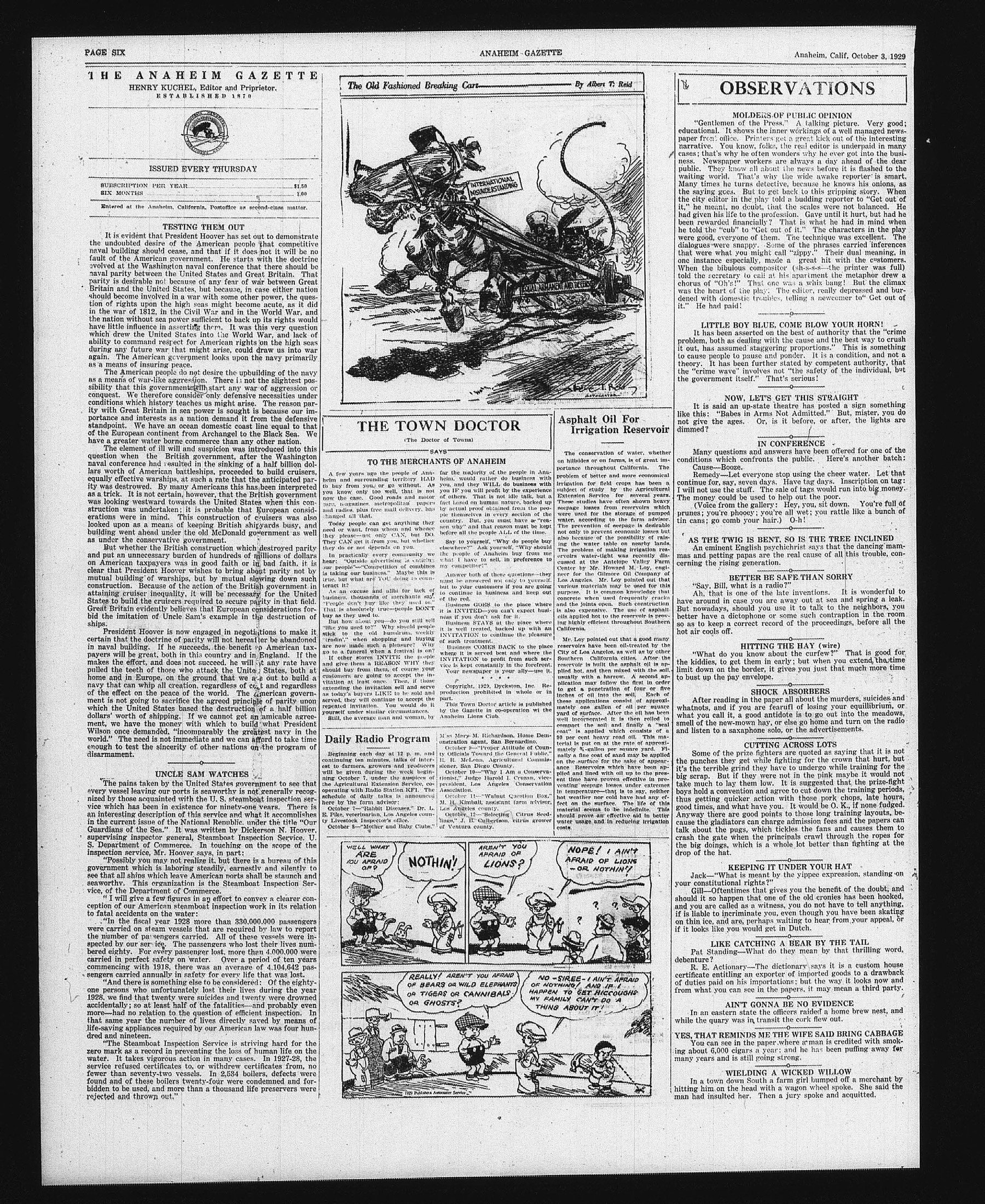
Searchable text
THE ANAHEIM GAZETTE
HENRY KUCHEL, Editor and Priprietor.
ESTABLISHED 1870
ISSUED EVERY THURSDAY
SUBSCRIPTION PER YEAR.....$1.50
SIX MONTHS.....1.00
Entered at the Anaheim, California, Postoffice as second-class matter.
TESTING THEM OUT
It is evident that President Hoover has set out to demonstrate the undoubted desire of the American people that competitive naval building should cease, and that if it does not it will be no fault of the American government. He starts with the doctrine evolved at the Washington naval conference that there should be naval parity between the United States and Great Britain. That parity is desirable not because of any fear of war between Great Britain and the United States, but because, in case either nation should become involved in a war with some other power, the question of rights upon the high seas might become acute, as it did in the war of 1812, in the Civil War and in the World War, and the nation without sea power sufficient to back up its rights would have little influence in asserting them. It was this very question which drew the United States into the World War, and lack of ability to command respect for American rights on the high seas during any future war that might arise, could draw us into war again. The American government looks upon the navy primarily as a means of insuring peace.
The American people do not desire the upbuilding of the navy as a means of war-like aggression. There is not the slightest possibility that this government will start any war of aggression or conquest. We therefore consider only defensive necessities under conditions which history teaches us might arise. The reason parity with Great Britain in sea power is sought is because our importance and interests as a nation demand it from the defensive standpoint. We have an ocean domestic coast line equal to that of the European continent from Archangel to the Black Sea. We have a greater water borne commerce than any other nation.
The element of ill will and suspicion was introduced into this
again. The American government looks upon the navy primarily as a means of insuring peace.
The American people do not desire the upbuilding of the navy as a means of war-like aggression. There is not the slightest possibility that this government will start any war of aggression or conquest. We therefore consider only defensive necessities under conditions which history teaches us might arise. The reason parity with Great Britain in sea power is sought because our importance and interests as a nation demand it from the defensive standpoint. We have an ocean domestic coast line equal to that of the European continent from Archangel to the Black Sea. We have a greater water borne commerce than any other nation.
The element of ill will and suspicion was introduced into this question when the British government, after the Washington naval conference had resulted in the sinking of a half billion dollars worth of American battleships, proceeded to build cruisers, equally effective warships, at such a rate that the anticipated parity was destrowed. By many Americans this has been interpreted as a trick. It is not certain, however, that the British government was looking westward towards the United States when this construction was undertaken; it is probable that European considerations were in mind. This construction of cruisers was also looked upon as a means of keeping British shirayards busy, and building went ahead under the old McDonald government as well as under the conservative government.
But whether the British construction which destroyed parity and put an unnecessary burden of hundreds of millions of dollars on American taxpayers was in good faith or in bad faith, it is clear that President Hoover wishes to bring about parity not by mutual building of warships, but by mutual slowing down such construction. Because of the action of the British government in attaining cruiser inequality, it will be necessary for the United States to build the cruisers required to secure parity in that field. Great Britain evidently believes that European considerations forbid the imitation of Uncle Sam's example in the destruction of ships.
President Hoover is now engaged in negotiations to make it certain that the doctrine of parity will not hereafter be abandoned in naval building. If he succeeds, the benefit to American taxpayers will be great, both in this country and in England. If the makes the effort, and does not succeed, he will at any rate have pulled the teeth of those who attack the United States, both at home and in Europe, on the ground that we are out to build a navy that can whip all creation, regardless of cost and regardless of the effect on the peace of the world. The American government is not going to sacrifice the agreed principle of parity upon which the United States based the destruction of a half billion dollars' worth of shipping. If we cannot get an amicable agreement, we have the money with which to build what President Wilson once demanded, "incomparably the greatest navy in the world." The need is not immediate and we can afford to take time enough to test the sincerity of other nations on the program of disarmament.
UNCLE SAM WATCHES
The pains taken by the United States government to see that every vessel leaving our ports is seaworthy is not generally recognized by those acquainted with the U.S. steamboat inspection service which has been in existence for ninety-one years. There is an interesting description of this service and what it accomplishes in the current issue of the National Republic under the title "Our Guardians of the Sea." It was written by Dickerson N. Hoover, supervising inspector general, Steamboat Inspection Service. U.S. Department of Commerce. In touching on the scope of the
UNCLE SAM WATCHES
The pains taken by the United States government to see that every vessel leaving our ports is seaworthy is not generally recognized by those acquainted with the U.S. steamboat inspection service which has been in existence for ninety-one years. There is an interesting description of this service and what it accomplishes in the current issue of the National Republic under the title "Our Guardians of the Sea." It was written by Dickerson N. Hoover, supervising inspector general, Steamboat Inspection Service, U.S. Department of Commerce. In touching on the scope of the inspection service, Mr. Hoover says, in part:
"Possibly you may not realize it, but there is a bureau of this government which is laboring steadily, earnestly and silently to see that all ships which leave American ports shall be staunch and seaworthy. This organization is the Steamboat Inspection Service, of the Department of Commerce.
"I will give a few figures in an effort to convey a clearer conception of our American steamboat inspection work in its relation to fatal accidents on the water:
"In the fiscal year 1928 more than 330,000,000 passengers were carried on steam vessels that are required by law to report the number of passengers carried. All of these vessels were inspected by our service. The passengers who lost their lives numbered eighty. For every passenger lost, more than 4,000,000 were carried in perfect safety on water. Over a period of ten years commencing with 1918, there was an average of 4,104,642 passengers carried annually in safety for every life that was lost.
"And there is something else to be considered: Of the eighty-one persons who unfortunately lost their lives during the year 1928, we find that twenty were suicides and twenty were drowned accidentally; so at least half of the fatalities—and probably even more—had no relation to the question of efficient inspection. In that same year the number of lives directly saved by means of life-saving appliances required by our American law was four hundred and nineteen.
"The Steamboat Inspection Service is striving hard for the zero mark as a record in preventing the loss of human life on the water. It takes vigorous action in many cases. In 1927-28, the service refused certificates to, or withdrew certificates from, no fewer than seventy-two vessels. In 2,534 boilers, defects were found and of these boilers twenty-four were condemned and forbidden to be used, and more than a thousand life preservers were rejected and thrown out."
ANAHEIM · GAZETTE
The Old Fashioned Breaking Cart By Albert T. Reid
INTERNATIONAL MISUNDERSTANDING
EQUAL ARMAMENT AND DEFENSE
THE TOWN DOCTOR
(The Doctor of Towns)
Asphalt Oil For Irrigation Reservoir
THE TOWN DOCTOR
(The Doctor of Towns)
SAYS
TO THE MERCHANTS OF ANAHEIM
A few years ago the people of Anaheim and surrounding territory HAD to buy from you or go without. As you know only too well, that is not now the case. Good roads and motor cars, magazines, metropolitan papers and radios, plus free mail delivery, has changed all that.
Today people can get anything they need or want, from whom and whence they please—not only CAN, but DO. They CAN get it from you, but whether they do or not depends on you.
In practically every community we hear: "Outside advertising is criticizing our people"—"Competition of combines is taking our business." Maybe this is true, but what are YOU doing to counteract it?
As an excuse and alibi for lack of business, thousands of merchants say "People don't buy like they used to." That is absolutely true—people DON'T buy as they used to.
But how about you—do you still sell "like you used to?" Why should people stick to the old humdrum, weekly "tradin," when shopping and buying are now made such a pleasure? Why go to a funeral when a festival is on?
If other stores INVITE the people and give them a REASON WHY they should buy from them, of course your customers are going to accept the invitation at least once. Then, if those extending the invitation sell and serve as today's buyers LIKE to be sold and served, they will continue to accept the repeated invitation. You would do it yourself under similar circumstances.
Still, the average man and woman, by far the majority of the people in Anaheim, would rather do business with you, and they WILL do business with you IF you will profit by the experience of others. That is not idle talk, but a fact based on human nature, backed up by actual proof obtained from the people themselves in every section of the country. But, you must have a "reason why" and that reason must be kept before all the people ALL of the time.
Say to yourself, "Why do people buy elsewhere?" Ask yourself, "Why should the people of Anaheim buy from me what I have to sell, in preference to my competitor?"
Answer both of these questions—they must be answered not only to yourself, but to your customers if you are going to continue in business and keep out of the red.
Business GOES to the place where it IS INVITED—you can't expect business if you don't ask for it.
Business STAYS at the place where it is well treated, backed up with an INVITATION to continue the pleasure of such treatment.
Business COMES BACK to the place where it is served best and where the INVITATION to profit from such service is kept constantly in the forefront.
Your newspaper is your ally—use it.
Copyright, 1929, Dyckston, Inc. Reproduction prohibited in whole or in part.
This Town Doctor article is published by the Gazette in co-operation wi the Anaheim Lions Club.
Daily Radio Program
Beginning each day at 12 p.m. and continuing ten minutes, talks of interest to farmers, growers and producers will be given during the week beginning October 7, under the auspices of the Agricultural Extension Service, cooperating with Radio Station KF1. The schedule of daily talks is announced here by the farm advisor:
October 7—"Rabbit Diseases," Dr. L. E. Pike, veterinarian, Los Angeles county Livestock Inspector's office.
October 8—"Mother and Baby Clubs."
Miss Mary M. Richardson, Home Demonstration agent, San Bernardino.
October 9—"Proper Attitude of County Officials Toward the General Public," R. R. McLean, Agricultural Commissioner, San Diego County.
October 10—"Why I Am a Conservationist," Judge Harold I. Cruzan, vice-president, Los Angeles Conservation Association.
October 11—"Walnut Question Box," M. H. Kimball, assistant farm advisor, Los Angeles county.
October 12—"Selecting Citrus Seedlings," J. B. Culbertson, citrus grower of Ventura county.
The conservation of water, whether on hillsides or on farms, is of great importance throughout California. The problem of better and more economical irrigation for field crops has been a subject of study by the Agricultural Extension Service for several years. These studies have often shown heavy seepage losses from reservoirs which were used for the storage of pumped water, according to the farm advisor. The prevention of seepage is desirable not only to prevent economic losses but also because of the possibility of raising the water table on nearby lands. The problem of making irrigation reservoirs water-tight was recently discussed at the Antelope Valley Farm Center by Mr. Howard M. Loy, engineer for the Gilmore Oil Company of Los Angeles. Mr. Loy pointed out that various materials may be used for this purpose. It is common knowledge that concrete when used frequently cracks and the joints open. Such construction is also expensive. The use of asphalt oils applied hot to the reservoir is proving highly efficient throughout Southern California.
Mr. Loy pointed out that a good many reservoirs have been oil-treated by the City of Los Angeles, as well as by other Southern California cities. After the reservoir is built the asphalt oil is applied hot, and then mixed with the soil usually with a harrow. A second application may follow first in order to get a penetration of four or five inches of oil into the soil. Each of these applications consist of approximately one gallon of oil per square yard of surface. After the oil has been well incorporated it is then rolled to compact the soil and finally a "seal coat" is applied which consists of a 90 percent heavy road oil. This material is put on at the rate of approximately ½-gallon per square yard. Finally a fine coat of sand may be applied on the surface for the sake of appearance Reservoirs which have been applied and lined with oil up to the present time have proven effective in preventing seepage losses under extremes in temperature—that is to say, neither hot weather nor cold have had any effect on the surface. The life of this material seems to be indefinite. This should prove an effective aid in better water usage and in reducing irrigation costs.
continuing ten minutes, talks of interest to farmers, growers and producers will be given during the week beginning October 7, under the auspices of the Agricultural Extension Service, operating with Radio Station KF1. The schedule of daily talks is announced here by the farm advisor:
October 7—"Rabbit Diseases," Dr. L. E. Pike, veterinarian, Los Angeles county Livestock Inspector's office.
October 8—"Mother and Baby Clubs."
WELL WHAT ARE YOU AFRAID OF?
NOTHIN!
AREN'T YOU AFRAID OF LIONS?
NOPE! I AIN'T AFRAID OF LIONS - OR NOTHIN!
REALLY! AREN'T YOU AFRAID OF BEARS OR WILD ELEPHANTS OR TIGERS OR CANNIBALS OR GHOSTS?
NO - SIREE- I AIN'T AFRAID OF NOTHING! AND IF I HAPPEN TO GET HICCOUGHS MY FAMILY CAN'T DO A THING ABOUT IT!
1929 Publishers Auto-caster Service
OBSERVATIONS
MOLDERS OF PUBLIC OPINION
"Gentlemen of the Press." A talking picture. Very good; educational. It shows the inner workings of a well managed newspaper front office. Printers get a great kick out of the interesting narrative. You know, folks, the real editor is underpaid in many cases; that's why he often wonders why he ever got into the business. Newspaper workers are always a day ahead of the dear public. They know all about the news before it is flashed to the waiting world. That's why the wide awake reporter is smart. Many times he turns detective, because he knows his onions, as the saying goes. But to get back to this gripping story. When the city editor in the play told a budding reporter to "Get out of it," he meant, no doubt, that the scales were not balanced. He had given his life to the profession. Gave until it hurt, but had he been rewarded financially? That is what he had in mind when he told the "cub" to "Get out of it." The characters in the play were good, everyone of them. The technique was excellent. The dialogues were snappy. Some of the phrases carried inferences that were what you might call "zippy." Their dual meaning, in one instance especially, made a great hit with the customers. When the bibulous compositor (sh-s-s-s—the printer was full) told the secretary to call at his apartment the metaphor drew a chorus of "Oh's!" That one was a whiz bang! But the climax was the heart of the play. The editor, really depressed and burdened with domestic troubles, telling a newcomer to "Get out of it." He had paid!
LITTLE BOY BLUE, COME BLOW YOUR HORN!
It has been asserted on the best of authority that the "crime problem, both as dealing with the cause and the best way to crush it out, has assumed staggering proportions." This is something to cause people to pause and ponder. It is a condition, and not a theory. It has been further stated by competent authority, that the "crime wave" involves not "the safety of the individual, but the government itself." That's serious!
NOW, LET'S GET THIS STRAIGHT
It is said an up-state theatre has posted a sign something like this: "Babes in Arms Not Admitted." But, mister, you do not give the ages. Or, is it before, or after, the lights are dimmed?
IN CONFERENCE
NOW, LET'S GET THIS STRAIGHT
It is said an up-state theatre has posted a sign something like this: "Babes in Arms Not Admitted." But, mister, you do not give the ages. Or, is it before, or after, the lights are dimmed?
IN CONFERENCE
Many questions and answers have been offered for one of the conditions which confronts the public. Here's another batch:
Cause—Booze.
Remedy—Let everyone stop using the cheer water. Let that continue for say, seven days. Have tag days. Inscription on tag: I will not use the stuff. The sale of tags would run into big money. The money could be used to help out the poor.
(Voice from the gallery: Hey, you, sit down. You're full of prunes; you're phooney; you're all wet; you rattle like a bunch of tin cans; go comb your hair.) O-h!
AS THE TWIG IS BENT, SO IS THE TREE INCLINED
An eminent English psychichrist says that the dancing mammas and petting papas are the real cause of all this trouble, concerning the rising generation.
BETTER BE SAFE THAN SORRY
"Say, Bill, what is a radio?"
Ah, that is one of the late inventions. It is wonderful to have around in case you are away out at sea and spring a leak. But nowadays, should you use it to talk to the neighbors, you better have a dictophone or some such contraption in the room so as to keep a correct record of the proceedings, before all the hot air cools off.
HITTING THE HAY (wire)
"What do you know about the curfew?" That is good for the kiddies, to get them in early; but when you extend the time limit down on the border, it gives you just that much more time to bust up the pay envelope.
SHOCK ABSORBERS
After reading in the paper all about the murders, suicides and whatnots, and if you are fearufl of losing your equilibrium, or what you call it, a good antidote is to go out into the meadows, smell of the new-mown hay, or else go home and turn on the radio and listen to a saxaphone solo, or the advertisements.
CUTTING ACROSS LOTS
Some of the prize fighters are quoted as saying that it is not the punches they get while fighting for the crown that hurt, but it's the terrible grind they have to undergo while training for the big scrap. But if they were not in the pink maybe it would not take much to lay them low. It is suggested that the prize-fight boys hold a convention and agree to cut down the training periods, thus getting quicker action with those pork chops, late hours, good times, and what have you. It would be O. K., if none fudged. Anyway there are good points to those long training layouts, because the gladiators can charge admission fees and the papers can talk about the pugs, which tickles the fans and causes them to crash the gate when the principals crawl through the ropes for the big doings, which is a whole lot better than fighting at the
KEEPING IT UNDER YOUR HAT
Jack—"What is meant by the yippee expression, standing on your constitutional rights?"
Gill—Oftentimes that gives you the benefit of the doubt, and should it so happen that one of the old cronies has been hooked, and you are called as a witness, you do not have to tell anything, if is liable to incriminate you, even though you have been skating on thin ice, and are, perhaps waiting to hear from your appeal, or if it looks like you would get in Dutch.
LIKE CATCHING A BEAR BY THE TAIL
Pat Standing—What do they mean by that thrilling word, debenture?
R. E. Actionary—The dictionary says it is a custom house certificate entitling an exporter of imported goods to a drawback of duties paid on his importations; but the way it looks now and from what you can see in the papers, it may mean a third party.
AIN'T GONNA BE NO EVIDENCE
In an eastern state the officers raided a home brew nest, and while the quarry was in transit the cork flew out.
YES, THAT REMINDS ME THE WIFE SAID BRING CABBAGE
You can see in the paper where arman is credited with smoking about 6,000 cigars a year; and he has been puffing away for many years and is still going strong.
WIELDING A WICKED WILLOW
In a town down South a farm girl bumped off a merchant by hitting him on the head with a wagon wheel spoke. She said the man had insulted her. Then a jury spoke and acquitted.