anaheim-gazette 1929-08-22
Scanned page
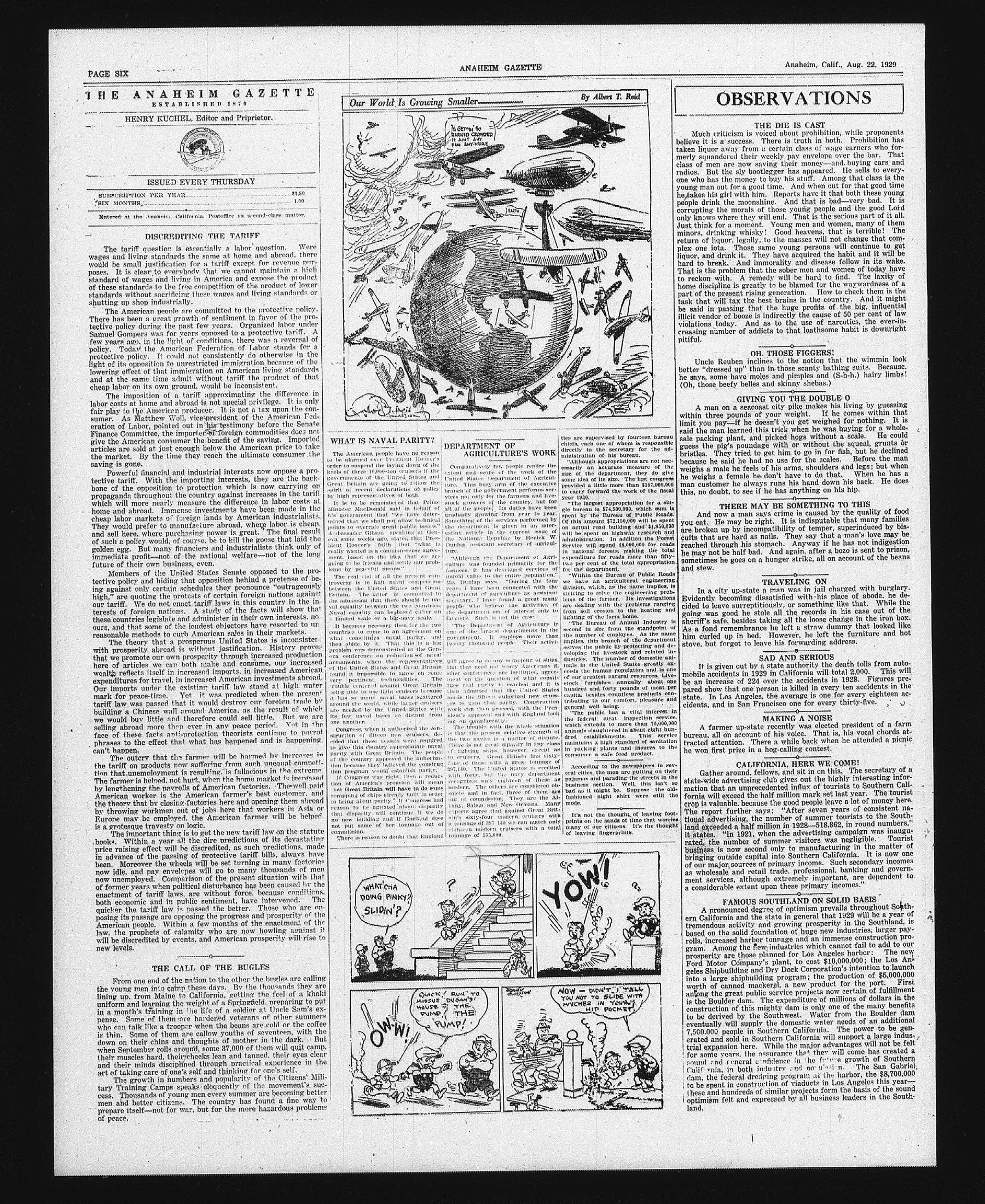
Searchable text
THE ANAHEIM GAZETTE
ESTABLISHED 1870
HENRY KUCHEL, Editor and Priprietor.
ISSUED EVERY THURSDAY
SUBSCRIPT PER YEAR.....$1.50
SIX MONTHS.....1.00
Entered at the Anaheim, California, Postoffice as second-class matter.
DISCREDITING THE TARIFF
The tariff question is essentially a labor question. Were wages and living standards the same at home and abroad, there would be small justification for a tariff except for revenue purposes. It is clear to everybody that we cannot maintain a high standard of wages and living in America and expose the product of these standards to the free competition of the product of lower standards without sacrificing these wages and living standards or shutting up shop industrially.
The American people are committed to the protective policy. There has been a great growth of sentiment in favor of the protective policy during the past few years. Organized labor under Samuel Gompers was for years opposed to a protective tariff. A few years ago, in the light of conditions, there was a reversal of policy. Today the American Federation of Labor stands for a protective policy. It could not consistently do otherwise in the light of its opposition to unrestricted immigration because of the lowering effect of that immigration on American living standards and at the same time admit without tariff the product of that cheap labor on its own ground, would be inconsistent.
The imposition of a tariff approximating the difference in labor costs at home and abroad is not special privilege. It is only fair play to the American producer. It is not a tax upon the consumer. As Matthew Woll, vice-president of the American Federation of Labor, pointed out in his testimony before the Senate Finance Committee, the importer of foreign commodities does not give the American consumer the benefit of the saving. Imported articles are sold at just enough below the American price to take
protective policy. It could not consistently do otherwise in the light of its opposition to unrestricted immigration because of the lowering effect of that immigration on American living standards and at the same time admit without tariff the product of that cheap labor on its own ground, would be inconsistent.
The imposition of a tariff approximating the difference in labor costs at home and abroad is not special privilege. It is only fair play to the American producer. It is not a tax upon the consumer. As Matthew Woll, vice-president of the American Federation of Labor, pointed out in his testimony before the Senate Finance Committee, the importer of foreign commodities does not give the American consumer the benefit of the saving. Imported articles are sold at just enough below the American price to take the market. By the time they reach the ultimate consumer the saving is gone.
Powerful financial and industrial interests now oppose a protective tariff. With the importing interests, they are the backbone of the opposition to protection which is now carrying on propaganda throughout the country against increases in the tariff which will more nearly measure the difference in labor costs at home and abroad. Immense investments have been made in the cheap labor markets of foreign lands by American industrialists. They would prefer to manufacture abroad, where labor is cheap, and sell here, where purchasing power is great. The final result of such a policy would, of course, be to kill the goose that laid the golden egg. But many financiers and industrialists think only of immediate profit—not of the national welfare—not of the long future of their own business, even.
Members of the United States Senate opposed to the protective policy and hiding that opposition behind a pretense of being against only certain schedules they pronounce "outrageously high," are quoting the protests of certain foreign nations against our tariff. We do not enact tariff laws in this country in the interests of foreign nations. A study of the facts will show that these countries legislate and administer in their own interests, no ours, and that some of the loudest objectors have resorted to unreasonable methods to curb American sales in their markets.
The theory that a prosperous United States is inconsistent with prosperity abroad is without justification. History proves that we promote our own prosperity through increased production here of articles we can both make and consume, our increased wealth reflects itself in increased imports, in increased American expenditures for travel, in increased American investments abroad. Our imports under the existing tariff law stand at high water mark for peace-time. Yet it was predicted when the present tariff law was passed that it would destroy our foreign trade by building a Chinese wall around America, as the result of which we would buy little and therefore could sell little. But we are selling abroad more than ever in any peace period. Yet in the face of these facts anti-protection theorists continue to parrot phrases to the effect that what has happened and is happening can't happen.
The outcry that the farmer will be harmed by increases in the tariff on products now suffering from such unequal competition that unemployment is resulting, is fallacious in the extreme. The farmer is helped, not hurt, when the home market is increased by lengthening the pavrolls of American factories. The well paid American worker is the American farmer's best customer, and the theory that by closing factories here and opening them abroad by throwing workmen out of jobs here that workers in Asia or Eurone may be employed, the American farmer will be helped is a grotesque travesty on logic.
The important thing is to get the new tariff law on the statute books. Within a year all the dire predictions of its devastating price raising effect will be discredited, as such predictions, made...
The outcry that the farmer will be harmed by increases in tariff on products now suffering from such unequal competition that unemployment is resulting, is fallacious in the extreme. The farmer is helped, not hurt, when the home market is increased by lengthening the pavrolls of American factories. The well paid American worker is the American farmer's best customer, and the theory that by closing factories here and opening them abroad by throwing workmen out of jobs here that workers in Asia or Europe may be employed, the American farmer will be helped is a grotesque travesty on logic.
The important thing is to get the new tariff law on the statute books. Within a year all the dire predictions of its devastating price raising effect will be discredited, as such predictions, made in advance of the passing of protective tariff bills, always have been. Moreover the wheels will be set turning in many factories now idle, and pay envelopes will go to many thousands of men now unemployed. Comparison of the present situation with that of former years when political disturbance has been caused by the enactment of tariff laws, are without force, because conditions, both economic and in public sentiment, have intervened. The quicker the tariff law is passed the better. Those who are opposing its passage are opposing the progress and prosperity of the American people. Within a few months of the enactment of the law, the prophets of calamity who are now howling against it will be discredited by events, and American prosperity will rise to new levels.
THE CALL OF THE BUGLES
From one end of the nation to the other the bugles are calling the young men into camp these days. By the thousands they are lining up, from Maine to California, getting the feel of a khaki uniform and learning the weight of a Springfield, preparing to put in a month's training in the life of a soldier at Uncle Sam's expense. Some of them are hardened veterans of other summers who can talk like a trooper when the beans are cold or the coffee is thin. Some of them are callow youths of seventeen, with the down on their chins and thoughts of mother in the dark. But when September rolls around, some 37,000 of them will quit camp, their muscles hard, their cheeks lean and tanned, their eyes clear and their minds disciplined through practical experience in the art of taking care of one's self and thinking for one's self.
The growth in numbers and popularity of the Citizens' Military Training Camps speaks eloquently of the movement's success. Thousands of young men every summer are becoming better men and better citizens. The country has found a fine way to prepare itself—not for war, but for the more hazardous problems of peace.
ANAHEIM GAZETTE
Our World Is Growing Smaller___ By Albert T. Reid
IS GETTIN' SO DARKED CROWDED IT AINT ANY FUN ANY MORE
WHAT IS NAVAL PARITY?
DEPARTMENT OF
ties are supervised by fourteen bureau chiefs, each one of whom is responsible directly to the secretary for the ad-
WHAT IS NAVAL PARITY?
The American people have no reason to be alarmed over President Hoover's order to suspend the laying down of the keels of three 10,000-ton cruisers if the governments of the United States and Great Britain are going to follow the spirit of recent declarations of policy by high representatives of both.
It is to be remembered that Prime Minister MacDonald said in behalf of his government that "we have determined that we shall not allow technical points to override great public issues." Ambassador Gibson speaking at Geneva some weeks ago, stated that President Hoover's faith that "what is really wanted is a common-seme agreement, based on the idea that we are going to be friends and settle our problems by peaceful means."
The real end of all the present controversy is to halt naval competition between the United States and Great Britain. The latter is committed to the admission that there should be naval equality between the two countries. Naval equality can be based either on limited scale or a big-navy scale.
It becomes necessary then for the two countries to come to an agreement on what constitutes naval parity, and then abide by it. That this is a big problem was demonstrated at the Geneva conference on reduction of naval armaments, when the representatives of the United States and Great Britain found it impossible to agree on some very pertinent technicalities. The double centered around Great Britain being able to use light cruisers because it has so many naval bases scattered around the world, while larger cruisers are needed by the United States with its few naval bases so distant from one another.
Congress, when it authorized the construction of fifteen new cruisers, decided that these vessels were required to give this country approximate naval parity with Great Britain. The people of the country approved the authorization because they believed the construc tion program would establish parity.
If Congress was right, then a reduction of America's program will mean that Great Britain will have to do some scraping of ships already built in order to bring about parity. It Congress had reason to be agitated about disparity that disparity will continue if we do no new building and if England does not put some of her tonnage out of commission.
There is reason to doubt that England
DEPARTMENT OF AGRICULTURE'S WORK
Comparatively few people realize the extent and scope of the work of the United States Department of Agriculture. This busy arm of the executive branch of the government performs services not only for the farmers and livestock growers of the country, but for all of the people. Its duties have been gradually growing from year to year. Something of the services performed by the department is given in an interesting article in the current issue of the National Republic by Renick W. Dunlap, assistant secretary of agriculture.
"Although the Department of Agriculture was founded primarily for the farmers, it has developed services of untold value to the entire population," Mr. Dunlap says. "During the four years I have been connected with the department of agriculture as assistant secretary, I have found a great many people who believe the activities of the department are of interest only to farmers. Such is not the case."
The Department of Agriculture is one of the largest departments in the government. It employs more than twenty thousand people. Their activi ties will agree to do any scrapping of ships, but that need not worry Americans if after conferences are instituted, agreement on the question of what constitutes real parity is reached and it is then admitted that the United States needs the fifteen authorized new cruisers to gain that parity. Construction work can then proceed, with the President's approval and with England looking on complacently.
The trouble with the whole situation is that the present relative strength of the two navies is a matter of dispute. There is not great disparity in any class of fighting ships; however, except as to cruisers. Great Britain has sixy-four of these with a gross tonnage of 397,140. The United States is credited with forty, but the navy department recognizes only eighteen of these as modern. The others are considered obsolete and in fact, three of them are out of commission. They are the Alany, Salem and New Orleans. Many experts agree that against Great Britain's sixty-four modern cruisers with a tonnage of 397,140 we can match only eighteen modern cruisers with a total tonnage of 155,000.
ties are supervised by fourteen bureau chiefs, each one of whom is responsible directly to the secretary for the administration of his bureau.
"Although appropriations are not necessarily an accurate measure of the size of the department, they do give some idea of its size. The last congress provided a little more than $157,000,000 to carry forward the work of the fiscal year 1830.
"The largest appropriation for a single bureau is $74,500,000, which sum is spent by the Bureau of Public Roads. Of this amount $72,150,000 will be spent on actual road building and $1,850,000 will be spent on highway research and administration. In addition the Forest Service will spend $8,000,000 for roads in national forests, making the total expenditure for roads more than fifty-two per cent of the total appropriation for the department.
"Within the Bureau of Public Roads we have an agricultural engineering division, which, as the name implies, is striving to solve the engineering problems of the farmer. Its investigations are dealing with the problems ranging from soil erosion to the heating and lighting of the farm home.
"The Bureau of Animal Industry is second in size from the standpoint of the number of employees. As the name implies, this branch of the department serves the public by protecting and developing the livestock and related industries. The number of domestic animals in the United States greatly exceeds the human population and is one of our greatest natural resources. Livestock furnishes annually about one hundred and forty pounds of meat per capita, besides countless products contributing to our comfort, pleasure and general well being.
"The public has a vital interest in the federal meat inspection service, which extends to more than 70,000,000 animals slaughtered in about eight hundred establishments. This service maintains a high standard of sanitation in packing plants and insures to the consumer a safe food product.
According to the newspapers in several cities, the men are putting on their pajamas and parading the streets in business section. Well, this isn't so bad as it might be. Suppose the old fashioned night shirt were still the mode.
It's not the thought of leaving footprints on the sands of time that worries many of our citizens. It's the thought of leaving fingerprints.
of the country approved the authorization because they believed the construction program would establish parity.
If Congress was right, then a reduction of America's program will mean that Great Britain will have to do some scrapping of ships already built in order to bring about parity. It Congress had reason to be agitated about disparity that disparity will continue if we do no new building and if England does not put some of her tonnage out of commission.
There is reason to doubt that England
Great Britain has sixy-four of these with a gross tonnage of 397,140. The United States is credited with forty, but the navy department recognizes only eighteen of these as modern. The others are considered obsolete and in fact, three of them are out of commission. They are the Alany, Salem and New Orleans. Many experts agree that against Great Britain's sixty-four modern cruisers with a tonnage of 397,140 we can match only eighteen modern cruisers with a total tonnage of 155,000.
WHAT'CHA DOING PINKY? SLIDIN'?
YOW!
QUICK! RUN TO MISSUS DUGAN'S HOUSE OF THE PUMP! THE PUMP!
NOW - DIDN'T I TELL YOU NOT TO SLIDE WITH MUCHES IN YOUR HIP POCKET!
OBSERVATIONS
THE DIE IS CAST
Much criticism is voiced about prohibition, while proponents believe it is a success. There is truth in both. Prohibition has taken liquor away from a certain class of wage earners who formerly squandered their weekly pay envelope over the bar. That class of men are now saving their money—and buying cars and radios. But the sly bootlegger has appeared. He sells to everyone who has the money to buy his stuff. Among that class is the young man out for a good time. And when out for that good time he takes his girl with him. Reports have it that both these young people drink the moonshine. And that is bad—very bad. It is corrupting the morals of those young people and the good Lord only knows where they will end. That is the serious part of it all. Just think for a moment. Young men and women, many of them minors, drinking whisky! Good heavens, that is terrible! The return of liquor, legally, to the masses will not change that complex one iota. Those same young persons will continue to get liquor, and drink it. They have acquired the habit and it will be hard to break. And immorality and disease follow in its wake. That is the problem that the sober men and women of today have to reckon with. A remedy will be hard to find. The laxity of home discipline is greatly to be blamed for the waywardness of a part of the present rising generation. How to check them is the task that will tax the best brains in the country. And it might be said in passing that the huge profits of the big, influential illicit vendor of booze is indirectly the cause of 50 per cent of law violations today. And as to the use of narcotics, the ever-increasing number of addicts to that loathsome habit is downright pitiful.
OH, THOSE FIGGERS!
Uncle Reuben inclines to the notion that the wimmin look better "dressed up" than in those scanty bathing suits. Because, he says, some have moles and pimples and (S-h-h.) hairy limbs! (Oh, those beefy belles and skinny shebas.)
GIVING YOU THE DOUBLE O
A man on a seacoast city pike makes his living by guessing within three pounds of your weight. If he comes within that limit you pay—if he doesn't you get weighed for nothing. It is said the man learned this trick when he was buying for a wholesale packing plant, and picked hogs without a scale. He could guess the pig's poundage with or without the squeal, grunts or
Uncle Reuben inclines to the notion that the wimmin look better "dressed up" than in those scanty bathing suits. Because he says, some have moles and pimples and (S-h-h.) hairy limbs! (Oh, those beefy belles and skinny shebas.)
GIVING YOU THE DOUBLE O
A man on a seacoast city pike makes his living by guessing within three pounds of your weight. If he comes within that limit you pay—if he doesn't you get weighed for nothing. It is said the man learned this trick when he was buying for a wholesale packing plant, and picked hogs without a scale. He could guess the pig's poundage with or without the squeal, grunts or bristles. They tried to get him to go in for fish, but he declined because he said he had no use for the scales. Before the man weighs a male he feels of his arms, shoulders and legs; but when he weighs a female he don't have to do that. When he has a man customer he always runs his hand down his back. He does this, no doubt, to see if he has anything on his hip.
THERE MAY BE SOMETHING TO THIS
And now a man says crime is caused by the quality of food you eat. He may be right. It is indisputable that many families are broken up by incompatibility of temper, superinduced by biscuits that are hard as nails. They say that a man's love may be reached through his stomach. Anyway if he has not indigestion he may not be half bad. And again, after a bozo is sent to prison, sometimes he goes on a hunger strike, all on account of the beans and stew.
TRAVELING ON
In a city up-state a man was in jail charged with burglary. Evidently becoming dissatisfied with his place of abode, he decided to leave surreptitiously, or something like that. While the going was good he stole all the records in his case out of the sheriff's safe, besides taking all the loose change in the iron box. As a fond remembrance he left a straw dummy that looked like him curled up in bed. However, he left the furniture and hot stove, but forgot to leave his forwarding address.
SAD AND SERIOUS
It is given out by a state authority the death tolls from automobile accidents in 1929 in California will total 2,000. This will be an increase of 224 over the accidents in 1928. Figures prepared show that one person is killed in every ten accidents in the state. In Los Angeles, the average is one for every eighteen accidents, and in San Francisco one for every thirty-five.
MAKING A NOISE
A farmer up-state recently was elected president of a farm bureau, all on account of his voice. That is, his vocal chords attracted attention. There a while back when he attended a picnic he won first prize in a hog-calling contest.
CALIFORNIA, HERE WE COME!
Gather around, fellows, and sit in on this. The secretary of a state-wide advertising club gives out the highly interesting information that an unprecedented influx of tourists to Southern California will exceed the half million mark set last year. The tourist crop is valuable, because the good people leave a lot of money here. The report further says: "After seven years of consistent national advertising, the number of summer tourists to the Southland exceeded a half million in 1928—518,862, in round numbers," it states. "In 1921, when the advertising campaign was inaugurated, the number of summer visitors was negligible. Tourist business is now second only to manufacturing in the matter of
CALIFORNIA, HERE WE COME!
Gather around, fellows, and sit in on this. The secretary of a state-wide advertising club gives out the highly interesting information that an unprecedented influx of tourists to Southern California will exceed the half million mark set last year. The tourist crop is valuable, because the good people leave a lot of money here. The report further says: "After seven years of consistent national advertising, the number of summer tourists to the Southland exceeded a half million in 1928—518,862, in round numbers," it states. "In 1921, when the advertising campaign was inaugurated, the number of summer visitors was negligible. Tourist business is now second only to manufacturing in the matter of bringing outside capital into Southern California. It is now one of our major sources of primary income. Such secondary incomes as wholesale and retail trade, professional, banking and government services, although extremely important, are dependent to a considerable extent upon these primary incomes."
FAMOUS SOUTHLAND ON SOLID BASIS
A pronounced degree of optimism prevails throughout Southern California and the state in general that 1929 will be a year of tremendous activity and growing prosperity in the Southland, is based on the solid foundation of huge new industries, larger payrolls, increased harbor tonnage and an immense construction program. Among the new industries which cannot fail to add to our prosperity are those planned for Los Angeles harbor: The new Ford Motor Company's plant, to cost $10,000,000; the Los Angeles Shipbuilding and Dry Dock Corporation's intention to launch into a large shipbuilding program; the production of $5,000,000 worth of canned mackerel, a new product for the port. First among the great public service projects now certain of fulfillment is the Boulder dam. The expenditure of millions of dollars in the construction of this mighty dam is only one of the many benefits to be derived by the Southwest. Water from the Boulder dam eventually will supply the domestic water needs of an additional 7,500,000 people in Southern California. The power to be generated and sold in Southern California will support a large industrial expansion here. While the major advantages will not be felt for some years, the assurance that they will come has created a sound and general confidence in the future growth of Southern California, in both industry and population. The San Gabriel dam, the federal dredging program at the harbor, the $8,700,000 to be spent in construction of viaducts in Los Angeles this year—these and hundreds of similar projects form the basis of the sound optimism felt and expressed by all business leaders in the Southland.