anaheim-gazette 1929-07-18
Scanned page
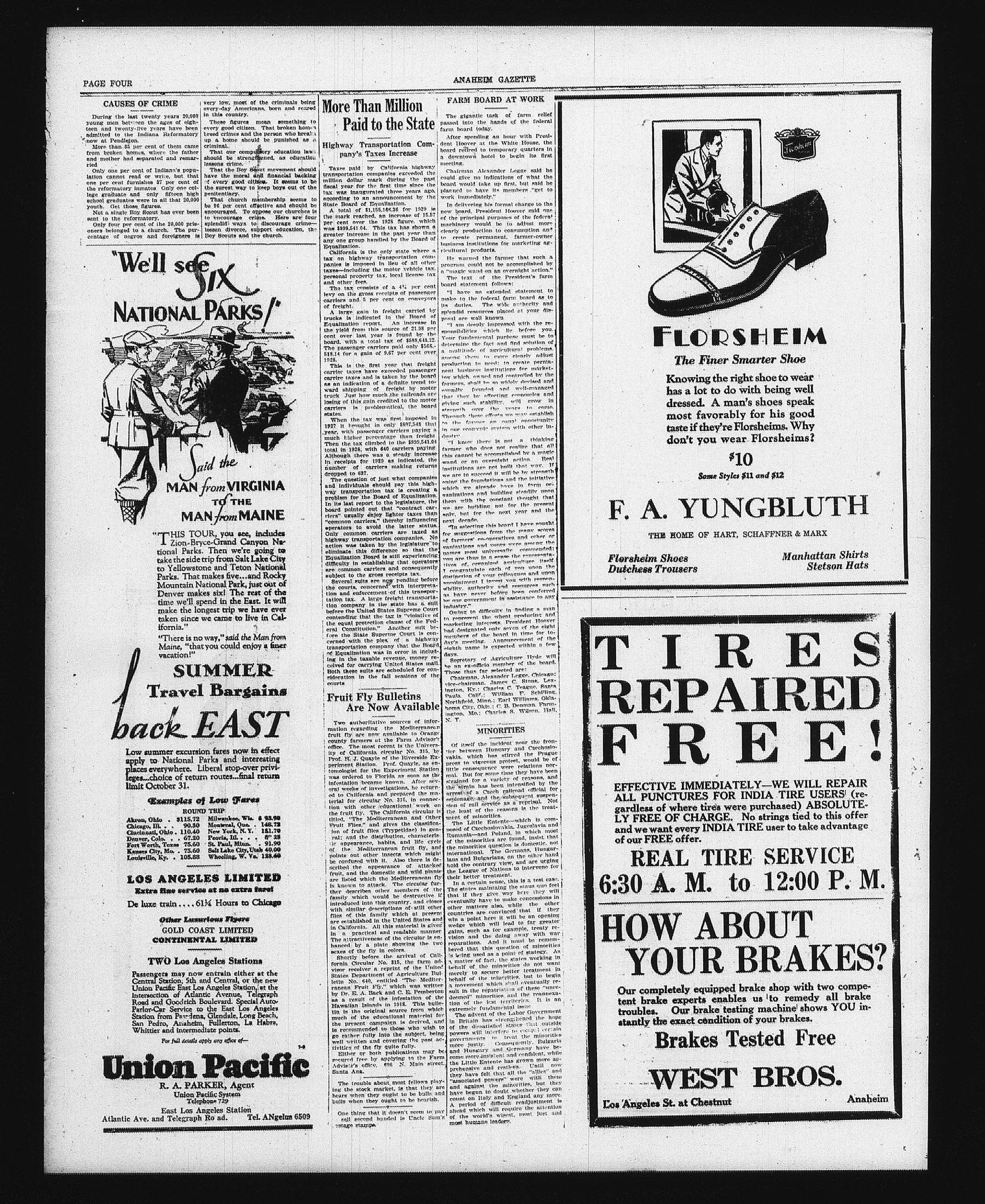
Searchable text
CAUSES OF CRIME
During the last twenty years 20,000 young men between the ages of eighteen and twenty-five have been admitted to the Indiana Reformatory now at Pendleton.
More than 85 per cent of them came from broken homes, where the father and mother had separated and remarried.
Only one per cent of Indiana's population cannot read or write, but that one per cent furnishes 37 per cent of the reformatory inmates. Only one college graduate and only fifteen high school graduates were in all that 20,000 youth. Get those figures.
Not a single Boy Scout has ever been sent to the reformatory.
Only four per cent of the 20,000 prisoners belonged to a church. The percentage of negros and foreigners is very low, most of the criminals being every-day Americans, born and reared in this country.
These figures mean something to every good citizen. That broken home breed crimes and the person who breaks up a home should be punished as a criminal.
That our compulsory education laws should be strengthened, as education lessens crime.
That the Boy Scout movement should have the moral and financial backing of every good citizen. It seems to be the surest way to keep boys out of the penitentiary.
That church membership seems to be 96 per cent effective and should be encouraged. To oppose our churches is to encourage crime. Here are four splendid ways to discourage crime—lessen divorce, support education, the Boy Scouts and the church.
"We'll see Six National Parks!"
Said the MAN from VIRGINIA TO THE MAN from MAINE
"THIS TOUR, you see, includes Zion-Bryce-Grand Canyon National Parks. Then we're going to take the side trip from Salt Lake City to Yellowstone and Teton National Parks. That makes five...and Rocky Mountain National Park, just out of Denver makes six! The rest of the time we'll spend in the East. It will make the longest trip we have ever taken since we came to live in California."
"There is no way," said the Man from Maine, "that you could enjoy a finer vacation!"
SUMMER Travel Bargains back EAST
Low summer excursion fares now in effect apply to National Parks and interesting places everywhere. Liberal stop-over privileges...choice of return routes...final return limit October 31.
Examples of Low Fares
ROUND TRIP
Akron, Ohio . 3115.72 Milwaukee, Wis. $ 93.90
Chicago, IL . 90.50 Monkcal, Que. 148.73
Cincinnati, Ohio . 110.40 New York, N.Y. 151.70
Denver, Colo. . 67.20 Peoria, Ill. . 8"25
Fort Worth, Texas 75.60 St. Paul, Minn. 91.90
Salt Lake City, Utah 40.00
Examples of Low Fares
ROUND TRIP
Akron, Ohio . $115.72 Milwaukee, WI. $ 93.90
Chicago, IL . . $9.30 Monkreal, Que. . $148.73
Cincinnati, Ohio . 110.40 New York, N.Y. 151.70
Denver, Colo. . . $67.20 Peoria, IL. . . $8'25
Fort Worth, Texas 75.60 St. Paul, Minn. . $91.90
Kansas City, Mo. . $75.60 Salt Lake City, Utah 40.00
Louisville, Ky. . $105.88 Wheeling, W.Va. $123.60
LOS ANGELES LIMITED
Extra fine service at no extra fare!
De luxe train ... 61¼ Hours to Chicago
Other Luxurious Flyers
GOLD COAST LIMITED
CONTINENTAL LIMITED
TWO Los Angeles Stations
Passengers may now entrain either at the Central Station, 5th and Central, or the new Union Pacific East Los Angeles Station, at the intersection of Atlantic Avenue, Telegraph Road and Goodrich Boulevard. Special Auto-Parlor-Car Service to the East Los Angeles Station from Pasadena, Glendale, Long Beach, San Pedro, Anaheim, Fullerton, La Habra, Whittier and intermediate points.
For full details apply any office of—
Union Pacific
R. A. PARKER, Agent
Union Pacific System
Telephone 729
East Los Angeles Station
Atlantic Ave. and Telegraph Ro ad.
Tel. ANgelus 6509
More Than Million Paid to the State
Highway Transportation Company's Taxes Increase
Taxes paid by California highway transportation companies exceeded the million dollar mark during the past fiscal year for the first time since the tax was inaugurated three years ago, according to an announcement by the State Board of Equalization.
A total of $1,155,166.36 for 1929 is the mark reached, an increase of 15.57 per cent over the 1928 figure, which was $999,541.04. This tax has shown a greater increase in the past year than any one group handled by the Board of Equalization.
California is the only state where a tax on highway transportation companies is imposed in lieu of all other taxes—including the motor vehicle tax, personal property tax, local license tax and other fees.
The tax consists of a 4½ per cent levy on the gross receipts of passenger carriers and 5 per cent on conveyors of freight.
A large gain in freight carried by trucks is indicated in the Board of Equalization report. An increase in the yield from this source of 21.98 per cent over last year is found by the board, with a total tax of $588,648.22. The passenger carriers paid only $566,-518.14 for a gain of 9.67 per cent over 1928.
This is the first year that freight carrier taxes have exceeded passenger carriage taxes and is taken by the board as an indication of a definite trend toward shipping of freight by motor truck. Just how much the railroads are losing of this gain credited to the motor carriers is problematical, the board states.
When the tax was first imposed in 1927 it brought in only $807,548 that year, with passenger carriers paying a much higher percentage than freight. Then the tax climbed to the $999,541.04 total in 1928 with 640 carriers paying
FARM BOARD AT WORK
The gigantic task of farm relief passed into the hands of the federal farm board today.
After spending an hour with President Hoover at the White House, the board retired to temporary quarters in a downtown hotel to begin its first meeting.
Chairman Alexander Legge said he could give no indications of what the board would take up first, but said he planned to have its members "get to work immediately."
In delivering his formal charge to the new board, President Hoover said one of the principal purposes of the federal machinery would be to adjust more clearly production to consumption and to create permanent, farmer-owner business institutions for marketing agricultural products.
He warned the farmer that such a program could not be accomplished by a "magic wand on an overnight action."
The text of the President's farm board statement follows:
"I have no extended statement to make to the federal farm board as to its duties. The wide authority and splendid resources placed at your disposal are well known.
"I am deeply impressed with the responsibilities which lie before you. Your fundamental purpose must be to determine the fact and find solution of a multitude of agricultural problems among them to more clearly adjust production to need: to create permanent business institutions for marketing which owned and controlled by the farmers, shall be so widely devised and soundly founded and well-managed that they by effecting economies and giving such stability, will grow in strength over the years to come.
Through these efforts we may establish to the farmer an equal opportunity in our economic system with other industries."
"I know there is not a thinking farmer who does not realize that all
This is the first year that freight carrier taxes have exceeded passenger carriage taxes and is taken by the board as an indication of a definite trend toward shipping of freight by motor truck. Just how much the railroads are losing of this gain credited to the motor carriers is problematic, the board states.
When the tax was first imposed in 1927 it brought in only $807,548 that year, with passenger carriers paying a much higher percentage than freight. Then the tax climbed to the $999,541.04 total in 1928, with 640 carriers paying. Although there was a steady increase in receipts for 1929 as indicated, the number of carriers making returns dropped to 637.
The question of just what companies and individuals should pay this highway transportation tax is creating a problem for the Board of Equalization. In its last report to the legislature, the board pointed out that "contract carriers" usually enjoy lighter taxes than "common carriers," thereby influencing operators to avoid the latter status. Only common carriers are taxed as highway transportation companies. No action was taken by the legislature to eliminate this difference so that the Equalization Board is still experiencing difficulty in establishing that operators are common carriers and consequently subject to the gross receipts tax.
Several suits are now pending before the courts, concerned with interpretation and enforcement of this transportation tax. A large freight transportation company in the state has a suit before the United States Supreme Court contending that the tax is "violative of the equal protection clause of the Federal Constitution." Another suit before the State Superior Court is concerned with the plea of a highway transportation company that the Board of Equalization was in error in including in the taxable revenue, money received for carrying United States mail. Both these suits are scheduled for consideration in the fall sessions of the courts.
Fruit Fly Bulletins Are Now Available
Two authoritative sources of information regarding the Mediterranean fruit fly are now available to Orange county farmers at the Farm Advisor's office. The most recent is the University of California circular No. 315, by Prof. H.J. Quayle of the Riverside Experiment Station. Prof. Quayle, as entomologist for the Experiment Station was ordered to Florida as soon as the infestation became known. After several weeks of investigations, he returned to California and prepared the material for circular No. 315. In connection with other educational work on the fruit fly, The California circular is titled, "The Mediterranean and Other Fruit Flies," and gives the classification of fruit files (Trypetidae) in general; and the distribution, characteristic appearance, habits, and life cycle of the Mediterranean fruit fly, and among them to more clearly adjust production to need: to create permanent business institutions for marketing which owned and controlled by the farmers, shall be so widely devised and soundly founded and well-managed that they by effecting economies and giving such stability, will grow in strength over the years to come. Through these efforts we may establish to the farmer an equal opportunity in our economic system with other industries.
"I know there is not a thinking farmer who does not realize that all this cannot be accomplished by a magic wand or an overnight action. Real institutions are not built that way. If we are to succeed it will be by strength ening the foundations and the initiative which we already have in form organizations and building steadily upon them with the constant thought that we are building not for the present only, but for the next year and the next decade.
"In selecting this board I have sought for suggestions from the many scores of farmers' cooperatives and other organizations and yours were among the names most universally commended: you are thus in a sense the representatives of, organized agriculture itself. I congratulate each of you upon the distinction of your colleagues and upon appointment I invest you with responsibility, authority and resources such as have never before been conferred by our government in assistance to any industry."
Owing to difficulty in finding a man to represent the wheat producing and marketing interests, President Hoover had designated only seven of the eight members of the board in time for today's meeting. Announcement of the eighth name is expected within a few days.
Secretary of Agriculture Hyde will be an ex-officio member of the board. Those thus far selected are:
Chairman, Alexander Legge, Chicago; vice-chairman, James C. Stone, Lexington, Ky.; Charles C. Teague, Santa Paula, Calif.; William F. Schilling, Northfield, Minn.; Earl Williams, Oklahoma City, Okla.; C.B. Denman, Farmington, Mo.; Charles S. Wilson, Hall, N.Y.
MINORITIES
Of itself the incident near the frontier between Hungary and Czechoslovakia, which has stirred the Prague press to vigorous protest, would be of little consequence were relations normal. But for some time they have been strained for a variety of reasons, and the strain has been intensified by the arrest of a Czech railroad official for espionage and the subsequent suspension of rail service as a reprisal. Not least of the reasons is the treatment of minorities.
The Little Entente—which is composed of Czechoslovakia, Jugoslavia and Romania—and Poland, in which most of the minorities are found, insist that the minorities question is domestic, not
Prof. H. J. Quayle of the Riverside Experiment Station. Prof. Quayle, as entomologist for the Experiment Station was ordered to Florida as soon as the infestation became known. After several weeks of investigations, he returned to California and prepared the material for circular No. 315, in connection with other educational work on the fruit fly. The California circular is titled, "The Mediterranean and Other Fruit Flies," and gives the classification of fruit flies (Trypetidae) in general; and the distribution, characteristic appearance, habits, and life cycle of the Mediterranean fruit fly, and points out other insects which might be confused with it. Also there is described the appearance of attacked fruit, and the domestic and wild plants are listed which the Mediterranean fly is known to attack. The circular further describes other members of the family which would be destructive if introduced into this country, and closes with similar descriptions of still other files of this family which at present are established in the United States and in California. All this material is given in a practical and readable manner. The attractiveness of the circular is enhanced by a plate showing the two sexes of the fly in colors.
Shortly before the arrival of California Circular No. 315, the farm advisor receiver a reprint of the United States Department of Agriculture Bulletin No. 640, entitled "The Mediterranean Fruit Fly," which was written by Dr. E. A. Back and C. E. Pemberton as a result of the infestation of the Hawaiian Islands in 1918. This bulletin is the original source from which much of the educational material for the present campaign is derived, and is recommended to those who wish to go rather fully into the subject, being well written and covering the past activities of the fly quite fully.
Either or both publications may be secured free by applying to the Farm Advisor's office, 606 N. Main street, Santa Ana.
The trouble about most fellows playing the stock market, is that they are bears when they ought to be bulls and bulls when they ought to be bearish.
One thing that it doesn't seem to pay sell second handed is Uncle Sam's postage stamps.
FLORSHEIM
The Finer Smarter Shoe
Knowing the right shoe to wear has a lot to do with being well dressed. A man's shoes speak most favorably for his good taste if they're Florsheims. Why don't you wear Florsheims?
The Finer Smarter Shoe
Knowing the right shoe to wear has a lot to do with being well dressed. A man's shoes speak most favorably for his good taste if they're Florsheims. Why don't you wear Florsheims?
$10
Some Styles $11 and $12
F. A. YUNGBLUTH
THE HOME OF HART, SCHAFFNER & MARX
Horsheim Shoes
butchess Trousers
Manhattan Shirts
Stetson Hats
TIRES PREPAIRED FREE!
EFFECTIVE IMMEDIATELY—WE WILL REPAIR ALL PUNCTURES FOR INDIA TIRE USERS (regardless of where tires were purchased) ABSOLUTELY FREE OF CHARGE. No strings tied to this offer and we want every INDIA TIRE user to take advantage of our FREE offer.
EFFECTIVE IMMEDIATELY—WE WILL REPAIR ALL PUNCTURES FOR INDIA TIRE USERS (regardless of where tires were purchased) ABSOLUTELY FREE OF CHARGE. No strings tied to this offer and we want every INDIA TIRE user to take advantage of our FREE offer.
REAL TIRE SERVICE
30 A. M. to 12:00 P. M.
HOW ABOUT YOUR BRAKES?
Our completely equipped brake shop with two competent brake experts enables us to remedy all brake troubles. Our brake testing machine shows YOU instantly the exact condition of your brakes.
Brakes Tested Free
WEST BROS.
Angeles St. at Chestnut Anaheim