anaheim-gazette 1929-07-18
Scanned page
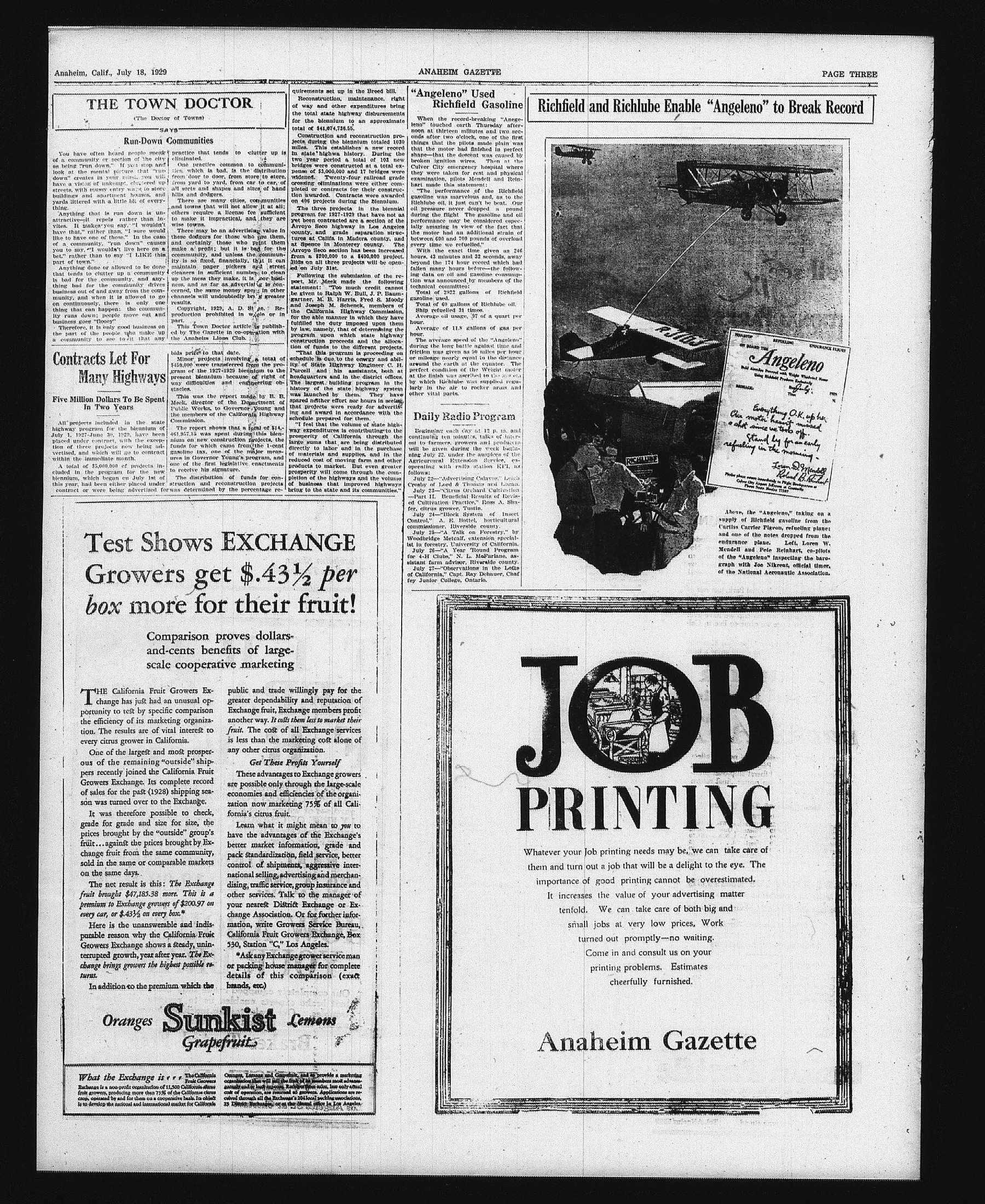
Searchable text
THE TOWN DOCTOR
(The Doctor of Towns)
SAYS
Run-Down Communities
You have often heard people sneak of a community or section of the city as being "run down." If you stop and look at the mental picture that "run down" creates in your mind, you will have a vision of unkempt, cluttered up streets, with messy entry ways to store buildings and apartment houses, and yards littered with a little bit of everything.
Anything that is run down is unattractive—it repels rather than invites. It makes you say: "I wouldn't have that," rather than, "I sure would like to have one of those." In the case of a community, "run down" causes you to say: "I wouldn't live here on a bet," rather than to say "I LIKE this part of town."
Anything done or allowed to be done that tends to clutter up a community is bad for the community, and anything bad for the community drives business out of and away from the community, and when it is allowed to go on continuously, there is only one thing that can happen: the community runs down; people move out and business goes "flooey."
Therefore, it is only good business on the part of the people who make up a community to see to it that any practice that tends to clutter up is eliminated.
One practice common to communities which is bad, is the distribution from door to door, from store to store, from yard to yard, from car to car, of all sorts and shapes and sizes of hand bills and dodgers.
There are many cities, communities and towns that will not allow it at all; others require a license fee sufficient to make it impractical, and they are wise towns.
There may be an advertising value in these dodgers for those who use them, and certainly those who print them make a profit; but it is bad for the community, and unless the community is so fixed, financially, that it can maintain paper pickers and street cleaners in sufficient number to clean up the mess they make, it is poor business, and as far as advertising is concerned, the same money spent in other channels will undoubtedly bring greater results.
Copyright, 1929, A. D. Stone. Reproduction prohibited in whole or in part.
This Town Doctor article is published by The Gazette in co-operation with the Anaheim Lions Club.
Contracts Let For Many Highways
Five Million Dollars To Be Spent In Two Years
All projects included in the state highway program for the biennium of July 1, 1927-June 30, 1929, have been placed under contract, with the exception of three projects now being ad-bids prior to that date.
Minor projects involving a total of $450,000 were transferred from the program of the 1927-1929 biennium to the present biennium because of right of way difficulties and engineering obstacles.
This was the report made by B. B. Meek, director of the Department of Public Works, to Governor Young and the members of the California Highway Commission.
The report shows that a total of $14,-461,957.15 was spent during this biennium on new construction projects, the funds for which came from the 1-cent requirements set up in the area.
Reconstruction, maintenance of way and other expenses the total state highway dollar for the biennium to an total of $41,074,736.55.
Construction and reconstruction projects during the biennium miles. This establishes a in state highwa history. Two year period a total bridges were constructed a pensof $3,000,000 and 17 widened. Twenty-four rail crossing eliminations were pleted or contracts for tha tion awarded. Contracts were on 406 projects during tha t.
Following the submission port, Mr. Meek made the statement: "Too much can be given to Ralph W. Bullgartner, M. B. Harris, Fryand Joseph M. Schenck, the California Highway for the able manner in which fulfilled the duty imposed by law, namely, that of detriment upon which state construction proceeds and tion of funds to the difference."
That this program is pr schedule is due to the curre nity of State Highway Entr Purcell and his assistant headquarters and in the di the largest building progr am history of the state highwa was launched by them. spared neither effort nor how that projects were ready ing and award in accorda tion schedule prepared for them.
"I feel that the volume o f way expenditures is contrib utive prosperity of California to large sums that are being directly to labor and in th
Contracts Let For Many Highways
Five Million Dollars To Be Spent In Two Years
All projects included in the state highway program for the biennium of July 1, 1927-June 30, 1929, have been placed under contract, with the exception of three projects now being advertised, and which will go to contract within the immediate month.
A total of $5,000,000 of projects included in the program for the new biennium, which began on July 1st of this year, had been either placed under contract or were being advertised for minor projects involving a total of $450,000 were transferred from the program of the 1927-1929 biennium to the present biennium because of right of way difficulties and engineering obstacles.
This was the report made by B. B. Meck, director of the Department of Public Works, to Governor Young and the members of the California Highway Commission.
The report shows that a total of $14,461,957.15 was spent during this biennium on new construction projects, the funds for which came from the 1-cent gasoline tax, one of the major measures in Governor Young's program, and one of the first legislative enactments to receive his signature.
The distribution of funds for construction and reconstruction projects was determined by the percentage re-
Test Shows EXCHANGE Growers get $.43½ per box more for their fruit!
Comparison proves dollars-and-cents benefits of large-scale cooperative marketing
THE California Fruit Growers Exchange has just had an unusual opportunity to test by specific comparison the efficiency of its marketing organization. The results are of vital interest to every citrus grower in California.
One of the largest and most prosperous of the remaining "outside" shippers recently joined the California Fruit Growers Exchange. Its complete record of sales for the past (1928) shipping season was turned over to the Exchange.
It was therefore possible to check, grade for grade and size for size, the prices brought by the "outside" group's fruit...against the prices brought by public and trade willingly pay for the greater dependability and reputation of Exchange fruit, Exchange members profit another way. It costs them less to market their fruit. The cost of all Exchange services is less than the marketing cost alone of any other citrus organization.
Get These Profits Yourself
These advantages to Exchange growers are possible only through the large-scale economies and efficiencies of the organization now marketing 75% of all California's citrus fruit.
Learn what it might mean to you to have the advantages of the Exchange's better market information, grade and
of the remaining "outside" shipers recently joined the California Fruit Growers Exchange. Its complete record of sales for the past (1928) shipping season was turned over to the Exchange.
It was therefore possible to check, grade for grade and size for size, the prices brought by the "outside" group's fruit...against the prices brought by Exchange fruit from the same community, sold in the same or comparable markets on the same days.
The net result is this: The Exchange fruit brought $47,185.38 more. This is a premium to Exchange growers of $200.97 on every car, or $.43½ on every box.*
Here is the unanswerable and indisputable reason why the California Fruit Growers Exchange shows a steady, uninterrupted growth, year after year. The Exchange brings growers the highest possible returns.
In addition to the premium which the
Get These Profits Yourself
These advantages to Exchange growers are possible only through the large-scale economies and efficiencies of the organization now marketing 75% of all California's citrus fruit.
Learn what it might mean to you to have the advantages of the Exchange's better market information, grade and pack standardization, field service, better control of shipments, advertising and merchandising, traffic service, group insurance and other services. Talk to the manager of your nearest District Exchange or Exchange Association. Or for further information, write Growers Service Bureau, California Fruit Growers Exchange, Box 530, Station "C," Los Angeles.
*Ask any Exchange grower service man or packing house manager for complete details of this comparison (exact brands, etc.)
Oranges Sunkist Lemons Grapefruit
What the Exchange is The California Fruit Growers Exchange is a non-profit organization of 11,500 California citrus fruit growers, producing more than 75% of the California citrus crop, operated by and for them on a cooperative basis. Its objective is to develop the national and international market for California
Oranges, Lemons and Grapefruit, and to provide a marketing organization that will sell the fruits of its members most advantageously and at least expiring. Recall from sales, less only actual cost of operation, are returned to growers. Applications are received through all the Exchange's 204 local packing associations, 23 Districts Exchanges, or at the Central office in Los Angeles-
quirements set up in the Breed bill.
Reconstruction, maintenance, right of way and other expenditures bring the total state highway disbursements for the biennium to an approximate total of $41,074,736.56.
Construction and reconstruction projects during the biennium totaled 1030 miles. This establishes a new record in state highwa history. During the two year period a total of 103 new bridges were constructed at a total expense of $3,000,000 and 17 bridges were widened. Twenty-four railroad grade crossing eliminations were either completed or contracts for their construction awarded. Contracts were awarded on 406 projects during the biennium.
The three projects in the biennial program for 1927-1929 that have not yet been contracted are a section of the Arroyo Seco highway in Los Angeles county, and grade separation structures at Califa in Madera county, and at Spence in Monterey county. The Arroyo Seco section has been increased from a $200,000 to a $400,000 project. Bids on all three projects will be opened on July 31st.
Following the submission of the report, Mr. Meek made the following statement: "Too much credit cannot be given to Ralph W. Bull, J. P. Baumgartner, M. B. Harris, Fred S. Moody and Joseph M. Schenck, members of the California Highway Commission, for the able manner in which they have fulfilled the duty imposed upon them by law, namely, that of determining the program upon which state highway construction proceeds and the allocation of funds to the different projects."
That this program is proceeding on schedule is due to the energy and ability of State Highway Engineer C. H. Purcell and his assistants, both at headquarters and in the district offices. The largest building program in the history of the state highway system was launched by them. They have spared neither effort nor hours in seeking that projects were ready for advertising and award in accordance with the schedule prepared for them.
"I feel that the volume of state highway expenditures is contributing to the prosperity of California through the large sums that are being distributed directly to labor and in the purchase of requirements set up in the Breed bill.
Reconstruction, maintenance, right of way and other expenditures bring the total state highway disbursements for the biennium to an approximate total of $41,074,736.56.
Construction and reconstruction projects during the biennium totaled 1030 miles. This establishes a new record in state highwa history. During the two year period a total of 103 new bridges were constructed at a total expense of $3,000,000 and 17 bridges were widened. Twenty-four railroad grade crossing eliminations were either completed or contracts for their construction awarded. Contracts were awarded on 406 projects during the biennium.
The three projects in the biennial program for 1927-1929 that have not yet been contracted are a section of the Arroyo Seco highway in Los Angeles county, and grade separation structures at Califa in Madera county, and at Spence in Monterey county. The Arroyo Seco section has been increased from a $200,000 to a $400,000 project. Bids on all three projects will be opened on July 31st.
Following the submission of the report, Mr. Meek made the following statement: "Too much credit cannot be given to Ralph W. Bull, J. P. Baumgartner, M. B. Harris, Fred S. Moody and Joseph M. Schenck, members of the California Highway Commission, for the able manner in which they have fulfilled the duty imposed upon them by law, namely, that of determining the program upon which state highway construction proceeds and the allocation of funds to the different projects."
That this program is proceeding on schedule is due to the energy and ability of State Highway Engineer C. H. Purcell and his assistants, both at headquarters and in the district offices. The largest building program in the history of the state highway system was launched by them. They have spared neither effort nor hours in seeking that projects were ready for advertising and award in accordance with the schedule prepared for them.
"I feel that the volume of state highway expenditures is contributing to the prosperity of California through the large sums that are being distributed directly to labor and in the purchase of requirements set up in the Breed bill.
Reconstruction, maintenance, right of way and other expenditures bring the total state highway disbursement for the biennium to an approximate total of $41,074,736.56.
Construction and reconstruction projects during the biennium totaled 1030 miles. This establishes a new record in state highwa history. During the two year period a total of 103 new bridges were constructed at a total expense of $3,000,000 and 17 bridges were widened. Twenty-four railroad grade crossing eliminations were either completed or contracts for their construction awarded. Contracts were awarded on 406 projects during the biennium.
The three projects in the biennial program for 1927-1929 that have not yet been contracted are a section of the Arroyo Seco highway in Los Angeles county, and grade separation structures at Califa in Madera county, and at Spence in Monterey county. The Arroyo Seco section has been increased from a $200,000 to a $400,000 project. Bids on all three projects will be opened on July 31st.
Following the submission of the report, Mr. Meek made the following statement: "Too much credit cannot be given to Ralph W. Bull, J. P. Baumgartner, M. B. Harris, Fred S. Moody and Joseph M. Schenck, members of the California Highway Commission, for the able manner in which they have fulfilled the duty imposed upon them by law, namely, that of determining the program upon which state highway construction proceeds and the allocation of funds to the different projects."
That this program is proceeding on schedule is due to the energy and ability of State Highway Engineer C. H. Purcell and his assistants, both at headquarters and in the district offices. The largest building program in the history of the state highway system was launched by them. They have spared neither effort nor hours in seeking that projects were ready for advertising and award in accordance with the schedule prepared for them.
"I feel that the volume of state highway expenditures is contributing to the prosperity of California through the large sums that are being distributed directly to labor and in the purchase of requirements set up in the Breed bill.
Reconstruction, maintenance, right of way and other expenditures bring the total state highway disbursement for the biennium to an approximate total of $41,074,736.56.
Construction and reconstruction projects during the biennium totaled 1030 miles. This establishes a new record in state highwa history. During the two year period a total of 103 new bridges were constructed at a total expense of $3,000,000 and 17 bridges were widened. Twenty-four railroad grade crossing eliminations were either completed or contracts for their construction awarded. Contracts were awarded on 406 projects during the biennium.
The three projects in the biennial program for 1927-1929 that have not yet been contracted are a section of the Arroyo Seco highway in Los Angeles county, and grade separation structures at Califa in Madera county, and at Spence in Monterey county. The Arroyo Seco section has been increased from a $200,000 to a $400,000 project. Bids on all three projects will be opened on July 31st.
Following the submission of the report, Mr. Meek made the following statement: "Too much credit cannot be given to Ralph W. Bull, J. P. Baumgartner, M. B. Harris, Fred S. Moody and Joseph M. Schenck, members of the California Highway Commission, for the able manner in which they have fulfilled the duty imposed upon them by law, namely, that of determining the program upon which state highway construction proceeds and the allocation of funds to the different projects."
That this program is proceeding on schedule is due to the energy and ability of State Highway Engineer C. H. Purcell and his assistants, both at headquarters and in the district offices. The largest building program in the history of the state highway system was launched by them. They have spared neither effort nor hours in seeking that projects were ready for advertising and award in accordance with the schedule prepared for them.
"I feel that the volume of state highway expenditures is contributing to the prosperity of California through the large sums that are being distributed directly to labor and in the purchase of requirements set up in the Breed bill.
Reconstruction, maintenance, right of way and other expenditures bring the total state highway disbursement for the biennium to an approximate total of $41,074,736.56.
Construction and reconstruction projects during the biennium totaled 1030 miles. This establishes a new record in state highwa history. During the two year period a total of 103 new bridges were constructed at a total expense of $3,000,000 and 17 bridges were widened. Twenty-four railroad grade crossing eliminations were either completed or contracts for their construction awarded. Contracts were awarded on 406 projects during the biennium.
The three projects in the biennial program for 1927-1929 that have not yet been contracted are a section of the Arroyo Seco highway in Los Angeles county, and grade separation structures at Califa in Madera county, and at Spence in Monterey county. The Arroyo Seco section has been increased from a $200,000 to a $400,000 project. Bids on all three projects will be opened on July 31st.
Following the submission of the report, Mr. Meek made the following statement: "Too much credit cannot be given to Ralph W. Bull, J. P. Baumgartner, M. B. Harris, Fred S. Moody and Joseph M. Schenck, members of the California Highway Commission, for the able manner in which they have fulfilled the duty imposed upon them by law, namely, that of determining the program upon which state highway construction proceeds and the allocation of funds to the different projects."
That this program is proceeding on schedule is due to the energy and ability of State Highway Engineer C. H. Purcell and his assistants, both at headquarters and in the district offices. The largest building program in the history of the state highway system was launched by them. They have spared neither effort nor hours in seeking that projects were ready for advertising and award in accordance with the schedule prepared for them.
"I feel that the volume of state highway expenditures is contributing to the prosperity of California through the large sums that are being distributed directly to labor and in the purchase of requirements set up in the Breed bill.
Reconstruction, maintenance, right of way and other expenditures bring the total state highway disbursement forthe biennium to an approximate totalof$41,074,736.56.
Construction and reconstruction projects duringthe bienniumtotaled1O3Omiiles.这 establishesa newrecordinstatehighwahistory.Duringthetwowearyperioda总计了1O3Omiiles.这 establishesa newrecordinstatehighwahistory.Duringthetwowearyperioda总计了1O3Omiiles.这 establishesa newrecordinstatehighwahistory.Duringthetwowearyperioda总计了1O3Omiiles.这 establishesa newrecordinstatehighwahistory.Duringthetwowearyperioda总计了1O3Omiiles.这 establishesa newrecordinstatehighwahistory.Duringthetwowearyperioda总计了1O3Omiiles."
Daily Radio Program
Beginning each day at 12 p.m. and continuing ten minutes, talks of interest to farmers, growers and producers will be given during the week beginning July 22, under the auspices of the Agricultural Extension Service, cooperating with radio station KI1, as follows:
July 22—"Advertising Calaves," Leigh Crosby of Lord & Thomas and Logan.
July 23—"Citrus Orchard Cultivation—Part II. Beneficial Results of Revised Cultivation Practice," Ross A. Shafer, citrus grower, Tustin.
July 24—"Block System of Insect Control," A. E. Bottel, horticultural commissioner, Riverside county.
July 25—"A Talk on Forestry," by Woodbridge Metcalf, extension specialist in forestry, University of California.
July 26—"A Year Round Program for 4-H Clubs," N. L. McFarlane, assistant farm advisor, Riverside county.
July 27—"Observations in the Lofts of California," Capt. Ray Dehauer, Chafey Junior College, Ontario.
Profits Yourself
to Exchange growers through the large-scale
ciencies of the organiting 75% of all Cali-
night mean to you to
es of the Exchange's
formation, grade and
on, field service, better
ents, aggressive intervertising and merchane, group insurance and
k to the manager of
Exchange or Ex-
. Or for further inforwers Service Bureau,
growers Exchange, Box
Los Angeles.
large grower service man
manager for complete
comparison (exact
Lemons
PRINTI
Whatever your Job printing needs may be, w
them and turn out a job that will be a deligh
importance of good printing cannot be
It increases the value of your advert
tenfold. We can take care of both
small jobs at very low prices,
turned out promptly—no wait
Come in and consult us on y
printing problems. Estima
cheerfully furnished.
Anaheim Ga
Richlube Enable "Angeleno" to Break Record
ON BOARD THE Angeleno
Bold Aluminum Powered with Wright Whirlwind Motor
Using Richfield Products Exclusively
MESSAGE:
Time: 1929 M
Everything O.K. up here.
Our motor hasn't missed
a shot since we took off.
Stand by for an early refueling in the
Angeleno
Build Aluminum Powered with Weight Whirlwind Motor
Using Richfield Products Exclusively
MESSAGE:
Everything O.K. up here.
Our motor hasn't missed
a shot since we took off.
Stand by for an early
refueling in the morning.
Loren D. Mendell
Roland B. Mendell
Pilot please return immediately to Flight Backquarters at
College City Airport Jefferson at Centennial
Phone Santa Monica 71107
Above, the "Angeleno," taking on a supply of Richfield gasoline from the Curtiss Carrier Plgeon, refueling plane; and one of the notes dropped from the endurance plane. Left, Loren W. Mendell and Pete Reinhart, co-pilots of the "Angeleno" inspecting the barograph with Joe Nikrent, official timer, of the National Aeronautic Association.
ING
ing needs may be, we can take care of
that will be a delight to the eye. The
printing cannot be overestimated.
value of your advertising matter
can take care of both big and
very low prices, Work
promptly—no waiting.
and consult us on your
problems. Estimates
meerfully furnished.
Gazette