anaheim-gazette 1929-06-20
Scanned page
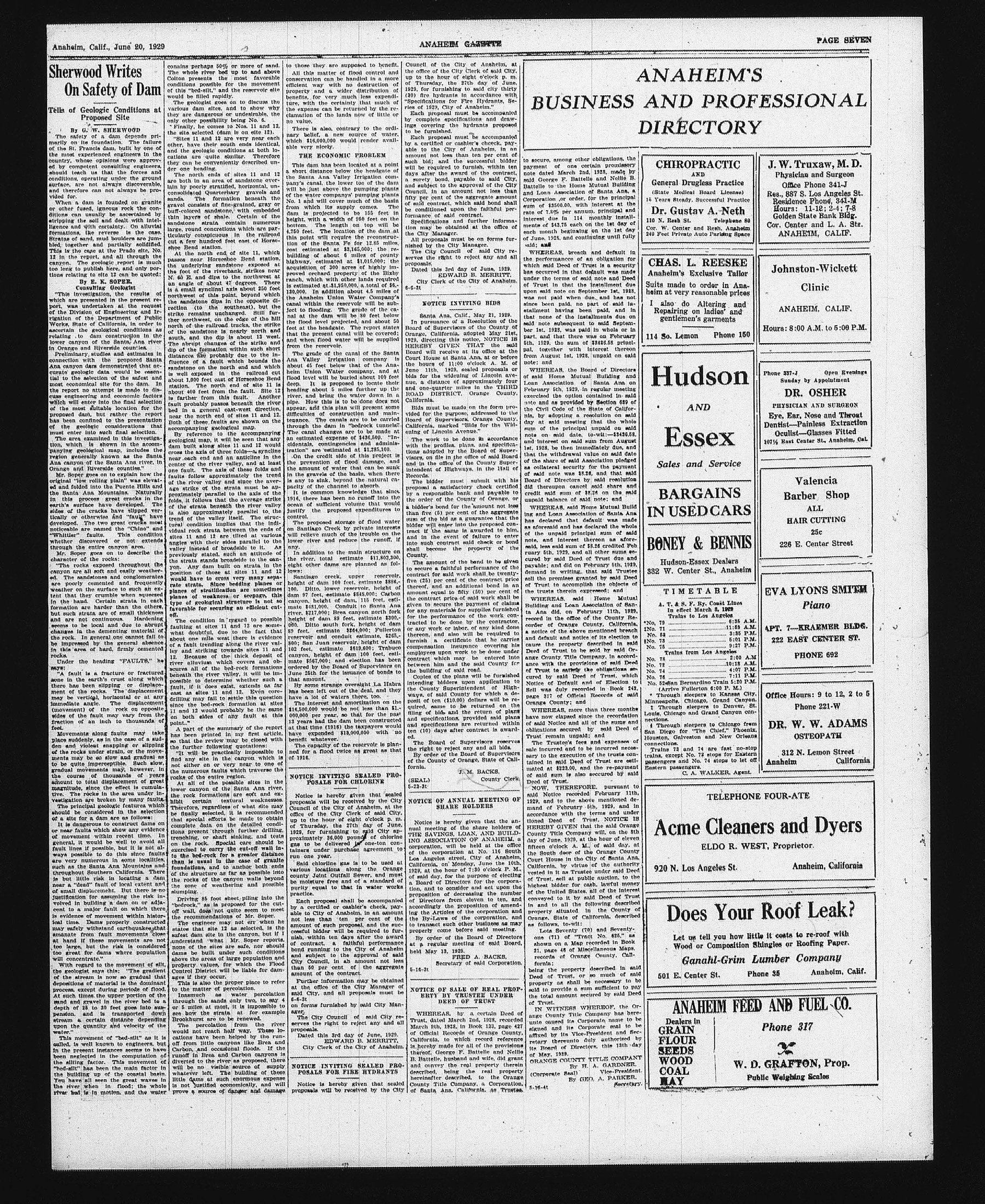
Searchable text
Sherwood Writes On Safety of Dam
Tells of Geologic Conditions at Proposed Site
By G. W. SHERWOOD
The safety of a dam depends primarily on its foundation. The failure of the St. Francis dam, built by one of the most experienced engineers in the country, whose opinions were approved by competent consulting engineers, should teach us that the forces and conditions operating under the ground surface, are not always discoverable, and therefore can not always be provided for.
When a dam is founded on granite or other fused, igneous rock the conditions can usually be ascertained by stripping the soil and dealt with intelligence and with certainty. On alluvial formations, the reverse is the case. Stratites of sand, mud boulders are jumbled together and partially solidified. This is the case at the Prado site, No. 12 in the report, and all through the canyon. The geologic report is much too long to publish here, and only portions relating to site 12 can be quoted:
By E. K. SOPER,
Consulting Geologist
"This investigation, the results of which are presented in the present report, was undertaken at the request of the Division of Engineering and Irrigation of the Department of Public Works, State of California, in order to ascertain the geological conditions as relating to dam construction in the lower canyon of the Santa Ana river in Orange and Riverside counties.
Preliminary studies and estimates in connection with the proposed Santa Ana canyon data demonstrated that accurate geologic data would be essential to the selection of the safest and most economical site for the dam. In the report no attempt is made to discuss engineering and economic factors which will enter into the final selection of the most suitable location for the proposed dam, but rather the report has been confined to the presentation of the geologic considerations that must enter into such final selection.
The area examined in this investigation, which is shown in the accompanying geological map, it will be seen that any dam built along sites 11 and 12 would contain perhaps 50% or more of sand. The whole river bed up to and above Colton presents the most favorable conditions possible for the movement of this "bed-silt," and the reservoir site would be filled rapidly.
The geologist goes on to discuss the various dam sites, and to show why they are dangerous or undesirable, the only other possibility being No. 6.
Finally, he comes to Nos. 11 and 12, the site selected (dam is on site 12).
"Sites 11 and 12 are very near each other, have their south ends identical, and the geologic conditions at both locations are quite similar. Therefore they can be conveniently described under one heading.
The north ends of sites 11 and 12 are both in an area of sandstone overlain by poorly stratified, horizontal, unconsolidated Quarterhary gravels and sands. The formation beneath the gravel consists of fine-grained, gray or buff-colored sandstone, with embedded thin layers of shale. Certain of the sandstone strata contain numerous large, round concretions which are particularly conspicuous in the railroad cut a few hundred feet east of Horse-shoe Bend station.
At the north end of site 11, which passes near Horseshoe Bend station, the underlying sandstone exposed at the foot of the riverbank, strikes near N. 60 E. and dips to the northwest at an angle of about 47 degrees. There is a small synclinal axis about 250 feet northwest of this point, beyond which the sandstone dips in the opposite direction (to the southeast), but the strike remains unchanged. Still further northwest, on the edge of the hill north of the railroad tracks, the strike of the sandstone is nearly north and south, and the dip is about 13 west. The abrupt changes of the strike and dip of the formation within such short distances are probably due to the influence of a fault which bounds the sandstone on the north end and which is well exposed in the railroad cut about 1,000 feet east of Horseshoe Bend station. The north end of site 11 is about 400 feet from the fault. Site 12 is farther from this fault. Another fault probably passes beneath the river bed in a general east-west direction, near the north end of sites 11 and 12. Both of these faults are shown on the accompanying geological map.
By reference to the accompanying geological map, it will be seen that any dam built along sites 11 and 12 would contain perhaps 50% or more of sand. The whole river bed up to and above Colton presents the most favorable conditions possible for the movement of this "bed-silt," and the reservoir site would be filled rapidly.
The geologist goes on to discuss the various dam sites, and to show why they are dangerous or undesirable, the only other possibility being No. 6.
Finally, he comes to Nos. 11 and 12, the site selected (dam is on site 12).
"Sites 11 and 12 are very near each other, have their south ends identical, and the geologic conditions at both locations are quite similar. Therefore they can be conveniently described under one heading.
The north ends of sites 11 and 12 are both in an area of sandstone overlain by poorly stratified, horizontal, unconsolidated Quarterhary gravels and sands. The formation beneath the gravel consists of fine-grained, gray or buff-colored sandstone, with embedded thin layers of shale. Certain of the sandstone strata contain numerous large, round concretions which are particularly conspicuous in the railroad cut a few hundred feet east of Horse-shoe Bend station.
At the north end of site 11, which passes near Horseshoe Bend station, the underlying sandstone exposed at the foot of the riverbank, strikes near N. 60 E. and dips to the northwest at an angle of about 47 degrees. There is a small synclinal axis about 250 feet northwest of this point, beyond which the sandstone dips in the opposite direction (to the southeast), but the strike remains unchanged. Still further northwest, on the edge of the hill north of the railroad tracks, the strike of the sandstone is nearly north and south, and the dip is about 13 west. The abrupt changes of the strike and dip of the formation within such short distances are probably due to the influence of a fault which bounds the sandstone on the north end and which is well exposed in the railroad cut about 1,000 feet east of Horseshoe Bend station. The north end of site 11 is about 400 feet from the fault. Site 12 is farther from this fault. Another fault probably passes beneath the river bed in a general east-west direction, near the north end of sites 11 and 12. Both of these faults are shown on the accompanying geological map.
By reference to the accompanying geological map, it will be seen that any dam built along sites 11 and 12 would contain perhaps 50% or more of sand. The whole river bed up to and above Colton presents the most favorable conditions possible for the movement of this "bed-silt," and the reservoir site would be filled rapidly.
The geologist goes on to discuss the various dam sites, and to show why they are dangerous or undesirable, the only other possibility being No. 6.
Finally, he comes to Nos. 11 and 12, the site selected (dam is on site 12).
"Sites 11 and 12 are very near each other, have their south ends identical, and the geologic conditions at both locations are quite similar. Therefore they can be conveniently described under one heading.
The north ends of sites 11 and 12 are both in an area of sandstone overlain by poorly stratified, horizontal, unconsolidated Quarterhary gravels and sands. The formation beneath the gravel consists of fine-grained, gray or buff-colored sandstone, with embedded thin layers of shale. Certain of the sandstone strata contain numerous large, round concretions which are particularly conspicuous in the railroad cut a few hundred feet east of Horse-shoe Bend station.
At the north end of site 11, which passes near Horseshoe Bend station, the underlying sandstone exposed at the foot of the riverbank, strikes near N. 60 E. and dips to the northwest at an angle of about 47 degrees. There is a small synclonal axis about 250 feet northwest of this point, beyond which the sandstone dips in the opposite direction (to the southeast), but the strike remains unchanged. Still further northwest, on the edge of the hill north of the railroad tracks, the strike of the sandstone is nearly north and south, and the dip is about 13 west. The abrupt changes of the strike and dip of the formation within such short distances are probably due to the influence of a fault which bounds the sandstone on the north end and which is well exposed in the railroad cut about 1,000 feet east of Horseshoe Bend station. The north end of site 11 is about 400 feet from the fault. Site 12 is farther from this fault. Another fault probably passes beneath the river bed in a general east-west direction, near the north end of sites 11 and 12. Both of these faults are shown on the accompanying geological map.
By reference to the accompanying geological map, it will be seen that any dam built along sites 11 and 12 would contain perhaps 50% or more of sand. The whole river bed up to and above Colton presents the most favorable conditions possible forthe movementofthis "bed-silt,"andthe reservoirsitewouldbefilledrapidly.
The geologist goes on to discussthevariousdamsites,andtoshowthemtheyaresupposedtobeinthis matteroffloodcoolconservationcanbehandiedefficientwaywithnodestpropertyanda widerdistrictbenefits,foryermuchlessture,twiththecertainthatistheexpansioncanbereturnedclamationofthelandsnownovalue.
Thereisalsocontrarytonarybelief,anewsourcewhich$16,000,000$wouldremainverynice.
THE ECONOMIC PROJECT
This dam has been locatedbathaminaAnaValleyIrrigationpany's canal,thelower toewillbejustabovethepumpofthewatercompany'spumpNo.1andwillcovermuchoffromwhichits supplycorridonametisprojectedtobeheightwithawidthof950bottom.bottom.Thelengthontothe4,750feet.ThelocationoffthispointwillrequirethecreationoftheSantaFeForkforcostestimatedat$3,$165,$000buildingofabout6mileshighway Estimatedat$1,$000acquisitionof300acresofprovedorchardpropertyofranchwhichwithotherlandisestimatedat$3,$950,$000,a$130,$000.Inadditionabout4TheAnaheimUnionWaterpanywithinthereservoirwifeffectto flooding.Thegradealatthedamwillbe800fthefloodlevelprojected,andfeatattheheadgate.Therolethatpresentcanalswillbewindwhenfloodwaterwillbefromthereservoir.
ThegradeofthecanalofforanaValleyIrrigationcoalfoundation45feetbelowthatonhealmunionWatercompanypanyfloodlevelwillbeburiedabove深。它是 proposed to headheading about5milesfurtherriver,andbringthewinterpipeHowthisistobeadappear,andthisplanwillprovidersifficultiesofconstructiontenance.Thecanalsaretobethroughthedrainin"bedroom.Thecanalchangesaretobearanestimatedexpenseof$433cidentals,contingenciesandtenance.atstaffamountsof$433cidentals。
Preliminary studies and estimates in connection with the proposed Santa Ana canyon data demonstrated that accurate geologic data would be essential to the selection of the safest and most economical site for the dam. In the report no attempt is made to discuss engineering and economic factors which will enter into the final selection of the most suitable location for the proposed dam, but rather the report has been confined to the presentation of the geologic considerations that must enter into such final selection.
The area examined in this investigation, which is shown in the accompanying geological map, includes the region generally known as the Santa Ana canyon of the Santa Ana river, in Orange and Riverside counties."
Mr. Soper goes on to explain how the original "low rolling plain" was elevated and folded into the Puente Hills and the Santa Ana Mountains. Naturally in this process great cracks in the earth's surface have developed. The sides of the cracks have slipped vertically or otherwise and "fault" have developed. The two great cracks most noticeable are named the "Chino" and "Whittler" faults. This condition whether discovered or not extends through the entire canyon area.
Mr. Soper goes on to describe the character of the rocks:
"The rocks exposed throughout the canyon are all soft and easily weathered. The sandstones and conglomerates are poorly cemented and frequently weather on the surface to such an extent that they crumble when squeezed in the hand. Certain strata in each formation are harder than the others, but such strata are of small thickness and are not continuous. Hardening seems to be local and due to abrupt changes in the demeining material of the rock. In general one cannot fail to be impressed by the general absence in this area of hard, firmly cemented rocks.
Under the heading "FAULTS," he says:
"A fault is a fracture or fractured zone in the earth's crust along which there has been slipping or displacement of the rocks. The displacement may be vertical, horizontal or at any immediate angle. The displacement (movement) of the rock on opposite sides of the fault may vary from the fraction of an inch to thousands of feet.
Movements along faults may take place suddenly, as in the case of a sudden and violent snapping or slipping of the rocks under strain, or the movements may be so slow and gradual as to be quite imperceptible. Such slow, gradual movements may, however, in the course of thousands of years amount to total displacement of great magnitude, since the effect is cumulative. The rocks in the area under investigation are broken by many faults.
The principal geologic features which should be considered in the selection of a site for a dam are as follows:
It is dangerous to construct dams on or near faults which show any evidence of movement within recent time. In general, it would be well to avoid all fault lines if possible, but it is not al-
The grade of the canal at Ana Valley Irrigation co., about 45 feet below that on hemlin Union Water company flood level will be buried above deep. It is proposed to be heading about 6 miles further river, and bring the water pipe. How this is to be done appear, and this plan will provide difficulties of construction tenance. The canals are to be through the dam in "bedrock." The canal changes are to be an estimated expense of $430 cidentals, contingencies andtration" are estimated at $120.
On the credit side of this prevention of flood damage the amount of water that can be any to sink, beyond the capacity of the channel to absorb it. It is common knowledge 1916, there has been no runoff ocean of sufficient volume justify the proposed expedient control.
The proposed storage of on Santiago Creek by private will relieve much of the trotower lower river and reduce any.
In addition to the main siver, total estimate eight other dams are planned:
Santiago creek, upper height of dam 100 feet, east 100. Ditto, lower reservoir dam 97 feet, estimate $848,000 canyon, height of dam 115 mate $481,000. Conduit to river, $217,000; Brea canyon height of dam 89 feet, east 000. Ditto south fork, help 89 feet, estimate $284,000 reservoir and conduit esting 800; San Juan reservoir, help 102 feet, estimate $619,600 canyon, height of dam 100 mate $567,000; and election ordered by the Board of Sur June 25th for the issuance that amount.
By some strange oversight has been left out of the design have a lot of waters there.
The interest and amortization $16,500,000 would be not less than 000,000 per year, so that for 13 years had the dam been at that time (1916) the taxpayer have expended $18,000,000 benefit whatever.
The capacity of the reservoir for a flood twice as great of 1916.
NOTICE INVITING SEA POSALS FOR CHLOE
Notice is hereby given proposals will be received Council of the City of Ana office of the City Clerk up to the hour of eight o'clock on Thursday, the 27th day 1829, for furnishing to six proximately 36,000 pounds gas to be delivered in oil trainers under purchase order distances also probably due to the influence of a fault which bounds the sandstone on the north end and which is well exposed in the railroad cut about 1,000 feet east of Horseshoe Bend station. The north end of site 11 is about 400 feet from the fault. Site 12 is further from this fault. Another fault probably passes beneath the river bed in a general east-west direction, near the north end of sites 11 and 12. Both of these faults are shown on the accompanying geological map.
By reference to the accompanying geological map, it will be seen that any dam built along sites 11 and 12 would cross the axis of three folds—a syncline near each end and an anticline in the center of the river valley, and at least one fault. The axis of these folds and faults follow approximately the trend of the river valley and since the average strike of the strata must be approximately parallel to the axis of the folds, it follows that the average strike of the strata beneath the river valley is also approximately parallel to the trend of the valley itself. The structural condition implies that the individual rock strata between the ends of sites 11 and 12 are tilted at various angles with their sides parallel to the valley instead of broadside to it. As previously stated, such an attitude of the strata stands broadside to the canyon. Any dam built on strata in the position of those at sites 11 and 12 would have to cross very many separate strata. Since bedding planes or planes of stratification are sometimes planes of weakness or seepage, this type of geological structure is not so favorable for securing an efficient cut-off.
The condition in regard to possible faulting at sites 11 and 12 are somewhat doubtful, due to the fact that about one mile west there is evidence of a fault trending along the river valley and striking towards sites 11 and 12. Because of the thick deposit of river alluvium which covers and obscures all of the bed-rock formations beneath the river valley, it will be impossible to determine whether such a fault, if it does exist, extends as far east as sites 11 and 12. Even core drilling may fall to settle this question since the bed-rock formation at sites 11 and 12 would probably be the same on both sides of any fault at this point."
A part of the summary of the report has been printed in my first article, so that the review may be closed with further following quotations:
"It will be practically impossible to find any site in the canyon which is not either on or very near to one of the numerous faults which traverse the rocks of the entire region.
At all of the possible sites in the lower canyon of the Santa Ana river, the rock formations are soft and exhibit certain textural weaknesses. Therefore, regardless of what site may be finally selected, it is recommended that special efforts be made to obtain complete data on the detailed conditions present through further drilling, trenching, or shaft sinking, and tests on the rock. Special care should be exercised to carry out cut-off wall in distances also probably due to the influence of a fault which bounds the sandstone on the north end and which is well exposed in the railroad cut about 1,000 feet east of Horseshoe Bend station. The north end of site 11 is about 400 feet from the fault. Site 12 is further from this fault. Another fault probably passes beneath the river bed in a general east-west direction, near the north end of sites 11 and 12. Both of these faults are shown onthe accompanying geological map."
By reference to the accompanying geological map, it will be seen that any dam built along sites 11 and 12 would cross the axis of three folds—a syncline near each end and an anticline in the center of the river valley,and at least one fault. The axis of these folds and faults follow approximatelythe trendoftherivervalleyandsincetheaveragestrikeofthestratamustbeapproximatelyparalleltotheaxisofthefolds.itfollowsthattheaveragestrikeofthestratabeneaththerivervalleyisalsoapproximatelyparalleltothetrendoftherivervalleyitselfollowsallofthefolds.itfollowsthattheaveragestrikeofthestratabeneaththerivervalleyisalsoapproximatelyparalleltothetrendoftherivervalleyitselfollowsallofthefolds.itfollowsthattheaveragestrikeofthestratabeneaththerivervalleyisalsoapproximatelyparalleltothetrendoftherivervalleyitselfollowsallofthefolds.itfollowsthattheaveragestrikeofthestratabeneaththerivervalleyisalsoapproximatelyparalleltothetrendoftherivervalleyitselfollowsallofthefolds.itfollowsthattheaveragestrikeofthestratabeneaththerivervalleyisalsoapproximatelyparalleltothetrendoftherivervalleyitselfollowsallofthefolds.itfollowsthattheaveragestrikeofthestratabeneaththerivervalleyisalsoapproximatelyparalleltothetrendoftherivervalleyitselfollowsallofthefolds.itfollowsthattheaveragestrikeofthestratabeneaththerivervalleyisalsoapproximatelyparalleltothetrendoftherivervalleyitselfollowsallofthefolds.itfollowsthattheaveragestrikeofthestratabeneaththerivervalleyisalsoapproximatelyparalleltothetrendoftherivervalleyitselfollowsallofthefolds.itfollowsthattheaveragestrikeofthestratabeneaththerivervalleyisalsoapproximatelyparalleltothetrendoftherivervalleyitselfollowsallofthefolds.itfollowsthattheaveragestrikeofthestratabeneaththerivervalleyisalsoapproximatelyparalleltothetrendoftherivervalleyitselfollowsallofthefolds.itfollowsthattheaveragestrikeofthestratabeneaththerivervalleyisalsoapproximatelyparalleltothetrendoftherivervalleyitselfollowsallofthefolds.itfollowsthattheaveragestrikeofthestratabeneaththerivervalleyisalsoapproximatelyparalleltothetrendoftherivervalleyitselfollowsallofthefolds.itfollowsthattheaveragestrikeofthestratabeneaththerivervalleyisalsoapproximatelyparalleltothetrendoftherivervalleyitselfollowsallofthefolds.itfollowsthattheaveragestrikeofthestratabeneaththerivervalleyisalsoapproximatelyparalleltothetrendoftherivervalleyitselfollowsallofthefolds.itfollowsthattheaveragestrikeofthestratabeneaththerivervalleyisalsoapproximatelyparalleltothetrendoftherivervalleyitselfollowsallofthefolds.itfollowsthattheaveragestrike ofthestratabeneaththerrivervalleyisalsoapproximatelyparalleltothetrendoftherrivervalleyitselfollowsallofthefolds.itfollowsallofthefolds.itfollowsallofthefolds.itfollowsallofthefolds.itfollowsallofthefolds.itfollowsallofthefolds.itfollowsallofthefolds.itfollowsallofthefolds.itfollowsallofthefolds.itfollowsallofthefolds.itfollowsallofthefolds.itfollowsallofthefolds.itfollowsallofthefolds.itfollowsallofthefolds.itfollowsallofthefolds.itfollowsallotthefolds.itfollowssmallfthesmallfthesmallfthesmallfthesmallfthesmallfthesmallfthesmallfthesmallfthesmallfthesmallfthesmallfthesmallfthesmallfthesmallfthesmallfthesmallfthesmallfthesmallfthesmallfthesmallfthesmallfthesmallfthesmallfthesmallfthesmallfthesmallfthesmallfthesmallfthesmallfthesmallfthesmallfthesmallfthessmallfthesmallfthesmallfthesmallfthesmallfthesmallfthesmallfthesmallfthesmallfthesmallfthesmallfthesmallfthesmallfthesmallfthesmallfthesthissmallfthesthissmallfthesthissmallfthesthissmallfthesthissmallfthesthissmallfthesthissmallfthesthissmallfthesthissmallfthesthissmallfthesthissmallfthesthissmallfthesthissmallfthesthissmallfthesthissmallfthesthissmallfthesthissmallfthesthissmallfthesthissmallfthesthissmallfthesthissmallfthesthissmallFThesthissmallFThesthissmallFThesthissmallFThesthissmallFThesthissmallFThesthissmallFThesthissmallFToresthissmallFToresthissmallFToresthissmallFToresthissmallFToresthissmallFToresthissmallFToresthissmallFToresthissmallFToresthissmallFToresthissmallFToresthissmallFTorest his small FTrest his small FTrest his small FTrest his small FTrest his small FTrest his small FTrest his small FTrest his small FTrest his small FTrest his small FTrest his small FTrest his small FTrest his small FTrest his small FTrest his small FTrest his small FTrest his small FTrest his small FTrest his small FTrest his small FTrest his small FTrest his small FTrest his small FTrest his small FTrest his small FTrest his small FTTrest his small FTrest his small FTrest his small FTrest his small FTrest his small FTrest his small FTrest his small FTrest his small FTrest his small FTrest his small FTrest his small FTrest his small FTrest his small FTrest his small FTrest his small FTrest his small FTrest his small FTrest his small FTrest his small FTrest his small FTrest his small FTrest his small FTrest his small FTrest his small FTT rest his small FTrest his small FTrest his small FTrest his small FTrest his small FTrest his small FTrest his small FTrest his small FTrest his small FTrest his small FTrest hisSmallFT rest his SmallFT rest his SmallFT rest他的SmallFT rest他的SmallFT rest他的SmallFT rest他的SmallFT rest他的SmallFT rest他的SmallFT rest他的SmallFT rest他的SmallFT rest他的SmallFT rest他的SmallFT rest他的SmallFT rest他的SmallFT rest他的SmallFT rest他的SmallFT rest他的SmallFT rest他的SmallFT rest他的SmallFT rest他的SmallFT rest他的SmallFT rest他的SmallFT rest他的SmallFT rest他的SmallFT rest他的SmallFT rest他的SmallFT rest他的SmallFT rest他的SmallFT rest他的SmallFT rest他的SmallFT rest他的SmallFT rest他的SmallFT rest他的SmallFT rest他的SmallFT rest他的SmallFT rest他的SmallFT rest他的SmallFT rest他的SmallFT rest他的SmallFT rest他的SmallFT rest他的SmallFT rest他的SmallFT rest他的SmallFT rest他的SmallFT rest他的SmallFT rest他的SmallFT rest他的SmallFT rest他的SmallFT rest了他的 SmallFT rest了他的 SmallFT rest了他的 SmallTF rest在他的 SmallTF rest在他的 SmallTF rest在他的 SmallTF rest在他的 SmallTF rest在他的 SmallTF rest在他的 SmallTF rest在他的 SmallTF rest在他的 SmallTF rest在他的 SmallTF rest在他的 SmallTF rest在他的 SmallTF rest在他的 SmallTF rest在他的 SmallTF rest在他的 SmallTF rest在他的 SmallTF rest在他的 SmallTF rest在他的 SmallTF rest在他的 SmallTF rest。他的 SmallTF rest和他的 SmallTF rest和他的 SmallTF rest和他的 SmallTF rest和他的 SmallTF rest和他的 SmallTF rest和他的 SmallTF rest和他的 SmallTF rest和他的 SmallTF rest和他的 SmallTF rest和他的 SmallTF rest和他的 SmallTF rest和他的 SmallTF rest和他的 SmallTF rest和他的 SmallTF restart和他的 SmallTF restart和他的 SmallTF restart和他的 SmallTF restart和他的 SmallTF restart和他的 SmallTF restart和他的 SmallTF restart和他的 SmallTF restart和他的 SmallTF restart和他的 SmallTF restart和他的 SmallTF restart和他的 SmallTF restart和他的 SmallTF restart和他的 SmallTF restart和他的 SmallTF restart和他的 SmallTF restart和他的 SmallTF restart和他的 SmallTF restart和他的 SmallTF restart和他的 Small TF restart和他的 Small TF restart和他的 Small TF restart和他的 Small TF restart和他的 Small TF restart和他的 Small TF restart和他的 Small TF restart和他的 Small TF restart和他的 Small TF restart和他的 Small TF restart和他的 Small TF restart和他的 Small TF restart和他的 Small TF restart和他的 Small TF restart和他的 Small TF restart和他的 Small TF restart和他的 Small TF restart和他的 Small TF restart和他的 Small TF restart和他的 Small TF restart和他的 Small TF restart和他的 Small TF restart和他的 Small TF restart和他的 Single TF restart和他的 Single TF restart和他的 Single TF restart和他的 Single TF restart,他的 Single TF restart了他的 Single TF restart了他的 Single TF restart了他的 Single TF restart了他的 Single TF restart了他的 Single TF restart了他的 Single TF restart了他的 Single TF restart了他的 Single TF restart了他的 Single TF restart了他的 Single TF restart了他的 Single TF restart了他的 Single TF restart了他的 Single TF restart了他的 Single TF restart了他的 Single TF restart了他的 Single TF restart了他的 Single TF restart了他的 Single TF restart了他的 Single TF restart了他的 Single TF restart了他的 Single TF restart的 Single TF restart了他的 Single TF restart了他的 Single TF restart了他的 Single TF restart了他的 Single TF restart了他的 Single TF reset。他的 Single TF reset。他的 Single TF reset。他的 Single TF reset。他的 Single TF reset。他的 Single TF reset。他的 Single TF reset。他的 Single TF reset。他的 Single TF reset。他的 Single TF reset。他的 Single TF reset。他的 Single TF reset。他的 Single TF reset。他的 Single TF reset。他的 Single TF reset。他的 Single TF reset。他的 Single TF reset。他的 Single TF reset。他的 Single TF reset。他的 Single TF reset。他的 Single TF reset。他的 Single TF reset。他的 Single TF reset。他的 Single TF reset。他的 Single TF reset的Single TFresetHis singleTFresetHis singleTFresetHis singleTFresetHis singleTFresetHis singleTFresetHis singleTFresetHis singleTFresetHis singleTFresetHis singleTFresetHis singleTFresetHis singleTFresetHis singleTFresetHis singleTFresetHis singleTFresetHis singleTFresetHis singleTFresetHis singleTFresetHis singleTFresetHis singleTFresetHis singleTFresetHis singleTFresetHis singleTFresetHis singleTFresetHis singleTFresetHis singleTfresetHis singleTfresetHis singleTfresetHis singleTfresetHis singleTfresetHis singleTfresetHis singleTfresetHis singleTfresetHis singleTfresetHis singleTfresetHis singleTfresetHis singleTfresetHis singleTfresetHis singleTfresetHis singleTfresetHis singleTfreset His singleTfreset His singleTfreset His singleTfreset His singleTfreset His singleTfreset His singleTfreset His singleTfreset His singleTfreset His singleTfreset His singleTfreset His singleTfreset His singleTfreset His singleTfreset His singleTfreset His singleTfreset His singleTfreset His singleTfreset His singleTfreset His singleTfreset HissingleTfreset HissingleTfreset HissingleTfreset HissingleTfreset HissingleTfreset HissingleTf Reset HissingleTfReset HissingleTfReset HissingleTfReset HissingleTfReset HissingleTfReset HissingleTfReset HissingleTfReset HissingleTfReset HissingleTfReset HissingleTfReset HissingleTfReset HissingleTfReset HissingleTfReset HissingleTfReset Hissingle T fReset Hissingle T fReset Hissingle T fReset Hissingle T fReset Hissingle T fReset Hissingle T fReset Hissingle T fReset Hissingle T fReset Hissingle T fReset Hissingle T fReset Hissingle T fReset Hissingle T fReset Hissingle T fReset Hissingle T fReset Hissingle T fReset Hissingle T fReset Hi single T fReset Hi single T fReset Hi single T fReset Hi single T fReset Hi single T fReset Hi single T fReset Hi single T fReset Hi single T fReset Hi single T fReset Hi single T fReset Hi single T fReset Hi single T fReset Hi single T fReset Hi single T fReset Hi single T fReset Hi single T fReset Hi single T fReset Hi single T fReset Hi single T fReset Hi single T fReset Hi single T fReset Hi single T fReset Hi single T fReset Hi single T fResetHi single T fResetHi single T fResetHi single T fResetHi single T fResetHi single T fResetHi single T fResetHi single T fResetHi single T fResetHi single T fResetHi single T fResetHi single T fResetHi sSingle T fResetHi sSingle T fResetHi sSingle T fResetHi sSingle T fResetHi sSingle T fResetHi sSingle T fResetHi sSingle T fResetHi sSingle T fResetHi sSingle T fResetHi sSingle T fResetHi sSingle T fResetHi sSingle TI resettHi sSingle TI resettHi sSingle TI resettHi sSingle TI resettHi sSingle TI resettHi sSingle TI resettHI sSingle TI resettHI sSingle TI resettHI sSingle TI resettHI sSingle TI resettHI sSingle TI resettHI sSingle TI resettHI sSingle TI resettHI sSingle TI resettHI SSingle TI resettHI SSingle TI resettHI SSingle TI resettHI SSingle TI resettHI SSingle TI resettHI SSingle TI resettHI SSingle TI resettHI SSingle TI resettHI SSingle TI resettHI SSingle TI resettHI SSingle TI resettHI SSingle TI resettHI SI resettHI SI resettHI SI resettHI SI resettHI SI resettHI SI resettHI SI resettHI SI resettHI SI resettHI SI resettHI SI resettHI SI resettHI SI resettHI SI resettHI SI resettHI SI resettHI SI resettHI SI resettHI SI resettHI SI resettHI SI resettHI SI resettHI SI resettHI SI resettHi SI resettHIISI resettHi SI ressettHi SI ressettHi SI ressettHi SI ressettHi SI ressettHi SI ressettHi SI ressettHi SI ressettHi SI ressettHi SI ressettHi SI ressettHi SI ressettHi SI ressettHi SI ressettHi SI ressettHi SI ressettHi SI ressettHi SI ressettHi SI ressettHi SI ressettHi SI ressettHi SI ressettHi Si resettHi Si resettHi Si resettHi Si resettHi Si resettHi Si resettHi Si resettHi Si resettHi Si resettHi Si resettHi Si resettHi Si resettHi Si resettHi Si res settHi Si ResettHi Si ResettHi Si ResetterSi ResetterSi ResetterSi ResetterSi ResetterSi ResetterSi ResetterSi ResetterSi ResetterSi ResetterSi ResetterSi ResetterSi ResetterSi ResetterSi ResetterSi ResetterSi ResetterSi ResetterSi ResetterSi ResetterSi ResetterSi ResetterSi ResetterSi ResetterSi ResetterSi ResetterSi ResetterSi ResetterSi ResetterSi ResetterSi ResetterSi ResetterSI ResetterSI ResetterSI ResetterSI ResetterSI ResetterSI ResetterSI ResetterSI ResetterSI ResetterSI ResetterSI ResetterSI ResetterSI ResetterSI ResetterSI ResetterSI ResetterSI ResetterSI ResetterSI ResetterSI ResetterSI ResellerSI ResellerSI ResellerSI ResellerSI ResellerSI ResellerSI ResellerSI ResellerSI ResellerSI ResellerSI ResellerSI ResellerSI ResellerSI ResellerSI ResellerSI ResellerSI ResellerSI ResellerSI ResellerSI ResellerSI ResellerSI ResellerSI ResellerSI ResellerSI ResverterSI ResetterSI ResutterSi RESetterSi RESetterSi RESetterSi RESetterSi RESetterSi RESetterSi RESetterSi RESletterSi RESetterSi RESletterSi RESletterSi RESletterSi RESletterSi RESletterSi RESletterSi RESletterSi RESletterSi RESletterSi RESletterSi RESletterSi RESletterSi RESletterSi RESletterSi RESletterSi RESletterSi RESletterSi RESletterSIRESletterSIRESletterSIRESletterSIRESletterSIRESletterSIRESletterSIRESletterSIRESletterSIRESletterSIRESletterSIRESletterSIRESletterSIRESletterSIRESletterSIRESletterSIRESletterSIRESletterSIRESletterSIRESletterSIRESletterSIRESletterSIRES letterSIRESletterSIRESletterSIRESletterSIRESletterSIRESletterSIRESletterSIRESletterSIRESletterSIRESletterSIRESletterSIRESletterSIRESletterSIRESletterSIRESletterSIRESletterSIRESletterSIRESletterSIRES letterSIRES letterSIRES letterSIRES letterSIRES letterSIRES letterSIRES letterSIRES letterSIRES letterSIRES letterSIRES letterSIRES letterSIRES letterSIRES letterSIRES letterSIRES letterSIRES letterSIRES letterSIRES letterSIRES letterSIRES letterSIRES letterSIRES letterSIRES letterSIRES letterSIRES letterSIRES letterSIRES letterSIRES letterSIRIES letterSIRIES letterSIRIES letterSIRIES letterSIRIES letterSIRIES letterSIRIES letterSIRIES letterSIRIES letterSIRIES letterSIRIES letterSIRIES letterSIRIES letterSIRIES letterSIRIES letterSIRIES letterSIRIES letterSIRIES letterSIRIES letterSIRIES letterSIRIES letterSIRIES letterSIRIES letterSIRIES letterSIRIES letterSSRIS letters letterSSRIS letters letterSSRIS letters letterSSRIS letters letterSSRIS letters letterSSRIS letters letterSSRIS letters letterSSRIS letters letterSSRIS letters letterSSRIS letters
ments may be so slow and gradual as to be quite imperceptible. Such slow, gradual movements may, however, in the course of thousands of years amount to total displacement of great magnitude, since the effect is cumulative. The rocks in the area under investigation are broken by many faults.
The principal geologic features which should be considered in the selection of a site for a dam are as follows:
It is dangerous to construct dams on or near faults which show any evidence of movement within recent time. In general, it would be well to avoid all fault lines if possible, but it is not always possible to do this since faults are very numerous in some localities, such as the Santa Ana Mountains and throughout Southern California. There is but little risk in locating a dam near a "dead" fault of local extent and of small displacement. But there is no justification for assuming the risk involved in building a dam on or adjacent to a major fault on which there is evidence of movement within historical time. Dams properly constructed may safely withstand earthquakes that amenable from fault movements close at hand if these movements are not too large, but the risk is considered too great for dams where population will concentrate."
With regard to the movement of silt, the geologist says this: "The gradient of the stream is now so gradual that depositions of material is the dominant process, except during periods of flood. At such times the upper portion of the sand and gravel in the river bed to a depth of 25 to 30 feet goes into suspension, and is transported downstream a certain distance depending upon the quantity and velocity of the water."
This movement of "bed-silt" as it is called, is well known to engineers, but in the present instances seems to have been neglected in the computation of the sliding factor. This movement of "bed-silt" has been the main factor in the building up of the coastal basin. You have all seen the great waves in the river when in flood; the whole river bed is in motion, and the water find any site in the canyon which is not either on or very near to one of the numerous faults which traverse the rocks of the entire region.
At all of the possible sites in the lower canyon of the Santa Ana river, the rock formations are soft and exhibit certain textural weaknesses. Therefore, regardless of what site may be finally selected, it is recommended complete data on the detailed conditions present through further drilling, trenching, or shaft sinking, and tests on the rock. Special care should be exercised to carry the cut-off wall into the bed-rock for a greater distance than is usual in the case of granite foundations, and to anchor both ends of the structure as far as possible into the rocks of the canyon walls beyond the zone of weathering and possible slumping.
Driving 85 foot sheet piling into the "bed-rock," as is proposed for the cut-off wall, does not quite seem to meet the recommendations of Mr. Soper.
The engineer may not err when he states that site 12 as selected, is the safest dam site in the canyon, but if I understand what Mr. Soper reports, none of the sites are safe, nor should dams be built under such conditions above the areas of large population and property values, for which the Flood Control District will be liable for damages if they occur.
This is also the proper place to refer to the matter of percolation.
Inasmuch as water percolation through the sands only two, to say 4 or 5 miles at most, it is impossible to see how the strata at for example Brookhurst are to be renewed.
The percolation from the river would not reach half way. These locations have been helped by the runoff from little canyons like Brea and Carbon, and occasional floods. If the runoff in Brea and Carbon canyons is diverted to the river as proposed, there will be no visible source of supply whatever left. The building of these little dams at such enormous expense is not justified economically, and will prove a source of danger and damage.
NOTICE INVITING SEA POSALS FOR CHILDREN
Notice is hereby given by Council of the City of Anaheim, office of the City Clerk on up to the hour of eight o'clock on Thursday, the 27th day of 1929, for furnishing to sew proximately 36,000 pounds gas to be delivered to tailers under purchase and run one year.
Said chlorine gas is to various locations along county Joint Outfall Sewer be moisture free and of a purity equal to that in w practice.
Each proposal shall be by a certified or cashier's able to City of Anaheim, in not less than ten per cent of such proposal, orcessful bidder will be required within ten days after contract, a faithful bond running to the City Council and subject to the approval City Council, in an amount than 50 per cent of the amount of the contract.
Further information may at the office of the City said City, and all proposals on forms furnished by saliager.
The City Council of serves the right to reject proposals.
Dated this 3rd day of Edward B. H.
City Clerk of the City
to those they are supposed to benefit.
All this matter of flood control and conservation can be handled in a more efficient way with no destruction of property and a wider distribution of benefits, for very much less expenditure, with the certainty that much of the expense can be returned by the reclamation of the lands now of little or no value.
There is also, contrary to the ordinary belief, a new source of water, which $16,000,000 would render available very nicely.
THE ECONOMIC PROBLEM
This dam has been located at a point short distance below the headgate of the Santa Ana Valley Irrigation company’s canal, the lower toe of the dam will be just above the pumping plants of the water company’s pumping plants No. 1 and will cover much of the basin from which its supply comes. The dam is projected to be 155 feet in height, with a width of 950 feet on the bottom. The length on top will be 750 feet. The location of the dam at this point will require the reconstruction of the Santa Fe for 12.85 miles, cost estimated at $3,165,000; the rebuilding of about 6 miles of county highway, estimated at $1,015,000; the acquisition of 300 acres of highly improved orchard property of the Bixbyanch, which with other lands required is estimated at $1,950,000, a total of $6,300,000. In addition about 4.5 miles of the Anaheim Union Water Company’s canal within the reservoir will be subject to flooding. The grade of the canal at the dam will be 80 feet below the flood level projected, and about 50 feet at the headgate. The report states that the present canal will be covered; and when flood water will be supplied from the reservoir.
The grade of the canal of the Santa Ana Valley Irrigation company is about 45 feet below that of the Anaheim Union Water company, and at flood level will be buried about 100 feet deep. It is proposed to locate their reading about 5 miles further up the river, and bring the water down in a slope. How this is to be done does not appear, and this plan will present some difficulties of construction and maintenance. The canals are to be carried through the dam in "bedrock tunnels." The canal changes are to be made at an estimated expense of $436,500.
"Insidentials, contingencies and administrations," at $1,285,100.
Council of the City of Anaheim, at the office of the City Clerk of said City, up to the hour of eight o'clock p.m. of Thursday, the 27th day of June, 1929, for furnishing to said city thirty (30) fire hydrants in accordance with "Specifications for Fire Hydrants, Series of 1929, City of Anaheim."
Each proposal must be accompanied by complete specifications and drawings covering the hydrants proposed to be furnished.
Each proposal must be accompanied by a certified or cashier's cheeky payable to the City of Anaheim, in an amount not less than ten per cent of such bid; and the successful bidder will be required to furnish, within ten days after the award of the contract, a surety bond, payable to said City, and subject to the approval of the City Council, in an amount not less than fifty per cent of the aggregate amount of said contract, which said bond shall be conditioned upon the faithful performance of said contract.
Specifications and further information may be obtained at the office of the City Manager.
All proposals must be on forms furnished by the City Manager.
The City Council of said City reserves the right to reject any and all proposals.
Dated this 3rd day of June, 1929.
EDWARD B. MERRITT.
City Clerk of the City of Anaheim.
6-6-3t
NOTICE INVITING BIDS
Santa Ana, Calif., May 21, 1929.
In pursuance of a Resolution of the Board of Supervisors of the County of Orange, California, adopted May 21st, 1929, directing this notice. NOTICE IS HEREBY GIVEN THAT THE said Board will receive at its office at the Court House at Santa Ana, at or before the hours of 11:00 o'clock A.M. of June 11th, 1929, sealed proposals or bids for the widening of Lincoln avenue, a distance of approximately four and one-quarter miles in the THIRD ROAD DISTRICT, Orange County, California.
Bids must be made on the form provided for the purpose addressed to the Board of Supervisors, Orange County, California, marked "Bids for the Widening of Lincoln Avenue."
The work to be done in accordance with the profiles, plans, and specifica-
to secure, among other obligations, the payment of one certain promissory note dated March 2nd, 1929, made by said George F. Battelle and Nellie B. Battelle to the Home Mutual Building and Loan Association of Santa Ana, a Corporation or order, for the principal sum of $3500.00, with interest at the rate of 7.8% per annum, principal and interest due in 114 monthly installments of $43.75 each on the 1st day of June, 1928, and continuing until fully paid;
WHEREAS, breach and default in the performance of an obligation for which said Deed of Trust is a security has occurred in that default was made under the terms of said note and Deed of Trust in that the installment due upon said note on September 1st, 1928, was not paid when due, and has not since been paid, no part of said installation having been paid, and in that none of the installments due on said note subsequent to said September 1st, 1928, was paid in whole or in part, and that there was on February 5th, 1929, the sum of $3490.68 principal together with interest thereon from August 1st, 1928, unpaid on said note; and
WHEREAS, the Board of Directors of said Home Mutual Building and Loan Association of Santa Ana on February 5th, 1929, in regular meeting exercised the option contained in said note and as provided by Section 689 of the Civil Code of the State of California, by adopting a resolution on said day at said meeting that the whole sum of the principal unpaid on said note on said date, to-wit:—$4360.58,and interest on said sum from August 1st,been immediately due,and
The grade of the canal of the Santa Valley Irrigation company is about 45 feet below that of the Anaheim Union Water company, and at flood level will be buried about 100 feet deep. It is proposed to locate their reading about 5 miles further up the river, and bring the water down in a slope. How this is to be done does not appear, and this plan will present some difficulties of construction and maintenance. The canals are to be carried through the dam in "bedrock tunnel." The canal changes are to be made at an estimated expense of $436,500. "Individuals, contingencies and administration" are estimated at $1,285,100.
On the credit side of this project is the prevention of flood damage, and the amount of water that can be sunk on the gravels of the basin, when there is any to sink, beyond the natural capacity of the channel to absorb.
It is common knowledge that since 1916, there has been no runoff into the ocean of sufficient volume that would justify the proposed expenditures to control.
The proposed storage of flood water on Santiago Creek by private interests will relieve much of the trouble on the lower river and reduce the runoff, if any.
In addition to the main structure on the river, total estimate $11,802,300, eight other dams are planned as follows:
Santiago creek, upper reservoir, height of dam 100 feet, estimate $886,-100. Ditto, lower reservoir, height of dam 97 feet, estimate $848,000; Carbon canyon, height of dam, 115 feet, estimate $481,000; Conduit to Santa Ana river, $217,000; Brea canyon north fork height of dam 89 feet, estimate $300,-100. Ditto south fork, height of dam 89 feet, estimate $264,000; Fullerton reservoir and conduit estimate, $265,-800; San Juan reservoir, height of dam 102 feet, estimate $612,600; Trabuco canyon, height of dam 100 feet, estimate $567,000; and election has been ordered by the Board of Supervisors on June 25th for the issuance of bonds to that amount.
By some strange oversight La Habra has been left out of the deal, and they have a lot of waters there, too.
The interest and amortization on the $16,500,000 would be not less than $1,-000,000 per year, so that for the past 13 years had the dam been constructed at that time (1916) the taxpayers would have expended $18,000,000 with no benefit whatever.
The capacity of the reservoir is planned for a flood twice as great as that of 1916.
NOTICE INVITING SEALED PROPOSALS FOR CHLORINE
Notice is hereby given that sealed proposals will be received by the City Council of the City of Anaheim, at the office of the City Clerk of said City, up to the hour of eight o'clock p.m. of Thursday, the 27th day of June, 1929, for furnishing to said City approximately 36,000 pounds of chlorine gas to be delivered in one-ton containers under purchase agreement to
NOTICE OF ANNUAL MEETING OF SHARE HOLDERS
Notice is hereby given that the annual meeting of the share holders of THE SAVINGS, LOAN, AND BUILDING ASSOCIATION OF ANAHEIM, a corporation, will be held at the office Court House at Santa Ana, at or before the hours of 11:00 o'clock A. M. of June 11th, 1929, sealed proposals or bids for the widening of Lincoln avenue, a distance of approximately four and one-quarter miles in the THIRD ROAD DISTRICT, Orange County, California.
Bids must be made on the form provided for the purpose addressed to the Board of Supervisors, Orange County, California, marked "Bids for the Widening of Lincoln Avenue."
The work to be done in accordance with the profiles, plans, and specifications adopted by the Board of Supervisors, on file in the office of said Board and in the office of the County Superintendent of Highways, in the Hall of Records.
The bidder must submit with his proposal a satisfactory check certified by a responsible bank and payable to the order of the County of Orange, or a bidder's bond for the amount not less than five (5) per cent of the aggregate sum of the bid as a guarantee that the bidder will enter into the proposed contract if the same is awarded to him, and in the event of failure to enter into such contract said check or bond shall become the property of the County.
The amount of the bond to be given to secure a faithful performance of the contract for said work shall be twenty-five (25) per cent of the contract price thereof, and an additional bond in an amount equal to fifty (50) per cent of the contract price of said work shall be given to secure the payment of claims for any materials for supplies furnished for the performance of the work contracted to be done by the contractor, or any work or labor, of any kind done thereon, and also will be required to furnish a certificate that he carries compensation insurance covering his employees upon work to be done under contract which may be entered into between him and the said County for the building of said road.
Copies of the plans will be furnished intending bidders upon application to the County Superintendent of Highways, of said County for which a deposit of ten ($10.00) dollars will be required, same to be returned on the filing of bids and the return of plans and specifications, provided said plans and specifications are returned within ten (10) days after contract is awarded.
The Board of Supervisors reserves the right to reject any and all bids.
By order of the Board of Supervisors of the County of Orange, State of California.
J. M. BACKS,
(SEAL)
County Clerk,
5-23-31
NOTICE OF ANNUAL MEETING OF SHARE HOLDERS
Notice is hereby given that the annual meeting of the share holders of THE SAVINGS, LOAN, AND BUILDING ASSOCIATION OF ANAHEIM, a corporation, will be held at the office Court House at Santa Ana, at or before the hours of 11:00 o'clock A. M. of June 11th, 1929, sealed proposals or bids for the widening of Lincoln avenue, a distance of approximately four and one-quarter miles in the THIRD ROAD DISTRICT, Orange County, California.
Bids must be made on the form provided for the purpose addressed to the Board of Supervisors, Orange County, California, marked "Bids for the Widening of Lincoln Avenue."
The work to be done in accordance with the profiles, plans, and specifications adopted by the Board of Supervisors, on file in the office of said Board and in the office of the County Superintendent of Highways, in the Hall of Records.
The bidder must submit with his proposal a satisfactory check certified by a responsible bank and payable to the order of the County of Orange, or a bidder's bond for the amount not less than five (5) per cent of the aggregate sum of the bid as a guarantee that the bidder will enter into the proposed contract if the same is awarded to him, and in the event of failure to enter into such contract said check or bond shall become the property of the County.
The amount of the bond to be given to secure a faithful performance of the contract for said work shall be given to secure the payment of claims for any materials for supplies furnished for the performance of the work contracted to be done by the contractor, or any work or labor, of any kind done thereon, and also will be required to furnish a certificate that he carries compensation insurance covering his employees upon work to be done under contract which may be entered into between him and the said County for the building of said road.
Copies of the plans will be furnished intending bidders upon application to the County Superintendent of Highways, of said County for which a deposit of ten ($10.00) dollars will be required, same to be returned onthe filingofbidsandthereturnofplansandspecificationsprovidedsplansspecificationsarereturnedwithten(10)daysaftercontractisawarded.
The Board of Supervisors reservestherighttorejectanyandallbids.
By orderoftheBoardOfSupervisorsoftheCountyOfOrange.StateOfCalifornia.
J.M.BACKS,
(SEAL)
County Clerk,
5-23-31
NOW THEREFORE,pursuantto said Notice recorded February 11th,1929,andtotheabovementioneddemandofFebruary5th,1929,andinaccordancewiththetermsandunderlionedDeedofTrust.noticeISHEREBYGIVENthatthesaidOrangeCountyTitleCompanywill.onthe8thdayJune1929,thehourofelevenfifteeno'clockA.M.ofsaidday.at
HUCKSON-EAST
382 W. Center
NOTICE INVITING SEALED PROPOSALS FOR CHLORINE
Notice is hereby given that sealed proposals will be received by the City Council of the City of Anaheim, at the office of the City Clerk of said City, up to the hour of eight o'clock p.m. of Thursday, the 27th day of June, 1929, for furnishing to said City approximately 36,000 pounds of chlorine gas to be delivered in one-ton containers under purchase agreement to run one year.
Said chlorine gas is to be used at various locations along the Orange county Joint Outfall Sewer, and must be moisture free and of a standard of purity equal to that in water works practice.
Each proposal shall be accompanied by a certified or cashier's check, payable to City of Anaheim, in an amount not less than ten per cent of the amount of such proposal, and the successful bidder will be required to furnish, within ten days after the award of contract, a faithful performance bond running to the City of Anaheim and subject to the approval of said City Council, in an amount not less than 50 per cent of the aggregate amount of the contract.
Further information may be obtained at the office of the City Manager of said City, and all proposals must be 5-6-3t on forms furnished by said City Manager.
The City Council of said City reserves the right to reject any and all proposals.
Dated this 3rd day of June, 1929.
EDWARD B. MERRITT,
City Clerk of the City of Anaheim.
NOTICE INVITING SEALED PROPOSALS FOR FIRE HYDRANTS
Notice is hereby given that sealed proposals will be received by the City
NOTICE OF ANNUAL MEETING OF SHARE HOLDERS
Notice is hereby given that the annual meeting of the share holders of THE SAVINGS, LOAN, AND BUILDING ASSOCIATION OF ANAHEIM, a corporation, will be held at the corporation at No. 116 South Los Angeles street, City of Anaheim, California, on Monday, June the 10th, 1929, at the hour of 7:30 o'clock P.M., of said day, for the purpose of electing a Board of Directors for the corporation, and to consider and act upon the proposition of decreasing the number of Directors from eleven to ten, and accordingly the proposition of amending the Articles of the corporation and the By-Laws of the corporation, and to transact such other business as may properly come before said meeting.
By order of the Board of Directors at a regular meeting of said Board, held May 13, 1929.
FRED A. BACKS,
Secretary of said Corporation.
5-16-3t
NOTICE OF SALE OF REAL PROPERTY BY TRUSTEE UNDER DEED OF TRUST
WHEREAS, by a certain Deed of Trust, dated March 2nd, 1928, recorded March 9th, 1928, in Book 133, page 427 of Official Records of Orange County, California, to which record reference is hereby made for all of the provisions thereof, George F. Battelle and Nellie B. Battelle, husband and wife, did grant and convey the real property therein described, being the real property hereinafter described, to the Orange County Title Company, a Corporation, of Santa Ana, California, as Trustee.
NOW, THEREFORE, pursuant to said Notice recorded February 11th, 1929, and to the above mentioned demand of February 5th, 1929, and in accordance with the terms and under tioned Deed of Trust, NOTICE IS HEREBY GIVEN that the said Orange County Title Company will, on the 8th day of June, 1929, at the hour of eleven fifteen o'clock A.M., of said day, at the South door of the Orange County Court House in the City of Santa Ana, by virtue of the authority vested in it as Trustee under said Deed of Trust, sell at public auction, to the highest bidder for cash, lawful money of the United States, all of the interest conveyed to it by said Deed of Trust in and to all the following described property situated in the County of Orange, State of California, described as follows, to-wit:
Lots Seventy (70) and Seventy-one (71) of "Tract No. 625," as shown on a Map recorded in Book 21, page 46 of Miscellaneous Maps, records of Orange County, California;
being the property described in said Deed of Trust, or so much of said property as shall be necessary to be sold to provide a sum sufficient to pay the total amount secured by said Deed of Trust.
IN WITNESS WHEREOF, the Orange County Title Company has hereunto caused its Corporate name to be signed and its Corporate seal to be affixed by its Vice-President and Secretary thereunto duly authorized by its Board of Directors, this 13th day of May, 1928.
ORANGE COUNTY TITLE COMPANY
By H. A. GARDNER.
(Corporate Seal)
Vice-President.
By GEO. A. PARKER.
Secretary.
ANAHEIM'S
SS AND PROFESSIONAL
DIRECTORY
CHIROPRACTIC
AND
General Drugless Practice
(State Medical Board License)
15 Years Steady, Successful Practice
Dr. Gustav A. Neth
110 N. Resh St.
Telephone 80
Cor. W. Center and Resh, Anaheim
240 Feet Private Auto Parking Space
J. W. Truxaw, M. D.
Physician and Surgeon
Office Phone 341-J
Res., 887 S. Los Angeles St.
Residence Phoné, 341-M
Hours: 11-12; 2-4; 7-8
Golden State Bank Bldg.
Cor. Center and L. A. Sts.
ANAHEIM, CALIF.
CHAS. L. REESKE
Anaheim's Exclusive Tailor
Suits made to order in Anaheim at very reasonable prices
I also do Altering and
Repairing on ladies' and
gentlemen's garments
114 So. Lemon Phone 150
Johnston-Wickett
Clinic
ANAHEIM, CALIF.
Hours: 8:00 A.M. to 5:00 P.M.
Hudson
AND
Essex
Phone 337-J Open Evenings
Sunday by Appointment
DR. OSHER
PHYSICIAN AND SURGEON
Eye, Ear, Nose and Throat
Dentist—Painless Extraction
Oculist—Glasses Fitted
107½ East Center St., Anaheim, Oal.
Hudson
AND
Essex
Sales and Service
BARGAINS
IN USEDCARS
BONEY & BENNIS
Hudson-Essex Dealers
382 W. Center St., Anaheim
TIMETABLE
A. T. & S. F. Ry. Coast Lines
In effect March 8, 1929
Trains to Los Angeles
*No. 79 ... 6:35 A.M.
$No. 71 ... 11:59 A.M.
No. 52 ... 3:35 P.M.
$No. 73 ... 5:01 P.M.
No. 75 ... 9:27 P.M.
Trains from Los Angeles
No. 78 ... 2:00 A.M.
No. 72 ... 10:18 A.M.
No. 74 ... 4:07 P.M.
No. 76 ... 7:11 P.M.
No. 52 San Bernardino Train 5:20 P.M.
(Arrive Fullerton 6:00 P.M.)
* Through sleepers to Kansas City,
Minneapolis, Chicago, Grand Canyon.
* Through sleepers to Denver, St.
Louis, Chicago and Grand Canyon connections.
* Through sleepers to Chicago from San Diego for "The Chief," Phoenix,
Houston, Galveston and New Orleans connections.
Trains 73 and 74 are fast no-stop trains, except No. 72 stops for Eastern passengers and No. 74 stops to let off Eastern passengers.
C. A. WALKER, Agent.
Phone 337-J Open Evenings
Sunday by Appointment
DR. OSHER
PHYSICIAN AND SURGEON
Eye, Ear, Nose and Throat
Dentist—Painless Extraction
Ocullus—Glasses Fitted
107½ East Center St., Anaheim, Cal.
Valencia
Barber Shop
ALL
HAIR CUTTING
25¢
226 E. Center Street
EVA LYONS SMITH
Piano
APT. 7—KRAEMER BLDG.
222 EAST CENTER ST.
PHONE 692
Office Hours: 9 to 12, 2 to 5
Phone 221-W
DR. W. W. ADAMS
OSTEOPATH
312 N. Lemon Street
Anaheim California
TELEPHONE FOUR-ATE
Acme Cleaners and Dyers
ELDO R. WEST, Proprietor.
TELEPHONE FOUR-ATE
Acme Cleaners and Dyers
ELDO R. WEST, Proprietor.
920 N. Los Angeles St. Anaheim, California
Does Your Roof Leak?
Let us tell you how little it costs to re-roof with
Wood or Composition Shingles or Roofing Paper.
Ganahl-Grim Lumber Company
501 E. Center St. Phone 35 Anaheim, Calif.
ANAHEIM FEED AND FUEL CO.
Dealers in
GRAIN
FLOUR
SEEDS
WOOD
COAL
MAY
Phone 317
W. D. GRAFTON, Prop.
Public Weighing Scales