anaheim-gazette 1929-06-20
Scanned page
Searchable text
THE ANAHEIM GAZETTE
ESTABLISHED 1870
HENRY KUCHEL, Editor and Priprietor.
ISSUED EVERY THURSDAY
SUBSCRIPTION PER YEAR.....$1.50
SLX MONTHS.....1.00
Entered at the Anahiem, California, Postoffice as second-class matter.
ANTI-PROTECTION SOPHISTRIES
Opponents of the protective policy are not now strong enough in this country to make a frontal attack on the principle of protection. This has become the settled policy of the country, and during the last campaign the old arguments against protection were not heard from any quarter.
Anti-protectionists therefore limit themselves to attacks upon the schedules of any protective tariff bill introduced. They deal in wild generalizations about excessive rates and "robber" schedules which they assert will increase the cost of living. They tell how much the proposed new tariff will cost by the sophistical expedient of adding the rates to the prices of all commodities consumed in the United States. Experience has proved that importers do not sell what they buy abroad on the basis of cost to them. They merely undersell the domestic producer enough to take the American market, and by the time the article has reached the ultimate consumer the price of the foreign article is equal to that of the article made in America. If thus given the opportunity to cripple or destroy domestic production, the price of the foreign article is raised to new heights, as was illustrated in the case of certain grades of women's gloves when an adequate tariff was refused by this government and American factories were compelled to "shut up shop."
The test of the justification of any tariff rate is whether it more than measures the difference in the cost of labor entering into the production of the article at home and abroad. You prob-
They merely undersell the domestic producer enough to take the American market, and by the time the article has reached the ultimate consumer the price of the foreign article is equal to that of the article made in America. If thus given the opportunity to cripple or destroy domestic production, the price of the foreign article is raised to new heights, as was illustrated in the case of certain grades of women's gloves when an adequate tariff was refused by this government and American factories were compelled to "shut up shop."
The test of the justification of any tariff rate is whether it more than measures the difference in the cost of labor entering into the production of the article at home and abroad. You probably have noticed that no such analysis is attempted by critics of the pending tariff bill. Does the proposed tariff on sugar more than represent the difference in cost of labor between the Cuban peon and the American beet sugar raiser or factory worker? This is the essential problem involved, but it is never discussed by the imaginative politicians who would prefer peon-made sugar to sugar grown and manufactured by Americans enjoying the American standard of wages and living.
The American people will be and should be guided in their consideration of tariff schedules not by the wishes of foreign employers who attain cheapness of production by cheapening the worker, by importers who contribute nothing to our industrial upbuilding, by international investors who seek to bring about world-wide economic communism, but by the just interests of the American people. The demand for a protective tariff is based upon the difference between American and foreign wages and standards of living. It can be protected only by tariff schedules measuring the difference in labor costs at home and abroad. Let it be shown that the proposed tariff schedules violate this principle and the American people will agree that a "robber tariff" is in sight. Those who care to take the time to read the House hearings on the tariff will realize that this principle has been kept steadily in mind in adjusting the tariff, and that in many instances the full bridging of this gap has not been asked or received by American producers.
RESISTANCE TO THE MAJORITY
Less than eight months ago Herbert Hoover was elected President by an overwhelming plurality. His election represented a vote of confidence in his leadership, and a popular mandate for the program he stood for.
Yet within four months of President Hoover's inauguration we find a tremendous resistance developed on Capitol Hill—especially in the Senate of the United States—to the carrying out of his program, and an organized effort to resist and discredit his leadership; an effort to render barren of results the session of Congress called for the purpose of fulfilling the pledges of the majority party to the voters.
At the bottom of this resistance is a studied defiance of public opinion as expressed at the last general election. It is a deliberate flouting of the will of the American people, clearly expressed at the polls.
It is true that the executive department of the government is not the legislative department. But the President is made a partner in legislation through the veto power. It was well known by the Senators who thrust the debenture provision into the farm relief bill that in so doing they were deadlocking the Senate with the House of Representatives and with the President. They very well knew that the adoption of this amendment meant the delay or defeat of farm relief. The proposal was a new one not discussed by anyone in the last campaign. It is certain that some
At the bottom of this resistance is a studied defiance of public opinion as expressed at the last general election. It is a deliberate flouting of the will of the American people, clearly expressed at the polls.
It is true that the executive department of the government is not the legislative department. But the President is made a partner in legislation through the veto power. It was well known by the Senators who thrust the debenture provision into the farm relief bill that in so doing they were deadlocking the Senate with the House of Representatives and with the President. They very well knew that the adoption of this amendment meant the delay or defeat of farm relief. The proposal was a new one not discussed by anyone in the last campaign. It is certain that some members of the Senate adopted this policy of opposition merely to embarass the President and the administration. It was Senator Coneland of New York who frankly admitted that he "held his nose" as he voted for a proposal he believed would put President Hoover "in the hole."
Putting Presidents "in the hole" may be a safe policy when that President does not have public opinion behind him. The people are still with President Hoover, however, and those who are busy baiting the President are at the same time baiting that public opinion which makes and unmakes Senators as well as Presidents.
It is unfortunate that at this time we cannot have co-operation between the Senate and the President for the general good of the country. The fault for that lack of team work clearly rests however, not with the President, but with a partisan and factional coalition in the Senate. It is about time that statesmen, no matter what labels they wear, should co-operate to solve public problems, rather than to spectacularly perform for factional, personal and partisan advantage.*
FAIR MONEY
Alfred E. Smith is quietly but effectively solving the problem of what to do with presidential ex-candidates. According to our current best information and belief, Mr. Smith is making approximately $5,000 a day—i.e., he is dictating 5,000 words daily on a book for which he will be paid $1 a word. His literary activities, like those of Mr. Calvin Coolidge, throw a light on the money there is to be made in the best-seller industry—money which compares favorably with that available in the movie industry, in Wall Street, or in such lucrative professions as those of batting home runs or punching imported heavyweights at specified times and places.
Financially, this remains pre-eminently a land of opportunity even for gentlemen who aren't elected.
Flood Control and Water Conservation
Especially As To the Effect the Proposed Plans Will Have on the Two Water Companies
By G. W. SHERWOOD
Mr. Bailey, in his answer to my third article on the engineering features of the project, complains that he does not find my name in the membership of the American Society of Civil Engineers. If he will look back to the year in which he was born, he will find my name on the membership roll of old society, and a little research will develop the fact that my application was signed by Mr. L. F. Rovee, now one of the most prominent railroad figures in this country; and by Thomas Rodd, then chief engineer of the Pennsylvania Company, under whose tutelage I learned to separate facts from fiction. That I chose to withdraw, when I retired from the profession, is my own business, and no concern of his.
That he may make no more mistakes of the kind, I will also tell him that I have served in positions on the New York Central R. R., the Pennsylvania Co., the Louisville and Nashville R. R., the Nicaragua Canal Cons. Co., and in the Engineering College of Lehigh University, etc., etc. I must plead guilty, however, to non-membership in the Orange County society.
Now if Mr. Bailey will set forth his experience and achievements, and tell how it happened he was sent down here to make the survey of this dinky little river, when his great talents should have been in demand upon greater if not more important work. His work here has not been impressive. The geologist picked out the site; the three helped him on his plans; the Santa Fe engineer located the railroad, giving him plenty of time to address ladies clubs and draw his salary. If he had performed any notable service on any public work in this state, I should have heard of it.
What I want of him is the answer put up to the three, and what exactly did they approve?
This catechism might be continued indefinitely, but space forbids.
If he passes this examination it can be continued. Let him take notice, however, that the voters demand some better answer than laudation of himself and his three confesses, or abuse of the writer. They are in great danger of physical and financial disaster.
EUROPE PROTESTS
Reports from Europe indicate considerable alarm over the effect of the new tariff bill. Rene Duchentin, president of the General Federation of French production and Etienne Fougere, president of the National Association for Economic Expansion, in a joint letter to La Journée Industrielle warn that the present policy of the United States will lead to reprisals. "Is it by this process," which calls inevitably for reprisals that peace is to be consolidated?" they ask.
That same journal editorially asserts that more than $800,000,000 francs worth of French imports are adversely affected by the new American tariff.
"Belglum, Spain, Germany, Great Britain, Czecho-Slovakia, all friends of America, have seen fit to protest."
They (the Americans) wish to reserve their own markets for themselves so as to avoid the threatened dangers of overproduction.
From Geneva correspondents comes a similar report. "All the Swiss trade papers declare that these industries, which regard America as one of their best customers, consider the export trade there will be practically killed by such a tariff and demand reprisals by the Swiss Federal Government, especially against the importation of American motor cars."
Looking at the new tariff bill and our general traffice policy these European protestants would undoubtedly admit that it is a national benefit. Looking at the matter from the standpoint of world citizenship the policy, we freely admit, is not so good. Self-preservation, however, is the first law of nature and Europe is the place where the lesson has been taught. Japan learned it from Europe and followed closely the European pattern for preservation through militarism. America more progressively, has recognized the greater advantage of economic bullwarks.
Sanitation In The Poultry Yard
Care exercised in keeping poultry yards clean and in sanitary condition has a double function in keeping the flock clear of parasites that underline the health and sap the vigor of the birds. The injury by mites, lice fleas and other parasitic organisms is sometimes obvious, but it also happens that some insects and other small creatures, are carriers of intermediate hosts of some of the internal parasites of poultry.
For example, according to specialists in the United States Department of Agriculture, one variety of roundworm must develop for one stage of its life outside the poultry it affects. The roundworms lays its eggs within the chicken and they are eliminated in the droppings. They will not mature if picked up by a fowl. They do mature if a water flea picks up the eggs. Then if a hen takes in the water flea with her drinking water—the roundworm parasite of the flea develops into a poultry parasite.
Many similar examples are known, and others are suspected. The grasshopper, for instance, has recently been shown to transmit at least one important parasite of domestic poultry.
Sanitation and cleanliness which prevents such insects from having access to the droppings may thus break a cycle through which infestation reaches the flock. The insects in them selves may not be harmful to poultry, but if they have had an opportunity to feed on contaminated droppings they may be the means of spreading those particular parasites.
experience and achievements, and tell how it happened he was sent down here to make the survey of this dinky little river, when his great talents should have been in demand upon greater if not more important work. His work here has not been impressive. The geologist picked out the site; the three helped him on his plans; the Santa Fe engineer located the railroad, giving him plenty of time to address ladies clubs and draw his salary. If he had performed any notable service on any public work in this state, I should have heard of it.
What I want of him is the answer to specific questions, not a catalogue of dams that are asserted to have been built thus and so, under very different conditions. The Santa Ana is in a class by itself, and conditions elsewhere will have no bearing here. What he says of the Gatum (Panama) dam. I happen to know is incorrect. Perhaps he knows as little about the others. An earth dam 60 or 70 feet high is quite a different proposition from one 155 feet in height. One built of good gravel and clay material with a properly puddled core wall, is something different from one built of pure sand faced with a thin wall of concrete reining on the face of the dam. If he can tell me the location of any dam built in this manner of pure sand, 155 feet high, I will make a pilgrimage to view it and thereafter forever relapse into silence.
I will not here discuss the impossibility of pumping sand and gravel to such a height. This material is most difficult to move in this manner of any. It would wear out the pipes and pumps in no time at all, and require enormous power. To state that this material can be handled cheaply in this manner be tokens a lack of experience that is fantastic.
The flood of 1916 is the basis for all these calculations of dam height, acre feet and the like, and is entirely incorrect. What happened is this: Beginning at Colton the old wooden ramshackle bridges, mostly on narrow pile slants, clogged up with debris and giving way under the weight went out. The wreckage then washed down to the next bridge formed a dam and forced it out. This was repeated with every bridge. At the last bridge, at the head of the canyon, there must have been a tremendous amount of wreckage. Rushing on down the river was probably dammed again at Scully's Point. Thus it appears that the high water marks were due to the volume of water backed up by the temporary dams and not by the natural volume of the flood.
Any calculations based on the use of the high water marks would be greatly erroneous. The velocity could not be measured and any computation made was only a wild guess. The water level must have subsided within an hour to the level which it maintained, when we first reached the scene a day or two later. The water was going down then in great waves, and the onward movement of the "bed-silt" was enormous, and this movement continued for several weeks in considerable volume.
All the bridges have been replaced by trade there will be practically killed by such a tariff and demand reprisals by the Swiss Federal Government, especially against the importation of American motor cars."
Looking at the new tariff bill and our general traffi policy these European protestants would undoubtedly admit that it is a national benefit. Looking at the matter from the standpoint of world citizenship the policy, we freely admit, is not so good. Self-shown to transmit at least one important parasite of domestic poultry.
Sanitation and cleanliness which prevents such insects from having access to the droppings may thus break a cycle through which infestation reaches the flock. The insects in them selves may not be harmful to poultry, but if they have had an opportunity to feed on contaminated droppings they may be the means of spreading those particular parasites.
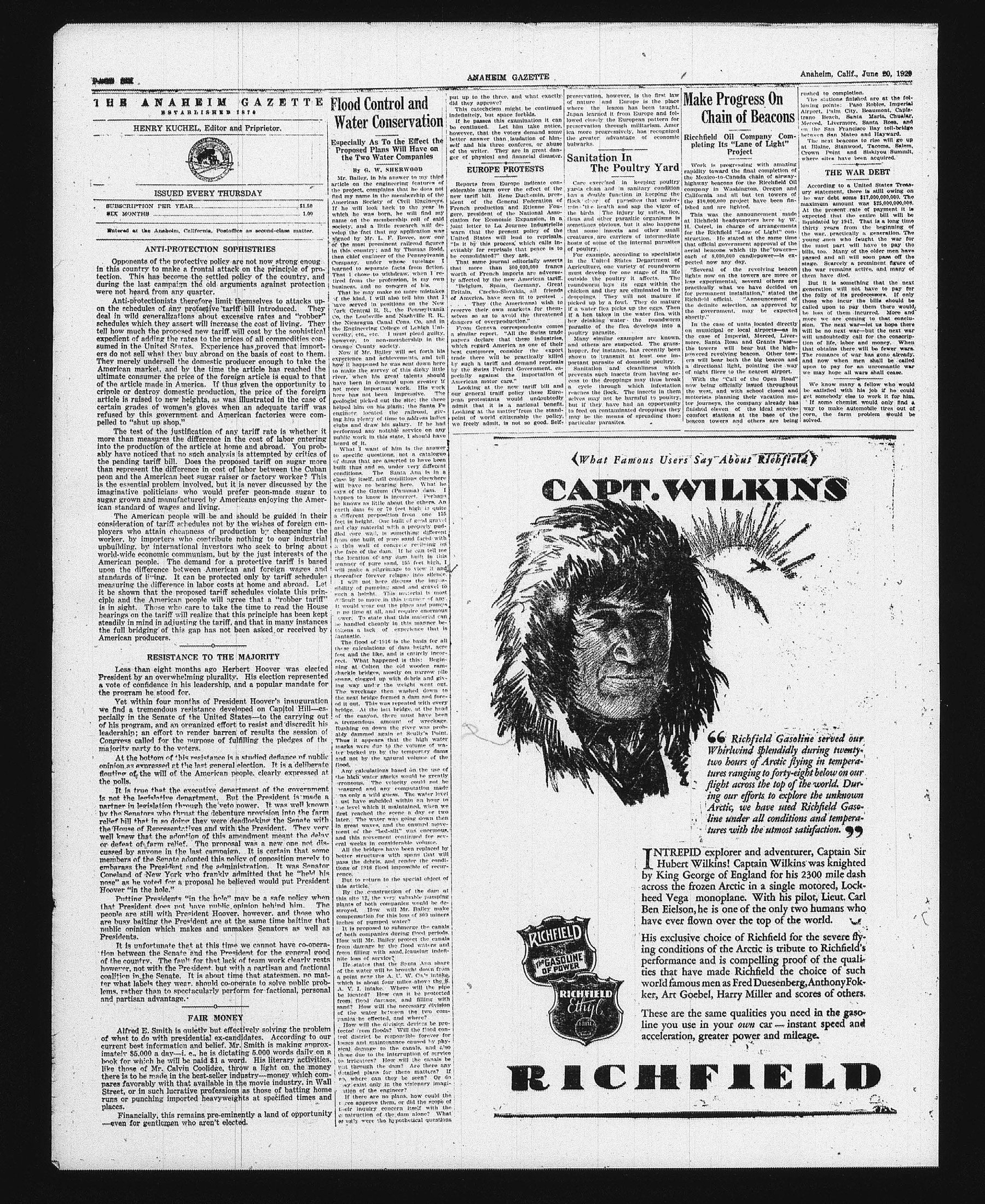
<What Famous Users S
CAPT.W
Any calculations based on the use of high water marks would be greatly erroneous. The velocity could not be measured and any computation made was only a wild guess. The water level must have subsided within an hour to the level which it maintained, when we first reached the scene a day or two later. The water was going down then in great waves, and the onward movement of the "bed-silt" was enormous and this movement continued for several weeks in considerable volume.
All the bridges have been replaced by better structures with spans that will pass the debris, and render the conditions of 1916 flood impossible of recurrence.
But to return to the special object of this article.
By the construction of the dam at this site 12, the very valuable pumping plants of both companies would be destroyed. How will Mr. Bailey make compensation for this loss of 800 miners inches of pumped water?
It is proposed to submerge the canals of both companies during flood periods. How will Mr. Bailey protect the canals from damage by the flood waters and from filling with sand, causing indefinite loss of service?
He states that the Santa Ana share of the water will be brought down from a point near the A. U. W. Co.'s intake, which is about four miles above the S. A. V. I. intake. Where will the pipe be located? How can it be protected from flood damage, and filling with sand? How will the necessary division of the water between the two companies be effected, and where?
How will the division devices be protected from floods? Will the flood control district be responsible forever for losses and maintenance caused by physical damage to the canals, and also those due to the interruption of service to irrigators? How will the canals be put through the dam? Are there any detailed plans for these matters? If so, where can they be seen? Or do they exist only in the visionary imagination of the engineer?
If there are no plans, how could the three approve them, or did the scope of their inquiry concern itself with the construction of the dam alone? What equally were the hypothetical questions
Anaheim, Calif., June 20, 1920
Make Progress On Chain of Beacons
Ricchfield Oil Company Completing Its "Lane of Light" Project
Work is progressing with amazing rapidity toward the final completion of the Mexico-to-Canada chain of airway-highway beacons for the Ricchfield Oil company in Washington, Oregon and California and all but ten towers of the $10,000,000 project have been finished and are lighted.
This was the announcement made at Richfield headquarters here by W. H. Cotrel, in charge of arrangements for the Ricchfield "Lane of Light" construction. He stated at the same time that official government approval of the aerial beacons which tip the towers—each of 8,000,000 candlepower—is expected now any day.
Several of the revolving beacon lights now on the towers are more or less experimental, several others are practically what we have decided on for permanent installation," stated the Richfield official.
"Announcement of the definite selection, as approved by the government, may be expected shortly."
In the case of units located directly on municipal or local airports—as in the case of Imperial, Merced, Livermore, Santa Rosa and Grants Pass—the towers will bear but the high-powered revolving beacon. Other towers will bear both the big beacon and a directional light, pointing the way of night filers to the nearest airport.
With the "Call of the Open Road" now being officially issued throughout the west, and with school closed and motorists planning their vacation motor journeys, the company already has finished eleven of the ideal service-comfort stations at the base of the beacon towers and others are being rushed to completion.
The stations finished are at the following points: Paso Robles, Imperial Airport, Palm City, Beaumont, Capistrano Beach, Santa Maria, Chualar, Merced, Livermore, Santa Rosa, and on the San Francisco Bay toll-bridge between San Mateo and Hayward.
The next beacons to rise will go up at Blaine, Stanwood, Tacoma, Salem, Crown Point and Siskiyou Summit, where sites have been acquired.
THE WAR DEBT
According to a United States Treasury statement, there is still owing on the war debt some $17,000,000,000. The maximum amount was $25,000,000,000. At the present rate of payment it is expected that the entire bill will be liquidated by 1947. That is a long time thirty years from the beginning of the war, practically a generation. The young men who feight the war for the most part will have to pay the bills, too. Many of the older men have passed and all will soon pass off the stage. Scarcely a prominent figure of the war remains active, and many of them have died.
But it is something that the next generation will not have to pay for the folly of its predecessors. If only those who incur the bills should be called upon to pay them there would be less of them incurred. More and more we are coming to that conclusion.
The next war—let us hope there will be no next war—but the next war will undoubtedly call for the consecription of life, labor and money. When that obtains there will be fewer wars. The romance of war has gone already, and now when men shall be called upon to pay for an unromantic war we may hope all wars shall cease.
We know many a fellow who would be satisfied with his job if he could get somebody else to work it for him. If some chemist would only find a way to make automobile tires out of corn, the farm problem would be solved.
Famous Users Say About Richfield
PT. WILKINS
66 Richfield Gasoline served our Whirlwind splendidly during twenty-two hours of Arctic flying in temperatures ranging to forty-eight below on our flight across the top of the world. During our efforts to explore the unknown Arctic, we have used Richfield Gasoline under all conditions and temperatures with the utmost satisfaction.
INTREPID explorer and adventurer, Captain Sir Hubert Wilkins! Captain Wilkins was knighted by King George of England for his 2300 mile dash across the frozen Arctic in a single motored, Lockheed Vega monoplane. With his pilot, Lieut. Carl Ben Eielson, he is one of the only two humans who have ever flown over the top of the world.
His exclusive choice of Richfield for the severe flying conditions of the Arctic is tribute to Richfield's performance and is compelling proof of the qualities that have made Richfield the choice of such world famous men as Fred Duesenberg, Anthony Fokker, Art Goebel, Harry Miller and scores of others.
These are the same qualities you need in the gasoline you use in your own car — instant speed and acceleration, greater power and mileage.