anaheim-gazette 1929-06-06
Scanned page
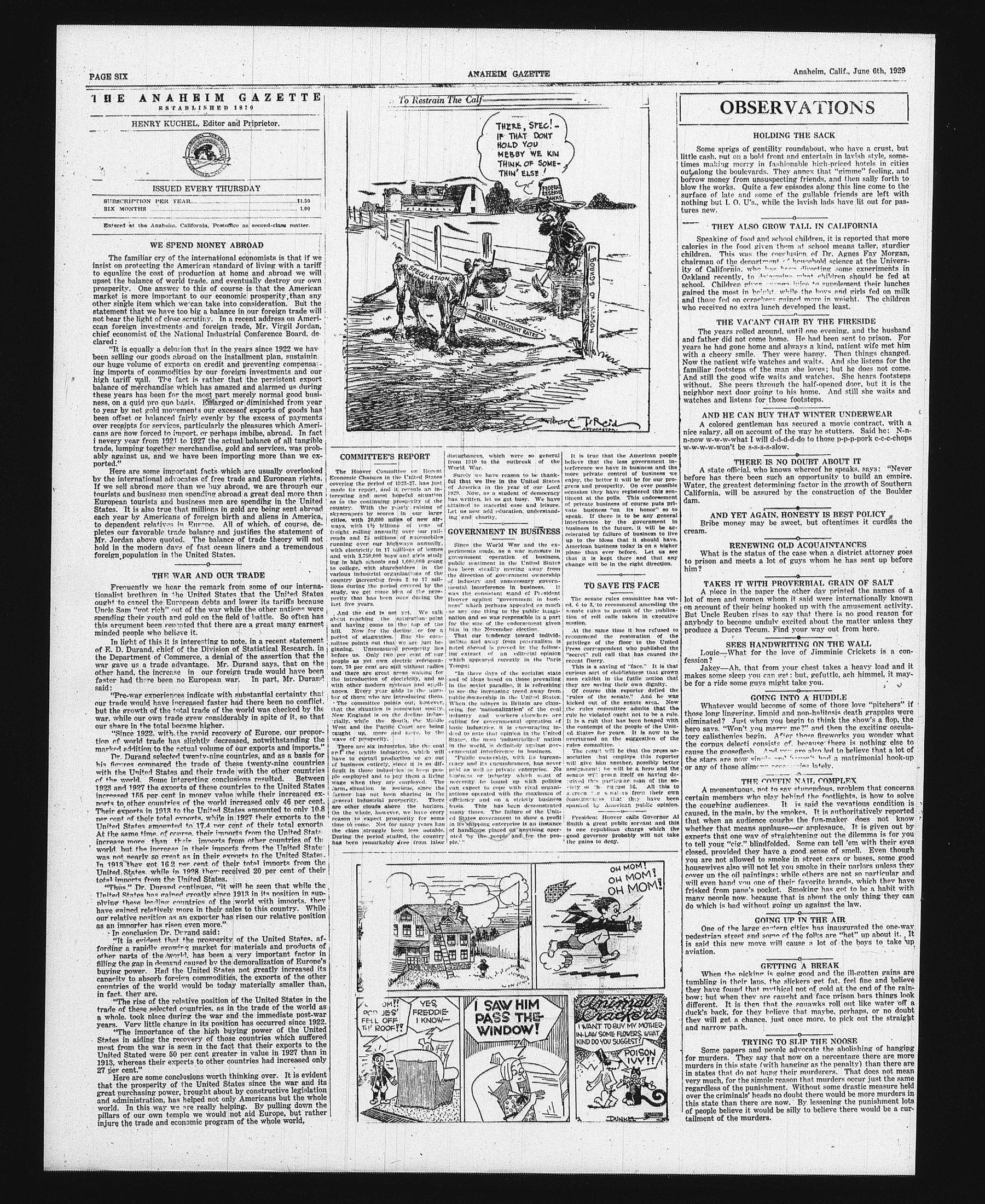
Searchable text
THE ANAHEIM GAZETTE
ESTABLISHED 1870
HENRY KUCHEL, Editor and Priprietor.
ISSUED EVERY THURSDAY
SUBSCRIPT PER YEAR.....$1.50
SIX MONTHS.....1.00
Entered at the Anaholm, California, Postoffice as second-class matter.
WE SPEND MONEY ABROAD
The familiar cry of the international economists is that if we insist on protecting the American standard of living with a tariff to equalize the cost of production at home and abroad we will upset the balance of world trade, and eventually destroy our own prosperity. One answer to this of course is that the American market is more important to our economic prosperity than any other single item which we can take into consideration. But the statement that we have too big a balance in our foreign trade will not bear the light of close scrutiny. In a recent address on American foreign investments and foreign trade, Mr. Virgil Jordan, chief economist of the National Industrial Conference Board, declared:
"It is equally a delusion that in the years since 1922 we have been selling our goods abroad on the installment plan, sustaining our huge volume of exports on credit and preventing compensating imports of commodities by our foreign investments and our high tariff wall. The fact is rather that the persistent export balance of merchandise which has amazed and alarmed us during these years has been for the most part merely normal good business, on a quid pro quo basis. Enlarged or diminished from year to year by net gold movements our excessof exports of goods has been offset or balanced fairly evenly by the excess of payments over receipts for services, particularly the pleasures which Americans are now forced to import, or perhaps imbibe, abroad. In fact i never year from 1921 to 1927 the actual balance of all tangible trade, lumping together merchandise, gold and services, was prob-
been selling our goods abroad on the installment plan, sustaining our huge volume of exports on credit and preventing compensating imports of commodities by our foreign investments and our high tariff wall. The fact is rather that the persistent export balance of merchandise which has amazed and alarmed us during these years has been for the most part merely normal good business, on a quid pro quo basis. Enlarged or diminished from year to year by net gold movements our excessof exports of goods has been offset or balanced fairly evenly by the excess of payments over receipts for services, particularly the pleasures which Americans are now forced to import, or perhaps imbibe, abroad. In fact i nevery year from 1921 to 1927 the actual balance of all tangible trade, lumping together merchandise, gold and services, was probably against us, and we have been importing more than we exported."
Here are some important facts which are usually overlooked by the international advocates of free trade and European rights. If we sell abroad more than we buy abroad, we are through our tourists and business men spending abroad a great deal more than European tourists and business men are spending in the United States. It is also true that millions in gold are being sent abroad each year by Americans of foreign birth and aliens in America, to dependent relatives in Europe. All of which, of course, depletes our favorable trade balance and justifies the statement of Mr. Jordan above quoted. The balance of trade theory will not hold in the modern days of fast ocean liners and a tremendous foreign population in the United States.
THE WAR AND OUR TRADE
Frequently we hear the remark from some of our internationalist brethren in the United States that the United States ought to cancel the European debts and lower its tariffs because Uncle Sam "got rich" out of the war while the other nations were spending their youth and gold on the field of battle. So often has this argument been repeated that there are a great many earnest minded people who believe it.
In light of this it is interesting to note, in a recent statement of E. D. Durand, chief of the Division of Statistical Research, in the Department of Commerce, a denial of the assertion that the war gave us a trade advantage. Mr. Durand says, that on the other hand, the increase in our foreign trade would have been faster had there been no European war. In part, Mr. Durand said:
"Pre-war experiences indicate with substantial certainty that our trade would have increased faster had there been no conflict, but the growth of the total trade of the world was checked by the war, while our own trade grew considerably in spite of it, so that our share in the total became higher.
"Since 1922, with the rapid recovery of Europe, our proportion of world trade has slightly decreased, notwithstanding the marked addition to the actual volume of our exports and imports."
Dr. Durand selected twenty-nine countries, and as a basis for his figures compared the trade of these twenty-nine countries with the United States and their trade with the other countries of the world. Some interesting conclusions resulted. Between 1923 and 1927 the exports of these countries to the United States increased 155 per cent in money value while their increased exports to other countries of the world increased only 46 per cent. Their exports in 1913 to the United States amounted to only 10.8 per cent of their total exports, while in 1927 their exports to the United States amounted to 17.4 per cent of their total exports. At the same time, of course, their imports from the United State increase more than their imports from other countries of the world, but the increase in their imports from the United States been re-
Dr. Durand selected twenty-nine countries, and as a basis for his figures compared the trade of these twenty-nine countries with the United States and their trade with the other countries of the world. Some interesting conclusions resulted. Between 1923 and 1927 the exports of these countries to the United States increased 155 per cent in money value while their increased exports to other countries of the world increased only 46 per cent. Their exports in 1913 to the United States amounted to only 10.8 per cent of their total exports, while in 1927 their exports to the United States amounted to 17.4 per cent of their total exports. At the same time, of course, their imports from the United State increase more than their imports from other countries of the world, but the increase in their imports from the United States was not nearly so great as in their exports to the United States. In 1913 they got 16.2 per cent of their total imports from the United States, while in 1928 they received 20 per cent of their total imports from the United States.
"Thus," Dr. Durand continues, "it will be seen that while the United States has gained greatly since 1913 in its position in supplying these leading countries of the world with imports, they have gained relatively more in their sales to this country. While our relative position as an exporter has risen our relative position as an importer has risen even more."
In conclusion Dr. Durand said:
"It is evident that the prosperity of the United States, affording a rapidly growing market for materials and products of other parts of the world, has been a very important factor in filling the gap in demand caused by the demoralization of Europe's buying power. Had the United States not greatly increased its capacity to absorb foreign commodities, the exports of the other countries of the world would be today materially smaller than, in fact, they are.
"The rise of the relative position of the United States in the trade of these selected countries, as in the trade of the world as a whole, took place during the war and the immediate post-war years. Very little change in its position has occurred since 1922.
"The importance of the high buying power of the United States in aiding the recovery of those countries which suffered most from the war is seen in the fact that their exports to the United States were 50 per cent greater in value in 1927 than in 1913, whereas their exports to other countries had increased only 27 per cent."
Here are some conclusions worth thinking over. It is evident that the prosperity of the United States since the war and its great purchasing power, brought about by constructive legislation and administration, has helped not only Americans but the whole world. In this way we are really helping. By pulling down the pillars of our own temple we would not aid Europe, but rather injure the trade and economic program of the whole world,
ANAHEIM GAZETTE
To Restrain The Calf
THERE, SPEC!--
IF THAT DON'T
HOLD YOU
MEBBY WE KIN
THINK OF SOMETHIN' ELSE!
FEDERAL RESERVE BANKS
SPECULATION
RAISE IN DISCOUNT RATES
Albert T Reid
COMMITTEE'S REPORT
The Hoover Committee on Recent Economic Changes in the United States covering the period of 1923-27, has just made its report, and it reveals an interesting and most hopeful prospect of the country. With the yearly raising of skyscrapers by scores in our large cities, with 20,000 miles of new airways, with 1½ billion of tons of freight rolling annually over our railroads and 25 millions of automobiles running over our highways annually, with electricity in 17 millions of homes and with 3,750,000 boys and girls studying in high schools and 1,000,000 going to college, with shareholders in the various industrial organizations of the country increasing from 2 to 17 millions during the period covered by the study, we get some idea of the prosperity that has been ours during the last five years.
And the end is not yet. We talk about reaching the saturation point and having come to the top of the hill. Now for the decline, or for a period of stagnation. Due to the committee points out that we are just beginning. Unmeasured prosperity lies before us. Only two per cent of our people as yet own electric refrigerators, 70 per cent are still without radios and there are great areas walking for the introduction of electricity, and so with other modern systems and appliances. Every year adds to the number of those who are introducing them. The committee points out, however, that the situation is somewhat spotty. New England is on the decline industrially, while the South, the Middle West and the Pacific Coast are being caught up, more and more, by the wave of prosperity.
There are six industries, like the coal and the textile industries, which will have to curtail production or go out of business entirely, since it is so difficult in those industries to keep people employed and to pay them a living wage when they are employed. The farm situation is serious, since the farmer has not been sharing in the general industrial prosperity. There are other clouds above the horizon. On the whole, however, we have every reason to expect prosperity for some time to come. Not for many years has the class struggle been less notable. During the period studied, the country has been remarkably free from labor disturbances, which were so general from 1910 to the outbreak of the World War.
Surely we have reason to be thankful that we live in the United States of America in the year of our Lord 1929. Now, as a student of democracy has written, let us get busy. We have attained to material ease and leisure. Let us now add education, understanding and charity.
GOVERNMENT IN BUSINESS
Since the World War and the experiments made, as a war measure in government operation of business, public sentiment in the United States has been steadily moving away from the direction of government ownership of industry and unnecessary governmental interference in business. It was the consistent stand of President Hoover against "government in business" which perhaps appealed as much as any one thing to the public imagination and so was responsible in a part for the size of the endorsement given him in the November election.
That our tendency toward individualism and away from paternalism is noted abroad is proved by the following extract of an editorial opinion which appeared recently in the Paris Temps:
"In these days of the socialist state and of ideas based on those prevailing in the Soviet paradise, it is refreshing to see the increasing trend away from public ownership in the United States. When the miners in Britain are clamoring for 'nationalization' of the coal industry and workers elsewhere are calling for governmental operation of basic industries, it is encouraging indeed to note that opinion in the United States, the most 'industrialized' nation in the world, is definitely against governmental interference in business.
"Public ownership, with its bureaucracy and its encumbrances, has never paid as well as private enterprise. No business or industry which must of necessity be bound up with politics can expect to cope with rival organizations operated with the maximum of efficiency and on a strictly business basis. This has been demonstrated many times. The failure of the United States government to show a profit in its shipping enterprise is an instance of handicaps placed on anything operated by the people and for the people."
It is true that the American people believe that the less government interference we have in business and the more private control of business we enjoy, the better it will be for our progress and prosperity. On ever possible occasion they have registered this sentiment at the polls. This endorsement of private business of course puts private business "on its honor" so to speak. If there is to be any general interference by the government in business in the future, it will be accelerated by failure of business to live up to the idea that it should have American business today is on a higher plane than ever before. Let us see that it is kept there and that any change will be in the right direction.
TO SAVE ITS FACE
The senate rules committee has voted 6 to 3, to recommend amending the senate rules to permit of the publication of roll calls taken in executive session.
At the same time it has refused to recommend the restoration of the privilege of the floor to the United Press correspondent who published the "secret" roll call that has caused the recent flurry.
This is a saving of "face." It is that curious sort of childishness that grown men exhibit in their futile notion that they are saving their own dignity.
Of course this reporter defied the "rules of the senate." And he was kicked out of the senate area. Now the rules committee admits that the rule he violated ought not to be a rule. It is a rulant that has been heaped with the contempt of the people of the United States for years. It is now to be overturned on the suggestion of the rules committee.
The result will be that the press association that employs this reporter will give him another, possibly better assignment; he will be a hero and the senate will preen itself on having derived this particular man of the society of this century 16. All this to accronte his natives from their own consciousness that they have been spanked by American public opinion.
President Hoover calls Governor Al Smith a great public servant and this is one republican charge which the good governor probably will not take the pains to deny.
have to curtail production or go out of business entirely, since it is so difficult in those industries to keep people employed and to pay them a living wage when they are employed. The farm situation is serious since the farmer has not been sharing in the general industrial prosperity. There are other clouds above the horizon. On the whole, however, we have every reason to expect prosperity for some time to come. Not for many years has the class struggle been less notable. During the period studied, the country has been remarkably free from labor.
"Public ownership, with its bureaucracy and its encumbrances, has never paid as well as private enterprise. No business or industry which must of necessity be bound up with politics can expect to cope with rival organizations operated with the maximum of efficiency and on a strictly business basis. This has been demonstrated many times. The failure of the United States government to show a profit in its shipping enterprise is an instance of handicaps placed on anything operated by the people and for the people."
President Hoover calls Governor Al Smith a great public servant and this is one republican charge which the good governor probably will not take the pains to deny.
OH MOM!
OH MOM!
OH MOM!
YES, FREDDIE I KNOW
I SAW HIM PASS THE WINDOW!
Animal trackers
I WANT TO BUY MY MOTHER-IN-LAW SOME FLORERS. WHAT KIND DO YOU SUGGEST?
POISON IVY!!
OBSERVATIONS
HOLDING THE SACK
Some sprigs of gentility roundabout, who have a crust, but little cash, put on a bold front and entertain in lavish style, sometimes making merry in fashionable high-priced hotels in cities out along the boulevards. They annex that "gimme" feeling, and borrow money from unsuspecting friends, and then sally forth to blow the works. Quite a few episodes along this line come to the surface of late and some of the gullable friends are left with nothing but I. O. U's., while the lavish lads have lit out for pastures new.
THEY ALSO GROW TALL IN CALIFORNIA
Speaking of food and school children, it is reported that more calories in the food given them at school means taller, sturdier children. This was the conclusion of Dr. Agnes Fay Morgan, chairman of the department of household science at the University of California, who has been directing some experiments in Oakland recently, to determine what children should be fed at school. Children given orange juice to supplement their lunches gained the most in height, while the boys and girls fed on milk and those fed on crackers gained more in weight. The children who received no extra lunch developed the least.
THE VACANT CHAIR BY THE FIRESIDE
The years rolled around, until one evening, and the husband and father did not come home. He had been sent to prison. For years he had gone home and always a kind, patient wife met him with a cheery smile. They were happy. Then things changed. Now the patient wife watches and waits. And she listens for the familiar footsteps of the man she loves; but he does not come. And still the good wife waits and watches. She hears footsteps without. She peers through the half-opened door, but it is the neighbor next door going to his home. And still she waits and watches and listens for those footsteps.
AND HE CAN BUY THAT WINTER UNDERWEAR
A colored gentleman has secured a movie contract, with a nice salary, all on account of the way he stutters. Said he: N-n-now w-w-w-what I will d-d-d-d-do to those p-p-p-pork c-c-c-chops w-w-w-w-won't be s-s-s-s-slow.
AND HE CAN BUY THAT WINTER UNDERWEAR
A colored gentleman has secured a movie contract, with a nice salary, all on account of the way he stutters. Said he: N-n-now w-w-w-what I will d-d-d-d-do to those p-p-p-pork c-c-c-chops w-w-w-w-won't be s-s-s-s-slow.
THERE IS NO DOUBT ABOUT IT
A state official, who knows whereof he speaks, says: "Never before has there been such an opportunity to build an empire. Water, the greatest determining factor in the growth of Southern California, will be assured by the construction of the Boulder dam.
AND YET AGAIN, HONESTY IS BEST POLICY
Bribe money may be sweet, but oftentimes it curdles the cream.
RENEWING OLD ACQUAINTANCES
What is the status of the case when a district attorney goes to prison and meets a lot of guys whom he has sent up before him?
TAKES IT WITH PROVERBIAL GRAIN OF SALT
A piece in the paper the other day printed the names of a lot of men and women whom it said were internationally known on account of their being hooked up with the amusement activity. But Uncle Reuben rises to say that there is no good reason for anybody to become unduly excited about the matter unless they produce a Duces Tecum. Find your way out from here.
SEES HANDWRITING ON THE WALL
Louie—What for the love of Jimminie Crickets is a confession?
Jakey—Ah, that from your chest takes a heavy load and it makes some sleep you can get; but, gefuttle, ach himmel, it may-be for a ride some guys might take you.
GOING INTO A HUDDLE
Whatever would become of some of those love "pitchers" if those long lingering, limpid and non-halitosis death grapples were eliminated? Just when you begin to think the show's a flop, the hero says, "Won't you marry me?" and then the exciting osculatory calisthenics begin. After those fireworks you wonder what the corpus delecti consists of, because there is nothing else to cause the gooseflesh. And you are also led to believe that a lot of the stars are now simple and heavenly had a matrimonial hook-up or any of those alimony occurrences lately.
THE COFFIN NAIL COMPLEX
A momentous, not to say stuntuous, problem that concerns certain members who play behind the footlights, is how to solve the coughing audiences. It is said the vexatious condition is caused, in the main, by the smokes. It is authoritatively reported that when an audience coughs the fun-maker does not know whether that means applause—or applesauce. It is given out by experts that one way of straightening out the dilemma is for you to tell your "cig." blindfolded. Some can tell 'em with their eyes ahead provided they have a good sense of smell. Even though
THE COFFIN NAIL COMPLEX
A momentous, not to say stumorous, problem that concerns certain members who play behind the footlights, is how to solve the coughing audiences. It is said the vexatious condition is caused, in the main, by the smokes. It is authoritatively reported that when an audience coughs the fun-maker does not know whether that means applause—or applesauce. It is given out by experts that one way of straightening out the dilemma is for you to tell your "cig." blindfolded. Some can tell 'em with their eyes closed, provided they have a good sense of smell. Even though you are not allowed to smoke in street cars or buses, some good housewives also will not let you smoke in their parlors unless they cover up the oil paintings; while others are not so particular and will even hand you one of their favorite brands, which they have frisked from panda's pocket. Smoking has got to be a habit with many people now, because that is about the only thing they can do which is bad without going up against the law.
GOING UP IN THE AIR
One of the large eastern cities has inaugurated the one-way pedestrian street and some of the folks are "het" up about it. It is said this new move will cause a lot of the boys to take up aviation.
GETTING A BREAK
When the nicking is going good and the ill-gotten gains are tumbling in their laps, the slickers get fat, feel fine and believe they have found that mythical not of gold at the end of the rainbow; but when they are caught and face prison bars things look different. It is then that the squawks roll out like water off a duck's back, for they believe that maybe, perhaps, or no doubt they will get a chance, just once more, to pick out the straight and narrow path.
TRYING TO SLIP THE NOOSE
Some papers and people advocate the abolishing of hanging for murders. They say that now on a percentage there are more murders in this state (with hanging as the penalty) than there are in states that do not hang their murderers. That does not mean very much, for the simple reason that murders occur just the same regardless of the punishment. Without some drastic measure held over the criminals' heads no doubt there would be more murders in this state than there are now. By lessening the punishment lots of people believe it would be silly to believe there would be a curtailment of the murders.