anaheim-gazette 1929-05-23
Scanned page
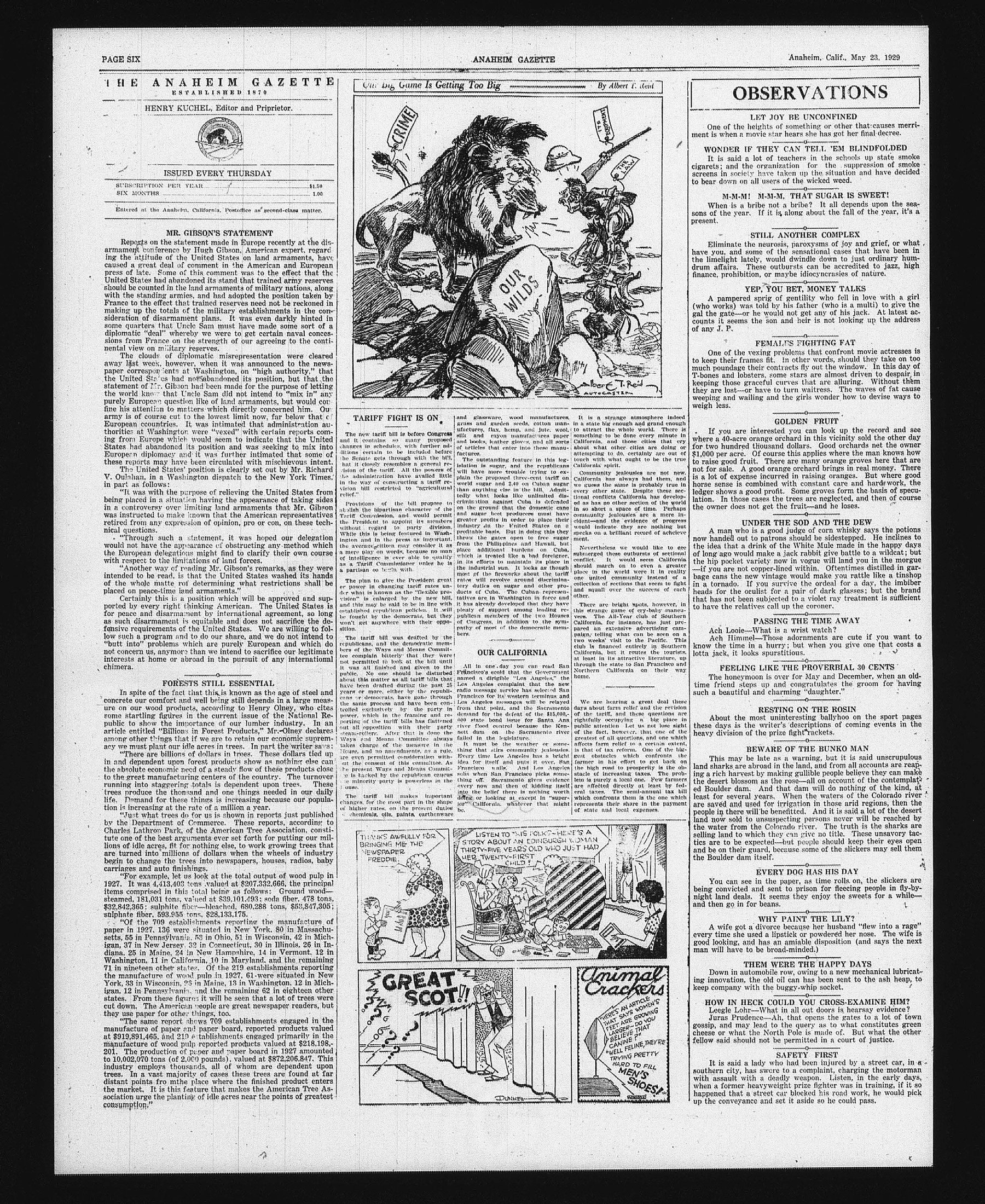
Searchable text
THE ANAHEIM GAZETTE
ESTABLISHED 1870
HENRY KUCHEL, Editor and Priprietor.
ISSUED EVERY THURSDAY
SUBSCRIPTION PER YEAR $1.50
SIX MONTHS 1.00
Entered at the Anaheim, California, Postoffice as second-class matter.
MR. GIBSON'S STATEMENT
Reports on the statement made in Europe recently at the disarmament conference by Hugh Gibson, American expert, regarding the attitude of the United States on land armaments, have caused a great deal of comment in the American and European press of late. Some of this comment was to the effect that the United States had abandoned its stand that trained army reserves should be counted in the land armaments of military nations, along with the standing armies, and had adopted the position taken by France to the effect that trained reserves need not be reckoned in making up the totals of the military establishments in the consideration of disarmament plans. It was even darkly hinted in some quarters that Uncle Sam must have made some sort of a diplomatic "deal" whereby we were to get certain naval concessions from France on the strength of our agreeing to the continental view on military reserves.
The clouds of diplomatic misrepresentation were cleared away last week, however, when it was announced to the newspaper correspondents at Washington, on "high authority," that the United States had not abandoned its position, but that the statement of Mr. Gibson had been made for the purpose of letting the world know that Uncle Sam did not intend to "mix in" any purely European question like of land armaments, but would confine his attention to matters which directly concerned him. Our army is of course cut to the lowest limit now, far below that of European countries. It was intimated that administration authorities at Washington were "vexed" with certain reports coming from Europe which would seem to indicate that the United States had abandoned its position and was seeking to mix into
The clouds of diplomatic misrepresentation were cleared away last week, however, when it was announced to the newspaper correspondents at Washington, on "high authority," that the United States had not abandoned its position, but that the statement of Mr. Gibson had been made for the purpose of letting the world know that Uncle Sam did not intend to "mix in" any purely European question like of land armaments, but would confine his attention to matters which directly concerned him. Our army is of course cut to the lowest limit now, far below that of European countries. It was intimated that administration authorities at Washington were "vexed" with certain reports coming from Europe which would seem to indicate that the United States had abandoned its position and was seeking to mix into European diplomacy and it was further intimated that some of these reports may have been circulated with mischievous intent.
The United States' position is clearly set out by Mr. Richard V. Oulahan, in a Washington dispatch to the New York Times, in part as follows:
"It was with the purpose of relieving the United States from being placed in a situation having the appearance of taking sides in a controversy over limiting land armaments that Mr. Gibson was instructed to make known that the American representatives retired from any expression of opinion, pro or con, on these technical questions.
"Through such a statement, it was hoped our delegation would not have the appearance of obstructing any method which the European delegations might find to clarify their own course with respect to the limitations of land forces.
"Another way of reading Mr. Gibson's remarks, as they were intended to be read, is that the United States washed its hands of the whole matte rof determining what restrictions shall be placed on peace-time land armaments."
Certainly this is a position which will be approved and supported by every right thinking American. The United States is for peace and disarmament by international agreement, so long as such disarmament is equitable and does not sacrifice the defensive requirements of the United States. We are willing to follow such a program and to do our share, and we do not intend to "butt into" problems which are purely European and which do not concern us, anymore than we intend to sacrifice our legitimate interests at home or abroad in the pursuit of any international chimera.
FORESTS STILL ESSENTIAL
In spite of the fact that this is known as the age of steel and concrete our comfort and well being still depends in a large measure on our wood products, according to Henry Olney, who cites some startling figures in the current issue of the National Republic to show the importance of our lumber industry. In an article entitled "Billions in Forest Products," Mr.-Olney declares among other things that if we are to retain our economic supremacy we must plant our idle acres in trees. In part the writer says:
"There are billions of dollars in trees. These dollars tied up in and dependent upon forest products show as nothing else can the absolute economic need of a steady flow of these products close to the great manufacturing centers of the country. The turnover running into staggering totals is dependent upon trees. These trees produce the thousand and one things needed in our daily life. Demand for these things is increasing because our population is increasing at the rate of a million a year.
"Just what trees do for us is shown in reports just published by the Department of Commerce. These reports, according to Charles Lathrop Park, of the American Tree Association, constitute one of the best arguments ever set forth for putting our millions of idle acres, fit for nothing else, to work growing trees that..."
There are billions of dollars in trees. These dollars tied up in and dependent upon forest products show as nothing else can the absolute economic need of a steady flow of these products close to the great manufacturing centers of the country. The turnover running into staggering totals is dependent upon trees. These trees produce the thousand and one things needed in our daily life. Demand for these things is increasing because our population is increasing at the rate of a million a year.
"Just what trees do for us is shown in reports just published by the Department of Commerce. These reports, according to Charles Lathrop Park, of the American Tree Association, constitute one of the best arguments ever set forth for putting our millions of idle acres, fit for nothing else, to work growing trees that are turned into millions of dollars when the wheels of industry begin to change the trees into newspapers, houses, radios, baby carriages and auto finishings.
"For example, let us look at the total output of wood pulp in 1927. It was 4,413,403 tons valued at $207,332,666, the principal items comprised in this total being as follows: Ground wood—steamed, 181,031 tons, valued at $39,101,493; soda fiber, 478 tons, $32,842,365; sulphite fiber—bleached, 680,288 tons, $53,847,305; sulphate fiber, 593,955 tons, $28,133,175.
"Of the 709 establishments reporting the manufacture of paper in 1927, 136 were situated in New York, 80 in Massachusetts, 55 in Pennsylvania, 53 in Ohio, 51 in Wisconsin, 42 in Michigan, 37 in New Jersey, 32 in Connecticut, 30 in Illinois, 26 in Indiana, 25 in Maine, 24 in New Hampshire, 14 in Vermont, 12 in Washington, 11 in California, 10 in Maryland, and the remaining 71 in nineteen other states. Of the 219 establishments reporting the manufacture of wood pulp in 1927, 61 were situated in New York, 33 in Wisconsin, 26 in Maine, 13 in Washington, 12 in Michigan, 12 in Pennsylvania, and the remaining 62 in eighteen other states. From these figures it will be seen that a lot of trees were cut down. The American people are great newspaper readers, but they use paper for other things, too.
"The same report shows 709 establishments engaged in the manufacture of paper and paper board, reported products valued at $919,891,465, and 219 establishments engaged primarily in the manufacture of wood pulp reported products valued at $218,198,-201. The production of paper and paper board in 1927 amounted to 10,002,070 tons (of 2,000 pounds), valued at $872,206,847. This industry employs thousands, all of whom are dependent upon trees. In a vast majority of cases these trees are found at far distant points fro mthe place where the finished product enters the market. It is this feature that makes the American Tree Association urge the planting of idle acres near the points of greatest consumption."
ANAHEIM GAZETTE
Our Big Game Is Getting Too Big By Albert T. Reid
TARIFF FIGHT IS ON.
The new tariff bill is before Congress and it contains so many proposed changes in schedules, with further ad-
and glassware, wood manufactures, grass and garden seeds, cotton manufactures, flax, hemp, and jute, wool, silk and rayon manufactures paper and books, leather gloves, and all sorts of articles that enter into these manu-
It is a strange atmosphere indeed in a state big enough and grand enough to attract the whole world. There is something to be done every minute in California, and those cities that cry about what other cities are doing or
TARIFFIGHTISON
The new tariff bill is before Congress and it contains so many proposed changes in schedules, with further additions certain to be included before the Senate gets through with the bill, that it closely resembles a general revision of the tariff. All the powers of the administration have availed little in the way of constructing a tariff revision bill restricted to "agricultural relief."
Provisions of the bill propose to abolish the bipartisan character of the Tariff Commission, and would permit the President to appoint its members without regard to party division. While this is being featured in Washington and in the press as important, the average citizen may consider it as a mere play on words, because no man of intelligence is ever able to qualify as a Tariff Commissioner unless he is a partisan co-begin with.
The plan to give the President greater power in changing tariff rates under what is known as the "flexible provision" is enlarged by the new bill, and this may be said to be in line with established republican policies. It will be fought by the democrats, but they won't get anywhere with their opposition.
The tariff bill was drafted by the republicans, and the democratic members of the Ways and Means Committee complain bitterly that they were not permitted to look at the bill until it was all finished and given to the public. No one should be disturbed about this matter as all tariff bills that have been drafted during the past 25 years or more, either by the republicans or democrats, have gone through the same process and have been controlled exclusively by the party in power, which in the framing and reporting of the tariff bills has flattened out all opposition with their party steam-rollers. After that is done the Ways and Means Committee always takes charge of the measure in the House, and no amendments, as a rule, are even permitted consideration without the consent of this committee. As the present Ways and Means Committee is backed by the republican caucus the minority party is powerless in the House.
The tariff bill makes important changes, for the most part in the shape of higher rates, on the present duties chemicals, oils, paints, earthenware and glassware, wood manufactures, grass and garden seeds, cotton manufactures, flax, hemp, and jute, wool, silk and rayon manufactures paper and books, leather gloves, and all sorts of articles that enter into these manufactures.
The outstanding feature in this legislation is sugar, and the republicans will have more trouble trying to explain the proposed three-cent tariff on world sugar and 2.40 on Cuban sugar than anything else in the bill. Admittedly what looks like unlimited discrimination against Cuba is defended on the ground that the domestic cane and sugar beet producers must have greater profits in order to place their industry in the United States on a profitable basis. But in doing this they throw the gates open to free sugar from the Philippines and Hawaii, but place additional burdens on Cuba, which is treated like a bad foreigner, in its efforts to maintain its place in the industrial sun. It looks as though most of the fireworks about the tariff rates will revolve around discriminatory duties on sugar and other products of Cuba. The Cuban representatives are in Washington in force and it has already developed that they have plenty of support among leading republican members of the two Houses of Congress, in addition to the sympathy of most of the democratic members.
OURCALIFORNIA
All in one day you can read San Francisco's scold that the Government named a dirigible "Los Angeles," the Los Angeles complaint that the new radio message service has selected San Francisco for its western terminus and Los Angeles messages will be relayed from that point, and the Sacramento demand for the defeat of the $15,000,000 state bond issue for Santa Ana river flood control because the Kennett dam on the Sacramento river failed in the legislature.
It must be the weather or something that stirs community jealousies. Every time Los Angeles has a bright idea for itself and puts it over, San Francisco walks. And Los Angeles solis when San Francisco picks something off. Sacramento gives evidence every now and then of kidding itself into the belief there is nothing worth doing or looking at except in "superior" California, whatever that might be.
It is a strange atmosphere indeed in a state big enough and grand enough to attract the whole world. There is something to be done every minute in California, and those cities that cry about what other cities are doing or attempting to do, certainly are out of touch with what ought to be the true California spirit.
Community jealousies are not new. California has always had them, and we guess the same is probably true in every other state. Despite these sectional conflicts California has developed as has no other section of the world in so short a space of time. Perhaps community jealousies are a mere incident—and the evidence of progress would indicate they are nothing but specks on a brilliant record of achieve ment.
Nevertheless we would like to see submerged these outbursts of sectional conflict. It would seem California should march on to even a greater place in the world were it in reality one united community instead of a collection of sections that seem to fight and squall over the success of each other.
There are bright spots, however, in this strange game of cry-baby maneuvers. The All-Year club of Southern California, for instance, has just prepared an extensive advertising campaign, telling what can be seen on a two weeks' visit to the Pacific. This club is financed entirely in Southern California, but it routes tourists at least in its attractive literature, up through the state to San Francisco and Northern California on their way home.
We are hearing a great deal these days about farm relief and the revision of the tariff, and these questions are rightfully occupying a big place in public attention. Let us not lose sight of the fact, however, that one of the greatest of all questions, and one which affects farm relief to a certain extent, is that of tax reform. One of the biggest obstacles which confronts the farmer in his effort to get back on the high road to prosperity is the obstacle of increasing taxes. The problem is purely a local one. Few farmers are affected directly at least by federal taxes. The semi-annual tax bill which confronts them is the one which represents their share in the payment of state and local expenses.
THANKS AWFULLY FOR BRINGING ME THE NEWSPAPER PREDDIE.
LISTEN TO THIS FOLK—HERE'S A STORY ABOUT AN EDINBURGH WOMAN THIRTY-FIVE YEARS OLD WHO JUST HAD HER TWENTY-FIRST CHILD!
GREAT SCOT!!
Animal Crackers
"HERES AN ARTICLE THAT SAYS WOMEN'S FEET ARE GROWING LARGER—DO YOU BELIEVE?"
"WELL FELINE, THEY'RE TRYING PRETTY HARD TO FILL MEN'S SHOES!"
OBSERVATIONS
LET JOY BE UNCONFINED
One of the heights of something or other that causes merriment is when a movie star hears she has got her final decree.
WONDER IF THEY CAN TELL 'EM BLINDFOLDED
It is said a lot of teachers in the schools up state smoke cigarets; and the organization for the suppression of smoke screens in society have taken up the situation and have decided to bear down on all users of the wicked weed.
M-M-M! M-M-M, THAT SUGAR IS SWEET!
When is a bribe not a bribe? It all depends upon the seasons of the year. If it is along about the fall of the year, it's a present.
STILL ANOTHER COMPLEX
Eliminate the neurosis, paroxysms of joy and grief, or what have you, and some of the sensational cases that have been in the limelight lately, would dwindle down to just ordinary humdrum affairs. These outbursts can be accredited to jazz, high finance, prohibition, or maybe idiocyncrasies of nature.
YEP, YOU BET, MONEY TALKS
A pampered sprig of gentility who fell in love with a girl (who works) was told by his father (who is a multi) to give the gal the gate—or he would not get any of his jack. At latest accounts it seems the son and heir is not looking up the address of any J. P.
FEMALEFS FIGHTING FAT
One of the vexing problems that confront movie actresses is to keep their frames fit. In other words, should they take on too much poundage their contracts fly out the window. In this day of T-bones and lobsters, some stars are almost driven to despair in keeping those graceful curves that are alluring. Without them they are lost—or have to turn waitress. The waves of fat cause weeping and wailing and the girls wonder how to devise ways to weigh less.
GOLDEN FRUIT
If you are interested you can look up the record and see where a 40-acre orange orchard in this vicinity sold the other day for two hundred thousand dollars. Good orchards net the owner
GOLDEN FRUIT
If you are interested you can look up the record and see where a 40-acre orange orchard in this vicinity sold the other day for two hundred thousand dollars. Good orchards net the owner $1,000 per acre. Of course this applies where the man knows how to raise good fruit. There are many orange groves here that are not for sale. A good orange orchard brings in real money. There is a lot of expense incurred in raising oranges. But where good horse sense is combined with constant care and hard work, the ledger shows a good profit. Some groves form the basis of speculation. In those cases the trees are neglected, and then of course the owner does not get the fruit—and he loses.
UNDER THE SOD AND THE DEW
A man who is a good judge of corn whisky says the potions now handed out to patrons should be sidestepped. He inclines to the idea that a drink of the White Mule made in the happy days of long ago would make a jack rabbit give battle to a wildcat; but the hip pocket variety now in vogue will land you in the morgue—if you are not copper-lined within. Oftentimes distilled in garbage cans the new vintage would make you rattle like a tinshop in a tornado. If you survive the ordeal for a day, the imbiber heads for the oculist for a pair of dark glasses; but the brand that has not been subjected to a violet ray treatment is sufficient to have the relatives call up the coroner.
PASSING THE TIME AWAY
Ach Looie—What is a wrist watch?
Ach Himmel—Those adornments are cute if you want to know the time in a hurry; but when you give one that costs a lotta jack, it looks spurstitious.
FEELING LIKE THE PROVERBIAL 30 CENTS
The honeymoon is over for May and December, when an old-time friend steps up and congratulates the groom for having such a beautiful and charming "daughter."
RESTING ON THE ROSIN
About the most uninteresting ballyhoo on the sport pages these days is the writer's descriptions of coming events in the heavy division of the prize fight rackets.
BEWARE OF THE BUNKO MAN
This may be late as a warning, but it is said unscrupulous land sharks are abroad in the land, and from all accounts are reaping a rich harvest by making gullible people believe they can make the desert blossom as the rose—all on account of the contemplated Boulder dam. And that dam will do nothing of the kind, at least for several years. When the waters of the Colorado river are saved and used for irrigation in those arid regions, then the people in there will be benefitted. And it is said a lot of the desert land now sold to unsuspecting persons never will be reached by the water from the Colorado river. The truth is the sharks are selling land to which they can give no title. These unsavory tactics are to be expected—but people should keep their eyes open and be on their guard, because some of the slickers may sell them...
This may be late as a warning, but it is said unscrupulous land sharks are abroad in the land, and from all accounts are reaping a rich harvest by making gullible people believe they can make the desert blossom as the rose—all on account of the contemplated Boulder dam. And that dam will do nothing of the kind, at least for several years. When the waters of the Colorado river are saved and used for irrigation in those arid regions, then the people in there will be benefitted. And it is said a lot of the desert land now sold to unsuspecting persons never will be reached by the water from the Colorado river. The truth is the sharks are selling land to which they can give no title. These unsavory tactics are to be expected—but people should keep their eyes open and be on their guard, because some of the slickers may sell them the Boulder dam itself.
EVERY DOG HAS HIS DAY
You can see in the paper, as time rolls on, the slickers are being convicted and sent to prison for fleecing people in fly-by-night land deals. It seems they enjoy the sweets for a while—and then go in for beans.
WHY PAINT THE LILY?
A wife got a divorce because her husband "flew into a rage" every time she used a lipstick or powdered her nose. The wife is good looking, and has an amiable disposition (and says the next man will have to be broad-minded.).
THEM WERE THE HAPPY DAYS
Down in automobile row, owing to a new mechanical lubricating innovation, the old oil can has been sent to the ash heap, to keep company with the buggy-whip socket.
HOW IN HECK COULD YOU CROSS-EXAMINE HIM?
Leegle Lohr—What in all out doors is hearsay evidence?
Juras Prudence—Ah, that opens the gates to a lot of town gossip, and may lead to the query as to what constitutes green cheese or what the North Pole is made of. But what the other fellow said should not be permitted in a court of justice.
SAFETY FIRST
It is said a lady who had been injured by a street car, in a southern city, has swore to a complaint, charging the motorman with assault with a deadly weapon. Listen, in the early days, when a former heavyweight prize fighter was in training, if it so happened that a street car blocked his road work, he would pick up the conveyance and set it aside so he could pass.